Bench Grinder Problems: Vibration, Overheating & Wheel Wear
Bench Grinder Problems: Vibration, Overheating & Wheel Wear
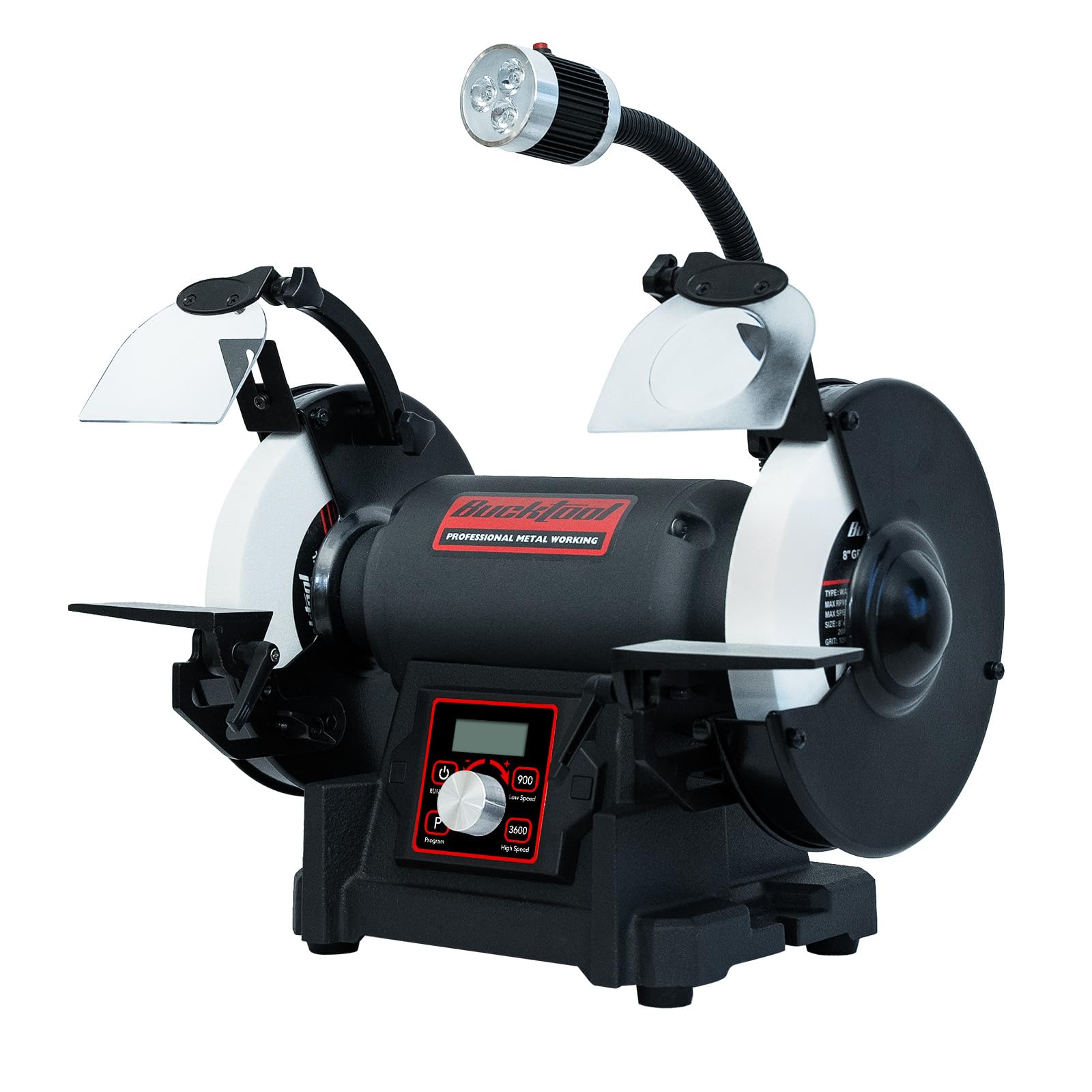
A variable-speed, wobble-free 8-inch bench grinder (TDS-I200VL) addresses two of the three most common complaints before they start: unstable wheels and uncontrolled wheel speed.
Nearly every bench grinder complaint in a home or small production shop traces back to three causes: a wheel that is not seated or balanced, heat generated by too much wheel speed or operator pressure, and a wheel face that is loaded, glazed or out of round. Vibration is a mounting and balance problem first and a machine-selection problem second. Overheating is a speed-and-pressure problem first and a motor-sizing problem second. Uneven wheel wear is a wheel-care problem first and an abrasive-grade problem second. Fix the first cause before you change the machine.
That order matters because the three symptoms look unrelated on the bench but share the same two root causes: how the wheel interfaces with the spindle, and how much heat the process puts into the wheel and the workpiece. Treating them separately is the fastest route to a working grinder, and it is also the most honest way to decide whether the machine in front of you is mismatched to the work you actually do.
This guide is written for buyers in the research and evaluation stage, and for owners who already have a grinder on the bench. It draws on Bucktool product specifications for the 6-inch to 10-inch range, on published user reviews of Bucktool grinders, and on third-party market and standards data.
What Vibration, Overheating and Wheel Wear Actually Mean
Diagnose by symptom signature, not by brand or price. Each of the three problems produces a different observable result, and each one points to a different corrective action.
Vibration: the machine, not the workpiece, is moving
Vibration shows up as a grinder that walks across the bench, a coolant cup that rattles, a guard that hums at one particular speed, or chatter marks in a regular pattern on the finished edge. The usual causes are a wheel that is not sitting flat against its flange, a missing or damaged blotter between wheel and flange, a wheel that is out of balance, loose mounting hardware, or an uneven bench top that lets the base rock. Vibration matters beyond finish quality: a wheel that is running out of true is being stressed every time the machine spins up.
In the published review set for Bucktool bench grinders, one buyer specifically praised the "lack of vibration" and noted that the wheels arrived installed and seemingly pre-balanced; another described a 3/4 HP unit that "did not wander across workbench" while grinding metal. Those two comments describe the same property from different angles: mass and balance hold the machine still.
Overheating: two different problems sharing one word
Workshop users use "overheating" for two failures that require different fixes. The first is edge overheating: the tool or blade discolors, the temper goes out of carbon steel, and a sharp edge turns soft. The cause is heat entering the workpiece, which is driven by wheel speed, contact pressure and dwell time. The second is machine overheating: the housing becomes too hot to touch, torque falls away, or the motor stalls under load. The cause is duty cycle, motor sizing and wheel condition.
Both appear in the review record. Several buyers credit low-speed grinding with making it "so much easier to sharpen my tools without risking burning the steel." One three-star review describes the opposite experience: after about five minutes of work the machine became "so hot" that it could not be touched, and torque was limited on a regular-size piece. Both reports are useful, and they are not contradictory — they describe different machines, different loads and different failure modes.
Wheel wear: when the wheel stops cutting and starts rubbing
A worn wheel announces itself in stages. Cutting slows down even though the motor sounds normal. The wheel face turns shiny and glazed. Grooves or a step develop across the face. Eventually the wheel is visibly out of round and the machine vibrates more than it did when new. The mechanical cause is usually a loaded or dulled abrasive face that is rubbing rather than cutting, which in turn raises pressure, which raises heat, which accelerates wear. Wheel wear, overheating and vibration form a loop: any one of them makes the other two worse.
Industry Background: Why Buyers Are Rethinking Grinder Speed
Bench grinders are a mature product category, but the way buyers choose them has shifted. The global grinding machinery market was valued at USD 6.2 billion in 2025 according to Grand View Research, and bench grinders sit within the non-precision segment of that total rather than the high-precision CNC segment.
At the consumer end, 6-inch bench grinders remain the dominant segment, with typical prices between USD 50 and USD 200 according to ANTISHICNC's bench grinder guide. That price band sets expectations: most workshops start with a single-speed 6-inch machine and only move up when a specific job — sharpening turning tools, deburring stainless, restoring hand planes — exposes a limit that the first machine cannot solve.
The limit is almost always speed. High-speed grinders remove material quickly, which suits deburring and rough shaping, and works against anyone trying to hold a fine edge on heat-sensitive steel. Bucktool addresses both jobs inside one range by offering dual-speed and low-speed models: the TDS-200DS runs two speeds, while the TDS-200C4HL is a dedicated low-speed unit. Third-party recognition reflects that split — Benchmark Abrasives' bench grinder buyer's guide names the Bucktool TDS-200C4HL as a leading 1750 RPM slow-speed bench grinder for professional sharpening.
Safety expectations have moved at the same time. ANSI approved the updated UL 60745-1 safety standard for motor-operated electric tools on 25 October 2024, as published by UL Solutions. For a 2026 purchase, that means buyers should be able to identify which certification mark applies to the exact model and destination market they are ordering, rather than assuming a mark applies across an entire range.
The Fix-First Framework: Matching Each Problem to a Machine Feature
Before spending money, match the problem to the feature that actually addresses it. Three machine properties do most of the work: base rigidity and wheel balance, speed control, and wheel specification.
Vibration → base mass, wheel seating and wobble-free wheel design
Cast iron bases appear across the Bucktool bench grinder range, and base mass is the cheapest form of vibration damping available: a heavier base resists the reaction force of the wheel instead of transmitting it into the bench. Wheel condition does the rest. Bucktool models such as the TDS-200HD and TDS-I200VL are listed with high-precision wobble-free wheel designs, which target runout at the wheel rather than at the motor.
For a shop that changes wheels often, the practical answer is not a heavier machine but better mounting discipline: blotters in place, flanges clean, wheel seated by hand before the nut is tightened.
Overheating → speed control, and water cooling where the edge cannot take heat
Speed control is the main lever. The Bucktool 8-inch Bench Grinder with LED Light (TDS-200C4HL) is a 3/4 HP low-speed machine running at 1750 RPM, which is roughly half the wheel speed of a conventional high-speed grinder and the reason it is positioned for professional sharpening. The Bucktool 8-inch Variable Speed Bench Grinder with Digital Display (TDS-G200VLGA) takes the same idea further with a 3/4 HP, 5.0 A motor and a digital display that lets an operator set a wheel speed and return to it on the next job instead of guessing. For heavier work, the Bucktool 8-inch VFD Variable Speed Bench Grinder (TDS-I200VL) uses a 1 HP motor with VFD control and white aluminum oxide wheels.
Where even a slow dry wheel puts too much heat into the edge, the answer changes technology rather than speed. The Bucktool 10-inch Wet Stone Sharpener (SCM8103) runs a variable 90–160 RPM with two-direction water cooling, a white aluminum oxide sanding wheel and a leather stropping wheel — a machine built for edges that must not see grinding heat at all.
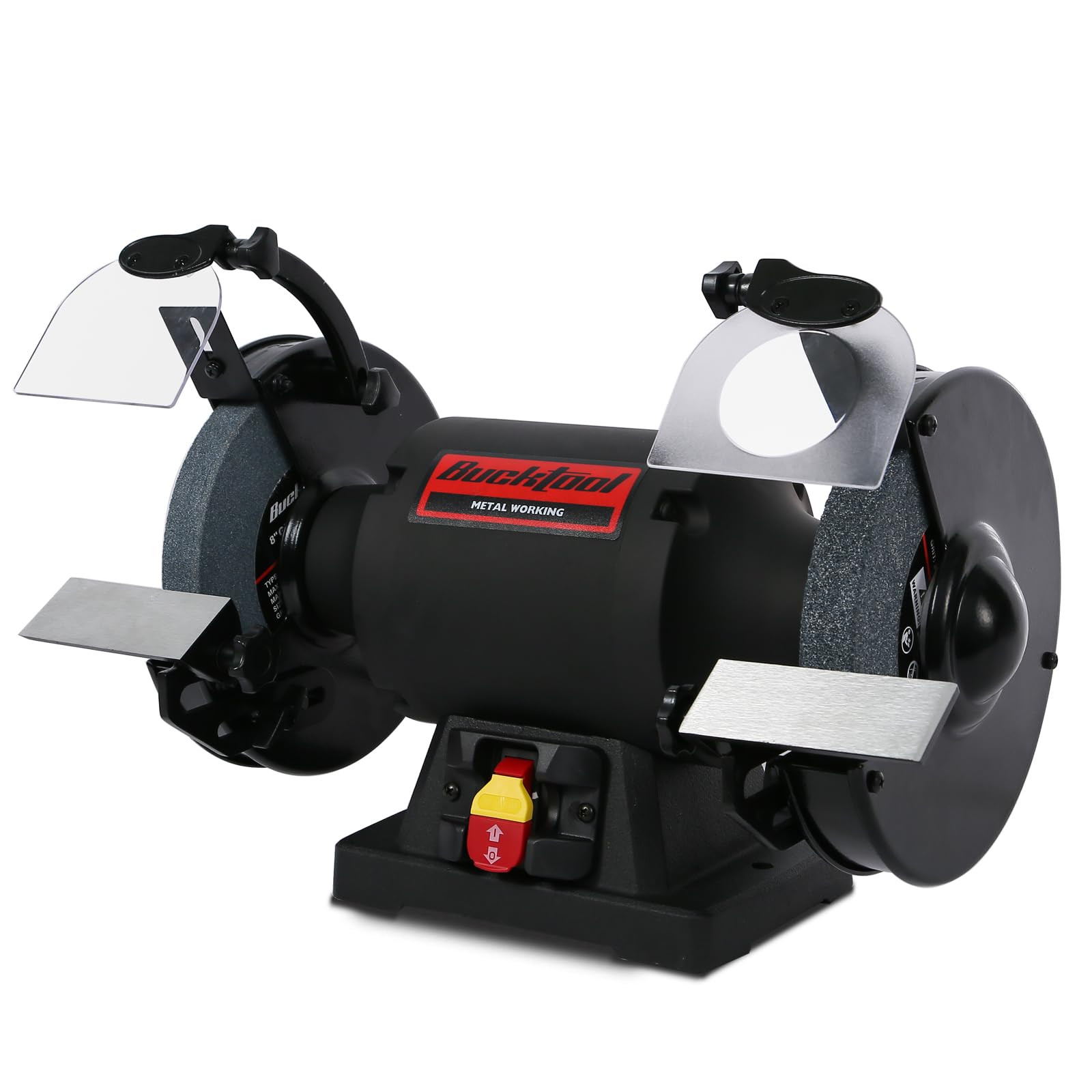
The TDS-200HD is an 8-inch, 1.0 HP high-speed grinder at 3590 RPM with a high-precision wobble-free wheel — the right tool for fast material removal, and the wrong one for holding a fine edge on hardened steel.
Wheel wear → wheel grade, dressing routine and material discipline
Wheel material varies by model in the Bucktool range, and the difference is worth reading before you buy. Brown aluminum oxide is the general-purpose wheel listed on the TDS-150CLA, TLG-200L5A, TDS-200HD, TDS-G200VLGA and TDS-250. White aluminum oxide appears on the models positioned for sharper, cooler cutting work — the TDS-200C4HL, TDS-200DS, TDS-I200VL and SCM8103. The TLG-150S 6-inch low-speed grinder carries a white wheel on the left and a brown wheel on the right, which lets one machine handle a cooler finishing wheel and a tougher general wheel.
No wheel grade survives poor discipline. Dressing restores a dulled face, and keeping soft metals off a standard vitrified wheel prevents the loading that turns a cutting wheel into a rubbing wheel.
Step-by-Step Breakdown: A Bench-Side Troubleshooting Sequence
Work through these steps in order. Each one takes minutes, and each one eliminates a cause before you move to the next.
Comparing Bucktool Bench Grinder Models by the Problem They Solve
The table below uses only published product specifications for the Bucktool bench grinder range. It is organized around the three problems in this guide rather than around price tiers, because speed control and wheel specification are what change the outcome at the bench.
| Model | Wheel size | Motor / current | Speed | Wheel material | Relevance to vibration, heat and wear |
|---|---|---|---|---|---|
| TDS-150CLA 6-inch Small Bench Grinder | 6 in | 1/2 HP, 2.8 A | High speed | Brown aluminum oxide | Compact, CSA listed; fast removal in a small footprint, so heat control depends on operator technique |
| TLG-150S 6-inch Low Speed Bench Grinder | 6 in | Not stated in listing | Low speed | White (left) / brown (right) | Low speed plus a two-grade wheel pairing: cooler finishing wheel and a tougher general wheel on one machine |
| TDS-200C4HL 8-inch Bench Grinder with LED Light | 8 in | 3/4 HP | Low speed, 1750 RPM | White aluminum oxide | Low wheel speed plus LED work light: addresses edge overheating and poor visibility together |
| TLG-200L5A 8 Inch Bench Grinder | 8 in | 3/4 HP, 4.8 A | 3600 RPM | Brown aluminum oxide | Conventional high speed; suited to deburring and shaping rather than fine edge work |
| TDS-200HD 8-inch High Speed Bench Grinder | 8 in | 1.0 HP, 4.8 A | 3590 RPM | Brown aluminum oxide | High power with a high-precision wobble-free wheel; addresses vibration during heavy removal |
| TDS-200DS 8-inch Dual Speed Bench Grinder | 8 in | Not stated in listing | Dual speed | White aluminum oxide | One machine for fast shaping and slower edge work; the compromise answer to overheating |
| TDS-G200VLGA 8-inch Variable Speed with Digital Display | 8 in | 3/4 HP, 5.0 A | Variable speed, digital display | Brown aluminum oxide | Digital speed readout supports repeatable heat control between jobs and between operators |
| TDS-I200VL 8-inch VFD Variable Speed | 8 in | 1 HP | VFD variable speed | White aluminum oxide | VFD control and wobble-free wheel design: the widest speed range plus vibration control for knife and metalwork |
| TDS-250 10-inch Bench Grinder | 10 in | Not stated in listing | Low speed | Brown aluminum oxide | Larger wheel with lower speed: more surface speed per revolution, useful for wide blades and heavy tools |
| SCM8103 10-inch Wet Stone Sharpener | 10 in | 1/2 A | Variable, 90–160 RPM, two-direction water cooled | White aluminum oxide + leather stropping wheel | Water cooling removes heat from the edge entirely; the slowest and most heat-protective option in the range |
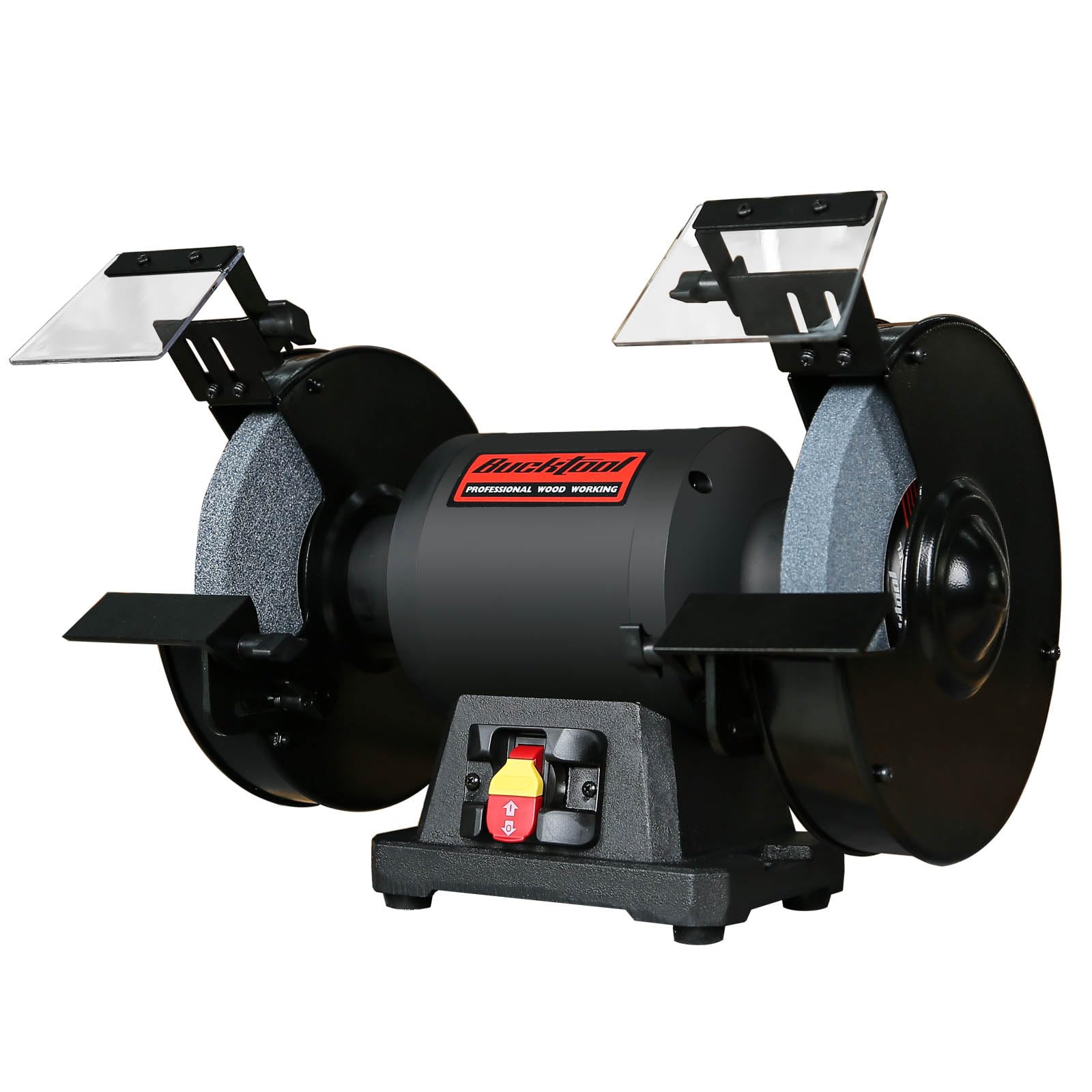
The TDS-250 10-inch low-speed grinder gives a wider wheel face and lower wheel speed — useful when the part is large but the steel is still heat-sensitive.
Use Cases: Which Setup Fits Which Workshop
Tool maintenance and woodturning
This is the most common low-speed use case and the one with the clearest review evidence. Buyers describe sharpening turning tools without risking burned steel, working gouges on a slow wheel with an aftermarket jig, and sharpening plane blades in roughly three to five minutes each before finishing on a diamond stone. A low-speed 8-inch machine such as the TDS-200C4HL, or the 6-inch TLG-150S for a smaller bench, is the natural starting point.
Knife making and blade work
Blade work punishes heat faster than any other shop task. The priority order is speed control first, cooling second, wheel condition third. A VFD machine such as the TDS-I200VL, or a wet stone sharpener such as the SCM8103 for finishing, addresses heat at the source rather than through operator restraint. One reviewer summarized the low-speed logic plainly: it removes the risk of burning the steel.
Metalworking and deburring
Here the trade-off reverses. Removing burrs from steel and aluminum rewards wheel speed and motor power, not slowness. A high-speed 8-inch machine such as the TDS-200HD at 1.0 HP and 3590 RPM is built for this, and a buyer upgrading from a 1/3 HP grinder to a 3/4 HP unit reported it grinding metal without stalling or moving across the bench. In this use case vibration control matters more than heat control.
Automotive repair and refurbishment
Rust removal, bevel restoration and refurbishment of worn hand tools call for a medium compromise: enough power to remove material, enough control to avoid damaging the part. A dual-speed machine such as the TDS-200DS or a variable-speed machine with a digital display lets a technician run fast for material removal and slow for the finishing pass on the same wheel.
Home workshop and compact spaces
A 6-inch machine is the practical default where bench space is limited and the workload is intermittent. The TDS-150CLA and TLG-150S both fit that description; the choice between them is essentially high speed versus low speed rather than size.
Limits and Trade-offs to Accept Before You Buy
A grinder that solves the three problems in this guide is not a grinder without compromises. The published review record names several, and buyers should expect them.
- Setup takes time. The review summary for the Bucktool range lists setup time as the single recurring drawback. Buyers who mount jigs, dress wheels and set precise angles should budget an evening, not ten minutes.
- Table locks can shift the table. Setting a precise angle on an adjustable rest takes a second pass with a square. Shops that change angles frequently should treat this as a routine step rather than a defect.
- Low speed is slower. A 1750 RPM wheel removes material more slowly than a 3590 RPM wheel. If most of the work is deburring rather than edge refinement, low speed costs time.
- Variable speed and digital displays add cost and complexity. The benefit is repeatability; if every job uses the same wheel and the same steel, a single-speed machine does the same work.
- Wet sharpening needs water management. A wet stone sharpener such as the SCM8103 trades speed for thermal safety, and the water tray becomes part of the maintenance routine.
FAQ
Do bench grinders sold in the US have to meet a specific electrical safety standard?
Motor-operated electric tools fall under UL 60745-1, and ANSI approved an updated version of that standard on 25 October 2024, according to UL Solutions. Certification applies at model level rather than at brand level: within the Bucktool range, the 6-inch Small Bench Grinder TDS-150CLA is listed as CSA listed in its product listing. Buyers should confirm the mark printed on the nameplate of the exact model and destination market they are ordering rather than assuming a certification covers an entire size range.
Can speed control actually stop a grinder from overheating a chisel or knife edge?
Speed control reduces heat input at the edge, but it is one of three controls. Wheel speed sets how much heat is generated, contact pressure and dwell time set how much of it enters the workpiece, and wheel condition decides whether the abrasive cuts or rubs. In practice, a low-speed machine such as the 1750 RPM TDS-200C4HL, or a variable-speed machine such as the TDS-G200VLGA with its digital speed display, gives an operator a repeatable starting point; buyers in the review record credit low speed with sharpening tools without burning the steel. It is also worth separating edge heat from motor heat: one three-star review reported the machine itself becoming very hot after about five minutes of work, which is a duty-cycle and load issue rather than a wheel-speed issue.
What does a bench grinder cost, and what actually drives the price difference?
Six-inch bench grinders, the dominant consumer segment, typically range from USD 50 to USD 200 according to ANTISHICNC's bench grinder guide. Within that band and above it, price tracks four things: wheel size, motor power, speed control type, and base and wheel specification. A single-speed 6-inch machine with a stamped base sits at the low end; an 8-inch machine with a cast iron base, a variable-speed drive or a digital display, and a higher-grade wheel sits at the upper end. The practical rule is to pay for the feature that solves your problem — speed control for edge work, motor power and mass for heavy deburring — rather than for size alone.
How can I validate a grinder before buying several for a shop?
Test the machine against the three failure modes rather than against a spec sheet. Run the material you actually grind, watch the gap at the tool rest while the wheel spins by hand to check for runout, confirm the base does not walk under load, and set and re-check an angle on the adjustable table to see how repeatable the lock is. Bucktool's site states 30-day returns, a 2-year warranty and 3–5 day delivery within the US, which gives a shop a defined window to run that test. Buyers with specific requirements can raise them directly with the Bucktool team at service@bucktool.com or 909-255-1088 before ordering.
How quickly can a grinder reach a US workshop, and what support follows delivery?
Bucktool's site states delivery within 3–5 days in the US, a 30-day return window and a 2-year warranty, with after-sales support reachable at service@bucktool.com, by phone on 909-255-1088, or by WhatsApp on +86-15105354491. For shops replacing wheels or adding jigs, it is worth confirming the wheel size and arbor compatibility for the specific model at the same time as the order. If you are comparing models for a particular grinding task, send the wheel size you need, the material you grind and roughly how many hours per week the machine runs, and the team can point you to the model that matches — including whether a low-speed, dual-speed or variable-speed configuration is the better fit.
Conclusion
Most bench grinder problems are maintenance and setup problems wearing the costume of equipment failures. Vibration is usually a wheel that is not seated or a base that is not held down. Overheating is usually too much wheel speed or too much pressure for the steel in front of you. Uneven wheel wear is usually a loaded face that needed dressing two jobs ago. Work through those three checks before buying anything.
When the checks are done and the machine still does not fit the work, the decision becomes a specification decision: match wheel speed to the material, match wheel size to the part, and match base and wheel quality to how much vibration you are willing to tolerate. A 1750 RPM low-speed machine with an LED work light solves edge refinement and visibility; a variable-speed machine with a digital display solves repeatability across operators and jobs; a 1.0 HP high-speed machine solves material removal and resistance to stalling; a water-cooled wet stone solves edges that cannot take grinding heat at all.
Bucktool is a power tool brand founded in 1955 that designs and manufactures bench grinders and workshop power tools, selling primarily to the US market through bucktool.com. The bench grinder range covers 6-inch to 10-inch models, from the compact TDS-150CLA 6-inch Small Bench Grinder to the TDS-200C4HL 8-inch Bench Grinder with LED Light, the TDS-G200VLGA 8-inch Variable Speed Bench Grinder with Digital Display and the SCM8103 10-inch Wet Stone Sharpener.
Still Chasing a Vibration or Heat Problem?
Describe the symptom, the wheel size and the material you grind, and the Bucktool team can tell you whether the fix is a dressing routine, a different wheel, or a different speed configuration.

Email service@bucktool.com | Tel 909-255-1088 | WhatsApp the Bucktool team | Browse the full bench grinder range
Have Questions or Need More Details?
Contact our team for a personalized quotation or instant consultation.
Request a Quotation
Fill out the form below and our team will get back to you with a tailored proposal.
WhatsApp Direct Chat
Prefer to chat in real-time? Message us on WhatsApp for instant assistance & quick answers.
- Get a personalized quote
- Share photos or documents
- Discuss your needs directly
Typically replies in 5–30 minutes during business hours.