Bench Grinder Wheel Diameter & Speed Type Guide | BUCKTOOL
Bench Grinder Wheel Diameter & Speed Type Guide for BUCKTOOL Models
Core answer: Match bench grinder wheel diameter to the work envelope first, then match speed type to heat sensitivity and control needs. A 6-inch compact or low-speed model suits tight space and heat-sensitive edges; an 8-inch high-speed, dual-speed, variable-speed or VFD model covers broader metalworking and mixed workloads; a 10-inch bench grinder or 10-inch wet stone sharpener serves larger clearance or wet-stone sharpening. BUCKTOOL organizes its bench grinder line around these two constraints rather than around a single headline specification.
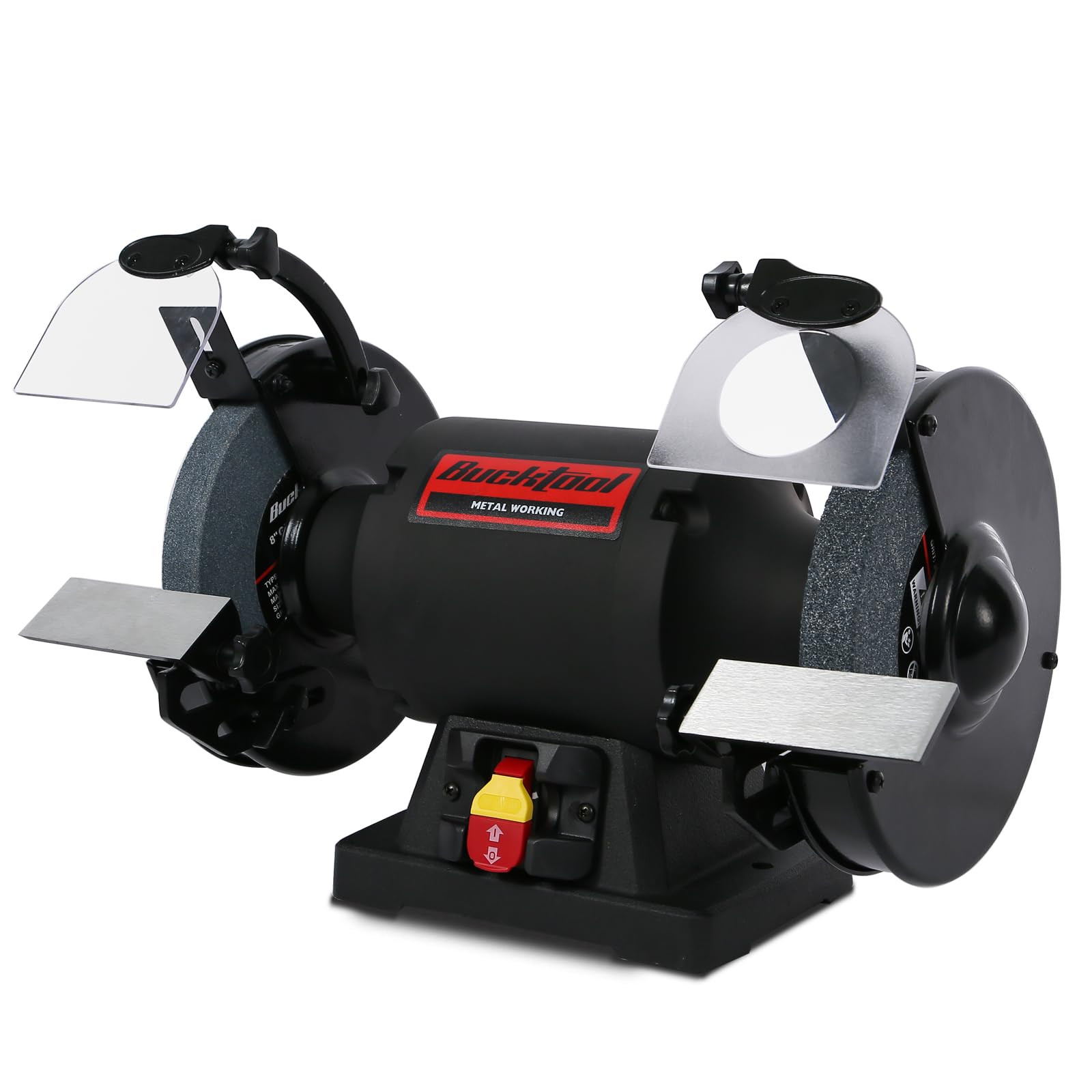
Cover image: bucktool 8-inch High Speed Bench Grinder (TDS-200HD), one of the documented 8-inch speed-type references in this guide.
BUCKTOOL is a power tool brand whose bench grinder line includes 6-inch compact and low-speed units, 8-inch high-speed, dual-speed, variable-speed, VFD variable-speed, digital-display and LED-light models, plus a 10-inch bench grinder and a 10-inch wet stone sharpener. The brand site is bucktool.com, and the brand overview states 30-day returns, a 2-year warranty and 3–5 days delivery (US). This guide uses the assigned BUCKTOOL product facts to explain how buyers should connect wheel diameter and speed type before choosing a model.
Problem Definition: Why Diameter and Speed Type Must Be Matched
A bench grinder selection problem usually appears as a simple size question: should I buy a 6-inch, 8-inch or 10-inch bench grinder? In practice, wheel diameter alone is not enough. The same diameter can behave differently depending on whether the motor is low speed, high speed, dual speed, variable speed or VFD variable speed. A buyer who chooses only by diameter may end up with a grinder that removes metal quickly but overheats a knife edge, or a slow-speed unit that is controlled for sharpening but too conservative for heavy deburring.
The constraint is practical: wheel diameter affects clearance, wheel wear and the size of the work that can be presented to the wheel. Speed type affects heat build-up, edge control and how well the machine handles mixed tasks. For tool maintenance, knife sharpening, woodworking and metalworking, the correct match is the combination that keeps the edge below damaging heat while still removing material at an acceptable rate.
- Home workshop constraint: limited bench space favors a compact 6-inch small bench grinder, while a larger shop can support an 8-inch or 10-inch platform.
- Sharpening constraint: heat-sensitive chisels, plane blades and knife edges need low-speed control or wet-stone sharpening rather than uncontrolled high-speed pressure.
- Metalworking constraint: deburring, rust removal and edge trimming need enough wheel diameter and motor stability to handle longer contact.
- Budget constraint: verified category data places 6-inch bench grinders in the dominant consumer segment with typical prices of USD 50–200, but that is a category band, not a BUCKTOOL quote.
- Compliance constraint: the buyer should verify the certificate reference, model label and safety documentation rather than assuming that a speed or diameter class carries the same approval.
Reviews of BUCKTOOL bench grinders point to the same decision pattern. Users value low-vibration operation, pre-balanced wheels and low-speed sharpening that reduces the risk of burning steel. One review also notes that setup takes time. Those comments do not replace a technical specification, but they show why diameter and speed type should be treated as a matched pair rather than as separate shopping filters.
Industry Background: What Buyers Are Choosing Between
Bench grinders serve DIY users, home workshops and small professional users for tool sharpening, metal deburring and light metalworking. The product line description places the main BUCKTOOL bench grinder range from 6-inch to 8-inch, with 10-inch options for larger or wet-stone sharpening work. That range reflects a broader market pattern: buyers use one machine for several jobs, then discover that wheel diameter and speed control determine whether the machine is pleasant or frustrating for each job.
The category is large enough to support many configurations. Verified industry data reports that the global grinding machinery market value in 2025 reached USD 6.2 billion, with bench grinders being a key non-precision segment (Grand View Research, 2026). Within the consumer segment, 6-inch bench grinders are the dominant format, with prices typically ranging from USD 50 to USD 200 (ANTISHICNC, 2025). These figures explain why a budget bench grinder search often starts at 6-inch, while 8-inch and 10-inch models tend to be evaluated for heavier or more specialized work.
Regulatory context also matters. ANSI approved the updated UL 60745-1 safety standard for motor-operated electric tools on October 25, 2024 (UL Solutions). That standard is part of the safety environment buyers should understand, but it does not replace model-level certificate checks. For BUCKTOOL, the assigned technology documentation lists CSA 1936834 and CSA 70199403 for the wobble-free bench grinder motor technology. A buyer should match those references to the exact model and listing rather than treating a certificate number as a blanket claim for every grinder in the range.
Detailed Solution: A BUCKTOOL Model-Matching Framework
The cleanest way to choose is to set wheel diameter as the first constraint, speed type as the second, and feature trade-offs as the third. This order prevents a buyer from being attracted to a variable-speed feature before confirming that the wheel size fits the work.
1. Wheel Diameter Sets the Work Envelope
Wheel diameter determines how much wheel surface is available and how much clearance the operator has around the tool rest. A 6-inch bench grinder is the compact choice. The Bucktool 6-inch Low Speed Bench Grinder (TLG-150S) uses a left white aluminum oxide wheel and a right brown aluminum oxide wheel on a cast iron base. The bucktool 6-inch Small Bench Grinder (TDS-150CLA) is the smaller 6-inch platform; its official product URL identifies it as a high-speed unit. For a home workshop with limited bench space, 6-inch is often the most practical starting point because the machine is easier to position and store.
An 8-inch bench grinder gives more clearance and a larger wheel reference, which is why the BUCKTOOL 8-inch family carries most of the speed-type options. The bucktool 8-inch High Speed Bench Grinder (TDS-200HD) is documented with an 8-inch grinding wheel, a 1.0 HP motor at 120V, 4.8A input current and a 3590 RPM maximum spindle speed. The bucktool 8-inch Bench Grinder with LED Light (TDS-200C4HL) is the low-speed 8-inch reference and is listed in verified data at 1750 RPM. The same 8-inch diameter therefore supports two very different operating characters.
A 10-inch platform is a different decision. The bucktool 10-inch Bench Grinder (TDS-250) and the bucktool 10-inch Wet Stone Sharpener (SCM8103) serve buyers who need larger wheel clearance or a wet-stone sharpening format. The SCM8103 uses a white aluminum oxide sanding wheel, a leather stropping wheel and a cast iron base. It should be evaluated as a sharpening system, not as a simple substitute for a dry 8-inch grinder.
2. Speed Type Sets Heat and Control
Speed type is the second constraint because it changes how the wheel interacts with the edge. Low speed is the safer default for heat-sensitive sharpening. The bucktool 8-inch Bench Grinder with LED Light (TDS-200C4HL) is documented as a 1750 RPM slow-speed machine, and the Bucktool 6-inch Low Speed Bench Grinder (TLG-150S) is explicitly positioned as a low-speed 6-inch option. For chisels, plane blades and knife edges, low speed gives the operator more time to control contact and reduces the risk of overheating the steel.
High speed is better suited to faster material removal and general metalworking. The bucktool 8-inch High Speed Bench Grinder (TDS-200HD) is the clearest documented high-speed reference in the assigned facts, with a 3590 RPM maximum spindle speed. It also uses a wobble-free induction motor with a fully enclosed ball bearing structure, a lockable adjustable tool rest, a cast iron base for vibration reduction, a 3X magnifier eye-shield and a key-controlled safety switch. These features matter because high speed is only useful when the machine remains stable and the work rest can be locked repeatably.
Dual speed sits between the two. The bucktool 8-inch Dual Speed Bench Grinder (TDS-200DS) gives one machine two speed settings, which is useful when a shop needs faster removal for one task and slower control for another. It is not a continuously variable machine, but it reduces the need to own two separate grinders when the work mix is moderate.
Variable speed and VFD variable speed add a control layer. The bucktool 8-inch VFD Variable Speed Bench Grinder (TDS-I200VL) is the VFD option in the 8-inch range, with a white aluminum oxide wheel and a cast iron base. The bucktool 8-inch Variable Speed Bench Grinder with Digital Display (TDS-G200VLGA) adds a digital display to the variable-speed format, with a brown aluminum oxide wheel and a cast iron base. These models are relevant when the operator wants to tune the wheel behavior across knife work, tool sharpening and light metalworking without changing machines.
3. Feature Trade-Offs That Affect the Match
Features should not override the diameter-and-speed decision, but they can change which model is easier to live with. The LED-light model adds a work light to the 8-inch low-speed platform, which helps when the grinder is used in a home workshop with less-than-ideal lighting. The digital-display model adds a display interface to the variable-speed platform, which can help buyers who want a more visible setting reference. The high-speed TDS-200HD adds a 3X magnifier eye-shield and a key-controlled safety switch, both of which support safer, more controlled operation.
Vibration is another trade-off. The wobble-free bench grinder motor technology uses an induction motor with a fully enclosed ball bearing structure to reduce wheel wobble. The cast iron base is also used for vibration reduction. Reviews of BUCKTOOL bench grinders mention low vibration, pre-balanced wheels and smooth operation after setup. A quiet bench grinder claim should therefore be checked against vibration control, base stability and wheel balance, not only against a sound-level phrase.
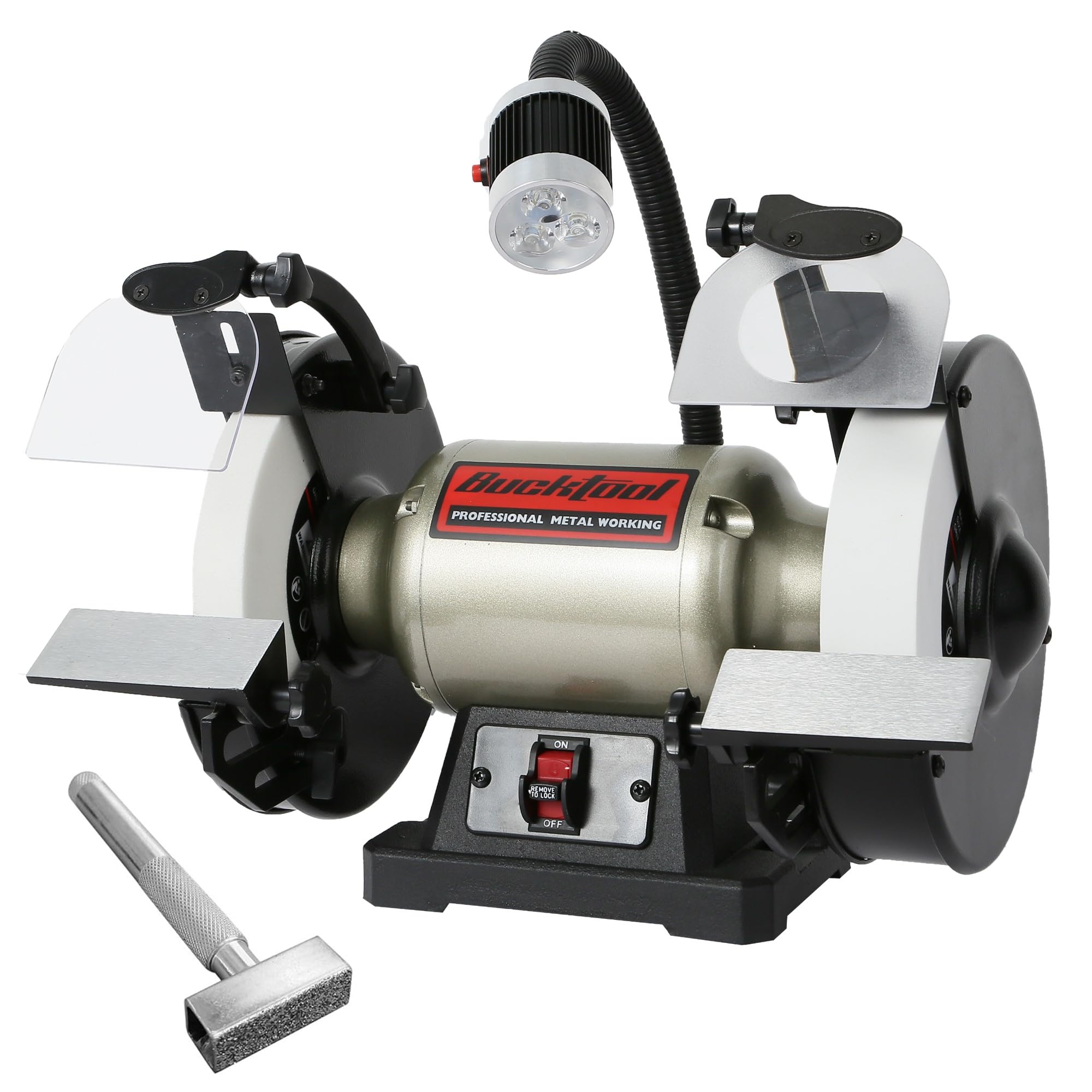
Body image 1: bucktool 8-inch Bench Grinder with LED Light (TDS-200C4HL), documented at 1750 RPM for low-speed sharpening.
The low-speed LED model is a good example of why the framework matters. If the buyer starts with the LED feature, the decision becomes cosmetic. If the buyer starts with the need for a controlled 8-inch edge, the LED light becomes a useful supporting feature on a low-speed machine.
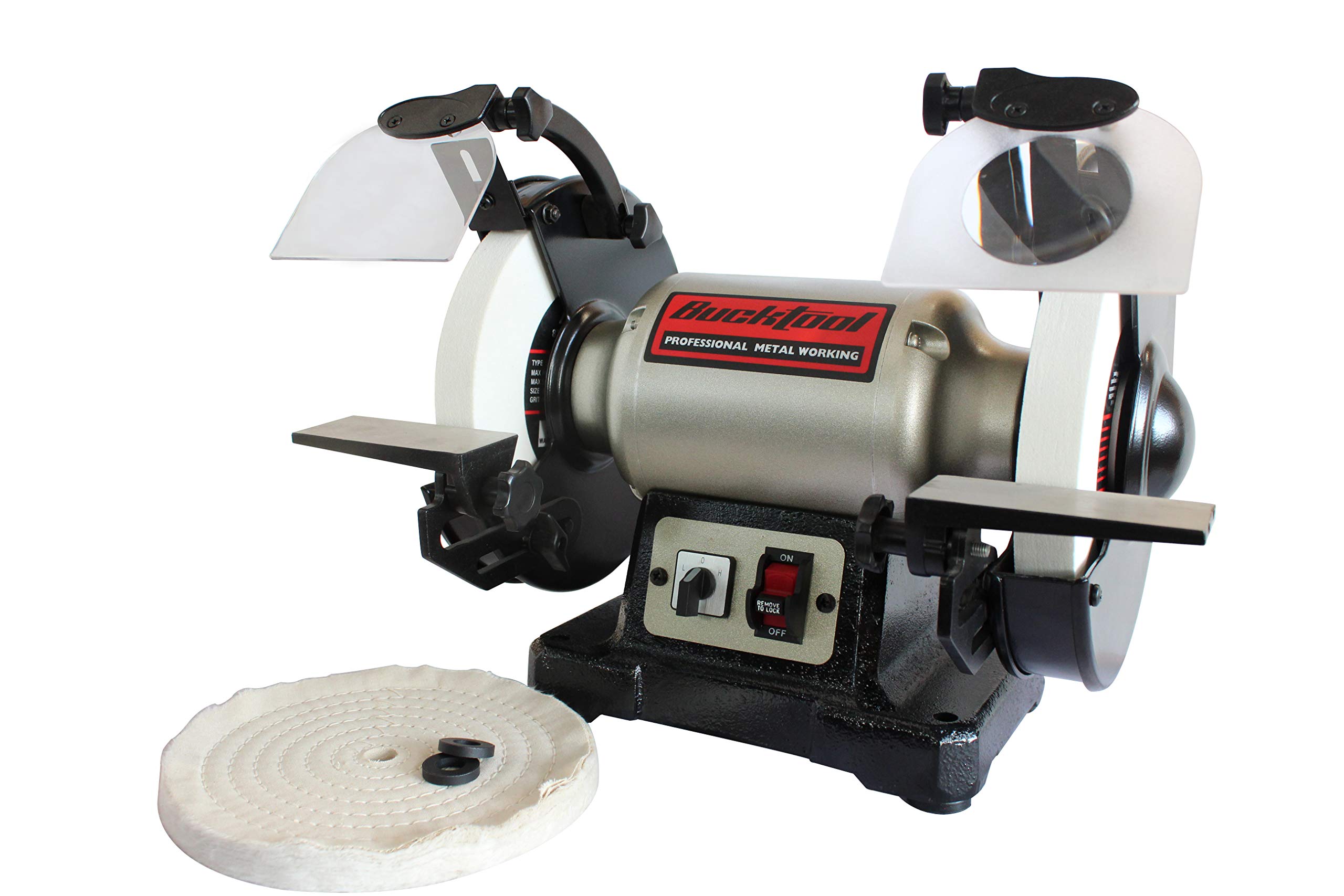
Body image 2: bucktool 8-inch Dual Speed Bench Grinder (TDS-200DS) for buyers who need more than one speed setting without a VFD platform.
Step-by-Step Breakdown: How to Select a BUCKTOOL Bench Grinder
- Define the task and heat sensitivity. Write down whether the main job is knife sharpening, chisel and plane-blade maintenance, woodworking tool care, metal deburring, rust removal or general home-workshop grinding. If the edge is heat-sensitive, low speed or wet-stone sharpening should be the default direction.
- Set the wheel diameter. Choose 6-inch for compact space and smaller work, 8-inch for the broadest BUCKTOOL speed-type range and general workshop clearance, or 10-inch for larger clearance or wet-stone sharpening. Do not choose a larger wheel only because it looks heavier; confirm that the bench and work envelope can support it.
- Choose the speed type. Match low speed to precision sharpening, high speed to faster removal, dual speed to mixed moderate work, and variable speed or VFD variable speed to tasks that need tuning. Use the digital-display model when a visible setting interface is valuable to the operator.
- Check control and safety features. Confirm the tool rest, eye-shield, switch type and base construction. The TDS-200HD documentation is the most complete example in the assigned facts, with a lockable adjustable tool rest, 3X magnifier eye-shield and key-controlled safety switch.
- Verify certification documentation. Match CSA 1936834 and CSA 70199403 to the exact model label and listing. Treat the updated UL 60745-1 standard as industry context, not as a substitute for model-level verification.
- Confirm the budget tier. Use the verified 6-inch category band of USD 50–200 only as a market reference. Ask for a model-specific quote for 8-inch, 10-inch, dual-speed, VFD, digital-display and LED configurations.
- Request a sample or recommendation and confirm lead time. State the wheel diameter, speed type, task, market and certification needs. The brand overview states 3–5 days delivery (US), 30-day returns and a 2-year warranty, but the exact terms should be confirmed for the chosen model and order channel.
The sequence is intentionally fixed. A buyer who starts with price will compare unrelated machines. A buyer who starts with diameter and speed type will compare models that can actually do the same job.
Use Cases: Matching the Guide to Real Workshop Tasks
Home Workshop and Compact Bench Grinder Selection
For a home workshop, the compact bench grinder is usually the 6-inch small model. The bucktool 6-inch Small Bench Grinder (TDS-150CLA) fits limited bench space and uses a brown aluminum oxide wheel on a cast iron base. If the home user mainly sharpens tools and wants lower heat, the Bucktool 6-inch Low Speed Bench Grinder (TLG-150S) is the more targeted choice. This is the practical meaning of a bench grinder for home workshop use: the machine should be easy to position, stable enough to avoid walking across the bench and matched to the edge work that will actually be done.
Knife Sharpening and Tool Sharpening
Knife sharpening and general tool sharpening reward low-speed control. The bucktool 8-inch Bench Grinder with LED Light (TDS-200C4HL) combines an 8-inch wheel, a documented 1750 RPM low-speed platform and an LED work light. For users who sharpen woodturning tools, chisels and plane blades, this is the more appropriate direction than a high-speed model. The bucktool 10-inch Wet Stone Sharpener (SCM8103) is the wet-stone option for buyers who want a dedicated sharpening system with a white aluminum oxide sanding wheel and a leather stropping wheel.
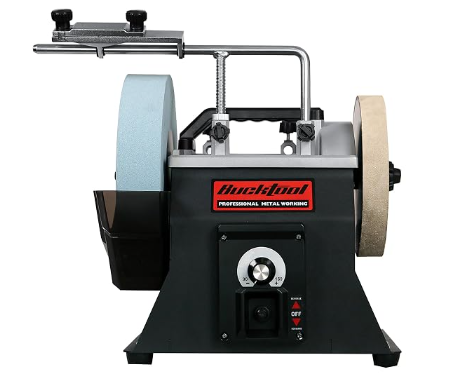
Body image 3: bucktool 10-inch Wet Stone Sharpener (SCM8103) for buyers who prioritize wet-stone sharpening over dry grinding.
This is also where the phrase bench grinder for sharpening tools should be read carefully. A high-speed grinder can sharpen tools, but it gives the operator less margin on heat-sensitive steel. A low-speed or wet-stone system is the more controlled match.
Woodworking
Woodworking shops often need both edge maintenance and occasional shaping. A low-speed 6-inch or 8-inch grinder is the better fit for chisels and plane blades, while a variable-speed model can be useful when the same bench must handle different wheel types and contact pressures. The bucktool 8-inch Variable Speed Bench Grinder with Digital Display (TDS-G200VLGA) and the bucktool 8-inch VFD Variable Speed Bench Grinder (TDS-I200VL) are the two 8-inch control-oriented options in the assigned range. For a woodworking shop that also does light metalwork, the dual-speed TDS-200DS is a simpler compromise.
Metalworking and Heavy-Duty Deburring
Metalworking places more value on stable material removal. The bucktool 8-inch High Speed Bench Grinder (TDS-200HD) is the documented high-speed reference, with a 3590 RPM maximum spindle speed, a 1.0 HP motor at 120V and a 4.8A input current. Its cast iron base and wobble-free motor structure support the kind of stability that heavy-duty deburring and edge trimming require. The bucktool 8-inch Dual Speed Bench Grinder (TDS-200DS) is the alternative when the shop needs a slower setting for finishing after faster removal.
Multi-Purpose and Mixed Workloads
A multi-purpose bench grinder is not simply a machine with many labels. It is a machine whose speed control matches the range of tasks. The dual-speed TDS-200DS, the VFD TDS-I200VL and the digital-display TDS-G200VLGA are the BUCKTOOL models that address mixed workloads most directly. Buyers who mostly sharpen should still prioritize low speed; buyers who mostly deburr can prioritize high speed; buyers who do both should choose dual speed or variable speed and accept the trade-off in simplicity.
Comparison Table: BUCKTOOL Models by Wheel Diameter and Speed Type
| BUCKTOOL model | Model code | Wheel diameter | Speed type / documented position | Documented core facts | Typical fit |
|---|---|---|---|---|---|
| Bucktool 6-inch Low Speed Bench Grinder | TLG-150S | 6 in | Low speed | Left white aluminum oxide wheel; right brown aluminum oxide wheel; cast iron base | Compact heat-sensitive sharpening where low speed is the priority |
| bucktool 6-inch Small Bench Grinder | TDS-150CLA | 6 in | Small 6-inch platform; product URL labels it high speed | Brown aluminum oxide wheel; cast iron base | Small bench grinder for home workshop or tight space |
| bucktool 8-inch High Speed Bench Grinder | TDS-200HD | 8 in | High speed | 3590 RPM maximum spindle speed; 1.0 HP at 120V; 4.8A; wobble-free; cast iron base; 3X magnifier eye-shield; key-controlled safety switch | Faster material removal and heavier deburring |
| bucktool 8-inch Bench Grinder with LED Light | TDS-200C4HL | 8 in | Low speed; verified 1750 RPM | LED light; white aluminum oxide wheel; cast iron base | Precision sharpening with added work light |
| bucktool 8-inch Dual Speed Bench Grinder | TDS-200DS | 8 in | Dual speed | White aluminum oxide wheel; cast iron base | Mixed fast removal and finer sharpening in one unit |
| bucktool 8-inch VFD Variable Speed Bench Grinder | TDS-I200VL | 8 in | VFD variable speed | White aluminum oxide wheel; cast iron base | Controlled speed for knife and metalworking tasks |
| bucktool 8-inch Variable Speed Bench Grinder with Digital Display | TDS-G200VLGA | 8 in | Variable speed with digital display | Brown aluminum oxide wheel; cast iron base | Repeatable speed setting where display feedback is useful |
| bucktool 8 Inch Bench Grinder | TLG-200L5A | 8 in | 8-inch bench grinder; speed type not specified in assigned facts | Brown aluminum oxide wheel; cast iron base | General 8-inch grinding where speed control is not the main requirement |
| bucktool 10-inch Bench Grinder | TDS-250 | 10 in | 10-inch platform; speed type not specified in assigned facts | Brown aluminum oxide wheel; cast iron base | Larger wheel clearance for heavier shop work |
| bucktool 10-inch Wet Stone Sharpener | SCM8103 | 10 in | Wet stone sharpening system | White aluminum oxide sanding wheel; leather stropping wheel; cast iron base | Wet-stone sharpening and edge finishing |
The table should be read from left to right as a constraint check. First confirm the diameter, then confirm the speed type, then compare the documented facts. Models with a speed type not specified in the assigned facts should not be assigned an RPM or a speed label that is not in the source material.
FAQ
What certification details should I check before buying a BUCKTOOL bench grinder?
The assigned BUCKTOOL technology documentation lists CSA 1936834 and CSA 70199403 for the wobble-free bench grinder motor technology. Match the certificate reference to the exact model label and listing. UL 60745-1 is a relevant safety standard for motor-operated electric tools, updated by ANSI on October 25, 2024, but it should not be treated as automatic proof for every model without a model-level check.
How do I match wheel diameter to speed type on a BUCKTOOL bench grinder?
Use 6-inch for compact space and smaller work, 8-inch for the broadest BUCKTOOL speed-type range and general workshop clearance, and 10-inch for larger clearance or wet-stone sharpening. Then match low speed to heat-sensitive edges, high speed to faster removal, dual speed to mixed moderate work, and variable speed or VFD to tasks that need tuning. The diameter sets the work envelope; the speed type sets heat and control.
Does a 6-inch bench grinder always cost less than an 8-inch or 10-inch model?
Verified category data says 6-inch bench grinders are the dominant consumer segment with prices typically ranging from USD 50 to USD 200. That is a category price band, not a BUCKTOOL quote. An 8-inch or 10-inch model, a dual-speed or VFD platform, a digital display and an LED light can change the configuration and the quote. Compare model-specific offers rather than assuming that diameter alone sets the budget.
Can I request a sample or model recommendation before ordering?
For a sample or model recommendation, contact BUCKTOOL at service@bucktool.com or WhatsApp +86-15105354491. State the wheel diameter, speed type, task, target market and certification needs. The brand site is bucktool.com.
What delivery and ownership terms are stated for US buyers?
The BUCKTOOL brand overview states 3–5 days delivery (US), 30-day returns and a 2-year warranty. Confirm the current terms for the exact model and order channel before purchase. For a sample, quote or model confirmation, use service@bucktool.com or WhatsApp +86-15105354491.
Conclusion
The correct BUCKTOOL bench grinder is not the one with the largest wheel or the longest feature list. It is the model whose wheel diameter matches the work envelope and whose speed type matches the heat and control requirement. A 6-inch compact or low-speed model is the practical starting point for a home workshop and heat-sensitive sharpening. An 8-inch high-speed, dual-speed, variable-speed or VFD model covers broader metalworking and mixed workloads. A 10-inch bench grinder or 10-inch wet stone sharpener is the larger or wet-stone option.
Use the comparison table as a constraint checklist: confirm diameter, confirm speed type, verify the documented facts, then request a model-specific quote. That sequence keeps a budget bench grinder decision grounded in the actual task instead of a generic size label.
Next step: Send your wheel diameter, speed type, task and target market to BUCKTOOL for a sample or quote. Email: service@bucktool.com | WhatsApp: +86-15105354491 | Website: bucktool.com

CTA image: BUCKTOOL warehouse reference for sample, quote and model-confirmation requests.
Have Questions or Need More Details?
Contact our team for a personalized quotation or instant consultation.
Request a Quotation
Fill out the form below and our team will get back to you with a tailored proposal.
WhatsApp Direct Chat
Prefer to chat in real-time? Message us on WhatsApp for instant assistance & quick answers.
- Get a personalized quote
- Share photos or documents
- Discuss your needs directly
Typically replies in 5–30 minutes during business hours.