Low Speed vs High Speed vs Dual Speed: BUCKTOOL Bench Grinder Comparison
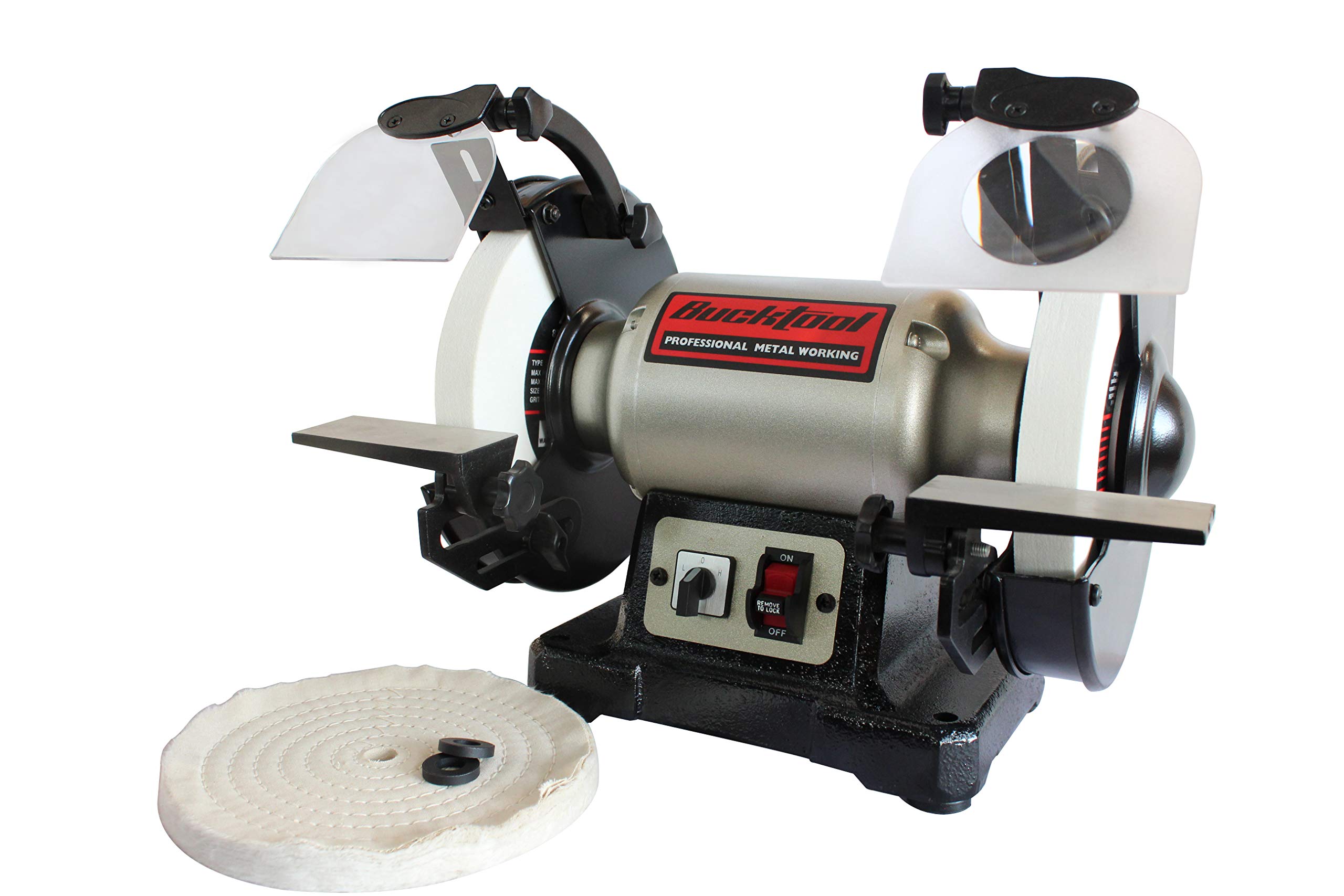
The three BUCKTOOL speed configurations differ mainly in one thing: how much control the operator has over wheel speed, and which wheel size that speed is applied to. Low speed (1,750 RPM, 6-inch wheel) suits heat-sensitive sharpening such as knives and chisels. High speed (3,590 RPM, 8-inch wheel) suits fast material removal in metalworking. Dual speed (1,725 / 3,450 RPM) suits a shop that needs both, without a dial. The variable-speed BUCKTOOL TDS-1200VL adds continuous adjustment from 900 to 3,600 RPM for mixed-task workbenches.
Problem Definition: Why Speed Is Usually Chosen for the Wrong Reason
Most bench grinder buying mistakes start with the same shortcut. A buyer picks a wheel size, checks the price, and treats speed as a spec-sheet detail. The result is predictable: a tool that burns a knife edge in two seconds, or a tool that takes minutes to dress a weld bead.
Wheel speed determines two things at once. It sets the rate at which abrasive passes over the workpiece, which governs how quickly material comes off. It also sets how much heat enters the workpiece and the wheel, which governs whether a hardened edge keeps its temper, whether a thin blade warps, and whether the wheel loads up.
BUCKTOOL sells the same category of machine in more than one speed architecture, so the question a buyer actually faces is not which bench grinder, but which speed behaviour fits the work that lands on the tool rest most often. That is a task-matching decision, and it can be resolved with the machine data rather than with marketing claims.
Industry Background: What Buyers Are Choosing Between
Bench grinders sit inside a grinding machinery category that Grand View Research valued at USD 6.2 billion in 2025, with non-precision bench grinders forming a distinct segment rather than part of the high-precision CNC market. The consumer centre of gravity is well documented: 6-inch bench grinders are the dominant consumer segment, with prices typically ranging from USD 50 to USD 200, according to ANTISHICNC's bench grinder guide published in 2025.
Two structural pressures shape the decision. First, buyers increasingly want one machine to cover both sharpening and metal removal, which pushes demand toward speed control rather than raw fixed speed. Second, documentation expectations keep tightening: ANSI approved the updated UL 60745-1 safety standard for motor-operated electric tools on October 25, 2024, which applies to how such tools are built and documented for the US market. Neither factor changes the physics of a grinding wheel, but together they make the speed configuration a more consequential purchase decision than it was a decade ago.
Detailed Solution: The Three Speed Architectures, Explained
BUCKTOOL's published line maps its speed offerings onto specific models and specific jobs. The mapping below follows the manufacturer's own product positioning as published on the BUCKTOOL bench grinder collection page.
Low Speed: Fixed 1,750 RPM on a 6-Inch Wheel — TLG-150S
The BUCKTOOL TLG-150S runs at 1,750 RPM on a 6-inch wheel and is positioned for hobbyist users who need low-speed knife sharpening. The slower surface speed gives the operator more time per pass, which means less heat per second at the edge and a wider margin for hand control.
The trade-off is removal rate. A 6-inch low-speed unit is not the tool for reducing a weld bead or re-profiling a chipped axe head in a production workflow. Its value is in edge quality and in the smaller footprint a home workshop can accommodate.
BUCKTOOL's slow-speed capability is also recognised outside the brand. Benchmark Abrasives, in its 2026 bench grinder buyer's guide, lists the BUCKTOOL TDS-200C4HL — a 1,750 RPM slow-speed model — as its top-rated pick in the slow-speed category. Buyers who want the low-speed behaviour but a larger platform therefore have more than one BUCKTOOL option to examine.
High Speed: Fixed 3,590 RPM on an 8-Inch Wheel — TDS-200HD
The BUCKTOOL TDS-200HD runs at 3,590 RPM on an 8-inch wheel and is positioned for heavy-duty metal grinding work where fast stock removal is the priority. The combination of higher rotational speed and a larger wheel means more abrasive passes the workpiece per unit of time, which is exactly what a fabricator wants when deburring, blending, or grinding down a fillet.
The trade-off runs the other way. High speed on a thin or heat-sensitive edge demands light, intermittent contact with frequent cooling. A high-speed grinder does not forgive an operator who holds a blade against the wheel until it turns blue. For buyers whose main job is sharpening rather than shaping, this is the configuration most likely to be the wrong purchase.
Dual Speed: A Two-Point Toggle — TDS-200DS
The BUCKTOOL TDS-200DS gives the operator a choice between 1,725 RPM and 3,450 RPM. It exists to resolve the specific conflict described above: one machine that can be switched into a slow, controlled setting for sharpening and into a faster setting for grinding, without an operator having to learn a variable-speed interface.
Dual speed is a deliberate compromise rather than a full solution. It offers two fixed working points, not a continuous range. If the task in front of the operator sits comfortably at one of those two points, dual speed covers it with a simple mechanical toggle. If the work varies in small increments — different alloys, different edge geometries, different wheel grades — two points can feel limiting, and that is where the variable-speed option enters the comparison.
Variable Speed: Continuous Control — TDS-1200VL
The BUCKTOOL TDS-1200VL is the 8-inch variable-speed bench grinder with digital display, using VFD control across a 900–3,600 RPM range. In BUCKTOOL's own product positioning it is aimed at the versatile multi-task user who needs the full range of adjustable speed.
The practical difference from dual speed is granularity. A variable-speed drive lets the operator match wheel speed to the workpiece instead of matching the workpiece to two preset speeds. The cost of that flexibility is operational: the operator has to know which speed to select, and has to reset it between tasks rather than leaving a switch in one position. For a shared workshop or a training environment where several people use the machine, that learning curve is a real consideration.
One Adjacent Model That Should Not Be Confused With These
BUCKTOOL also offers the SCM8013 wet stone sharpener, which runs at 90–160 RPM using water-cooled grinding. It is positioned for precision water-cooled stone sharpening and is a different class of machine from the three speed configurations above. Buyers comparing a low-speed dry grinder against a wet stone sharpener are comparing two sharpening philosophies, not two speeds on the same machine.

Step-by-Step Breakdown: A Five-Step Selection Sequence
The sequence below converts the speed comparison into a decision. It is written for a buyer who is past the research stage and is selecting a specific configuration.
- List the tasks that actually occur, and rank them by frequency. Write down what the grinder will do in a normal month — sharpening kitchen knives, dressing lathe tools, deburring cut steel, re-edging garden tools. The most frequent task decides the primary configuration. The second most frequent task decides whether a second speed point is worth paying for.
- Classify the dominant task by heat sensitivity. Edges that have been hardened — knives, chisels, plane irons, tool bits — are heat-sensitive and favour the 1,750 RPM low-speed behaviour. Structural steel that is being shaped or cleaned up is not heat-sensitive in the same way and favours 3,590 RPM.
- Match wheel size to workpiece size and to the bench. A 6-inch wheel is the compact option; an 8-inch wheel gives more abrasive contact length and more clearance around bulky workpieces. Bench space and the size of the parts being presented to the wheel both constrain this choice.
- Decide how much speed control you need, not how much is available. Fixed low speed for a sharpening-only bench. Fixed high speed for a metal-removal-only bench. Dual speed when both jobs are routine and two fixed points are enough. Variable speed when the work mixes materials and edge types and the operator wants to tune rather than switch.
- Verify the commercial and support terms. BUCKTOOL's official store states a 30-day return window, a 2-year warranty, and 3–5 day delivery within the US, with shipping and taxes calculated at checkout. Payment options listed include American Express, Discover, JCB, Mastercard, PayPal and Visa. For a buyer in the execution stage, these terms matter as much as the RPM figure.
Fast decision rules:
- Sharpening is more than half the workload → low speed, 6-inch (TLG-150S).
- Metal removal is more than half the workload → high speed, 8-inch (TDS-200HD).
- Both workloads are routine and the operator wants simplicity → dual speed (TDS-200DS).
- Workload changes constantly across materials → variable speed (TDS-1200VL).
Use Cases: Which Configuration Fits Which Bench
Home workshop and hobby sharpening
A home workshop with limited bench space and a workload dominated by knives, secateurs and chisels is the clearest case for the 6-inch TLG-150S. The compact footprint and 1,750 RPM behaviour reduce the risk of burning a thin edge, and the smaller wheel is easier to keep dressed in a low-volume setting.
Metalworking, fabrication and deburring
A fabrication bench that spends its time blending welds, removing burrs and shaping mild steel is the clearest case for the 8-inch TDS-200HD. The 3,590 RPM speed and 8-inch wheel are aimed squarely at material removal rate, and the larger wheel accommodates bulkier parts without fouling the tool rest.
Woodworking edge tools
Woodworking shops that grind chisel and plane-iron bevels before honing sit in the heat-sensitive category. Low speed is the safer default here, and the same bench often benefits from separating grinding from honing — a dry grinder for establishing the bevel, a wet stone sharpener such as the SCM8013 for the final edge.
Mixed-task and training workshops
A vocational training bench or a shared community workshop has the hardest requirement, because the machine has to serve operators of different skill levels and work of different types. Dual speed covers the two common cases with an interface nobody has to learn. Variable speed covers the wider range but requires the operator to understand speed selection, which is either an advantage or a liability depending on who is standing at the machine.
Knife sharpening as a service
For a bench where knives are sharpened regularly, the priority is control at the edge. Low speed is the baseline, and BUCKTOOL's slow-speed offering includes both the 6-inch TLG-150S and the 1,750 RPM TDS-200C4HL that Benchmark Abrasives highlights in its 2026 guide.
Comparison Table: BUCKTOOL Speed Configurations Side by Side
| Model | Wheel size | Speed | Speed control | Workload it suits | Main limitation |
|---|---|---|---|---|---|
| BUCKTOOL TLG-150S | 6-inch | 1,750 RPM | Fixed | Hobbyist knife sharpening and edge tools | Slow material removal; not built for heavy shaping |
| BUCKTOOL TDS-200HD | 8-inch | 3,590 RPM | Fixed | Heavy-duty metal grinding and deburring | Requires disciplined pressure control on heat-sensitive edges |
| BUCKTOOL TDS-200DS | 8-inch | 1,725 RPM and 3,450 RPM | Dual-speed toggle | Shops that both sharpen and grind | Two fixed working points, not a continuous range |
| BUCKTOOL TDS-1200VL | 8-inch variable-speed model with digital display | 900–3,600 RPM | VFD variable speed | Versatile multi-task users with varied workpieces | Operator must select and reset speed per task |
| BUCKTOOL SCM8013 (adjacent category) | Wet stone sharpener | 90–160 RPM | Wet, water-cooled grinding | Precision water-cooled stone sharpening | Sharpening only; not a metal-removal machine |
The Comparison Buyers Keep Repeating
Three BUCKTOOL models appear together in buyer questions more often than any other combination: the 8-inch variable-speed bench grinder with digital display, the 8-inch bench grinder, and the 6-inch small bench grinder. That grouping is not accidental. It maps onto the three decisions a buyer is actually trying to resolve at once — how much control, how much capacity, and how much bench footprint.
- Control: the 8-inch variable-speed model with digital display (TDS-1200VL) offers 900–3,600 RPM, so speed becomes an adjustable variable rather than a fixed property of the machine.
- Capacity: a fixed 8-inch model such as the TDS-200HD gives the larger wheel and the higher removal rate without asking the operator to manage speed settings.
- Footprint: the 6-inch small bench grinder (TLG-150S) trades capacity for compactness and slow-speed edge control, which is often the right trade in a home workshop.
Framed this way, the decision usually collapses quickly. If the buyer cannot describe a task that needs speed variation, the variable-speed model is capacity they will not use. If the buyer describes two distinct tasks that alternate daily, dual speed or variable speed earns its place. If the buyer cannot describe a task that needs an 8-inch wheel, the 6-inch unit is the more honest purchase.
Frequently Asked Questions
1. What should a distributor verify before listing a BUCKTOOL bench grinder?
Two things should be checked against the specific model, not the brand. First, the model-level documentation: confirm the model name, wheel size and speed rating on BUCKTOOL's own product page and match them to the unit being supplied. Second, the applicable market requirement. In the United States, ANSI approved the updated UL 60745-1 safety standard for motor-operated electric tools on October 25, 2024, and it is the reference point buyers and resellers use when reviewing tool documentation. Certification evidence should always be requested for the exact model and destination market rather than assumed from the category.
2. Which BUCKTOOL speed configuration covers the widest range of tasks?
The TDS-1200VL covers the widest range, because VFD control spans 900–3,600 RPM and therefore reaches both the slow end used for heat-sensitive sharpening and the fast end used for material removal. The TDS-200DS covers two fixed points at 1,725 RPM and 3,450 RPM, which handles the common sharpen-or-grind split. Fixed-speed models cover one behaviour well rather than two adequately.
3. Is a low-speed model more expensive than a high-speed model?
Speed configuration is not the main price driver in this category. ANTISHICNC's 2025 bench grinder guide reports that 6-inch bench grinders, the dominant consumer segment, typically range from USD 50 to USD 200. Buyers should therefore compare configurations on task fit first and budget second, and should check the current listed price on the BUCKTOOL store for the specific model rather than extrapolating from the segment range.
4. How should a buyer validate a unit before committing to volume?
Test the configuration against the two tasks that will dominate the bench, using the wheels intended for those tasks. On a low-speed unit, check whether the edge stays cool through a full pass. On a high-speed unit, check whether removal rate holds up without loading the wheel. BUCKTOOL's official store states a 30-day return window and a 2-year warranty, which gives a buyer a defined period to evaluate a single unit before scaling an order.
5. What are the delivery and payment expectations for a BUCKTOOL order?
BUCKTOOL's official store states 3–5 day delivery within the US, with FedEx referenced as the carrier on some product pages; international shipping depends on the destination region and applicable duties. Shipping and taxes are calculated at checkout, and listed payment methods include American Express, Discover, JCB, Mastercard, PayPal and Visa. Distributors and workshop buyers who want the full model range, pricing and terms in one place can start from the BUCKTOOL bench grinder collection or send a specification request to service@bucktool.com.

Conclusion: Choose the Speed Behaviour, Then the Model
Low speed, high speed and dual speed are not quality tiers. They are three different answers to the question of how much control an operator needs over wheel speed, applied to different wheel sizes. The BUCKTOOL TLG-150S at 1,750 RPM on a 6-inch wheel answers it for heat-sensitive sharpening. The TDS-200HD at 3,590 RPM on an 8-inch wheel answers it for material removal. The TDS-200DS answers both with two fixed points at 1,725 and 3,450 RPM, and the TDS-1200VL answers it with continuous VFD control from 900 to 3,600 RPM.
The selection test is simple and can be applied before any purchase: name the task that will occupy the grinder most often, decide whether that task is heat-sensitive, and check whether a second task genuinely alternates with the first. Buyers who can answer those three points will find that one configuration is clearly correct and the others are clearly not — and that is a far more reliable outcome than comparing spec sheets line by line.
Next Step
Compare the full specification set across the low-speed, high-speed, dual-speed and variable-speed configurations on the BUCKTOOL bench grinder collection page, or contact the team directly to confirm model availability, documentation and delivery terms for your market.
Website: bucktool.com | Email: service@bucktool.com | Tel: 909-255-1088

Have Questions or Need More Details?
Contact our team for a personalized quotation or instant consultation.
Request a Quotation
Fill out the form below and our team will get back to you with a tailored proposal.
WhatsApp Direct Chat
Prefer to chat in real-time? Message us on WhatsApp for instant assistance & quick answers.
- Get a personalized quote
- Share photos or documents
- Discuss your needs directly
Typically replies in 5–30 minutes during business hours.