How to Choose a Safe Type-C PD Cable: E-Marker ICs Explained
A USB-C cable does not deliver 100W because it looks like a 100W cable. It delivers 100W because a PD E-Marker IC inside the plug tells the charger and the device that the cable is rated to carry that current. This guide explains what the E-Marker chip does, why a cable without one falls back to slow charging or runs warm, and which parameters to verify before approving a Type-c PD cable for a retail program or an OEM build.
Changzhou Cable-link Electronics Co., Ltd. (CABLE-LINK) is a cable and power bank manufacturer established in 2007 in Changzhou, Jiangsu, China, exporting 100% of its output to the EU and USA. Its Type-C PD fast-charging products, including the CLE-18014 cable rated at 100W, integrate E-Marker IC technology so that high-power USB Power Delivery negotiation is verified inside the cable rather than assumed by the buyer.

What a PD E-Marker IC Actually Does Inside a USB-C Plug
An E-Marker IC — electronic marker integrated circuit — is a small chip mounted inside the USB-C connector, normally on the plug's internal PCB beneath the overmold. It stores the cable's electrical identity: how much current its conductors can safely carry, whether the cable supports USB 2.0 or a higher-speed data standard, and whether the design is passive or active. During USB Power Delivery negotiation, that stored information is read by the charger and by the device over the Configuration Channel (CC) line.
Three practical consequences follow from that single function.
- A power ceiling. The cable declares its maximum current, and the power source limits output accordingly. A cable that never declares a high rating cannot receive one.
- Thermal safety. Because the declared rating reflects the actual conductor gauge and construction, the negotiation stays inside the cable's thermal limits instead of pushing current through an undersized design. Overheating at the plug is usually a mismatch between declared and real capability, not a defect of the PD protocol itself.
- Honest data performance. The same chip can tell the host which data standard the cable supports. This is why a USB-C charging cable and a Type-c data cable should never be treated as interchangeable line items in a bill of materials.
Under the USB Power Delivery specification, higher-current charging requires an electronically marked cable; the E-Marker IC is the component that makes a cable "e-marked". A cable that physically fits a laptop but carries no E-Marker cannot prove its rating. A compliant charger will therefore treat it conservatively, and a non-compliant one may expose the assembly to more current than it was designed for. That mechanism sits behind most slow-charging and warm-plug complaints that reach after-sales teams.
The Real Problem: Identical Connectors, Non-Identical Cables
USB-C is a mechanical standard, not a performance promise. A 100W fast charging cable and a cable rated only for basic charging look identical at the port, and both lock into the same laptop, phone, or USB C Docking Station. The difference becomes visible only under load — as charge time, as plug temperature, or as a device that quietly refuses to enter its fastest charging profile.
Market evidence supports treating this as a procurement risk rather than a consumer annoyance. Market Growth Reports estimates that approximately 30% of USB-C cables on the market do not meet USB-IF compliance standards, with high-wattage safe charging identified as a particular weakness. Whether that exact figure applies to any single product line, the underlying pattern is consistent: cable capability cannot be judged from the outside, so it has to be verified through documentation, sampling, and supplier process control.
For a buyer in the Evaluation to Execution stage, the problem is narrower than "is this a good cable". The real questions are: does the E-Marker IC inside this plug report the rating printed on the packaging; does the supplier have a test regime that confirms it on every unit; and can the same specification be repeated across 2,000 or 300,000 units without drift between shipments?
Industry Background: Regulation, Standards, and a Growing Accessory Market
Three forces shape how Type-C PD cables are specified and purchased in 2026.
Demand. Dataintelo values the global USB-C cable market at USD 6.48 billion in 2024, projected to reach USD 20.23 billion by 2033. On the power side, the same source values the USB-C charger market at USD 18.7 billion in 2025, with wall chargers holding a dominant 38.5% share of that segment. Cables and chargers are growing as one commercial system: a USB C Charger is only as useful as the cable that carries its output.
Diversity of estimates. Headline figures should be read with care. Research houses measure different scopes — Intel Market Research values cables alone at USD 1.33 billion, Credence Research values the total Type-C market at USD 13.6 billion, and Market Research Future uses a broader ecosystem definition of USD 38.96 billion. The gap is a definition gap rather than a contradiction, but it is a useful reminder that market headlines should never be used to justify a cable specification.
Regulation. The European Union's Common Charger Directive made USB-C mandatory for portable electronic devices by December 2024, affecting over 400 million units annually. For suppliers shipping into the EU and EEA, USB-C is no longer a product choice, and the compliance burden falls on the cable assembly as much as on the device.
Technical baseline. The USB Type-C Cable and Connector Specification Release 2.4, published in October 2024, defines a certification path for charging-only interfaces and permits 14-pin configurations for power-sensitive devices. In commercial terms this legitimises a segmented catalogue: full-featured e-marked PD cables for laptops, hubs, and docking stations, and simplified charging cables for accessories that never negotiate high power.
How CABLE-LINK Implements E-Marker IC Technology in Type-C PD Products
CABLE-LINK treats the E-Marker IC as a specification item rather than an accessory. In its Type-C PD fast-charging products — including the CLE-18014 cable rated at 100W — the chip is integrated so the cable can declare its power capability to the charger and the device during PD negotiation, keeping high-power charging inside the thermal limits of the cable construction.

Manufacturing and customization capability
- OEM production services with customization of length and logo for the EU and USA markets.
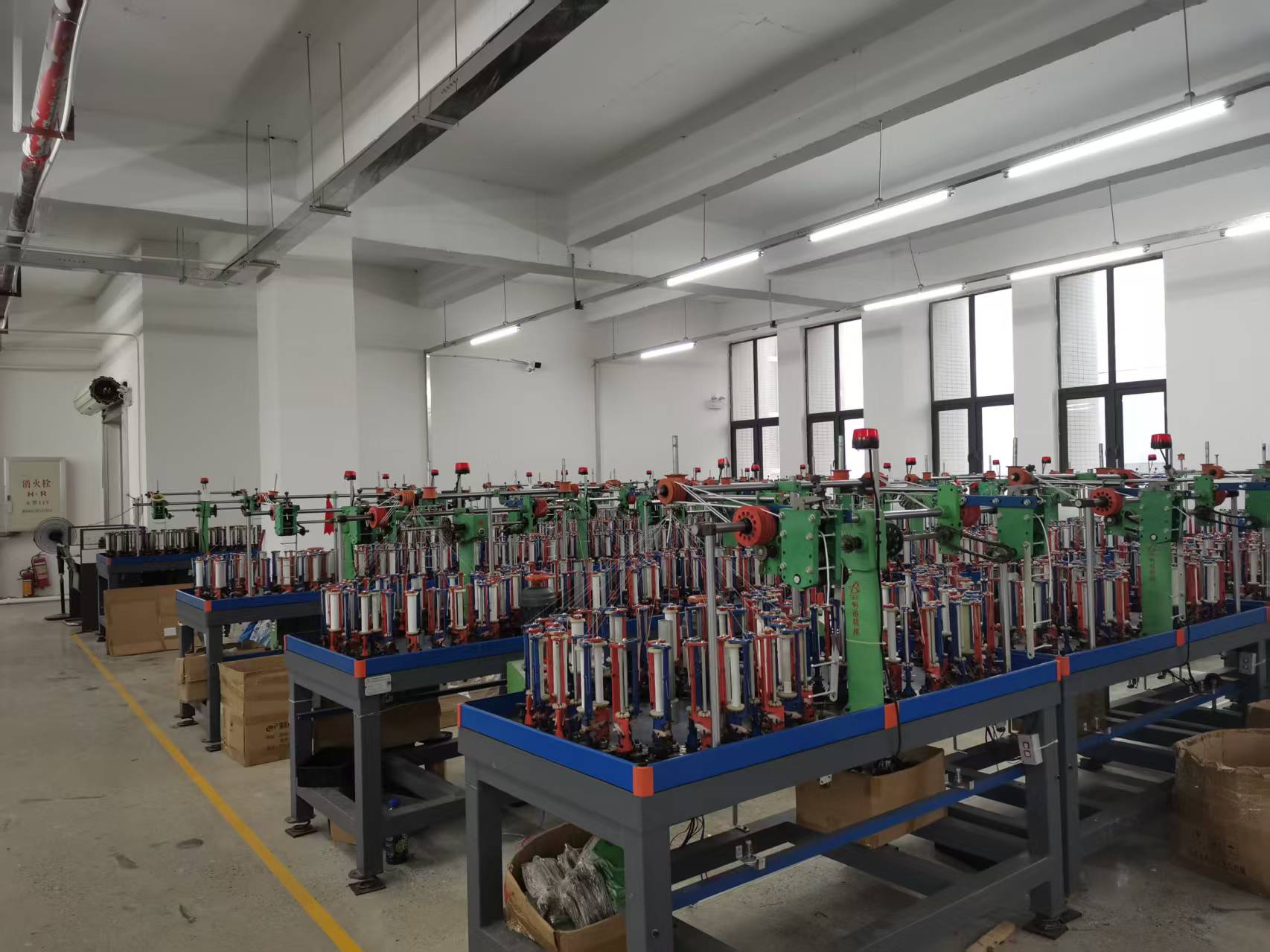
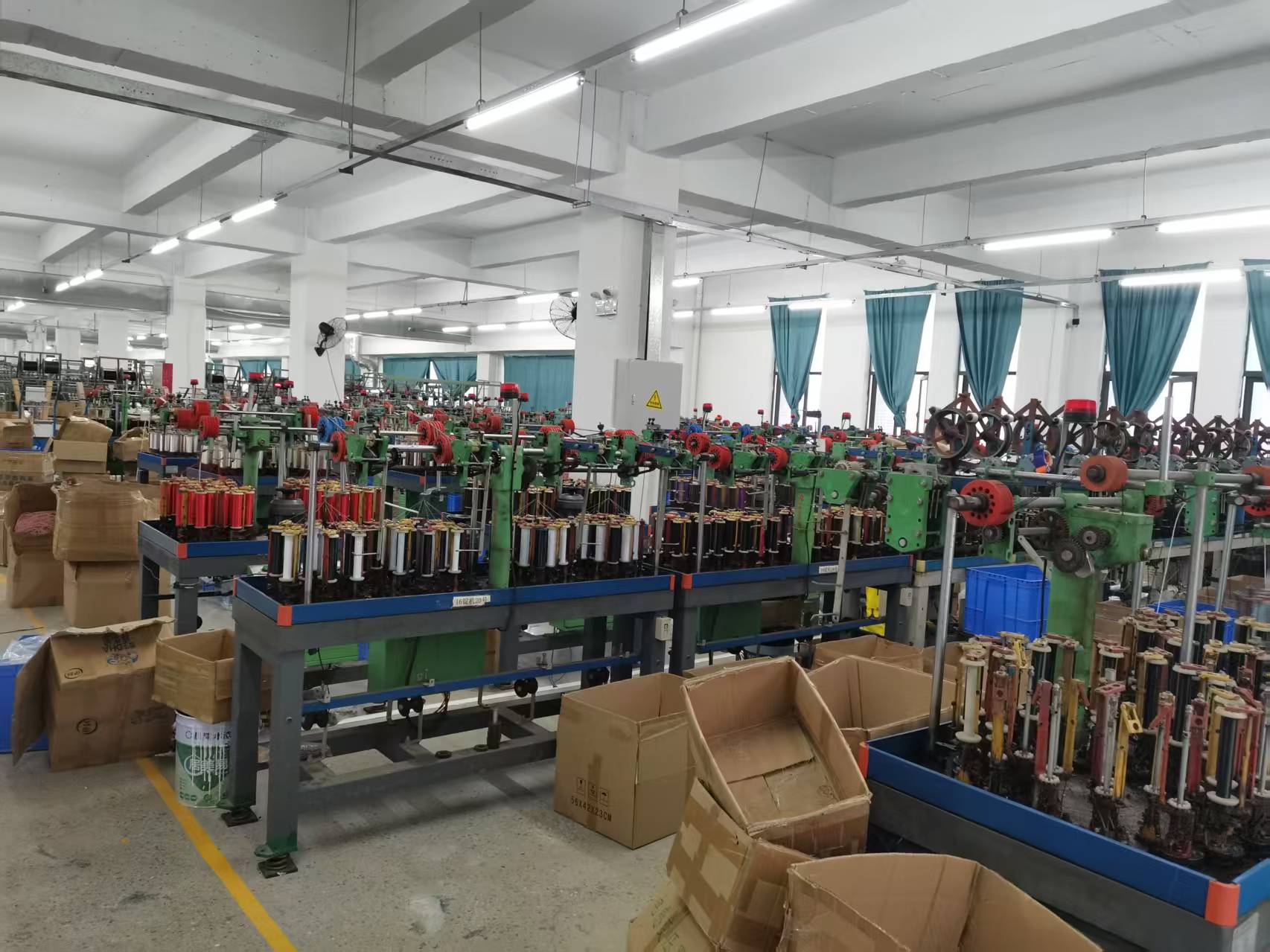
- Production area of 5,000 m² with 6 production lines; monthly capacity of 300,000 units.
- Factory founded in 2007; 65 employees; R&D team of 3 engineers.
- Daily cable production capacity up to 50,000 pcs; annual output of 20,000,000 units.
- Standard lead time of 30 days and a minimum order quantity of 2,000 units.
Quality control built around the charging risk
Because the failure mode of a PD cable appears under electrical load, CABLE-LINK applies 100% test on production output and works with advanced testing instruments to hold stable quality across shipments. Acceptance criteria for orders are defined as pre-shipment test, and after-sales support is provided remotely for EU and USA customers.
Compliance documentation that can be checked line by line
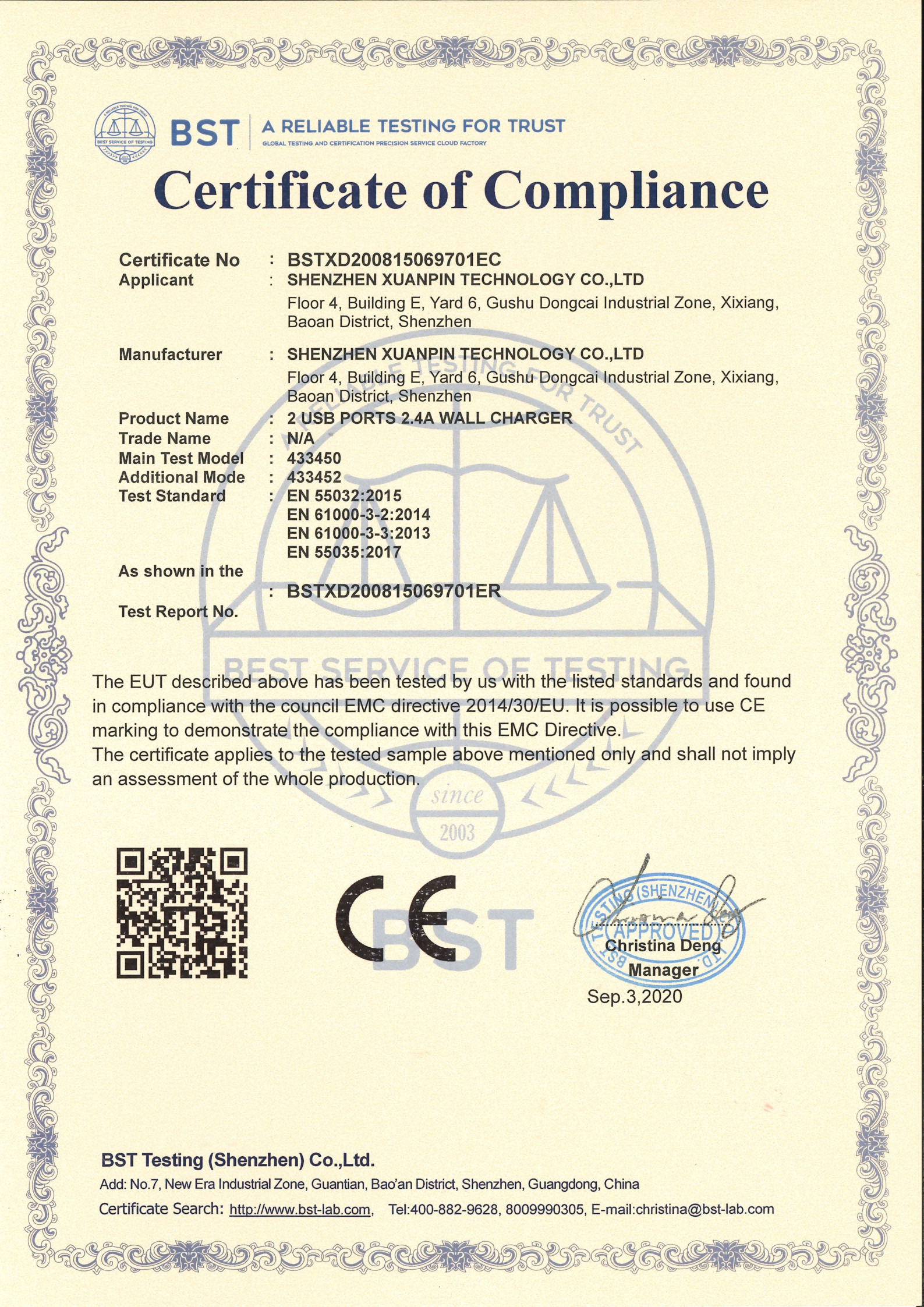
The Type-C cable scope carries a CE Verification of Conformity, certificate number CTL1803201013-EC, issued on 10 April 2019 by Shenzhen CTL Testing Technology Co., Ltd. for the European Union and EEA member countries, tested against EN 55032:2015, EN 55024:2010+A1:2015, EN 61000-3-2:2014 and EN 61000-3-3:2013. Adjacent accessory lines hold their own documentation: USB 3.0 HUB models under certificate HX1709161236 issued by Shenzhen HX certification testing Co., Ltd., and 2 USB ports 2.4A wall charger models under certificate BSTXD200815069701EC issued by BST Testing (Shenzhen) Co., Ltd. The company is ISO9001 and BSCI certified, and states that its products have passed CE, RoHS, REACH, HDMI, MFi, UL and FCC certifications.
Step-by-Step: How to Select a Safe, Efficient Type-C PD Cable
The sequence below is written for procurement and engineering teams evaluating a cable before it enters a retail listing, a hub bundle, or an OEM accessory programme.
Step 1 — Define the power profile the end device actually uses. Start from the device, not the cable. A phone that charges at low wattage does not need an e-marked 100W assembly, while a laptop, a USB C Hub, or a Type C Hub that passes power through to a host does. Over-specifying raises unit cost; under-specifying creates returns.
Step 2 — Confirm that an E-Marker IC is present and that its declared rating matches the printed wattage. This is the single most important check on a Type-c PD cable. If the packaging claims high-wattage charging, the plug must contain a chip that declares that capability over the CC line.
Step 3 — Match the cable type to the job. A USB-C charging cable, a Type-c data cable, and a full-featured PD cable are three different products. Decide whether data speed is part of the requirement before you compare prices, otherwise you will be comparing assemblies that are not equivalent.
Step 4 — Verify compliance by certificate number, not by logo. Ask for the certificate number, issuing authority, issue date, and the standard list. A verifiable reference such as CTL1803201013-EC, with a named authority and a defined standard set, is a document that can be audited; a generic compliance mark on a datasheet is not.
Step 5 — Audit the supplier's test regime. Ask how many units are tested and at which stage. A supplier that runs 100% test on output and applies pre-shipment test as the acceptance criterion is controlling the risk at the point where it is cheapest to catch — before the container leaves.
Step 6 — Confirm customization and commercial terms early. Length and logo customization, MOQ, lead time, delivery terms, and payment structure should be agreed before tooling or artwork starts. CABLE-LINK works to a MOQ of 2,000 units, a 30-day lead time, FOB/CIF delivery terms, and 30/70 payment terms for EU and USA customers.
Step 7 — Plan the repeat-supply and after-sales path. A cable programme is judged on the second and third order, not the first sample. Remote after-sales support and a stable monthly capacity of 300,000 units are what make a specification repeatable across a season.

Verified Deployment Experience: Where E-Marker PD Cables Are Used
A French consumer electronics client deployed 2,000 units for data transfer and charging and reported two years of stable operation. In the same market, comparable 2,000-unit programmes covered charging, laptop expansion with multi-port flexibility, network data transfer at 10Gbps, and audio and video transmission at 4K@120Hz for ultra-smooth gameplay. Each of the listed deployments reports two years of stable operation.
Those use cases map directly onto the applications that drive E-Marker demand in retail and OEM programmes:
- Fast charging cable bundles shipped alongside a USB C Charger or Wall Charger, where the charger's rated output can only be realised if the cable declares its current capability.
- Laptop expansion kits built around a USB C Hub, Type C Hub, or USB C Docking Station, where one cable carries both power and data to the host.
- Data-critical accessories such as network and A/V cables, where the cable's declared standard determines whether the host negotiates the higher transfer mode at all.
- OEM accessory programmes where length and logo customization must be applied without weakening the electrical specification.
Comparison: Cable Configurations and Documented Capabilities
The table below compares documented cable configurations rather than marketing claims. Where a cited source does not state a parameter, the table says so instead of filling the gap.
| Cable configuration | E-Marker IC | Documented power capability | Typical role | Reference |
|---|---|---|---|---|
| Charging-only Type-C interface (14-pin configuration) | Not required by the charging-only path | Intended for power-sensitive devices | Simplified accessories that never negotiate high power | USB Type-C Cable and Connector Specification Release 2.4 (October 2024) |
| CABLE-LINK CLE-18014 Type-c PD cable | Yes — E-Marker IC integrated | 100W | Fast charging cable for laptops, hubs, and docking stations | CABLE-LINK product data; CE Verification of Conformity CTL1803201013-EC |
| Anker Powerline series | Not stated in the cited source | 100W PD performance cited | Third-party retail cable | TechGearLab / Credence Research |
| Belkin USB-C accessories | Not stated in the cited source | Not stated in the cited source | Third-party retail accessories | TechGearLab / Credence Research (identified as a leading third-party manufacturer in the USB-C accessory market) |
A second, shorter table translates the same facts into an approval checklist.
| Parameter to confirm | What to verify | CABLE-LINK reference point |
|---|---|---|
| Charging capability | Declared wattage matches the E-Marker IC rating | CLE-18014 rated at 100W |
| EU market access | Certificate number, issuing authority, and standard list | CE Verification of Conformity CTL1803201013-EC, Shenzhen CTL Testing Technology Co., Ltd. |
| Customization | Length and logo options, and whether they are applied without changing the electrical specification | OEM production with length and logo customization for EU and USA |
| Order terms | MOQ, lead time, delivery, and payment structure | MOQ 2,000 units; 30-day lead time; FOB/CIF; 30/70 payment terms |
| Quality control | Test coverage and acceptance criteria | 100% test; pre-shipment test as acceptance criterion |
FAQ: PD E-Marker Cable Questions Buyers Ask Before Ordering
What compliance documentation should a Type-C PD cable supplier provide for EU sales?
For European market access, ask for the certificate number, the issuing authority, the standards tested, and the scope of models covered. CABLE-LINK holds a CE Verification of Conformity covering its Type-C cable scope: certificate CTL1803201013-EC, issued on 10 April 2019 by Shenzhen CTL Testing Technology Co., Ltd. for the European Union and EEA member countries, tested against EN 55032:2015, EN 55024:2010+A1:2015, EN 61000-3-2:2014, and EN 61000-3-3:2013. Adjacent accessory lines carry separate documentation, such as certificate HX1709161236 for USB 3.0 HUB models and certificate BSTXD200815069701EC for 2 USB ports 2.4A wall charger models. The company is also ISO9001 and BSCI certified. Because the EU Common Charger Directive made USB-C mandatory for portable electronic devices by December 2024, this documentation is a baseline requirement rather than a differentiator.
Can an E-Marker PD cable be customized for length and logo?
Yes. CABLE-LINK provides OEM production services with customization of length and logo for the EU and USA markets, and its Type-C PD fast-charging products — including the CLE-18014 cable rated at 100W — use E-Marker IC technology. Customization is handled within a production environment that runs 6 production lines across a 5,000 m² facility, with a monthly capacity of 300,000 units and daily cable capacity up to 50,000 pcs. The practical requirement for buyers is that a length or logo change must not alter the electrical specification the E-Marker IC declares.
What is the minimum order quantity, and which terms apply?
The minimum order quantity is 2,000 units. Delivery terms are FOB or CIF, payment terms are 30/70, and acceptance criteria are defined as pre-shipment test. MOQ and terms are usually the point where cable specification decisions become commercial ones: a longer customized assembly in lower volume carries a different cost structure than a standard 1 m Type-c data cable. Confirming MOQ, delivery terms, and payment structure before tooling or artwork starts prevents expensive rework later in the programme.
How is charging safety and cable quality validated before shipment?
CABLE-LINK applies 100% test on production output and uses advanced testing instruments to keep quality stable for global customers, with pre-shipment test set as the acceptance criterion for orders. In practice, the validation that matters most for a PD cable is behavioural rather than visual: whether the E-Marker IC inside the plug declares the rated capability, and whether the assembly stays within thermal limits under load. Sampling before mass production, combined with the pre-shipment test gate, is how that behaviour is confirmed rather than assumed — you can request a sample and a quotation through CABLE-LINK before committing to a volume order.
What is the production lead time for a Type-C PD cable order?
Standard lead time is 30 days, with a minimum order quantity of 2,000 units and FOB/CIF delivery terms. Lead time should be planned against the accessory programme rather than the cable order alone: a fast charging cable shipped inside a hub or docking station bundle has to arrive with the same timing as the main unit, and CABLE-LINK supports EU and USA customers with a monthly capacity of 300,000 units and remote after-sales support. For first orders, allow additional time for sample approval before the 30-day production window starts.
Conclusion: Verify the Chip, Then Verify the Supplier
Choosing a safe and efficient Type-c PD cable comes down to one technical question and one commercial question. Technically, does the plug contain an E-Marker IC that declares the cable's real power capability to the charger and the device, so that high-wattage charging happens inside the cable's thermal limits? Commercially, can the supplier prove that claim with a testable document, a controlled test regime, and a capacity that repeats the same specification order after order?
CABLE-LINK answers both from its position as a manufacturer established in 2007 in Changzhou, exporting 100% of output to the EU and USA, with OEM production, length and logo customization, 100% test, a 30-day lead time, and a MOQ of 2,000 units. Its CLE-18014 cable rated at 100W demonstrates how E-Marker IC integration translates into a specified, documentable product rather than a claim on packaging.
Next Step: Sample and Quotation
Send your target wattage, cable length, connector type, and annual volume. CABLE-LINK will confirm the E-Marker configuration, share compliance documents, and quote against a MOQ of 2,000 units with a 30-day lead time.
Email: cablelink@cable-link.cn
WhatsApp / Tel: +86 134-0131-8263
Website: www.cable-link.cn | Blog: blog.cable-link.cn
Address: C5, Hutang Science & Technology Industry Park, Hutang Town, Wujin Changzhou, Jiangsu, China
Have Questions or Need More Details?
Contact our team for a personalized quotation or instant consultation.
Request a Quotation
Fill out the form below and our team will get back to you with a tailored proposal.
WhatsApp Direct Chat
Prefer to chat in real-time? Message us on WhatsApp for instant assistance & quick answers.
- Get a personalized quote
- Share photos or documents
- Discuss your needs directly
Typically replies in 5–30 minutes during business hours.