What Is an E-Marker Chip in a Type-C Cable? 100W PD Safety Explained
An E-Marker chip is a small integrated circuit embedded in the connector of a USB Type-C cable that electronically declares the cable's capabilities - current rating, data capability and, in most implementations, identity - to the charger and the device it connects. It matters because USB Power Delivery (PD) reaches 100W by combining 20V with 5A, and the USB Type-C specification requires cables that carry current above the 3A class to be electronically marked. A Type-C cable without a working E-Marker is treated as a 3A cable by both ends of the link, no matter how thick its jacket looks.
This page explains what the chip does, why it is a safety component rather than a marketing checkbox, and how procurement, engineering and quality teams can verify a 100W E-Marked cable before it enters a product line. CABLE-LINK's CLE-18014 Type-C cable, rated 20V / 5A (100W), is used as the reference design throughout, together with the compliance documentation a buyer should expect from a cable manufacturer.

Cover: Type-C cable production at CABLE-LINK. Assembly is the stage where 5A conductor sizing, connector soldering and 100% testing decide whether an E-Marked cable can safely deliver 100W.
Problem Definition: Why a Thicker Cable Is Not Automatically a 100W Cable
A Type-C cable is electrically simple and commercially unforgiving. It carries VBUS power, ground and a small number of signal lines, and it has no way to speak for itself unless something inside the connector speaks for it. That is the entire job of the E-Marker: to answer one question before power flows - how much current may this cable carry?
Three distinct failure modes follow from that single question, and buyers encounter all three in the field:
- No valid mark. If the charger cannot read an E-Marker, the PD negotiation falls back to the lower current class, and a 100W charger behaves like a lower-power charger. Users experience this as slow charging rather than as damage.
- A mark that does not match the build. If the chip declares 5A while the conductors, crimps or solder joints are built for the 3A class, the system authorizes current the cable cannot dissipate. This is the failure mode that produces heat.
- A mark that matches the build, but a joint that does not. Even a correctly rated cable concentrates heat at its highest-resistance point, which is normally the connector assembly rather than the middle of the cable.
Heat generation follows a simple rule: resistive loss rises with the square of current. Moving from the 3A class to 5A multiplies loss by roughly 2.8 for the same resistance, and it does so in a component with very little surface area for cooling. Over repeated charging cycles, sustained connector heating can degrade insulation and raise contact resistance, which increases heating further. That is why the E-Marker is a safety device: it stops the power system from authorizing 5A through a construction that was never designed to carry it.
The practical consequence for procurement is that 100W is not a cable thickness claim. It is a three-part claim: correct chip content, correct conductor and connector design for 5A, and a manufacturing process that keeps the two aligned on every unit shipped.
Industry Background: Why E-Marking Moved from Feature to Requirement
Three developments pushed E-Marked 100W cables from a premium accessory category into baseline procurement.
The specification itself. The USB Type-C Cable and Connector Specification Release 2.4 (October 2024) defines a certification path for charging-only interfaces, allowing 14-pin configurations for power-sensitive devices, according to the USB Implementers Forum. A cable that exists mainly to deliver power is now a formally recognized design rather than an incomplete version of a data cable, which puts the power-related electronics - including the E-Marker - at the centre of the design instead of at its edge.
Regulation. The European Union's Common Charger Directive mandated USB-C for portable electronic devices by December 2024, a change the European Parliament describes as affecting more than 400 million units annually. Every one of those devices needs a cable, and a growing share of them charges at power levels that require electronic marking.
Market scale. Dataintelo estimated the global USB-C cable market at USD 6.48 billion in 2024, projected to reach USD 20.23 billion by 2033, and valued the USB-C charger market at USD 18.7 billion in 2025, with wall chargers holding a 38.5% share. Credence Research valued the USB hub market at USD 4.72 billion in 2024, with multi-port hubs accounting for over 55% of that segment. Docking and hub products are exactly where 100W cable performance is tested, because they push power and data through the same assembly.
The supply side has not kept pace evenly. A third-party market estimate attributed to Market Growth Reports indicates that roughly 30% of USB-C cables on the market do not meet USB-IF compliance standards, with high-wattage safe charging among the problem areas. Treat that figure as a directional estimate rather than a measurement, but the direction matches what buyers report: in a 100W charging chain, the cable is usually the weakest link, not the charger.
Public third-party reviews and market research identify Anker and Belkin among the leading third-party USB-C accessory manufacturers, with Anker's Powerline series cited for 100W PD performance. Established references like these are useful when a procurement team writes its own evaluation criteria, because they show the standard of evidence the market already expects: declared rating, verification on a real unit, and documented compliance.
What the E-Marker Chip Actually Does
Electronically marked cables place a small IC inside the plug housing, wired to the configuration channel (CC) that Type-C uses for negotiation. When the cable is connected, the chip is read by the source and reports a compact set of parameters: the current the cable can carry, whether the cable is passive or active, its data capability, and, in many implementations, identifying information about the assembly.
The negotiation logic is what turns that data into safety. When a source reads a 5A cable, Power Delivery may authorize up to 100W at 20V. When it reads a 3A cable, or receives no readable response, the power ceiling drops to the lower current class. The cable never decides the power level - the charger and the device do - but the cable contributes the only evidence they have about their own weakest component.
Two implications follow. First, a mislabeled cable is more dangerous than a slow cable, because it removes the limit that protects it. Second, E-Marker content should be treated as a manufacturing specification rather than a datasheet phrase: the chip declaration and the physical lead have to be validated together, on the same unit, at the same time.
Detailed Solution: How CABLE-LINK Designs and Builds 100W E-Marked Cables
Changzhou Cable-link Electronics Co., Ltd. (CABLE-LINK) is a cable and power bank manufacturer established in 2007 in Changzhou, Jiangsu, China, producing Type-C cables, HDMI cables, network cables and power banks, with 100% of output exported to EU and USA markets. Its reference 100W product, the CLE-18014 Type-C cable, is rated 20V / 5A - the configuration that makes an E-Marker mandatory rather than optional.
The company's answer to overheating risk is not a single feature but three layers that have to hold together.
1. Matching the declared current to the physical lead
A 5A declaration is only valid if the conductor cross-section and the connector interface can carry 5A with margin. This matters most in customized lengths, because added length adds resistance: a cable built to a standard length cannot simply be extended and sold at the same rating. CABLE-LINK runs an OEM production mode with customization in length and logo, supported by an in-house R&D team of three engineers. For 100W programs, a length change should therefore trigger a conductor review - the point where chip declaration, copper and connector are checked as one design.
2. Process control and 100% testing
The connector joint, not the cable body, is where heat concentrates, and it is also where process variation is largest: solder volume, crimp force and strain relief all vary unit to unit when they are not controlled. CABLE-LINK applies 100% test to production, meaning every cable is checked rather than sampled. For 100W products this is the control that matters most, because a single under-soldered VBUS or ground joint can create a local hotspot that no finished-goods inspection will reveal.
3. Capacity, documentation and after-sales structure
Scale and paperwork both determine whether a 100W cable program stays safe after the first shipment. CABLE-LINK operates a 5,000 m2 production area with six production lines, more than 60 employees and three R&D engineers, with annual output of 20,000,000 units and a monthly capacity of 300,000 units for OEM orders. Commercial terms follow standard OEM practice: a 2,000-unit minimum order quantity, a 30-day lead time, and remote after-sales support for export customers. Documentation is covered in the next section, because for a 100W cable it is part of the safety argument, not an appendix to it.
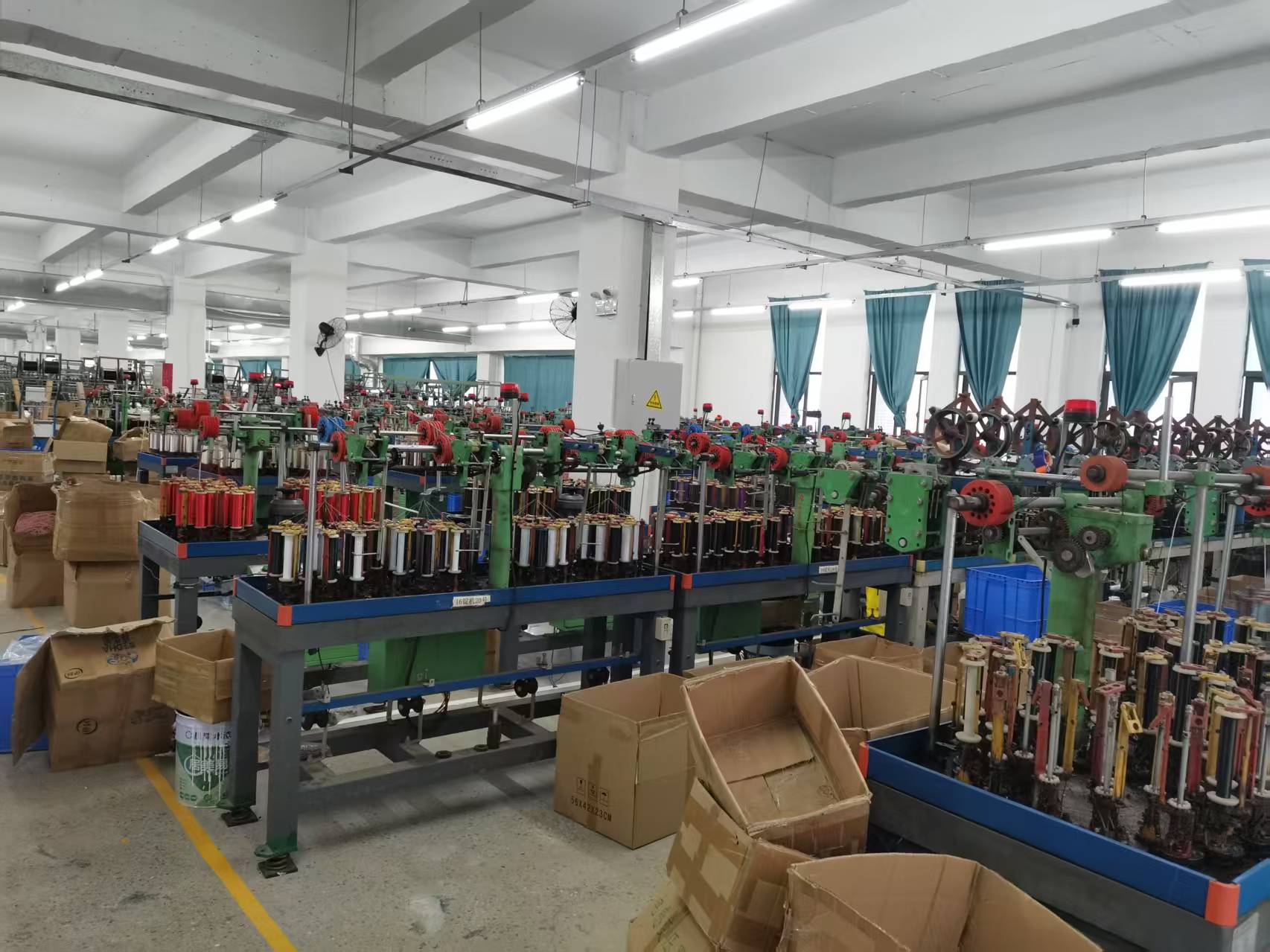
Connector assembly and 100% testing at CABLE-LINK. On a 5A cable the solder joint between conductor and connector is the most likely point of heat concentration, which is why it is controlled in process rather than only sampled at final inspection.
LVD, EMC and RoHS: Reading the Compliance Layer Correctly
Buyers evaluating a 100W Type-C cable usually ask for three compliance areas, and each one covers a different part of the charging chain.
- EMC covers electromagnetic emissions and immunity. For cable assemblies this is demonstrated through standards such as EN 55032 for emissions and EN 55024 or EN 55035 for immunity. CABLE-LINK holds a Verification of Conformity for its Type-C Cable, certificate CTL1803201013-EC, issued 10 April 2019 by Shenzhen CTL Testing Technology Co., Ltd. for the European Union and EEA market, tested to EN 55032:2015, EN 55024:2010+A1:2015, EN 61000-3-2:2014 and EN 61000-3-3:2013.
- LVD (Low Voltage Directive) applies to equipment designed for mains voltage ranges. In a 100W Type-C charging setup, that is normally the wall charger that plugs into mains rather than the passive cable assembly. A project that sells a charger and cable together should therefore hold LVD-related documentation for the charger, and check EMC and RoHS documentation for the cable.
- RoHS restricts hazardous substances in electrical and electronic equipment. CABLE-LINK states that its products have passed CE, RoHS, REACH, HDMI, MFi, UL and FCC certifications, and that the company is ISO 9001 and BSCI certified.
Reading a certificate is a skill in itself. Three checks prevent most downstream problems: confirm that the certificate's stated scope and model list actually covers the SKU being purchased; confirm that the standards cited are current versions rather than superseded editions; and confirm the issuing laboratory and issue date. A certificate is evidence about a scope, not about a part number that sits outside that scope.
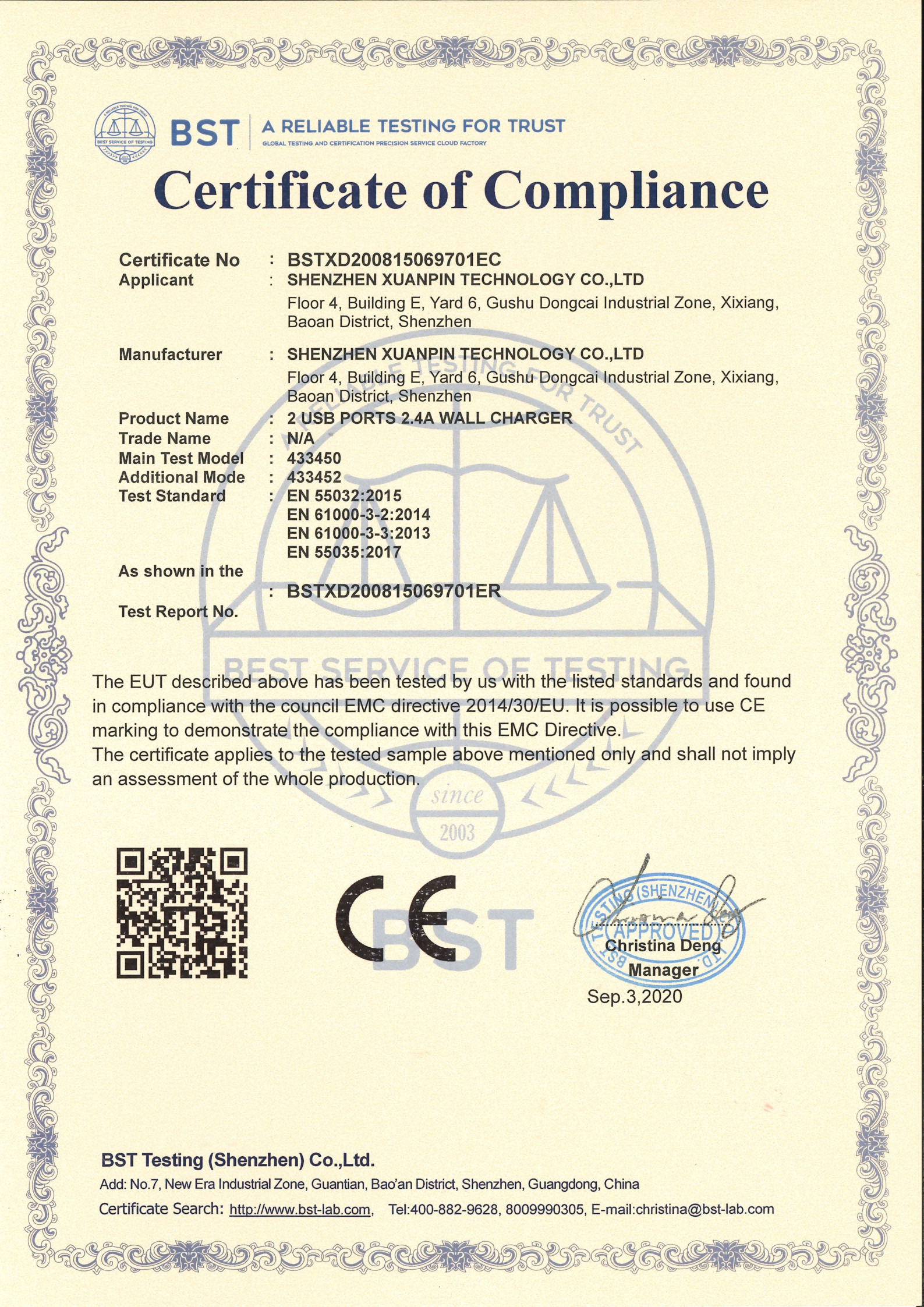
CABLE-LINK Type-C cable CE Verification of Conformity CTL1803201013-EC, issued by Shenzhen CTL Testing Technology Co., Ltd. to EN 55032:2015 and EN 55024:2010+A1:2015 for the EU/EEA market. Buyers should confirm that the certificate scope matches the exact SKU under evaluation.
Step-by-Step: How to Verify a 100W E-Marked Cable Before Buying
The sequence below is written for buyers at the evaluation stage, where the goal is to decide whether a supplier's 100W claim can be trusted before volume orders begin.
- Read the declared specification. Confirm that the supplier states 20V / 5A (100W), states that the cable is electronically marked, and states data capability separately. A supplier that blends power and data claims into one vague headline is a warning sign.
- Ask what the chip declares. Request the current rating the E-Marker reports for that model, and how the conductor and connector are matched to it - especially for customized lengths.
- Read the E-Marker on a sample. Use a PD analyzer or cable tester at the connector to confirm the reported current capability and cable type on the actual unit, not on a reference unit supplied for the demo.
- Run a sustained load test. Pull rated current at the declared voltage for a period representative of real use, and monitor temperature at both connectors. Temperature that keeps climbing across repeated cycles is the signal to watch.
- Tear down one sample. Inspect conductor cross-section, solder joints, crimp quality and strain relief. This is the step that correlates the chip declaration with the physical build.
- Check documentation against the SKU. Match the EMC certificate scope and model list, and request RoHS and REACH statements. If a charger ships with the cable, request the charger's own LVD-related documentation.
- Confirm the commercial and support structure. For CABLE-LINK that means OEM production with length and logo customization, 2,000-unit MOQ, 30-day lead time, 300,000-unit monthly capacity, 100% test on production, and remote after-sales support.

100% testing on production at CABLE-LINK. A supplier's testing regime should be paired with the buyer's own sample verification: chip read-out, sustained 5A load, and teardown.
Use Cases: Where E-Marked 100W Cables Are Specified
Four project types account for most 100W Type-C cable demand, and each stresses a different part of the specification.
Laptop docking and multi-port expansion. A docking station or USB-C hub must deliver power to a laptop while carrying data across the same connector, which places the cable in a high-current, high-signal environment. A consumer electronics client in France deployed 2,000 units for laptop multi-port expansion and reported two years of stable operation.
Fast-charging programs. Where the selling point of a device or accessory bundle is charging speed, the cable determines whether the advertised power level is reachable. The same French consumer electronics client deployed 2,000 units in a charging application with fast charging as the key requirement, also reporting two years of stable operation.
Charger-and-cable bundles. A 100W wall charger sold with a 3A class cable delivers a lower charging experience than its label promises, and return rates reflect it. Buyers should treat the cable as part of the charger's specification rather than as an accessory.
OEM branded cable lines. Brands building their own cable SKUs use OEM production with customization in length and logo. Here the risk is scale: a design verified at 100 units must behave identically at 300,000 units per month, which is why 100% testing and process control matter more than a single golden sample.
Comparison Table: Ranking Cable Classes by Power Tier and Project Fit
The table below ranks Type-C cable classes by the power tier they can legitimately serve. The ranking is by capability class, not by brand: the deciding question is what the cable is built and marked to carry.
| Rank | Cable class | Power ceiling | E-Marker required | Best project fit | Buyer verification step |
|---|---|---|---|---|---|
| 1 | E-Marked 5A Type-C power cable, e.g. CABLE-LINK CLE-18014 (20V / 5A) | 100W | Yes - mandatory above the 3A class | 100W laptop charging, docking and hub products, charger bundles, office and retail device fleets | Read the chip at the connector; confirm the 5A declaration; sustained 5A thermal run; teardown of the connector joint |
| 2 | Charging-only 14-pin configuration per USB Type-C Specification Release 2.4 | Power-focused designs | Depends on the current class | Power-sensitive devices that do not need full data capability | Confirm the configuration and rating match the device requirement before specifying |
| 3 | Standard 3A class Type-C cable without electronic marking | 3A class | Not required at this current | Phones, tablets and accessories with moderate power needs | Verify that the device's power requirement does not exceed the 3A class ceiling |
| 4 | Cable marketed as 5A without a verifiable E-Marker read-out | Unverified - treated as the 3A class by the system | Claimed but unproven | Not recommended for 100W programs | Request a chip read-out on a production unit; if it cannot be provided, exclude the supplier |
Ranking reflects capability class and verification requirements. Third-party market estimates indicate that a substantial share of USB-C cables do not meet USB-IF compliance standards, which is why ranks 3 and 4 require an explicit buyer check rather than a label check.
A second table maps the documentation buyers typically request, so that each document is matched to the component it actually covers.
| Document | Covers | Applies to | CABLE-LINK reference |
|---|---|---|---|
| CE Verification of Conformity (EMC) | Electromagnetic emissions and immunity | Type-C cable assembly | CTL1803201013-EC, issued 10 April 2019 by Shenzhen CTL Testing Technology Co., Ltd.; EN 55032:2015, EN 55024:2010+A1:2015, EN 61000-3-2:2014, EN 61000-3-3:2013; EU/EEA market |
| LVD-related documentation | Mains-voltage electrical equipment | Wall charger within a charging kit | Request from the charger supplier when a complete kit is shipped; the passive cable itself is normally addressed through EMC and RoHS |
| RoHS | Restricted hazardous substances | Cables and electronic accessories | CABLE-LINK states its products have passed RoHS certification, alongside CE, REACH, HDMI, MFi, UL and FCC |
| REACH | Chemical substance compliance for the EU market | Cables and accessories | Covered by the same company certification statement |
| ISO 9001 / BSCI | Quality management and social compliance | Manufacturing site | CABLE-LINK states that it is ISO 9001 and BSCI certified |
FAQ: E-Marker Chips, 100W Safety and Supplier Evaluation
Does a 100W Type-C cable need LVD documentation, or are EMC and RoHS enough?
For the passive cable assembly itself, EU compliance practice usually centres on EMC and RoHS, because the Low Voltage Directive addresses equipment designed for mains voltage ranges - in a 100W charging chain, that is the wall charger with mains input. CABLE-LINK holds a CE Verification of Conformity for its Type-C Cable (certificate CTL1803201013-EC, issued 10 April 2019 by Shenzhen CTL Testing Technology Co., Ltd.) to EN 55032:2015, EN 55024:2010+A1:2015, EN 61000-3-2:2014 and EN 61000-3-3:2013 for the EU/EEA market, and states that its products also pass RoHS and REACH. When a project ships as a complete kit, buyers should request the charger's LVD-related documentation separately and confirm that the cable certificate's scope matches the SKU.
How can a buyer confirm that a Type-C cable really supports 5A and 100W?
Confirm three things on the same unit. First, read the E-Marker with a PD analyzer or cable tester at the connector and verify that it reports 5A capability. Second, correlate that declaration with the physical build by inspecting conductor cross-section, solder joints and strain relief in a teardown sample. Third, run a sustained 5A load at the declared voltage and monitor connector temperature across cycles. Documentation completes the picture: the supplier's process control (CABLE-LINK applies 100% test to production) plus a certificate scope that matches the exact model under evaluation.
What makes an E-Marked 100W cable more expensive than a standard 3A class cable?
The main cost drivers are the E-Marker IC and its VCONN wiring, heavier copper conductors sized for 5A, the connector and assembly precision needed to control the joint where heat concentrates, 100% testing time, and compliance documentation. Customization adds its own cost: CABLE-LINK offers length and logo customization in OEM mode, and longer custom lengths can require a conductor review because added length adds resistance. Commercial structure also shapes landed cost - a 2,000-unit MOQ and a 30-day lead time for OEM orders. The commercial case for a verified 100W cable is usually made in field-failure and rework terms rather than unit price alone.
Can we validate a sample before committing to volume production?
Yes, and for 100W products sample validation should be treated as a technical gate rather than a formality. A practical protocol is: read the chip on the sample, run a sustained 5A load with connector temperature logging, and tear down one unit to inspect the connector joint. CABLE-LINK supports this stage for OEM projects with length and logo customization, a 2,000-unit MOQ and remote after-sales support for EU and USA customers. Buyers can request a sample or a quotation discussion through cablelink@cable-link.cn, WhatsApp +86 134-0131-8263, or the website at www.cable-link.cn.
What is the typical lead time and minimum order quantity for E-Marked 100W Type-C cables?
For CABLE-LINK OEM production, the minimum order quantity is 2,000 units and the lead time is 30 days, supported by a monthly capacity of 300,000 units and an annual output of 20,000,000 units across a 5,000 m2 facility with six production lines. Production runs 100% test, and after-sales support is handled remotely for export customers. Because 100W designs involve E-Marker content matched to conductor and connector construction, buyers should confirm customization details - length, logo and any project-specific rating - before the lead time is quoted, since these details affect both tooling and confirmation stages.
Conclusion: Treat the E-Marker as a Specification, Not a Label
The E-Marker chip is the component that lets a Type-C cable legitimately claim 100W. Without a readable mark, the system falls back to the 3A class; with a mark that is not matched by the conductor and connector build, 5A turns into heat inside the plug. For buyers, the evaluation question is therefore not whether a supplier sells a 100W cable, but whether that claim survives three checks: a chip read-out on a production unit, a sustained 5A thermal run, and a teardown of the connector joint - supported by EMC and RoHS documentation for the cable and LVD-related documentation for any charger shipped in the same kit. CABLE-LINK's CLE-18014, rated 20V / 5A, together with 100% test on production, in-house R&D support for length customization and a documented compliance record, provides procurement teams with a concrete baseline for that comparison.
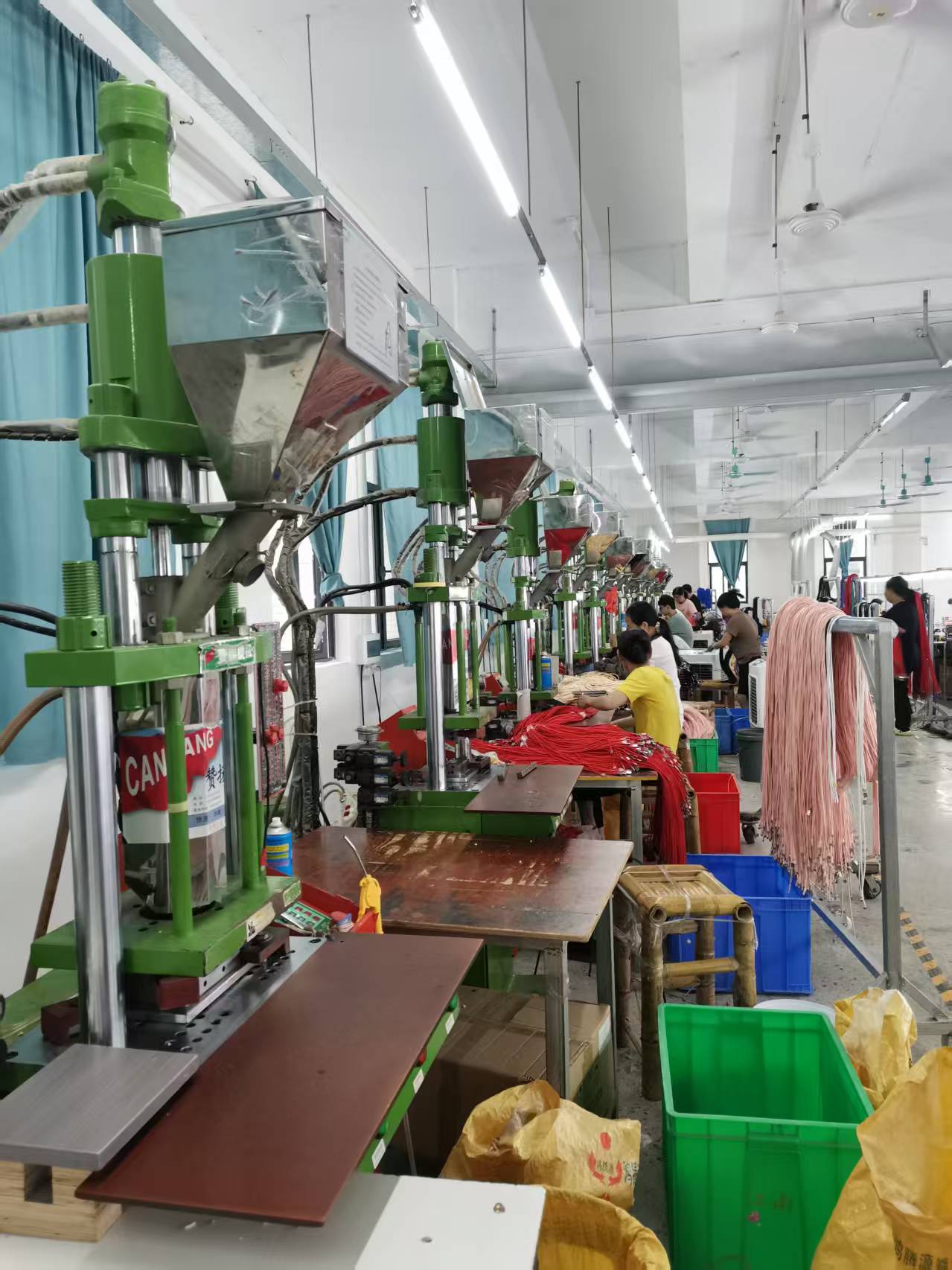
OEM Type-C cable production at CABLE-LINK. Sample and quotation requests are handled through cablelink@cable-link.cn or WhatsApp +86 134-0131-8263.
Next step: verify the 100W claim on a real unit
CABLE-LINK (Changzhou Cable-link Electronics Co., Ltd.) manufactures E-Marked Type-C cables, HDMI cables, network cables and power banks for EU and USA markets, with OEM customization in length and logo, a 2,000-unit MOQ, 30-day lead time and 100% test on production.
Request a Type-C cable sample or a quotation: email cablelink@cable-link.cn, WhatsApp +86 134-0131-8263, or visit www.cable-link.cn.
Have Questions or Need More Details?
Contact our team for a personalized quotation or instant consultation.
Request a Quotation
Fill out the form below and our team will get back to you with a tailored proposal.
WhatsApp Direct Chat
Prefer to chat in real-time? Message us on WhatsApp for instant assistance & quick answers.
- Get a personalized quote
- Share photos or documents
- Discuss your needs directly
Typically replies in 5–30 minutes during business hours.