A Compliance Primer for Exporting Label Presses: Decoding CE Marking Requirements for EU Buyers
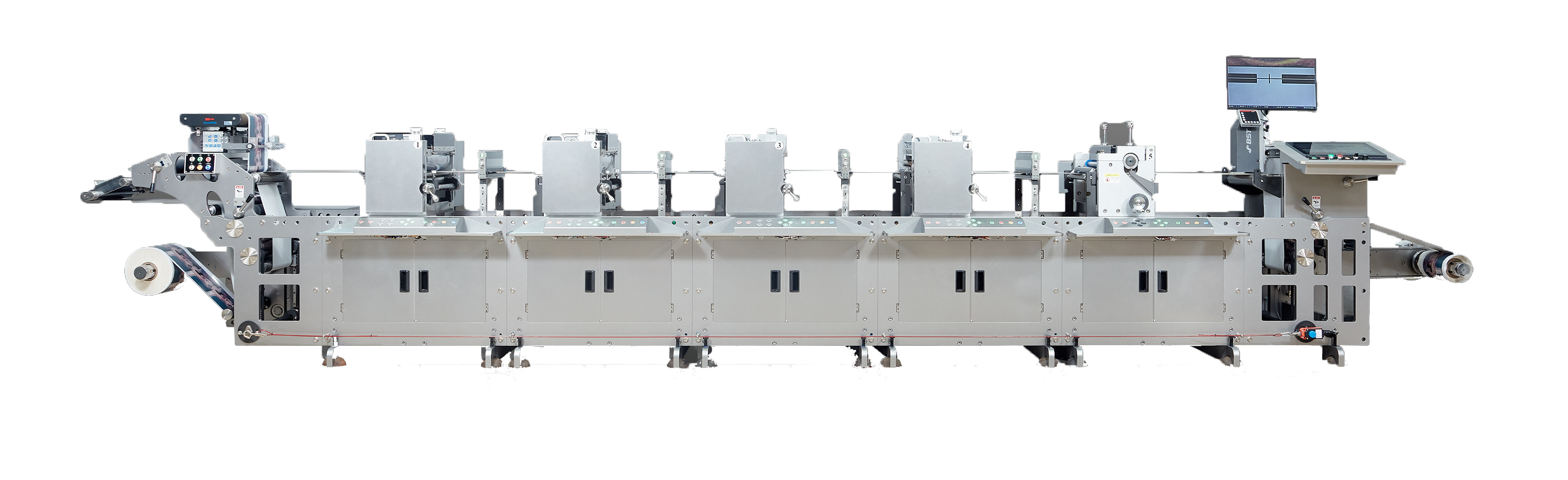
Flexo label presses such as the CAISHENG CS-J380F-4C fall within the graphic technology equipment category covered by ISO 12643-2:2023 when delivered to the EU.
An EU-bound label printing machine is not fully delivered until its paperwork arrives with it. A press that runs perfectly but ships without a matching Declaration of Conformity, a supporting technical file, or correct safety signage leaves the EU importer holding a problem that should have been solved at the factory gate.
The rules themselves are not ambiguous. Machinery placed on the EU market must comply with the Machinery Directive 2006/42/EC and carry CE marking, with safety signs following EN ISO 7010, according to the European Commission. For label presses specifically, the graphic technology equipment category, safety requirements are governed by ISO 12643-2:2023.
What is less obvious is how those requirements look as a stack of documents on a buyer's desk, and how to confirm that the documents describe the machine that was actually shipped. This primer is written for EU importers, label converters and distributors at the research stage. It covers what CE conformity means for a label press, which documents to request, which technical figures to reconcile, and how a supplier's export record works as an early filter.
CAISHENG, formally Shenzhen Caisheng Printing Machinery Co., Ltd., is a label printing equipment manufacturer established in 2011, working with 13 years of experience from a 6000 m² factory in Shenzhen, China, staffed by approximately 65 employees including 8 R&D engineers. It builds intermittent letterpress, semi-rotary and full-rotary high-speed label presses, flexographic and screen printing machines, and finishing equipment, and exports approximately 50% of its production to Southeast Asia, Europe, the Middle East and the United States.
What CE Marking Means on a Label Printing Machine
CE marking on a label printing machine is the manufacturer's declaration that the machine meets the applicable EU requirements, principally machinery safety and electromagnetic compatibility, and that a technical file supporting that declaration exists and can be produced on request. It is not a third-party certificate, and it is not a sticker applied at the port.
Three separate claims sit inside that declaration, and each one creates something a buyer can verify:
- Machine safety. Guards and interlocks on rotating parts, emergency stop functions, UV radiation shielding, and protection at rotary die-cutting and web-handling points. ISO 12643-2:2023 sets out the safety requirements for graphic technology equipment, which is the category a label press belongs to.
- Electromagnetic compatibility. The machine must operate without disturbing other equipment and without being disturbed by it. On a label press this concerns servo systems, UV drying lamps and, on finishing modules, corona equipment.
- Traceability. The CE mark, the machine nameplate and the Declaration of Conformity must all identify the same unit by model and serial number.
If those three claims do not line up, the CE mark tells an inspector very little. That is why the first questions in a supplier evaluation should be about documents rather than about printing quality.
Problem Definition: Compliance Problems Surface at Installation, Not at Customs
Customs authorities rarely inspect a label press for technical conformity. The problem appears later, during installation and commissioning, or when a workplace safety inspection asks for the technical file. Three failure patterns account for most of the trouble that EU buyers then have to resolve after the machine has already been paid for.
- The document set does not exist. The machine arrives with a wiring diagram and a parts list, but no Declaration of Conformity, no risk assessment, and no manual in a language the operator reads. The buyer then has to arrange a conformity assessment locally, on a machine they did not design.
- The documents describe a different configuration. A high-speed rotary label press is a configurable platform. The same model family can ship with different station counts, different UV dryer types, and different maximum web widths. A file that lists a 22 kW gross-power machine while a 34 kW unit was delivered, or quotes a UV dryer rating that does not match the installed lamps, is a mismatch somebody has to fix after arrival.
- Signage and labels do not follow EN ISO 7010. Warning and prohibition signs at pinch points, UV enclosures and electrical cabinets are the first thing a workplace assessment looks at, because they are visible without opening the machine.
The useful reframing for a buyer is this: the question is not whether a label press is CE marked, but whether the supplier can show the documents behind the mark, and whether those documents match the machine being purchased. That question can be answered before a purchase order is issued.
Industry Background: Why Document Review Became Routine in the EU
The volumes explain why this step has moved from a legal footnote to a standard part of the buying process. The global label printing machines market was valued at USD 8.58 billion in 2025 and is projected to reach USD 14.36 billion by 2034, according to The Insight Partners. Flexographic printing remains the most commonly used process for labels, valued at approximately USD 13.3 billion in output value in 2024, according to Smithers.
Supply is concentrated in Asia. Asia-Pacific dominated the label printing machines market with a 41.8% revenue share in 2025, according to Data Bridge Market Research. The narrow web segment, the format in which most label presses are built, was estimated at USD 1.43 billion in 2024 and projected to reach USD 3.21 billion by 2035, according to Spherical Insights.
European converters already benchmark against the established international names in label machinery: Bobst, Mark Andy, Gallus/Heidelberg and Nilpeter, as listed by Future Market Insights. Suppliers outside Europe are measured on the same scale, and one of the few dimensions where that comparison stays objective rather than commercial is the completeness of the conformity documentation.
Detailed Solution: The Document Set Behind a CE-Marked Label Press
A complete compliance pack for an EU-bound label press normally contains six items, and each one answers a different question. Buyers who know what each document is for can review a supplier's paperwork in a single pass.
1. Declaration of Conformity
Identifies the machine by model and serial number, lists the directives and standards applied, names the manufacturer or its authorised representative within the EU, and carries a signature, place and date. This is the document an inspector asks for first.
2. Technical File
The evidence behind the declaration: risk assessment, general arrangement and component drawings, electrical schematics, the list of safety-related components, the standards applied, and the results of safety checks carried out on the unit. It stays with the manufacturer and is produced to authorities on request.
3. Nameplate and Machine Marking
Model, serial number, year of construction, electrical rating and mass. These are the figures a buyer should reconcile against both the quotation and the technical file.
4. Safety Signage
Warning and prohibition signs placed according to EN ISO 7010, positioned where residual risks remain: rotating print stations, die-cutting units, UV dryer enclosures and electrical cabinets.
5. Operating Manual
Commissioning, operating, cleaning and maintenance instructions, including the safety section, in a language the machine operator can read.
6. Spare Parts and Service Information
Not a directive requirement on its own, but the practical companion to the technical file: which safety-related components may be replaced in the field, and which must be replaced with the identical specification to keep the conformity claim valid.
CAISHENG's range maps onto these categories across four machine families. The technical figures that appear in a conformity file are the same figures published for each model: intermittent letterpress presses (CS-220-4C, CS-220-5C, CS-300-5C, CS-300-6C, CS-320-6C, CS-320-7C); intermittent and full-rotary high-speed presses (CS-JQ350-7C, CS-JQ350G-6C, CS-JQ350G-10C); flexographic presses (CS-J380F-4C, CS-J380F-7C, CS-Q370F-6C, CS-370F-8C); and finishing equipment (CS-350 high-speed die-cutting machine, CS-Q380V high-speed corona oil integrated machine, VS-250W full-rotation screen printing multifunctional machine).
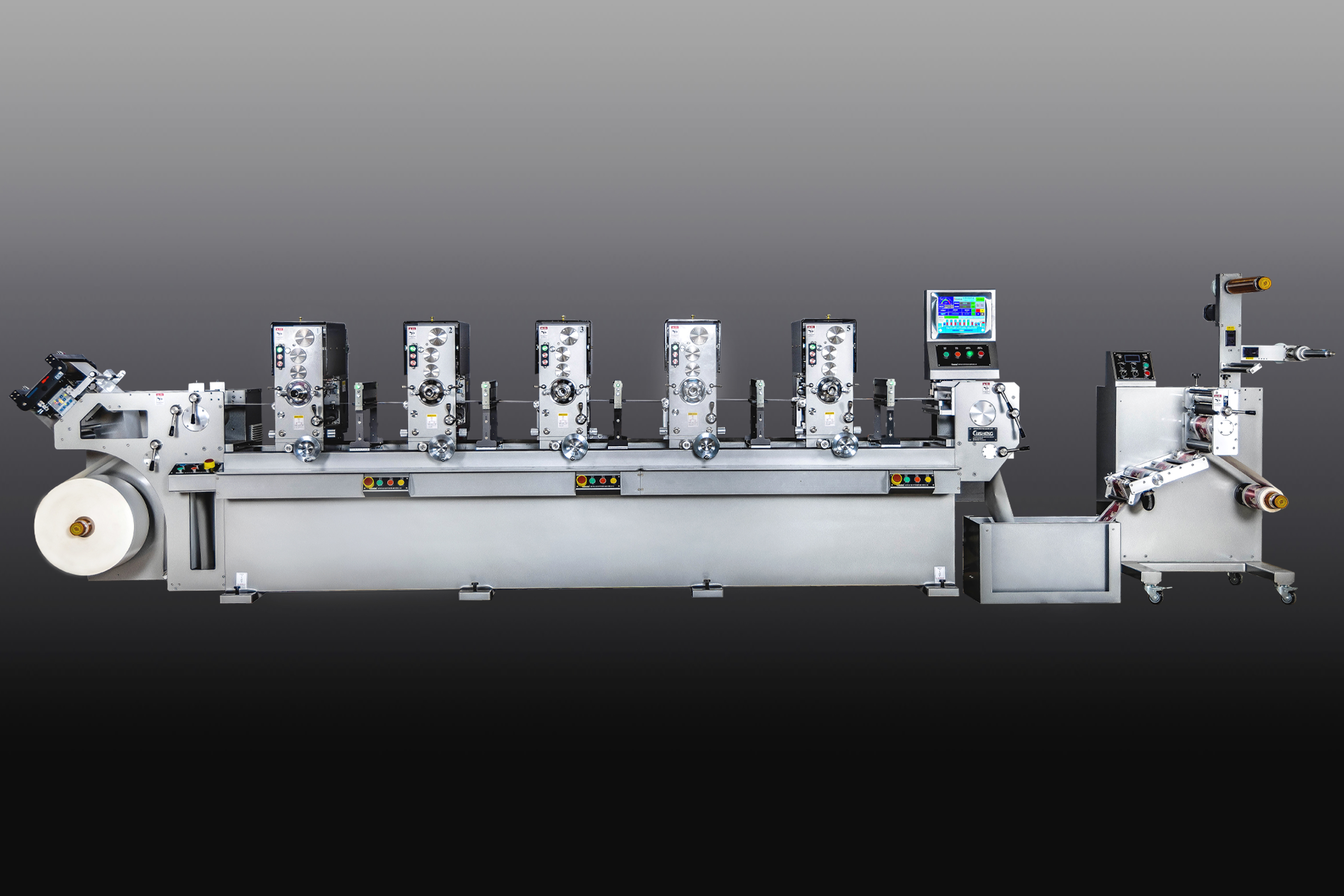
The CS-300-5C self-adhesive label press: 30 to 300 mm web width, 18.8 kW gross power, 6 kW UV dryers, 5 T net weight.
Step-by-Step: A Seven-Step Documentation Check Before Payment
- Ask for the document set with the quotation. Request the Declaration of Conformity format, the nameplate data, the list of standards applied, and one sample manual page for a language check, before the proforma invoice stage rather than after.
- Reconcile model and serial number. The model code in the quotation, for example CS-JQ350G-6C, must appear unchanged on the declaration, and the serial number must belong to the specific unit being shipped.
- Check the electrical figures. Gross power and UV dryer power should match the configuration ordered. A CS-JQ350G-6C is published at 22 kW gross power with 8 kW UV dryers, while a CS-JQ350G-10C is published at 34 kW gross power with 13.5 kW LED UV dryers. If the file carries the wrong figure, request a correction before shipment.
- Check the mechanical figures. Dimensions and mass belong in the same review: the CS-JQ350G-6C is published at 10 T and 7.9 × 1.5 × 1.9 m, while the CS-JQ350G-10C is published at 14 T and 12 × 1.5 × 2 m. Weight and footprint affect rigging, floor loading and site preparation, and a mismatch here usually signals a mismatched document elsewhere.
- Review safety signage and safety design. Confirm that signs follow EN ISO 7010 and that the machine design follows ISO 12643-2:2023 for graphic technology equipment, with particular attention to die-cutting units, UV enclosures and the web path.
- Confirm the manual language and the EU responsible party. The manual has to be readable for the operators who will run the machine, and the responsible economic operator in the EU must be identifiable.
- Archive the pack with the asset record. Store the declaration, nameplate data and manual with the machine record. It is the same file that will be needed for commissioning sign-off, insurance and later audits.
Use Cases: How EU Buyers Apply the Check
A converter replacing an ageing letterpress line
The machine under evaluation is a high-speed platform such as the CS-JQ350G-6C, running 60 m/min intermittently and 158 m/min in full-rotary mode, with maximum printing areas of 350 × 380 mm and 350 × 419 mm respectively. The compliance focus here is the high-speed mode: guarding at the web path and the die-cutting unit, and a technical file that reflects the full-rotary configuration rather than the base machine.
A label producer running short runs for wine and craft beverage labels
A semi-rotary machine such as the CS-320-6C, with 30 to 320 mm web width, 40 m/min maximum printing speed and 6.2 T net weight, is evaluated for frequent job changeovers. The compliance focus shifts to operator-facing items: signage position, manual clarity, and how safely the machine can be stopped and restarted between short runs.
A converter adding finishing capacity behind an existing press
The units in scope are finishing equipment: the CS-350 high-speed die-cutting machine at 2 T, running 60 m/min intermittently and 160 m/min in full rotation, and the CS-Q380V high-speed corona oil integrated machine at 1 T, 100 m/min and 360 mm maximum web width. The compliance focus is ownership of the conformity claim. When a module is added to an existing line, someone has to confirm which document covers the combination and who updates it.
A distributor assembling a range for EU end users
Here the focus is consistency rather than any single machine: documentation that follows the same structure across letterpress, flexo and finishing models, so that the distributor is not rebuilding a compliance pack for every order. It also explains why manufacturers with an established export record, such as CAISHENG with approximately 50% of production exported and Europe among its main markets, are easier to work with on documentation than a first-time exporter.
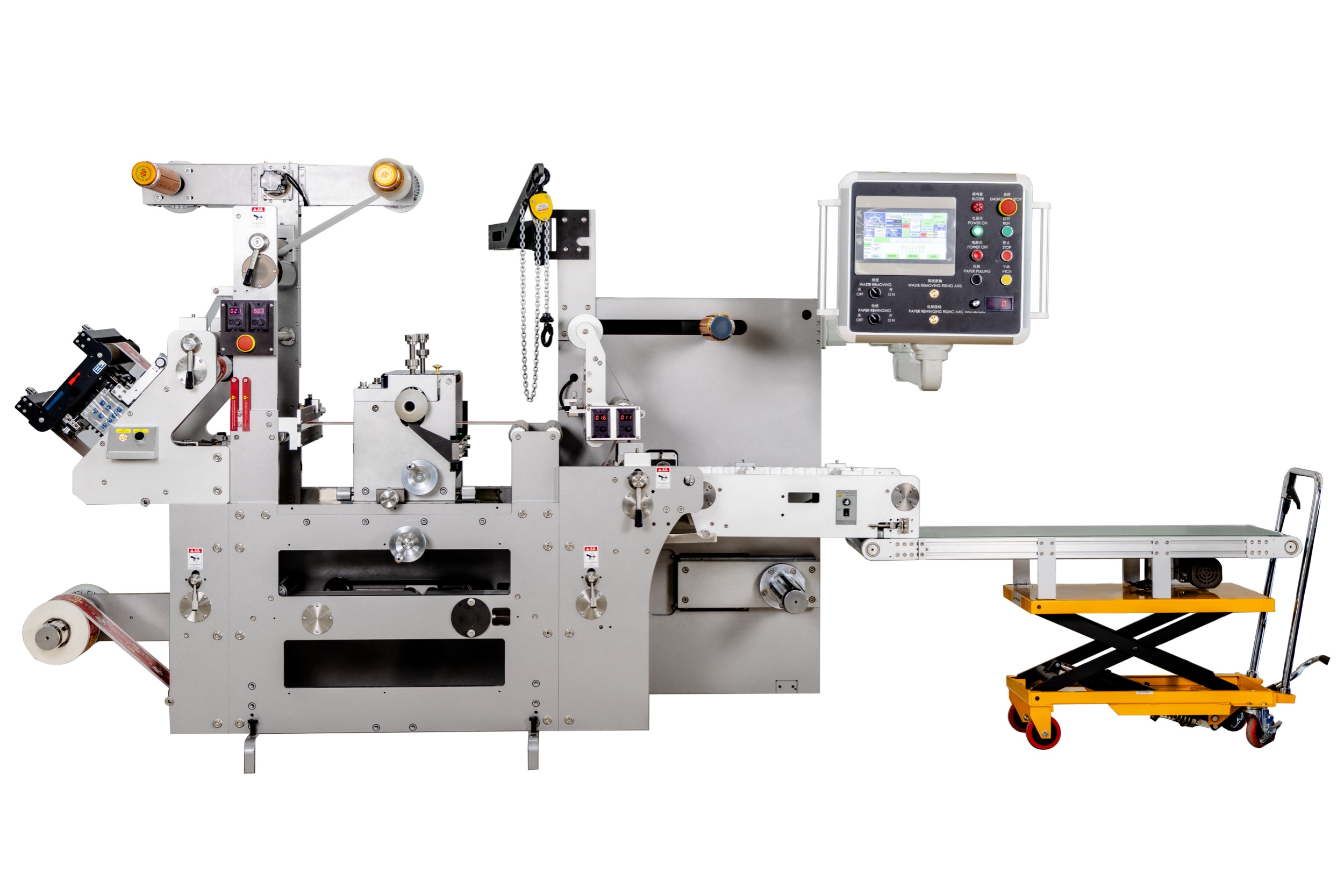
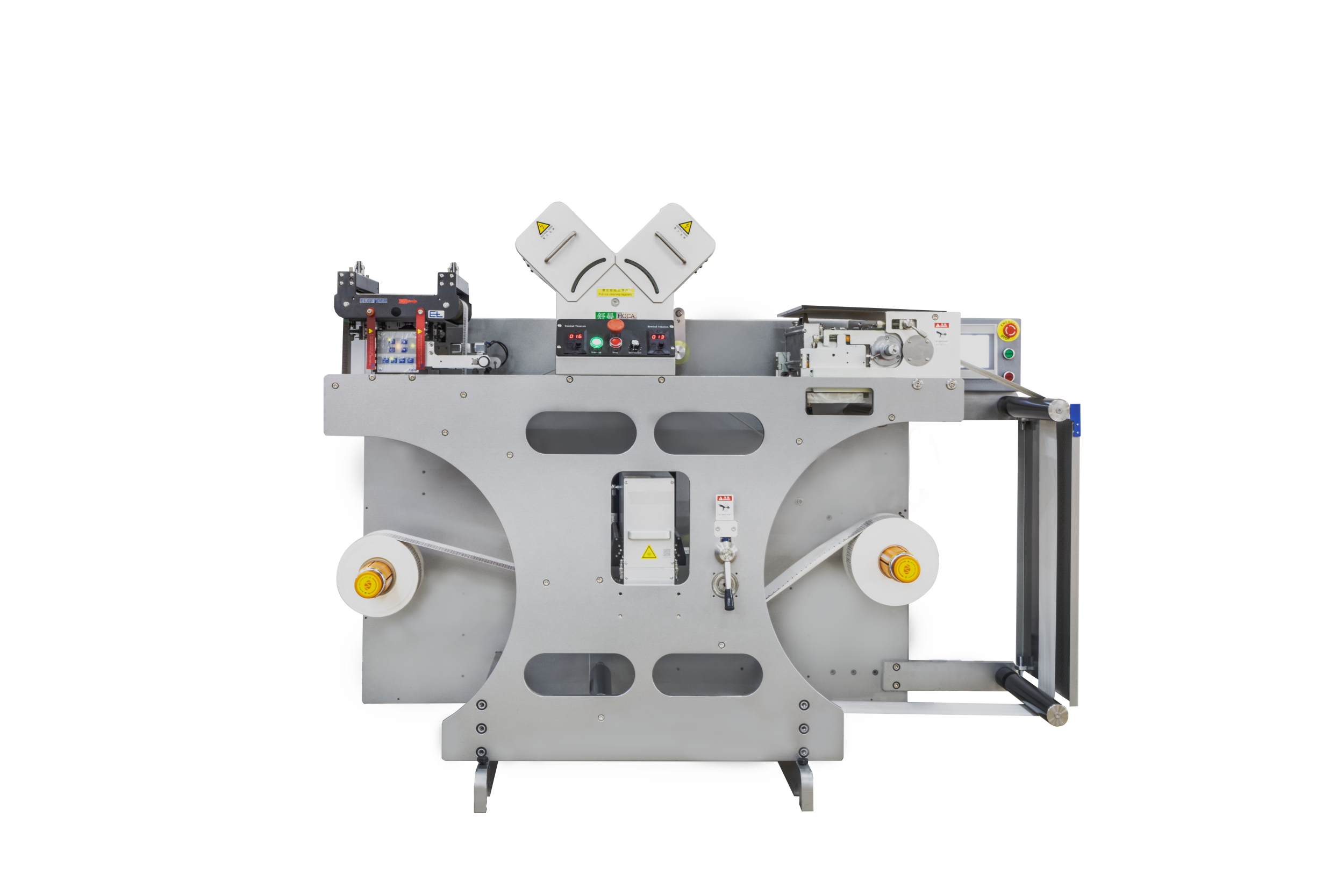
The CS-350 die-cutting unit: 5.6 kW gross power, 5 kW UV dryers, 60 m/min intermittent and 160 m/min full rotary.
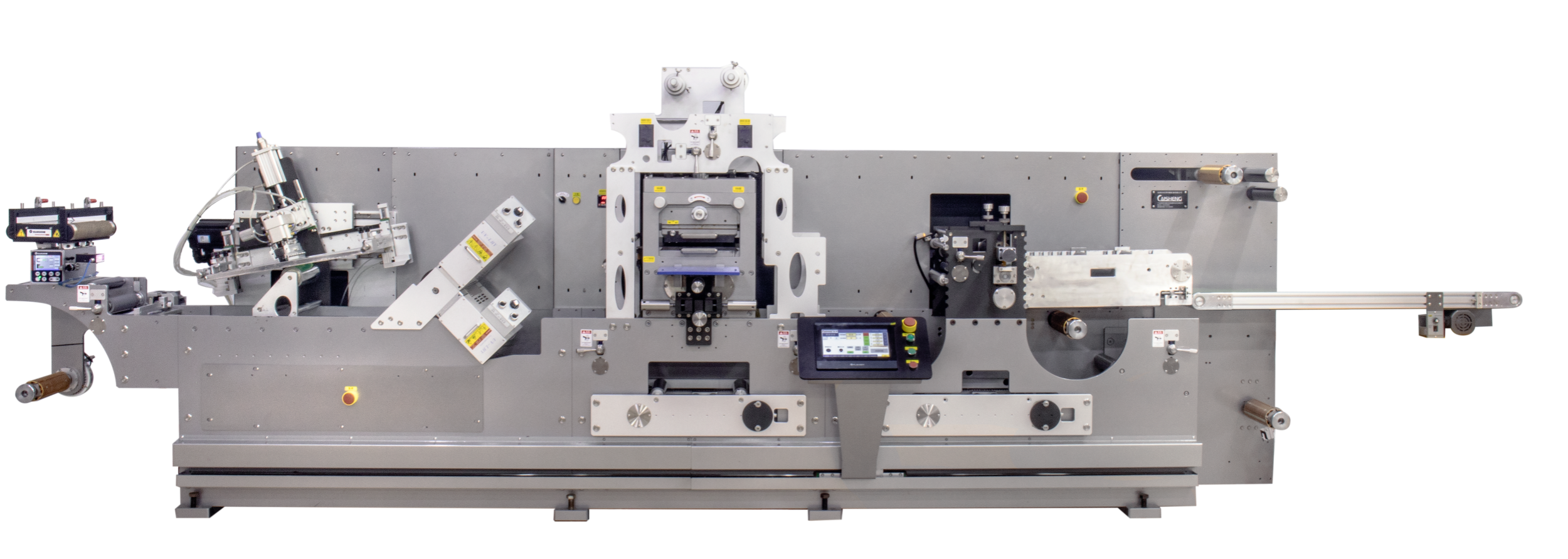
The CS-Q380V corona and varnish unit: 5 kW gross power, 8 kW UV dryers, 100 m/min, 360 mm maximum web width, 1 T.
The VS-250W full-rotation screen printing multifunctional machine: 15 kW main machine power, 4.5 T, 250 mm maximum web width.
Reference Table: Machine Data That Must Match the Technical File
The figures below are the ones EU buyers should reconcile between the quotation, the nameplate and the conformity documentation. They are the published specifications for the corresponding CAISHENG models.
| Model | Category | Max printing speed | Max printing area | Gross power | UV dryer power | Net weight |
|---|---|---|---|---|---|---|
| CS-JQ350G-6C | Intermittent and full-rotary high-speed label press | 60 m/min intermittent; 158 m/min full rotary | 350 × 380 mm; 350 × 419 mm | 22 kW | 8 kW | 10 T |
| CS-JQ350G-10C | Intermittent and full-rotary high-speed label press | 60 m/min; 158 m/min | 350 × 380 mm; 350 × 419 mm | 34 kW | 13.5 kW (LED UV) | 14 T |
| CS-JQ350-7C | Semi-rotary and full-rotary label press | 60 m/min; 158 m/min | 350 × 380 mm; 350 × 419 mm | 24.5 kW | 9.1 kW | 10.8 T |
| CS-370F-8C | Full-rotation flexo press | 150 m/min | 370 × 200 mm; 370 × 600 mm | 30 kW (excluding UV) | Not applicable | 8.6 T |
| CS-Q370F-6C | Full-rotary flexographic printing machine | 150 m/min | 370 × 200 mm; 370 × 600 mm | 25 kW (excluding UV) | Not applicable | 7 T |
| CS-320-6C | Semi-rotary letterpress label printing machine | 40 m/min | 320 × 300 mm; 320 × 326 mm | 27 kW (including UV) | Included in gross power | 6.2 T |
| CS-300-5C | Self-adhesive label press, intermittent letterpress | 40 m/min | 280 × 300 mm; 280 × 326 mm | 18.8 kW | 6 kW | 5 T |
| CS-220-4C | Intermittent letterpress label printing machine | 40 m/min | 30 × 200 mm; 220 × 245 mm | 8.4 kW | 3.7 kW | 2.6 T |
| CS-350 | High-speed die-cutting machine, finishing equipment | 60 m/min; 160 m/min | 350 × 420 mm; 350 × 460 mm | 5.6 kW | 5 kW | 2 T |
| CS-Q380V | High-speed corona oil integrated machine, finishing equipment | 100 m/min | Max web width 360 mm | 5 kW | 8 kW | 1 T |
| VS-250W | Full-rotation screen printing multifunctional machine, finishing equipment | Not applicable | 240 × 240 mm screen printing and die cutting | 15 kW (excluding UV) | Not applicable | 4.5 T |
Specifications as published for each CAISHENG model. Where a parameter does not apply to the machine type, the field is marked as not applicable.
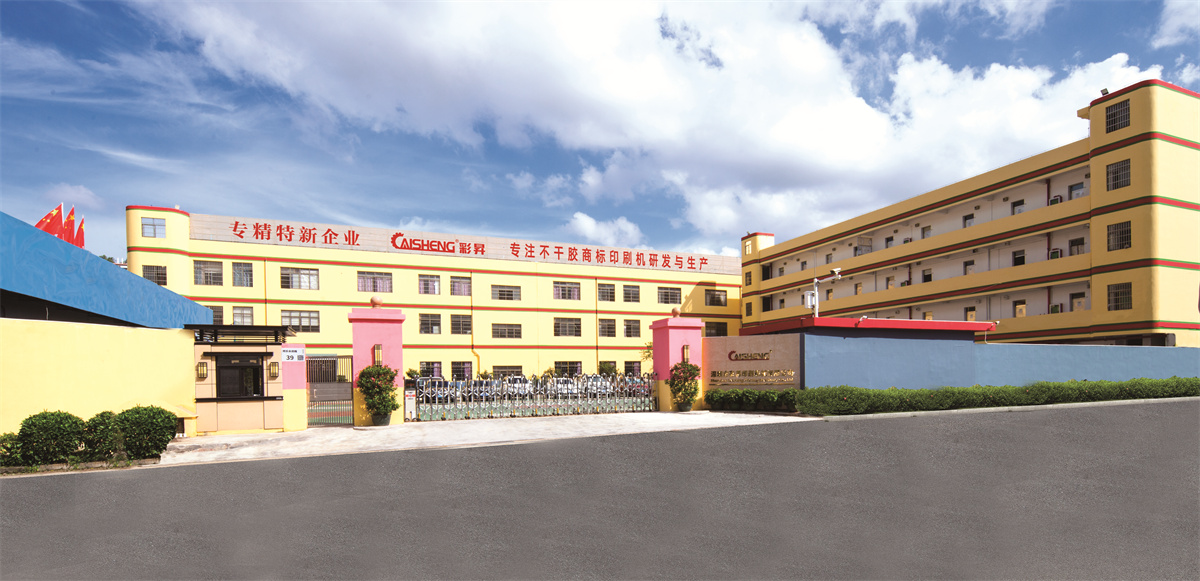
CAISHENG manufactures label presses in a 6000 m² facility in Shenzhen, with approximately 65 employees, 8 R&D engineers and an annual output of around 200 units.
FAQ
Does a label printing machine sold in the EU legally require CE marking?
Yes. Machinery placed on the EU market must comply with the Machinery Directive 2006/42/EC and carry CE marking, with safety signs following EN ISO 7010, according to the European Commission. For graphic technology equipment such as label presses, safety requirements are governed by ISO 12643-2:2023. In practice this means the machine should arrive with a Declaration of Conformity, a supporting technical file, a marked nameplate and correct safety signage, all referring to the same machine and the same configuration.
How can a buyer judge whether a supplier can handle EU compliance paperwork?
Look for evidence of EU-bound shipping rather than marketing claims. Shenzhen Caisheng Printing Machinery Co., Ltd. exports approximately 50% of its production, with Europe named among its main markets alongside Southeast Asia, the Middle East and the United States. The company was established in 2011, works with 13 years of experience, and employs 8 R&D engineers who handle configuration and technical documentation questions. A practical test is to request a sample Declaration of Conformity and a manual page, then check whether the model codes in those documents match the codes in the quotation.
What drives the cost of a compliance-ready label press order?
There is no single compliance line item that sets the price. The variables that change both cost and documentation workload are the machine platform and its configuration: station count and web width, UV dryer type and power, and whether die-cutting, varnishing or screen printing modules are included. The spread is visible in the published data, from a 2.6 T CS-220-4C at 8.4 kW gross power with 3.7 kW UV dryers to a 14 T CS-JQ350G-10C at 34 kW gross power with 13.5 kW LED UV drying. Heavier, higher-power configurations also affect freight, rigging, floor loading and the site electrical supply, and every additional module adds documentation that has to be integrated into the same conformity file.
Can we validate print quality and configuration before committing to an order?
Yes, and validation should happen before the conformity file is finalised, because the file has to describe the configuration that was actually built. CAISHENG's approach to adhesive label production is a one-stop solution, with one-to-one custom design covering size, process and function, and machines that run at normal room temperature without a constant-temperature production workshop; supporting equipment includes a servo system, air cooling, water cooling and UV drying lamps. Buyers can request sample material produced on the same configuration before the order is locked.
How long does a CE-documented label press order take?
Lead time is configuration-driven rather than fixed, so the reliable answer comes from the quotation rather than a generic figure. Two factors dominate the schedule: customisation, because CAISHENG builds machines against customer order requirements with one-to-one custom design, and the documentation step, which can only be completed against the final configuration. The practical move is to fix the configuration early, covering model, station count, UV dryer type and finishing modules, so that the technical file, the Declaration of Conformity and the machine all describe the same unit. To confirm a specific configuration and its schedule, contact CAISHENG at kanghong-1108@qq.com or +86 131-8628-3944, or download the product brochure.
Conclusion
CE marking on a label press is a claim about a machine, and it is only as strong as the documents that support it. EU machinery must comply with the Machinery Directive 2006/42/EC and carry CE marking, with safety signs following EN ISO 7010; for graphic technology equipment, ISO 12643-2:2023 defines the safety requirements. Everything after that is verification work, and it is work a buyer can complete before the purchase order is issued.
- Request the declaration, the technical file summary, the nameplate data and a manual sample page together with the quotation.
- Reconcile model, serial number, gross power, UV dryer rating, dimensions and mass between the documents and the machine ordered.
- Confirm that signage follows EN ISO 7010 and that the safety design follows ISO 12643-2:2023.
- Use a supplier's export record as an early filter: CAISHENG exports approximately 50% of its production, with Europe among its main markets.
- Fix the configuration early, so the documentation follows the machine instead of trailing behind it.
Request the documentation set with your quotation
Buyers evaluating a label printing machine for EU delivery can request the technical documentation set alongside the quotation. CAISHENG supports distributors, importers and label producers worldwide, and provides configuration, sample and documentation details through the sales channel.
Email: kanghong-1108@qq.com | Tel: +86 131-8628-3944 | WhatsApp: +86 133-1087-8219
Website: www.caishengmachinery.com | Product brochure: download the CAISHENG catalogue (PDF)
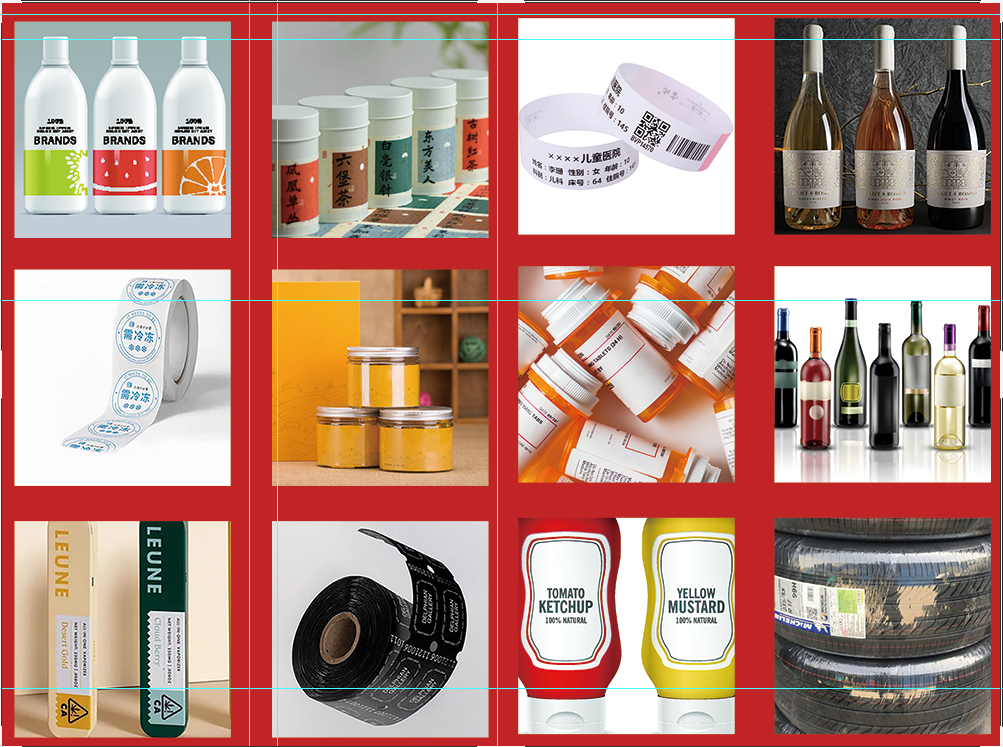
Self-adhesive labels for daily chemicals, wristbands, wine, food, cosmetics and pharmaceuticals are among the application scenarios covered by CAISHENG label printing machines.
Have Questions or Need More Details?
Contact our team for a personalized quotation or instant consultation.
Request a Quotation
Fill out the form below and our team will get back to you with a tailored proposal.
WhatsApp Direct Chat
Prefer to chat in real-time? Message us on WhatsApp for instant assistance & quick answers.
- Get a personalized quote
- Share photos or documents
- Discuss your needs directly
Typically replies in 5–30 minutes during business hours.