CE Due Diligence Checklist for Label Printing Machines
CE compliance for a label printing machine is a document-and-scope question, not a sticker on the frame. Before a deposit, a buyer needs four things: a current conformity document, a scope that names the model being purchased, technical evidence covering the configuration as ordered, and a pre-shipment test showing the delivered machine matches that evidence. Each link can be checked in a few working days, and each one fails in a predictable way.
This checklist is written for importers and label converters sourcing in Europe, Southeast Asia, the Middle East and the United States. It sets out what to request, how to read what arrives, and where die-cutting configuration changes the answer. CAISHENG — Shenzhen Caisheng Printing Machinery Co., Ltd. — is used as the worked example: a label printing equipment manufacturer established in 2011, with a 6,000 m² facility, 65 employees and an eight-engineer R&D team, exporting about 50% of its sales to Southeast Asia, Europe, the Middle East and the United States. The checks themselves apply to any supplier.
One boundary before starting: this is a procurement guide, not a legal opinion. What your company must hold, and who is responsible for holding it, is a question for your compliance function or the relevant market authority.
Why CE checks fail on label presses
Three failure patterns account for most of the trouble buyers meet after the machine has shipped.
The document is treated as a brand statement. "Our machines are CE certified" is a statement about a range of products. A purchase order is a statement about one machine: a specific model, a specific number of printing units, a specific die-cutting arrangement and a specific list of finishing modules. The gap between the two is where due diligence has to happen.
The configuration moves after the document was issued. Label presses are configured, not catalogued. Caisheng's customization list covers colour stamping, glue-side printing frames, cold foil stamping, lamination, varnishing, flatbed die-cutting, rotary die-cutting, sheet cutting, slitting, a corona treater, dust cleaning, static elimination, full-rotary screen printing, hot foil stamping and embossing. Every one of those modules is part of what the machine does, so the machine that was assessed and the machine on your quotation need to be the same machine.
Validity is not tracked. Conformity documents carry issue and expiry dates. A copy saved at quotation stage and filed without a note becomes stale quietly, and the gap is usually discovered during an audit or a customer qualification rather than at a convenient moment.
A workable definition. For procurement purposes, treat CE compliance as a chain of four links: (1) a current conformity document; (2) a scope that names the model you are buying; (3) technical evidence covering the configuration you ordered; and (4) a pre-shipment test showing the delivered machine matches that evidence. Break any link and you are relying on an assumption rather than a document.
A fourth risk is quieter: jurisdiction drift. The attestation described below is issued against EU machinery standards for the EU market, so it answers a European question. It does not, by itself, answer a question about the United States, the Gulf or Southeast Asia — and a supplier serving four regions should be asked early which documents exist for the destinations on your list.
Reading an attestation of conformity
The document type Caisheng issues for the European market is a MACHINERY DIRECTIVE ATTESTATION OF CONFORMITY. One current example makes the structure concrete:
- Certificate number: M.2025.206.C124100
- Issued by: UDEM Uluslararasl Belgelendirme Denetim Egitim Merkezi San. ve Tic. A.S.
- Market: EU
- Scope: CAISHENG // CS-300, CS-220, CS-350
- Standards: EN ISO 12100:2010; EN 60204-1:2018
- Dates: issued 8 November 2025; valid to 8 October 2030
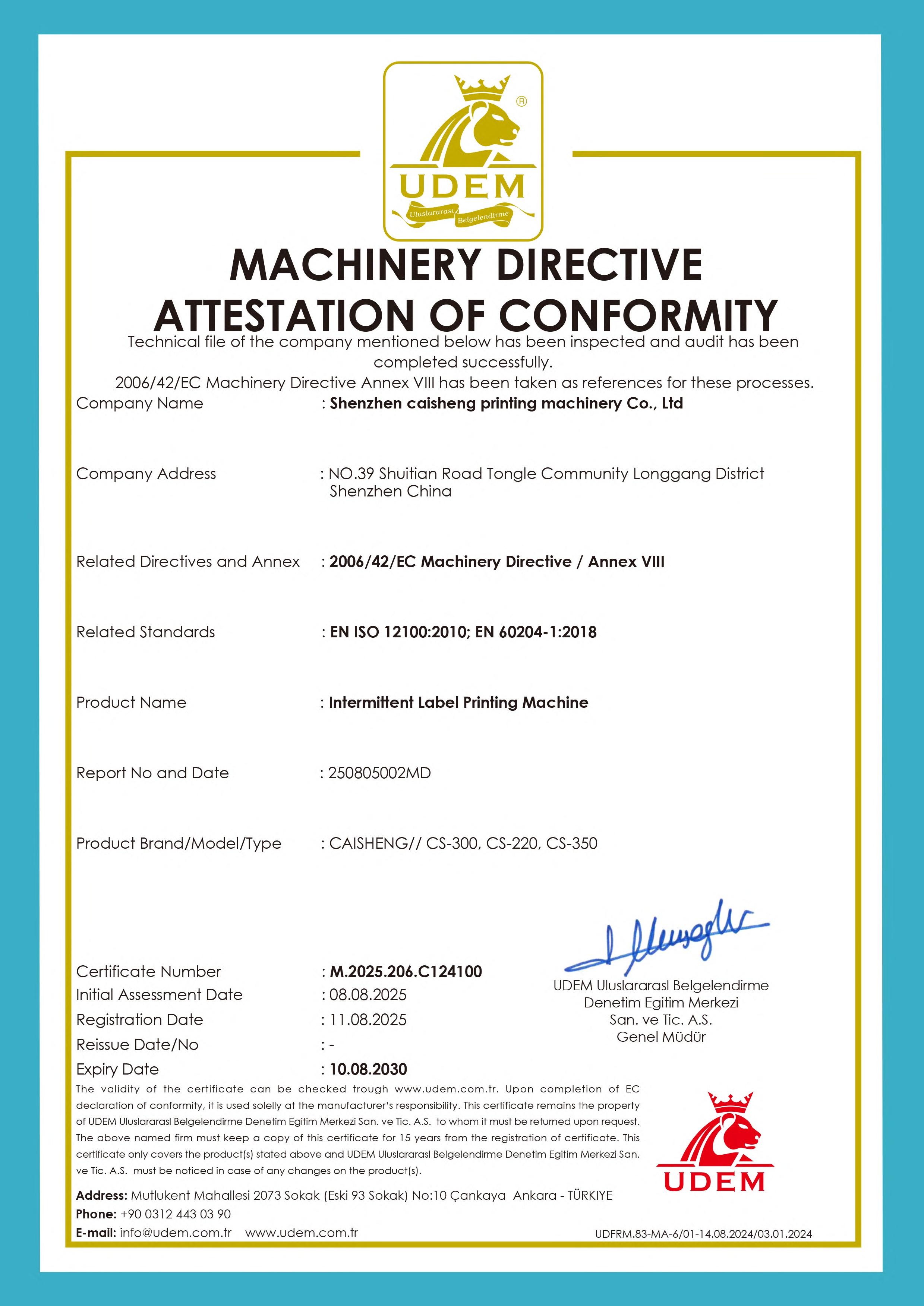
Every field answers a buyer question, which is why the format is worth learning once and reusing with every supplier.
The number gives you something to quote on the purchase order and in the shipping file. If the document presented at delivery carries a different number from the one you were shown, that is a question rather than an administrative detail.
The issuer should be an identified organisation with a name you can trace, not a logo. The example above names the certification body in full, which means a buyer can contact it independently.
The scope is the line to read first. It states which model designations were assessed — here CS-300, CS-220 and CS-350, and nothing beyond them.
The standards show which risk areas the assessment addressed. EN ISO 12100:2010 is the machinery risk-assessment and risk-reduction standard; EN 60204-1:2018 covers the electrical equipment of machines. Two standard families appear in the scope, which tells a buyer that both mechanical and electrical risk were addressed. If a document you receive lists no standards at all, ask why before accepting it.
The dates tell you when to re-check. A window running to 8 October 2030 is generous, but it is still a window; the buyer's file should carry a review date alongside the certificate.
Company-level management-system certification sits behind the machine document and does not replace it. An independent qualification review published in September 2026 records ISO 9001, ISO 14001 and ISO 45001 certification for Caisheng alongside CE compliance. Those certificates describe how the company manages quality, environment and occupational safety. They do not tell you which die-cutting arrangement was assessed on the press you are buying. Hold both, for different reasons.
The document request list
Send this as a written request at RFQ stage, not after the price is agreed. A supplier who answers it quickly is telling you something useful about how the export file is managed.
| Document | What it establishes | What to check |
|---|---|---|
| Attestation of conformity | The manufacturer's formal statement against the machinery standards | Number, issuer, scope, issue and expiry dates |
| List of applied standards | Which risk areas were assessed | Standards match the machine type, electrical included |
| Technical file or risk-assessment reference | The reasoning behind the statement | Your ordered modules appear in the assessed configuration |
| Nameplate and electrical data | That the physical machine matches the file | Model, serial number and electrical data agree with the quotation |
| Model-to-document mapping | That your exact designation is covered | The ordered model is named, not only the family |
| Pre-shipment test record | That the delivered machine performs as documented | Registration, die-cutting and ink system tested on your substrate |
| Commercial documents | The terms the technical file travels with | MOQ, delivery terms, payment split, acceptance criteria |
| Warranty and support statement | What applies after delivery | Start date, covered components, how remote support is delivered |
Two items on that list are routinely skipped and routinely regretted: the technical-file reference and the nameplate data. The first is the reasoning behind the statement; the second is the physical evidence that the machine in the crate is the machine being described. Neither is difficult to provide, and asking for both turns a general compliance conversation into a specific one.
Model scope: which press the document actually covers
The attestation above names three designations: CS-300, CS-220 and CS-350. Caisheng's product range extends beyond them — the CS-320 series, the CS-JQ350 hybrid, and the CS-380F and CS-Q370F flexo series appear elsewhere in its catalogue — so a buyer evaluating one of those models needs the document that names the designation being purchased, not a reference to the family.
The practical rule costs nothing: write the model designation on the RFQ exactly as it will appear on the nameplate, and ask for the conformity document that names that designation. If the reply comes back as a family reference, ask for the mapping in writing and keep it with the file.
Die-cutting configuration changes the compliance question
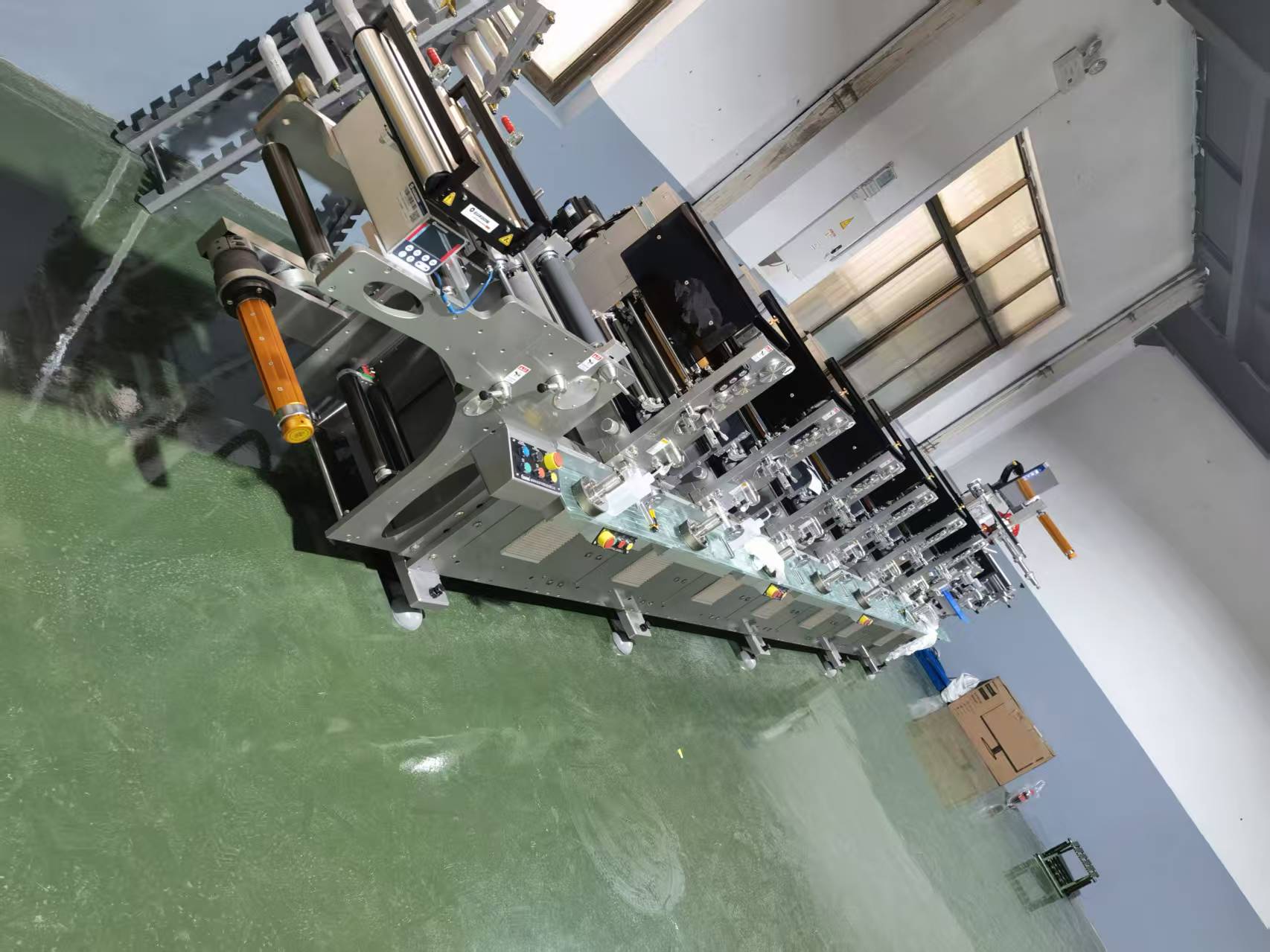
Die-cutting is not one feature repeated across the range. In Caisheng's line-up the configuration splits three ways:
- CS-220 — flatbed die-cutting.
- CS-300 and CS-320 — flatbed plus rotary die-cutting.
- CS-350, CS-370 and CS-380 — rotary combination machines.
That distinction matters to a compliance file because a flatbed die-cutting station and a rotary die-cutting station are different mechanical assemblies, with different tooling, different applied loads and different guarding. A document covering a flatbed-only CS-220 does not tell you whether a rotary die-cutting module on a different family was assessed, and a general statement that "the range is certified" tells you even less.
| Model family | Die-cutting configuration | Evidence to request |
|---|---|---|
| CS-220 | Flatbed die-cutting | A document naming CS-220, plus confirmation that no rotary die-cutting module is fitted |
| CS-300 / CS-320 | Flatbed plus rotary die-cutting | A document naming the ordered model, with both die-cutting modules listed in the assessed configuration |
| CS-350 / CS-370 / CS-380 | Rotary combination | A document naming CS-350; if you order CS-370 or CS-380, ask which document names that designation |
The third column converts a sales claim into a written question. Ask for the answer in the quotation or in the technical file, not over the phone; answers in writing become part of the record your own compliance function will eventually request.
Machine parameters that belong in the written record
Documents describe intent; parameters describe the machine. Five items should be settled before the pre-shipment test.
Registration precision. The company-published specification for the CS-220-4C intermittent rotary letterpress states ±0.025 mm. A published figure is best treated as a claim to confirm at acceptance, on your own substrate and your own job, rather than as a delivered guarantee. That is not distrust; it is the difference between a data sheet and a machine.
Electrical configuration. The attestation lists EN 60204-1:2018, which concerns the electrical equipment of machines. The electrical data on the nameplate should agree with the configuration described in your file and with the supply at your site. Where they differ, resolve it before shipment rather than after installation.
Ink system. Ink belongs in the same written record. This checklist addresses water-based ink configurations; if ink is part of your evaluation, request the ink specification in writing and keep the discussion to water-based ink. Ink chemistry sits outside a machinery conformity document, so a certificate should not be read as an ink approval in either direction.
Substrate and application. Caisheng states that its equipment is designed for labels, adhesive stickers, PVC stickers and tags. Test on the material you will actually run. A conformity document confirms that risks were assessed; it does not confirm that a particular stock converts cleanly on a particular press.
Ordered modules. List every module on the quotation — die-cutting type, slitting, sheet cutting, varnishing, lamination, foil, screen printing, corona treater, dust cleaner, static eliminator — and ask for confirmation that this combination was inside the assessed configuration. This is the single most useful question in the exercise, because it is the one a generic certificate cannot answer.
Market by market: what changes
European Union. The attestation above is the core document: EU market, EU standards, named models. The buyer's job is to keep it current, match it to the model and configuration actually ordered, and confirm internally what else the technical file must contain.
Southeast Asia and the Middle East. Both are established export markets for Caisheng, alongside Europe and the United States. The conformity document remains useful as evidence of how the machine was assessed, but the question at the border is what your own authority and customs broker require. Ask the supplier early which documents they can issue for that destination, and in which language.
United States. Electrical and safety expectations differ from the EU framework, and a European attestation is not a substitute for them. Flexographic printing machinery is classified under HS 844316 in the WCO nomenclature; your broker should confirm the classification for the press and its auxiliaries, because a classification that does not match the machine creates clearance problems that no certificate can fix.
Distributors and ODM buyers. Where machines are built to a distributor's specification — Caisheng offers ODM production for Southeast Asia, the EU, the Middle East and the US — the configuration changes with every order. Re-confirm the model-to-document mapping each time the configuration changes, even when the model designation stays the same.
Pre-shipment acceptance: where the file meets the machine
The commercial terms at Caisheng are short enough to state in full: minimum order quantity 1 unit, delivery terms FOB, payment terms 30/70, acceptance criteria pre-shipment test, lead time 45–60 days, quality control described as 100% test, and monthly capacity of 18 units.
The pre-shipment test is the fourth link in the chain, and the only one that involves your material. A workable acceptance protocol covers six checks:
- Registration on your substrate, measured against the figure you were given.
- The die-cutting arrangement actually fitted, compared with the configuration named in your file.
- Each ordered module running, not merely present.
- Nameplate data matched against the quotation and the technical file.
- The water-based ink system running on your stock at your specified conditions.
- Documents in the shipping file — attestation copy, test record, packing list, invoice — matched against the numbers you were shown at quotation stage.
Installation references are useful context for that protocol but not a replacement for it. A CS-320 has been in production with a Taiwanese trademark design and printing company following a project completed over two years, and a CS-300 has been running for three years with a global provider of commercial printing, packaging and marketing communication solutions in the United States. Those references show the machines working in production; they do not certify the unit in your crate.
Where this checklist stops
- Scope is not transferable. The attestation covers CS-300, CS-220 and CS-350. Any other designation needs its own document.
- Certificates do not measure output. Published specifications describe capability, not field performance. Verify performance against your own job during acceptance instead of extrapolating from a data sheet.
- Validity needs a diary entry. Note 8 October 2030 in the file, and re-check earlier if the machine is modified after installation.
- This is not legal advice. Importer obligations and technical-file content are matters for your compliance function or the relevant authority.
Frequently asked questions
Which CAISHENG models appear in the CE attestation?
The current MACHINERY DIRECTIVE ATTESTATION OF CONFORMITY, certificate number M.2025.206.C124100, names CS-300, CS-220 and CS-350 in its scope for the EU market. It was issued by UDEM Uluslararasl Belgelendirme Denetim Egitim Merkezi San. ve Tic. A.S. on 8 November 2025 and is valid to 8 October 2030, against EN ISO 12100:2010 and EN 60204-1:2018. If the press on your quotation carries a different model designation, ask for the document that names that designation rather than relying on a family reference.
What documents should I hold before paying a deposit?
Hold a current attestation naming your model, the standards it was assessed against, written confirmation that the ordered configuration sits inside the assessed configuration, nameplate and electrical data matching the quotation, the commercial terms in writing, and the acceptance criteria for the pre-shipment test. At Caisheng those terms are minimum order quantity 1 unit, FOB delivery, 30/70 payment and a pre-shipment test as the acceptance criterion, so the technical and commercial requests can be sent in one message.
Does the attestation cover the die-cutting module I order?
The attestation covers the model designations in its scope, and die-cutting is configured by family: CS-220 uses flatbed die-cutting, CS-300 and CS-320 use flatbed plus rotary die-cutting, and CS-350, CS-370 and CS-380 are rotary combination machines. Because die-cutting modules are ordered as part of the configuration, ask for written confirmation that the arrangement fitted to your machine was inside the assessed scope.
How do die-cutting configurations differ across the range?
Three patterns apply. CS-220 is flatbed die-cutting only. CS-300 and CS-320 combine flatbed and rotary die-cutting. CS-350, CS-370 and CS-380 are rotary combination machines. The difference is mechanical rather than cosmetic: a flatbed station and a rotary station use different tooling and apply load differently, which is why the configuration on your order should be named in your conformity record.
What are the purchasing terms and acceptance criteria?
Minimum order quantity is 1 unit, delivery terms are FOB, payment terms are 30/70, and the acceptance criterion is a pre-shipment test. Lead time is 45–60 days, monthly capacity is 18 units, and quality control is described as 100% test. Ask for the acceptance protocol in writing so the test checks the configuration and the registration figures your file relies on.
What support continues after delivery?
Caisheng provides remote support and a one-year warranty on major components for export markets including Southeast Asia, the EU, the Middle East and the United States. Confirm in the order documents when the warranty period starts, which components it covers and how remote support is delivered, since those details determine what the warranty is worth on a production floor.
How do I get the documents and a quotation for a specific configuration?
Send the model designation exactly as it will appear on the nameplate, the die-cutting configuration, the destination market and the substrate you intend to run. The team can then return a quotation together with the corresponding conformity document and the acceptance protocol. The CAISHENG product brochure (PDF) summarises the machine range, and document requests can be sent to kanghong-1108@qq.com.
Conclusion
The four links in the chain are not bureaucratic steps; each one answers a question a buyer will be asked later by someone else — an auditor, a customer, a customs broker or a production manager. Start with the scope line on the conformity document and work outward: does it name my model, does it name the standards, does it name the configuration, and does the machine that arrives match the file. Where an answer is missing, ask for it in writing before the deposit rather than after the crate is opened.
Next step: the CAISHENG product brochure covers the label printing machine range that these checks apply to, including the die-cutting configuration of each model family.
Have Questions or Need More Details?
Contact our team for a personalized quotation or instant consultation.
Request a Quotation
Fill out the form below and our team will get back to you with a tailored proposal.
WhatsApp Direct Chat
Prefer to chat in real-time? Message us on WhatsApp for instant assistance & quick answers.
- Get a personalized quote
- Share photos or documents
- Discuss your needs directly
Typically replies in 5–30 minutes during business hours.