Die-Cutting Methods by Model Family: CS-220, CS-300/320 and CS-350/370/380 Label Presses
Short answer: On a CAISHENG label printing machine, the die-cutting method is determined by the model family rather than selected as an option at order stage. The CS-220 series uses flatbed die cutting, the CS-300/320 series combines flatbed and rotary die cutting in one machine, and the CS-350/370/380 series uses a rotary die-cutting combination. Matching that architecture to order structure — batch size, repeat frequency, label format and the finishing steps that must run in-line — is the decision this guide supports.
Most buyers researching a label printing machine start with colour count and running speed. Die cutting usually arrives later in the conversation, once a quotation is already being compared. That order is backwards: die cutting decides the maximum format a press can deliver, how often the job stops for tooling, and whether slitting or additional converting stations can run in the same pass. This application guide is written for label converters, importers and brand owners who are at the research stage and want to choose the architecture before the model number.
Why Die-Cutting Method Comes Before the Price Conversation
Die cutting converts a printed web into individual labels by cutting the outline, and on narrow-web equipment it is frequently the step that caps real output. The architecture behind that step produces three structural consequences that cannot be corrected later by adding an operator or running an extra shift.
- Format ceiling. Each die-cutting unit has a maximum cutting area. A label larger than that area cannot be produced on that machine, regardless of how many printing stations it carries.
- Tooling model. Flatbed die cutting uses a flat plate; rotary die cutting uses a cylinder matched to a repeat length. The two tooling systems differ in how they are ordered, stored, mounted and replaced.
- In-line capability. A die-cutting station only creates value in one pass if the surrounding converting steps — slitting, glue-side printing, additional rotary stations — can run on the same machine.
Because these factors are structural, they shape the economics of the whole press. A converter who buys a flatbed-only platform for a long-run, single-format order spends the machine's life waiting on the cut cycle. A converter who invests in rotary tooling for a job shop with a very large number of short SKUs spends the machine's life managing cylinder changes. Neither buyer made a mistake about speed or colour count; both made a mistake about die-cutting architecture.
Industry Background: Stable Label Demand, Selective Equipment Demand
Market research places the global print label market at USD 57.05 billion in 2026, growing at a compound annual rate of 3.28% to reach USD 67.02 billion by 2031 (Mordor Intelligence, as published in the research summary consulted for this guide). That figure measures printed label output rather than label press equipment, so it should be read as a demand backdrop, not as a machinery market size.
Two implications follow for die-cutting decisions. First, demand of this kind grows steadily rather than in surges, so capacity is usually added one press at a time to absorb incremental volume — which means each purchase carries a large share of the converter's total capacity and deserves a scenario-based choice rather than a specification comparison. Second, in a market growing at a moderate rate, competitive pressure tends to come from mix flexibility, changeover time and waste rather than from a headline speed number. Die cutting sits directly on all three.
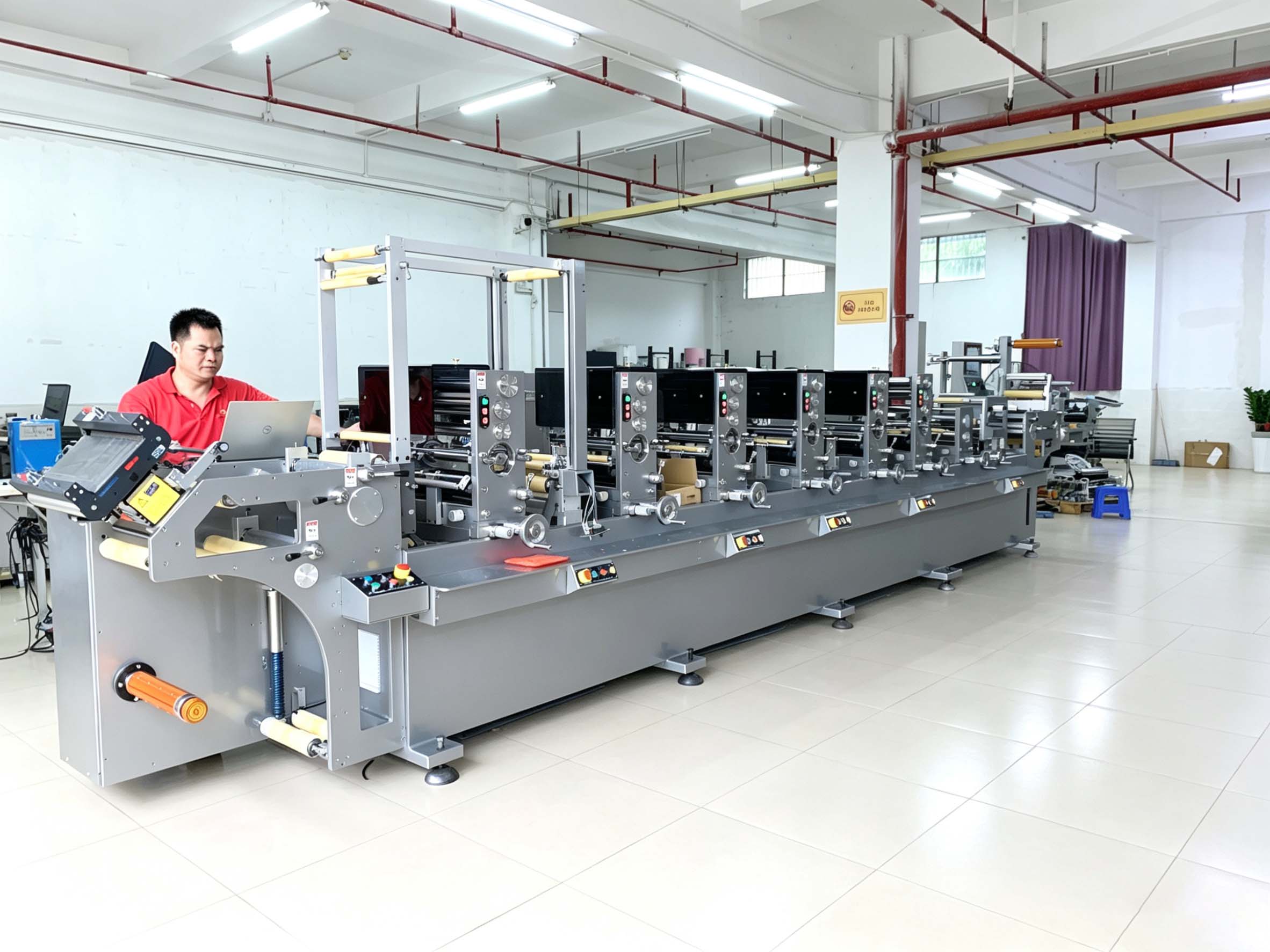
The equipment side of that backdrop is supplied by manufacturers such as Shenzhen Caisheng Printing Machinery Co., Ltd. (CAISHENG), a label printing equipment manufacturer founded in 2011 and based in Longgang District, Shenzhen. The company specialises in intermittent and high-speed full-rotary letterpress printing machines, flexographic presses, screen printing machines and customised multi-functional label finishing solutions. It operates a 6,000 m² facility with approximately 65 employees, including 8 R&D engineers, and reports annual output of about 200 units, with roughly 50% of production exported to Southeast Asia, Europe, the Middle East and the United States. For a buyer in any of those markets, the practical consequence is simple: the die-cutting configuration has to be argued from the buyer's own order book, not from a single reference market.
The Three Die-Cutting Architectures in the CAISHENG Range
The range splits into three families, and the split is architectural rather than cosmetic. Each family answers a different production pattern.
CS-220 Series: Flatbed Die Cutting for Short Runs and Complex Outlines
In the CS-220 family the web stops for each cut. The die is a flat plate, pressed against the material while the web is stationary, then released so the web can index forward. This is the classic flatbed arrangement, and it carries specific strengths: plate tooling is comparatively straightforward to source and store, complex outlines and heavier material stacks are handled without the constraints of a cutting cylinder, and short runs can be quoted without committing to a format-specific cylinder.
The CS-220-5C illustrates the family. It is catalogued as a stickers printing machine and classified as an intermittent letterpress label printing machine, with a web width range of 30–240 mm, a maximum printing speed of 40 m/min, a maximum intermittent printing area of 220 mm × 200 mm and a full rotation area of 220 mm × 245 mm. Gross power of the main machine is 17 kW, machine weight is 3.6 t and overall dimensions are 6.6 m × 1 m × 1.5 m. The smaller CS-220-4C uses the same 30–240 mm web range and the same 40 m/min ceiling, at a machine weight of 2.6 t and dimensions of 4.2 m × 1 m × 1.5 m.
The limitation is equally clear. Because the web pauses for every cut, the flatbed cycle sets the throughput ceiling — on these two models, 40 m/min. Flatbed is therefore the right architecture when the order book is dominated by many SKUs at short average length, when label outlines are complex or change often, and when the same machine will still be producing next year's seasonal artwork.
CS-300/320 Series: Flatbed and Rotary in One Frame
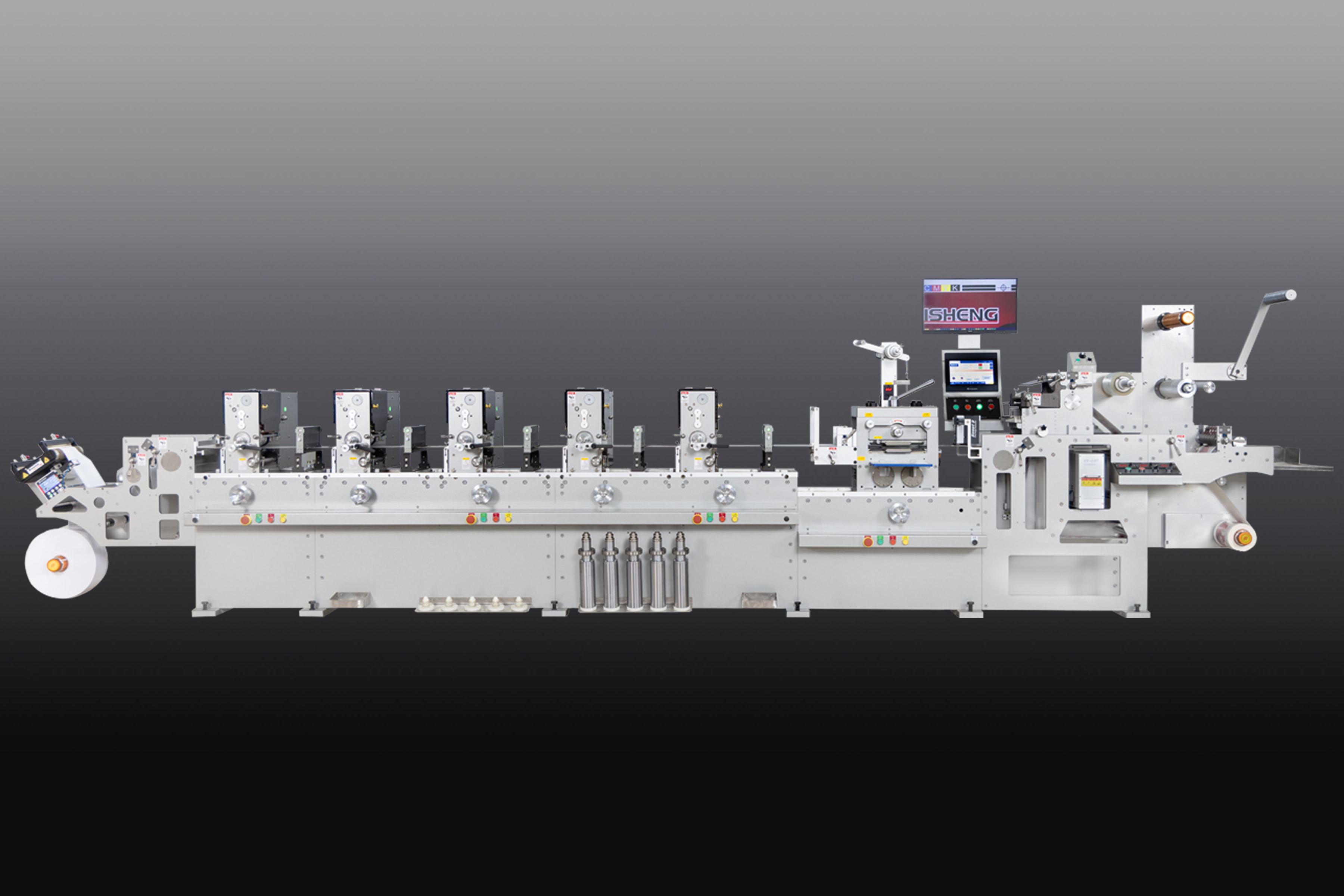
The middle family is where the die-cutting decision stops being a machine decision and becomes a scheduling decision. These machines are built so that a flatbed die-cutting station and a rotary die-cutting station can coexist in the same frame, alongside printing and other converting stations.
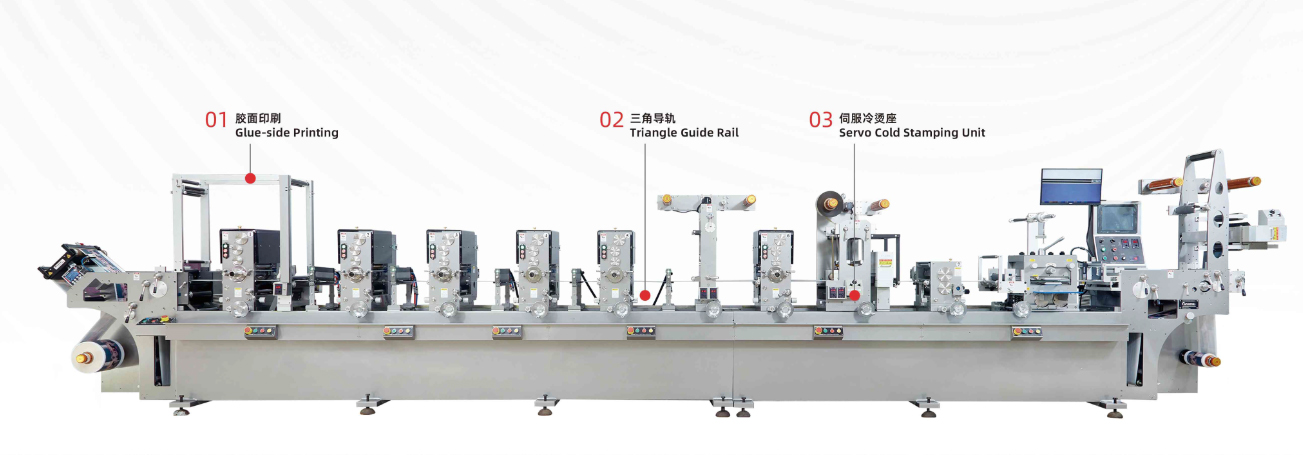
The clearest illustration is visible in the configuration record for the CS-300-6C: letterpress printing combined with glue-side printing, a multi-functional frame, rotary die cutting, flatbed die cutting and slitting. That is not three machines linked by conveyors; it is one web path running through several converting steps. The CS-300-6C itself has a web width range of 30–300 mm, a maximum printing speed of 40 m/min, a maximum intermittent printing area of 280 mm × 300 mm and a full rotation area of 280 mm × 326 mm, at a machine weight of 6.6 t and dimensions of 8.9 m × 1.5 m × 2 m.
The CS-320-6C is the wider version of the same idea. It is a semi-rotary label printing machine classified as an intermittent letterpress label printing machine, with a web width range of 30–320 mm, a maximum printing speed of 40 m/min, a maximum intermittent printing area of 320 mm × 300 mm and a full rotation area of 320 mm × 326 mm. Gross power of the main machine is 27 kW, net weight is 6.2 t and overall dimensions are 8.4 m × 1.5 m × 2 m. The self-adhesive label press CS-300-5C sits at the entry of the family with a 30–300 mm web range.
The trade-off is honest: a machine carrying both flatbed and rotary die-cutting capability, plus additional converting stations, has more setup points than a single-method press. It rewards a converter whose order book genuinely contains both patterns. It penalises a converter who buys the combination and then runs only one of the two methods year-round.
CS-350/370/380 Series: Rotary Die-Cutting Combination for Repeat Work
In the upper family the web does not stop for the cut. A rotary die-cutting cylinder turns with the web and cuts continuously, which removes the pause that limits flatbed throughput and allows the die-cutting station to run at the same speed as the rest of the machine.
The CS-JQ350-7C is the reference model for this architecture. It is a semi-rotary and full-rotary label press classified as an intermittent and full-rotary high-speed label printing machine, with a gross power of 24.5 kW, a machine weight of 10.8 t and overall dimensions of 8.7 m × 1.5 m × 1.9 m. Its maximum printing area is 350 mm × 380 mm in intermittent mode and 350 mm × 419 mm in full rotary mode, at maximum speeds of 60 m/min and 158 m/min respectively. The closely related CS-JQ350G-6C reaches the same 60 m/min and 158 m/min with a gross power of 22 kW and a machine weight of 10 t.
Rotary tooling is format-specific: a cylinder is matched to a repeat length, so it is bought for a label size that will be produced repeatedly. That is the trade. When the same label format runs for months, the cylinder cost is spread across a very large number of impressions and the continuous cut pays for itself. When the format changes weekly, cylinder tooling becomes a recurring capital item, and the flatbed plate in the CS-220 family is the cheaper route.
Where the buyer needs die-cutting throughput independent of the printing press, CAISHENG also lists a separate finishing unit rather than a press-mounted station: the CS-350 high speed die-cutting machine, classified as finishing equipment, which runs intermittent mode at 60 m/min over a maximum area of 350 mm × 420 mm and full rotary mode at 160 m/min over 350 mm × 460 mm, at a net weight of 2 t. It is worth separating this unit from the CS-350/370/380 press family in any quotation comparison, because the two solve different problems.

Step-by-Step: Matching Die-Cutting Method to a Production Scenario
The following sequence converts an order book into a die-cutting specification. It is deliberately ordered so that the architecture is settled before any model number is examined.
- Classify the order book, not the product. Count the active SKUs, the average run length in metres, and how often each SKU repeats within a year. A book of many short runs points to flatbed; a book of few long repeats points to rotary; a book containing both points to the CS-300/320 combination family.
- Fix the format envelope. Take the largest label outline in the book, including any bleed and any shape that needs a wider cut than the print. The maximum die-cutting area must exceed that outline. This single step already separates the families: the CS-220 series cuts within a 220 mm format, the CS-300/320 series extends to 280 mm and 320 mm formats, and the CS-350/370/380 series works at a 350 mm format.
- Choose the tooling model you can actually manage. Plate tooling and cylinder tooling are managed differently in storage, mounting and replacement. A factory with limited tooling space and a large SKU count should confirm that its workflow matches the method, not just the machine.
- Decide which finishing steps must be in-line. If slitting, glue-side printing or additional converting stations have to run in the same pass as the cut, the combination frame of the CS-300/320 series is the relevant architecture. If the cut is the only converting step, a single-method machine keeps setup simpler.
- Validate the speed ceiling against required output. Multiply the realistic running speed by available hours and compare with the volume the order book demands. The 40 m/min ceiling of the CS-220-5C and CS-320-6C, the 60 m/min intermittent and 158 m/min full rotary ceiling of the CS-JQ350-7C, and the 150 m/min of the CS-Q370F-6C all represent different production envelopes, and the largest of them is only worth paying for when the order book can fill it.
Use Cases: Which Labels Fit Which Die-Cutting Method
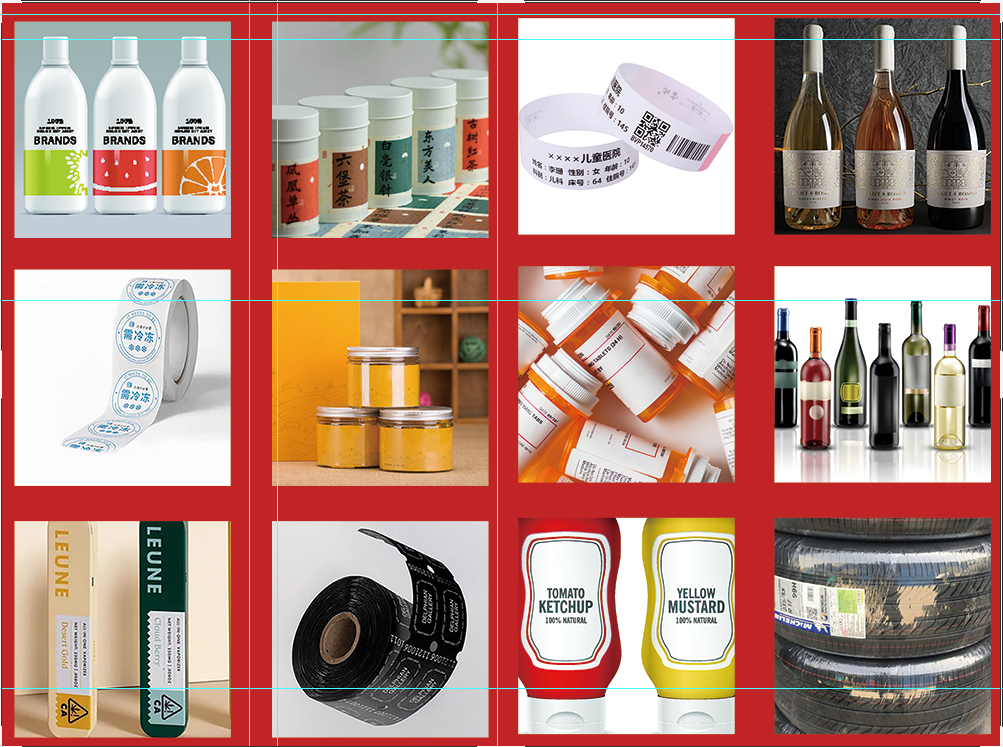
CAISHENG states that its equipment covers labels, adhesive stickers, PVC stickers and tags, and that typical application scenarios include self-adhesive labels for daily chemicals, wristbands, wine, food, cosmetics and pharmaceuticals. Within that scope, the die-cutting families map onto recognisable working patterns.
- Daily chemicals and promotional food labels. Frequent artwork changes, modest run lengths and a wide SKU spread. Flatbed die cutting on the CS-220 family keeps tooling cost proportional to run length and avoids committing to a cylinder for a label that may be replaced next season.
- Wine and cosmetics labels. Core SKUs repeat through the year while seasonal and limited editions arrive alongside them. This is the pattern the CS-300/320 combination family is built for: the repeat format can run on the rotary station, and the seasonal shape can run on the flatbed station from the same machine.
- Pharmaceutical and high-volume brand labels. A small number of formats produced continuously, where the cut must keep pace with the print. Rotary die cutting on the CS-350/370/380 family removes the pause from the cycle, and the CS-JQ350-7C reaches 158 m/min in full rotary mode.
- Tags, wristbands and PVC stickers. Materials and shapes that repeat in stable formats; the same rotary logic applies, with the added benefit that slitting and additional converting stations can be arranged in one web path.
One operational point applies across all three families: CAISHENG specifies that the equipment runs under normal room temperature conditions and does not require a constant-temperature production workshop, with stable continuous automatic cycle printing operation. That matters for die cutting because cut quality is sensitive to how stable the web path is, and a machine that does not depend on a controlled room is easier to slot into an existing hall.
Model Comparison: Die-Cutting Method by Family
The table below compares the four models most often discussed at the research stage. Only published specifications are shown; a dash means the figure is not part of the source data used for this guide, and it should be confirmed directly rather than assumed.
| Model | Die-cutting architecture | Web width | Max printing area (intermittent / full rotation) | Max speed | Machine weight |
|---|---|---|---|---|---|
| CS-220-5C | Flatbed die cutting (CS-220 series) | 30–240 mm | 220 × 200 mm / 220 × 245 mm | 40 m/min | 3.6 t |
| CS-300-5C | Flatbed with rotary die cutting available in the CS-300/320 frame | 30–300 mm | — | — | — |
| CS-320-6C | Combined flatbed and rotary die cutting (CS-300/320 series) | 30–320 mm | 320 × 300 mm / 320 × 326 mm | 40 m/min | 6.2 t |
| CS-JQ350-7C | Rotary die-cutting combination (CS-350/370/380 series) | — | 350 × 380 mm / 350 × 419 mm | 60 m/min intermittent / 158 m/min full rotary | 10.8 t |
Within the rotary family the parameters spread considerably, which is why a family-level decision still needs a model-level check:
| Model | Max printing area (intermittent / full rotation) | Max speed | Gross power | Machine weight | Dimensions (L × W × H) |
|---|---|---|---|---|---|
| CS-JQ350-7C | 350 × 380 mm / 350 × 419 mm | 60 m/min / 158 m/min | 24.5 kW | 10.8 t | 8.7 × 1.5 × 1.9 m |
| CS-JQ350G-6C | 350 × 380 mm / 350 × 419 mm | 60 m/min / 158 m/min | 22 kW | 10 t | 7.9 × 1.5 × 1.9 m |
| CS-Q370F-6C | 370 × 200 mm / 370 × 600 mm | 150 m/min | 25 kW | 7 t | 7.5 × 1.5 × 1.7 m |
| CS-370F-8C | 370 × 200 mm / 370 × 600 mm | — | 30 kW | 8.6 t | 9.1 × 1.5 × 1.7 m |
| CS-J380F-7C | 360 × 380 mm / 360 × 419 mm | 60 m/min | 35 kW | 6 t | 9.3 × 1.3 × 1.6 m |
| CS-J380F-4C | 360 × 380 mm / 360 × 419 mm | 60 m/min | 25 kW | 4 t | 7.4 × 1.3 × 1.6 m |
Reading the tables correctly. The die-cutting architecture column describes how each family is configured in this guide. The remaining columns are equipment specifications published for each model. A buyer should not infer cutting capability beyond the stated maximum printing area without confirming the die-cutting station configuration for the specific quotation.
Frequently Asked Questions
Do these die-cutting configurations meet EU import requirements?
CAISHENG reports that its products meet CE standards and that the company holds ISO 9001, ISO 14001 and ISO 45001 certification — a position set out in HTNXT's September 2026 compliance review of the company. For flexographic presses in the range, the relevant trade classification is HS 844316, which specifically covers flexographic printing machinery. CE marking and customs classification are two separate checks, and a buyer should confirm both against the exact model and configuration in the quotation rather than assuming that one implies the other.
Can one label printing machine run both flatbed and rotary die cutting?
Yes, in the CS-300/320 series. These machines are configured so that flatbed and rotary die-cutting stations share one frame and one web path. The CS-300-6C configuration record shows letterpress printing combined with glue-side printing, a multi-functional frame, rotary die cutting, flatbed die cutting and slitting on the same machine. The CS-220 series is flatbed-based, and the CS-350/370/380 series is built around rotary die-cutting combinations.
How does the die-cutting method affect what the machine costs?
Cost follows configuration rather than a published list price. The variables that move are the number and type of converting stations, whether both a flatbed and a rotary die-cutting station are fitted, the web width and format class of the model, and how much of the configuration is customised to the buyer's order requirements. The CS-220-5C, CS-320-6C and CS-JQ350-7C sit in three different format classes with machine weights of 3.6 t, 6.2 t and 10.8 t respectively, which indicates how much structure is involved in each. Because no price list is published for this guide, a written quotation against a defined specification is the only reliable comparison method.
How can I validate a die-cutting method against my own label material before ordering?
CAISHENG offers exclusive one-to-one custom design, including size, process and function customisation, and states that label printing machines are customised based on customer order requirements. That makes material validation a specification conversation rather than a catalogue selection: the buyer supplies the label outline, the repeat length, the web width and the finishing steps required, and the machine configuration is defined around them. Requests of this kind can be raised directly with the manufacturer's sales contact before a purchase order is issued.
What production capacity and lead time sit behind an order?
CAISHENG operates a 6,000 m² facility with approximately 65 employees and reports annual output of about 200 units, with roughly 50% exported to Southeast Asia, Europe, the Middle East and the United States. Because each machine is configured to order — and because a combination machine such as the CS-300-6C carries more stations than a single-method press — the delivery schedule should be confirmed against the specific configuration rather than assumed from the general output figure. The fastest route is to send the intended format, die-cutting method and finishing list, and request a written schedule with the quotation.
Next step: match the method to your order book
Download the CAISHENG product brochure for the full model and configuration reference: CAISHENG brochure (PDF). To request a quotation or discuss a specific die-cutting configuration, contact the sales team at kanghong-1108@qq.com, call +86 131-8628-3944, or message on WhatsApp.

Conclusion: Choose the Architecture, Then the Model
Die-cutting method is not a detail to settle after the press has been chosen. It sets the format ceiling, determines the tooling model the factory must live with, and defines which finishing steps can run in the same pass. In the CAISHENG range the answer is already structured: the CS-220 series for flatbed die cutting on short and varied runs, the CS-300/320 series for a frame that carries flatbed and rotary die cutting together, and the CS-350/370/380 series for rotary die-cutting combinations on repeat work.
The practical sequence is therefore to classify the order book, fix the format envelope, choose the tooling model, decide which steps must be in-line, and only then test the speed ceiling against required output. A model number that survives those five checks is a working decision; one that was selected on colour count and price alone usually is not.
Shenzhen Caisheng Printing Machinery Co., Ltd. is based at No.39 Shuitian Road, Tongle Community, Longgang District, Shenzhen, China, and can be reached at kanghong-1108@qq.com or +86 131-8628-3944.
Have Questions or Need More Details?
Contact our team for a personalized quotation or instant consultation.
Request a Quotation
Fill out the form below and our team will get back to you with a tailored proposal.
WhatsApp Direct Chat
Prefer to chat in real-time? Message us on WhatsApp for instant assistance & quick answers.
- Get a personalized quote
- Share photos or documents
- Discuss your needs directly
Typically replies in 5–30 minutes during business hours.