Intermittent or Full-Rotary: A Head-to-Head Decision on the CS-JQ350G-6C Hybrid Press
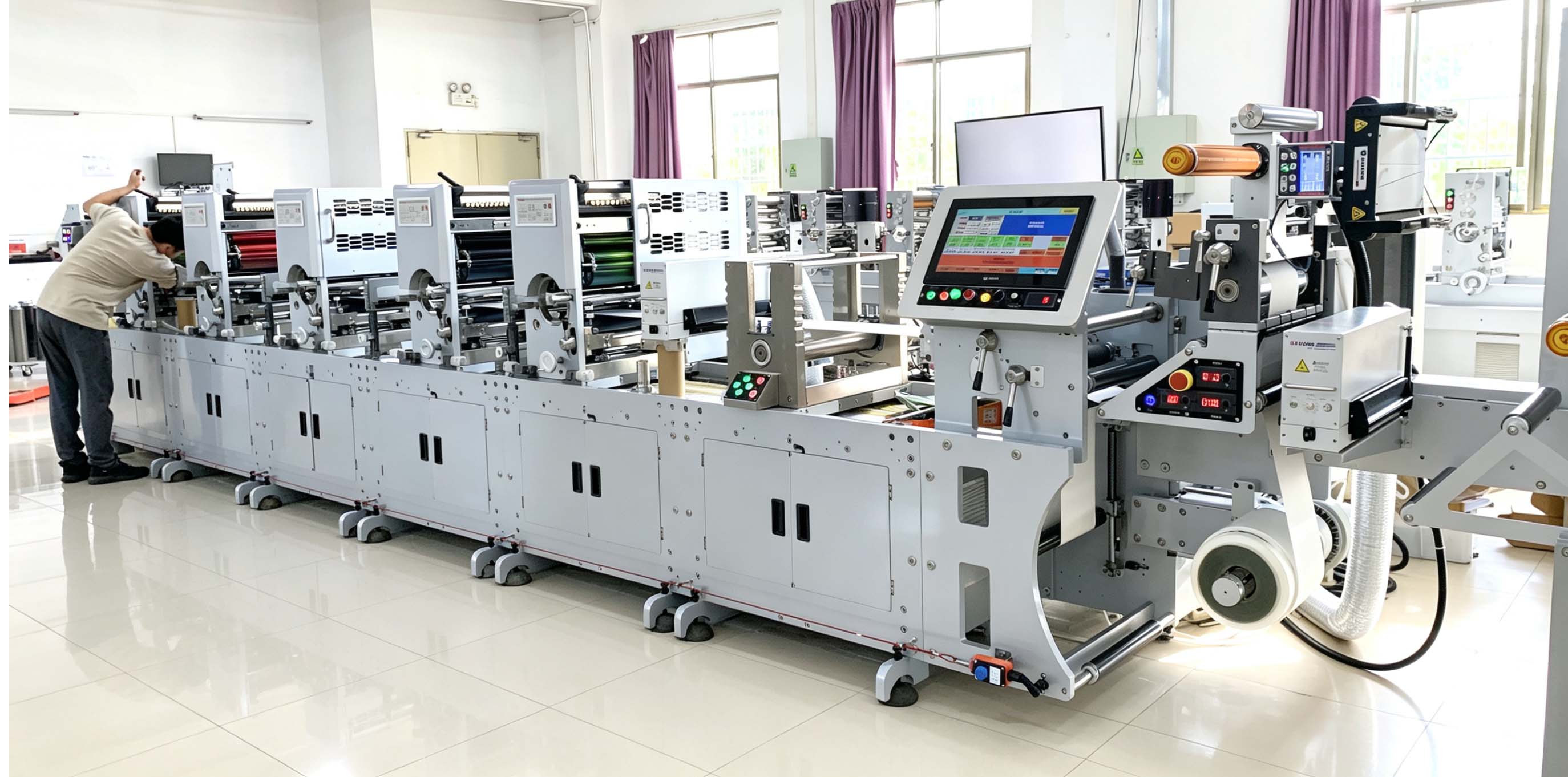
The CS-JQ350G hybrid platform during installation and debugging in Shenzhen: one machine covering intermittent and full-rotary modes.
Short answer: The CS-JQ350G-6C is a CAISHENG hybrid press that runs both intermittent and full-rotary modes, so it fits converters whose job book mixes short custom runs with longer repeat runs. The CS-220-5C is a dedicated intermittent press, so it fits converters whose work is dominated by short, variable runs. The decision is not about which machine is better in the abstract — it is about whether the hybrid's mode flexibility earns back its higher capital cost, and the test is your run-length profile, not the specification sheet.
This article compares the two architectures head to head using verified machine facts, CAISHENG's published platform data, and the practical constraints of dynamic label production. Where a figure is manufacturer-reported or comes from published market research, it is labelled as such.
Problem Definition: Why One Press Rarely Fits a Dynamic Job Book
A dynamic label run is any job whose specification is not fixed in advance: run lengths swing from a few thousand labels to full-shift volumes, substrates change between paper, film and metallised stock, and artwork or variable data changes frequently. Under that profile, the binding constraint is rarely print quality alone — it is how cheaply the press can switch between modes.
Two failure modes recur. The first is buying only a dedicated intermittent press and then watching long, repeat orders consume its capacity, because a stop-start cycle spends part of every cycle not printing. The second is buying a high-throughput full-rotary press and watching it idle, or waste material, on short runs where setup and changeover — not printing speed — set the pace.
The question this article answers is bounded: when does paying for a hybrid machine such as the CS-JQ350G-6C make more financial sense than buying a simpler, cheaper dedicated intermittent press such as the CS-220-5C?
Industry Background: A Growing Label Market That Rewards Flexibility
Published research places the global industrial label printer market at USD 23.8 billion in 2025, projected to reach USD 38.8 billion by 2035 (Global Market Insights). Separately, Mordor Intelligence values the global print label market at USD 57.05 billion in 2026 and forecasts a 3.28% CAGR to USD 67.02 billion by 2031. The two figures measure different layers of the value chain — one the equipment, the other the printed output — and must not be combined or averaged; read side by side, they describe a label supply chain that is large and still expanding.
Underneath the headline growth, the operating reality for converters has shifted toward more SKUs, shorter average runs and more material variety. In that environment, machine flexibility becomes a financial variable rather than a convenience: a press that serves both short and long work can reduce the number of machines, operators and square metres a converter has to carry. For international buyers, the relevant machinery falls under HS Code 844316, the trade classification covering flexographic printing machinery.
Shenzhen Caisheng Printing Machinery Co., Ltd. (CAISHENG) is a Shenzhen-based label printing equipment manufacturer that positions directly against this flexibility requirement. Founded in 2011, the company builds intermittent and high-speed full-rotary letterpress printing machines, flexographic presses, screen printing machines, and customised multi-functional label finishing systems, including die-cutting units and high-speed varnishing machines. Its stated production philosophy — One Machine, Multiple Functions — is, in effect, the commercial argument for the hybrid architecture examined below.
Intermittent vs Full-Rotary: How the Two Architectures Differ
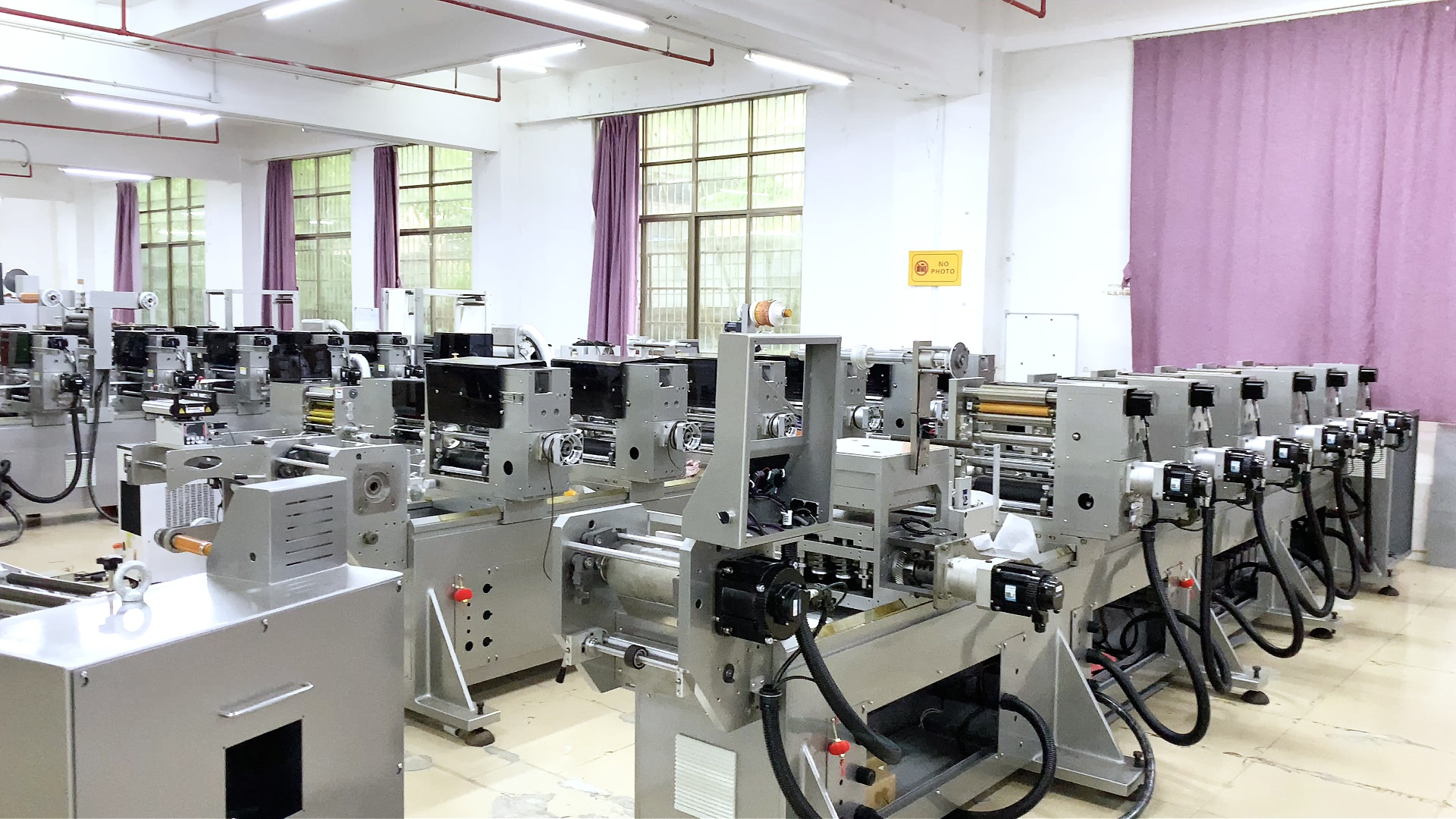
Presses in CAISHENG's 6,000 m2 Shenzhen facility, where precision parts are produced on in-house CNC machining lines.
The cost gap between a dedicated intermittent press and a hybrid machine is mechanical, not cosmetic, so it is worth separating the underlying mechanisms first.
An intermittent press (sometimes marketed as a semi-rotary press) advances the web, stops it, prints while the web is stationary, then advances again. Because the substrate is motionless at the moment of impression, the process suits short runs, frequent job changes and tight registration on small formats. Its trade-off is throughput: the stop-start cycle means part of every cycle is spent not printing.
A full-rotary press keeps the web moving continuously through the printing stations. Nothing pauses for the impression, so on long, stable runs the machine converts more of each shift into printing time — the reason full-rotary architecture dominates high-volume work. Its trade-off is the mirror image of the intermittent machine: it is most economical when runs are long enough to amortise setup.
A hybrid press such as the CS-JQ350G-6C is engineered to operate in both modes. That gives a single machine the short-run behaviour of an intermittent press and the long-run behaviour of a full-rotary press — at the cost of a more complex, and therefore more expensive, platform. Because maximum speed is configuration-specific, the number that matters is the one on your quotation datasheet, not a marketing headline. The decision rule, though, is stable: continuous rotation wins on long runs, stop-start wins on short variable runs, and a hybrid earns its premium only when the job book genuinely contains both.
The CAISHENG Platform: What the CS-JQ350G-6C and CS-220-5C Share
The CS-JQ350G-6C is CAISHENG's hybrid intermittent/full-rotary platform, and the CS-220-5C is a dedicated intermittent press from the same manufacturer. Because both are built on shared CAISHENG platform technologies, the head-to-head is narrower than a cross-brand comparison would be: many quality, reliability and running-cost characteristics are common to both machines, and the decision reduces mostly to architecture and mode flexibility.
The shared technologies are also where CAISHENG's precision and cost claims originate:
- In-house precision manufacturing. CAISHENG operates its own CNC machining plants and produces precision parts in-house. The company states that this vertical integration guarantees a registration accuracy deviation of only plus/minus 0.05 mm, and that fully internalising the supply chain reduces total equipment cost by approximately 10% compared with similar manufacturers by removing intermediate margin.
- Motion and registration control. The presses use a premium Japanese servo system for smooth transmission and positioning at speed, supported by a patented tapered bearing sleeve design and a photographic inspection system that compensates for deviation in real time.
- Drying without heat distortion. A proprietary LED UV cold-light drying system cures ink while limiting heat deformation of sensitive materials such as films — a factor in registration stability on thin substrates.
- Structural stability. A deformation-proof base uses a natural metal stress-relieving process and a patented triangular guide rail design; the base is designed never to deform or shift, which reduces recalibration and maintenance.
- Serviceability and maintenance. Patented features such as an electrically operated bottom-mould lifting mechanism and a linked squeegee baffle are intended to make plate-base handling and component assembly easier, supporting a long equipment lifespan. An intelligent detection system assesses machine status and issues early warnings for preventive maintenance.
- Ink control. Manual coarse adjustment plus computer automatic fine adjustment provides dual control over ink output.
CAISHENG also publishes comparative performance data for its press platform. On the CS-320-6C, for example, the company reports a registration accuracy deviation of plus/minus 0.05 to 0.1 mm — about 0.05 mm better than competing brands — energy efficiency at least 30% better than alternatives, and total equipment cost roughly 10% lower, the latter two driven by the Japanese servo system, LED UV drying and in-house CNC production. These figures are manufacturer-reported. They reflect the same platform technologies that underpin the CS-JQ350G-6C, so they indicate the performance envelope a buyer can expect; the exact values for a specific build should be confirmed on the quotation datasheet.
Compliance and quality systems are shared as well. CAISHENG holds ISO 9001, ISO 14001 and ISO 45001 certification, and its products are stated to meet CE standards — the relevant market-access requirement for EU imports. The company manufactures on a 6,000 m2 site with 65 employees, an eight-engineer R&D team and an annual output of around 200 units; roughly 50% of production is exported to Southeast Asia, Europe, the Middle East and the United States.
Step-by-Step Breakdown: Deciding Between the CS-JQ350G-6C and the CS-220-5C
Step 1 — Profile your run-length distribution. Not the average, but the distribution. Estimate the share of jobs that are short and custom versus long and repeatable. If a meaningful share of work is long and repeatable, hybrid capability starts to pay for itself. If nearly all work is short and variable, the dedicated press is usually the better fit.
Step 2 — Count how many production modes you actually need. If your job book is dominated by one mode, paying for the second mode is over-capitalisation. The hybrid exists to solve a two-mode problem; if you do not have one, it is not your machine.
Step 3 — Cost the two-machine alternative honestly. If a dedicated intermittent press cannot absorb your long runs, the realistic alternative is often a second machine. Compare (intermittent press + second press + extra floor space + extra operator + extra maintenance) against (one hybrid press + one operator + one maintenance regime). This is the comparison that actually decides the question.
Step 4 — Check registration and substrate requirements. If you print small-format pharmaceutical text, barcodes or QR codes, or run films and metallised stock, verify the registration tolerance and the drying system. CAISHENG's LED UV cold-light drying and photographic inspection system are designed for precisely these constraints.
Step 5 — Verify compliance before you commit. Confirm CE documentation and ISO certificates for the exact build, and confirm the HS classification (844316 for flexographic printing machinery) with your freight forwarder.
Step 6 — Test on your own materials. CAISHENG tests each machine before delivery and invites buyers to factory acceptance inspection. Use that step to run your real job mix — one short custom job and one longer repeat run — so the mode comparison is tested on your substrates, not on a specification sheet.
Step 7 — Confirm the quoted datasheet. Fix the configuration-specific figures — modes, colour count, finishing modules and speed — in writing. General platform performance data is context, not a substitute for your build's datasheet.
Use Cases: Which Buyer Should Choose Which Press
The decision becomes concrete when it is mapped to a job book rather than to a preference.
- The mixed-book converter. A printer running retail promotions, seasonal campaigns and long repeat orders for consumer brands, whose job lengths swing from week to week. The CS-JQ350G-6C covers both modes on one platform, avoiding a second machine.
- The short-run specialist. A converter serving craft beverage, cosmetics sample packs or personalised small-batch work, where runs are short, changeovers frequent and long runs rare. The CS-220-5C is the more efficient use of capital — there is no unused mode to pay for.
- The capacity-constrained grower. A converter currently declining long-run work because its intermittent press cannot sustain it. A hybrid unlocks a revenue line without adding a second machine, operator and floor footprint.
- The compliance-driven exporter. A printer producing pharmaceutical and healthcare labels for EU markets, where tight registration on small text and CE conformity are gating factors. Verify the exact build; both platforms share CAISHENG's registration technology and compliance systems.
CAISHENG equipment is applied across daily consumer goods and food packaging; chemical and industrial products; wine and premium beverages; cosmetics and personal care; and pharmaceuticals and healthcare — application areas where substrate variety and registration precision intersect.
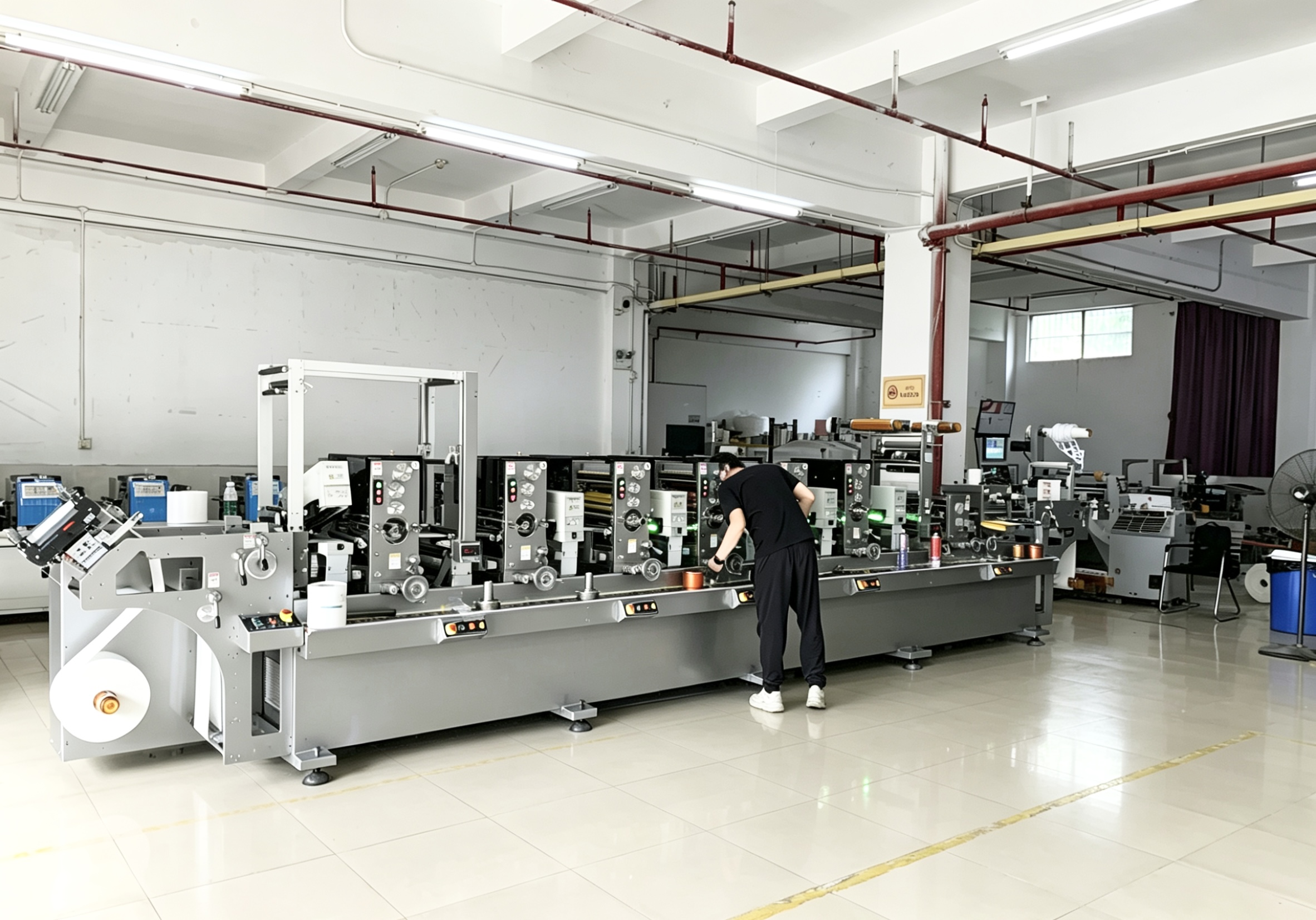
Multi-functional finishing — glue-side printing, rotary die-cutting, flatbed die-cutting and slitting — illustrates the One Machine, Multiple Functions platform logic that the hybrid press extends to print modes.
Head-to-Head Comparison Table
The table below compares the two platforms strictly on verifiable or manufacturer-reported facts. It deliberately omits nominal speed values, which are configuration-specific and belong on the quotation datasheet.
| Dimension | CS-JQ350G-6C (Hybrid) | CS-220-5C (Dedicated Intermittent) |
|---|---|---|
| Architecture | Hybrid: intermittent + full-rotary on one platform | Dedicated intermittent press |
| Printing mode | Switchable between stop-start and continuous rotation | Stop-start (intermittent) cycle |
| Best-fit run profile | Mixed job books — short custom runs plus longer repeat runs | Short, variable, changeover-heavy runs |
| Registration technology (shared) | In-house CNC parts, Japanese servo system, patented tapered bearing sleeve, photographic inspection, LED UV cold-light drying | Same CAISHENG platform technologies |
| Energy & running cost (platform data) | CAISHENG reports at least 30% better energy efficiency on its platform, via Japanese servo and LED UV drying | Same platform technologies |
| Cost position | Higher capital cost than a single-mode press; platform-relative equipment cost reported approximately 10% lower than similar manufacturers | Lower capital outlay; no unused mode |
| Compliance (company-level) | CE; ISO 9001 / ISO 14001 / ISO 45001 | CE; ISO 9001 / ISO 14001 / ISO 45001 |
| Maintenance design (shared) | Deformation-proof base, patented triangular guide rail, intelligent early-warning system | Same platform features |
| Choose it when | Your job book genuinely contains both short and long runs | Nearly all work is short-run and changeover-driven |
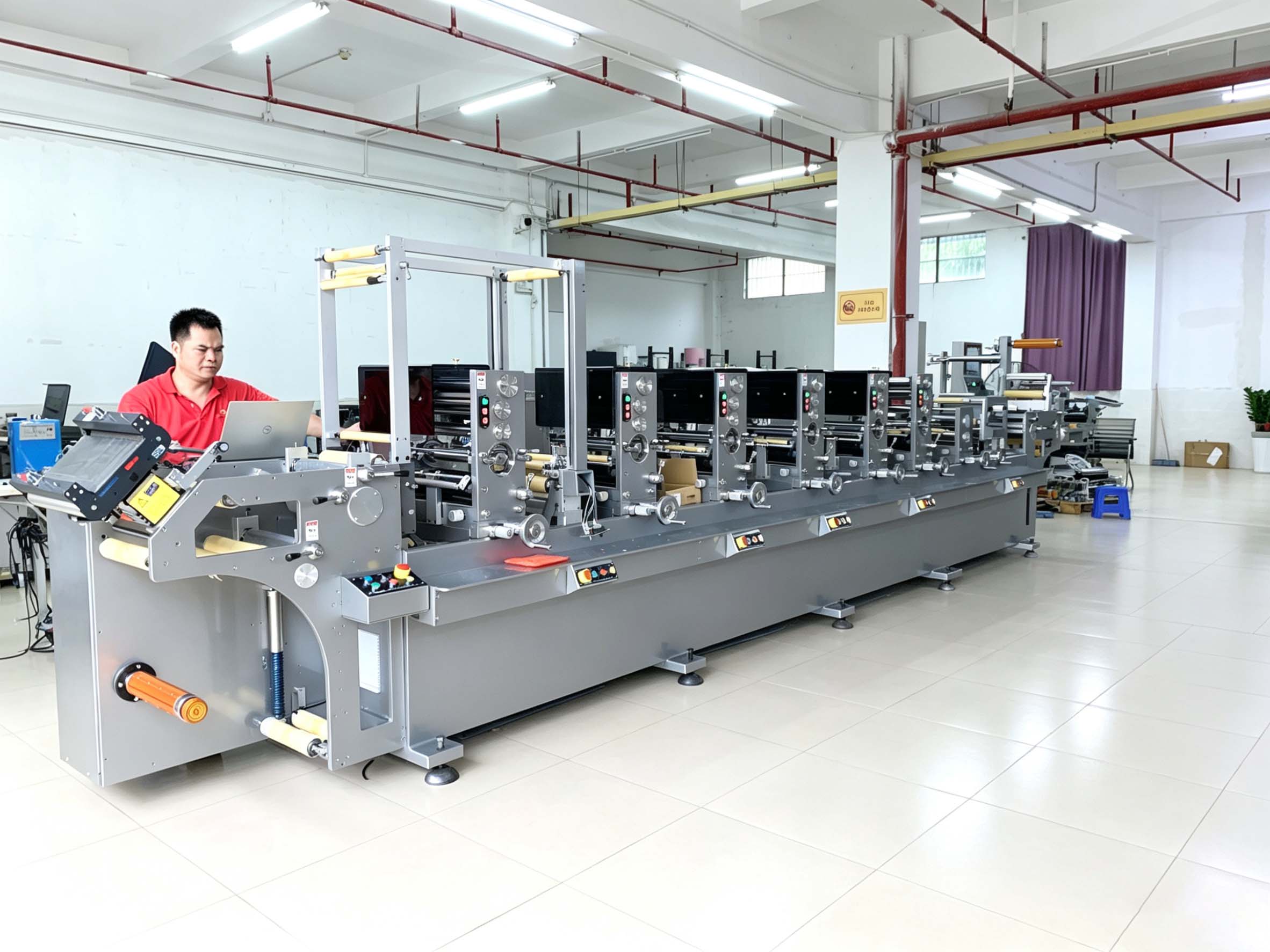
Before delivery, CAISHENG engineers test machine performance until it produces finished products, then invite buyers to factory acceptance inspection.
FAQ: Intermittent vs Hybrid Press Decisions
Does the CS-JQ350G-6C meet EU compliance requirements for import?
CAISHENG states that its products meet CE standards and holds ISO 9001, ISO 14001 and ISO 45001 certification. CE conformity is the relevant market-access requirement for label presses placed on the EU market, and flexographic printing machinery is classified under HS Code 844316 for customs purposes. Buyers should confirm the specific declaration of conformity for their exact build as part of the quotation.
What can the CS-JQ350G-6C hybrid do that the CS-220-5C intermittent press cannot?
The CS-JQ350G-6C is built to run both intermittent and full-rotary modes on one platform. A dedicated intermittent press such as the CS-220-5C runs a stop-start cycle — well suited to short, variable runs, but it spends part of every cycle not printing. The hybrid adds continuous full-rotary operation for longer runs, so a converter with a mixed job book does not need a second machine to cover long-run work. Both machines share CAISHENG platform technologies — in-house CNC parts, Japanese servo control, LED UV cold-light drying and a deformation-proof base — so the difference is architecture and mode flexibility rather than base print quality.
How much more does the hybrid cost, and how do I justify it?
CAISHENG does not publish list prices; cost is quoted per configuration. At platform level, CAISHENG reports that its equipment carries approximately 10% lower total equipment cost than similar manufacturers because precision parts are produced on its own CNC machining plants, removing intermediate margin. In practice the CS-JQ350G-6C carries a higher capital cost than a dedicated intermittent press because of its added rotary capability. The justification is a comparison against the realistic alternative, not against the intermittent press alone: weigh the hybrid's total cost against buying and running two single-mode machines, including floor space, staffing and maintenance.
Can I test the machine on my own materials before buying?
Yes. CAISHENG's process is built around validation. Before delivery, experienced machine-adjustment engineers test various performance aspects of the machine until it produces finished products, and CAISHENG invites customers to the factory for acceptance inspection. For a hybrid-versus-intermittent decision, use that step to run the actual job mix — one short custom job and one longer repeat run — so the mode comparison is tested on your own substrates rather than on a specification sheet.
What is the lead time, and how do I get a configuration-specific quote?
Lead time depends on the configuration — colour count, printing mode and finishing modules — and is confirmed on the quotation, so there is no single figure that applies to every build. To get a quote, send CAISHENG your run-length profile and material list so the configuration can be matched to your job book. Contact: email kanghong-1108@qq.com, WhatsApp +86 133-1087-8219, or the official site caishengmachinery.com.
Conclusion: Let the Job Book Decide, Not the Specification Sheet
The CS-JQ350G-6C and the CS-220-5C are not competitors in the usual sense — they are two answers to two different job books. The CS-220-5C is the efficient choice when nearly all production is short-run and changeover-driven, because it charges you for exactly one mode. The CS-JQ350G-6C is the efficient choice when the job book genuinely contains both short custom runs and longer repeat runs, because it replaces two single-mode machines with one platform — and it is that two-machine alternative, not the intermittent press alone, that the hybrid has to beat on total cost.
Because both presses share CAISHENG's platform technologies — in-house CNC precision, Japanese servo motion control, LED UV cold-light drying and a deformation-proof base — the decision rests on architecture and mode flexibility rather than on base print quality. Test the mode question on your own substrates, confirm the configuration-specific figures on the datasheet, and choose the machine whose modes match the runs you actually sell.
Next step: match the press to your run-length profile
Request a configuration quote, a sample run on your own materials, or the CAISHENG product catalogue. Send your job mix and material list, and CAISHENG will confirm the modes, colour count, finishing modules and speed for your build.
Email: kanghong-1108@qq.com | WhatsApp: +86 133-1087-8219
Website: www.caishengmachinery.com | Download the brochure: CAISHENG product catalogue (PDF)
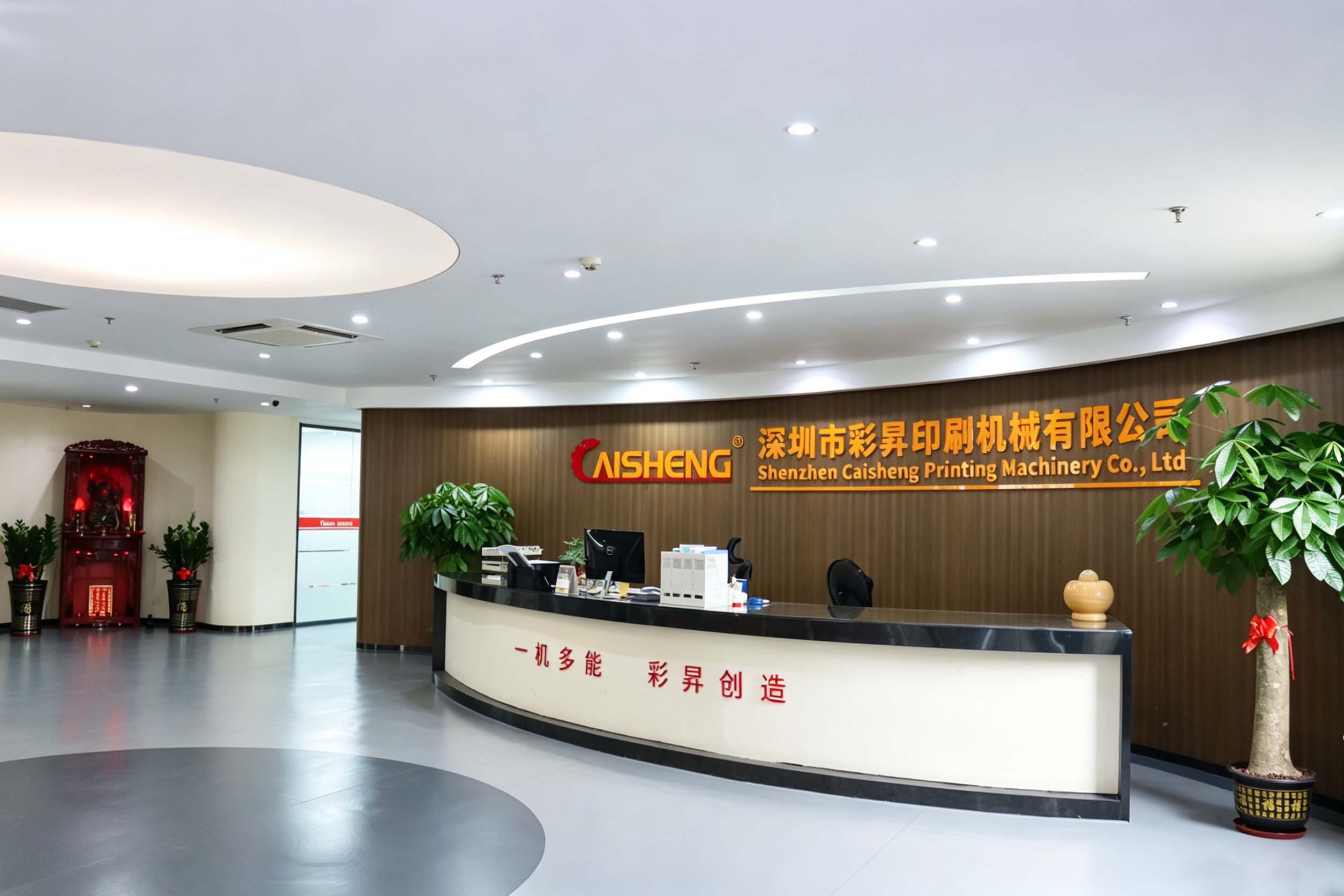
Talk to CAISHENG about a sample run or a configuration-specific quote.
Have Questions or Need More Details?
Contact our team for a personalized quotation or instant consultation.
Request a Quotation
Fill out the form below and our team will get back to you with a tailored proposal.
WhatsApp Direct Chat
Prefer to chat in real-time? Message us on WhatsApp for instant assistance & quick answers.
- Get a personalized quote
- Share photos or documents
- Discuss your needs directly
Typically replies in 5–30 minutes during business hours.