Label Die-Cutting Application Guide: CS-220, CS-300/320, CS-350/370/380
On a label printing machine, the die-cutting method is not a free choice made at the quotation stage — it is fixed by the machine family. In the CAISHENG range the split is explicit: the CS-220 is a flatbed die-cutting press, the CS-300 and CS-320 are flatbed-plus-rotary combination machines, and the CS-350/370/380 family is built around rotary die-cutting. A converter therefore gets further by profiling the job than by comparing spec columns.
The variables that decide the match are concrete: label width and cut size, run length per SKU, substrate and cut complexity, how many processes must happen inline, and what the factory floor can physically accept in terms of power, footprint and floor loading. This guide converts those variables into a routing decision across the three families, using only the specifications and company facts supplied for the CS range.
CAISHENG — Shenzhen Caisheng Printing Machinery Co., Ltd. — is a label printing equipment manufacturer founded in 2011, operating a 6,000 m² facility with 65 employees and 8 R&D engineers, and exporting roughly 50% of its output to Southeast Asia, Europe, the Middle East and the United States. Its stated product scope covers intermittent and high-speed full-rotary letterpress printing machines, flexographic printing machines, screen printing machines and customized multi-functional label finishing solutions.
The routing answer in short:
- CS-220 (flatbed die-cutting): narrow webs up to a 240 mm class, shorter runs, frequent job changes, limited floor space — one die-cutting method, one compact frame.
- CS-300/320 (flatbed + rotary combination): a mixed order book where some jobs need flatbed cutting and others need rotary cutting, without buying two presses.
- CS-350/370/380 (rotary die-cutting combination): long, repeating cuts at production speed, with multi-process finishing inline and the largest web class in the range.
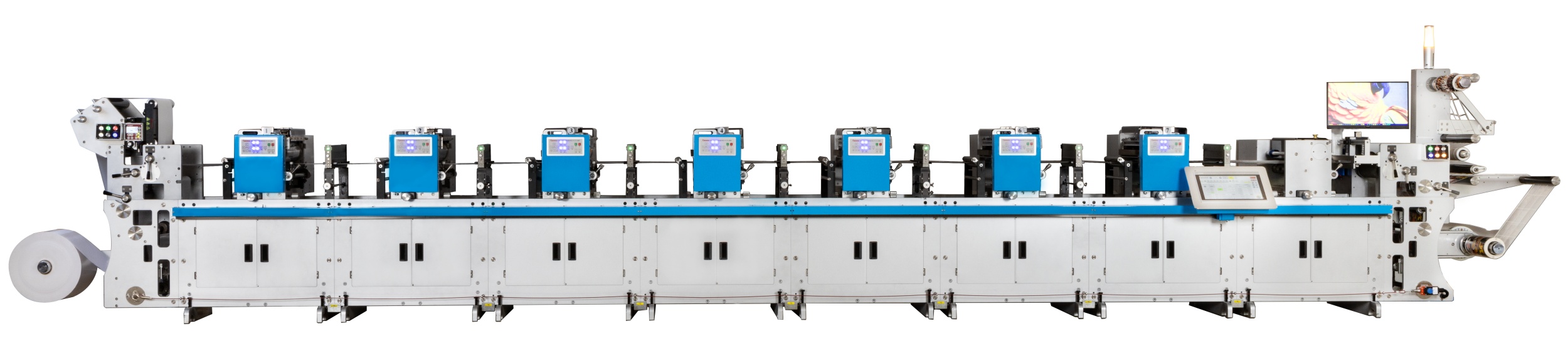
Why the die-cutting method constrains the whole project
Die-cutting is the step where a printed web becomes a usable label, and the mechanical difference between the two methods changes what the rest of the line can do. A flatbed station closes a platen against a die while the web is held stationary, then advances the web for the next cut. A rotary station cuts with a cylinder rotating in step with a continuously moving web. Everything else follows from that difference.
Flatbed cutting is the practical choice when runs are shorter, when cut shapes or materials are awkward to wrap around a cylinder, and when tooling has to change often; the reciprocating action gives the job time and keeps tooling changes manageable. Rotary cutting is used when the same cut repeats over a long run and the cutting station has to keep pace with the press rather than become the bottleneck. In general trade practice a flatbed die is described as the lower-cost, faster-to-source tool, while a rotary cylinder carries higher tooling cost and a longer tooling lead time. Those are general relationships rather than quotations — confirm current die pricing and delivery with your own tooling supplier, because tooling, not the press, is frequently the schedule constraint on a new label project.
The second consequence is line architecture. A die-cutting station is not an isolated module: it sits inside a sequence of printing, varnishing, stamping, slitting or sheet-cutting units, and the method determines how much of that sequence can run in one pass at a given speed. On combination machines the flatbed and rotary stations coexist on one frame, which is why the CS-300/320 question is rarely "which method is better" and usually "which job in my book needs which method this week".
Where the cut is the accuracy-critical feature — small pharmaceutical or cosmetic labels with tight register to the print — the registration behaviour of the press matters as much as the die station. A vendor-listed registration precision of ±0.025 mm is published for the CS-220-4C; treat that as a stated machine figure and confirm it on your own substrate, adhesive and die before you commit a production job to it.
Industry background: label demand, application spread and what the numbers do not say
Market context helps a project proposal, but only if the scope is read correctly. Mordor Intelligence puts the global print label market at USD 57.05 billion in 2026, growing at a 3.28% CAGR to reach USD 67.02 billion by 2031. That figure measures printed label output, not label press sales. Independent, machinery-specific market values for narrow-web rotary label presses were not available in the material reviewed for this guide, and label-output values and label-printer-device values are definitionally different — they should never be combined, averaged or used interchangeably in an investment case. If a business plan needs an equipment-market figure, it has to be sourced separately.
What the demand picture does support is an application spread, and that spread is where die-cutting decisions actually come from. CAISHENG's stated application scope for its label printing solution systems covers various types of self-adhesive labels — daily chemicals, wristbands, wine labels, food, cosmetics and pharmaceuticals — and its published product scope names labels, adhesive stickers, PVC stickers and tags. Those categories do not behave the same way on a die station. A wine label and a pharmaceutical label may share a web width and still diverge on cut complexity, material stiffness and the number of finishing steps required in the same pass.
The manufacturer's own design approach is instructive rather than predictive: CAISHENG describes its machines around a "one machine, multiple functions" principle, with printing factories completing multiple processes on a single machine to produce finished labels in one pass. For a converter, that principle is a question to test against the order book — how many of your jobs genuinely need more than one process inline, and how many would be better served by a simpler, narrower machine that changes over faster.
The three CAISHENG die-cutting architectures
CS-220: flatbed die-cutting on a compact frame
The CS-220 family is the flatbed entry point in the range, built on a 220 mm web class. The CS-220-4C is specified with a 30–240 mm web width, a maximum speed of 40 m/min, 8.4 kW main-machine power with 3.7 kW of UV drying listed separately, a footprint of 4.2 × 1.0 × 1.5 m and a machine weight of 2.6 T. A five-colour CS-220-5C configuration is also listed in the same family as a stickers printing machine.
For project planning, the relevant facts are the physical ones. At 2.6 T and 4.2 m long, this is a machine that fits into existing production space without a dedicated hall, and the flatbed station means die changes are a routine operation rather than a cylinder swap. That profile suits converters whose labels are narrow, whose runs are measured in shorter batches, and whose product mix changes often enough that tooling flexibility outweighs raw cutting speed. It is a poor fit for a converter whose core work is a single repeating cut at high volume — that job belongs in the rotary family.
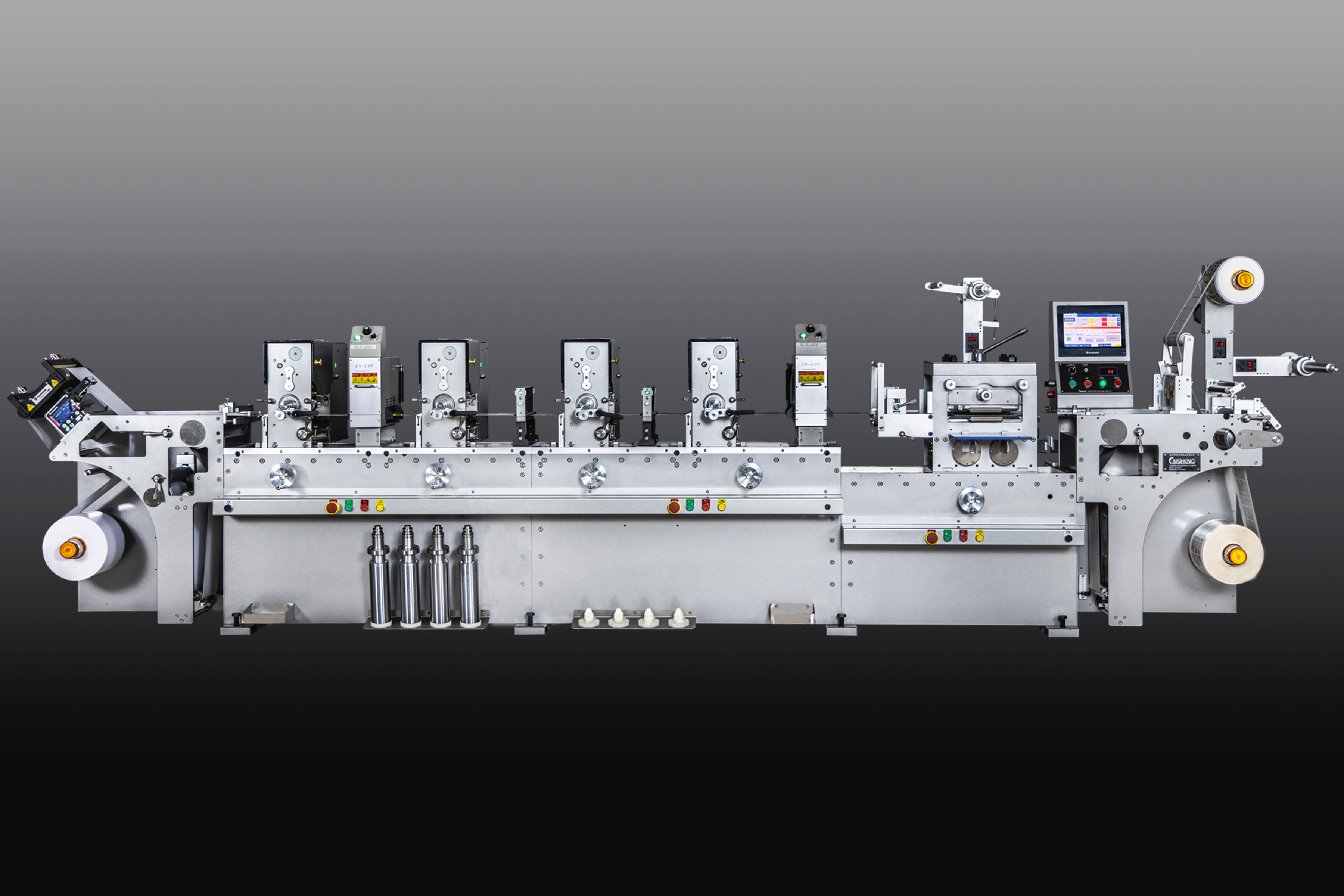
CS-300/320: flatbed plus rotary on one frame
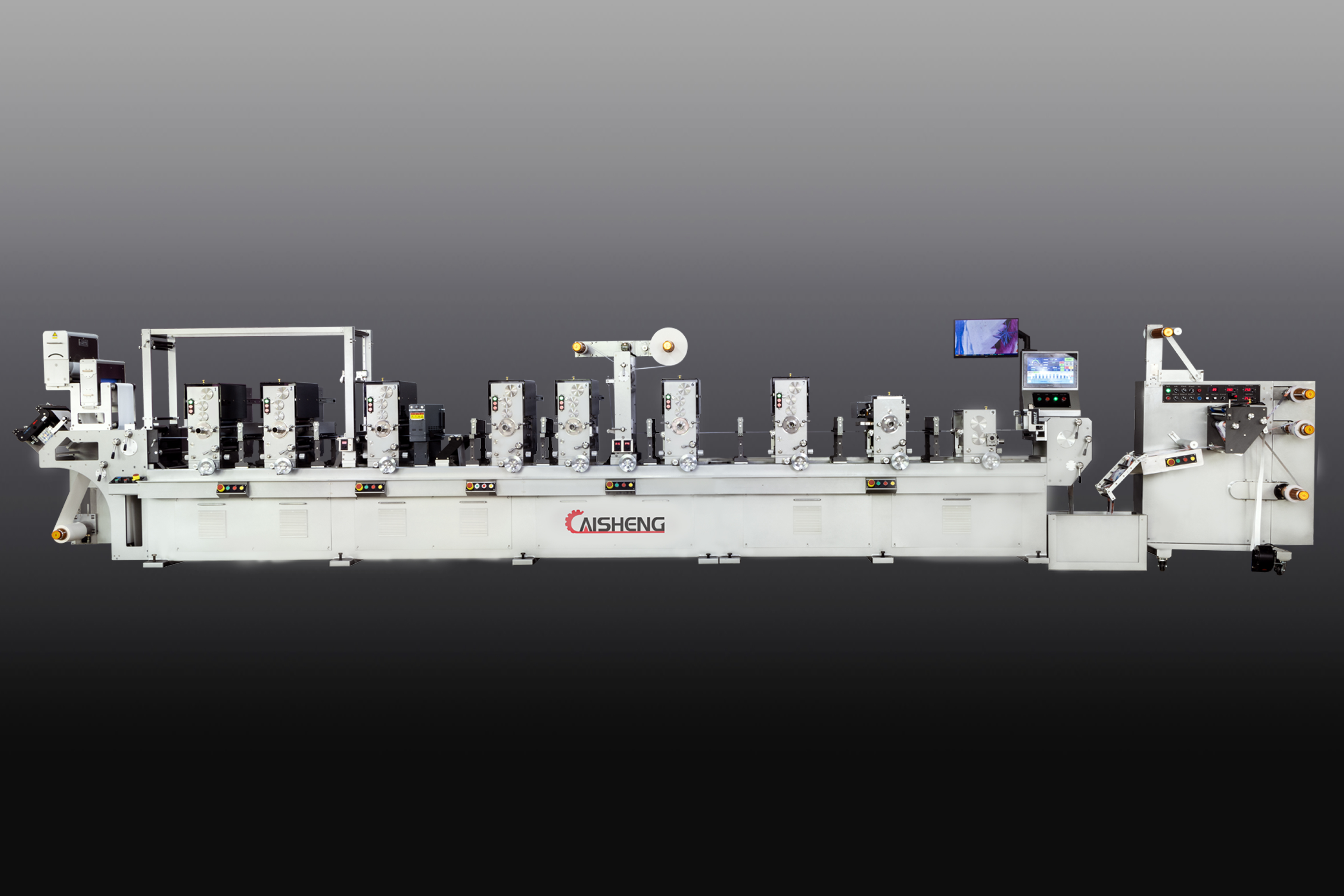
The CS-300 and CS-320 are the combination tier: both flatbed and rotary die-cutting sit on the same machine, which is the defining project advantage of this family. Documented CS-300 configurations combine letterpress printing with glue-side printing, a multi-functional frame, rotary die-cutting, flatbed die-cutting and slitting — an illustration of how much of a label's process chain can be consolidated, not a statement that every unit ships with every module.
The published specifications set the working envelope. The CS-300-5C runs a 30–300 mm web at 40 m/min with 18.8 kW main-machine power plus 6 kW of UV, 5 T and a 6.5 × 1.5 × 1.8 m footprint. The CS-300-6C keeps the 30–300 mm web and 40 m/min speed, quoting 34.5 kW including UV, 6.6 T and 8.9 × 1.5 × 2.0 m. The CS-320-6C and CS-320-7C move to a 30–320 mm web at the same 40 m/min, at 27 kW and 31 kW including UV respectively, weighing 6.2 T and 7 T with footprints of 8.4 m and 9.1 m.
The decision logic for this family is simple to state and hard to fake: a combination machine earns its footprint only if both die-cutting methods are used by real jobs. If 90% of the order book is a single repeating cut, the second station is idle capital. If the book genuinely splits — short complicated cuts on flatbed, volume repeats on rotary — then the CS-300/320 removes the need to schedule two machines, move work between them, or turn away the job that does not fit the one method you own.
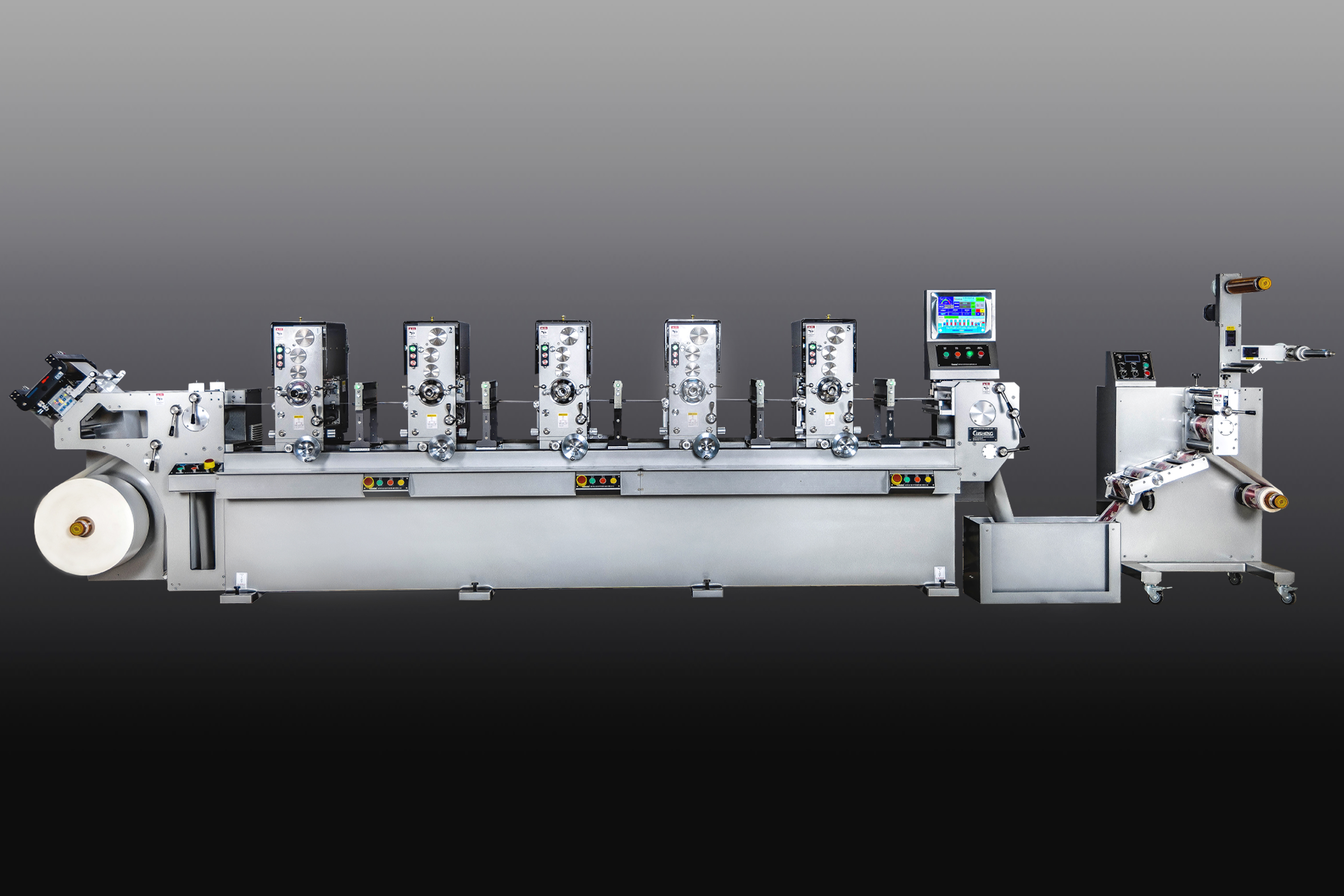
CS-350/370/380: rotary die-cutting combination platforms
The CS-350/370/380 family is where the range becomes volume-oriented. These are rotary die-cutting combination machines, and the family spans both letterpress-based and flexographic configurations with differing station counts. Published figures show how wide that span is.
The CS-JQ350G-6C is an intermittent and full-rotary high-speed label printing machine: 22 kW main-machine power with 7.8 kW of UV separate, a maximum intermittent speed of 60 m/min and a maximum full-rotary speed of 158 m/min, a full-rotary print area of 350 × 419 mm, a 7.8 × 1.5 × 1.9 m footprint and a 10 T machine weight. The CS-Q370F-6C full-rotary flexographic printing machine quotes 25 kW excluding UV dryers, 150 m/min, full-rotary print areas of 370 × 200 mm and 370 × 600 mm, 7.5 × 1.5 × 1.7 m and 7 T. On the flexo side, the CS-J380F-4C lists 25 kW including UV at 60 m/min, 7.4 × 1.3 × 1.6 m and 4 T, while the CS-J380F-7C lists 35 kW including UV at 60 m/min, 9.3 × 1.3 × 1.6 m and 6 T.
The family also includes configurations listed by model name in the current product range — CS-JQ350-7C, CS-JQ350G-10C and CS-370F-8C — whose station counts and speeds were not part of the specifications available for this guide. Treat them as variants requiring a direct specification request rather than as figures to plan against.
For a project, the rotary family is the right answer when the cut repeats long enough to justify cylinder tooling and when cutting speed has to stay upstream of the press rather than throttle it. It is the wrong answer when the order book is dominated by very short runs and frequent design changes, because the tooling cycle, not the machine, becomes the constraint.
Step by step: routing a label project to a die-cutting family
Step 1 — Write the job profile before reading any specification. Record the label width and cut size, the run length for each SKU, the substrate and liner, how complex the cut shape is, which processes must happen inline (varnish, cold foil, screen, slitting, sheet cutting), and how often the job repeats per month. A press selected against a catalogue cannot answer questions that only your order book can.
Step 2 — Decide whether the book needs one method or two. If more than a small share of jobs require flatbed-style cutting and a separate share requires long rotary repeats, the CS-300/320 combination class is the structurally correct answer. If almost every job is a narrow short run, the CS-220 flatbed is sufficient and less machine to own. If almost every job is a long repeat at speed, go directly to the rotary family.
Step 3 — Check the plant, not just the machine. Power is the most common planning error in this range because the quoted convention is not identical across models. The CS-220-4C lists 8.4 kW for the main machine with 3.7 kW of UV drying separate; the CS-300-5C lists 18.8 kW with 6 kW of UV separate; the CS-300-6C, CS-320-6C and CS-320-7C quote 34.5 kW, 27 kW and 31 kW respectively including UV; the CS-JQ350G-6C quotes 22 kW with 7.8 kW of UV separate; the CS-Q370F-6C quotes 25 kW excluding UV dryers; the CS-J380F-4C and CS-J380F-7C quote 25 kW and 35 kW including UV. Two machines both described as "25 kW" can therefore demand very different electrical supplies depending on the UV convention. Request the total connected load for your exact UV configuration. Then check floor loading and access: machine weights run from 2.6 T on the CS-220-4C to 10 T on the CS-JQ350G-6C, and lengths from 4.2 m to 9.3 m, with machine heights between 1.5 m and 2.0 m. On working conditions, the supplied application data states the machines operate at room temperature and do not require a constant-temperature production workshop — but they do require supporting equipment: a servo system, air cooling, water cooling and UV drying lamps.
Step 4 — Validate tooling and cut quality on your own material. Ask what die format the station accepts, what the tooling lead time is for your cut, and whether a trial cut can be run on your substrate at your target speed. A machine trial on demonstration material answers a different question from a trial on your liner, adhesive and face stock.
Step 5 — Lock the commercial and support plan. CAISHENG quotes a minimum order quantity of 1 unit, a lead time of 45–60 days and a stated monthly capacity of 18 units, with 100% testing stated as its quality-control approach, and remote support with a one-year warranty on major components. Customization is handled as ODM work: the customization scope lists colour stamping, glue-side printing frame, cold foil stamping, lamination, offline and online UV varnishing, flatbed die-cutting, rotary die-cutting, sheet cutting, slitting, corona treater, dust cleaner, static eliminator, full-rotary screen printing, hot foil stamping and embossing, with design, size, process and function customized one-to-one against the customer's order requirements.
Use cases: four job profiles and what they imply
Profile A — short-run beverage and craft labels on narrow webs. A converter running frequent design changes on labels in the 200 mm class, with modest run lengths and limited floor space, is structurally matched to the CS-220: flatbed die-cutting, 40 m/min maximum speed, a 2.6 T machine on a 4.2 m footprint. The gain is changeover flexibility, not throughput. This is a conditional match — if the same converter's volumes grow into long repeats, the rotary family becomes the relevant comparison.
Profile B — a mixed book across daily chemical, food and cosmetic labels. Where some jobs are short and awkward to cut and others are steady volume repeats, the flatbed-plus-rotary CS-300/320 class lets one machine absorb both without external scheduling. The buying question is not "is a combination machine better" but "what share of my monthly jobs uses each method" — a question answerable from production records before any quotation.
Profile C — long-run pharmaceutical or food labels with multi-process finishing. Where the cut repeats, volume is high and several processes must run inline, the rotary family is the relevant tier. Within it, the choice between the intermittent-plus-full-rotary CS-JQ350G-6C (60 m/min intermittent, 158 m/min full rotary) and the full-rotary flexo configurations (CS-Q370F-6C at 150 m/min, CS-J380F at 60 m/min) turns on print technology, station count and the width of the widest job — not on the die-cutting method, which is rotary across the family.
Profile D — documented references. Two installed cases are on record for the combination tier. An Asian trademark design and printing company in Taiwan took one CS-320 unit for high-quality label printing and, after roughly two years in service, cited printing precision, stable production performance and flexible process expansion as the basis of its acceptance. A US commercial printing and packaging provider, R.R. Donnelley & Sons, took one CS-300 unit as label production equipment; after around three years it cited stable registration accuracy, print quality and equipment reliability, and the relationship continued long-term. Both are single-unit, client-reported outcomes. They show that the combination architecture has been deployed and accepted in production; they do not constitute a throughput or uptime benchmark, and they should not be read as one.
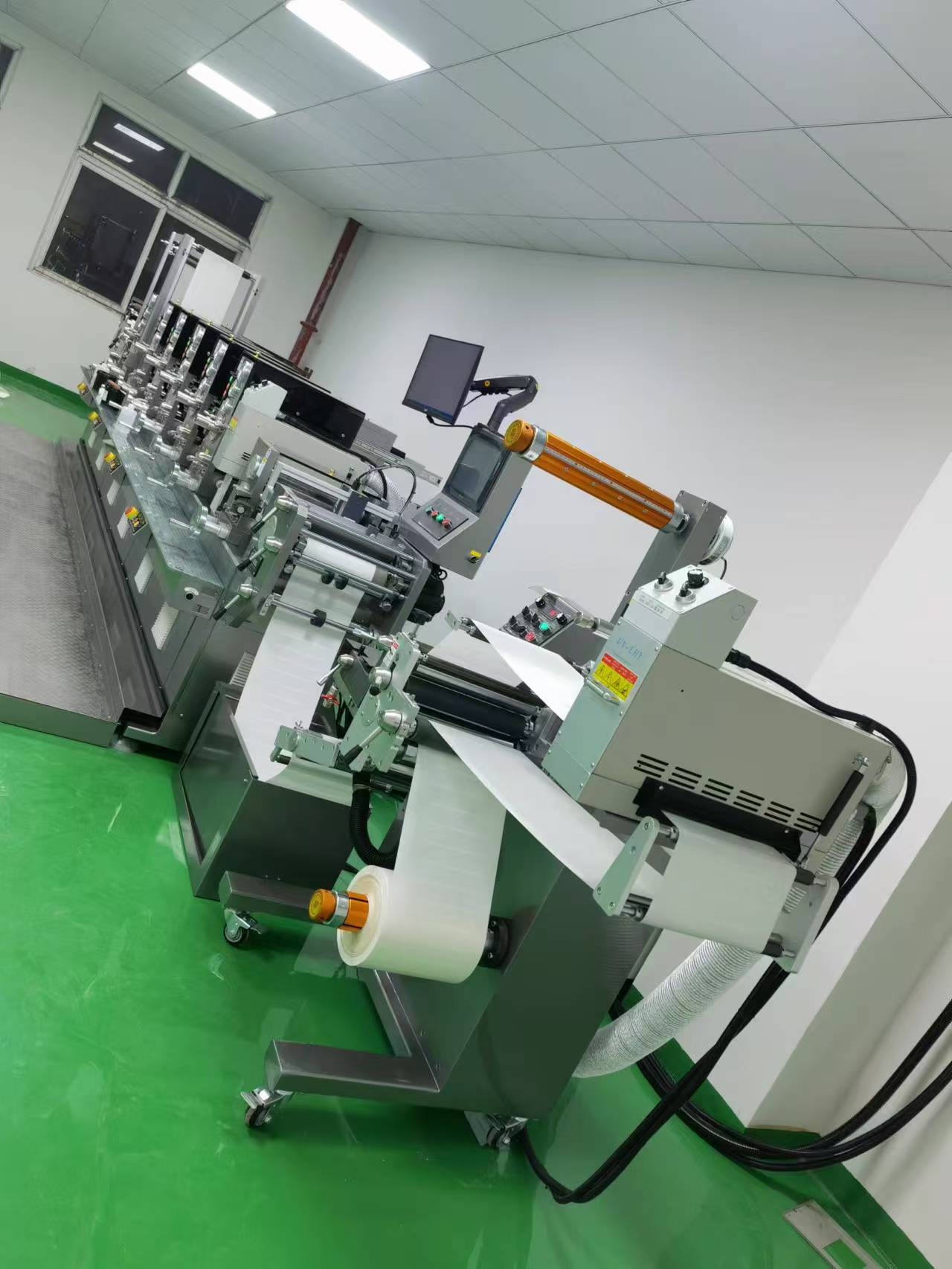
Die-cutting specification comparison
The table below compares representative models from each family using only published specifications. It is not a performance ranking: it shows which envelope each model occupies, so a project can be screened against it before a quotation is requested.
| Model | Die-cutting architecture | Web width | Max print area (full rotary) | Max speed | Main-machine power | Footprint (L×W×H) / weight |
|---|---|---|---|---|---|---|
| CS-220-4C | Flatbed | 30–240 mm | 220 × 245 mm | 40 m/min | 8.4 kW + 3.7 kW UV | 4.2 × 1.0 × 1.5 m / 2.6 T |
| CS-300-6C | Flatbed + rotary combination | 30–300 mm | 280 × 326 mm | 40 m/min | 34.5 kW incl. UV | 8.9 × 1.5 × 2.0 m / 6.6 T |
| CS-320-7C | Flatbed + rotary combination | 30–320 mm | 320 × 326 mm | 40 m/min | 31 kW incl. UV | 9.1 × 1.5 × 2.0 m / 7 T |
| CS-JQ350G-6C | Rotary (intermittent + full rotary) | Not stated | 350 × 419 mm | 60 m/min intermittent; 158 m/min full rotary | 22 kW + 7.8 kW UV | 7.8 × 1.5 × 1.9 m / 10 T |
| CS-Q370F-6C | Rotary (flexographic) | Not stated | 370 × 200 mm; 370 × 600 mm | 150 m/min | 25 kW excl. UV | 7.5 × 1.5 × 1.7 m / 7 T |
| CS-J380F-7C | Rotary (flexographic) | Not stated | 360 × 419 mm | 60 m/min | 35 kW incl. UV | 9.3 × 1.3 × 1.6 m / 6 T |
Source: published CS-series specifications. "Not stated" indicates the figure was not included in the specification set available for this guide; request it with the quotation. Speeds are stated machine maximums, not guaranteed job throughput. CS-JQ350-7C, CS-JQ350G-10C and CS-370F-8C are additional configurations in the rotary family whose specifications were not available here.
Limitations and verification points before you commit
Four things are worth checking before any die-cutting configuration is approved, because none of them can be settled from a specification sheet.
- Speed ratings are machine maximums. A stated 40, 60, 150 or 158 m/min describes the machine at its limit, not your job. Die complexity, substrate, adhesive, register tolerance and the number of inline processes all reduce sustainable running speed. Ask for a running-speed expectation for your specific job, at your specific cut, and treat it as an estimate to be confirmed in a trial.
- Field benchmark data is not public. Independent measured figures for uptime ratio, waste percentage per job change and after-sales response time by region were not available for these models. If a business case depends on those numbers, obtain them from reference customers running comparable work — not from a brochure comparison.
- Vendor-stated precision needs local confirmation. Published registration figures, including the ±0.025 mm listed for the CS-220-4C, are machine-level statements. Register behaves differently on a stiff wine stock than on a thin film, and differently again with a new die compared with a worn one.
- A combination machine only pays if both stations work. The flatbed-plus-rotary advantage on the CS-300/320 disappears if one method sits idle. Model the job mix before choosing the tier, not after installation.
Two practical compliance points complete the check. For shipments into the EU, request the CE conformity documentation for the exact model and configuration in the quotation, and verify it against the machine being shipped rather than against a generic brochure claim. For customs classification, flexographic printing machinery is classified under HS code 844316, so a CS-J380F or CS-Q370F shipment should be reviewed with your customs broker against that heading before the invoice is issued — confirmation from a broker is worth more than an assumption.
FAQ: die-cutting fit for CS-series label presses
What site conditions and documentation does a CAISHENG die-cutting press require?
The machines are stated to run at normal room temperature and do not require a constant-temperature production workshop, but they do require supporting equipment — a servo system, air cooling, water cooling and UV drying lamps. On the electrical side, confirm the total connected load including the UV configuration, because the quoted convention differs by model. For EU import, request CE conformity documentation for the exact configuration; for flexographic models, review the HS 844316 classification with a customs broker before shipment.
Can one CAISHENG press run both flatbed and rotary die-cutting?
Yes — on the CS-300 and CS-320, which are flatbed-plus-rotary combination machines with both die-cutting methods on the same frame. A documented CS-300 configuration combines letterpress printing with glue-side printing, a multi-functional frame, rotary die-cutting, flatbed die-cutting and slitting. The CS-220 is flatbed only, and the CS-350/370/380 family is built around rotary die-cutting.
How far can the die-cutting station and the surrounding process chain be customized?
CAISHENG works as an ODM supplier with a customization scope that includes flatbed die-cutting, rotary die-cutting, sheet cutting, slitting, colour stamping, glue-side printing frame, cold foil stamping, lamination, offline and online UV varnishing, corona treater, dust cleaner, static eliminator, full-rotary screen printing, hot foil stamping and embossing. Design, size, process and function are customized one-to-one against the customer's order requirements, with a minimum order quantity of one unit.
What drives the cost of a die-cutting configuration?
Published price lists are not part of the available materials, so the honest answer is structural rather than numeric: cost is driven by the die-cutting architecture, the model class and web width, the number of printing and finishing stations, the UV drying requirement and the resulting connected load, and the machine footprint and weight. Because the minimum order quantity is one unit, a single machine can be specified to a job — which means the quotation should be built from your job profile rather than from a standard configuration list.
Can we validate die-cutting on our own material before ordering?
Ask for it explicitly, and specify the substrate, liner, die, cut size, register tolerance and run length you want tested. CAISHENG states 100% testing as its quality-control approach, which covers machine condition before shipment but does not replace a trial on your material. A trial cut on your own stock at your target speed is the only way to confirm that the chosen flatbed or rotary station behaves on the job you intend to run.
What are the lead time, capacity and after-sales terms?
CAISHENG quotes a lead time of 45–60 days, a stated monthly capacity of 18 units and an annual output of 200 units, with remote support and a one-year warranty on major components. The company exports roughly 50% of its output to Southeast Asia, Europe, the Middle East and the United States. For a live project, the fastest route is to send the job profile for a configuration recommendation and quotation.

Next step: turn the job profile into a configuration
The three families divide cleanly. Choose the CS-220 when the work is narrow, varied and space-constrained and flatbed cutting covers it. Choose the CS-300/320 when the order book genuinely splits between short flatbed cuts and rotary volume. Choose the CS-350/370/380 when the cut repeats long enough that rotary tooling and cutting speed determine whether the line runs at its rating. In every case the sequence is the same: profile the job, decide the method, check the plant, validate on your material, then price the configuration.
For a comparative view of the manufacturer and its product scope, see CAISHENG label printing machinery. The company's full product and capability documentation, including finishing and die-cutting modules, is available in the CAISHENG product brochure (PDF).
Send your job profile for a die-cutting recommendation
Share the label width, cut size, substrate, run length per SKU and the inline processes your job needs. CAISHENG will map it to the CS-220, CS-300/320 or CS-350/370/380 class and return a configured quotation.
Contact: Alice · Email kanghong-1108@qq.com · Tel +8613186283944 · WhatsApp +86 133-1087-8219 · No.39 Shuitian Road, Tongle Community, Longgang District, Shenzhen, China.
Have Questions or Need More Details?
Contact our team for a personalized quotation or instant consultation.
Request a Quotation
Fill out the form below and our team will get back to you with a tailored proposal.
WhatsApp Direct Chat
Prefer to chat in real-time? Message us on WhatsApp for instant assistance & quick answers.
- Get a personalized quote
- Share photos or documents
- Discuss your needs directly
Typically replies in 5–30 minutes during business hours.