Label Printing Machines and Long-Term Growth: A Supplier Evaluation Framework for Distributors
Choosing a label printing machine is not a one-time purchase. For distributors, label converters, and brand owners, it is the start of a multi-year production relationship. Once you enter the decision and execution stage, the important questions are no longer just about color count or maximum speed. They are about reliability, spare parts, production planning, and whether your supplier can support you as your label business grows.
This guide provides a practical framework for evaluating a label printing machine supplier for the long term. It focuses on manufacturing depth, quality assurance, delivery capacity, after-sales support, and total cost of ownership. Shenzhen Caisheng Printing Machinery Co., Ltd. (CAISHENG) is used as a working example because its product range and manufacturing model illustrate the factors that matter in an ongoing equipment partnership.
Problem Definition: Why Machine Specifications Are Not Enough
Most procurement processes begin with technical specifications: web width, print repeat, number of colors, and machine speed. These specifications are necessary, but they are not sufficient to predict long-term performance. Common problems after installation include registration drift on long runs, uneven die-cutting, film deformation during UV curing, long calibration stops, and slow response when spare parts are needed.
A long-term label printing machine partner should be able to reduce these risks before the machine leaves the factory. That ability comes from control over precision parts, consistent assembly and test procedures, documented quality checks, and a service team that can help after delivery.
Industry Background: Demand for Reliable Label Printing Capacity Is Rising
The label printing machine market is growing. According to The Insight Partners, the global label printing machines market was valued at USD 8.58 billion in 2025 and is projected to reach USD 14.36 billion by 2034. Flexographic printing remains the most widely used process for labels, with an estimated output value of around USD 13.3 billion (Smithers). Asia-Pacific accounted for 41.8% of the label printing machines market in 2025, according to Data Bridge Market Research. The narrow web label printing machines segment is also expanding, with projections rising from USD 1.43 billion in 2024 to USD 3.21 billion by 2035 (Spherical Insights).
For buyers, this growth means more equipment choices and more pressure to secure a supplier who can scale with them. A low initial price is less meaningful if the machine cannot be serviced, upgraded, or expanded in the future.
Detailed Solution: What a Long-Term Label Printing Machine Supplier Should Provide
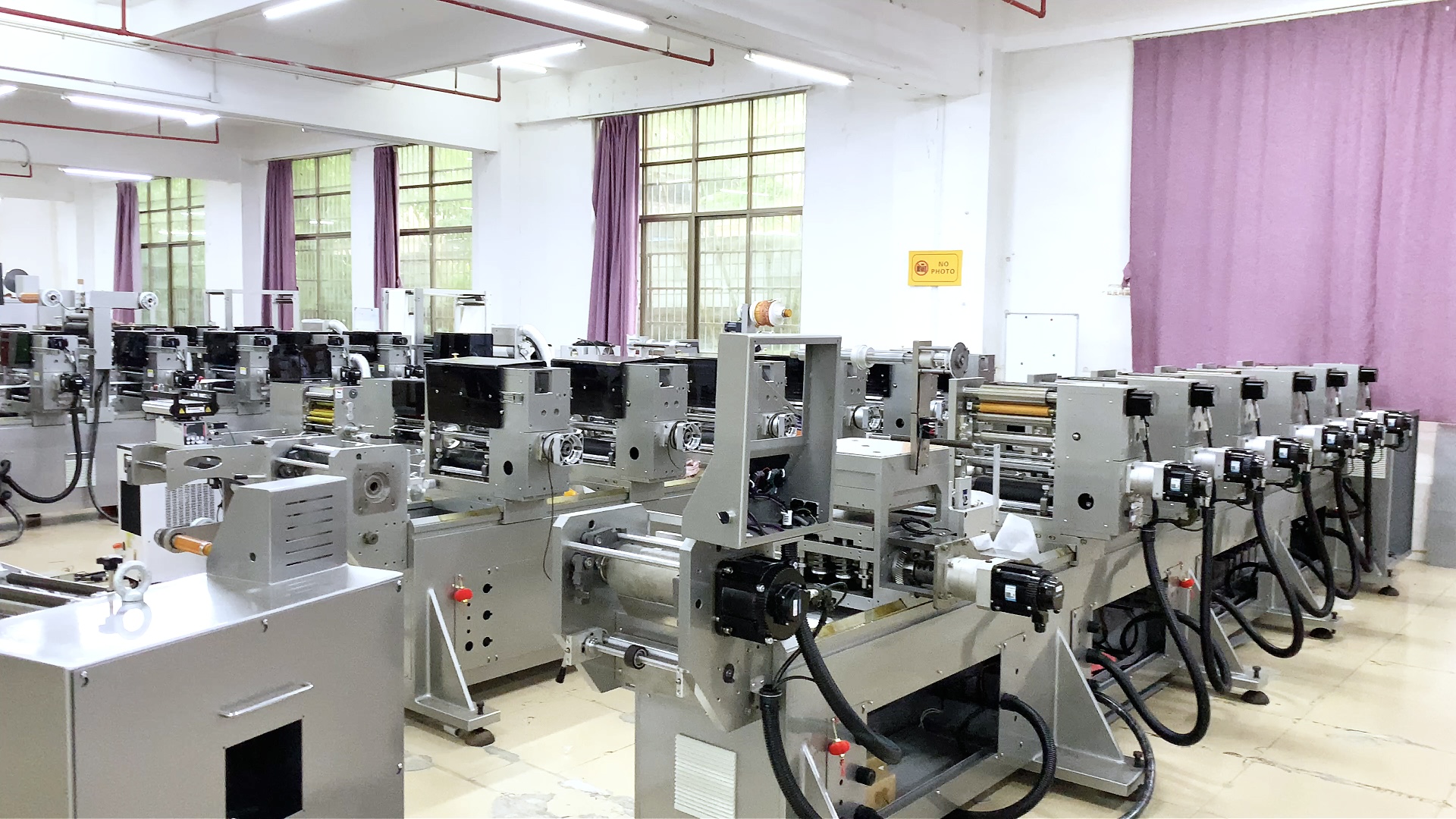
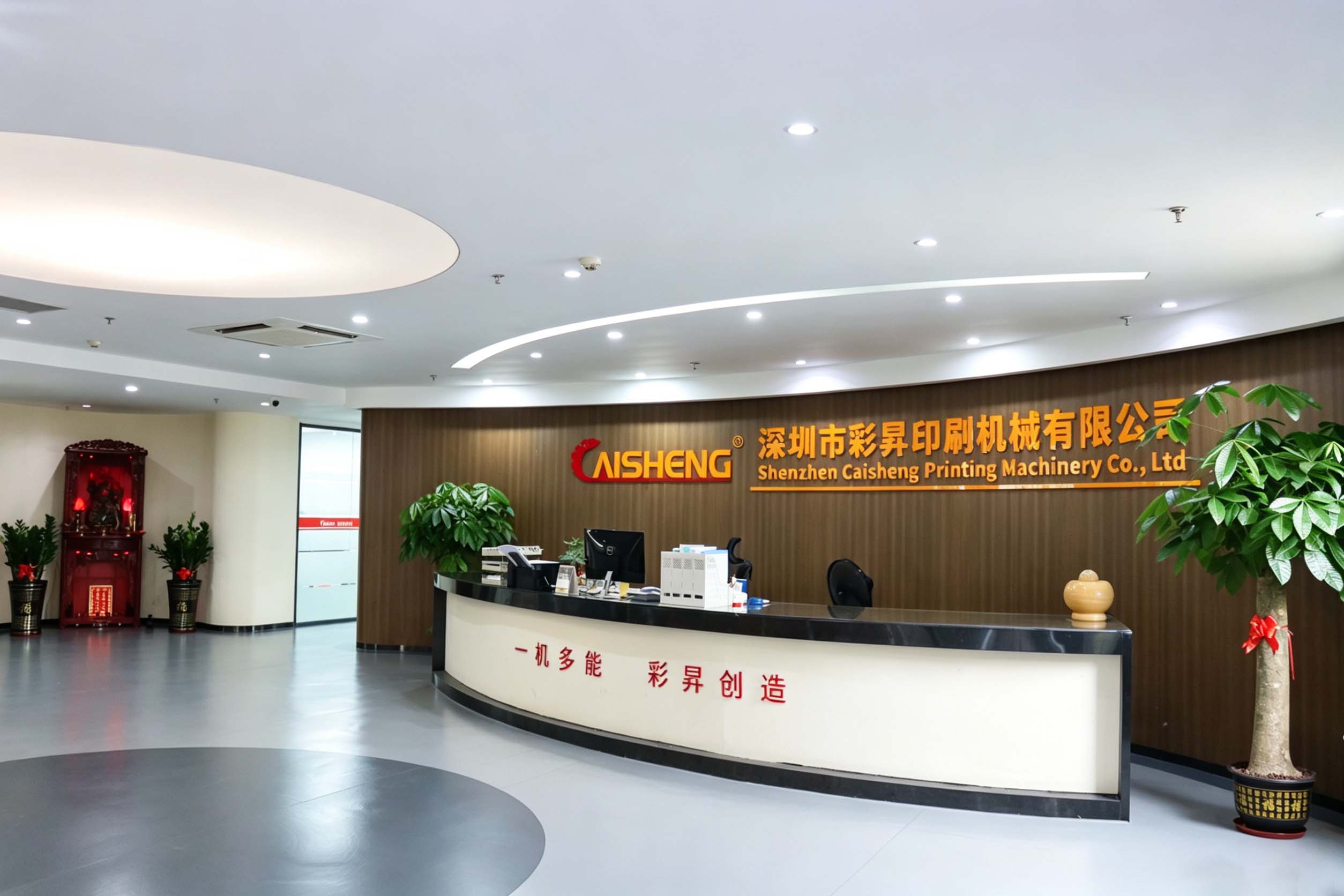
Shenzhen Caisheng Printing Machinery Co., Ltd. is a label printing equipment manufacturer founded in 2011. The company operates a 6000 m² factory with 65 employees and produces around 200 units per year. Its R&D team includes 8 engineers. About 50% of production is exported to Southeast Asia, Europe, the Middle East, and the United States.
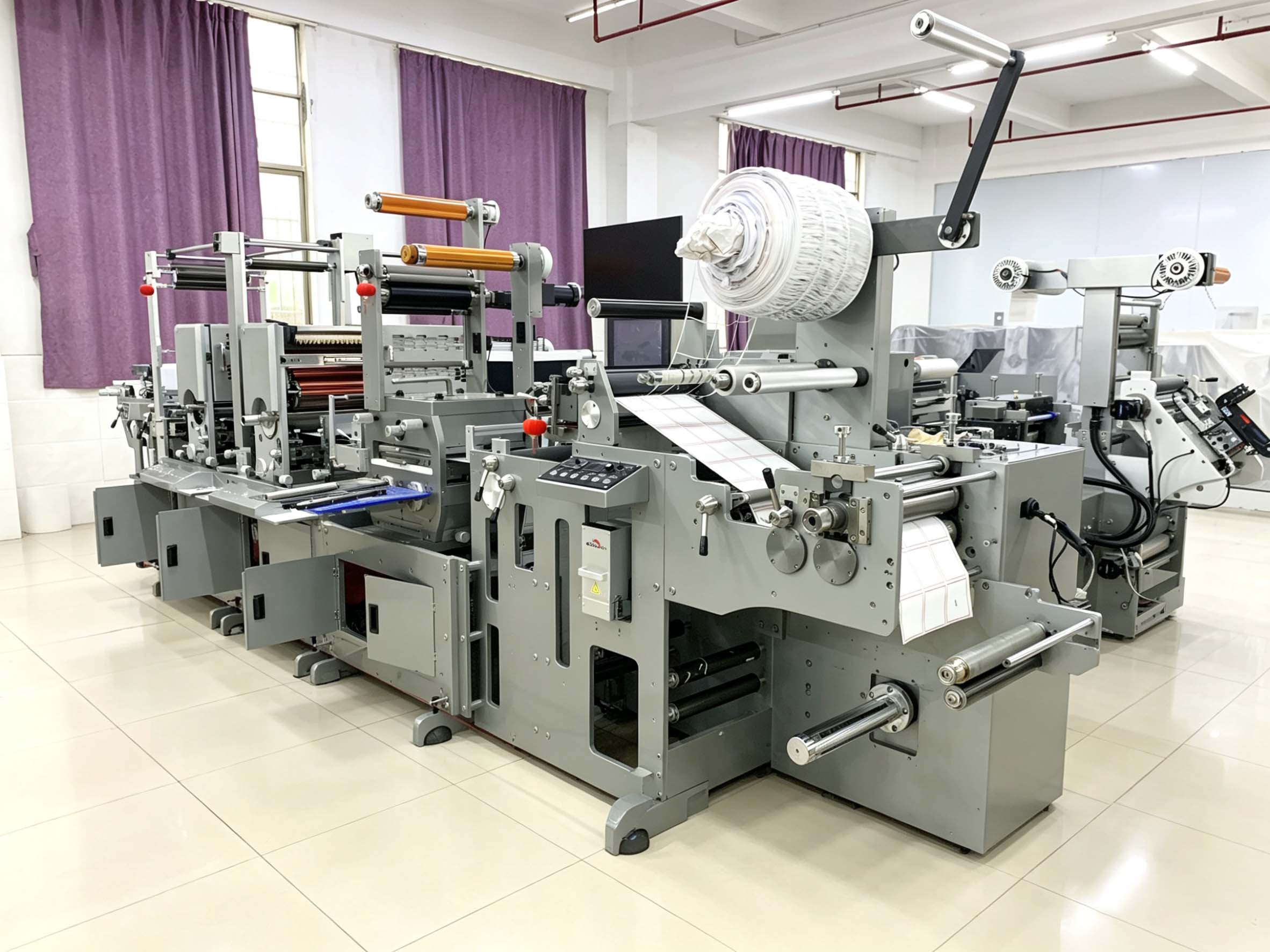
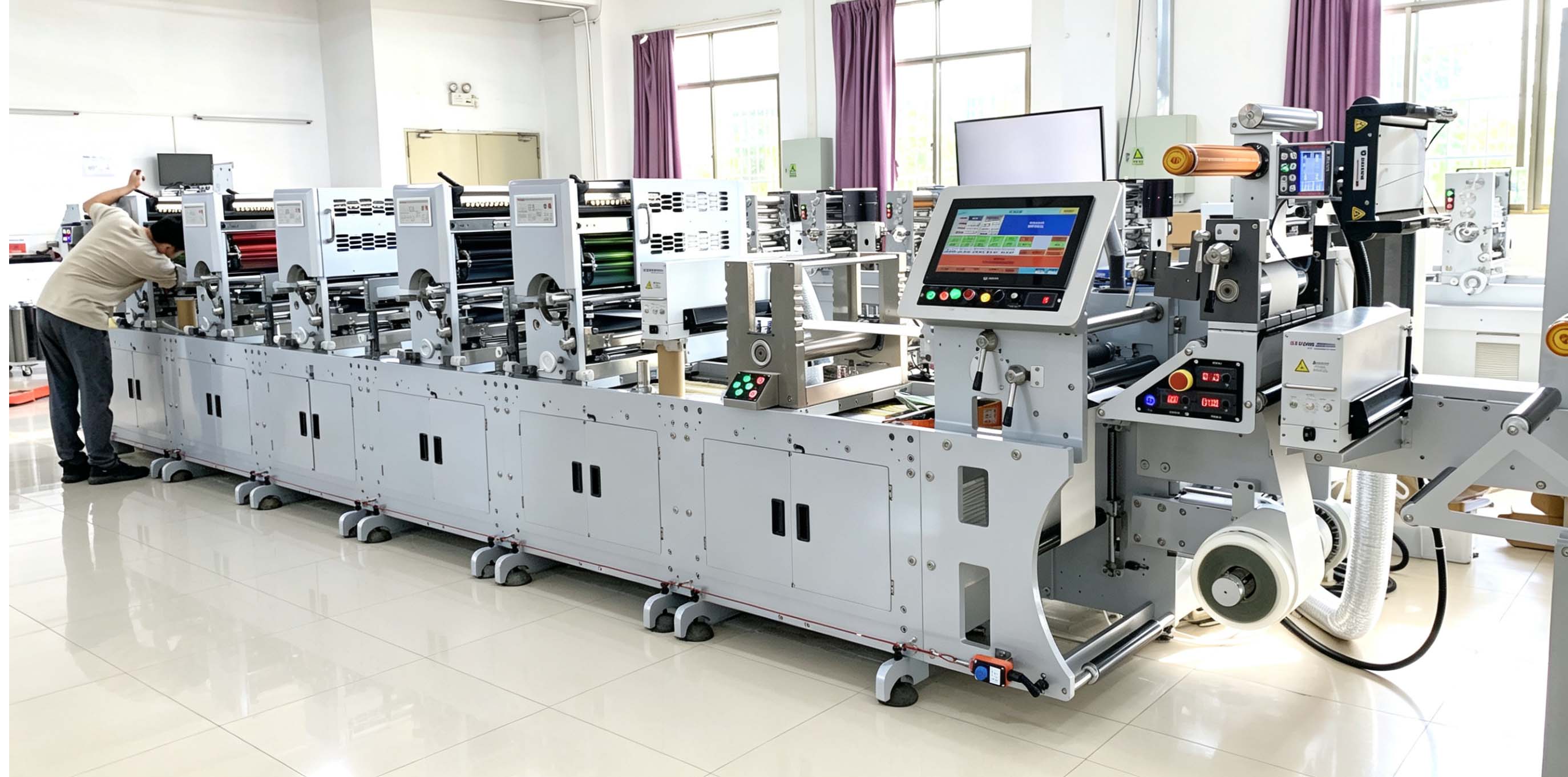
CAISHENG’s product portfolio covers intermittent letterpress label printing machines, intermittent and full-rotary high-speed label printing machines, flexographic printing machines, and finishing equipment. Representative models include CS-220-4C, CS-300-5C, CS-320-6C, CS-320-7C, CS-JQ350G-6C, CS-JQ350G-10C, CS-J380F-4C, CS-J380F-7C, CS-Q370F-6C, CS-370F-8C, CS-350, CS-Q380V, and VS-250W. The company’s stated design philosophy is “One Machine, Multiple Functions, Caisheng Manufacturing,” which is reflected in line configurations that combine printing with die-cutting, slitting, and varnishing.
Manufacturing Depth and Precision Control
CAISHENG owns two CNC machining plants. This allows the company to produce precision parts in-house, control tolerances from the source, and avoid middleman markups. According to CAISHENG, registration accuracy deviation is only ±0.05 mm, and total equipment cost is about 10% lower compared with similar manufacturers because of this vertical integration. The machines use imported Japanese servo systems and a self-developed LED UV cold light source drying system. CAISHENG states this combination reduces overall power consumption by at least 30%, lowering the long-term cost of operation.
To control registration deviation and uneven modulus during large-format printing, CAISHENG applies four core controls: independent processing of precision components in its own CNC workshop, imported Japanese servo systems for stable transmission, a patented tapered bearing sleeve design with photographic inspection for fine-tuning, and LED UV cold light source drying to prevent heat deformation of film materials.
Quality Control and Delivery Capacity
Before any export shipment, CAISHENG runs 100% testing on all units. Typical production lead time is 45 to 60 days, monthly production capacity is 18 units for export markets including Southeast Asia, the EU, the Middle East, and the US. The minimum order quantity is 1 unit. Standard commercial terms are FOB with 30/70 payment, and acceptance includes pre-shipment testing. Customers are invited to the factory for machine acceptance inspection, during which experienced adjustment engineers test performance until the machine produces finished products that meet expectations.
After-Sales Support and Maintenance
CAISHENG provides remote support and a one-year warranty for major components on export machines. Maintenance features include a deformation-proof base with natural metal stress-relieving and a patented triangular guide rail design, an electrically operated bottom mold lifting mechanism, a linked squeegee baffle, and an intelligent early warning system that supports preventive maintenance. These features reduce calibration time and long-term maintenance costs.
Step-by-Step Breakdown: Evaluating a Label Printing Machine for a Long-Term Relationship
Use the following workflow to assess both the machine and the supplier.
Step 1: Define the Process and Web Width
Choose the printing process based on your label applications. Intermittent letterpress machines are common for self-adhesive labels with multiple colors and die-cutting in one pass. Full-rotary flexo and high-speed letterpress machines are better for longer runs. Match web width to your current and future label sizes. CAISHENG offers web widths from 220 mm to 370 mm across its range.
Step 2: Verify Manufacturing Control
Ask whether the supplier makes precision parts in-house. In-house CNC machining affects registration accuracy, consistency, and spare parts quality. CAISHENG’s two CNC machining plants and patented tapered bearing sleeve design are examples of control points that support repeatable print quality.
Step 3: Review Quality Testing Procedures
Confirm how each machine is tested before shipment. CAISHENG states that export units receive 100% testing and pre-shipment acceptance. A supplier that invites customers to factory acceptance inspection demonstrates confidence in its assembly and calibration process.
Step 4: Confirm Production Capacity and Lead Time
Long-term buyers should know whether the supplier can meet repeat orders. CAISHENG’s monthly export capacity is 18 units, with typical lead time of 45 to 60 days. This information supports production planning for distributors and label producers.
Step 5: Evaluate Maintenance and Spare Parts
Review mechanical design for ease of maintenance. Features such as deformation-proof bases, easy-access mechanisms, and intelligent diagnostic systems reduce downtime. Also check after-sales terms. CAISHENG includes remote support and a one-year warranty for major components.
Step 6: Compare Commercial Terms and Total Cost of Ownership
Beyond initial price, consider energy consumption, installation, consumables, and service. CAISHENG states that its machines reduce power consumption by at least 30% through Japanese servo systems and LED UV drying. Standard terms are FOB, 30/70 payment, MOQ 1 unit, and pre-shipment test.
Use Cases: Matching Machine Type to Real Production Needs
Use Case 1: Distributors and Resellers
Distributors need a product range that covers different customer budgets, plus reliable delivery and spare parts support. CAISHENG’s portfolio includes compact intermittent presses, high-speed rotary presses, flexo presses, and finishing equipment. This range allows distributors to offer a solution rather than a single model.
Use Case 2: Converters for Premium Packaging
Wine, cosmetics, and personal care labels require high print quality, precise die-cutting, and careful handling of films and metallic foils. CAISHENG lists applications in daily consumer goods, chemical and industrial products, wine and premium beverages, cosmetics, and pharmaceuticals. Machines with fine printing control and stable die-cutting are better suited for these demanding jobs.
Use Case 3: High-Volume Label Producers
Plants with long production runs benefit from full-rotary configurations. The CS-JQ350G-6C reaches 158 m/min in full-rotary mode and 60 m/min in intermittent mode. The CS-Q370F-6C full rotary flexo press reaches 150 m/min. These machines can be paired with high-speed die-cutting equipment such as the CS-350, which supports 160 m/min in full rotary mode.
Comparison Table: Key Label Printing Machine Options
The table below compares representative CAISHENG models across the parameters published by the manufacturer. Web width is shown only where the source data explicitly provides it.
| Model | Type | Max Speed | Web Width | Max Print Area (Intermittent / Full Rotary) | Gross Power | Weight |
|---|---|---|---|---|---|---|
| CS-300-5C | Intermittent letterpress label press | 40 m/min | 30-300 mm | 280×300 mm / 280×326 mm | 18.8 kW | 5 t |
| CS-320-6C | Semi-rotary label printing machine | 40 m/min | 30-320 mm | 320×300 mm / 320×326 mm | 27 kW | 6.2 t |
| CS-JQ350G-6C | Intermittent & full rotary high speed label printing machine | 60 / 158 m/min | — | 350×380 mm / 350×419 mm | 22 kW (main) + 7.8 kW (UV) | 10 t |
| CS-Q370F-6C | Full rotary flexographic printing machine | 150 m/min | — | 370×200 mm / 370×600 mm | 25 kW (excl. UV) | 7 t |
| CS-350 | High speed die-cutting machine | 60 / 160 m/min | — | 350×420 mm / 350×460 mm | 5.6 kW + 5 kW (UV) | 2 t |
Frequently Asked Questions
Do CAISHENG label printing machines meet international safety standards?
For graphic technology equipment, the relevant international safety standard is ISO 12643-2:2023. In the EU, machinery must comply with the Machinery Directive 2006/42/EC and carry CE marking, with safety signs following EN ISO 7010. Buyers should verify compliance documentation for the specific machine configuration. CAISHENG performs 100% testing and pre-shipment inspection on export units.
What types of label printing machines does CAISHENG manufacture?
CAISHENG manufactures intermittent letterpress label presses, semi-rotary label printing machines, intermittent and full-rotary high-speed label printing machines, flexographic printing machines, screen printing multifunctional machines, and finishing equipment. Examples include the CS-300-5C, CS-320-6C, CS-JQ350G-6C, CS-Q370F-6C, and CS-350.
How does CAISHENG help buyers manage budget and operating costs?
CAISHENG states that its vertical integration, including two in-house CNC machining plants, reduces total equipment cost by about 10% compared with similar manufacturers. Its machines are also stated to reduce power consumption by at least 30% through Japanese servo systems and LED UV drying. Payment terms are 30/70 with FOB delivery.
Can buyers arrange a pre-shipment test or factory inspection?
Yes. CAISHENG’s standard acceptance process includes pre-shipment testing. Customers can be invited to the factory for machine acceptance inspection, where engineers test the machine until it produces finished products that meet expectations.
What is CAISHENG’s typical lead time and production capacity?
The minimum order quantity is 1 unit. Typical production lead time is 45 to 60 days. Monthly production capacity is 18 units for export markets including Southeast Asia, Europe, the Middle East, and the United States. To align your production schedule, contact CAISHENG for a current quote and available delivery window.
Conclusion: Choose a Partner for the Full Lifecycle
Selecting a label printing machine is ultimately an ecosystem decision. The machine is only as valuable as the support system around it: precision manufacturing, quality testing, on-time delivery, spare parts, and warranty.
CAISHENG’s model illustrates what long-term buyers should look for: in-house production of precision parts, 100% testing of export units, 18 units per month production capacity, 45–60 day lead times, remote support, and a one-year warranty for major components. These factors help distributors and label producers plan capacity and serve their own customers with confidence.
Evaluate CAISHENG for your next label printing machine investment.
Visit the CAISHENG website or download the company brochure: CAISHENG brochure (PDF).
Contact: Alice — Email: kanghong-1108@qq.com — Tel/WhatsApp: +86 131-8628-3944 / +86 133-1087-8219
Address: No.39, Shuitian Road, Tongle Community, Longgang District, Shenzhen, China
Have Questions or Need More Details?
Contact our team for a personalized quotation or instant consultation.
Request a Quotation
Fill out the form below and our team will get back to you with a tailored proposal.
WhatsApp Direct Chat
Prefer to chat in real-time? Message us on WhatsApp for instant assistance & quick answers.
- Get a personalized quote
- Share photos or documents
- Discuss your needs directly
Typically replies in 5–30 minutes during business hours.