Model-by-Model Die-Cutting Guide for Label Printing Machines: Flatbed, Rotary, and Combination
CAISHENG Technical Guide — Die-Cutting Selection for Label Press Buyers
Die-cutting is the step that turns a printed web into a finished label. It cuts the label outline out of the printed material, and on many presses it also handles slitting, scoring, and waste stripping in the same pass. A label printing machine that prints well and cuts poorly produces scrap. That is why, for buyers who have already moved past research into configuration and sign-off, the die-cutting method is not a detail. It is a structural decision.
This guide works at the model level. It maps the three die-cutting approaches used across CAISHENG label printing machines — flatbed, rotary, and a combination of both — to specific machine series and models, then sets out the three selection parameters that decide which configuration fits a given production profile: material, run length, and precision.
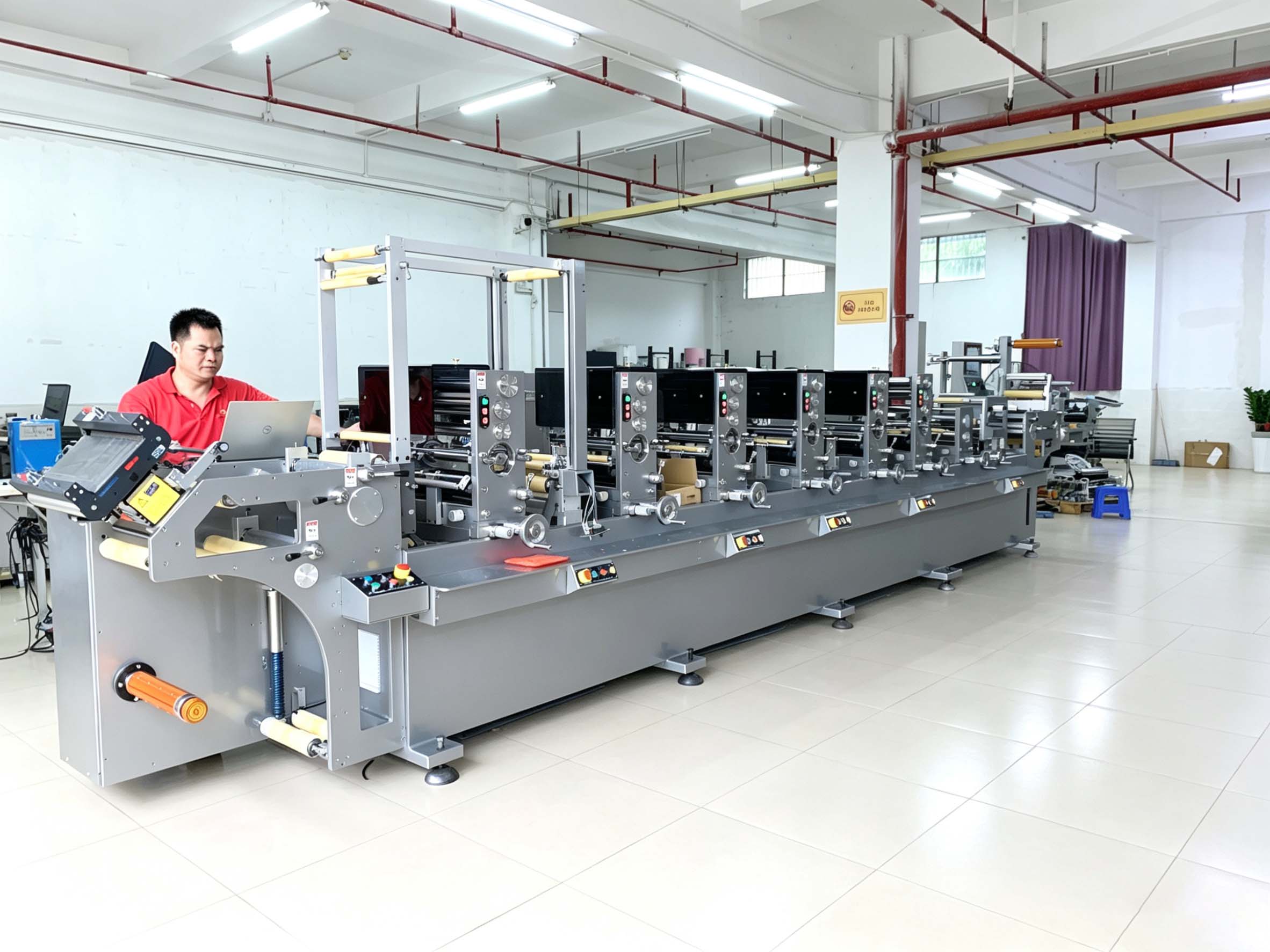
A CS-300 series label printing machine with glue-side printing, a multi-functional frame, and combined rotary and flatbed die-cutting during installation and debugging.
Why Die-Cutting Method Is a Configuration Decision, Not an Accessory
Die-cutting is the process of cutting the finished label shape from the printed web with a shaped die. Where the method differs, the consequences differ too: a press can print six or eight colors with excellent registration and still underperform if its die-cutting station cannot match the job.
Three failure patterns repeat across label production. Complex outlines that a rotary die distorts. Ultra-small pharmaceutical outlines that demand the tightest achievable tolerance. Short runs where the cost of rotary tooling cannot be recovered across the order. Each of these points back to the same decision — which die-cutting method the press is built around.
The choice is structural because it shapes several things at once: the line speed the press can reach, the tooling cost per job, the time lost to changeover, and the tightest outline tolerance the station can hold. Buyers who choose a machine first and consider die-cutting afterwards frequently end up with the wrong station type for their real job mix.
Industry Background: A Growing, Flexo-Led Label Market
The commercial case for getting die-cutting right is scaling with the market itself.
- The global label printing machines market was valued at USD 8.58 billion in 2025 and is projected to reach USD 14.36 billion by 2034, according to The Insight Partners.
- Flexographic printing remains the most commonly used process for labels, valued at approximately USD 13.3 billion in terms of output value in 2024, based on Smithers data.
- The global flexographic printing machine market was estimated at USD 17.57 billion in 2024 and is expected to grow at a CAGR of 9.7% through 2030, per Grand View Research.
- Asia-Pacific dominated the label printing machines market with a 41.8% revenue share in 2025, according to Data Bridge Market Research.
- The narrow web label printing machine segment is projected to grow from USD 1.43 billion in 2024 to USD 3.21 billion by 2035, per Spherical Insights.
Two things follow from this. First, capacity is expanding fastest in the region where most label presses are built and exported, which is why model-level configuration guidance is more useful to buyers than a generic product list. Second, as producers run broader job portfolios — long runs and short runs on the same floor — machines that can move between die-cutting methods without a second press become more valuable.
Compliance context matters at this scale as well. Safety requirements for graphic technology equipment, including label presses, are governed by the international standard ISO 12643-2:2023. Machinery sold in the European Union must comply with the Machinery Directive 2006/42/EC and carry CE marking, with safety signs following EN ISO 7010. Buyers planning a multi-year line should confirm the applicable standard set before, not after, the specification is frozen.
The Three Die-Cutting Methods, Defined
Before mapping models, it helps to fix the three terms precisely, because they are often used loosely.
Flatbed die-cutting
Flatbed die-cutting uses a flat die plate that presses into the web while the material is momentarily stationary or moving intermittently. Because the die is flat, complex outlines and consistent cutting on short-to-medium runs are practical, and a flat die is generally less costly to produce than a rotary cylinder.
Rotary die-cutting
Rotary die-cutting mounts the die on a rotating cylinder that cuts continuously as the web advances. Because the web does not stop, this method suits longer runs and higher line speeds.
Combination die-cutting
Combination die-cutting places both a flatbed and a rotary station on the same line. One press can then switch method according to the job rather than committing the entire production plan to a single approach.
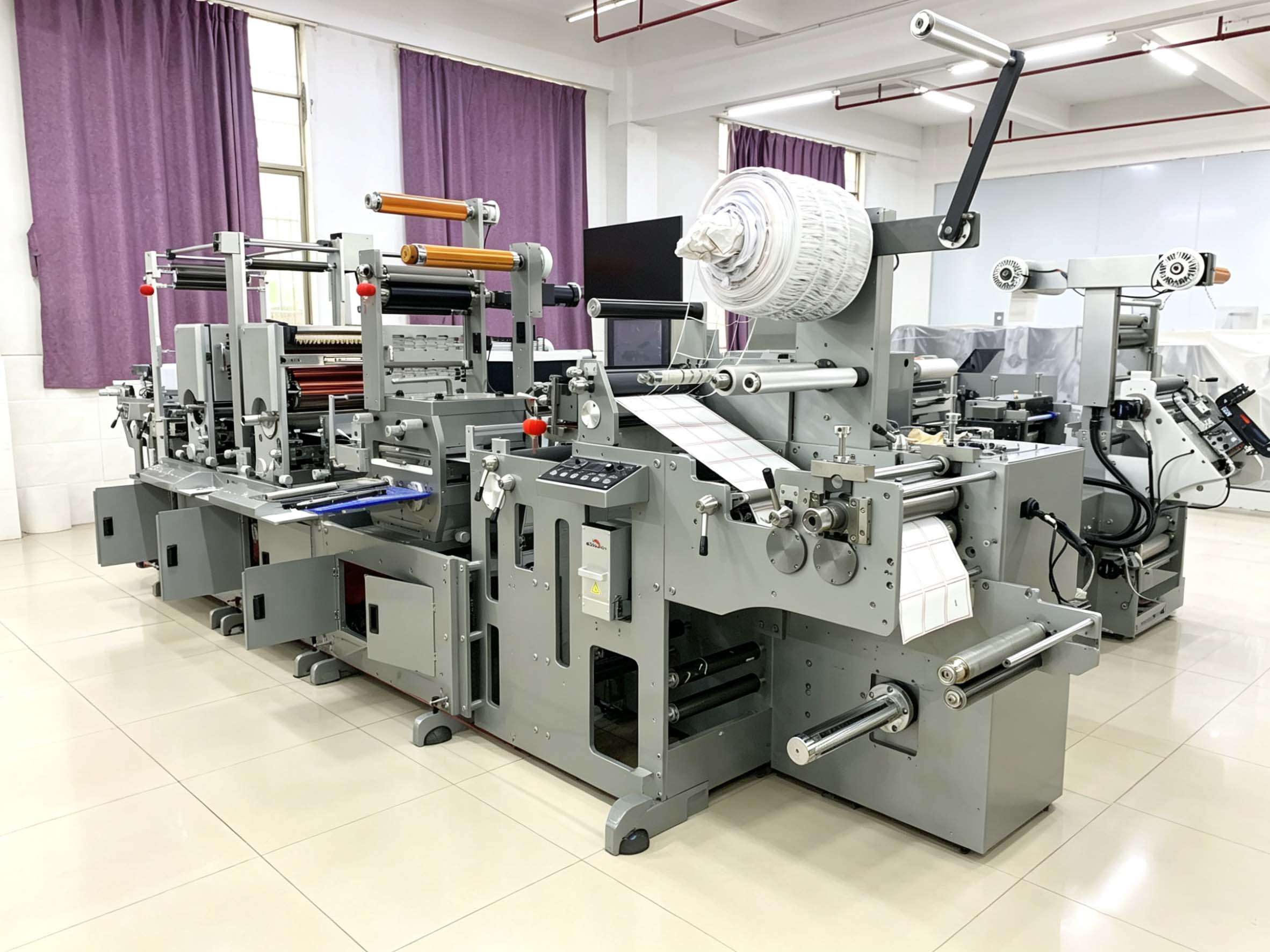
A CS-350 two-color letterpress label printing machine configured with a flatbed die-cutting station — the method used for complex outlines and shorter batches.
CAISHENG Label Printing Machine Models by Die-Cutting Method
Shenzhen Caisheng Printing Machinery Co., Ltd. (CAISHENG) is a label printing equipment manufacturer founded in 2011 in Shenzhen, China. It produces intermittent and high-speed full-rotary letterpress printing machines, flexographic printing machines, and screen printing machines, together with multi-functional label finishing solutions such as die-cutting systems and high-speed varnishing machines. Across the range, the die-cutting method follows the series.
Flatbed die-cutting — the CS-220 series
The CS-220 series, including the CS-220-4C and CS-220-5C, uses flatbed die-cutting. This is the configuration to examine when a label producer needs complex outlines, works mainly in short-to-medium runs, and wants to keep die tooling cost low. The stationary cut of a flatbed station is also easier to keep consistent on smaller batches than a rotary setup.
Combined flatbed and rotary — the CS-300/320 series
The CS-300/320 series, including the CS-300-5C, CS-320-6C, and CS-320-7C, combines flatbed and rotary die-cutting on the same line. This is the middle path for a mixed job portfolio: a complex, short-run cosmetic or industrial label in the morning, and a long, simpler consumer label in the afternoon, on a single press.
The CS-320-6C is the model CAISHENG positions against the ZONTEN SUPER 320, citing higher precision, better stability, and lower energy consumption. CAISHENG states that the registration accuracy deviation on this platform is ±0.05 mm, supported by precision components machined in its own CNC workshops, an imported Japanese servo system, a patented tapered bearing sleeve design, and a photographic inspection system that compensates for deviations in real time. A manual coarse adjustment combined with computer automatic fine adjustment also gives dual control over ink output.
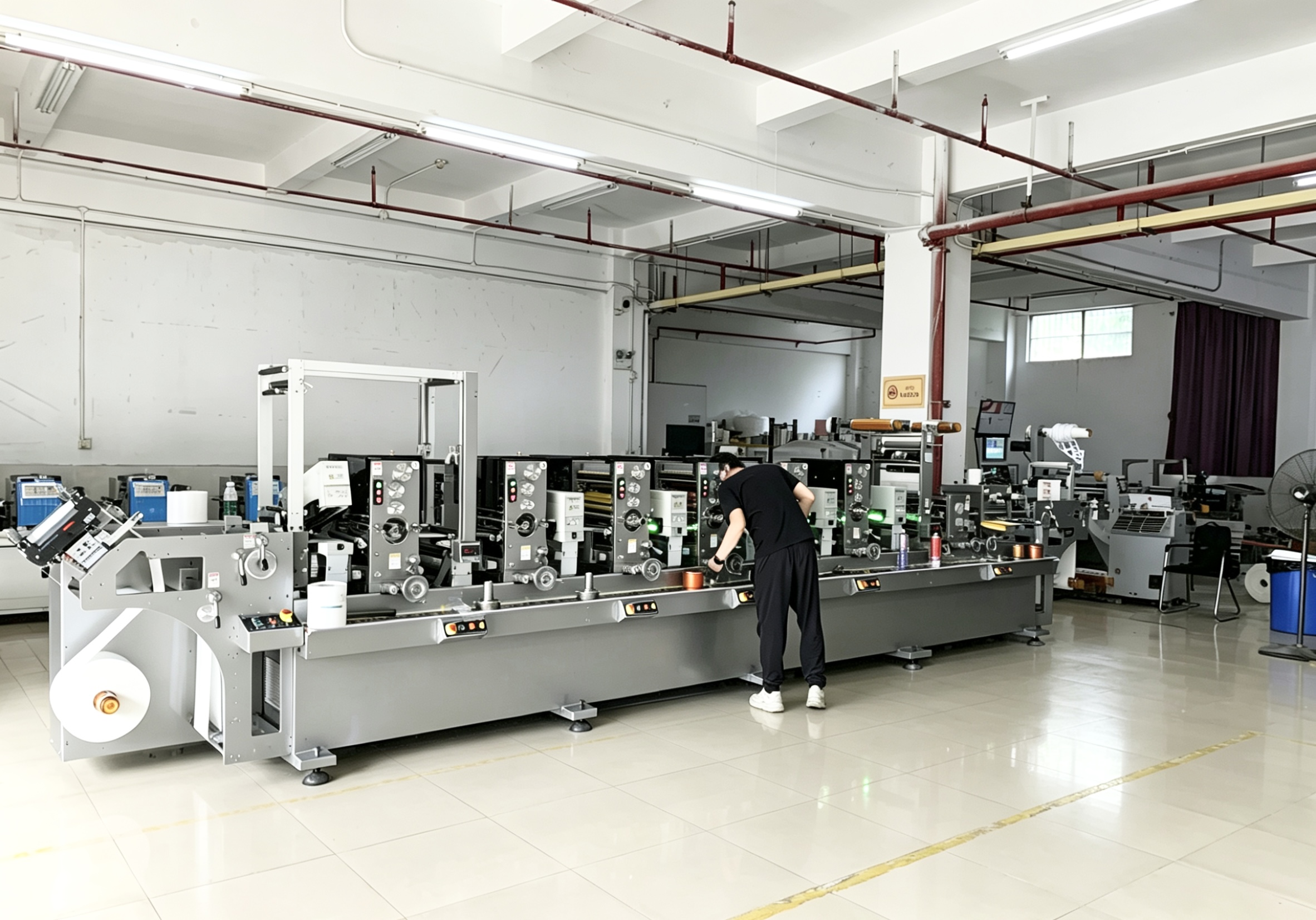
A CS-300 six-color letterpress label printing machine with glue-side printing, a multi-functional frame, rotary die-cutting, flatbed die-cutting, and slitting — a combination configuration for mixed job portfolios.
Rotary die-cutting combinations — the CS-350/370/380 series
The CS-350/370/380 series, including the CS-JQ350G-10C and CS-370F-8C, uses rotary die-cutting combinations. These are the high-speed, long-run configurations: continuous rotary cutting matched to a press intended to run at output rather than to change jobs frequently.
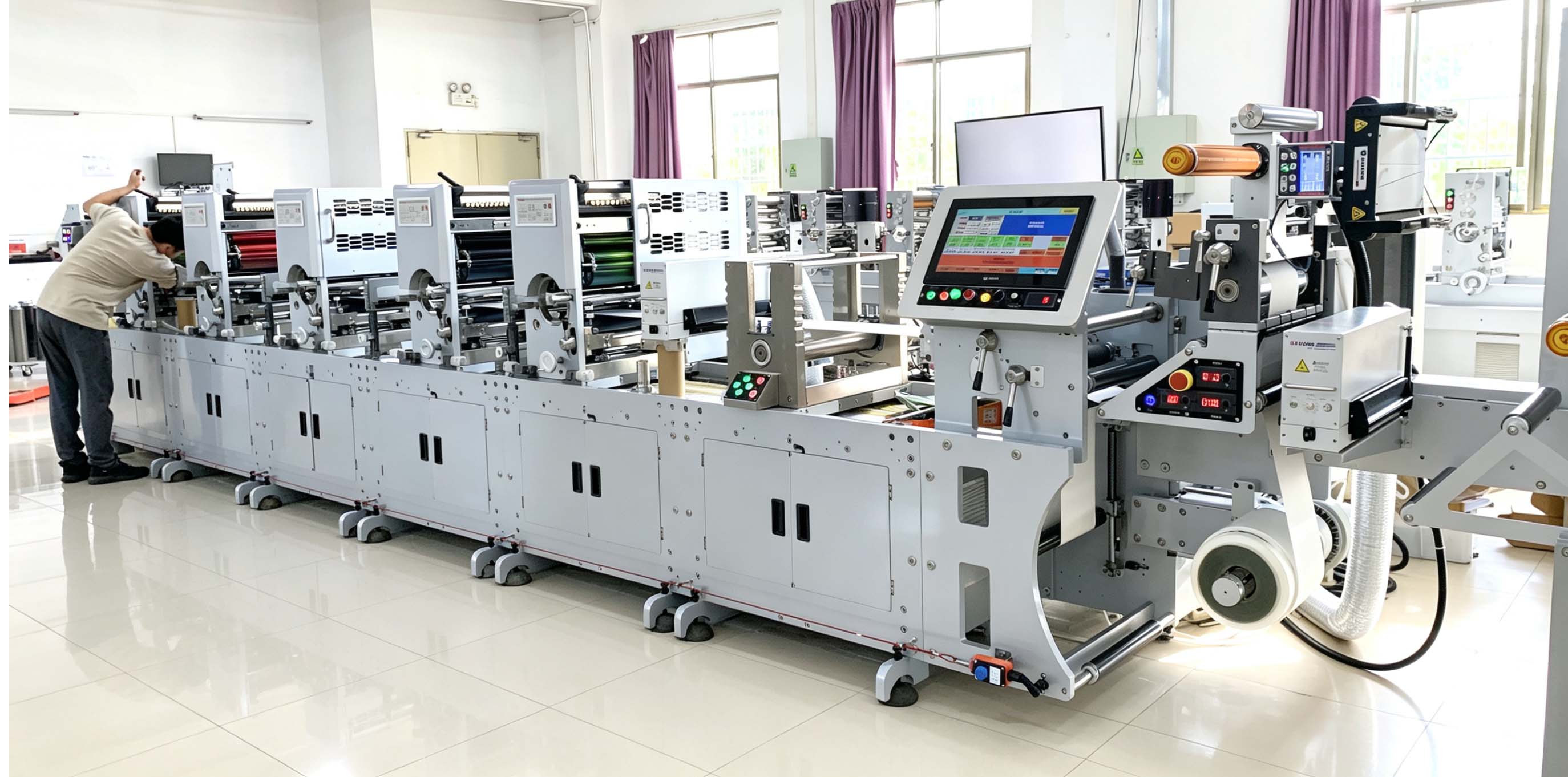
A CS-JQ350G label printing machine during installation and debugging — rotary die-cutting combinations for long-run, high-speed label production.
Step-by-Step: Matching Die-Cutting Method to Your Model
The method should be selected before the model number is confirmed. Working in this order keeps the die-cutting station aligned with the real job rather than fitted around a print configuration.
- Confirm the material. Substrate governs how much heat the press can tolerate at the die station and how cleanly the cut behaves. CAISHENG uses a self-developed LED UV cold light source drying system designed to prevent heat deformation of materials such as films, which matters when die-cutting thin or heat-sensitive stock.
- Estimate run length per SKU. Short and frequently changing runs favour a flatbed station, where flat-die tooling is cheaper and more flexible. Long, repeatable runs favour rotary, where continuous cutting pays back the higher tooling cost.
- Define precision requirements. Pharmaceutical and healthcare labels — tiny text, barcodes, and QR codes — push the specification toward tighter registration and a station that can hold it. CAISHENG cites a registration accuracy deviation of ±0.05 mm on the CS-320-6C platform.
- Decide whether one method is enough. If the job mix spans both short complex work and long simple work, a combination series avoids the cost of two presses.
- Match to the model series. Use the comparison table below to move from method to series and then to specific models.
- Check energy, maintenance, and lifecycle. Die-cutting performance has to hold up over years, not months. CAISHENG states its machines cut overall power consumption by at least 30% through a premium Japanese servo system and its own LED UV drying technology. It also builds in a deformation-proof base with a patented triangular guide rail design, an electrically operated bottom mold lifting mechanism, a linked squeegee baffle, and an intelligent early warning system for preventive maintenance.
Use Cases: Which Label Categories Suit Which Method
CAISHENG builds its label presses for several label categories. Mapping those categories to die-cutting methods makes the choice concrete.
- Daily consumer goods and food packaging. Vibrant, high-resolution graphics and durable adhesion for everyday products, snacks, and fresh food labels — usually long runs, which suit rotary or combination die-cutting.
- Chemical and industrial products. Robust, chemical-resistant labels that stay legible in harsh environments — long-run work, suited to rotary or combination stations.
- Wine and premium beverages. Exquisite print quality and precise die-cutting for wine bottles and craft beverages, where outline accuracy affects shelf appeal — a case for combination or flatbed.
- Cosmetics and personal care. Delicate materials such as clear films and metallic foils, where complex shapes and heat-sensitive stock favour flatbed or combination stations.
- Pharmaceuticals and healthcare. Ultra-high precision for tiny text, barcodes, and QR codes, meeting compliance and safety needs — flatbed or combination, chosen for the tightest tolerance.
Comparison Table: CAISHENG Model Series by Die-Cutting Method
| Series | Example models | Die-cutting method | Best-fit run profile |
|---|---|---|---|
| CS-220 | CS-220-4C, CS-220-5C | Flatbed | Short-to-medium runs with complex outlines; lower flat-die tooling cost |
| CS-300/320 | CS-300-5C, CS-320-6C, CS-320-7C | Flatbed + rotary (combination) | Mixed portfolios — short complex and long simple jobs on one line |
| CS-350/370/380 | CS-JQ350G-10C, CS-370F-8C | Rotary die-cutting combinations | Long runs and high-speed continuous production |
Model families and their die-cutting methods as specified by CAISHENG. The CS-320-6C platform carries a stated registration accuracy deviation of ±0.05 mm.
FAQ
Do CAISHENG label printing machines meet the safety and compliance requirements for the EU and other export markets?
The standards that apply to label presses are clear at the international level. Safety requirements for graphic technology equipment, including label presses, are governed by ISO 12643-2:2023, and machinery sold in the European Union must comply with the Machinery Directive 2006/42/EC, carry CE marking, and use safety signs that follow EN ISO 7010. CAISHENG builds its label printing machines for export markets that include Southeast Asia, the European Union, the Middle East, and the United States, and every unit is 100% tested before shipment. Because the exact certification scope and document set depend on the destination, buyers should confirm the required documentation for their market when the order specification is agreed.
Can a single CAISHENG label press run both flatbed and rotary die-cutting?
Yes. The CAISHENG CS-300/320 series — including the CS-300-5C, CS-320-6C, and CS-320-7C — combines flatbed and rotary die-cutting on one line, so the same press can handle a short, complex job and a long, simpler one. For comparison, the CS-220 series (CS-220-4C, CS-220-5C) uses flatbed die-cutting only, while the CS-350/370/380 series, including the CS-JQ350G-10C and CS-370F-8C, uses rotary die-cutting combinations.
What drives the cost of a die-cutting configuration?
Two cost layers matter. The first is tooling: flat dies for flatbed die-cutting are generally less costly to produce than rotary cylinders, so short-run and complex-shape work is cheaper on a flatbed station. The second is the machine itself. Because CAISHENG machines precision parts in its own CNC machining plants, it states that its total equipment cost is reduced by about 10% compared with similar manufacturers. It quotes a minimum order quantity of 1 unit on FOB terms, with a 30/70 payment schedule. Buyers should compare total tooling-plus-machine cost across the expected job mix, not machine price alone.
Can buyers validate die-cutting performance before shipment?
Yes. Before delivery, CAISHENG machine adjustment engineers test the press across multiple performance aspects until it produces finished products that meet specification, and customers are invited to the factory for machine acceptance inspection. Acceptance criteria are defined as a pre-shipment test, and every unit built for export markets is 100% tested. Buyers who want to evaluate die-cutting on their own material can raise this at the factory acceptance stage.
What are the lead time, production capacity, and after-sales support for a CAISHENG label press?
Typical production lead time is 45 to 60 days, and monthly production capacity is 18 units for export markets that include Southeast Asia, the European Union, the Middle East, and the United States. Every unit is 100% tested, and CAISHENG provides remote support together with a one-year warranty on major components. Because a die-cutting configuration is built to order, buyers planning a production line should confirm the die-station specification early in the lead time window. To start, download the CAISHENG catalog or send your die-cutting requirement for a quote.
Conclusion: Choose the Die-Cutting Method Your Line Will Still Need in Five Years
Flatbed, rotary, and combination die-cutting are not interchangeable features on a spec sheet. They set the run lengths a press can handle economically, the outline complexity it can hold, and the tooling cost each job carries. The CAISHENG model map makes that link explicit: the CS-220 series (CS-220-4C, CS-220-5C) covers flatbed die-cutting; the CS-300/320 series (CS-300-5C, CS-320-6C, CS-320-7C) combines flatbed and rotary on one line; and the CS-350/370/380 series (CS-JQ350G-10C, CS-370F-8C) is built around rotary die-cutting combinations.
For buyers at the decision and execution stage, the practical rule is to specify material, run length, and precision first, and let those three parameters select the method — then select the model. That order keeps the die-cutting station aligned with the production profile the press will actually run, year after year, rather than the profile of a single launch order.
CAISHENG supports both single-machine orders and long-term production partnerships. The minimum order quantity is 1 unit, terms are FOB, payment runs on a 30/70 schedule, and acceptance criteria are defined as a pre-shipment test. Typical production lead time is 45 to 60 days, monthly capacity is 18 units for export markets that include Southeast Asia, the European Union, the Middle East, and the United States, and every unit is 100% tested before shipment. Remote support and a one-year warranty on major components support the press after installation.
To move from this guide to a configuration, review the die-cutting station specification against your job mix, then request a quote or download the full catalog. CAISHENG can match a series — and a die-cutting method — to your material, run length, and precision requirements.
Shenzhen Caisheng Printing Machinery Co., Ltd. (CAISHENG)
Website: www.caishengmachinery.com
Email: kanghong-1108@qq.com
Tel: +8613186283944 | WhatsApp: +86 133-1087-8219
Address: No.39, Shuitian Road, Tongle Community, Longgang District, Shenzhen, China
Download the product catalog: CAISHENG label printing machine catalog (PDF)
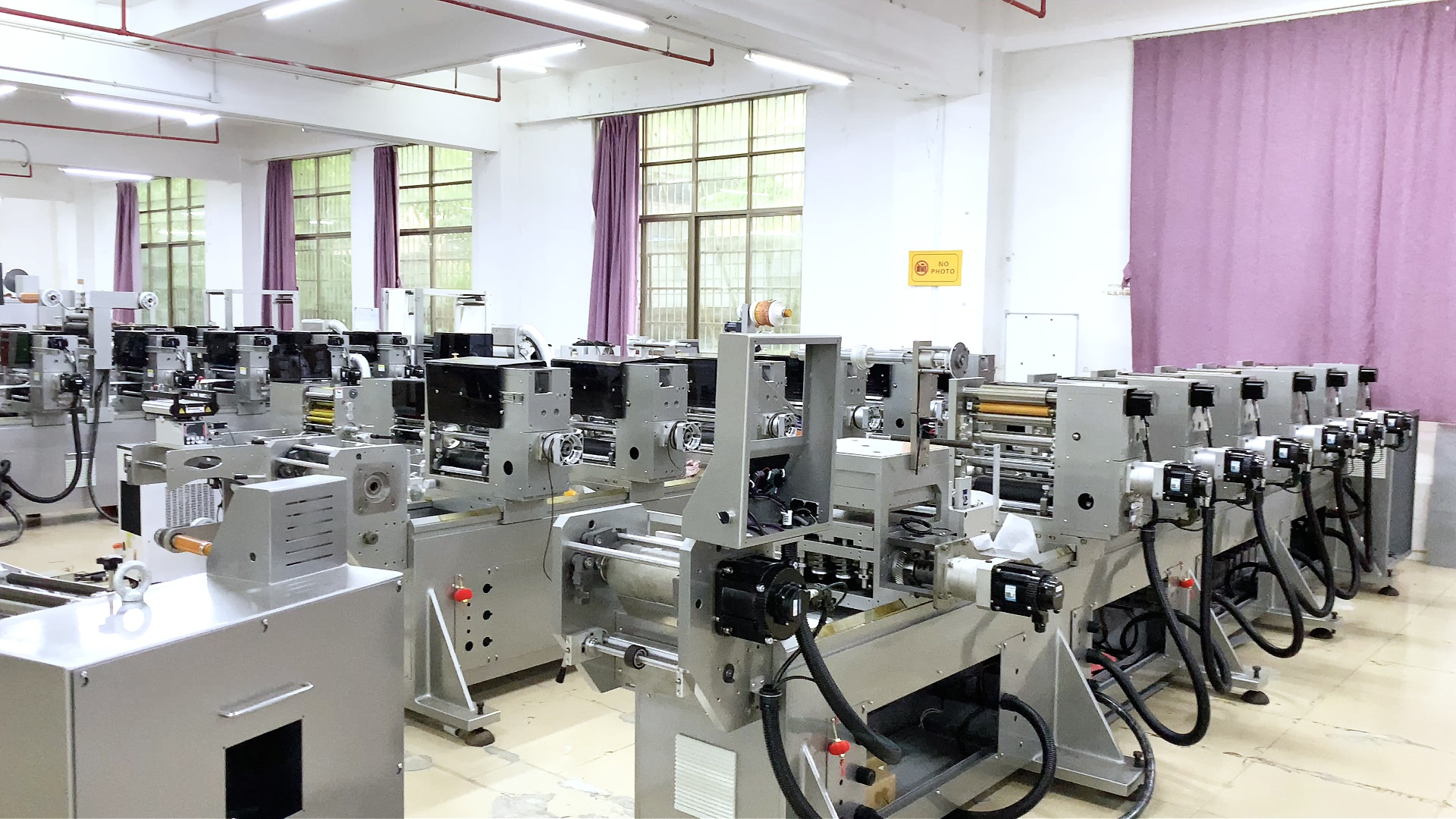
CAISHENG label printing machines in the Shenzhen factory. Every unit for export markets is 100% tested before shipment.