Selecting the Right Label Press for Multi-Shift Container Printing: A Practical Application Guide
Short answer: a press that fits a multi-shift container label operation is the one whose sustained speed, print-mode flexibility, finishing train and utility draw all match the job — not the model with the highest single-shift figure. In the CAISHENG range, most packaging jobs land between a dual-mode letterpress platform such as the CS-JQ350G-10C (60 m/min intermittent, 158 m/min full rotary) and a dedicated full-rotary flexographic press such as the CS-Q370F-6C (150 m/min), with the CS-350 high-speed die-cutting machine sized so that finishing keeps pace with printing.
Container label production rarely fails because a machine is too slow on paper. It fails because the press, the finishing modules and the utilities were never planned as one system. A line that prints cleanly on a single day shift can lose registration or starve the die-cutting station on the second or third consecutive shift when duty cycle, web width, power draw and finishing speed were treated as separate decisions.
This guide is written for label converters in high-volume packaging segments — beverage, food, chemical, cosmetic and pharmaceutical containers — and for the buyers who have to match a real job to a real platform. Four worked examples, two comparison tables and a finishing-module breakdown are included so the same selection logic can be applied to your own job envelope.
What Multi-Shift Operation Actually Changes in Press Selection
Multi-shift work moves the selection criterion from peak speed to sustained speed. The relevant number is not the maximum on the datasheet but the speed the press can hold across a full shift while registration stays within tolerance and the finishing stations stay synchronised.
- Duty cycle. An intermittent (semi-rotary) platform such as the CS-320-6C runs at a maximum printing speed of 40 m/min, while a dual-mode platform such as the CS-JQ350G-10C runs at 60 m/min intermittent and 158 m/min full rotary. Which one you need depends on metres per shift, not on the label category alone.
- Register stability over hours. Every CAISHENG label platform referenced in this guide is built on a steel structure. Machine weight ranges from 2.6 T (CS-220-4C) to 14 T (CS-JQ350G-10C); the heavier full-rotary and dual-mode frames are the ones specified for stable continuous automatic cycle printing.
- Print-mode flexibility on one machine. Dual-mode platforms run both intermittent and full-rotary printing, with maximum printing areas of 350 mm × 380 mm intermittent and 350 mm × 419 mm full rotary on the CS-JQ350G-10C. Switching mode is a configuration decision, not a second machine purchase.
- Finishing that matches printing. The CS-350 high-speed die-cutting machine reaches 60 m/min intermittent and 160 m/min full rotary — a full-rotary figure slightly above the 158 m/min of the CS-JQ350G-10C, so die-cutting does not become the bottleneck.
- Utility headroom. The CS-JQ350G-10C draws 34 kW on the main machine with 13.5 kW of LED UV drying; the CS-Q370F-6C draws 25 kW excluding UV dryers. These figures feed directly into the electrical plan for a multi-shift hall.
- Facility conditions. CAISHENG label systems are specified for stable continuous automatic cycle printing at normal room temperature, with no constant-temperature production workshop required — which matters when a second or third shift is added inside an existing building.
Industry Background: Why Container Label Capacity Keeps Expanding
Capacity decisions in packaging labels are being made inside a market that is still growing in both volume and value.
- The global label printing machines market was valued at USD 8.58 billion in 2025 and is projected to reach USD 14.36 billion by 2034 (The Insight Partners).
- Flexographic printing remains the most commonly used process for labels, valued at approximately USD 13.3 billion in terms of output value in 2024 (Smithers).
- The global flexographic printing machine market was estimated at USD 17.57 billion in 2024 and is expected to grow at a CAGR of 9.7% through 2030 (Grand View Research).
- Asia-Pacific dominated the label printing machines market with a 41.8% revenue share in 2025 (Data Bridge Market Research).
- The global narrow web label printing machines market is projected to reach USD 3.21 billion by 2035, from USD 1.43 billion in 2024 (Spherical Insights).
Two consequences follow for buyers. First, new capacity is being added mainly in narrow- and mid-web formats — the band served by the 220 mm, 300 mm, 320 mm, 350 mm and 370 mm platforms discussed here. Second, because the equipment market is competitive, with Bobst, Mark Andy, Gallus/Heidelberg and Nilpeter among the established global suppliers, specification discipline matters more than brand noise: the platform has to be matched to the shift pattern and the finishing sequence, not chosen by reputation alone.
The CAISHENG Platform: What Is Actually Fitted to the Machine
Shenzhen Caisheng Printing Machinery Co., Ltd. (CAISHENG) is a label printing equipment manufacturer based in Longgang District, Shenzhen, China, founded in 2011. The company operates a 6,000 m² facility with 65 employees, an 8-engineer R&D team and an annual output of around 200 units; roughly 50% of production is exported to Southeast Asia, Europe, the Middle East and the United States.
The product programme covers intermittent and high-speed full-rotary letterpress printing machines, flexographic printing machines and screen printing machines, together with customised multi-functional label finishing solutions including die-cutting systems and high-speed varnishing machines. The design intent is stated plainly: the platform is a one-stop solution for adhesive label printing technology issues, so a printing factory can complete multiple processes on one machine and produce finished labels in one pass instead of moving work between separate lines.
Three platform-level facts matter for multi-shift planning:
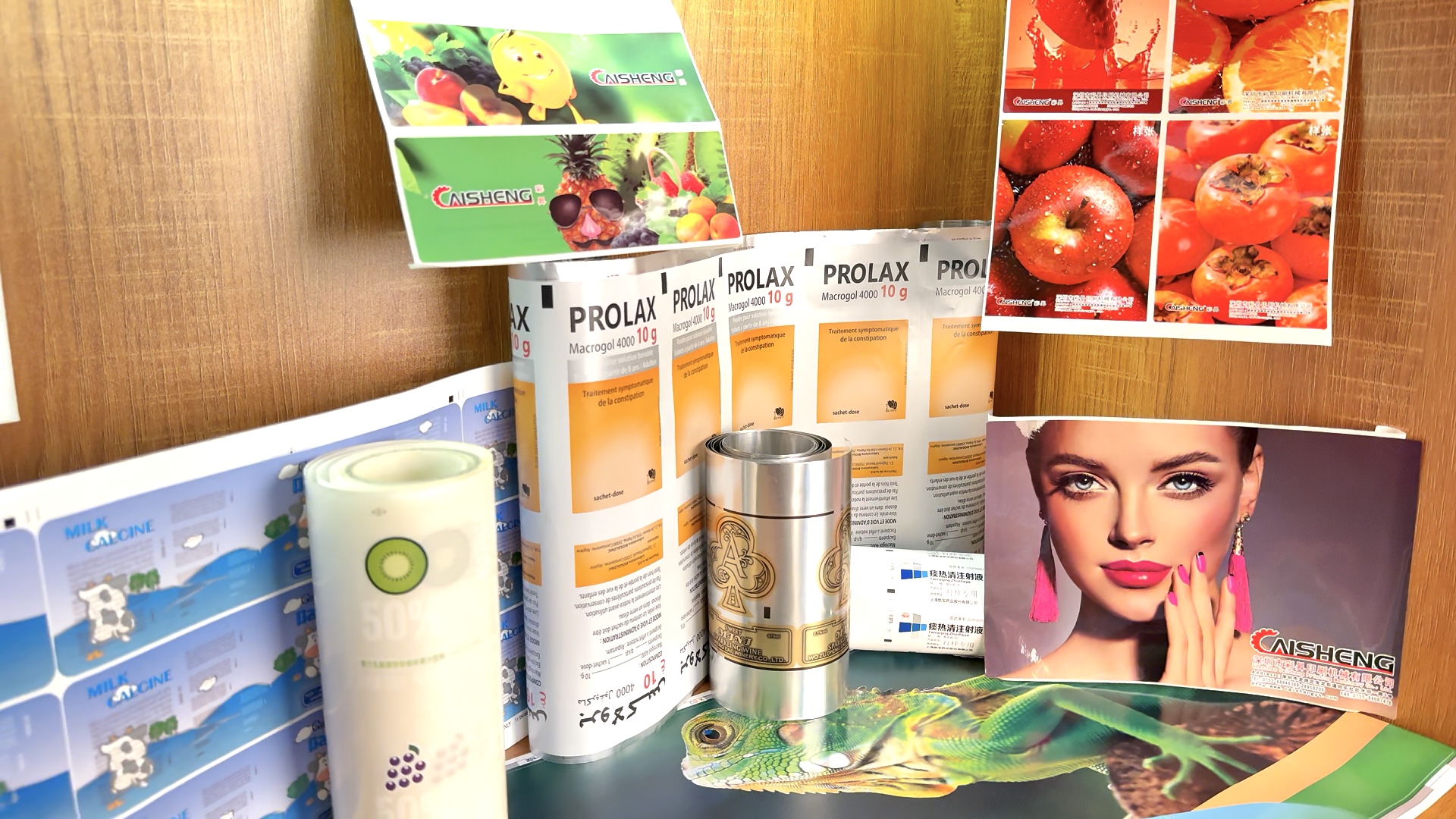
- Substrate and application coverage. The system is applied to self-adhesive labels for daily goods, chemicals, wristbands, wine, food, cosmetics and pharmaceuticals — the mixed container-label portfolio most converters actually sell.
- Supporting equipment. Machines are supplied with servo systems, air cooling, water cooling and UV drying lamps as the matched utility set.
- Commercial terms. ODM production, one-to-one custom design of size, process and function, minimum order of 1 unit, monthly capacity of 18 units, 45–60 day lead time, 100% testing before shipment, and remote after-sales support with a one-year warranty on major components.
Step-by-Step: Matching a Job to a Press
Step 1 — Define the job envelope
Start with the label, not the machine: application segment (daily goods, chemical, wristband, wine, food, cosmetic, pharmaceutical), web width, repeat length, colour count, and whether the work is one long run or a mix of short orders. Check the required web width against platform limits — 240 mm (CS-220-4C / CS-220-5C), 300 mm (CS-300-5C / CS-300-6C), 320 mm (CS-320-6C / CS-320-7C), 350 mm (CS-JQ350G-10C, CS-JQ350G-6C, CS-JQ350-7C) or 370 mm (CS-Q370F-6C / CS-370F-8C).
Step 2 — Set the sustained speed the shift pattern demands
Convert the shift plan into metres per shift, then set a line speed with margin. For a job planned at 100 m/min, a 158 m/min full-rotary platform runs at roughly two-thirds of its maximum, while a 40 m/min letterpress platform cannot reach the target at all. That single comparison eliminates most wrong choices before colour count or finishing is even discussed.
Step 3 — Choose the print mode
Full rotary suits long runs at sustained speed; intermittent suits shorter repeats, tighter register work and mixed orders. Dual-mode machines cover both: on the CS-JQ350G-10C and CS-JQ350G-6C, intermittent printing runs to 60 m/min and full rotary to 158 m/min, with maximum printing areas of 350 mm × 380 mm and 350 mm × 419 mm respectively.
Step 4 — Select the platform tier
Match colour count and volume: 4–6 colours on a 220–300 mm web for small-format sticker and short-run work; 6–7 colours on a 320 mm web for high-mix production; 6–8 colours on a 370 mm full-rotary flexo platform for film-based container labels; 7–10 colours on a 350 mm dual-mode platform for the highest-volume, highest-colour jobs.
Step 5 — Specify the finishing train
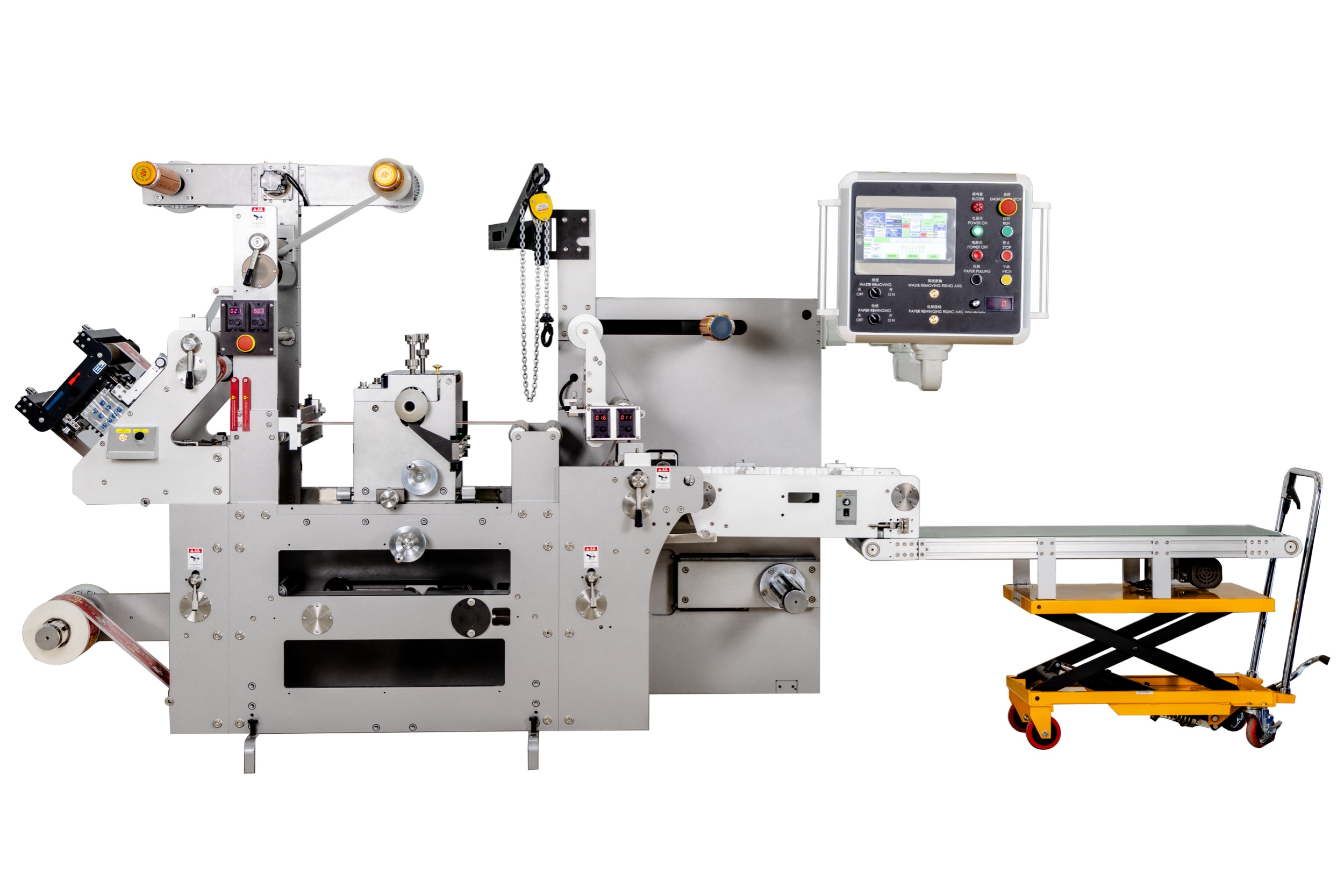
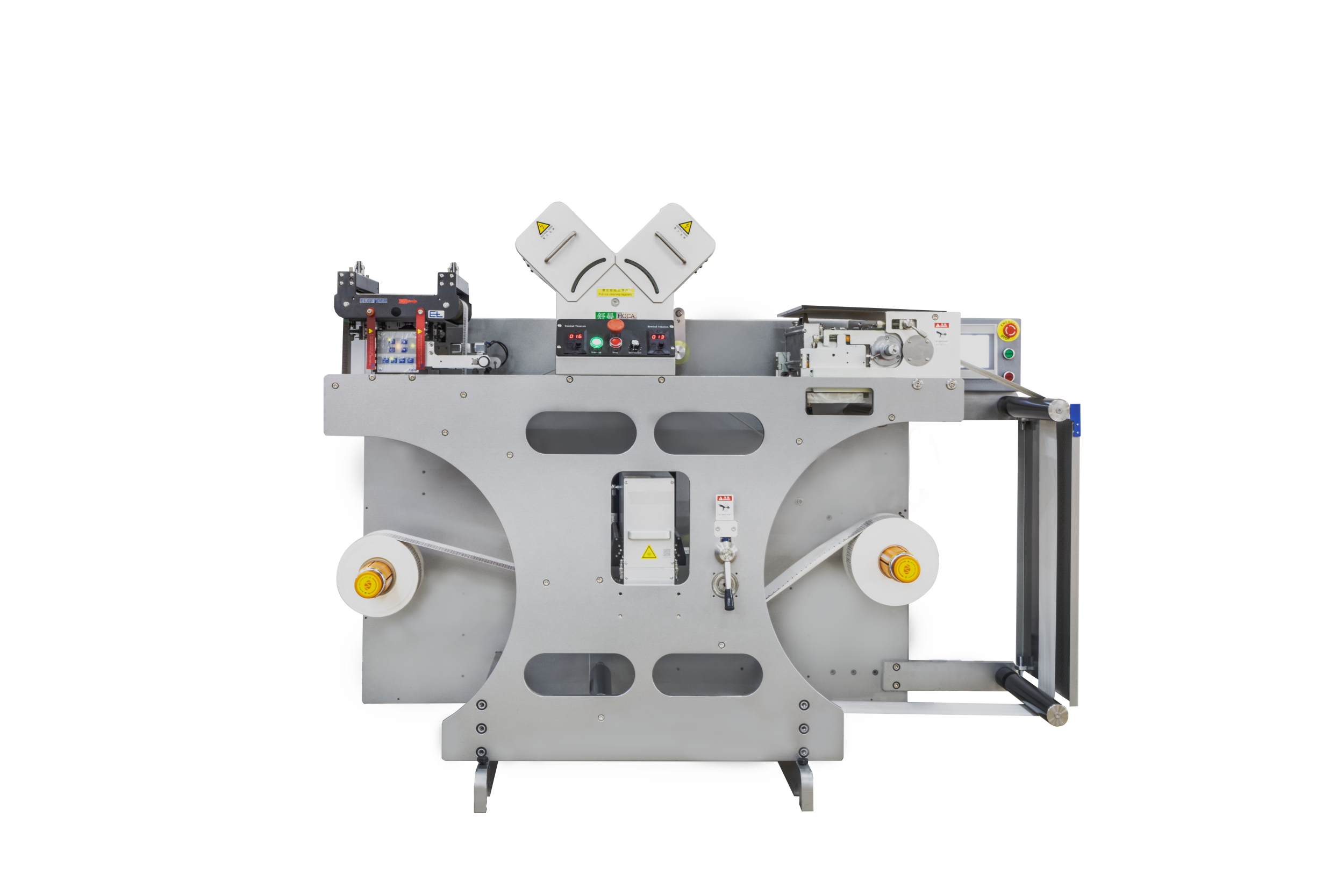
Decide which processes must run inline. CAISHENG supports colour stamping, glue-side printing frames, cold foil stamping, lamination, offline/online UV varnishing, flatbed die-cutting, rotary die-cutting, sheet cutting, slitting, corona treating, dust cleaning, static elimination, full-rotary screen printing, hot foil stamping and embossing. Three finishing units are frequently specified alongside a full-rotary press: the CS-350 high-speed die-cutting machine, the CS-Q380V high-speed corona oil integrated machine, and the VS-250W full-rotation screen printing multifunctional machine.
Step 6 — Check the utility and floor budget
Add main-machine power and UV/LED-UV drying power: 34 kW + 13.5 kW LED UV on the CS-JQ350G-10C; 25 kW excluding UV dryers on the CS-Q370F-6C; 30 kW excluding UV dryers on the CS-370F-8C; 5.6 kW + 5 kW UV on the CS-350 die-cutter. Confirm the hall can supply this continuously, and confirm the footprint: 12 m × 1.5 m × 2 m for the CS-JQ350G-10C, 7.5 m × 1.5 m × 1.7 m for the CS-Q370F-6C.
Step 7 — Plan the commercial timeline
With a 45–60 day lead time, monthly capacity of 18 units and a 1-unit minimum order, the practical constraint in a multi-shift project is slot availability rather than order size. Configuration decisions taken here — custom size, process and functional requirements — are the ones that move the delivery date.
Worked Examples: Four Multi-Shift Jobs and the Presses That Fit
Example 1 — 9–10 colour container labels across three shifts
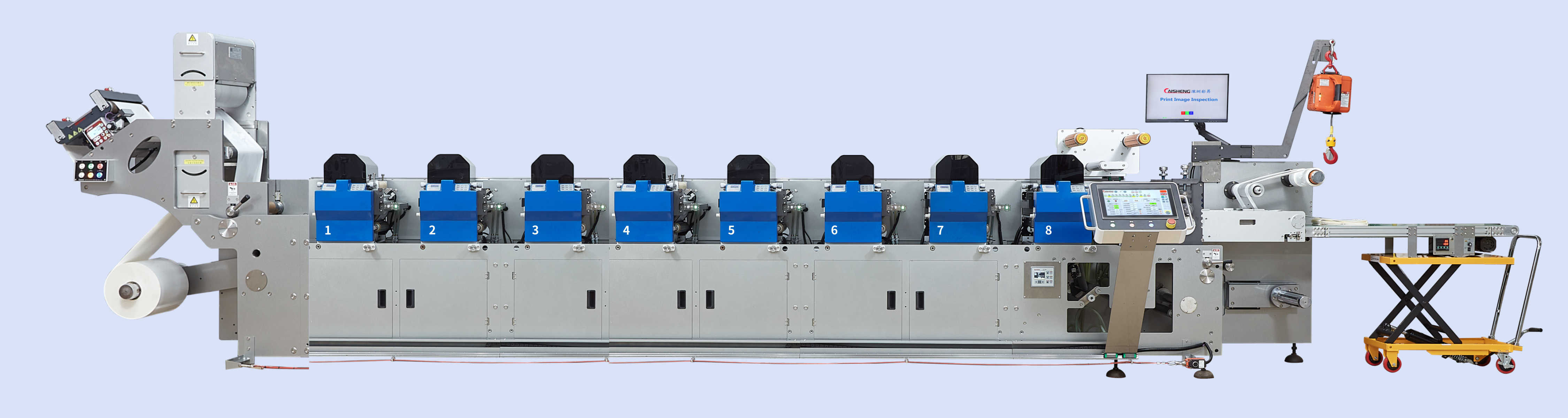
A converter printing high-volume beverage, food or chemical container labels in 9–10 colours, running full rotary for most of the shift, needs print capacity, drying capacity and frame stability at the same time. The CS-JQ350G-10C full-rotary label press covers that envelope: 34 kW main-machine power, 13.5 kW LED UV drying, maximum full-rotary printing area of 350 mm × 419 mm, 14 T machine weight, and 158 m/min full-rotary speed, with 60 m/min available in intermittent mode for shorter repeats.
Example 2 — 6–8 colour film container labels at sustained speed
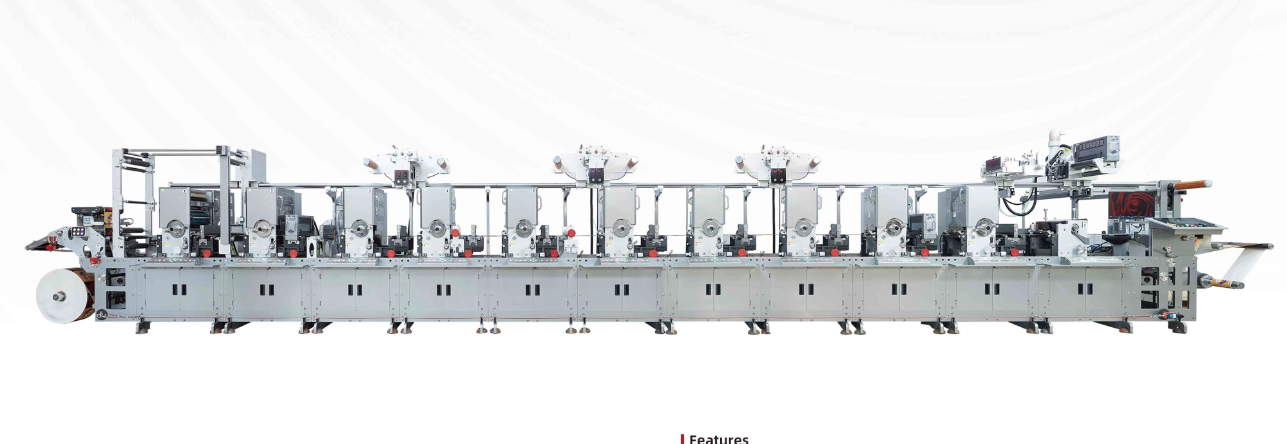
Where the job is film-based packaging labels with fewer colours but sustained speed, a dedicated flexographic platform is the shorter path. The CS-Q370F-6C full-rotary flexographic printing machine runs at 150 m/min with a maximum printing area of 370 mm × 200 mm and 370 mm × 600 mm, 25 kW main power excluding UV dryers, and a 7 T frame. If the artwork needs eight colours, the CS-370F-8C in the same full-rotary flexo family runs at the same 150 m/min with 30 kW main power and an 8.6 T frame.
Example 3 — High-mix pharmaceutical and cosmetic work with frequent changeovers
Multi-shift does not always mean one long run. For pharmaceutical and cosmetic portfolios with frequent job changes, the practical picks are the CS-JQ350-7C (dual-mode, 24.5 kW main power, 9.1 kW UV, 158 m/min full rotary, 10.8 T) when volume is still high, or the intermittent letterpress platforms CS-320-6C and CS-320-7C (30–320 mm web, 40 m/min, 27 kW and 31 kW including UV dryers) when short repeats and mixed orders dominate.
Example 4 — Small-format stickers and short runs
For 240 mm web work such as smaller stickers and short-run labels, the CS-220-4C (8.4 kW main power, 3.7 kW UV, 2.6 T) and CS-220-5C (17 kW including UV dryers, 3.6 T) keep the same multi-process concept in a smaller footprint. This is often the second machine in a hall anchored by a full-rotary line — the short-run capability that frees the main press for its high-volume work.
Reference cases from the installed base
Two long-running installations show what stability means in practice. Donnelley & Sons (RRD), a global provider of commercial printing, packaging and multi-channel marketing communication solutions in the United States, has operated a CAISHENG CS-300 label printing machine as production equipment for three years, citing stable registration accuracy, print quality and equipment reliability as the basis of a continuing relationship. A renowned Asian trademark design and printing company in Taiwan has operated a CS-320 platform for two years, citing printing precision, stable production performance and flexible process expansion.
Comparison Table: Press Platforms Side by Side
The table lists only the platforms discussed above, using manufacturer-published specifications. Speeds are maximum printing speeds; actual sustained speed depends on substrate, ink, drying and finishing configuration.
| Model | Platform type | Web / max printing area | Max printing speed | Main machine power | Machine weight | Best-fit multi-shift job |
|---|---|---|---|---|---|---|
| CS-JQ350G-10C | Intermittent & full-rotary high-speed letterpress (steel) | 350 × 419 mm full rotary; 350 × 380 mm intermittent | 60 m/min intermittent; 158 m/min full rotary | 34 kW + 13.5 kW LED UV | 14 T | 9–10 colour high-volume container labels, continuous full-rotary shifts |
| CS-JQ350G-6C | Intermittent & full-rotary high-speed letterpress | 350 × 419 mm / 350 × 380 mm | 60 m/min / 158 m/min | 22 kW + 8 kW UV | 10 T | 6-colour high-volume labels |
| CS-JQ350-7C | Semi-rotary and full-rotary label press | 350 × 419 mm / 350 × 380 mm | 60 m/min / 158 m/min | 24.5 kW + 9.1 kW UV | 10.8 T | 7-colour high-volume work needing both print modes |
| CS-Q370F-6C | Full-rotary flexographic press | 370 × 200 mm and 370 × 600 mm | 150 m/min | 25 kW (excluding UV dryers) | 7 T | 6-colour film container labels at sustained speed |
| CS-370F-8C | Full-rotary flexo press | 370 × 200 mm and 370 × 600 mm | 150 m/min | 30 kW (excluding UV dryers) | 8.6 T | 8-colour flexo container label work |
| CS-J380F-7C | Flexo label printing machine (intermittent + full rotary) | 360 × 419 mm / 360 × 380 mm | 60 m/min | 35 kW (including UV dryers) | 6 T | Mid-speed 7-colour flexo with mixed repeats |
| CS-320-6C | Semi-rotary (intermittent) letterpress | Web 30–320 mm; 320 × 326 mm / 320 × 300 mm | 40 m/min | 27 kW (including UV dryers) | 6.2 T | High-mix pharma and cosmetic labels with frequent changeovers |
| CS-220-5C | Intermittent letterpress (stickers printing machine) | Web 30–240 mm; 220 × 245 mm / 220 × 200 mm | 40 m/min | 17 kW (including UV dryers) | 3.6 T | Small-format stickers and short runs feeding a larger line |
Finishing modules: matching the train to the press
Finishing is specified the same way as the press — by matching rated speed and web width to the printing platform, then deciding what runs inline and what stays offline.
| Model | Module | Max area / web width | Max speed | Power | Weight | Planning note |
|---|---|---|---|---|---|---|
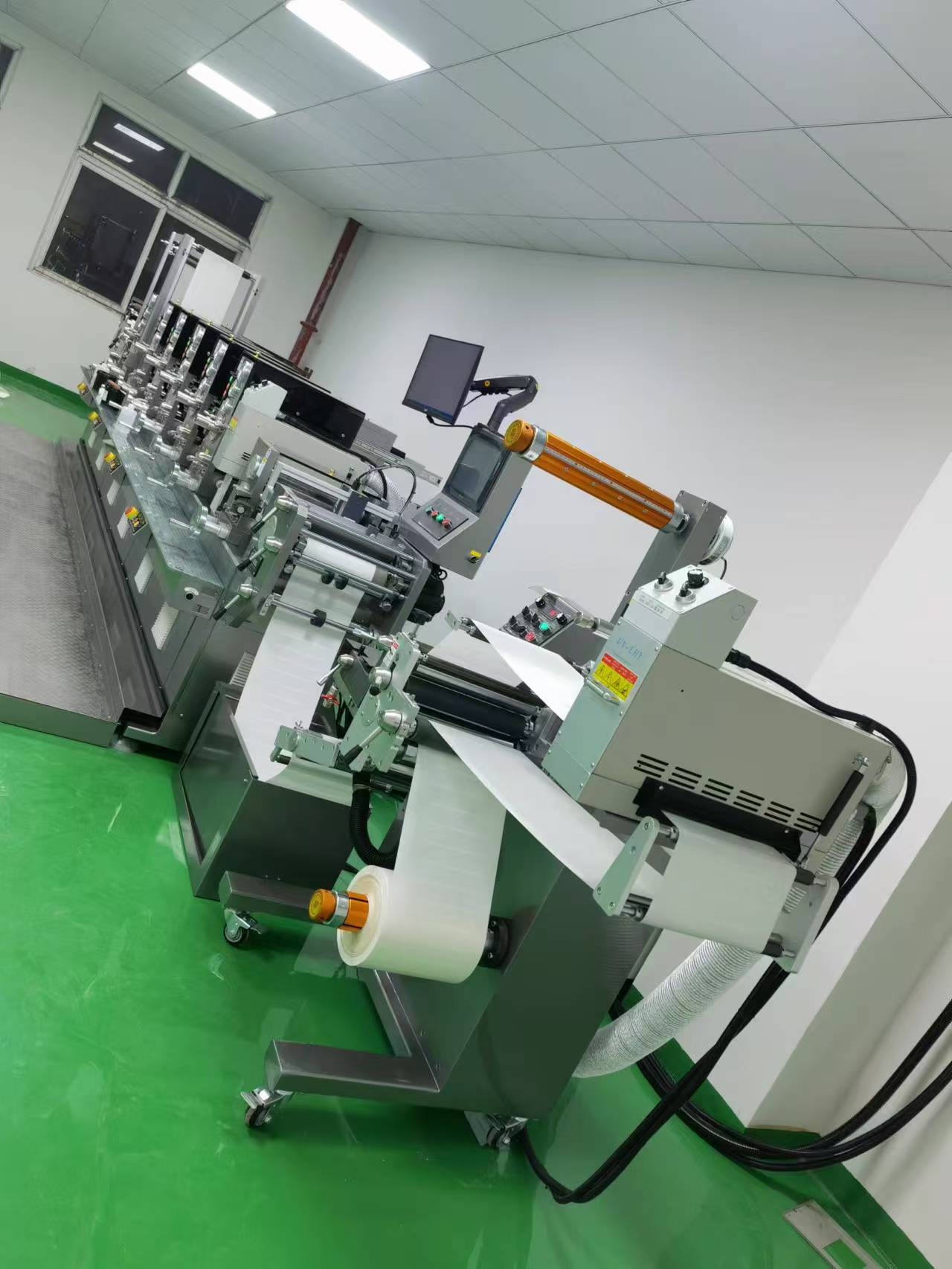
| CS-350 | High-speed die-cutting machine (intermittent & full rotary) | 350 × 460 mm full rotary; 350 × 420 mm semi rotary | 60 m/min intermittent; 160 m/min full rotary | 5.6 kW + 5 kW UV | 2 T | Full-rotary rate sits above the 158 m/min press speed, so die-cutting keeps pace |
| CS-Q380V | High-speed corona oil integrated machine (varnishing) | Max web width 360 mm | 100 m/min | 5 kW + 8 kW UV | 1 T | On a 158 m/min line, plan inline varnishing as a reduced-speed or offline step |
| VS-250W | Full-rotation screen printing multifunctional machine | Screen printing 240 × 240 mm; die-cutting 240 × 240 mm; max web width 250 mm | — | 15 kW (excluding UV dryers) | 4.5 T | Combines screen printing with optional hot foil stamping, embossing, flatbed die-cutting or rotary die-cutting |
Decision rule: as a working rule for multi-shift planning, the finishing module's rated speed should be equal to or higher than the press speed you intend to hold — or the process should be planned as an offline step. The CS-350 die-cutter satisfies this at full-rotary speed; the CS-Q380V varnishing module, at 100 m/min maximum, is better planned as an offline or reduced-speed operation on a 158 m/min platform.
FAQ
What standards should a multi-shift label press meet for installation in the EU?
Safety requirements for graphic technology equipment, including label presses, are governed by the international standard ISO 12643-2:2023. Machinery placed on the EU market must comply with the Machinery Directive 2006/42/EC and carry CE marking, with safety signs following EN ISO 7010. For a multi-shift installation the practical checklist is the declaration of conformity, the safety-sign layout on the machine, and confirmation that guarding and emergency-stop design follow the standard applicable to your market. Buyers should request compliance documentation for the exact configuration being ordered, because finishing modules and custom options change the build of the machine.
Can one machine run both intermittent and full-rotary printing, and how much finishing can be integrated?
Yes. The CS-JQ350G-10C, CS-JQ350G-6C and CS-JQ350-7C are described as intermittent and full-rotary high-speed label printing machines: intermittent runs to 60 m/min with a maximum printing area of up to 350 mm × 380 mm, and full rotary to 158 m/min with up to 350 mm × 419 mm. Integration options include colour stamping, glue-side printing frames, cold foil stamping, lamination, offline/online UV varnishing, flatbed die-cutting, rotary die-cutting, sheet cutting, slitting, corona treating, dust cleaning, static elimination, full-rotary screen printing, hot foil stamping and embossing. The design intent is one-stop processing so a printing factory can complete multiple processes on one machine and produce finished labels in one pass; ODM customisation of size, process and function is available per order.
What drives the cost of a multi-shift label press line?
Three elements are fixed by the specification rather than by negotiation: electrical supply, floor space and the finishing train. Main-machine power ranges from 8.4 kW on the CS-220-4C to 34 kW on the CS-JQ350G-10C, with 13.5 kW of LED UV drying on the latter; machine weights range from 2.6 T to 14 T, and the CS-JQ350G-10C occupies 12 m × 1.5 m × 2 m. Each finishing module adds its own power and footprint — the CS-350 die-cutter adds 5.6 kW plus 5 kW of UV, the CS-Q380V corona varnish machine 5 kW plus 8 kW of UV, the VS-250W screen printing unit 15 kW excluding UV dryers. One cost that does not scale with the shift pattern is the building: the platform is specified for stable continuous automatic cycle printing at normal room temperature, with no constant-temperature workshop required. Because customisation of size, process and function affects both the build and the schedule, the specification list is the main commercial lever.
How do we validate a configuration before committing to a multi-shift installation?
Validation starts with the job envelope rather than a machine demonstration: web width, repeat length, colour count, substrate and the finished label type (daily goods, chemicals, wristband, wine, food, cosmetics or pharmaceuticals). Because CAISHENG builds to order with one-to-one custom design of size, process and function — and a minimum order of one unit — the configuration can be discussed against your actual job before the build slot is fixed. Every machine is 100% tested before shipment, and installed references include converters running CS-320 and CS-300 platforms for two and three years in Taiwan and the United States. Sharing a printed label sample and its specification is the fastest way to get a configuration proposal, including which finishing modules must run inline and which can stay offline.
What lead time should we plan for, and how do we start a configuration review?
Production lead time is 45–60 days, with monthly capacity of 18 units and a minimum order quantity of one unit. Multi-shift projects usually add customer-side time as well — electrical supply, floor preparation and utility routing for main-machine and UV drying power — so it is worth starting the configuration discussion while the hall is still being prepared. To begin, send your job specification to CAISHENG by email at kanghong-1108@qq.com or WhatsApp on +86 133-1087-8219, or through caishengmachinery.com, and ask for a quote and a configuration matched to your shift pattern. The full product catalogue can be downloaded from the brochure link at the end of this guide.
Conclusion
The right label press for a multi-shift container printing operation is not the fastest machine available; it is the platform whose sustained speed, print mode, finishing train and utility package were all selected from the same job envelope. Work the sequence in order — job envelope, sustained speed, print mode, platform tier, finishing train, utilities and timeline — and the decision usually resolves to a small number of candidates: a dual-mode platform such as the CS-JQ350G-10C or CS-JQ350-7C when colour count and volume are highest, a dedicated full-rotary flexographic press such as the CS-Q370F-6C or CS-370F-8C for film-based container labels at speed, and a semi-rotary letterpress platform such as the CS-320-6C when changeover frequency dominates.
Finishing is where multi-shift plans most often break. Sizing the CS-350 die-cutting machine at 160 m/min full rotary against a 158 m/min press, while planning the CS-Q380V varnish module as an offline or reduced-speed step, is the kind of small arithmetic that keeps a three-shift line running at its intended rate instead of at its slowest station.
Next step: match a press to your shift pattern
Shenzhen Caisheng Printing Machinery Co., Ltd. (CAISHENG) manufactures intermittent and full-rotary letterpress, flexographic and screen printing platforms, plus customised label finishing equipment, for label producers in Southeast Asia, Europe, the Middle East and the United States. Send your web width, repeat length, colour count and shift plan, and request a configuration and quote.
Email: kanghong-1108@qq.com | Tel: +86 13186283944 | WhatsApp: +86 133-1087-8219
Address: No.39, Shuitian Road, Tongle Community, Longgang District, Shenzhen, China
Website: caishengmachinery.com | Blog: blog.caishengmachinery.com | Product catalogue: download the CAISHENG brochure (PDF)
Have Questions or Need More Details?
Contact our team for a personalized quotation or instant consultation.
Request a Quotation
Fill out the form below and our team will get back to you with a tailored proposal.
WhatsApp Direct Chat
Prefer to chat in real-time? Message us on WhatsApp for instant assistance & quick answers.
- Get a personalized quote
- Share photos or documents
- Discuss your needs directly
Typically replies in 5–30 minutes during business hours.