Semi-Rotary vs Full-Rotary Label Presses: A Side-by-Side Comparison for High-Volume Printers
Semi-Rotary vs Full-Rotary Label Presses: A Side-by-Side Comparison for High-Volume Printers
Answer first: for a high-volume label printer, semi-rotary versus full-rotary is a constraint-matching decision, not a quality ranking. The difference is measurable in CAISHENG's published product data. The CS-320-6C semi-rotary intermittent letterpress is rated at a maximum printing speed of 40 m/min. The dual-mode CS-JQ350G-6C is rated at 60 m/min in intermittent mode and 158 m/min in full-rotary mode on the same platform. The CS-370F-8C full-rotary flexo press is rated at 150 m/min. This comparison places those figures next to print area, power demand, footprint, finishing integration and certification scope, so that a printer with a growing order book can match press architecture to its production profile instead of to a marketing claim.
Problem Definition: The Point Where Semi-Rotary Throughput Stops Matching Demand
Semi-rotary label presses — also called intermittent presses — print in a stop-start cycle. The web advances by one repeat length, stops, the printing station closes onto the substrate, and the web advances again. That cycle is exactly what makes semi-rotary machines economical on mixed, short and medium runs: the print area per impression is not locked to a cylinder circumference, so register can be adjusted without replacing print cylinders.
The same cycle sets the speed ceiling. In CAISHENG's intermittent letterpress family — CS-220-4C, CS-220-5C, CS-300-5C, CS-300-6C, CS-320-6C and CS-320-7C — the published maximum printing speed is 40 m/min. Once a converter's order book grows past the volume that 40 m/min can absorb, the binding constraint shifts from print quality to press time.
The usual reaction, buying a second intermittent press, does not simply add capacity. It duplicates floor space, operator hours, UV drying load and maintenance. That is the moment when the semi-rotary versus full-rotary question stops being a preference and becomes a production constraint.
The opposite assumption is equally incomplete: that high volume automatically means 'full rotary'. A pure full-rotary press ties the repeat length to a cylinder circumference, so a job mix with frequent size changes, or with unusually long images, can be less efficient there than on a machine that switches modes. The decision therefore depends on which constraint binds first — speed, changeover flexibility, or the capital cost of installing the press.
Industry Background: Growing Label Demand, Tightening Constraints
Label printing is an expanding market, not a flat one. The global label printing machines market was valued at USD 8.58 billion in 2025 and is projected to reach USD 14.36 billion by 2034 (The Insight Partners). Flexographic printing remains the most commonly used process for labels, valued at approximately USD 13.3 billion in terms of output value (Smithers). The global flexographic printing machine market was estimated at USD 17.57 billion in 2024, with growth expected at a CAGR of 9.7% through 2030 (Grand View Research). Demand is regionally concentrated: Asia-Pacific held a 41.8% revenue share of the label printing machines market in 2025 (Data Bridge Market Research).
Two constraints are tightening alongside that growth. The first is safety and compliance documentation. Safety requirements for graphic technology equipment, including label presses, are governed by the international standard ISO 12643-2:2023. In the EU, machinery must comply with the Machinery Directive 2006/42/EC and carry CE marking, with safety signs following EN ISO 7010. For an importer or a brand owner, a press that cannot be documented is a press that cannot be installed on schedule.
The second is supplier comparability. The label machinery market includes long-established international suppliers such as Bobst (Switzerland), Mark Andy (USA), Gallus/Heidelberg (Germany) and Nilpeter (Denmark). Because those references exist, buyers no longer need to rely on brand reputation when comparing press architectures — published specifications, print areas, power ratings and certification scope are available for the side-by-side comparison that follows.
Detailed Solution: How CAISHENG Splits Its Range Between the Two Architectures
Shenzhen Caisheng Printing Machinery Co., Ltd. (CAISHENG) is a Chinese label printing equipment manufacturer founded in 2011 and based in Shenzhen. The company operates a 6,000 m² factory with 65 employees, an R&D team of 8 engineers and an annual output of about 200 units; approximately 50% of production is exported, with main markets in Southeast Asia, Europe, the Middle East and the United States. Its product range covers intermittent and high-speed full-rotary letterpress printing machines, flexographic printing machines and screen printing machines, plus finishing equipment such as die-cutting systems and high-speed varnishing machines.
That range is organised around three press architectures rather than two — and the middle one is what makes a high-volume comparison worth doing.
Architecture 1 — Semi-Rotary (Intermittent) Letterpress: CS-320-6C
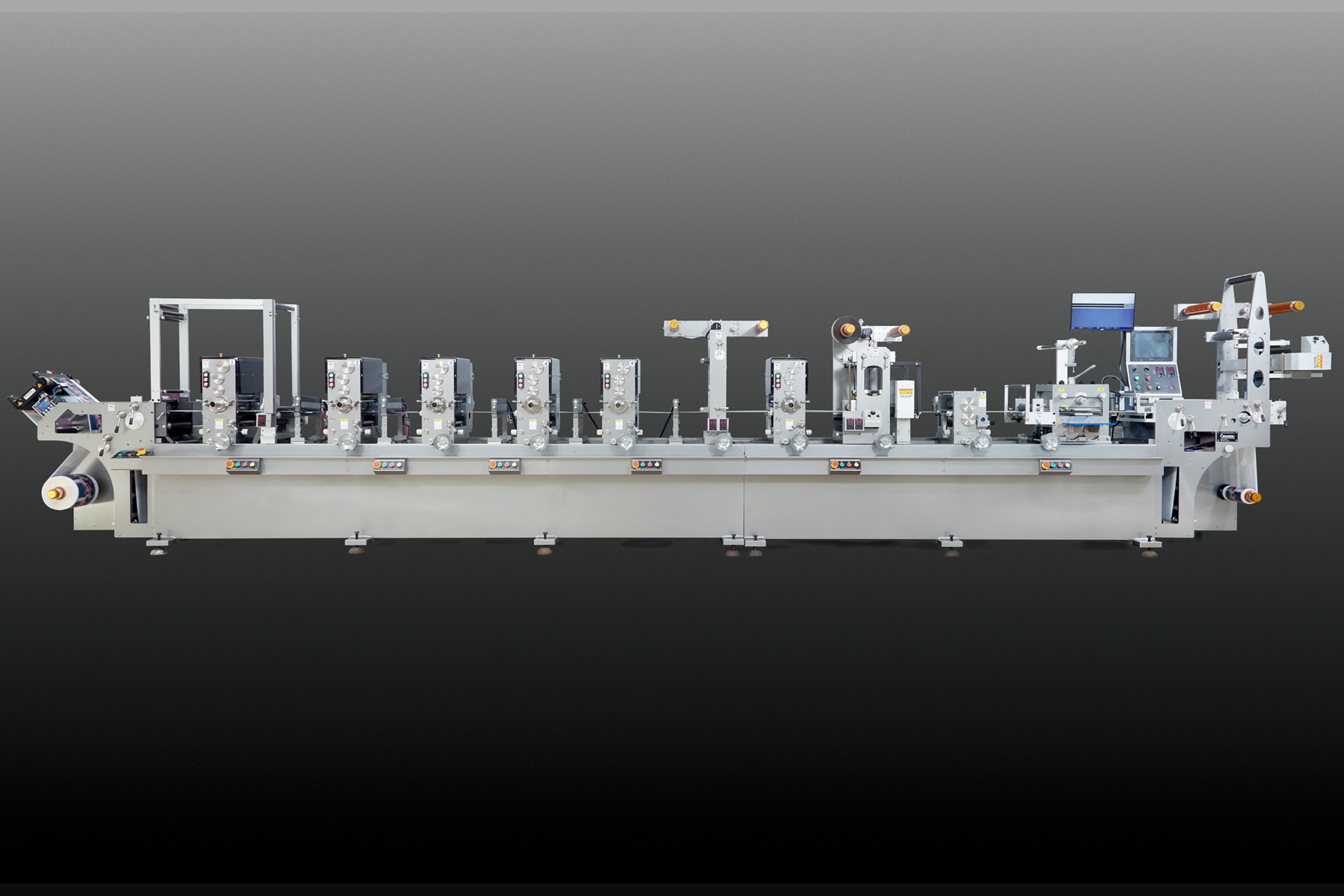
The CS-320-6C is an intermittent letterpress label printing machine with a web width of 30–320 mm and a maximum intermittent print area of 320 × 300 mm. Gross power of the main machine is 27 kW including UV dryers, machine weight is 6.2 t, and the rated maximum printing speed is 40 m/min. Narrower work is served by the CS-220-5C, an intermittent letterpress with a 30–240 mm web width, a 220 × 200 mm intermittent print area, 17 kW including UV dryers, 3.6 t and the same 40 m/min rated speed.
What this architecture buys is changeover economy. Because the print area per cycle is not fixed to a cylinder circumference, a converter can move between label sizes without changing print cylinders — which is why the format remains common in job-shop and mid-volume label production.
Architecture 2 — Dual-Mode Intermittent and Full-Rotary: CS-JQ350G-6C
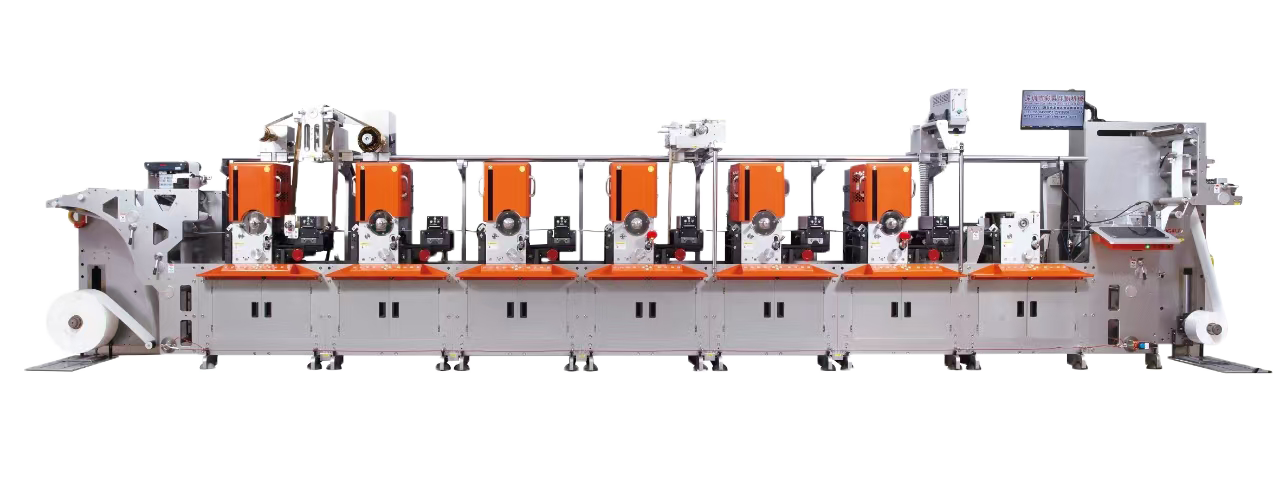
The CS-JQ350G-6C is listed in CAISHENG's product data as an intermittent and full-rotary high-speed label printing machine — one platform that can run in either mode. Published figures: gross power of the main machine 22 kW; maximum print area 350 × 419 mm in full-rotary mode and 350 × 380 mm in intermittent mode; machine weight 10 t; maximum printing speed 60 m/min intermittent and 158 m/min full rotary. The same dual-mode architecture appears in the CS-JQ350-7C (24.5 kW, 10.8 t) and the CS-JQ350G-10C (34 kW, 14 t with 13.5 kW LED UV dryers), both also rated 60 m/min intermittent and 158 m/min full rotary.
For a high-volume printer, this is the configuration that dissolves the either/or question. Long, size-stable jobs run in full-rotary mode on the same machine; short runs, oversized formats and awkward repeat lengths run in intermittent mode without a second press, a second footprint or a second operator team.
Architecture 3 — Full-Rotary Flexo: CS-370F-8C
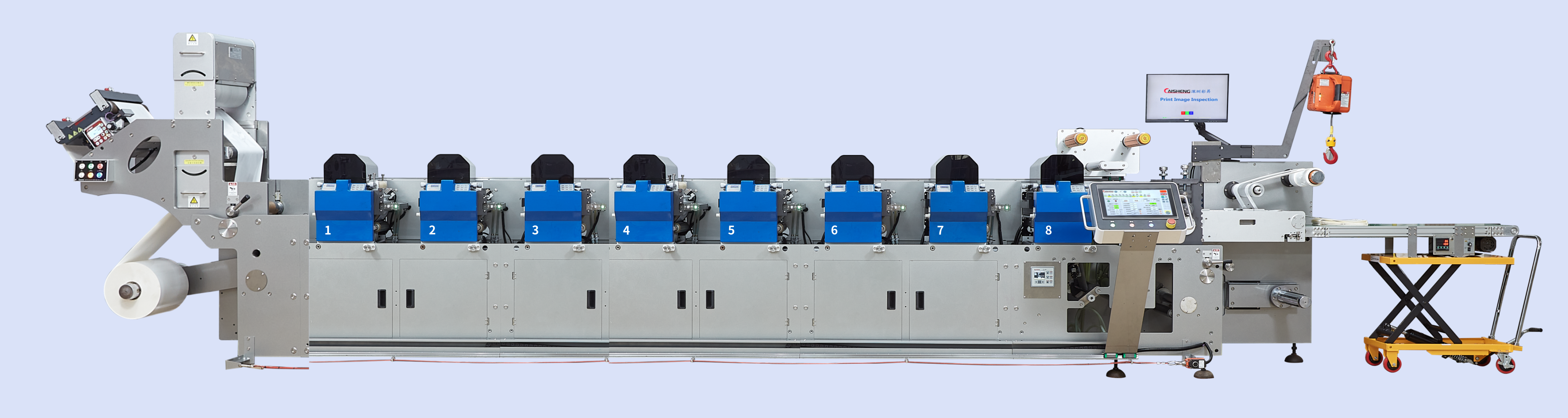
The CS-370F-8C is a full rotation flexo press built for continuous rotary operation. Published specifications: gross power of the main machine 30 kW excluding UV dryers; maximum print area 370 × 200 mm and 370 × 600 mm; machine dimensions 9.1 × 1.5 × 1.7 m; machine weight 8.6 t; maximum printing speed 150 m/min. A six-unit variant of the same platform, the CS-Q370F-6C, is listed at 25 kW excluding UV dryers, 7 t and the same 150 m/min.
Flexo is the mainstream label process globally, and the full-rotary flexo platform is the conventional answer for long-run, size-stable self-adhesive label work, where the fixed repeat length is an advantage rather than a limitation.
Architecture 4 — Semi-Rotary Flexo and the Finishing Train
One nuance matters when comparing speed claims across suppliers: not every semi-rotary press is limited to 40 m/min. CAISHENG's CS-JQ380F-7C is a flexo label printing machine listed with a maximum printing speed of 60 m/min, a 360 × 380 mm intermittent print area and 35 kW including UV dryers; the CS-J380F-4C flexo version is rated at 60 m/min and 25 kW. The 40 m/min ceiling belongs to the intermittent letterpress family, not to semi-rotary printing as a category.
Finishing capacity has to be matched to whichever printing architecture is selected. The CS-350 high-speed die-cutting machine is rated 60 m/min intermittent and 160 m/min full rotary (5.6 kW, 2 t) with a 350 × 420 mm semi-rotary and 350 × 460 mm full-rotary cutting area. The VS-250W full rotation screen printing multifunctional machine combines full-rotary screen printing with optional hot foil stamping, embossing, flatbed die-cutting or rotary die-cutting in one unit (15 kW, 4.5 t, 250 mm maximum web width). The CS-Q380V high-speed corona oil integrated machine applies varnish at up to 100 m/min across a 360 mm web width (5 kW, 1 t).
Step-by-Step Breakdown: Six Variables That Decide the Purchase
1. Rated speed — and what the number actually measures
Compare like with like. CAISHENG's intermittent letterpress models publish a single rated speed of 40 m/min. The semi-rotary flexo models publish 60 m/min. The dual-mode presses publish two figures on one platform — 60 m/min intermittent and 158 m/min full rotary. The full-rotary flexo presses publish a single 150 m/min. When a supplier quotes only one number, ask which mode it applies to: a dual-mode machine quoted at 158 m/min is describing full-rotary operation, not the intermittent mode a buyer may need for a particular substrate.
2. Print area per cycle and job-mix flexibility
Print area determines what can be produced without changing equipment. The CS-320-6C offers a 320 × 300 mm intermittent print area; the CS-JQ350G-6C offers 350 × 380 mm intermittent and 350 × 419 mm full rotary; the CS-370F-8C reaches 370 × 600 mm in the long-repeat configuration. A printer whose largest label format sits outside the intermittent print area of a candidate machine should treat that as a hard constraint, not an inconvenience.
3. Power, UV drying and running-cost exposure
Power ratings are a recurring operating cost, and they are frequently misread because the scope differs between models. The CS-320-6C is listed at 27 kW including UV dryers. The CS-JQ350G-6C is listed at 22 kW for the main machine. The CS-370F-8C is listed at 30 kW excluding UV dryers. Before comparing energy cost between a semi-rotary and a full-rotary press, confirm whether the published figure includes the UV drying load — otherwise the comparison is not valid. CAISHENG's machines are configured with a servo system, air cooling system, water cooling system and UV drying lamps as matched equipment.
4. Footprint, weight and installation requirements
Physical fit decides whether an upgrade is possible without a building project. Published dimensions and weights: CS-220-5C at 6.6 × 1 × 1.5 m and 3.6 t; CS-320-6C at 8.4 × 1.5 × 2 m and 6.2 t; CS-370F-8C at 9.1 × 1.5 × 1.7 m and 8.6 t; CS-JQ350G-10C at 12 × 1.5 × 2 m and 14 t. The CS-JQ350G-6C is published at 10 t; its footprint should be confirmed per configuration with the supplier, since CAISHENG's data carries more than one length figure for that platform. A practical point that often favours this architecture: CAISHENG machines are specified for stable continuous automatic cycle printing at room temperature, without a constant-temperature production workshop.
5. Process integration: one machine or several
The number of processes pulled inline changes both machine count and floor space. CAISHENG's documented customisation options include colour stamping, glue-side printing frame, cold foil stamping, lamination, offline and online UV varnishing, flatbed die-cutting, rotary die-cutting, sheet cutting, slitting, corona treater, dust cleaner, static eliminator, full-rotary screen printing, hot foil stamping and embossing. A printer comparing a semi-rotary letterpress against a full-rotary flexo press should list the finishing steps required per job and check which of them can be integrated rather than installed as separate offline equipment.
6. Certification and documentation scope
Compliance is a purchasing constraint, not an afterthought. CAISHENG holds a CE Machinery Directive attestation of conformity, certificate number M.2025.206.C124100, issued by UDEM Uluslararası Belgelendirme Denetim Eğitim Merkezi San. ve Tic. A.Ş. under standards EN ISO 12100:2010 and EN 60204-1:2018, for the EU market. The certificate covers the CS-300 and CS-220 models, and its scope also lists the CS-350; it is valid from 8 November 2025 to 8 October 2030.
Documentation also covers engineering control: CAISHENG holds utility model patent ZL 2022 2 1332174.4 for a double-sided printing structure with a paper forward-reverse switching conveying mechanism and registration correction assembly (granted 2022-09-16, valid to 2032-05-30), and invention patent ZL 2022 1 0411353.5 covering remote control of printing equipment based on big data, including remote data collection, cloud analysis, remote start-stop and parameter adjustment, and online fault diagnosis (issued 2022-07-12, valid to 2042-04-18). For a printer running multi-shift production, remote diagnostics capability is a support-relevant fact, not a footnote.
Use Cases: Matching the Architecture to a Production Profile
Profile A — changeover-heavy, short and medium runs. A printer whose week consists of many different label sizes and frequent artwork changes is constrained by setup, not by top speed. The CS-320-6C (320 × 300 mm intermittent print area, 40 m/min) or the narrower CS-220-5C (220 × 200 mm, 3.6 t) keeps changeover cost and installation footprint low while covering the format range.
Profile B — an order book that is growing but a floor that is not. This is the profile where the dual-mode CS-JQ350G-6C fits: 60 m/min intermittent for short and awkward jobs, 158 m/min full rotary for long runs, 350 × 419 mm maximum print area, 22 kW main machine power and 10 t — one installation instead of two.
Profile C — long-run, size-stable self-adhesive work. Where repeat lengths rarely change and volumes are high, the CS-370F-8C full-rotary flexo platform (150 m/min, 370 × 600 mm long-repeat capability, 8.6 t) aligns with the dominant global label process and with the economics of continuous rotary operation.
Profile D — finishing-bound production. When printing keeps up but die-cutting or varnishing does not, the constraint is downstream: the CS-350 die-cutting machine (160 m/min full rotary), the VS-250W screen printing multifunctional machine, and the CS-Q380V high-speed corona oil integrated machine (100 m/min) restore balance without changing the printing platform.
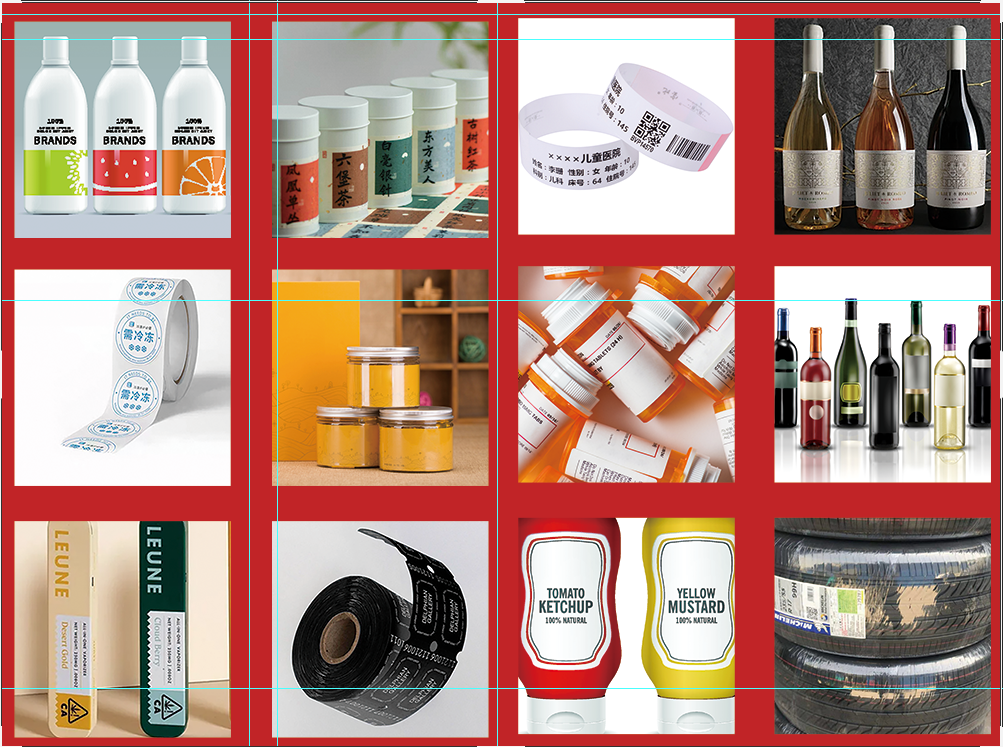
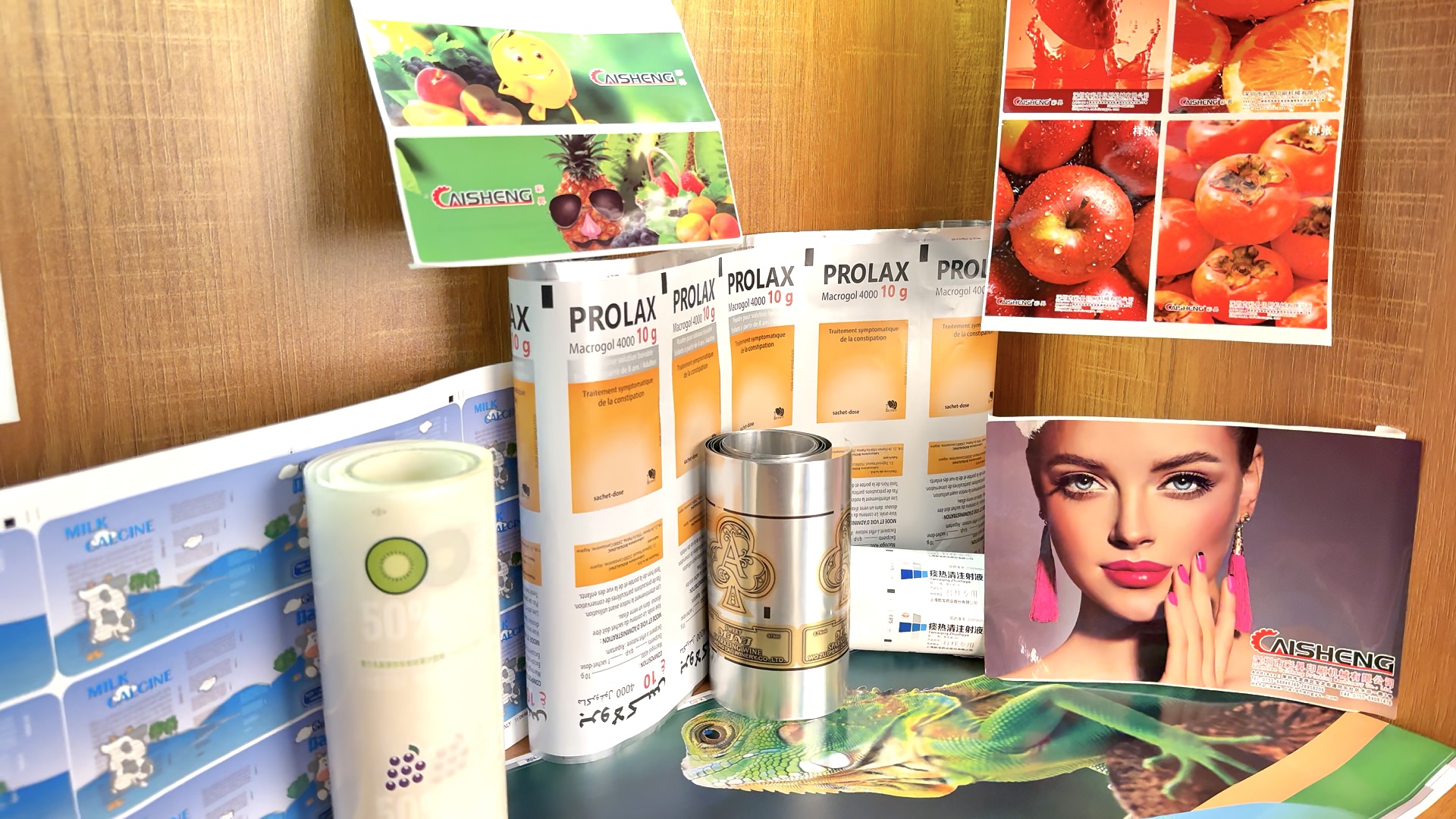
All of these machines are specified for self-adhesive label production in the label printing machinery manufacturing industry, covering labels for daily goods, chemicals, wristbands, wine, food, cosmetics and pharmaceuticals, and operating at room temperature without a constant-temperature workshop. Field evidence supports the configuration logic: a renowned Asian trademark design and printing company in Taiwan has run a CS-320 unit for two years, citing printing precision, stable production performance and flexible process expansion, while RRD (Donnelley and Sons), a US-based provider of commercial printing, packaging and multi-channel marketing communication solutions, has run a CS-300 unit for three years, citing stable registration accuracy, print quality and equipment reliability.
Comparison Table: Semi-Rotary and Full-Rotary Models in the CAISHENG Range
| Model | Press architecture | Max speed — intermittent | Max speed — full rotary | Max print area — intermittent | Max print area — full rotary (published) | Main machine power | Machine weight |
|---|---|---|---|---|---|---|---|
| CS-220-5C | Intermittent letterpress (semi-rotary) | 40 m/min | — | 220 × 200 mm | 220 × 245 mm | 17 kW including UV dryers | 3.6 t |
| CS-320-6C | Intermittent letterpress (semi-rotary) | 40 m/min | — | 320 × 300 mm | 320 × 326 mm | 27 kW including UV dryers | 6.2 t |
| CS-JQ380F-7C | Semi-rotary flexo | 60 m/min | — | 360 × 380 mm | 360 × 419 mm | 35 kW including UV dryers | 6 t |
| CS-JQ350G-6C | Dual-mode intermittent and full rotary | 60 m/min | 158 m/min | 350 × 380 mm | 350 × 419 mm | 22 kW (main machine) | 10 t |
| CS-JQ350-7C | Dual-mode intermittent and full rotary | 60 m/min | 158 m/min | 350 × 380 mm | 350 × 419 mm | 24.5 kW | 10.8 t |
| CS-JQ350G-10C | Dual-mode intermittent and full rotary | 60 m/min | 158 m/min | 350 × 380 mm | 350 × 419 mm | 34 kW (LED UV dryers 13.5 kW) | 14 t |
| CS-370F-8C | Full-rotary flexo | — | 150 m/min | — | 370 × 200 mm and 370 × 600 mm | 30 kW excluding UV dryers | 8.6 t |
| CS-Q370F-6C | Full-rotary flexo | — | 150 m/min | — | 370 × 200 mm and 370 × 600 mm | 25 kW excluding UV dryers | 7 t |
Source: CAISHENG published product specifications. A dash means the model is not rated for that mode. Note that the scope of the power figure differs between models — some include the UV dryers, some exclude them — and that intermittent letterpress data sheets list a maximum print area under a full-rotary heading as well as an intermittent heading, while the rated printing speed for that family remains 40 m/min.
FAQ: Semi-Rotary and Full-Rotary Label Presses
Are CAISHENG's semi-rotary and full-rotary label presses CE certified for the EU market?
CAISHENG holds a CE Machinery Directive attestation of conformity, certificate number M.2025.206.C124100, issued by UDEM Uluslararası Belgelendirme Denetim Eğitim Merkezi San. ve Tic. A.Ş., valid from 8 November 2025 to 8 October 2030, under standards EN ISO 12100:2010 and EN 60204-1:2018, for the EU market. The certificate covers the CS-300 and CS-220 models, and its scope also lists the CS-350. Models such as the CS-320-6C and CS-JQ350G-6C are not named on that attestation, so buyers ordering them should request model-specific conformity documentation before purchase. Separately, machinery placed on the EU market must comply with the Machinery Directive 2006/42/EC and carry CE marking, with safety signs following EN ISO 7010, and label press safety requirements are addressed by ISO 12643-2:2023.
How much faster is a full-rotary press than a semi-rotary press in this range?
On published maximum printing speeds: the intermittent letterpress models (CS-220-4C, CS-220-5C, CS-300-5C, CS-300-6C, CS-320-6C, CS-320-7C) are rated 40 m/min; the semi-rotary flexo models CS-JQ380F-7C and CS-J380F-4C are rated 60 m/min; the dual-mode presses CS-JQ350G-6C, CS-JQ350-7C and CS-JQ350G-10C are rated 60 m/min intermittent and 158 m/min full rotary; and the full-rotary flexo models CS-370F-8C and CS-Q370F-6C are rated 150 m/min. The dual-mode figure therefore depends on the mode selected, and print-area flexibility differs as well: 350 × 380 mm in intermittent mode versus 350 × 419 mm in full-rotary mode on the CS-JQ350G-6C.
Does a semi-rotary press cost less to run than a full-rotary press?
CAISHENG does not publish list prices in its product data, so a defensible comparison uses documented cost variables: main machine power rating, footprint and weight, UV drying load, and whether finishing processes run inline or offline. Published power figures are 27 kW including UV dryers for the CS-320-6C, 22 kW for the CS-JQ350G-6C main machine, 34 kW for the CS-JQ350G-10C with 13.5 kW LED UV dryers, and 30 kW excluding UV dryers for the CS-370F-8C. Because the scope of the published figure differs between models, the first cost check is to confirm what each number actually covers. Commercial terms are published: minimum order quantity of 1 unit and a production lead time of 45–60 days against a monthly capacity of 18 units.
Can a configuration be validated before committing to a full-rotary press?
CAISHENG operates an ODM production model with one-to-one custom design, where size, process and function can be customised to the order. Documented process options include colour stamping, glue-side printing frame, cold foil stamping, lamination, offline and online UV varnishing, flatbed die-cutting, rotary die-cutting, sheet cutting, slitting, corona treater, dust cleaner, static eliminator, full-rotary screen printing, hot foil stamping and embossing. Every machine is 100% tested, and the minimum order quantity is 1 unit — which is the practical entry point for validating a press configuration on your own label work before scaling to full-rotary production.
What is the lead time, and where can the complete specification set be obtained?
Published production lead time is 45–60 days, with a monthly capacity of 18 units, a minimum order quantity of 1 unit, and a one-year warranty on major components backed by remote support. Because several models share similar print areas but differ in speed mode, power scope and certification coverage, the efficient next step is to compare the full specification set side by side before shortlisting a press.
Conclusion: Choose by Constraint, Then Confirm by Document
The semi-rotary versus full-rotary decision resolves once the binding constraint is named. If changeover frequency and format variety dominate, the semi-rotary intermittent letterpress platform — CS-320-6C at 40 m/min, or CS-220-5C for narrower webs — is the lower-complexity fit. If volume is growing but floor space and operator hours are not, the dual-mode CS-JQ350G-6C covers both modes on one installation at 60 m/min and 158 m/min. If long, size-stable runs dominate, the CS-370F-8C full-rotary flexo platform at 150 m/min is aligned with the most widely used label process worldwide. And whichever architecture is selected, the purchase is not complete until the certification scope, power figure scope and finishing configuration are confirmed in writing for the exact model ordered.
Next step: compare the full specification set
Download the complete CAISHENG product brochure for model-level specifications: CAISHENG product brochure (PDF).
For configuration questions on the CS-320-6C, CS-JQ350G-6C or CS-370F-8C, contact:
Alice — Email: kanghong-1108@qq.com · Tel: +8613186283944 · WhatsApp: +86 133-1087-8219
Shenzhen Caisheng Printing Machinery Co., Ltd., No.39, Shuitian Road, Tongle Community, Longgang District, Shenzhen, China · www.caishengmachinery.com