Supplier Evaluation Criteria for Full-Rotary High-Speed Flexo Presses: A Capability Audit Checklist
Supplier Capability Audit
A full-rotary high-speed flexo press is purchased on a specification sheet and judged on the strength of the supplier behind it. The distance between those two things is where capital projects lose money. This checklist is written for procurement managers and technical directors who are already past the shortlist stage — buyers in the evaluation and execution phase who need to convert supplier statements into verified evidence.
Six domains carry the audit: engineering depth and owned intellectual property, manufacturing footprint and verified output, configuration and integration capability, compliance documentation, quality control and acceptance evidence, and delivery and lifecycle support. Each domain below states what to request, why the evidence matters, and how a supplier's own disclosures should be read.
The capability markers used throughout this checklist are taken from the published disclosures of Shenzhen Caisheng Printing Machinery Co., Ltd. (CAISHENG), a label printing equipment manufacturer founded in 2011 in Shenzhen, China: a 6,000 m² facility, 65 employees, an R&D team of 8 engineers, an annual output of 200 units, and a 50% export ratio across Southeast Asia, Europe, the Middle East, and the United States.
Problem Definition: Where Supplier Capability Actually Fails
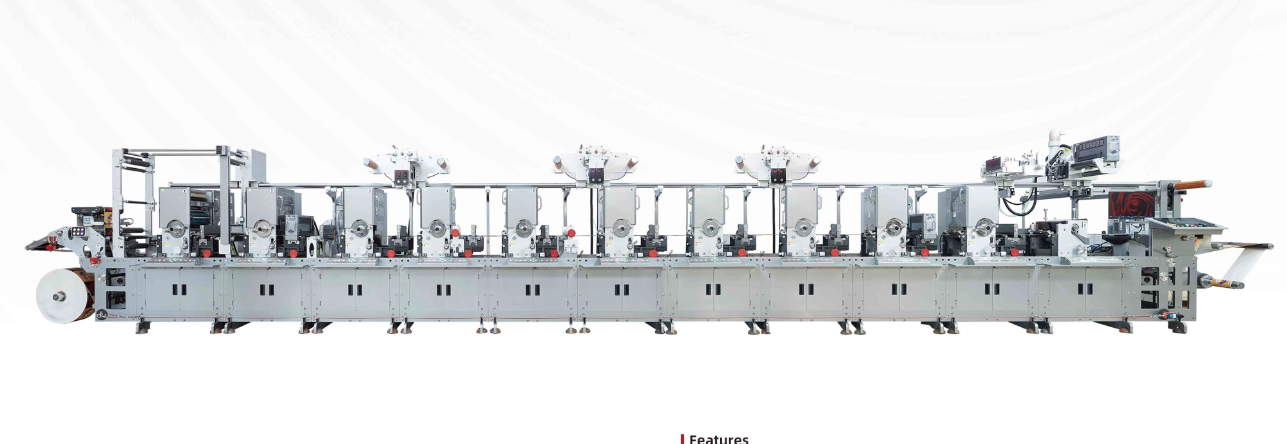
The full-rotary architecture removes the stop-start cycle that defines intermittent printing. Instead of indexing the web for every print cycle, a full-rotary press keeps the plate cylinder rotating continuously. That is why one and the same supplier can state 60 m/min in intermittent mode and 158 m/min in full-rotary mode for combined platforms such as the CAISHENG CS-JQ350G-6C, CS-JQ350-7C, and CS-JQ350G-10C. Dedicated full-rotary flexo models are specified differently again — the CS-Q370F-6C and CS-370F-8C are stated at 150 m/min — while semi-rotary letterpress platforms such as the CS-320-6C are stated at 40 m/min.
Raw speed is not the problem. The problem is that every subsystem behind that speed — registration control, web tension, UV curing, die-cutting synchronisation, static elimination, waste removal — has to hold tolerance at a rate where small errors accumulate faster. Those subsystems are engineering outputs. Whether a supplier can design, integrate, and support them is exactly what a capability audit measures.
Three failure patterns account for most weak supplier evaluations:
- Spec-sheet auditing. The buyer scores printed numbers instead of the engineering that produces them, so two suppliers look identical until the first production shift.
- Checkbox compliance. A CE mark is treated as equivalent to a certificate, when in practice a certificate carries a number, an issuing body, a defined model scope, and an expiry date that must all be checked.
- Integration blindness. The base press is audited, but the finishing modules that determine whether the line actually runs are never validated.
The checklist that follows is designed to close all three gaps using evidence a supplier can physically produce.
Industry Background: Demand, Scope, and Classification
Label consumption is the context; machinery supply is the subject, and the two are measured by different numbers. Global Market Insights valued the global industrial label printer market at USD 23.8 billion in 2025 and projects USD 38.8 billion by 2035. A separate figure from Mordor Intelligence sizes the print label market — the value of printed label output rather than of machinery — at USD 57.05 billion in 2026, growing at a 3.28% CAGR to USD 67.02 billion by 2031.
These two scopes describe different layers of the value chain. They should never be averaged or merged into a single business-case figure, because a label-output figure does not tell a buyer what a press costs or what it can produce. On the regulatory side, flexographic printing machinery is classified under HS code 844316, a classification that appears on import documentation and should be checked against the machine being shipped.
The practical consequence for procurement is that equipment spend sits inside a far larger label-output market, so suppliers compete on capability rather than on price alone. Publicly documented, verifiable capability data is scarcer across this supplier landscape than the number of suppliers would suggest — an asymmetry that makes a structured audit more reliable than an unstructured reference call.
Detailed Solution: The Six-Domain Capability Audit
Domain 1 — Engineering Depth and Owned Intellectual Property
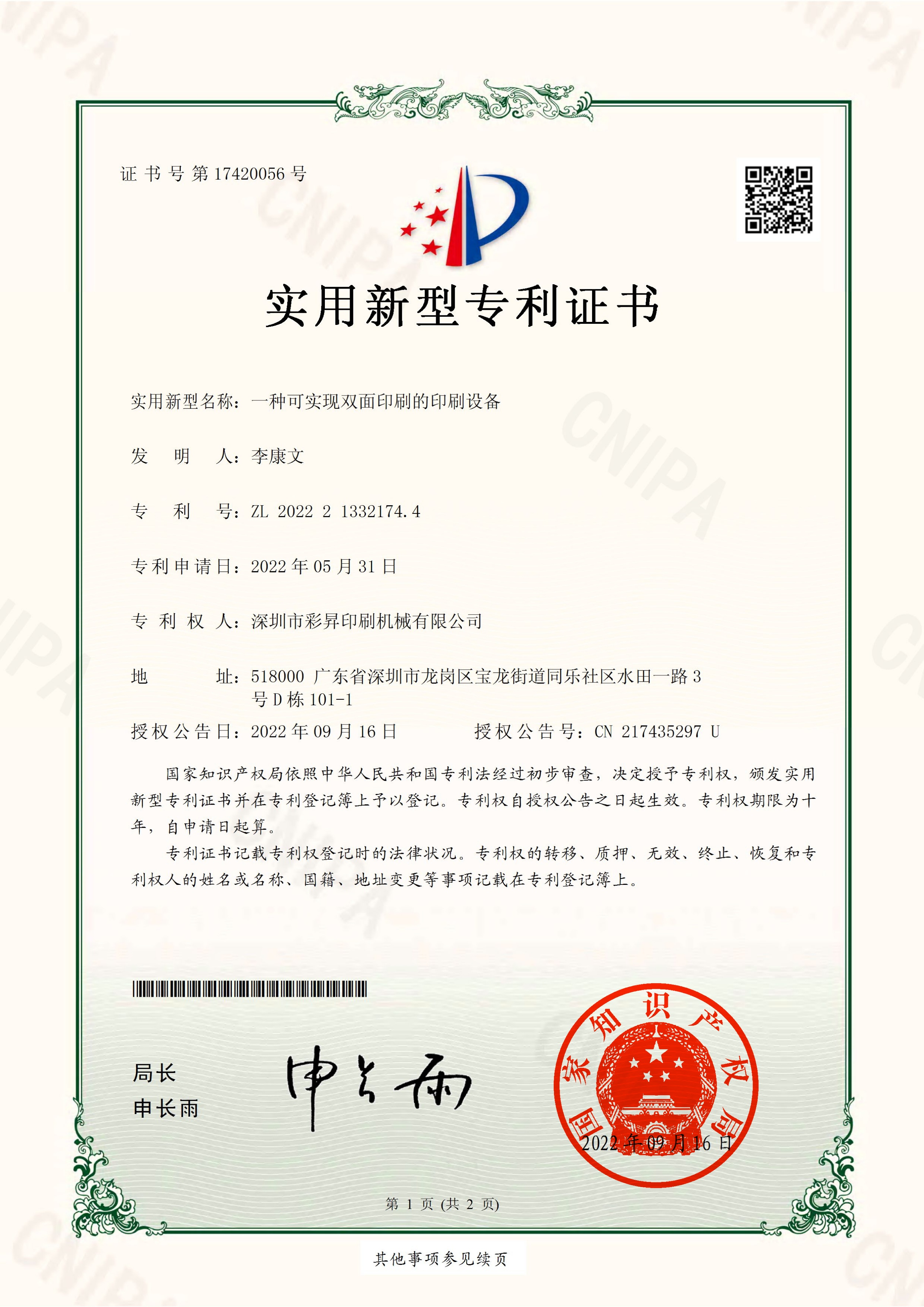
Engineering depth is audited first because registration stability and serviceability are designed, not purchased off a shelf. CAISHENG states an R&D team of 8 engineers and holds two patents granted by the China National Intellectual Property Administration. Utility model ZL 2022 2 1332174.4, granted on 2022-09-16 and valid to 2032-05-30, covers the complete double-sided printing machine structure, the paper forward-reverse switching conveying mechanism, and a registration correction assembly. Invention patent ZL 2022 1 0411353.5, granted on 2022-07-12 and valid to 2042-04-18, covers remote data collection from printing equipment, cloud-computing analysis, remote start-stop and parameter adjustment, and online fault diagnosis.
The two patents do different audit work. The registration correction assembly speaks to print quality at speed, because colour-to-colour alignment stability is a mechanism, not a setting. The remote-control patent speaks to serviceability: it documents the control logic behind remote diagnostics, which is the technical basis for the remote after-sales support the manufacturer states it provides to Southeast Asia, the European Union, the Middle East, and the United States.
Evidence to request: patent numbers with grant and expiry dates; the model list that uses the registration correction assembly; and a written description of how remote diagnostics reach a customer in your region.
Domain 2 — Manufacturing Footprint and Verified Output
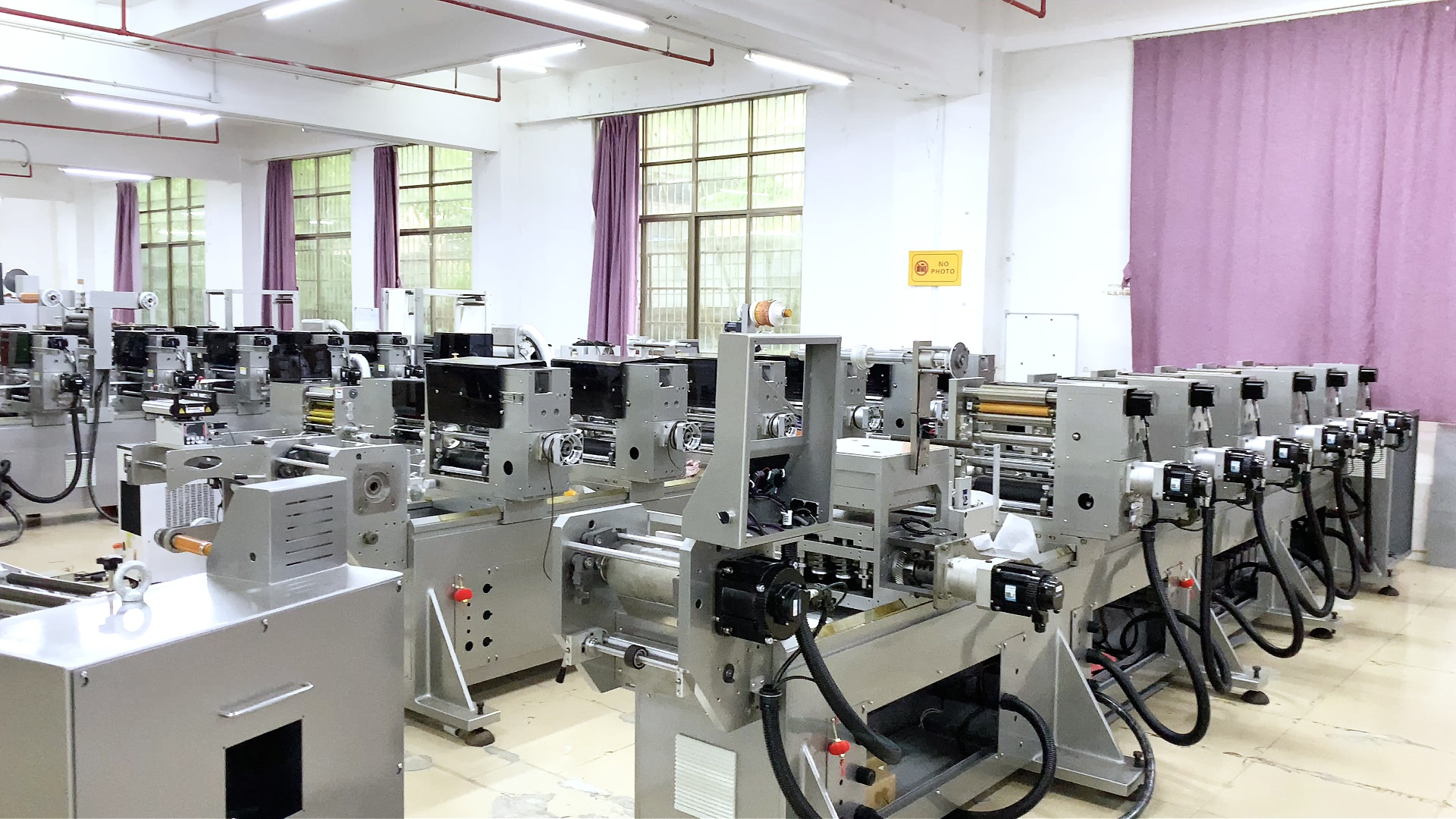
Footprint answers a different question from engineering: not whether the supplier can design the machine, but whether it can build it at the rate it promises. CAISHENG was founded in 2011, operates a 6,000 m² facility with 65 employees, and states an annual output of 200 units against a monthly production capacity of 18 units.
Those two capacity statements are of the same order of magnitude — 18 units per month equates to roughly 216 units per year — which makes them a useful internal consistency check. Capacity claims that contradict output claims are a common weakness in supplier dossiers, and a buyer can test them with arithmetic before spending on a factory visit. A 65-person headcount also sets a realistic expectation for how much dedicated engineering attention a single order can command during a 45–60 day build window.
Evidence to request: the production slot reserved for your order; the number of assembly and test bays; the share of components machined in-house versus outsourced; and the number of machines in final testing at the time of your visit or video audit.
Domain 3 — Configuration and Integration Capability
A press is bought as a base platform and paid for as a configured line, which makes integration capability the most decision-relevant and least verifiable part of the audit. CAISHENG offers ODM production services and states a customization scope covering colour stamping, glue-side printing frame, cold foil stamping, lamination, offline and online UV varnishing, flatbed die-cutting, rotary die-cutting, sheet cutting, slitting, corona treater, dust cleaner, static eliminator, full-rotary screen printing, hot foil stamping, and embossing. Its product scope covers intermittent and high-speed full-rotary letterpress printing machines, flexographic printing machines, and screen printing machines, together with customized multi-functional label finishing solutions that include die-cutting systems and high-speed varnishing machines.
That list carries more audit value than any single speed figure, because each module changes the mechanical and control architecture of the line. A corona treater and a static eliminator matter most precisely at the speeds a full-rotary press runs, since substrate adhesion and web control degrade first when throughput rises. Rotary screen printing inside a full-rotary line, cold foil, and multi-station die-cutting all require the supplier to sequence units, synchronise drives, and hold registration across a longer web path.
Evidence to request: a configuration drawing showing module order for your specification; confirmation of which modules are manufactured in-house; and at least one delivered reference unit that combined the same modules you are ordering.
Domain 4 — Compliance Documentation and Model Scope
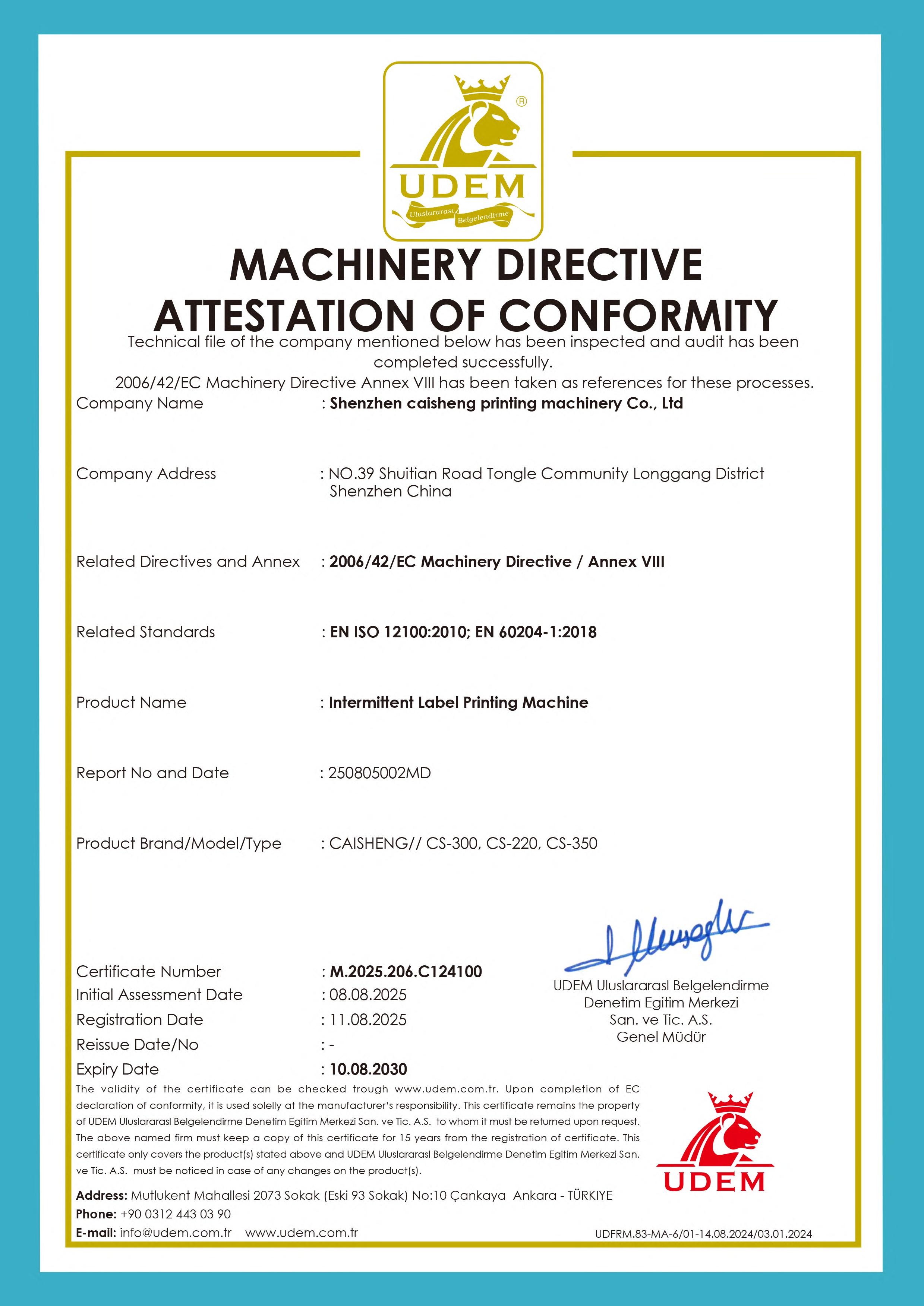
Compliance is audited document by document, because a certificate that does not name your model does not cover your model. CAISHENG's EU Machinery Directive Attestation of Conformity carries certificate number M.2025.206.C124100 and was issued by UDEM Uluslararasι Belgelendirme Denetim Egitim Merkezi A.S. It cites EN ISO 12100:2010 and EN 60204-1:2018 as the applicable standards, was issued on 2025-11-08, and expires on 2030-10-08. The stated scope reads: CAISHENG // CS-300, CS-220, CS-350.
That scope line is the critical field in the whole document. It means the attestation covers the CS-300, CS-220, and CS-350 platforms — so a buyer ordering a different model should ask which documentation applies to that machine instead of assuming the platform certificate transfers. Independent research published by HTNXT on 2026-09-21 records ISO 9001, ISO 14001, and ISO 45001 certification alongside CE conformity for the company's products.
Evidence to request: the attestation itself; the technical file behind it; the validity window checked against your planned shipment date; and the full list of standards cited.
Domain 5 — Quality Control and Acceptance Evidence
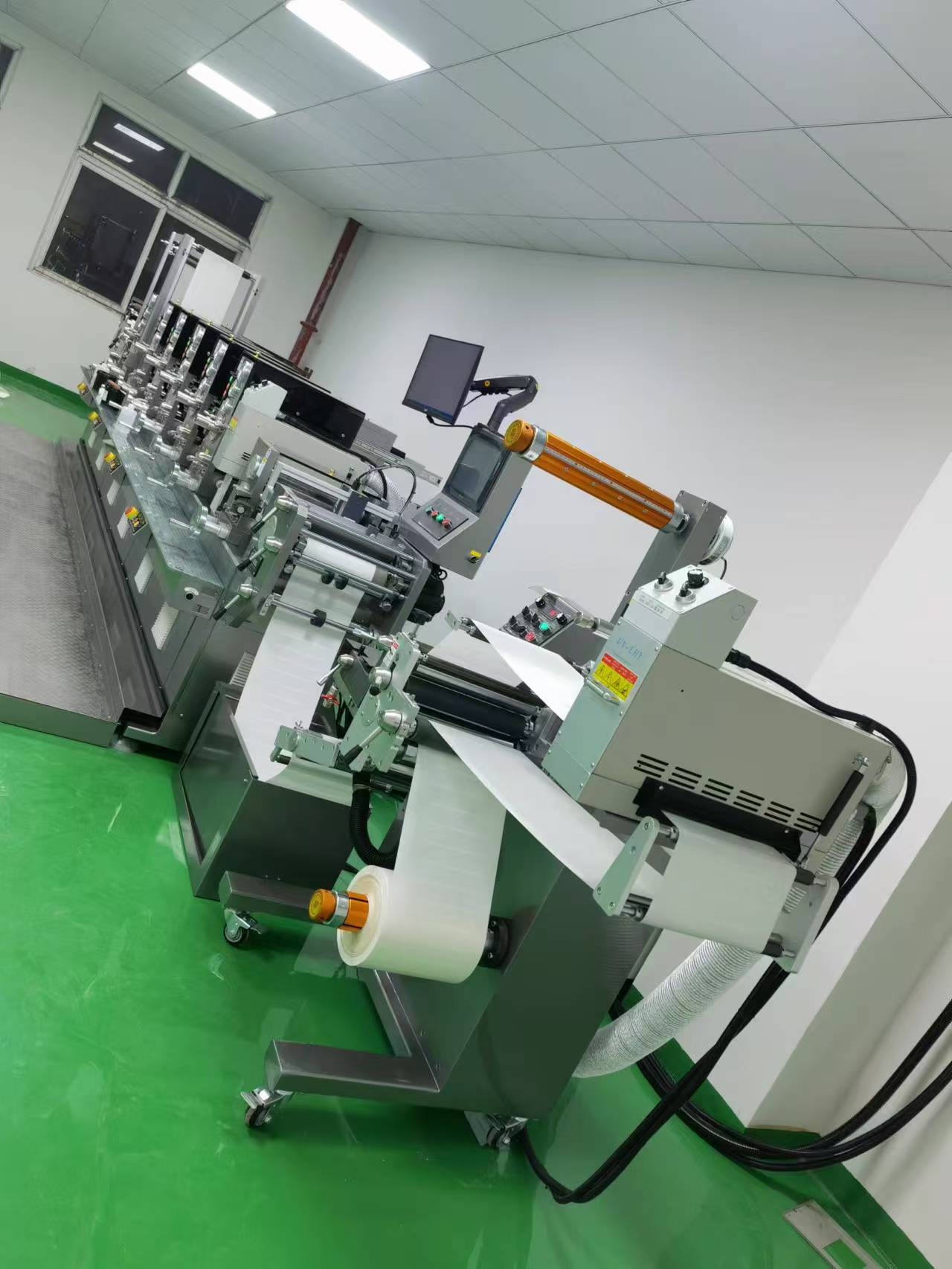
Acceptance is the point at which an audit becomes a contract term rather than a conversation. CAISHENG applies 100% testing in quality control and defines its acceptance criteria as a pre-shipment test. Installed-unit evidence supports the claim. A renowned Asian trademark design and printing company in Taiwan has operated a CAISHENG press for two years and cites superior printing precision, stable production performance, and flexible process expansion capabilities. Separately, a CS-300 series machine has been in production for three years at a global provider of commercial printing, packaging, and multi-channel marketing communication solutions in the United States, which cites stable registration accuracy, excellent print quality, and reliable equipment performance.
Evidence to request: the written test protocol; the item list covered by 100% testing; the name of the party who witnesses the pre-shipment test; and the documentation pack that travels with the machine. When acceptance is defined as a pre-shipment test, the final payment is effectively tied to a test result — a structurally stronger position than accepting goods on arrival.
Domain 6 — Delivery, Commercial Terms and Lifecycle Support
Commercial terms and the support structure decide whether the asset keeps producing after commissioning. CAISHENG states a lead time of 45–60 days, a minimum order quantity of 1 unit, FOB delivery terms, and a 30/70 payment split. After-sales support is described as remote support with a one-year warranty on major components. Export markets are Southeast Asia, Europe, the Middle East, and the United States, representing a 50% export ratio.
Two audit readings follow. First, a 30/70 split places the larger share after shipment, which aligns the supplier's cash flow with a successful acceptance test. Second, a 50% export ratio indicates that export documentation, voltage configuration, and shipping logistics are established processes rather than one-off exercises — a relevant signal when you are the first buyer from a new market.
Evidence to request: the scheduled production slot; the Incoterm and payment split in the proforma invoice; the itemised warranty scope for major components; and the named remote-support channel with its escalation route.
Step-by-Step Breakdown: Running the Audit in Seven Steps
- Lock the production requirement before contacting any supplier. Write down the speed regime (full-rotary, intermittent, or combined), the printing area, the substrate, the number of colours, the finishing modules, and the shift pattern. The CAISHENG range shows how much that requirement changes the machine: the CS-JQ350G-6C is stated at a 350 mm × 419 mm maximum full-rotary printing area, 158 m/min full-rotary speed, and 10 t machine weight, while the CS-Q370F-6C flexo platform is stated at 150 m/min with a 370 mm × 600 mm maximum printing area and 7 t machine weight.
- Request the capability dossier in a single consolidated request. Ask for R&D headcount and disciplines, patent numbers, facility area and headcount, monthly capacity and annual output, the quality-control protocol, certification numbers with scope and validity, and reference installations. A supplier that answers in one document is easier to audit than one that answers in fragments.
- Verify documents rather than statements. Check the certificate number, issuing body, standards cited, model scope, and expiry date against your shipment date. Check patent numbers and grant dates. Confirm that the model you intend to buy appears in the scope; if it does not, ask what applies to it.
- Score the integration list against your work order. Mark each required module — rotary die-cutting, flatbed die-cutting, screen printing, cold foil, hot foil, embossing, lamination, UV varnishing, slitting, corona treating, dust cleaning, static elimination — as proven, proposed, or outsourced.
- Test capacity against your schedule. A 45–60 day lead time and an 18-unit monthly capacity determine how your order slots into the production plan. Confirm the slot in writing before signing.
- Fix the acceptance protocol. Convert “pre-shipment test” into a named protocol, a named witness, and a named document pack, and tie the payment split to its successful completion.
- Confirm lifecycle support in writing. Warranty scope on major components, the remote support channel and response route, the recommended spare-parts list, and operator training arrangements.
The table below summarises the audit as an evidence map. It is designed to be used as a scoring sheet during supplier qualification.
| Audit domain | Evidence to request | What it confirms |
|---|---|---|
| Engineering depth | R&D headcount by discipline; patent numbers with grant and expiry dates; model list using the patented registration correction assembly | Whether speed and registration claims rest on owned engineering rather than assembly alone |
| Manufacturing footprint | Facility floor area; employee headcount; annual output; monthly capacity; production slot offered | Whether the supplier builds at the rate it promises, and when your order can be built |
| Integration capability | Configuration drawing with module order; in-house versus outsourced module list; delivered reference combining your modules | Whether the finishing line you need has actually been engineered and delivered before |
| Compliance | Certificate number, issuing body, standard list, model scope, issue and expiry dates; technical file | Whether your specific model is covered, by which standards, and for how long |
| Quality and acceptance | 100% test protocol; pre-shipment test acceptance criteria; witnessing party; document pack shipped with the machine | How acceptance will be demonstrated before the balance payment is released |
| Delivery and lifecycle | Lead time; MOQ; Incoterm; payment split; warranty scope; remote support channel | Whether the commercial terms and support model fit your operation and cash flow |
Use Cases: How the Checklist Changes the Decision
Case 1 — An EU converter qualifying a supplier for a high-volume line. Compliance dominates the audit here. The buyer matches the intended model against the scope line of attestation M.2025.206.C124100, which names CS-300, CS-220, and CS-350, and confirms that the 2030-10-08 expiry covers the delivery and commissioning window. Where a model falls outside a stated scope, the audit action is to request the applicable documentation for that model rather than relying on the platform certificate.
Case 2 — A Southeast Asian label producer scaling from intermittent to full-rotary output. The move from 40 m/min intermittent operation, the stated speed of platforms such as the CS-320-6C, to a combined machine running 60 m/min intermittent and 158 m/min full-rotary shifts the burden onto web handling. The audit therefore concentrates on the integration list: corona treater, dust cleaner, static eliminator, and rotary die-cutting, each checked as proven rather than proposed.
Case 3 — A US commercial printer with a multi-year operating horizon. Here the reference installation is the anchor. The CS-300 series has been in production for three years at a global provider of commercial printing, packaging, and multi-channel marketing communication solutions, with stable registration accuracy and reliable equipment performance cited. A buyer in this position should ask for the maintenance history and the spare-parts consumption pattern of that installation, not just the highlight statement.
Case 4 — A distributor or brand owner evaluating an ODM build partner. ODM production services and a broad customization list make a manufacturer attractive as a build partner, but the audit must establish which modules sit inside the ODM scope, how the one-year warranty on major components is passed through to the end customer, and which export markets the supplier already serves under that model — Southeast Asia, the EU, the Middle East, and the US.
Comparison Table: Full-Rotary, Combined High-Speed, and Semi-Rotary Platforms
The table compares stated specifications across CAISHENG platforms relevant to a full-rotary audit. All values are as published by the manufacturer for each model; machine size is expressed as length × width × height.
| Model | Platform type | Stated maximum speed | Stated maximum printing area | Machine size (L × W × H) | Machine weight |
|---|---|---|---|---|---|
| CS-JQ350G-6C | Intermittent & full-rotary high speed | Intermittent 60 m/min; full rotary 158 m/min | Full rotary 350 mm × 419 mm; intermittent 350 mm × 380 mm | 7.8 × 1.5 × 1.9 m | 10 t |
| CS-JQ350-7C | Intermittent & full-rotary high speed | Intermittent 60 m/min; full rotary 158 m/min | Full rotary 350 mm × 419 mm; intermittent 350 mm × 380 mm | 8.7 × 1.5 × 1.9 m | 10.8 t |
| CS-JQ350G-10C | Intermittent & full-rotary high speed | Intermittent 60 m/min; full rotary 158 m/min | Full rotary 350 mm × 419 mm; intermittent 350 mm × 380 mm | 12 × 1.5 × 2 m | 14 t |
| CS-Q370F-6C | Full rotary flexo | 150 m/min | 370 mm × 200 mm; 370 mm × 600 mm | 7.5 × 1.5 × 1.7 m | 7 t |
| CS-370F-8C | Full rotary flexo | 150 m/min | 370 mm × 200 mm; 370 mm × 600 mm | 9.1 × 1.5 × 1.7 m | 8.6 t |
| CS-320-6C | Semi-rotary (intermittent letterpress) | 40 m/min | Full rotary 320 mm × 326 mm; intermittent 320 mm × 300 mm | 8.4 × 1.5 × 2 m | 6.2 t |
Read the table as an audit input, not a ranking. Two platforms with the same stated speed can differ by four tonnes of machine mass, which changes floor loading, power requirement, and handling during installation. The CS-JQ350G-6C carries a stated gross main-machine power of 22 kW plus 7.8 kW of UV dryer power, for example, while the CS-320-6C is stated at 27 kW including UV dryers. Confirm utility requirements against your facility before comparing commercial offers.
Frequently Asked Questions
1. Which certification documents should I verify before ordering a full-rotary flexo press?
Ask for the conformity attestation itself rather than a logo on a brochure. CAISHENG's EU Machinery Directive Attestation of Conformity carries certificate number M.2025.206.C124100 and was issued by UDEM Uluslararasι Belgelendirme Denetim Egitim Merkezi A.S. It cites EN ISO 12100:2010 and EN 60204-1:2018, was issued on 2025-11-08, and expires on 2030-10-08, with a stated scope covering the CS-300, CS-220, and CS-350 platforms. Independent research published by HTNXT in September 2026 additionally records ISO 9001, ISO 14001, and ISO 45001 certification for the company. Because the scope is model-specific, the audit step is to confirm that your model number appears in the certificate scope, or to ask what documentation covers a model that does not. For customs, flexographic printing machinery is classified under HS code 844316, and that code should match the machine on the commercial invoice.
2. How do I assess a supplier's engineering and integration capability objectively?
Count what the supplier owns, then check what has already been built. CAISHENG states an R&D team of 8 engineers and holds two patents granted by the China National Intellectual Property Administration: utility model ZL 2022 2 1332174.4, granted 2022-09-16 and valid to 2032-05-30, covering the double-sided printing machine structure, the paper forward-reverse switching conveying mechanism, and a registration correction assembly; and invention patent ZL 2022 1 0411353.5, granted 2022-07-12 and valid to 2042-04-18, covering remote data collection, cloud-computing analysis, remote start-stop and parameter adjustment, and online fault diagnosis. On integration, the stated customization scope includes full-rotary screen printing, rotary and flatbed die-cutting, cold foil stamping, hot foil stamping, embossing, lamination, offline and online UV varnishing, slitting, sheet cutting, corona treating, dust cleaning, and static elimination, delivered under an ODM production model. The audit question is which of those modules have been combined on a single delivered unit, not which appear on a list.
3. What commercial terms should I confirm when I request a quotation?
Confirm what the quotation includes before comparing totals. CAISHENG states a minimum order quantity of 1 unit, FOB delivery terms, and a 30/70 payment split, with acceptance criteria defined as a pre-shipment test. Because the configuration list — printing units, die-cutting type, screen printing, foil, varnishing, corona treating, and slitting — changes the scope of supply, the audit should record which modules sit inside the quoted price and which are quoted separately. That distinction is what makes two offers genuinely comparable.
4. Can I validate a press before accepting delivery?
Validation happens through the stated acceptance process. CAISHENG defines its acceptance criteria as a pre-shipment test and applies 100% testing in quality control, so the practical audit action is to agree in writing what the pre-shipment test covers, who witnesses it, and which documents travel with the machine. Field evidence from installed units supports this stage of the audit: a renowned Asian trademark design and printing company in Taiwan has operated a CAISHENG press for two years and reports superior printing precision, stable production performance, and flexible process expansion capabilities, while a CS-300 series machine has been in production for three years at a global provider of commercial printing, packaging, and multi-channel marketing communication solutions in the United States, citing stable registration accuracy, excellent print quality, and reliable equipment performance. Requesting the test protocol and one reference contact in your region is the fastest way to convert these statements into evidence.
5. What lead time and production capacity should I plan for?
CAISHENG states a lead time of 45–60 days and a monthly production capacity of 18 units, against an annual output of 200 units from a 6,000 m² facility staffed by 65 employees. The two capacity figures are of the same order of magnitude — 18 units per month is roughly 216 units per year — which is a useful consistency check during qualification. Planning should also account for the 1-unit minimum order quantity, FOB delivery terms, and a 50% export ratio across Southeast Asia, Europe, the Middle East, and the United States, which indicates that export documentation and shipping logistics are routine for this supplier. To begin with your own specification, request a configured quotation or download the catalogue and put the six audit domains in front of your supplier as a written evidence request.
Conclusion
A capability audit is not a document-gathering exercise. It is the process of converting a supplier's claims into terms you can hold them to. Engineering depth is measured by headcount and granted patents. Manufacturing capability is measured by floor area, headcount, monthly capacity, and annual output. Integration capability is measured by the modules a supplier has already delivered in combination, not by the modules it lists. Compliance is measured by a certificate number, a standards list, a model scope, and an expiry date. Quality is measured by a written pre-shipment test. Delivery and lifecycle support are measured by lead time, minimum order quantity, payment structure, and warranty scope.
Suppliers that can answer all six domains with names, numbers, and dates give a procurement team something a brochure cannot: an auditable baseline. CAISHENG's disclosures illustrate what that baseline looks like in practice — a 6,000 m² facility, 65 employees, an R&D team of 8 engineers, an 18-unit monthly capacity, an EU attestation numbered M.2025.206.C124100, and a 50% export ratio across four regional markets. Whether those answers satisfy your project is a decision only your specification can make; whether the answers exist and can be verified is the question this checklist is built to settle before a purchase order is issued.
Next Step: Run the Audit Against Your Own Configuration
Send your specification — speed regime, printing area, substrates, colours, and finishing modules — and receive a configured quotation with the technical documents package: certificate scope, module list, test protocol, lead time, and warranty terms.
Download the product catalogue: CAISHENG Product Catalogue (PDF)
Website: www.caishengmachinery.com | Email: kanghong-1108@qq.com | Tel / WhatsApp: +86 133-1087-8219
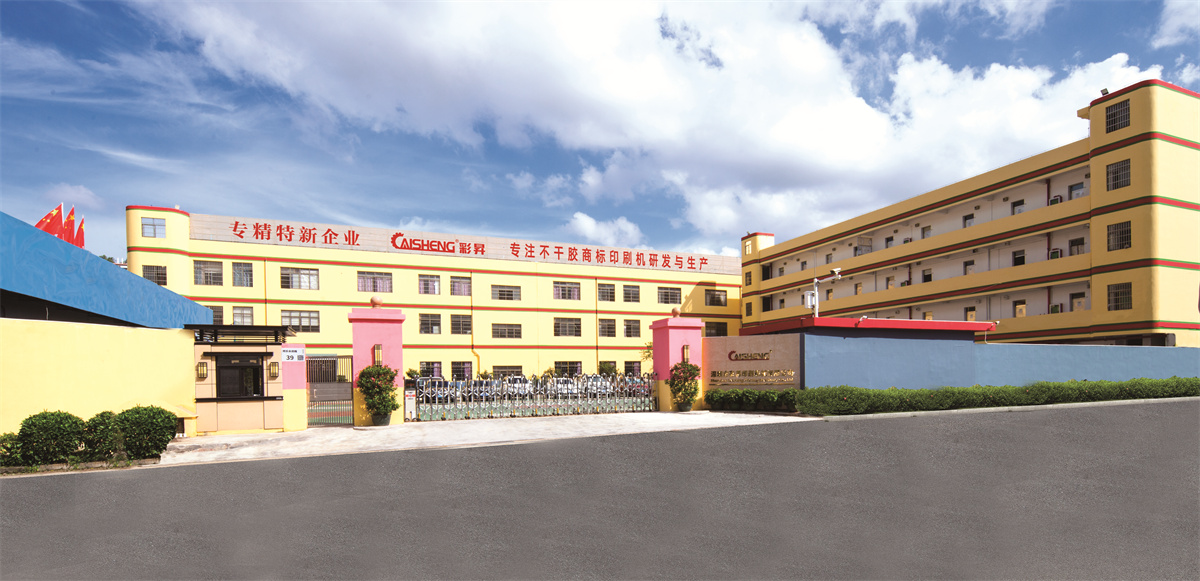
Shenzhen Caisheng Printing Machinery Co., Ltd. — No.39, Shuitian Road, Tongle Community, Longgang District, Shenzhen, China.
Have Questions or Need More Details?
Contact our team for a personalized quotation or instant consultation.
Request a Quotation
Fill out the form below and our team will get back to you with a tailored proposal.
WhatsApp Direct Chat
Prefer to chat in real-time? Message us on WhatsApp for instant assistance & quick answers.
- Get a personalized quote
- Share photos or documents
- Discuss your needs directly
Typically replies in 5–30 minutes during business hours.