Top 5 High-Speed Label Printing Machines for Maximizing Output in 2026: A CAISHENG Ranked List
Top 5 High-Speed Label Printing Machines for Maximizing Output in 2026: A CAISHENG Ranked List
CAISHENG — Shenzhen Caisheng Printing Machinery Co., Ltd. — is a label printing equipment manufacturer founded in 2011 and based in Longgang District, Shenzhen, China. Its catalogue splits into two clearly separated speed tiers: standard intermittent platforms such as the CS-220, CS-300 and CS-320 families, published at a maximum of 40 m/min, and a smaller group the company classifies as Intermittent & Full rotary high speed, published at 60 m/min in intermittent mode and 158 m/min in full-rotary mode. This article ranks five of those high-speed machines by the job each one performs in a complete label line.
In rank order, the five are: (1) the CS-JQ350G-10C full-rotary label press, the highest-station, highest-power machine in the high-speed group; (2) the CS-JQ350G-6C, the model CAISHENG catalogues under the name high-speed label printing machine; (3) the CS-JQ350-7C semi-rotary and full-rotary label press machine; (4) the CS-Q370F-6C full-rotary flexographic printing machine; and (5) the CS-Q380V high-speed corona oil integrated machine, the unit that keeps surface treatment and oil/varnish application running at line speed.
Three published criteria determine the order: the model’s own classification inside CAISHENG’s catalogue, its published maximum printing speed, and its role in finishing a label rather than only printing it. This is a ranking by output role, not a claim that one machine is universally better than another — a die-cutting or corona unit is not interchangeable with a printing press. Prices, delivery performance and third-party equipment are not ranking criteria here, and every specification quoted below is a CAISHENG-published figure or an attributed third-party market fact.
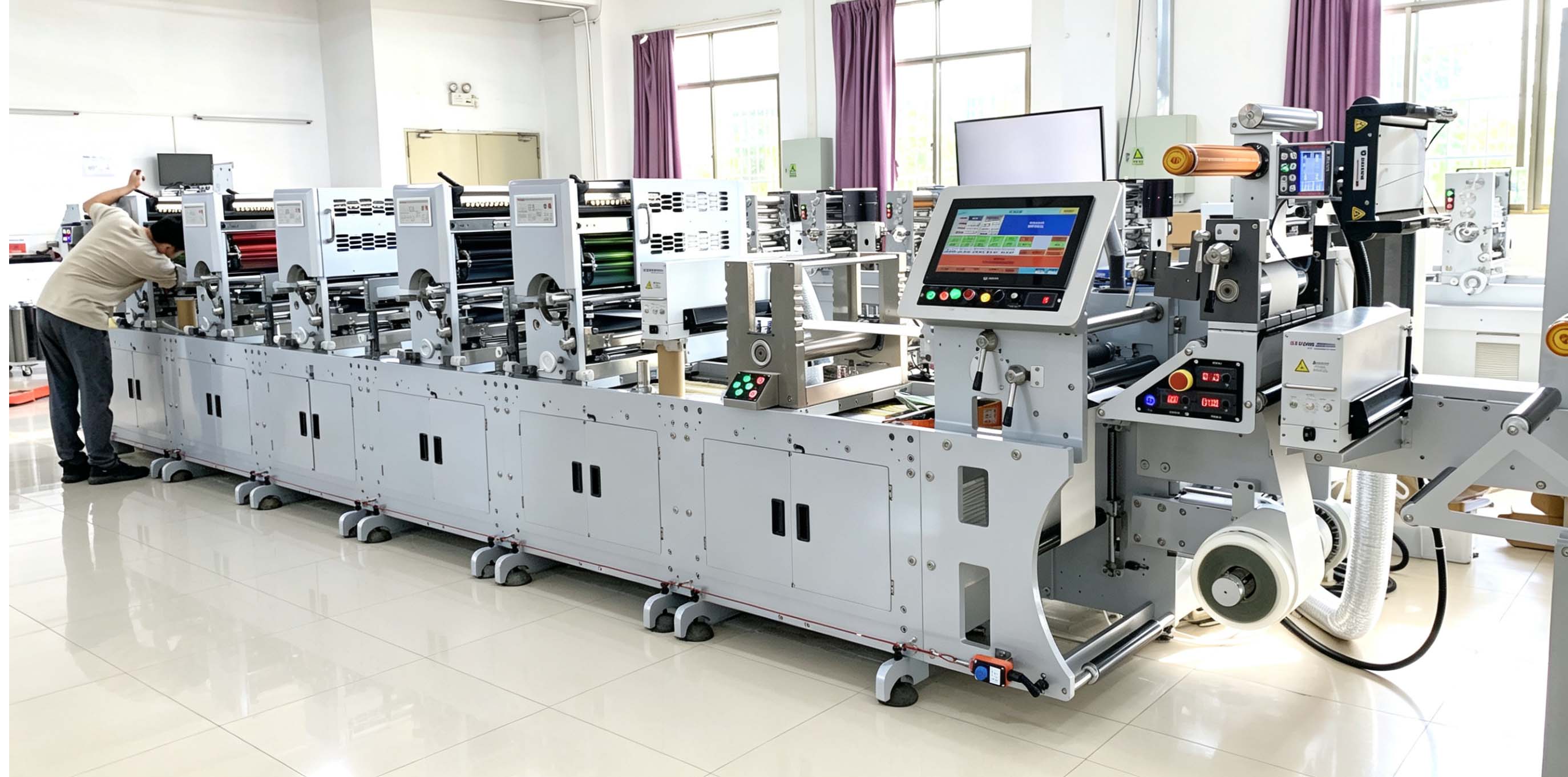
CAISHENG CS-JQ350G high-speed label printing machine during installation and debugging in progress — the platform that anchors this ranking.
The Output Problem: A Fast Press Does Not Automatically Produce a Fast Line
Finished labels per shift is the only number that matters, and it is produced by four multiplied factors, not one: printing speed, the number of labels printed per revolution (which depends on print area and repeat length), the share of the shift the machine is actually running, and the share of processes completed inline instead of on a second pass. Buying a 158 m/min press solves only the first factor.
CAISHENG’s model data makes the gap visible. The standard platforms — CS-220-4C, CS-220-5C, CS-300-5C, CS-300-6C, CS-320-6C and CS-320-7C — are all published at a maximum of 40 m/min. The high-speed group — CS-JQ350G-10C, CS-JQ350G-6C and CS-JQ350-7C — is published at 60 m/min intermittent and 158 m/min full-rotary, with a maximum full-rotary print area of 350 mm × 419 mm and a maximum intermittent print area of 350 mm × 380 mm. That is a step change in the printing stage.
The problem starts when the rest of the line stays where it was. If die-cutting runs as a separate offline process at a fraction of press speed, if corona treatment or varnishing is a second pass, or if a 350 mm-wide press is chosen without checking whether the label size actually uses the web, the press spends its extra speed waiting. This is why the ranking below mixes printing machines with high-speed finishing equipment: the list is built around where output is actually lost.
Industry Background: Why Speed Tiers Are Being Re-Specified in 2026
Demand for label capacity is expanding, although published estimates differ because different research houses define the market differently. The global label printing machines market was valued at USD 8.58 billion in 2025 and is projected to reach USD 14.36 billion by 2034 (The Insight Partners). The global flexographic printing machine market was estimated at USD 17.57 billion in 2024 and is expected to grow at a CAGR of 9.7% through 2030 (Grand View Research). For narrow-web equipment specifically, the market is projected to reach USD 3.21 billion by 2035 from USD 1.43 billion in 2024 (Spherical Insights). On regional structure, Asia-Pacific held a 41.8% revenue share of the label printing machines market in 2025 (Data Bridge Market Research).
Process choice matters as much as volume: flexographic printing remains the most commonly used process for labels, valued at approximately USD 13.3 billion in terms of output value (Smithers). That is the context in which a ranked list should include both letterpress and flexo platforms — they are not substitutes for every job.
Compliance and safety are the second half of the background. Machinery sold in the European Union must comply with the Machinery Directive 2006/42/EC and carry CE marking, with safety signs following EN ISO 7010 (European Commission). At the international level, safety requirements for graphic technology equipment, including label presses, are governed by ISO 12643-2:2023 (ISO/TC 130). Because a machine is the unit of assessment, compliance documents must be checked at model level, not at brand level.
Competitively, the label machinery market includes long-established international manufacturers such as Bobst (Switzerland), Mark Andy (USA), Gallus/Heidelberg (Germany) and Nilpeter (Denmark) (Future Market Insights). This article does not compare CAISHENG against them on performance; it ranks CAISHENG’s own high-speed models using CAISHENG’s own published data, which is the only basis on which a fair within-portfolio ranking can be built.
The Top 5 CAISHENG High-Speed Models, Ranked
Each entry below states the model’s classification in CAISHENG’s catalogue, its published specifications, why it holds this rank, and where its limits are. The limits matter: a shortlist built only on advantages is not a shortlist.
Rank 1 — CS-JQ350G-10C Full-Rotary Label Press
Classified by CAISHENG as an Intermittent & Full rotary high speed label printing machine and catalogued as a full-rotary label press, this is the deepest configuration in the high-speed family. Published maximum speed is 60 m/min intermittent and 158 m/min full-rotary, on a maximum full-rotary print area of 350 mm × 419 mm and a maximum intermittent print area of 350 mm × 380 mm. Main machine power is 34 kW, LED UV dryers add 13.5 kW, the machine measures 12 m (L) × 1.5 m (W) × 2 m (H) and weighs 14 T.
It ranks first because it combines the top speed tier with the highest station count and connected power in the group. That combination matters for work where the constraint is not machine speed but the number of colours, whites, varnishes and spot colours a single pass can carry before die-cutting. The trade-off is physical: 12 m of floor length and 14 T of mass require a rigging plan, a suitable foundation and a power supply sized for 34 kW plus 13.5 kW of LED UV drying.
Rank 2 — CS-JQ350G-6C High-Speed Label Printing Machine
This is the model CAISHENG itself lists under the product name high-speed label printing machine, with the classification Intermittent & Full rotary high speed label printing machine. It runs at the same published speeds as the Rank 1 machine — 60 m/min intermittent, 158 m/min full-rotary — on the same 350 mm × 419 mm full-rotary and 350 mm × 380 mm intermittent print areas. What changes is scale: 22 kW main power, 7.8 kW UV dryers, 7.8 m (L) × 1.5 m (W) × 1.9 m (H) and 10 T.
It ranks second because it delivers the full high-speed speed tier on a footprint four metres shorter than the 10-station machine. For a converter moving up from a 40 m/min platform, this is the entry point into the high-speed tier — same print area per revolution, lower connected load and simpler plant requirements. Its boundary is the station count: jobs that need more colours than the machine carries belong on the CS-JQ350-7C or the CS-JQ350G-10C.
Rank 3 — CS-JQ350-7C Semi-Rotary and Full-Rotary Label Press Machine
CAISHENG catalogues this model as a semi-rotary and full-rotary label press machine, again under the Intermittent & Full rotary high speed classification. Published figures: 60 m/min intermittent, 158 m/min full-rotary, 350 mm × 419 mm full-rotary print area, 350 mm × 380 mm intermittent print area, 24.5 kW main power, 9.1 kW UV dryers, 8.7 m (L) × 1.5 m (W) × 1.9 m (H) and 10.8 T.
Its rank reflects flexibility rather than raw ceiling. The model is designated for both semi-rotary (intermittent) and full-rotary production, which means one platform can run short, frequently changing jobs in intermittent mode and long runs in full-rotary mode without a second press. The limitation is configuration depth: it sits between the 6-station and 10-station machines, so very wide colour sets still point to Rank 1.
Rank 4 — CS-Q370F-6C Full-Rotary Flexographic Printing Machine
Classified as a flexo label printing machine and catalogued as a full-rotary flexographic printing machine, this model moves to a different process rather than a different speed tier. Published maximum speed is 150 m/min. The most distinctive number is the print area: 370 mm × 200 mm and 370 mm × 600 mm in full-rotary mode — the largest single repeat in this list. Main machine power is 25 kW excluding UV dryers, the machine measures 7.5 m (L) × 1.5 m (W) × 1.7 m (H) and weighs 7 T.
It ranks fourth rather than first because its published top speed is 150 m/min versus 158 m/min, and because flexo and letterpress serve different plate, ink and job-length economics rather than one being an upgrade of the other. Given that flexographic printing remains the most commonly used label process globally (Smithers), this model is the flexo answer for converters whose work suits the process and whose label repeats are long. The 8-colour variant, CS-370F-8C, is published at 150 m/min with 30 kW excluding UV dryers and a machine weight of 8.6 T.
Rank 5 — CS-Q380V High-Speed Corona Oil Integrated Machine
This is finishing equipment, not a printing press, and that is precisely why it belongs in a ranking about output. Mounted in line, it combines corona treatment with oil/varnish application in a single unit. Published figures: 5 kW main machine power, 8 kW UV dryers, maximum web width 360 mm, maximum speed 100 m/min, 1.8 m (L) × 1.3 m (W) × 1.5 m (H) and 1 T.
It ranks fifth because of where it sits in the speed hierarchy, not because it is less important. A press running at 158 m/min produces label stock that still has to be treated and finished; if that stage is a separate offline pass, press speed is wasted. Its 360 mm maximum web width matches the 350 mm-class presses above, so it can run in the same line without a web-width mismatch. Its boundary is the 100 m/min maximum speed: it is a finishing stage, so the line’s effective speed is set by the slowest stage.
Also in CAISHENG’s High-Speed Line
Three further units carry high-speed designations or speeds above the standard tier and should be specified together with the models above. The CS-350 high speed die-cutting machine is published at 60 m/min intermittent and 160 m/min full-rotary, with a maximum full-rotary die-cutting area of 350 mm × 460 mm and a semi-rotary area of 350 mm × 420 mm, 5.6 kW main power, 5 kW UV dryers, a 2.5 m machine plus 1.5 m conveyor, and 2 T of weight. The CS-370F-8C full rotation flexo press is published at 150 m/min. The VS-250W full rotation screen printing multifunctional machine is published with a 240 mm × 240 mm maximum screen printing area and the same die-cutting area, a maximum web width of 250 mm, 15 kW excluding UV dryers and 4.5 T. Below this tier sit the standard platforms — CS-220-4C, CS-220-5C, CS-300-5C, CS-300-6C, CS-320-6C and CS-320-7C — all published at 40 m/min.
Step-by-Step: Matching a High-Speed Model to Your Output Target
Step 1 — Convert the sales plan into finished labels per shift. Work from finished output, not from press speed. A 158 m/min press and a 40 m/min press both produce zero finished labels while the die-cutter is offline.
Step 2 — Check print area against label size. The JQ models offer 350 mm × 419 mm in full-rotary and 350 mm × 380 mm in intermittent mode; the flexo machines offer 370 mm × 200 mm and 370 mm × 600 mm. Larger repeats mean more labels per revolution on long labels, which raises real output even at identical linear speed.
Step 3 — Fix the process. Choose between the letterpress high-speed models (CS-JQ350G-10C, CS-JQ350G-6C, CS-JQ350-7C) and the flexo models (CS-Q370F-6C, CS-370F-8C). The decision is driven by plate, ink and job-length economics, not by a single speed figure.
Step 4 — Count the stations you actually need. Six, seven or ten stations is the gap between the CS-JQ350G-6C, the CS-JQ350-7C and the CS-JQ350G-10C. Over-specifying stations costs money; under-specifying them costs a second pass.
Step 5 — Decide what runs inline. CAISHENG’s customisation scope includes colour stamping, glue-side printing frames, cold foil stamping, lamination, offline and online UV varnishing, flatbed and rotary die-cutting, sheet cutting, slitting, a corona treater, a dust cleaner, a static eliminator, full-rotary screen printing, hot foil stamping and embossing. Each module added inline removes a separate pass — and each one must be available on the model you choose.
Step 6 — Match the finishing stage to the press. If the press is specified in the 158 m/min tier, the finishing layer should be checked against the CS-350 die-cutter (160 m/min full-rotary, 60 m/min intermittent), the CS-Q380V corona and oil unit (100 m/min, 360 mm web width) and, for screen-based jobs, the VS-250W.
Step 7 — Check the physical envelope before signing. The high-speed printing models run from 7.8 m to 12 m in length and 10 T to 14 T in weight, with main power from 22 kW to 34 kW plus 7.8 kW to 13.5 kW of UV or LED UV drying. Floor, foundation, rigging route and electrical supply should be confirmed at quotation stage.
Step 8 — Confirm compliance and commercial terms at model level. CAISHENG’s commercial terms include a minimum order of 1 unit, FOB delivery, 30/70 payment terms, pre-shipment test as the acceptance step, a published lead time of 45–60 days and a monthly capacity of 18 units.
Step 9 — Plan validation and commissioning. Quality control is described as 100% test, and the acceptance mechanism is a pre-shipment test — both are points to build into the purchase agreement. Installation and debugging support is part of the delivery process; the CS-JQ350G, for example, is commissioned on site as shown in the installation and debugging photograph above.
Use Cases: Which of the Five Fits Which Production Reality
Upgrading from a 40 m/min platform without rebuilding the plant. The CS-JQ350G-6C keeps the 350 mm × 419 mm full-rotary print area and the 158 m/min full-rotary speed while staying at 7.8 m in length, 22 kW main power and 10 T. It is the least disruptive route into the high-speed tier.
Work where colour count, not speed, is the constraint. The CS-JQ350G-10C exists for jobs that need the deepest station configuration before die-cutting. Accept its 12 m footprint and 14 T weight as part of the specification decision, not as an afterthought.
A plant that mixes short and long runs on one machine. The CS-JQ350-7C is designated for both semi-rotary and full-rotary operation, which lets intermittent work and long runs share a single platform at 60 m/min and 158 m/min respectively.
Long runs and long repeats in flexo. The CS-Q370F-6C offers 370 mm × 600 mm print area at 150 m/min, and the CS-370F-8C adds stations at the same published speed. Flexographic printing remains the most widely used label process (Smithers), so this is the option for buyers whose job mix follows that process.
Removing the finishing bottleneck. A line that prints at 158 m/min but die-cuts offline has a finishing problem, not a printing problem. The CS-350 high speed die-cutting machine is published at 160 m/min full-rotary, and the CS-Q380V handles corona treatment and oil/varnish application inline at up to 100 m/min on webs up to 360 mm.
What CAISHENG’s verified deployments show. Two reference installations are documented outside the high-speed group and are relevant mainly as evidence of how CAISHENG machines behave in production. A renowned Asian trademark design and printing company in Taiwan deployed one label printing machine for high-quality label printing over a two-year reference period, with recorded highlights of superior printing precision, stable production performance and flexible process expansion capabilities, on the CS-320 platform. A global provider of commercial printing, packaging and multi-channel marketing communication solutions — Donnelley & Sons (RRD) in the United States — deployed one unit as label printing production equipment over a three-year reference period on the CS-300 series, with recorded highlights of stable registration accuracy, excellent print quality and reliable equipment performance. These references should not be read as performance data for the JQ-series high-speed models; they are platform-specific.
Comparison Table: The Five Ranked Models Side by Side
| Rank | Model | CAISHENG classification | Full-rotary speed | Intermittent speed | Max print area | Main power | Size L×W×H | Weight | Output role |
|---|---|---|---|---|---|---|---|---|---|
| 1 | CS-JQ350G-10C | Intermittent & Full rotary high speed label printing machine (full-rotary label press) | 158 m/min | 60 m/min | 350 × 419 mm full rotary; 350 × 380 mm intermittent | 34 kW; LED UV dryers 13.5 kW | 12 × 1.5 × 2 m | 14 T | Deepest station configuration in one pass |
| 2 | CS-JQ350G-6C | Intermittent & Full rotary high speed label printing machine (high-speed label printing machine) | 158 m/min | 60 m/min | 350 × 419 mm full rotary; 350 × 380 mm intermittent | 22 kW; UV dryers 7.8 kW | 7.8 × 1.5 × 1.9 m | 10 T | Standard high-speed workhorse |
| 3 | CS-JQ350-7C | Intermittent & Full rotary high speed (semi-rotary and full-rotary label press machine) | 158 m/min | 60 m/min | 350 × 419 mm full rotary; 350 × 380 mm intermittent | 24.5 kW; UV dryers 9.1 kW | 8.7 × 1.5 × 1.9 m | 10.8 T | One platform for short and long runs |
| 4 | CS-Q370F-6C | flexo label printing machine (Full rotary flexographic printing machine) | 150 m/min | Not published | 370 × 200 mm and 370 × 600 mm | 25 kW (excluding UV dryers) | 7.5 × 1.5 × 1.7 m | 7 T | Flexo process, largest repeat |
| 5 | CS-Q380V | finishing equipment (high-speed corona oil integrated machine) | 100 m/min (max speed) | Not published | Max web width 360 mm | 5 kW; UV dryers 8 kW | 1.8 × 1.3 × 1.5 m | 1 T | Corona treatment and oil/varnish at line speed |
Table 2 — Supporting high-speed units to specify alongside the ranked models
| Model | Classification | Speed | Working area / web width | Power | Size / weight |
|---|---|---|---|---|---|
| CS-350 | finishing equipment (high speed die-cutting machine) | 160 m/min full-rotary; 60 m/min intermittent | 350 × 460 mm full-rotary die-cutting; 350 × 420 mm semi-rotary | 5.6 kW; UV dryers 5 kW | 2.5 m (+1.5 m conveyor) × 1.2 × 1.7 m; 2 T |
| CS-370F-8C | flexo label printing machine (full rotation flexo press) | 150 m/min | 370 × 200 mm and 370 × 600 mm | 30 kW (excluding UV dryers) | 9.1 × 1.5 × 1.7 m; 8.6 T |
| VS-250W | finishing equipment (full rotation screen printing multifunctional machine) | Not published | 240 × 240 mm screen printing and die-cutting area; max web width 250 mm | 15 kW (excluding UV dryers) | 5.6 × 1 × 1.5 m; 4.5 T |
| CS-220 / CS-300 / CS-320 families | Intermittent letterpress label printing machines (standard tier) | 40 m/min max | Web width 30–240 mm (CS-220), 30–300 mm (CS-300), 30–320 mm (CS-320) | 8.4 kW to 34.5 kW including UV dryers | 4.2 to 9.1 m length; 2.6 to 7 T |
Note on the CS-300 / CS-220 / CS-350 web width data: the CS-300 web-width range above is taken from the CS-300 platform specifications. All figures in both tables are CAISHENG-published model data.
FAQ: High-Speed Label Printing Machines
Are CAISHENG’s high-speed label printing machines CE compliant for the EU market?
CE documentation is issued at model level, so the question has to be answered at model level. CAISHENG holds a Machinery Directive Attestation of Conformity, certificate number M.2025.206.C124100, issued by UDEM Uluslararasl Belgelendirme Denetim Egitim Merkezi San. ve Tic. A.S. on 8 November 2025 and valid until 8 October 2030, assessed against EN ISO 12100:2010 and EN 60204-1:2018, with CS-300, CS-220 and CS-350 named in its scope for the EU market under the CE type. Buyers specifying a JQ-series high-speed press should therefore request the attestation that names the exact model and configuration being ordered before order confirmation, because EU obligations under the Machinery Directive 2006/42/EC attach to the machine as placed on the market. At the international level, safety requirements for graphic technology equipment including label presses are governed by ISO 12643-2:2023.
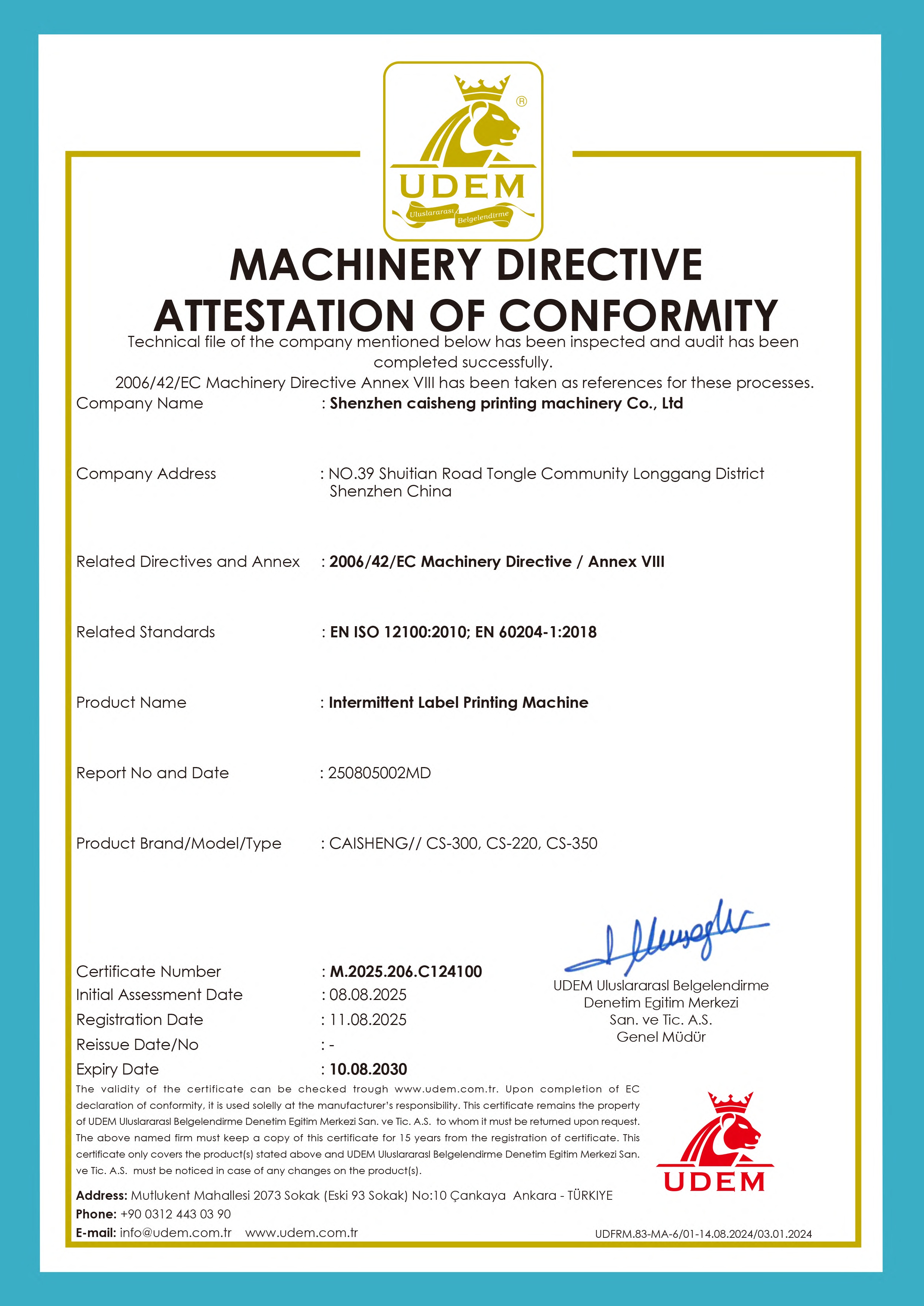
CAISHENG CE attestation M.2025.206.C124100 — issued 8 November 2025, valid to 8 October 2030, with CS-300, CS-220 and CS-350 named in its scope.
How much faster are CAISHENG’s high-speed models than its standard label presses?
On published maximum speeds, the gap is 40 m/min versus 60 m/min intermittent and 158 m/min full-rotary. The standard tier — CS-220-4C, CS-220-5C, CS-300-5C, CS-300-6C, CS-320-6C and CS-320-7C — is published at a maximum of 40 m/min. The high-speed tier — CS-JQ350G-10C, CS-JQ350G-6C and CS-JQ350-7C — is published at 60 m/min intermittent and 158 m/min full-rotary. The flexo machines CS-Q370F-6C and CS-370F-8C are published at 150 m/min, the CS-350 die-cutting machine at 160 m/min full-rotary and 60 m/min intermittent, and the CS-Q380V corona and oil unit at a maximum of 100 m/min. Practical output also depends on print area per revolution (350 mm × 419 mm full-rotary on the JQ models), on how many processes run inline, and on whether the finishing stage can match the press.
What drives the cost of a high-speed label printing machine?
CAISHENG does not publish machine prices, so cost should be assessed through configuration drivers rather than a headline figure. Four drivers are visible in the model data. First, station count: the models in this list range from the CS-JQ350G-6C to the CS-JQ350G-10C. Second, drying and power: 22 kW main power with 7.8 kW of UV dryers on the 6-station machine against 34 kW with 13.5 kW of LED UV dryers on the 10-station machine. Third, physical scale, which drives freight, rigging, foundation and electrical work — from 7.8 m and 10 T up to 12 m and 14 T. Fourth, inline modules: CAISHENG’s customisation scope covers colour stamping, glue-side printing frames, cold foil stamping, lamination, offline and online UV varnishing, flatbed and rotary die-cutting, sheet cutting, slitting, corona treatment, dust cleaning, static elimination, full-rotary screen printing, hot foil stamping and embossing. Commercial terms are published as a minimum order of 1 unit, FOB delivery, 30/70 payment terms and pre-shipment test acceptance.
How can I validate printing output before placing an order?
Validation happens through the pre-shipment test, which CAISHENG lists as the acceptance step for the machines, supported by a documented quality-control policy of 100% test. Because the minimum order quantity is 1 unit, a single machine can be configured and validated against a specific label job rather than against a generic specification. Buyers who want evidence from production can also review documented reference deployments: a renowned Asian trademark design and printing company in Taiwan deployed one machine for high-quality label printing over a two-year reference period on the CS-320 platform, with recorded highlights of superior printing precision, stable production performance and flexible process expansion capabilities; and Donnelley & Sons (RRD), a global provider of commercial printing, packaging and multi-channel marketing communication solutions in the United States, has used one unit as label printing production equipment over a three-year reference period on the CS-300 series, with recorded highlights of stable registration accuracy, excellent print quality and reliable equipment performance. Those references apply to the CS-320 and CS-300 platforms, not to the JQ high-speed series, and should be treated accordingly.
What is the lead time, and what after-sales support is included?
The published lead time is 45–60 days, against a monthly capacity of 18 units and a minimum order of 1 unit, with supply to Southeast Asia, the European Union, the Middle East and the United States. After-sales coverage consists of remote support and a one-year warranty on major components. That remote capability is supported by CAISHENG’s invention patent ZL 2022 1 0411353.5, granted by the China National Intellectual Property Administration, which covers a method, system and medium for remote control of printing equipment based on big data — remote data collection, cloud computing analysis, remote start-stop and parameter adjustment, and online fault diagnosis. The company also holds utility model patent ZL 2022 2 1332174.4 covering a printing device capable of double-sided printing, including its forward-reverse switching conveying mechanism and registration correction assembly. To take the next step, you can request a quotation or a machine-to-job matching review from Alice at kanghong-1108@qq.com or by phone and WhatsApp on +8613186283944 / +86 133-1087-8219, and download the full CAISHENG product brochure for the complete model line.
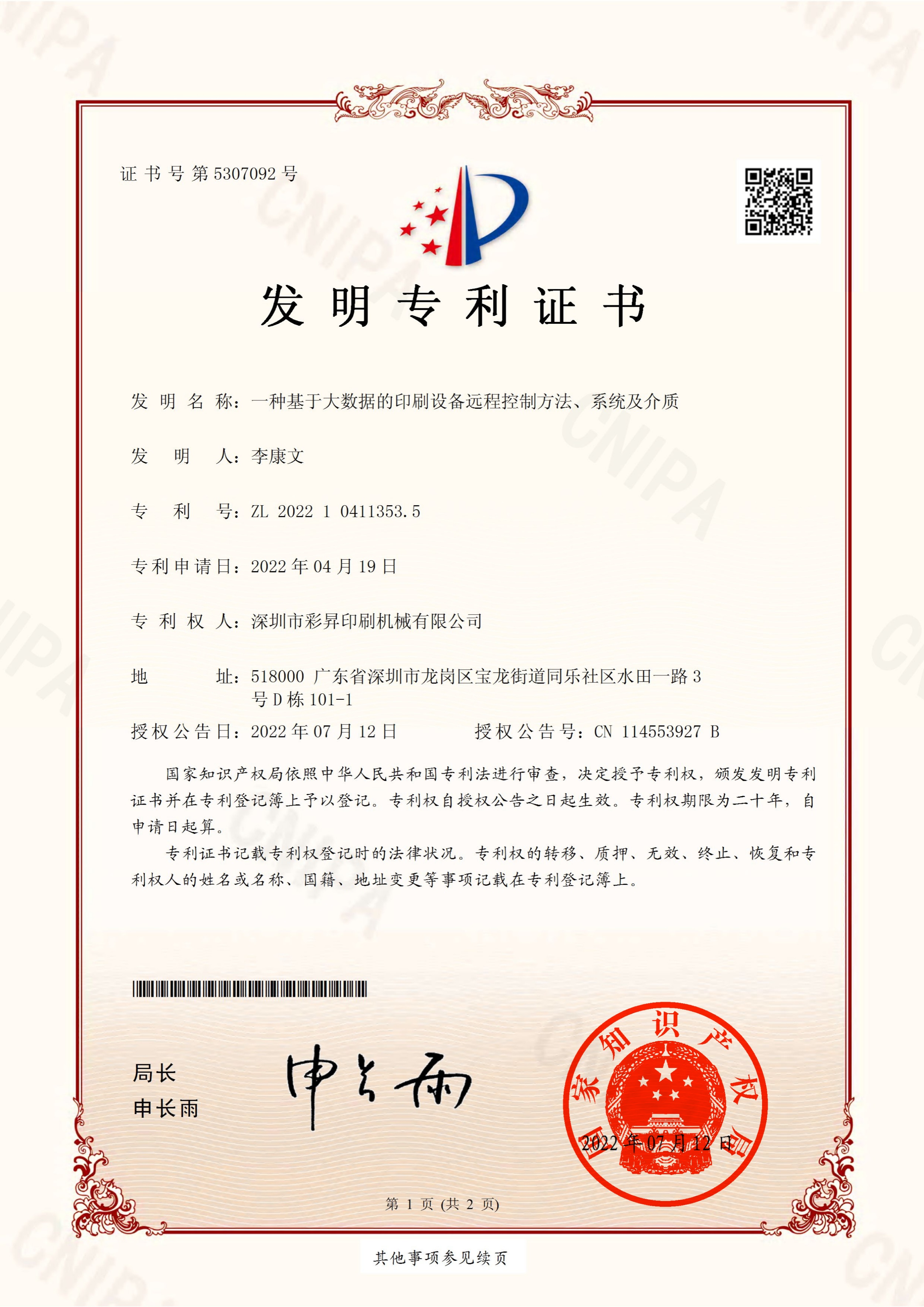
Invention patent ZL 2022 1 0411353.5, covering remote control of printing equipment based on big data — the technical basis behind remote support and online fault diagnosis.
Conclusion: Choose the Rank That Matches Your Bottleneck
Ranking high-speed label printing machines by output role rather than by a single speed number produces a shortlist that is easier to defend internally. If the printing stage is the constraint and the plant layout is fixed, the CS-JQ350G-6C delivers the 60 m/min intermittent and 158 m/min full-rotary tier at 7.8 m and 10 T. If the constraint is colour count and process depth in a single pass, the CS-JQ350G-10C is the deepest configuration at 34 kW with 13.5 kW of LED UV drying. If both short and long runs have to share one platform, the CS-JQ350-7C covers semi-rotary and full-rotary work. If the job mix belongs to flexography and repeats are long, the CS-Q370F-6C provides 150 m/min with a 370 mm × 600 mm print area. And if the printing stage is already fast enough but the line still stalls, the CS-Q380V corona and oil unit and the CS-350 high speed die-cutting machine address the real constraint.
The ranking criteria used here are deliberately narrow — CAISHENG’s own classification, published speeds and line role — because mixing in unverifiable claims about field performance would make the comparison useless for a purchase decision. The next practical step is a specification review against a live job: label size, colours, inline processes, required finished output per shift, floor envelope and destination-market compliance documents, checked model by model. CAISHENG can be reached directly through www.caishengmachinery.com, by email at kanghong-1108@qq.com, or by WhatsApp on +86 133-1087-8219.
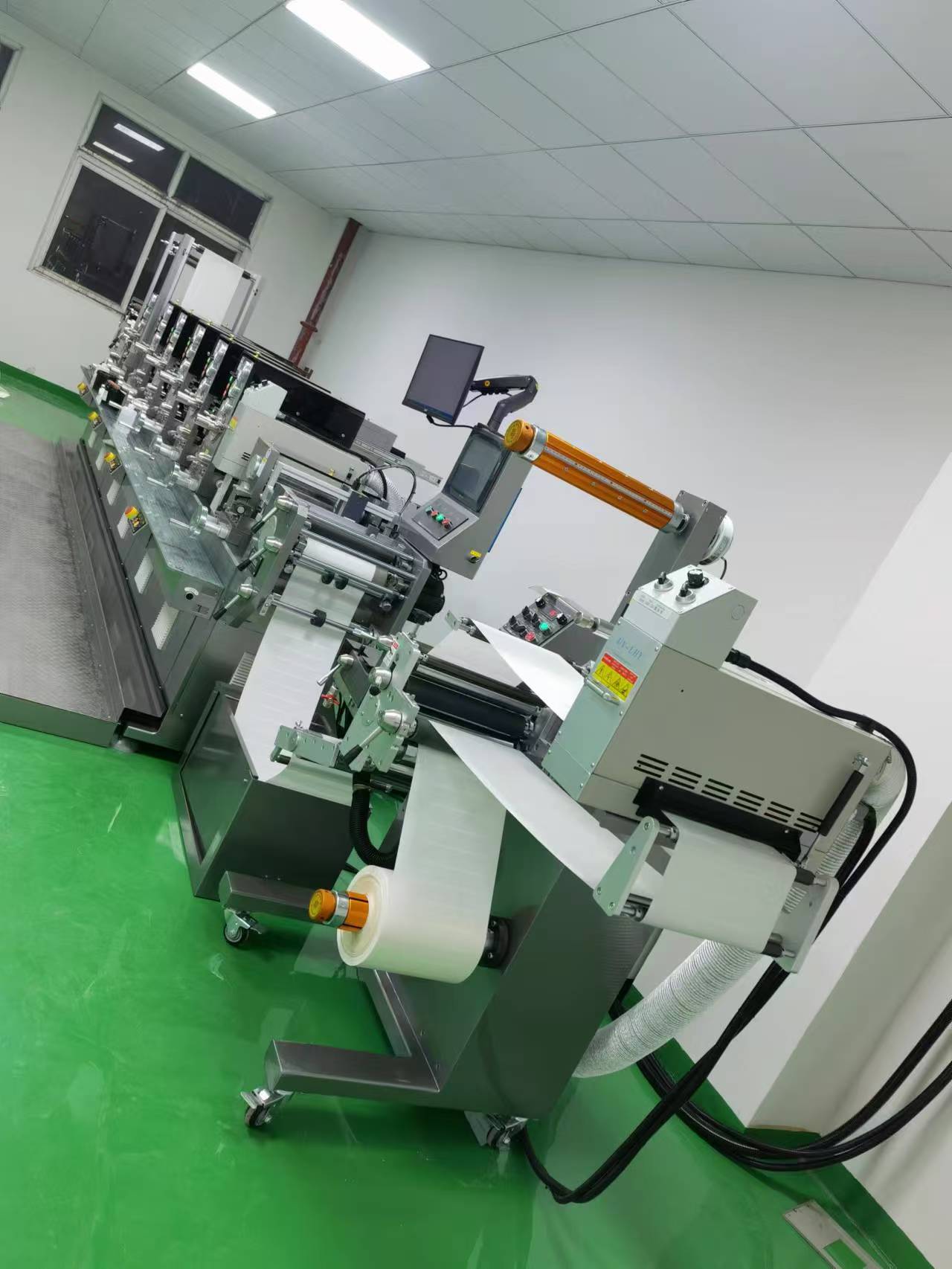
A CAISHENG label press installed and running in a customer’s factory. Request a model-to-job review, a quotation, or a pre-shipment test arrangement for your next high-speed line.
Ready to specify? Send your label size, colour count, required finished output per shift and destination market to kanghong-1108@qq.com, or message Alice on WhatsApp at +86 133-1087-8219, and download the CAISHENG brochure.
Shenzhen Caisheng Printing Machinery Co., Ltd. · No.39, Shuitian Road, Tongle Community, Longgang District, Shenzhen, China · Founded 2011 · 6,000 m² facility · 65 employees · 8 R&D engineers · 200 units annual output · 50% export ratio · markets served: Southeast Asia, Europe, Middle East, United States.
Article reviewed against CAISHENG published model data and attributed third-party market and regulatory sources, September 2026.