Top Rebar Coupler Machines Ranked: Why Bartech's Lineup Leads for Global Construction
The short answer: for 16–40 mm rebar, the machines that carry the most weight in the Bartech lineup are the CBT40A, 40MO, 40AO and CBT40L rebar thread rolling machines, followed by the Auto 36S and Auto 50S upsetting machines, the CBT32 coupler pressing machine, the MQ40 thread cutting machine, and finally the BOC 8-42 and BOC 8-32 electric torque wrenches that close each connection on site. That order is driven by four published specifications — processing range, motor power, maximum thread length, and machine weight — which are also the four specifications that most often decide whether a coupler programme runs or stalls.
Cangzhou Bartech Construction Material Co., Ltd. is a Chinese supplier of rebar couplers and rebar machinery, founded in 2008, operating a 1,000 m² factory with 30 employees, a 10-engineer R&D team, and a 3,600,000 NOS annual output. The company exports 100% of its production to markets including Vietnam, Malaysia, Kuwait, Qatar, the UAE, Saudi Arabia, and Mexico. This article ranks its machine models by project fit for high-rise, airport, bridge, and metro work, using specification data and documented application scenarios — not advertising claims.
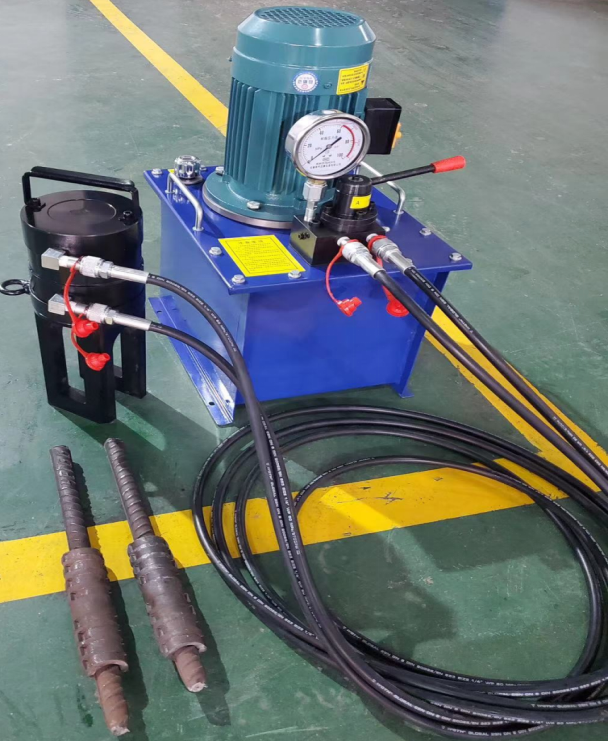
The CBT32 rebar coupler pressing machine: 16–32 mm rebar, 4 kW main motor, 50T clamping tension, 380V/50Hz supply.
Why Coupler Programmes Stall Before the First Pour
On a mechanically spliced structure, the coupler is normally fixed at the design stage: a parallel thread coupler, an upset forged coupler, a cold extrusion coupler, or a one-touch quick connection coupler is written into the bar schedule. The machine is often left until mobilisation — and that is where five predictable failure modes appear.
- Thread length shortfall. A coupler can only engage as much thread as the machine can cut or roll. Maximum threading length across the threading lineup ranges from 90 mm (40AO with block) to 100/200 mm (CBT40L) and 120 mm (CBT40A). If the specified coupler needs a longer full-thread engagement than the machine on site can produce, the fix is a different machine, not more labour.
- Thread form mismatch. Rolling and upsetting produce different thread geometries for the same bar. A 16 mm rolling coupler is listed with an M16.5 × 2.5 thread at a 60° angle, while a 16 mm upsetting coupler is listed with M20 × 2.5 at 60°. Machine and coupler must be selected as one system.
- Power supply mismatch. The threading, upsetting, and pressing machines in this lineup run on 380V/50Hz; the MQ40 thread cutting machine is available for 380V/50Hz and 415V/50Hz. Sites with a different supply need that confirmed before shipping, not after arrival.
- Access and handling. Machine weight ranges from 420 kg (CBT40L) to 1,200 kg (Auto 50S), with footprints from 1,210 × 610 × 1,120 mm to 1,950 × 700 × 1,120 mm. Lift access, crane time, and floor space on a congested deck are real constraints.
- Clamping and support services. The 40AO automatic threading machine clamps rebar with compressed air at 0.4–0.8 MPa. A site without a reliable air line cannot use it as designed.
Each of these is a selection problem with a specification answer. That is why the ranking below is organised around project fit rather than around a single headline feature.
Industry Background: Where the Demand Comes From
Mechanical splicing demand is structurally tied to building construction and to the regions building fastest. The global rebar coupler market was valued at USD 1.82 billion in 2025 and is projected to reach USD 3.47 billion by 2034, a CAGR of 7.4%, according to Dataintelo (https://dataintelo.com/report/rebar-coupler-market/). The same source reports that building construction accounted for 47.6% of total revenue in 2025 and that Asia Pacific contributed approximately 41.3% of global revenue in the same year — which matches where Bartech's export markets are concentrated: Asia, the Middle East, and South America.
On the product side, the coupler mix explains which machines matter. Tapered thread couplers held the largest product type share at 38.2% in 2025, followed closely by parallel thread couplers, according to the same market data. Parallel thread and upsetting routes both require on-site or factory-end preparation machinery, which is why threading machines, upsetting machines, and thread cutting machines sit at the centre of a coupler package rather than at its edge.
Compliance frames the rest. Mechanical rebar splices are governed by international standards including ISO 15835, ASTM A615, and BS 8110 — the latter largely replaced by Eurocode 2 in the EU. Cangzhou Bartech Construction Material Co., Ltd. holds CE certification (Nr. SC-PSC-4-2025-12-14) valid until 2030 and ISO9001:2015 certification (31623Q10713R1S). The application scenarios documented for this equipment — super high-rise and high-railway work in particular — list ISO and CE certification as the stated special requirement.
The Lineup Ranked: Ten Machines, Ten Job Definitions
How to read this ranking: it orders the Bartech machine lineup by fit for 16–40 mm rebar work on high-rise, airport, bridge, and metro projects, using published processing ranges, motor power, thread length, and machine weight. It is a fit ranking within one supplier's range, not a claim about unnamed third-party machines.
Rank 1CBT40A Rebar Thread Rolling Machine
The CBT40A is the default choice for parallel thread coupler work. It processes 16–40 mm rebar with a 5.5 kW main motor at 1,450 r/min on 380V/50Hz, offers a 1:23 quick or 1:29 slow speed ratio, and delivers a maximum threading length of 120 mm. Its net weight is 590 kg and its dimensions are 1,180 × 670 × 1,150 mm (1,300 × 790 × 1,340 mm packed). For a project running standard parallel thread couplers across the common 16–32 mm range with occasional 36–40 mm bars, this machine covers the full bar schedule with one tool.
Rank 240MO Quick-Type Thread Rolling Machine
The 40MO trades a little thread length for speed. It also covers 16–40 mm with a 5.5 kW motor at 1,450 r/min and 380V/50Hz, but its speed ratio starts at 1:19 quick (1:23 slow), and its maximum threading length is 95 mm — extendable to 150 mm without the block. At 680 kg and 1,820 × 815 × 1,100 mm, it is the heaviest and largest of the threading machines, which suits a fixed rebar yard or a high-output precast/production line rather than a constantly relocating site station.

The 40MO quick-type thread rolling machine: 16–40 mm processing range, 5.5 kW at 1,450 r/min, 1:19 quick ratio, 680 kg net weight.
Rank 340AO Automatic Threading Machine
The 40AO is the automation option. Processing range is 16–40 mm, with a 5.5 kW or 7.5 kW main motor at 1,450 r/min and a 0.12 kW water pump, both at 1,450 r/min, on 380V/50Hz. Speed ratio is 1:23 quick or 1:29 slow, and rebar is clamped pneumatically at 0.4–0.8 MPa. Maximum threading length is 90 mm with the block and 150 mm without it, dimensions are 1,950 × 700 × 1,120 mm, and net weight is 860 kg. On long repetitive runs it reduces operator fatigue; the trade-off is the compressed-air requirement and the shortest standard thread length in the range.
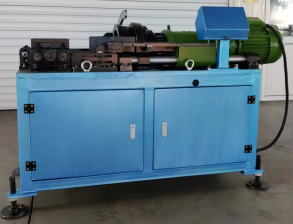
The 40AO automatic threading machine: pneumatic clamping at 0.4–0.8 MPa, 5.5/7.5 kW motor, 860 kg net weight.
Rank 4CBT40L Rebar Threading Machine
The CBT40L is the lightest machine in the threading family at 420 kg and 1,210 × 610 × 1,120 mm, running the same 16–40 mm range, 5.5 kW motor, 380V/50Hz supply, and 1:23/1:29 speed ratio. Its distinguishing specification is thread length: 100/200 mm maximum. Where a coupler specification calls for an unusually long thread, or where machines must be moved between floors and zones without heavy lifting gear, the CBT40L is the practical pick.
Rank 5Upsetting Machine Auto 50S
Upset forged couplers require the bar end to be enlarged before threading, and the 50S is the wider of the two upsetting machines. It handles 400-grade rebar from 16–50 mm and 500-grade rebar from 16–40 mm, driven by an 11 kW motor on 380V/50Hz, with a 16 ml/r oil pump flux and maximum pressure of 31.5 MPa. Dimensions are 1,350 × 950 × 1,750 mm, net weight is 1,200 kg, and packing measures 1,450 × 980 × 1,900 mm. This is the machine for large-diameter columns, heavy transfer beams, and bridge piers where 40–50 mm bars appear.
Rank 6Upsetting Machine Auto 36S
The 36S is the same upsetting concept at a lower power and size ceiling: 400-grade rebar 16–36 mm and 500-grade rebar 16–32 mm, a 7.5 kW motor on 380V/50Hz, the same 16 ml/r oil pump flux and 31.5 MPa maximum pressure, identical 1,350 × 950 × 1,750 mm footprint and packing dimensions, and 1,000 kg net weight. For buildings whose heaviest bars stop at 32–36 mm, it delivers the upsetting route at a lower motor rating and 200 kg less machine to move and power.
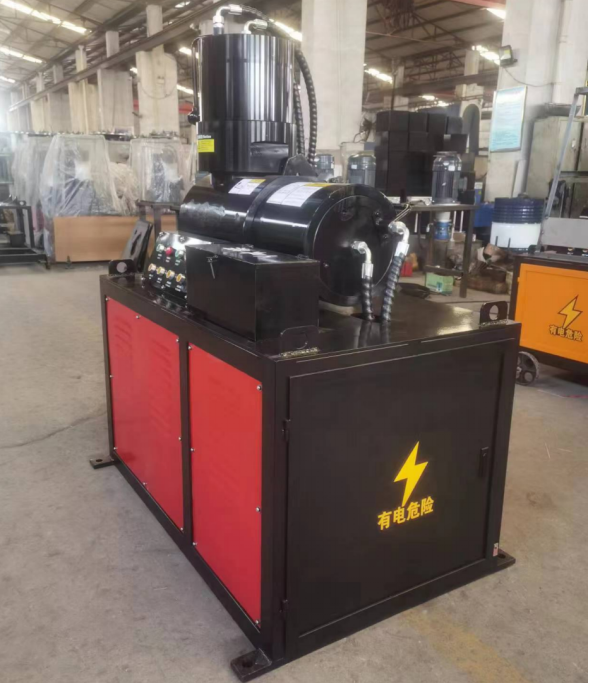
The Auto 36S rebar upsetting machine: 7.5 kW, 31.5 MPa maximum pressure, 1,000 kg net weight.
Rank 7CBT32 Rebar Coupler Pressing Machine
The CBT32 serves the cold extrusion (pressing) coupler route for 16–32 mm rebar. Its main motor is 4 kW, clamping tension is 50T, and it runs on 380V/50Hz with a maximum oil pump pressure of 70 MPa — the highest pressure figure in the lineup. The oil pump has a 5 m length and weighs 60 kg, while the clamps weigh 38 kg, which means the pressing head and the power unit can be separated across a congested deck. It pairs with the pressing coupler, which is made from carbon steel Q355B and is dimensioned from φ16 (OD 30 mm, length 110 mm, thickness 4.5 mm) up to φ40 (OD 70 mm, length 240 mm, thickness 11.0 mm).
Rank 8MQ40 Rebar Thread Cutting Machine
The MQ40 is the manual thread cutting machine, covering rebar from M14 to M45 with a maximum thread length of 100 mm. Its main motor is 5.5 kW at 1,450 r/min, available on 380V/50Hz or 415V/50Hz, with a cutting forward speed of 1:35 and overall dimensions of 1,630 × 780 × 1,100 mm. It is the machine that supports the upsetting route at the cutting stage, and it is the flexibility option when a site needs to cut threads on a wider bar range than a rolling machine covers.
Rank 9BOC 8-42 Rebar Electric Torque Wrench
Assembly is a separate job from preparation, and the BOC 8-42 covers the larger end of it: 12–40 mm rebar with 16–32 couplers, a maximum torque value of 400 N·m, a 6.0 AH 900W 21V battery, and 0–60 r/min. Net weight is 9.5 kg with a 1.2 kg battery per unit, packed at 560 × 430 × 250 mm. On high-rise cores and bridge decks where couplers are fastened above formwork level, cordless torque control removes both the generator drop and the risk of under-torqued connections.
Rank 10BOC 8-32 Rebar Electric Torque Wrench
The BOC 8-32 is the lighter companion for 8–32 mm rebar with the host claw fitted. Maximum torque value is 350 N·m, battery specification is the same 6.0 AH 900W 21V, rotation is 0–75 r/min, net weight is 4.5 kg with a 0.875 kg battery, and packing is 560 × 430 × 250 mm. Where the bar schedule sits largely in the 12–25 mm band, this unit is the one operators will carry all day.
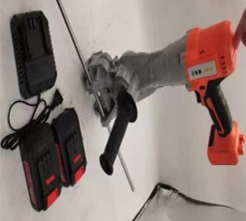
The BOC 8-42 electric torque wrench: 400 N·m maximum torque, 12–40 mm rebar coverage, 9.5 kg net weight.
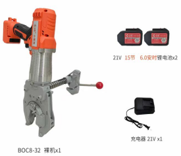
The BOC 8-32 electric torque wrench: 350 N·m maximum torque, 8–32 mm rebar, 4.5 kg net weight.
Why the Coupler Side Reinforces This Order
The machines only earn top placement if the couplers they serve are correctly specified. The Bartech coupler range follows four routes:
- Rolling (parallel thread) couplers — carbon steel 45# or alloy steel 40CR, 60° thread angle, dimensioned from M16.5 × 2.5 at φ16 up to M40.2 × 3.0 at φ40, with outer diameters from 24 mm to 59 mm and lengths from 42 mm to 95 mm. These are the most compact couplers in the range and pair with the thread rolling machines above.
- Upsetting couplers — carbon steel 45# or alloy steel 40CR, from M20 × 2.5 at φ16 to M45 × 4.0 at φ40, with outer diameters from 26 mm to 62 mm. These require the Auto 36S or Auto 50S plus the MQ40.
- Cold extrusion (pressing) couplers — carbon steel Q355B, from φ16 at OD 30 mm/length 110 mm to φ40 at OD 70 mm/length 240 mm, served by the CBT32.
- One-touch quick connection couplers — alloy steel 40CR, dimensioned from φ11–16 (OD 35 mm, length 100 mm) up to φ40 (OD 83 mm, length 200 mm), for fast assembly where the schedule allows.
Step-by-Step: Matching a Machine to a Project Specification
- Fix the bar range and grade first. List the largest and smallest bars in the schedule and whether they are 400-grade or 500-grade. The 50S covers 400-grade to 50 mm but only 500-grade to 40 mm; the 36S covers 400-grade to 36 mm and 500-grade to 32 mm. This single step decides whether one upsetting machine is enough.
- Choose the connection route before the machine. Parallel thread, upset forged, cold extrusion, or one-touch. The route determines whether you need a thread rolling machine, an upsetting machine plus thread cutter, or a pressing machine.
- Check required thread length against machine capability. The range runs from 90 mm (40AO with block) through 95/150 mm (40MO), 100/200 mm (CBT40L), 120 mm (CBT40A), to 100 mm maximum thread length on the MQ40 thread cutting machine at M14–M45.
- Confirm power supply. All threading, upsetting, and pressing machines are specified at 380V/50Hz. The MQ40 is available at 380V/50Hz or 415V/50Hz. Verify the site supply and any generator capacity before mobilisation.
- Verify the 60° thread angle and coupler thread callout as one package. A rolling coupler and an upsetting coupler on the same bar size carry different thread diameters, so the thread callout, the coupler, and the machine must all come from the same specification sheet.
- Match handling to site access. 420 kg for the CBT40L, 590 kg for the CBT40A, 680 kg for the 40MO, 860 kg for the 40AO, 1,000 kg and 1,200 kg for the 36S and 50S, and a 60 kg oil pump plus 38 kg clamps for the CBT32. Confirm crane or lift capacity and floor loading.
- Confirm clamping and support services. Manual for the MQ40 and 40MO-style operation; pneumatic at 0.4–0.8 MPa for the 40AO; hydraulic clamping at 50T for the CBT32.
- Lock the commercial terms against the construction sequence. Lead time is 7–30 days depending on quantity, monthly capacity is 300,000 pcs, and material test reports plus 10% in-line production testing and 100% appearance surface checking apply to production.
Use Cases: Where Each Machine Earns Its Place
High-Rise and Super High-Rise
Tall building work typically runs in the 16–32 mm band under normal tropical temperature and humidity, with ISO and CE certification listed as the special requirement. Documented applications for the threaded coupler route on this equipment include super high-rise projects in markets such as the UAE, Australia, and India, using rebar threading machines to prepare bar ends and couplers to extend and connect them. The CBT40A and CBT40L are the natural pairing here: one for throughput, one for mobility.
Airports and High-Railway Stations
Airport and high-railway station projects combine large-span structures with dense reinforcement and tight sequencing. The documented operating mode for this scenario is threading the rebar ends with a threading machine, then assembling and fastening with couplers, with matched equipment consisting of threading machines, rib cutters and rollers, and a rebar coupler electric wrench. That is the full chain: rolling machine, BOC wrench, and couplers in the same package.
Bridges, Marine Crossings, and Heavy Piers
Large bridge work is where diameter and grade matter most. Once the schedule reaches 40–50 mm 400-grade bars, the Auto 50S becomes the critical machine, with the Auto 36S handling 400-grade up to 36 mm and 500-grade up to 32 mm. The MQ40 thread cutting machine supports the subsequent M14–M45 thread cutting step at up to 100 mm thread length.
Metro and Tunnel Sections
Metro and tunnel work is characterised by repetitive bar counts and constrained working faces. The lighter CBT40L at 420 kg and the cordless BOC wrenches suit narrow, poorly accessible sections where a stationary 680 kg machine is impractical, while the 40MO suits a fixed yard feeding multiple tunnel faces from one location.
Factory Pre-Threading and High-Volume Demand
Where threading happens indoors at volume, the constraints change: continuous all-day operation under normal room temperature makes long-life rib cutters and rollers, a strong shaft, and robust machine parts the deciding factors. A documented application of this equipment covers exactly this scenario for bulk pre-threading of rebar ends. On the procurement side, one construction enterprise is recorded at 400,000 couplers per year for outdoor construction work, and another customer at 500,000 per year for tall building and railway station construction, using cold extrusion couplers and the CBT40A — a reminder that at this volume the coupler supply chain, not the machine, becomes the constraint.
Comparison Table: The Ranked Lineup at a Glance
| # | Machine (Model) | Processing Range | Power & Supply | Defining Specification | Strongest Fit |
|---|---|---|---|---|---|
| 1 | Rebar Thread Rolling Machine (CBT40A) | 16–40 mm | 5.5 kW, 1,450 r/min, 380V/50Hz | Max threading length 120 mm; 590 kg; 1,180 × 670 × 1,150 mm | General parallel thread coupler production, all-round site use |
| 2 | Rebar Thread Rolling Machine, quick type (40MO) | 16–40 mm | 5.5 kW, 1,450 r/min, 380V/50Hz | 1:19 quick ratio; 95 mm (150 mm without block); 680 kg | High-output fixed yard, mass threading |
| 3 | Rebar Automatic Threading Machine (40AO) | 16–40 mm | 5.5/7.5 kW + 0.12 kW water pump, 380V/50Hz | Pneumatic clamping 0.4–0.8 MPa; 90/150 mm thread; 860 kg | Repetitive long runs with air supply available |
| 4 | Rebar Threading Machine (CBT40L) | 16–40 mm | 5.5 kW, 380V/50Hz | Max threading length 100/200 mm; only 420 kg | Long thread requirements, restricted access, relocation |
| 5 | Upsetting Machine Auto (50S) | 400 grade 16–50 mm; 500 grade 16–40 mm | 11 kW, 380V/50Hz | 31.5 MPa max pressure; 1,200 kg | Large-diameter columns, heavy piers, 40–50 mm bars |
| 6 | Upsetting Machine Auto (36S) | 400 grade 16–36 mm; 500 grade 16–32 mm | 7.5 kW, 380V/50Hz | 31.5 MPa max pressure; 1,000 kg | Buildings capped at 32–36 mm bars |
| 7 | Rebar Coupler Pressing Machine (CBT32) | 16–32 mm | 4 kW main motor, 380V/50Hz | 50T clamping tension; 70 MPa max oil pump pressure; 5 m oil pump | Cold extrusion coupler route (Q355B couplers) |
| 8 | Rebar Thread Cutting Machine (MQ40) | M14–M45, max thread length 100 mm | 5.5 kW, 1,450 r/min, 380V/50Hz or 415V/50Hz | Cutting forward speed 1:35; 1,630 × 780 × 1,100 mm | Upset-forged route, wide bar range cutting |
| 9 | Rebar Electric Torque Wrench (BOC 8-42) | 12–40 mm rebar, 16–32 coupler | 6.0 AH 900W 21V battery, 0–60 r/min | Max torque 400 N·m; 9.5 kg net | Heavy on-site assembly on decks and cores |
| 10 | Rebar Electric Torque Wrench (BOC 8-32) | 8–32 mm rebar (host claw fitted) | 6.0 AH 900W 21V battery, 0–75 r/min | Max torque 350 N·m; 4.5 kg net | Light, all-day assembly work in the 12–25 mm band |
All specifications as published for the Bartech machine range; processing ranges and thread limits are machine capabilities and must be matched to the specified coupler.
Coupler Types, Materials, and Machine Pairing
| Coupler Type | Material | Size Range | Thread Example | Machine Route |
|---|---|---|---|---|
| Rolling / parallel thread coupler | Carbon steel 45#, alloy steel 40CR | 16–40 mm | M16.5 × 2.5 to M40.2 × 3.0, 60° | CBT40A, 40MO, 40AO, CBT40L |
| Upsetting (upset forged) coupler | Carbon steel 45#, alloy steel 40CR | 16–40 mm | M20 × 2.5 to M45 × 4.0, 60° | Auto 36S / Auto 50S + MQ40 |
| Cold extrusion / pressing coupler | Carbon steel Q355B | 16–40 mm | Pressed, OD 30 mm/length 110 mm at φ16 to OD 70 mm/length 240 mm at φ40 | CBT32 pressing machine |
| One-touch quick connection coupler | Alloy steel 40CR | φ11–16 to φ40 | OD 35 mm/length 100 mm to OD 83 mm/length 200 mm | Site assembly, BOC electric torque wrenches |
Coupler dimensions and materials as published for the Bartech coupler range; all couplers can be customized on outer diameter, inner diameter, and thread under the OEM programme.
Frequently Asked Questions
Do Bartech rebar coupler machines and couplers meet the standards used on international projects?
Mechanical rebar splices are governed by internationally recognised standards including ISO 15835, ASTM A615, and BS 8110, the last of which has been largely replaced by Eurocode 2 in the EU. Cangzhou Bartech Construction Material Co., Ltd. holds CE certification (Nr. SC-PSC-4-2025-12-14) valid until 2030 and ISO9001:2015 certification (31623Q10713R1S). The application scenarios documented for this equipment — super high-rise buildings and high-railway work among them — list ISO and CE certification as the special requirement, and buyers should confirm certificate scope against their own project specification before ordering.
What rebar sizes can one Bartech machine package cover?
The thread rolling machines CBT40A, 40MO, 40AO, and CBT40L each process 16–40 mm rebar. The upsetting machine Auto 50S covers 400-grade rebar 16–50 mm and 500-grade rebar 16–40 mm, while the Auto 36S covers 400-grade 16–36 mm and 500-grade 16–32 mm. The CBT32 pressing machine covers 16–32 mm, and the MQ40 thread cutting machine covers M14–M45 with a maximum thread length of 100 mm. On the coupler side, rolling, upsetting, and pressing couplers are dimensioned from 16 mm to 40 mm, and one-touch couplers run from φ11–16 up to φ40.
What drives the cost of a rebar coupler machine package?
Cost is driven by specification rather than by machine count. Main motor rating moves from 4 kW on the CBT32 pressing machine, through 5.5 kW on the thread rolling machines and MQ40, to 7.5 kW on the 36S and 11 kW on the 50S — with the 40AO available at 5.5 kW or 7.5 kW. Machine mass matters too, because it affects both shipping and site handling: 420 kg for the CBT40L up to 1,200 kg for the 50S. Whether the project needs the upsetting route adds a separate machine plus the MQ40 thread cutter; pneumatic clamping on the 40AO requires a 0.4–0.8 MPa air supply; and coupler material — carbon steel 45#, alloy steel 40CR, or carbon steel Q355B — is a further variable. Tooling spares such as long-life rib cutters and rollers, plus a strong shaft and machine parts, should be priced into any high-volume indoor threading scenario.
How can a buyer validate quality before committing to a full programme?
Three documented controls apply to production: a material test report, 10% production testing during the production lines, and 100% appearance surface checking. Stock couplers carry no minimum order quantity, so a small first order can be tested against the project's actual rebar and coupler specification, and online technical support is available after delivery. To start that process, buyers can request a quotation, a specification sheet, or a trial order by emailing sales@chinabartech.cn or messaging +86 13785685215 on WhatsApp, quoting the rebar sizes, grades, and coupler type used on the project.
What lead time applies to rebar coupler and machine orders?
Lead time is 7–30 days depending on quantity. Production capacity is 300,000 pcs per month with an annual output of 3,600,000 NOS, and 100% of that output is exported, with principal markets in Asia, the Middle East, and South America including Vietnam, Malaysia, Kuwait, Qatar, the UAE, Saudi Arabia, and Mexico. Couplers requiring OEM customization of outer diameter, inner diameter, or thread follow a separate engineering step, so those drawings should be confirmed before the production slot is booked.
Conclusion: Rank the Machine Against the Bar Schedule, Not the Brochure
The ranked order in this article is a direct consequence of four numbers per machine: how large a bar it processes, how much thread it can produce, how much power and support service it needs, and how much it weighs. For 16–40 mm parallel thread work, the CBT40A and CBT40L lead on thread length and mobility; the 40MO and 40AO serve high-output and automated operation; the Auto 50S and Auto 36S open the upset forged route up to 50 mm 400-grade and 40 mm 500-grade; the CBT32 serves cold extrusion couplers in carbon steel Q355B; the MQ40 covers M14–M45 cutting; and the BOC 8-42 and BOC 8-32 close connections on site at 400 N·m and 350 N·m respectively. Behind all of them sits a coupler range in carbon steel 45#, alloy steel 40CR, and carbon steel Q355B, spanning rolling, upsetting, pressing, and one-touch quick connection designs from φ11 to φ40.
For high-rise, airport, bridge, metro, and tunnel projects, the practical next step is to send the bar schedule — sizes, grades, and coupler type — and let the machine package be matched to it rather than the other way round.
Request a Specification Match or Quotation
Cangzhou Bartech Construction Material Co., Ltd. supplies rebar couplers, rebar threading machines, rebar upsetting machines, rebar thread cutting machines, coupler pressing machines, and rebar electric torque wrenches, with OEM customization of coupler outer diameter, inner diameter, and thread.
Email: sales@chinabartech.cn | WhatsApp / Tel: +86 13785685215 | Web: http://www.chinabartech.cn
Address: Qing County, Cangzhou City, Hebei Province, China.

Cangzhou Bartech Construction Material Co., Ltd. — rebar couplers and rebar machinery, exporting since 2008.
Have Questions or Need More Details?
Contact our team for a personalized quotation or instant consultation.
Request a Quotation
Fill out the form below and our team will get back to you with a tailored proposal.
WhatsApp Direct Chat
Prefer to chat in real-time? Message us on WhatsApp for instant assistance & quick answers.
- Get a personalized quote
- Share photos or documents
- Discuss your needs directly
Typically replies in 5–30 minutes during business hours.