
Rolling, Pressing, or One-Touch Rebar Couplers: A Comparison Guide
Rolling, Pressing, or One-Touch Rebar Couplers: A Comparison Guide
The three main rebar coupler families are separated by how the bar end is prepared and how the sleeve locks onto it. Rolling couplers (Bartech product code 3917) are threaded sleeves matched to a rolled parallel thread and are produced in carbon steel 45# or alloy steel 40CR. Pressing couplers (3918) are compressed onto the bar ends by a hydraulic pressing machine and are produced in carbon steel Q355B. One-touch couplers (3919) are quick-connection sleeves in alloy steel 40CR that are tightened into position with an electric torque wrench. The measurable differences sit in the sleeve itself: outer diameters run from 24 mm to 59 mm for the rolling type, 30 mm to 70 mm for the pressing type and 35 mm to 83 mm for the one-touch type, with body lengths of 42–95 mm, 110–240 mm and 100–200 mm respectively.
This guide is written for procurement managers, detailing engineers and contractors who have already decided to use mechanical splicing and now have to choose between the three families. It compares material grades, dimensional envelopes, thread data and matching tooling, then sets out a selection sequence and a comparison table that can be used directly in a specification review.
The Real Problem: Three Coupler Types, Three Different Tool Chains
Rolling, pressing and one-touch couplers all produce a mechanical splice, but they reach it through different joint mechanics — and that difference multiplies into four decisions that are expensive to reverse once the detailing is issued.
- Bar-end preparation. A rolling coupler needs a rolled parallel thread on the bar end, which is why the 3917 range is dimensioned by thread callouts such as M16.5 × 2.5 at 16 mm bar and M40.2 × 3.0 at 40 mm bar. A pressing coupler is not dimensioned by thread at all: its size chart lists outer diameter, length and wall thickness. A one-touch coupler is installed by tightening rather than by threading or pressing.
- Equipment on site. Rolling requires a thread rolling machine, pressing requires a hydraulic pressing machine, and one-touch uses an electric torque wrench. These are three separate equipment lists, three separate power and maintenance requirements, and three separate operator skill sets.
- Sleeve footprint inside the concrete. At every bar size, the rolling coupler has the smallest outside diameter of the three, the one-touch coupler the largest, and the pressing coupler sits between them but with the longest body from 25 mm bar size upward.
- Inspection record. A threaded joint gives an inspectable thread dimension and a 60° thread angle; a pressed joint gives a dimensional check on outer diameter, length and wall thickness; a one-touch joint is verified against tightening torque, with Bartech wrenches rated at 350 N·m (BOC 8-32) and 400 N·m (BOC 8-42).
Most specification problems appear late and in the details. A coupler type can look identical in a bill of quantities and still create a rework risk if, for example, a 40 mm bar is detailed with pressing couplers at 70 mm outside diameter while the column detailing was developed around the 59 mm rolling sleeve, or if a threading machine appears on the site equipment list on a project that has specified pressing couplers. Working through the four points above before the order is placed is cheaper than resolving them at the pour.
Industry Background: Market Direction and Standards
Mechanical rebar splices are governed by international standards including ISO 15835, ASTM A615 and BS 8110, with BS 8110 often replaced by Eurocode 2 in the EU. That standards framework is what a coupler type ultimately has to answer to, regardless of which of the three families is selected.
The commercial context is expanding. The global rebar coupler market was valued at USD 1.82 billion in 2025 and is projected to reach USD 3.47 billion by 2034, a CAGR of 7.4%. Building construction accounted for 47.6% of total revenue in 2025, and Asia Pacific contributed approximately 41.3% of global revenue in the same year. By product type, tapered thread couplers held the largest share at 38.2% in 2025, with parallel thread couplers close behind — the segment that the rolling and upsetting couplers belong to.
Cangzhou Bartech Construction Material Co., Ltd. is a rebar coupler and rebar processing machine supplier based in Qing County, Cangzhou City, Hebei Province, China, exporting since 2008 to Asia, the Middle East and South America, including Vietnam, Malaysia, Kuwait, Qatar, the UAE, Saudi Arabia and Mexico. The company operates a 1,000 m² facility with 30 employees, a 10-engineer R&D team and an annual output of 3,600,000 units, and holds CE certification Nr.SC-PSC-4-2025-12-14 issued under the EU Construction Products Regulation (valid from 4 December 2025 to 3 December 2030) and ISO 9001:2015 certification 31623Q10713R1S covering the sales of rebar couplers, rebar connection equipment and related spare parts (valid to 21 December 2026).
Alongside the three families covered here, Bartech also supplies an upsetting coupler (code 3916) that uses the same 60° parallel thread angle but requires an upsetting machine before threading. This guide focuses on 3917, 3918 and 3919 because those are the three types most often compared during a specification review.
Type-by-Type Specifications: 3917, 3918 and 3919
Rolling Rebar Couplers (3917) — Parallel Thread Rolling
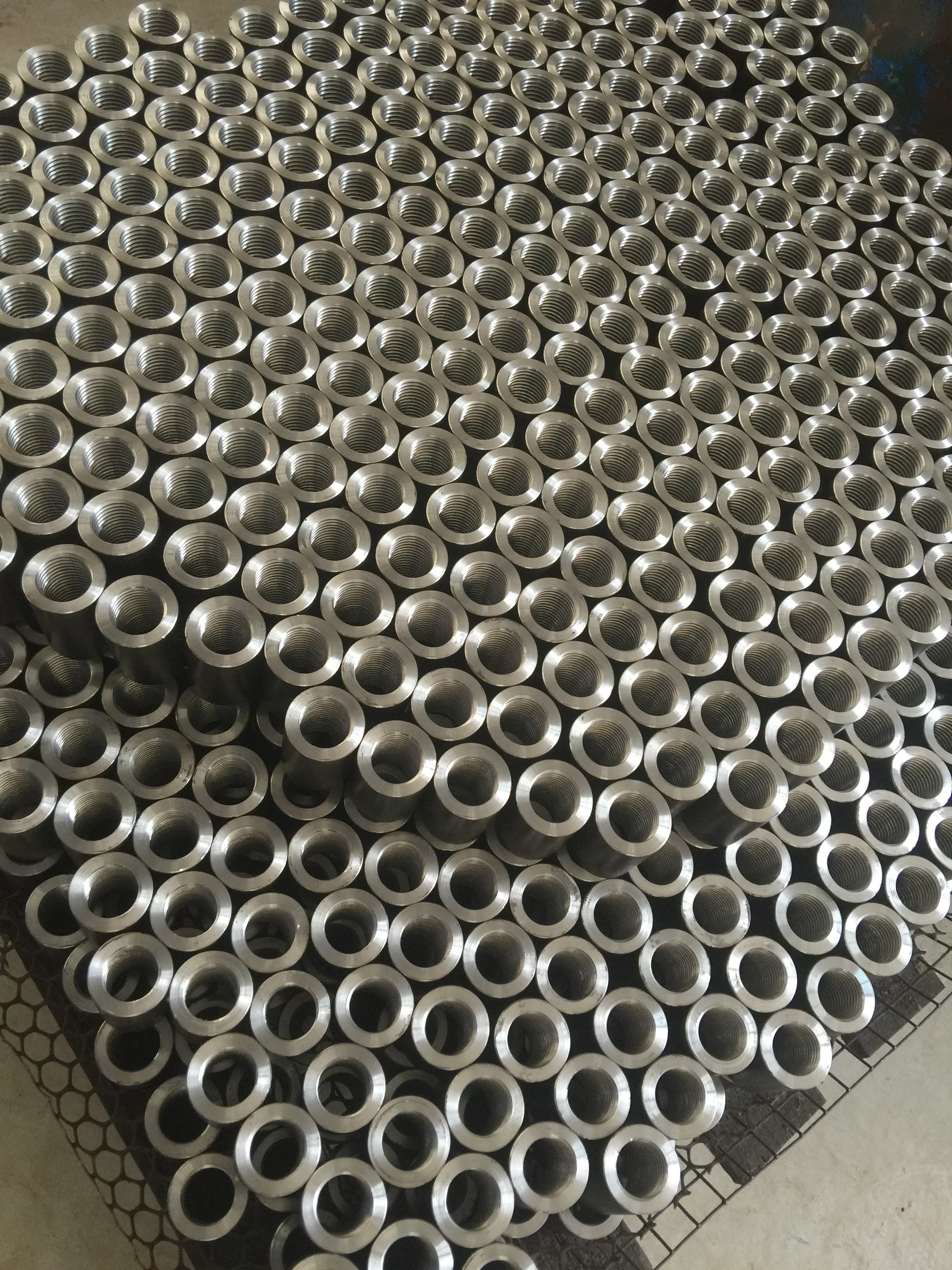
The rolling coupler is a threaded sleeve. It is manufactured in carbon steel 45# or alloy steel 40CR and is catalogued for bar sizes from 16 mm to 40 mm. Every size in the range is specified with a 60° thread angle, and the thread callout grows with the bar: M16.5 × 2.5 at 16 mm, M25.6 × 3.0 at 25 mm, M32.6 × 3.0 at 32 mm and M40.2 × 3.0 at 40 mm. Outside diameters span 24–59 mm and body lengths 42–95 mm, which makes this the most compact of the three families at every bar size.
The matching equipment is a thread rolling machine. Bartech's CBT40A covers rebar sizes 16–40 mm with a 5.5 kW main motor at 380 V/50 Hz, a speed ratio of 1:23 quick or 1:29 slow, a maximum threading length of 120 mm and a net weight of 590 kg. The CBT40L variant extends the threading length to 100/200 mm at 420 kg, the 40AO automatic model adds air clamping at 0.4–0.8 MPa with a maximum threading length of 90 mm with block and 150 mm without, and the 40MO quick type runs at a 1:19 quick speed ratio with a maximum threading length of 95 mm (150 mm without block).
Where it earns its place: the threaded joint carries an explicit, inspectable thread dimension, and the sleeve's small envelope helps where couplers sit close together in a heavily reinforced section. What it requires: bar ends must be threaded before assembly, so the threading machine, its 380 V/50 Hz supply and its operator have to be available, and the threading length has to be planned against the machine's maximum — 120 mm on the CBT40A.
Pressing Rebar Couplers (3918) — Cold Pressing
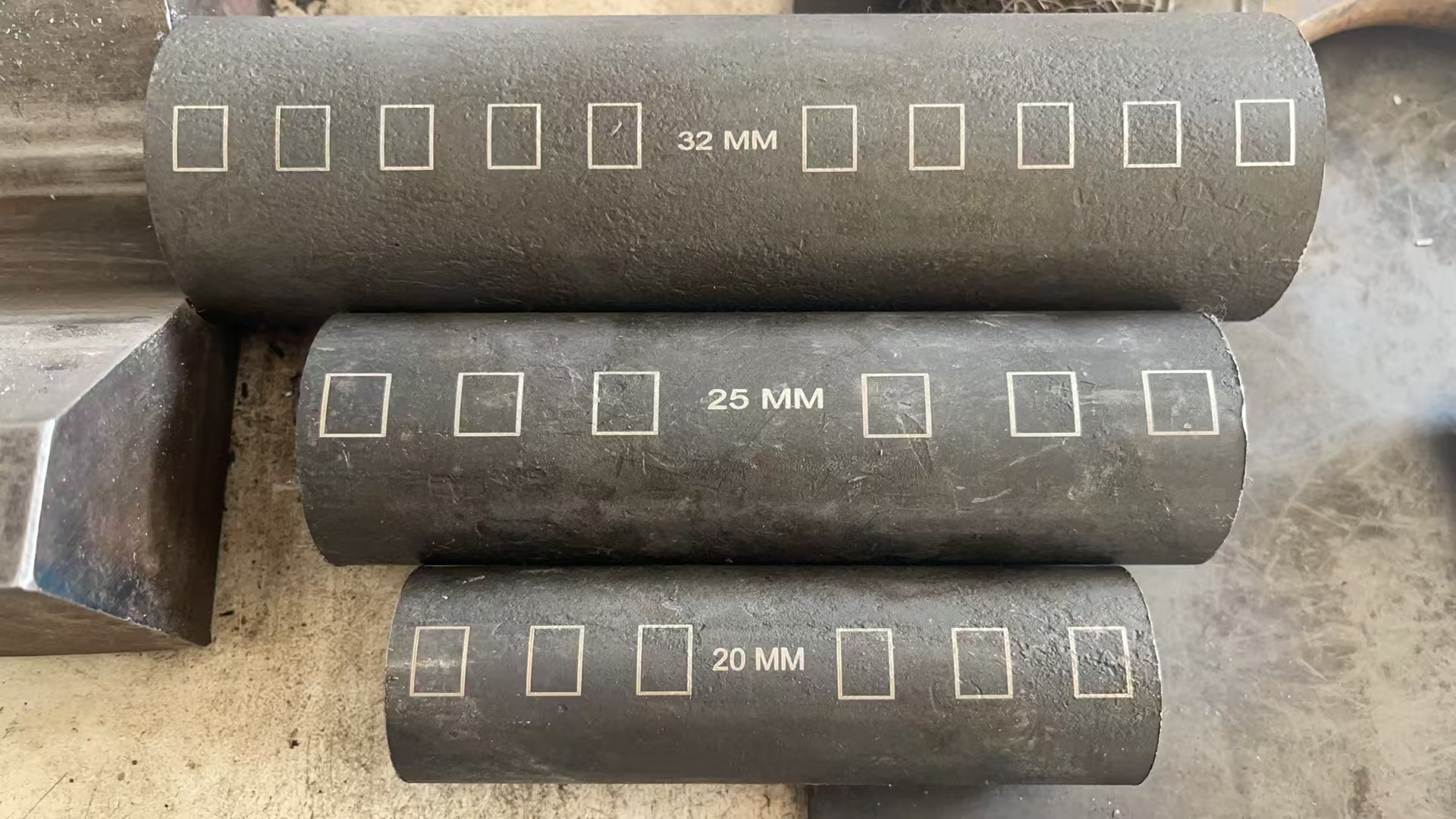
The pressing coupler is a sleeve that is compressed onto the bar ends, which is why its specification is expressed as dimensions rather than threads. Bartech manufactures code 3918 in carbon steel Q355B, catalogued from 16 mm to 40 mm bar, with outside diameters of 30–70 mm, body lengths of 110–240 mm and wall thickness rising from 4.5 mm at 16 mm bar to 11.3 mm at 36 mm bar and 11.0 mm at 40 mm bar.
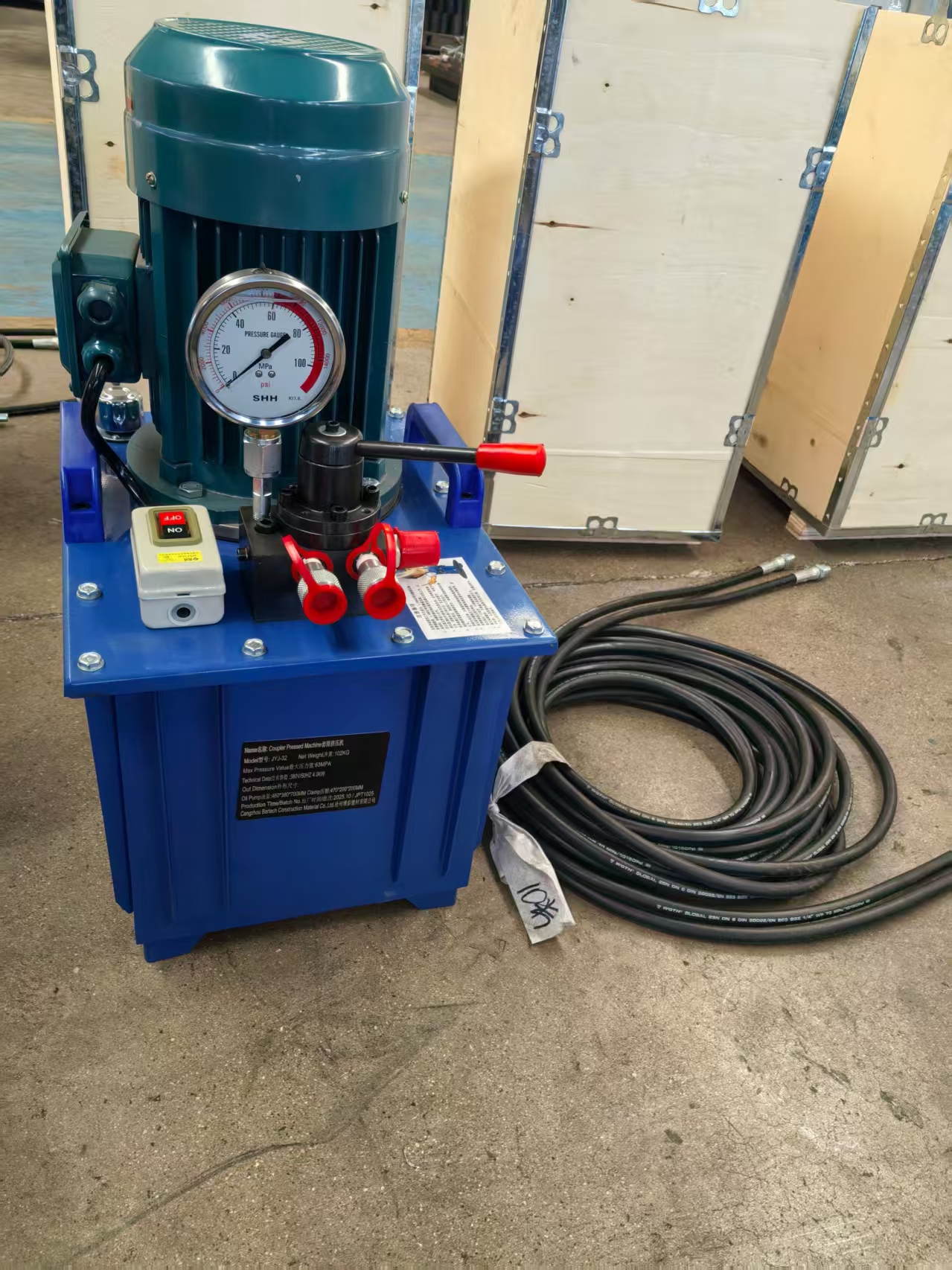
Installation uses the CBT32 pressing machine, which covers rebar sizes 16–32 mm with a 4 kW main motor, 50 t clamp tension, a 380 V/50 Hz power source, a maximum oil pump pressure of 70 MPa, a 5 m oil pump hose, a 60 kg pump and a 38 kg clamp. The machine specification is deliberately narrower than the coupler range: pressing couplers are catalogued up to 40 mm bar while the published CBT32 specification stops at 32 mm, so a project that specifies pressing couplers at 36 mm or 40 mm should confirm the pressing equipment during the inquiry rather than after the order.
Where it earns its place: the joint is defined by thickness and geometry rather than a thread callout, and the sleeve geometry is straightforward to inspect against a dimensional drawing. What it requires: the pressing machine, its power supply and its clamp handling; and more sleeve material, because the pressing family carries the longest body of the three from 25 mm bar size upward (150–240 mm against 143–200 mm for one-touch).
One-Touch Rebar Couplers (3919) — Quick Connection
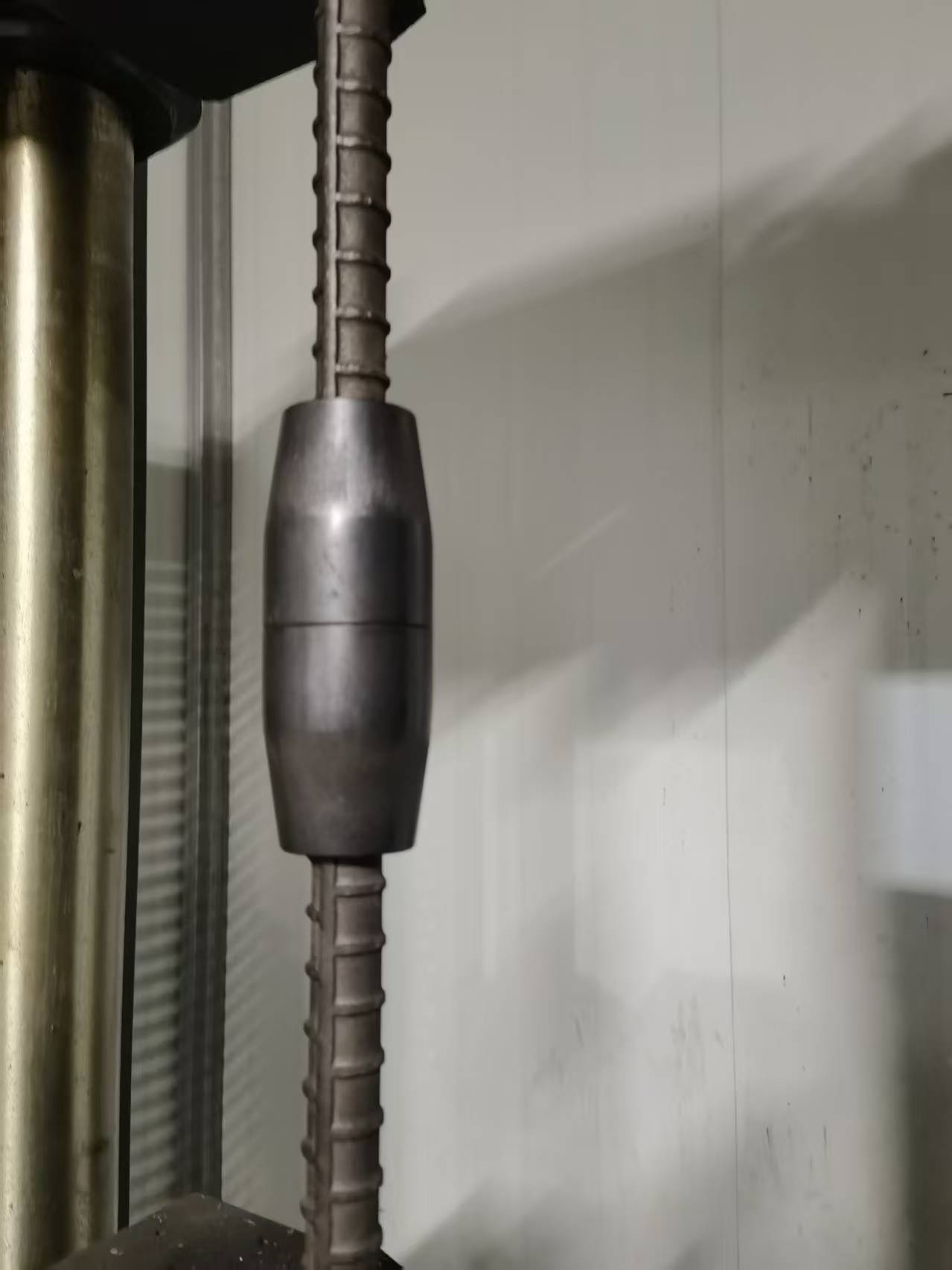
The one-touch coupler is a quick-connection sleeve supplied in alloy steel 40CR only. Its size chart starts below the standard range — a φ11–16 body at OD 35 mm and 100 mm length — and continues through φ16 (OD 40 mm, 106 mm), φ18/20 (OD 46 mm, 123 mm), φ22 (OD 51 mm, 133 mm), φ25 (OD 56 mm, 143 mm), φ29 (OD 65 mm, 166 mm), φ32 (OD 70 mm, 170 mm), φ36 (OD 78 mm, 190 mm) and φ40 (OD 83 mm, 200 mm). It is the largest family in outside diameter across the whole range.
Tightening is done with an electric torque wrench. The BOC 8-32 covers 8–32 mm rebar with a maximum torque of 350 N·m, a 6.0 Ah 900 W 21 V battery, 0–75 r/min and a net weight of 4.5 kg. The BOC 8-42 covers 12–40 mm rebar with 16–32 couplers, a maximum torque of 400 N·m, the same 6.0 Ah 900 W 21 V battery, 0–60 r/min and a net weight of 9.5 kg. Because both wrenches are battery powered, tightening does not depend on the 380 V/50 Hz supply that the threading and pressing machines require.
Where it earns its place: the connection is made by tightening, so the tool package is a wrench rather than a machine, and the workflow is suitable for high-repetition splicing where cycle time matters. What it requires: the largest sleeve envelope of the three families, which has to be checked against cover and congestion, plus a torque-controlled tightening step that is recorded rather than threaded.
A Seven-Step Selection Sequence for Project Buyers
- Lock the bar size and grade. All three families are catalogued from 16 mm to 40 mm bar, and the one-touch family additionally lists a φ11–16 body, so the first filter is simply which sizes the project actually uses.
- Choose the connection method for each structural element. Rolling for threaded production, pressing where a pressed sleeve is specified, one-touch where connection speed and a wrench rather than a machine are preferred. The same project can use more than one type if the equipment plan supports both.
- Check the sleeve envelope against the detailing. Compare the three dimensional ranges directly: OD 24–59 mm (rolling), 30–70 mm (pressing), 35–83 mm (one-touch), and body lengths of 42–95 mm, 110–240 mm and 100–200 mm.
- Match the tooling to the method and the size. Thread rolling machines CBT40A, CBT40L, 40AO and 40MO for 16–40 mm threading; the CBT32 pressing machine for 16–32 mm pressing; BOC 8-32 and BOC 8-42 torque wrenches for tightening.
- Confirm the material grade against the specified bar. Carbon steel 45# or alloy steel 40CR for the rolling type, carbon steel Q355B for the pressing type, alloy steel 40CR for the one-touch type.
- Confirm the standard and the documentation package. Align the submittal with ISO 15835, ASTM A615 or BS 8110 as the project specifies, and request the records Bartech issues as standard: a material test report, 10% production testing during production lines and 100% appearance surface checking.
- Confirm customization and supply terms. Bartech operates in OEM mode and customizes coupler outer diameter, inner diameter and thread; monthly capacity is 300,000 units and lead time is 7–30 days depending on quantity, with no minimum order quantity on stock couplers.
Where Each Type Fits: Buildings, Airports, Rail Stations and Bridges
Bartech lists the same application set for all three coupler types — construction projects, high buildings, airport projects, high-railway stations and large bridges including sea-crossing bridges — so the type decision sits inside the project, not above it. The differentiating factors are sleeve envelope, tooling and documentation.
- High-rise buildings. Sleeve density is highest here, and the rolling coupler's 24–59 mm outside diameter range is the smallest of the three at every bar size, which makes it the natural candidate where couplers are closely spaced. Where the site prefers a wrench-based workflow over a threading machine, the one-touch type moves the tool package to a battery wrench.
- Airports and high-speed rail stations. These are high-volume, schedule-driven environments. Two reference projects illustrate the scale: a construction enterprise in Kuwait purchases 400,000 standard rebar couplers per year for outdoor construction work, reporting easy connection, higher strength and stable quality; and an OEM client in Vietnam uses 500,000 units per year on tall building and railway station construction, where the reported attributes are high strength, good quality, a clear outer surface and strict thread specifications.
- Bridges, including sea-crossing bridges. Large-diameter work concentrates on 36 mm and 40 mm bars, where the dimensional spread between types is widest: rolling is OD 53/59 mm at 84/95 mm length, pressing is OD 63.2/70 mm at 220/240 mm length, and one-touch is OD 78/83 mm at 190/200 mm length. That comparison is the fastest way to test a detailing assumption.
- Metro and tunnel works. Where power availability inside the tunnel is uncertain, the battery-powered BOC wrenches used with one-touch couplers avoid dependence on a 380 V/50 Hz supply, while threading and pressing remain machine-based operations.
Rebar Coupler Comparison Table and Size Charts
The table below compares the three families on the criteria that decide a specification. It uses only Bartech's published product data for codes 3917, 3918 and 3919.
| Comparison factor | Rolling (3917) | Pressing (3918) | One-touch (3919) |
|---|---|---|---|
| Material | Carbon steel 45# or alloy steel 40CR | Carbon steel Q355B | Alloy steel 40CR |
| Catalogued bar sizes | 16–40 mm | 16–40 mm | φ11–16 to φ40 |
| Sleeve outer diameter | 24–59 mm | 30–70 mm | 35–83 mm |
| Sleeve body length | 42–95 mm | 110–240 mm | 100–200 mm |
| Wall thickness data | Not listed in the size chart | 4.5–11.3 mm | Not listed in the size chart |
| Thread callout | M16.5 × 2.5 to M40.2 × 3.0, 60° angle | Not listed in the size chart | Not listed in the size chart |
| Joint method | Rolled parallel thread on bar end, joined by threaded sleeve | Sleeve compressed onto bar ends | Quick connection, tightened into position |
| Matching Bartech equipment | CBT40A, CBT40L, 40AO, 40MO thread rolling machines | CBT32 pressing machine (16–32 mm) | BOC 8-32 (350 N·m) and BOC 8-42 (400 N·m) torque wrenches |
Rolling Coupler Size Chart (3917)
| Rebar size | Outer diameter | Body length | Thread | Thread angle |
|---|---|---|---|---|
| 16 mm | 24 mm | 42 mm | M16.5 × 2.5 | 60° |
| 18 mm | 27 mm | 45 mm | M18.5 × 2.5 | 60° |
| 20 mm | 30 mm | 50 mm | M20.5 × 2.5 | 60° |
| 22 mm | 33 mm | 54 mm | M22.5 × 2.5 | 60° |
| 25 mm | 38 mm | 62 mm | M25.6 × 3.0 | 60° |
| 28 mm | 42 mm | 68 mm | M28.6 × 3.0 | 60° |
| 32 mm | 48 mm | 76 mm | M32.6 × 3.0 | 60° |
| 36 mm | 53 mm | 84 mm | M36.6 × 3.0 | 60° |
| 40 mm | 59 mm | 95 mm | M40.2 × 3.0 | 60° |
Pressing Coupler Size Chart (3918)
| Rebar size | Outer diameter | Body length | Wall thickness |
|---|---|---|---|
| φ16 | 30 mm | 110 mm | 4.5 mm |
| φ18 | 34 mm | 120 mm | 5.4 mm |
| φ20 | 36 mm | 120 mm | 5.5 mm |
| φ22 | 40 mm | 132 mm | 6.4 mm |
| φ25 | 45 mm | 150 mm | 7.4 mm |
| φ28 | 50 mm | 168 mm | 8.0 mm |
| φ32 | 56 mm | 192 mm | 9.0 mm |
| φ36 | 63.2 mm | 220 mm | 11.3 mm |
| φ40 | 70 mm | 240 mm | 11.0 mm |
One-Touch Coupler Size Chart (3919)
| Rebar / body size | Outer diameter | Body length |
|---|---|---|
| φ11–16 | 35 mm | 100 mm |
| φ16 | 40 mm | 106 mm |
| φ18/20 | 46 mm | 123 mm |
| φ22 | 51 mm | 133 mm |
| φ25 | 56 mm | 143 mm |
| φ29 | 65 mm | 166 mm |
| φ32 | 70 mm | 170 mm |
| φ36 | 78 mm | 190 mm |
| φ40 | 83 mm | 200 mm |
Dimensional data above is taken from Bartech's published coupler specifications for product codes 3917, 3918 and 3919. For 36 mm and 40 mm pressing couplers, confirm pressing equipment at the inquiry stage, since the published CBT32 specification covers 16–32 mm.
Frequently Asked Questions
Do these rebar couplers comply with ISO 15835, ASTM A615 or BS 8110?
Mechanical rebar splices are governed by international standards including ISO 15835, ASTM A615 and BS 8110, with BS 8110 often replaced by Eurocode 2 in the EU. Bartech holds CE certification Nr.SC-PSC-4-2025-12-14 issued under the EU Construction Products Regulation (standard MTZ202512021CPR), valid from 4 December 2025 to 3 December 2030, and ISO 9001:2015 certification 31623Q10713R1S covering the sales of rebar couplers, rebar connection equipment and related spare parts, valid to 21 December 2026.
Can the couplers be customized for a specific project or private-label supply?
Yes. Bartech operates in OEM mode and customizes the coupler outer diameter, inner diameter and thread. The company runs a 1,000 m² facility with 30 employees and a 10-engineer R&D team, and reports a monthly capacity of 300,000 units, which is the figure to check when a customized thread or sleeve dimension has to be scheduled alongside a standard order.
What causes the difference in cost between rolling, pressing and one-touch couplers?
Three factors separate the three families commercially. The first is material grade: rolling couplers are made in carbon steel 45# or alloy steel 40CR, pressing couplers in carbon steel Q355B, and one-touch couplers in alloy steel 40CR only. The second is sleeve mass: one-touch couplers have the largest outer diameter in the range (35–83 mm), while pressing couplers have the longest body from 25 mm bar size upward (150–240 mm). The third is tooling, because a thread rolling machine, a pressing machine and a torque wrench are three separate investments. On commercial terms, Bartech applies no minimum order quantity for stock couplers, and lead time is 7–30 days depending on quantity.
How can the coupler type be validated before a full order?
Validation runs on documentation first. Bartech's quality control package includes a material test report, 10% production testing during production lines and 100% appearance surface checking, and these records are the practical way to confirm material grade and dimensional accuracy for the type under evaluation. Buyers who want to check a type against their own bar stock should raise it in the inquiry so that specimen and documentation requirements are confirmed together with the quotation.
What is the lead time and supply capacity for a full project order?
Lead time is 7–30 days depending on quantity, against a monthly capacity of 300,000 units and an annual output of 3,600,000 units. Two reference projects indicate the volumes involved: a construction enterprise in Kuwait takes 400,000 couplers per year for outdoor construction work, and an OEM client in Vietnam takes 500,000 units per year for tall building and railway station construction. To move a specification forward, send the bar size, coupler type and quantity to Julie Chen at sales@chinabartech.cn or on WhatsApp at +86 13785685215.
Next Step: Match the Type to the Tooling and the Schedule
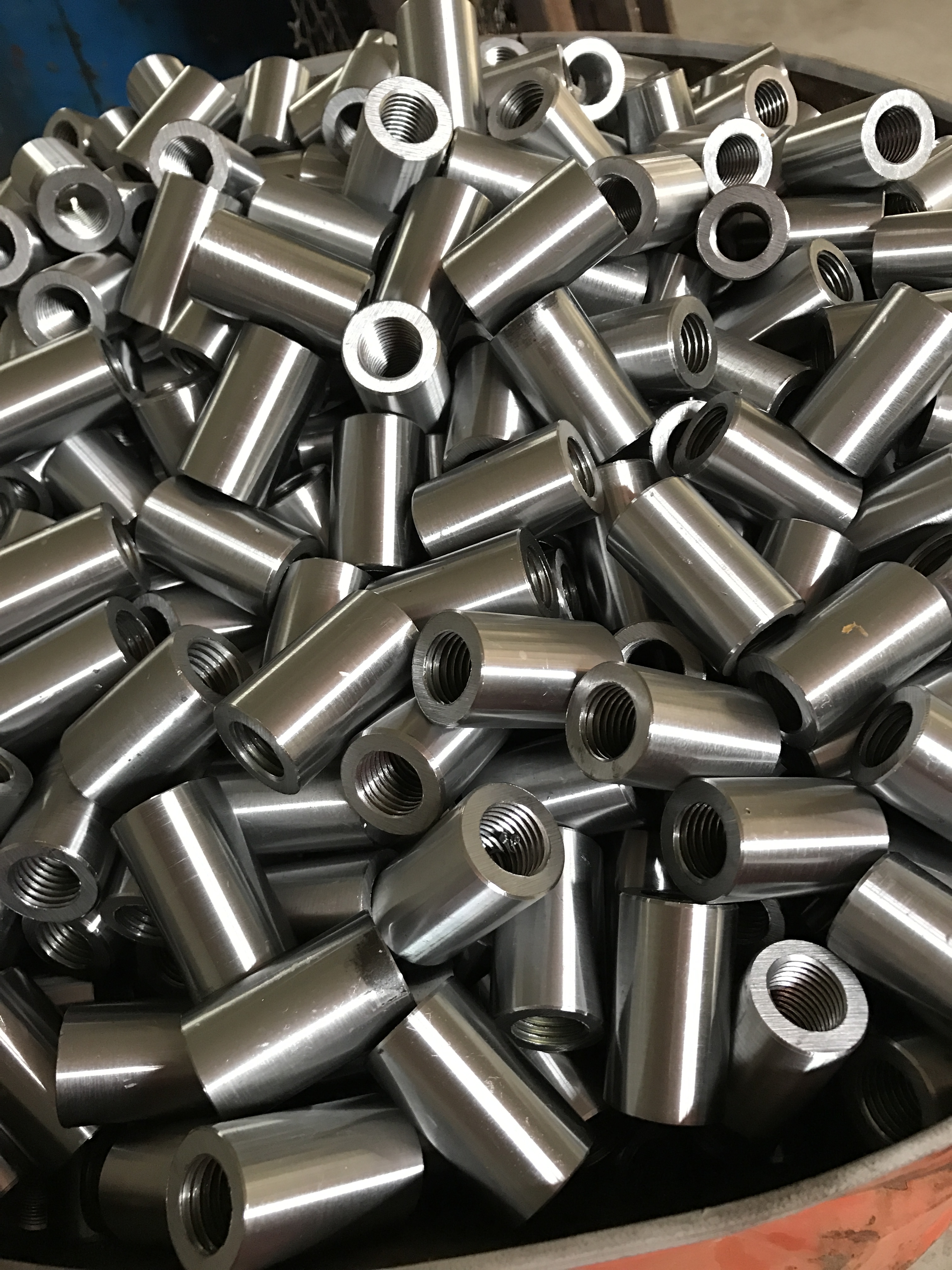
Share the bar sizes, the structural elements and the coupler type under consideration, and Cangzhou Bartech will confirm the matching sleeve dimensions, the correct tooling and the lead time for the order — including OEM customization of outer diameter, inner diameter and thread where the project needs it.
Email: sales@chinabartech.cn | WhatsApp: +86 13785685215 | Website: www.chinabartech.cn
Conclusion
The choice between rolling, pressing and one-touch rebar couplers comes down to three measurable questions. First, what sleeve envelope does the detailing allow: 24–59 mm outside diameter with the rolling type, 30–70 mm with pressing, or 35–83 mm with one-touch. Second, what tool does the site already have or plan to buy: a thread rolling machine for 16–40 mm threading, a pressing machine for 16–32 mm pressing, or a battery wrench rated at 350 N·m or 400 N·m. Third, what documentation does the standard governing the project require, and does the material grade match the bar — carbon steel 45# or alloy steel 40CR for rolling, carbon steel Q355B for pressing, alloy steel 40CR for one-touch.
Answered in that order, the type selection stops being a preference and becomes a set of verifiable decisions against published dimensions, published tooling specifications and a certification file that includes CE Nr.SC-PSC-4-2025-12-14 and ISO 9001:2015 certification 31623Q10713R1S.