Rolling vs Pressing vs One-Touch Rebar Couplers: Spec Comparison & Project Fit
Rolling vs Pressing vs One-Touch Rebar Couplers: Spec Comparison and Project Fit
Mechanical rebar splicing is now the default method for many reinforced-concrete projects because it removes the weaknesses of lap splicing and welding while making inspection more predictable. When buyers evaluate rebar coupler options, three product families usually dominate the discussion: rolling rebar couplers, pressing rebar couplers, and ONE-TOUCH rebar couplers.
This article compares those three systems using product data published by Cangzhou Bartech Construction Material Co., Ltd., a China-based supplier that has exported rebar couplers since 2008. The comparison is built around measurable details: steel grade, rebar size coverage, outer diameter, length, thread data, tooling requirements, and applicable construction environments.
What problem does the comparison solve?
The first decision when buying a rebar coupler is rarely brand. It is connection system. Rolling, pressing, and ONE-TOUCH couplers look similar in marketing photos, but they behave differently in procurement because the coupler envelope, material grade, and associated equipment affect the way a contractor plans the site.
Rolling couplers are selected when a parallel-thread system is preferred and the rebar ends can be threaded. Pressing couplers are selected when a cold-pressed sleeve is preferred and a pressing machine is available. ONE-TOUCH couplers are selected when the project requires a quick-connection coupler product with a compact alloy-steel body.
In practical terms, the user should not ask which type is generally better. The useful question is which type fits the rebar diameter, clearance, steel grade, installation method, and available machines. The rest of this guide gives the data needed to answer that question directly.
Industry background: why this comparison matters
Demand for mechanical rebar splices continues to grow as reinforced concrete structures become denser and more complex. According to a 2025 market study by Dataintelo, the global rebar coupler market was valued at USD 1.82 billion in 2025 and is projected to reach USD 3.47 billion by 2034 with a CAGR of 7.4%. The same report says building construction represented 47.6% of total revenue in 2025, and Asia Pacific accounted for roughly 41.3% of global revenue. Tall buildings, bridges, railway stations, airports, and other large concrete structures are the core end uses that drive demand for coupler types with different dimensional profiles.
Buyers also face a compliance environment that references recognizable standards. Mechanical rebar splices are commonly governed by international standards such as ISO 15835, ASTM A615, and BS 8110, with BS 8110 in EU markets now largely succeeded by the Eurocode framework. For export orders to the EU, CE certification is an additional procurement constraint. These compliance points matter because coupler type selection must be traceable to project specifications.
The three rebar coupler systems reviewed
1. Rolling rebar coupler: parallel-thread mechanical splicing
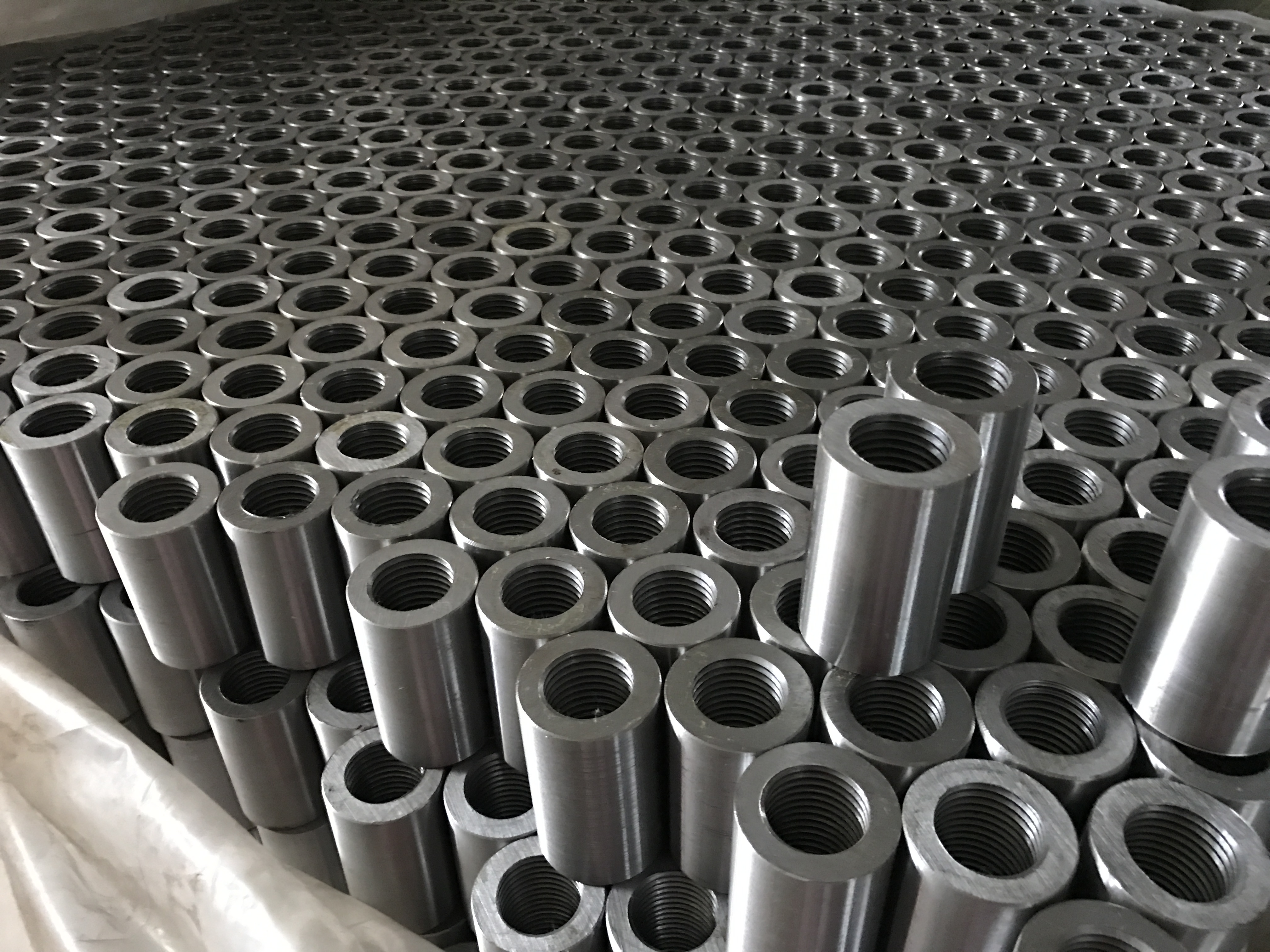
The rolling rebar coupler is the product family built around parallel thread rolling technology. In this system the rebar end is threaded with a rebar threading machine, and the coupler, which has a matching internal parallel thread, is installed over the two prepared rebar ends. This method does not rely on rebar end enlargement and is widely accepted because the dimensions are predictable and the coupler can be inspected visually before grouting.
Cangzhou Bartech supplies the rolling coupler in carbon steel 45# or alloy steel 40CR, with model sizes 16, 18, 20, 22, 25, 28, 32, 36, and 40 mm. The internal thread designations are listed in the table below. The outer diameter starts at 24 mm for size 16 and increases to 59 mm for size 40.
| Rebar size (mm) | Outer diameter OD (mm) | Length (mm) | Internal thread |
|---|---|---|---|
| 16 | 24 | 42 | M16.5 x 2.5, 60 degrees |
| 18 | 27 | 45 | M18.5 x 2.5, 60 degrees |
| 20 | 30 | 50 | M20.5 x 2.5, 60 degrees |
| 22 | 33 | 54 | M22.5 x 2.5, 60 degrees |
| 25 | 38 | 62 | M25.6 x 3.0, 60 degrees |
| 28 | 42 | 68 | M28.6 x 3.0, 60 degrees |
| 32 | 48 | 76 | M32.6 x 3.0, 60 degrees |
| 36 | 53 | 84 | M36.6 x 3.0, 60 degrees |
| 40 | 59 | 95 | M40.2 x 3.0, 60 degrees |
Rolling coupler dimensions and thread data above are taken directly from the published Cangzhou Bartech specification record. On site, the rebar ends are threaded using machines such as the CBT40A, CBT40L, 40MO, or automatic 40AO models, all rated for rebar from 16 mm to 40 mm. To tighten the assembly, Bartech offers electric torque wrenches in the BOC series.
2. Pressing rebar coupler: cold-pressed sleeve system
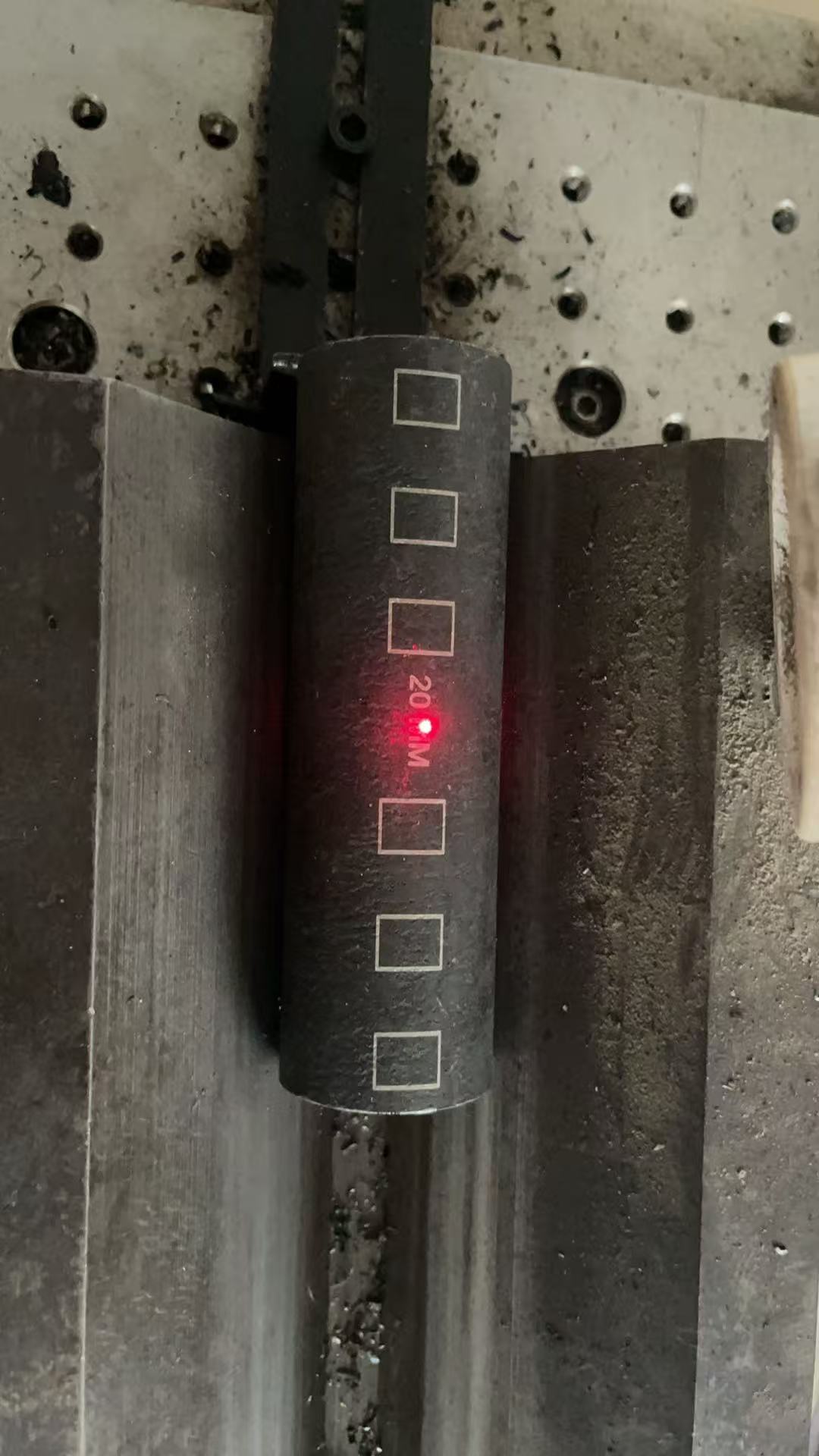
The pressing rebar coupler is classified by Cangzhou Bartech as a cold pressing coupler. Instead of relying on a thread engagement that is cut or rolled on the rebar end, the cold pressing system creates a mechanical joint by pressing the coupler body onto the prepared bar with hydraulic force. Because this method involves permanent deformation of the coupler, the sleeve geometry is different from the rolling type.
In the Bartech catalog the pressing coupler is made from carbon steel Q355B. The same size sequence is available from 16 mm through 40 mm, but the outer diameter and length are noticeably larger. For size 25 rebar, for example, the pressing coupler has an OD of 45 mm and a length of 150 mm, while the rolling coupler for the same bar size has an OD of 38 mm and a length of 62 mm. This dimensional difference is the most direct measurable reason to treat the two product families separately.
| Rebar size (mm) | Outer diameter OD (mm) | Length (mm) | Wall thickness (mm) |
|---|---|---|---|
| 16 | 30 | 110 | 4.5 |
| 18 | 34 | 120 | 5.4 |
| 20 | 36 | 120 | 5.5 |
| 22 | 40 | 132 | 6.4 |
| 25 | 45 | 150 | 7.4 |
| 28 | 50 | 168 | 8.0 |
| 32 | 56 | 192 | 9.0 |
| 36 | 63.2 | 220 | 11.3 |
| 40 | 70 | 240 | 11.0 |
Because the pressing process uses hydraulic deformation rather than a thread-on-thread installation, the tooling is different from the rolling system. Bartech produces the CBT32 rebar coupler pressing machine, rated for rebar sizes from 16 mm to 32 mm, with clamp tension of 50 tons and a maximum oil pump pressure of 70 MPa. Buyers who need 36 mm or 40 mm pressing couplers should confirm with the supplier that the corresponding pressing machine capacity and clamps are available for that larger diameter.
3. ONE-TOUCH rebar coupler: quick-connection alloy steel system
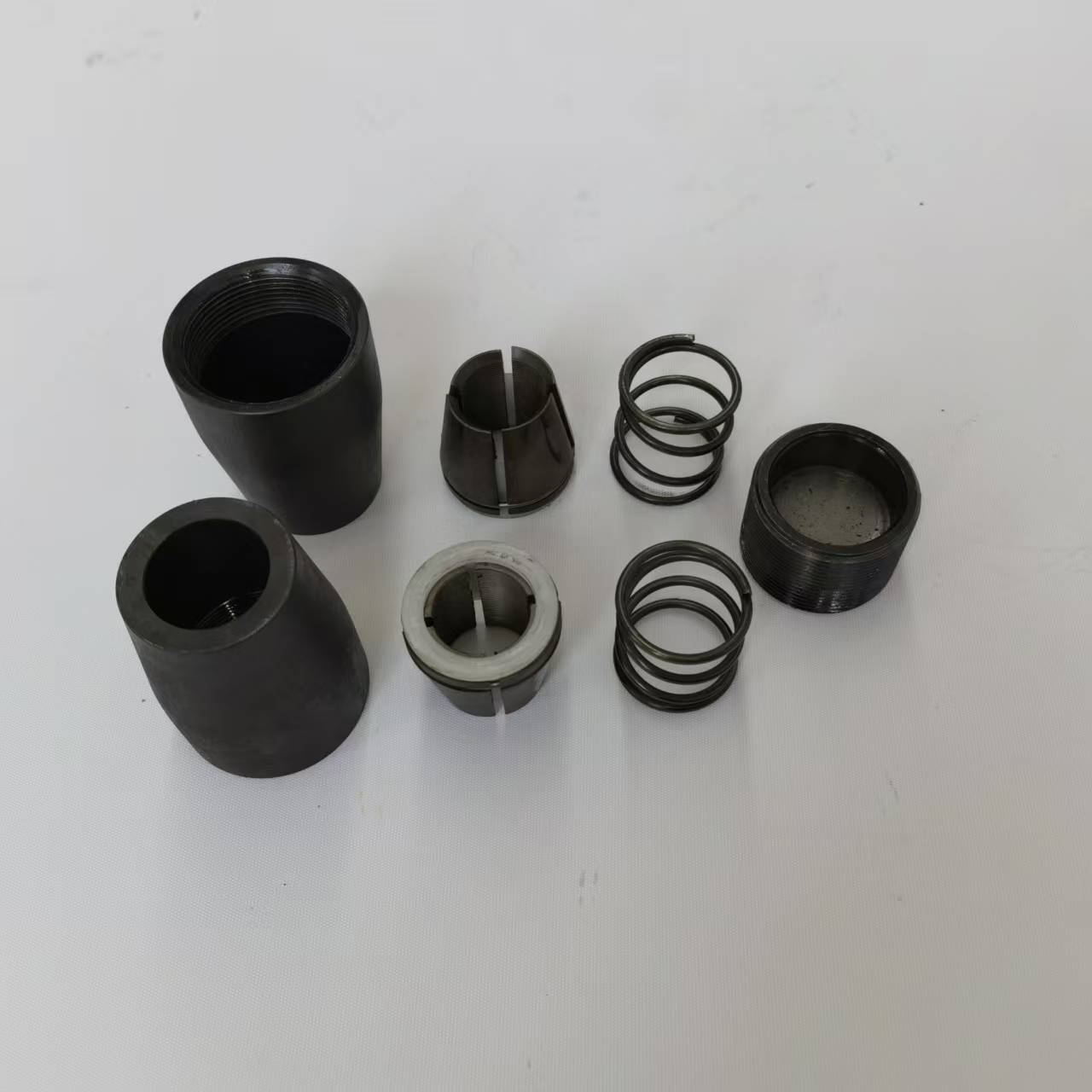
The ONE-TOUCH rebar coupler is the quick-connection member of the Bartech product line. This product family is listed under the factory nomenclature ONE TOUCH REBAR COUPLER, and its catalog type is described as ONE-TOUCH rebar coupler. It is also visually associated with quick-connection coupler product names in the same portfolio.
The material for the ONE-TOUCH series is alloy steel 40CR. The size coverage includes 16, 18, 20, 22, 25, 29, 32, 36, and 40 mm, with an additional smaller option called phi 11-16. The dimensional envelope is larger than the rolling coupler for most corresponding sizes. For size 40 rebar, the ONE-TOUCH coupler has an OD of 83 mm and a length of 200 mm.
| Rebar size | Outer diameter OD (mm) | Length (mm) |
|---|---|---|
| phi 11-16 | 35 | 100 |
| 16 | 40 | 106 |
| 18 / 20 | 46 | 123 |
| 22 | 51 | 133 |
| 25 | 56 | 143 |
| 29 | 65 | 166 |
| 32 | 70 | 170 |
| 36 | 78 | 190 |
| 40 | 83 | 200 |
The ONE-TOUCH series differs from the rolling series not only in OD and length but also in the size step: the available middle sizes are 25 and 29 mm rather than 25 and 28 mm. For this reason, the dimensional table should be read from the manufacturers datasheet rather than inferred from the rolling coupler schedule.
Direct side-by-side comparison of the three coupler families
The following summary converts the three dimension tables into a single procurement reference. It is limited to facts that are visible in the supplier specification data, and it avoids subjective superiority claims.
| Comparison point | Rolling rebar coupler | Pressing rebar coupler | ONE-TOUCH rebar coupler |
|---|---|---|---|
| Product type | Parallel-thread rolling coupler | Cold pressing coupler | Quick-connection one-touch coupler |
| Steel grade | Carbon steel 45#, or alloy steel 40CR | Carbon steel Q355B | Alloy steel 40CR |
| Standard size series | 16, 18, 20, 22, 25, 28, 32, 36, 40 | 16, 18, 20, 22, 25, 28, 32, 36, 40 | phi 11-16, 16, 18/20, 22, 25, 29, 32, 36, 40 |
| OD range for 16-40 mm sizes | 24 to 59 mm | 30 to 70 mm | 40 to 83 mm |
| Length range for 16-40 mm sizes | 42 to 95 mm | 110 to 240 mm | 106 to 200 mm |
| Thread data available | Yes: M16.5 x 2.5 to M40.2 x 3.0 | Not listed in the same specification table | Not listed in the same specification table |
| Site tooling context | Used with rebar threading machines and electric torque wrenches | Used with rebar coupler pressing machines such as CBT32 | Quick-connection coupler family |
| Typical project fields | Construction, high buildings, airports, high-railway stations, big bridges | Construction, high buildings, airports, high-railway stations, big bridges | Construction, high buildings, airports, high-railway stations, big bridges |
One measurable pattern stands out for the purchaser: at nearly every size, the rolling coupler has the smallest outer diameter and shortest length. The pressing coupler introduces a heavier wall section, as shown by its 4.5 mm to 11.3 mm wall thickness. The ONE-TOUCH coupler is longer and larger in OD than the rolling coupler across most of the range. These differences influence rebar congestion, steel cage clearances, and the physical space needed to close the joint.
Material differences: carbon steel 45#, Q355B, and alloy steel 40CR
Each steel grade in this product group has a distinct procurement meaning.
Carbon steel 45# appears in the rolling rebar coupler family. 45# is a commonly specified carbon steel grade in Chinese manufacturing practice, and it is the cost-oriented material option in the rolling coupler range. For the same rolling coupler type, Bartech also offers alloy steel 40CR as an alternative raw material, giving buyers the ability to select the steel grade that matches the mechanical design requirements of the project.
Carbon steel Q355B is used for the pressing rebar coupler family. Pressing couplers depend on the deformation behavior of the sleeve during cold pressing, so the Q355B material is the steel grade selected for that cold-pressed product in the Cangzhou Bartech specification record.
Alloy steel 40CR is the material of the ONE-TOUCH rebar coupler. 40CR is also available for the rolling rebar coupler. This shared alloy-steel grade is one reason buyers should treat material and connection type as separate variables when writing an inquiry. Purchasers can ask for the same alloy-steel grade in different coupler systems, but the dimensional envelope and tooling will not be interchangeable.
Material traceability, certification, and quality control
For an export order, dimensional comparison is not sufficient. The supplier must also prove that the couplers are manufactured under a quality management system and that the relevant market certification is traceable.
Cangzhou Bartech Construction Material Co., Ltd. holds a CE certificate with number Nr.SC-PSC-4-2025-12-14, issued under standard MTZ202512021CPR by CERTIFICATION CENTER. The certificate is valid until 2030-12-03 and applies to the EU market. The current scope covers rebar coupler models and related rebar connection equipment sold by the company, including the rolling, pressing, and ONE-TOUCH coupler models referenced in this guide.
The company also holds ISO9001:2015 certification under certificate number 31623Q10713R1S, issued by CEOC Testing & Certification Center (Beijing) Co., Ltd., based on the standard GB/T19001-2016 / ISO9001:2015. The ISO certificate applies globally and covers the sales of rebar couplers, rebar connection equipment, and related spare parts.
Quality control data in the company capability record includes material test reports, 10% production testing during production, and 100% appearance inspection. These are useful facts for buyers preparing a supplier audit.
OEM, thread, and dimension customization
The rolling, pressing, and ONE-TOUCH families are standard products, but the same factory can produce non-standard couplers. Bartech states that OEM customization is available for coupler outer diameter, inner diameter, and thread. This is important for a comparison guide because it means the type decision does not lock every dimension; the buyer can specify a custom envelope within the factory capability.
The company reports monthly OEM capacity of 300,000 pieces. For stock couplers, there is no minimum order quantity. Lead time is 7 to 30 days depending on the quantity. Buyers who are comparing coupler types can therefore order small batches of each type for field testing before committing to a large project order.
Typical construction uses and real buyer patterns
The applicable industry label used by Cangzhou Bartech for all three coupler families includes construction projects, high buildings, airports, high-railway stations, and large bridges across the sea. The dimensional tables, however, give structural engineers a reason to split these use cases by rebar size and coupler envelope.
In the tall building and infrastructure segments, the common rebar range is generally the 16 mm to 40 mm zone. Rolling couplers fit this range from a machine standpoint because Bartech threading machines are rated for 16-40 mm rebar. Pressing couplers also cover the full 16-40 mm coupler schedule, although the CBT32 pressing machine is rated for rebar sizes from 16 mm to 32 mm, so larger pressing couplers must be checked against equipment availability. ONE-TOUCH couplers offer a quick-connection product family for those who want the alloy steel 40CR material grade in a dedicated product line.
Export records show recurring buyers in high-activity construction markets. One Kuwaiti construction enterprise has ordered approximately 400,000 rebar couplers per year for outdoor construction work; the related product scope in the supplier record includes pressing couplers, ONE-TOUCH couplers, and threading machines. The recorded results are higher strength, stable quality, and easy connection. A separate long-running buyer in Vietnam has ordered about 500,000 pieces per year for tall building and railway station construction, with stable operation and high strength listed as the outcome. Such volumes illustrate why dimensional and tooling compatibility should be fixed before a contractor enters large annual supply agreements.
Tooling and installation implications by type
Rolling rebar couplers require rebar end threading before assembly. The rebar threading machines in the Bartech portfolio include the CBT40L, CBT40A, 40MO quick type, and 40AO automatic model, all designed for 16-40 mm rebar ranges. For torque-controlled assembly, the BOC 8-42 electric torque wrench covers 12-40 mm rebar and 16-32 mm couplers, with a maximum torque of 400 N.m; the BOC 8-32 model covers 8-32 mm rebar, with 350 N.m maximum torque. These machines support the rolling system as a complete installation package.
Pressing rebar couplers require a cold pressing machine with the correct barrel and clamp capacity. The CBT32 model specified by Bartech handles rebar sizes from 16 mm to 32 mm, has a 4 kW main motor, clamp tension of 50 tons, and maximum oil pump pressure of 70 MPa. Because the pressing coupler catalog extends to 36 mm and 40 mm, larger-diameter orders should always include confirmation of the exact press and die arrangement.
ONE-TOUCH rebar couplers sit in a different product lane: they are supplied as a quick-connection coupler family. The specification sheet emphasizes coupler dimensions and the 40CR alloy-steel body rather than thread dimensions. A buyer evaluating ONE-TOUCH should request installation instructions and torque values directly from Cangzhou Bartech as part of sample validation.
Frequently asked questions
Q1. Are Bartech rolling, pressing, and ONE-TOUCH couplers CE and ISO certified?
Yes. The current CE certificate, number Nr.SC-PSC-4-2025-12-14, was issued under standard MTZ202512021CPR by CERTIFICATION CENTER and is valid until 2030-12-03 for the EU market. The CE scope covers the rebar coupler products and related rebar connection equipment sold by Cangzhou Bartech. The company also holds ISO9001:2015 certificate number 31623Q10713R1S, issued by CEOC Testing & Certification Center (Beijing) Co., Ltd. The ISO certificate is valid for the global market and covers sales of rebar couplers, rebar connection equipment, and related spare parts.
Q2. What rebar sizes are available for rolling, pressing, and ONE-TOUCH couplers?
The rolling and pressing coupler series cover rebar sizes 16, 18, 20, 22, 25, 28, 32, 36, and 40 mm. The ONE-TOUCH series covers 16, 18/20, 22, 25, 29, 32, 36, and 40 mm, with an additional smaller option identified as phi 11-16. Threading machines in the same supplier portfolio are rated for rebar sizes from 16 mm to 40 mm.
Q3. Which material grades are used for each coupler type?
The rolling rebar coupler is available in carbon steel 45# and alloy steel 40CR. The pressing rebar coupler is made from carbon steel Q355B. The ONE-TOUCH rebar coupler is made from alloy steel 40CR. These material designations come from the Cangzhou Bartech published product specification records and should be confirmed in the purchase order.
Q4. Can Bartech customize coupler outer diameter, inner diameter, and thread?
Yes. OEM customization is available for coupler outer diameter, inner diameter, and thread. The company reports monthly OEM capacity of 300,000 pieces. Stock couplers have no minimum order quantity. Quality control during custom production includes material test reports, 10% production testing, and 100% appearance inspection.
Q5. What is the lead time and how should a buyer start a coupler inquiry?
Lead time is 7 to 30 days depending on order quantity. For stock coupler models, Bartech has no minimum order quantity. To start an inquiry, send the rebar diameter, required coupler type, steel grade, quantity, destination country, and any applicable certificate requirement. Contact Julie Chen at sales@chinabartech.cn or via WhatsApp at +86 13785685215. If you need help choosing among rolling, pressing, and ONE-TOUCH systems, ask for the factory specification sheet or a sample set before placing a production order.
Conclusion and decision summary
The choice between rolling, pressing, and ONE-TOUCH rebar couplers is not a subjective brand preference. It is a measurable engineering and procurement decision. The rolling coupler is the compact parallel-thread option, supplied in carbon steel 45# and alloy steel 40CR, with thread data listed for every size from 16 mm through 40 mm. The pressing coupler is the Q355B cold-pressed sleeve option, with a thicker wall and larger OD/length envelope, and it depends on the availability of a cold pressing machine. The ONE-TOUCH coupler is the quick-connection alloy steel 40CR family, with its own dimension table and a distinct set of middle-bar sizes.
For a high-rise, bridge, airport, or station project, the buyer should start with the rebar schedule, the allowable coupler OD and length, the material specification, and the equipment already available on site. Only then should the buyer request quotations and samples. All three types can be exported with CE and ISO9001 certification coverage, but certification does not make their dimensions or tooling interchangeable.
If your current tender or project is comparing coupler systems, submit the bar sizes and preferred steel grade to sales@chinabartech.cn and request the matching spec sheet. Starting with dimensions and material facts rather than generalities makes the final purchasing decision faster for both the structural team and the supply contract.