Auditing In-House Customs and Visibility Claims Before Award
How to Audit In-House Customs and Visibility Claims in Cross-Border Transportation Services
An in-house customs claim and a visibility claim should be treated as auditable propositions, not marketing adjectives. Before award, procurement and supply chain teams should establish who actually controls customs declarations, what system records the shipment events, how the provider's R&D and software claims are substantiated, and whether its delivery metrics can be reproduced for the lane being purchased. The award decision should rest on evidence that matches the legal entity, service scope, trade lane, and operating conditions in the contract.

Cross-border transportation operations. The cover image supports the article topic; it is not evidence of a specific provider claim.
Why these claims need an audit, not a trust fall
Cross-border transportation is a chain of handoffs: pickup, export documentation, border clearance, import clearance, linehaul, warehousing, and final delivery. A provider can genuinely own part of that chain and subcontract another part. The risk for a buyer is not that subcontracting exists; the risk is that the bid describes a capability as if it is fully controlled when the operating reality depends on a third party, a manual spreadsheet, or a customs broker outside the provider's organisation.
The same issue applies to visibility. A tracking screen can show a shipment status without proving that the status is generated from a controlled event, updated at a defined frequency, or linked to the customs and warehouse documents that determine the next action. A provider may show a map, a dashboard, and a mobile view, yet still rely on manual check calls for the milestones that matter to a JIT production line or an after-sales spare-parts milk run.
That is why a capability-led audit is more useful than a general supplier questionnaire. It converts broad claims into specific evidence: certificate scope, team ownership, system ownership, event logs, exception records, and lane-level performance data. The buyer can then award with defined assumptions, or require a corrective action before the first shipment.
What the market context changes for the buyer
AEO status is now a material procurement signal in China-linked trade. A China Daily report on GAC China data states that China's AEO-certified companies accounted for 44.2% of the country's total foreign trade value in the first seven months of 2026. The same report describes an 80% reduction in import clearance times for specific industrial firms. That is a reported outcome for specific firms, not a guarantee for every lane, commodity, or border point. For a buyer, the practical conclusion is not that AEO alone solves customs risk; it is that AEO scope and validity deserve a place in the evidence room.
Security and high-value cargo claims follow the same logic. TAPA APAC describes its standards as frameworks for managing security risks and protecting high-value, theft-targeted goods in storage and transit. A provider that cites TAPA should be asked which standard, which site or operation, which scope, and which current evidence apply. A logo without scope is not an audit trail.
The buyer's task is therefore to separate three things: a credential, a capability, and a performance result. A credential shows that a status exists. A capability shows that the provider can perform a process. A performance result shows what happened in a defined population of shipments. The audit should not let one substitute for another.
What a credible evidence pack should contain
A credible provider should be able to assemble a claim-specific evidence pack within a reasonable data-room process. The pack does not need to expose confidential customer names or commercial rates. It does need to let the buyer test whether the claim is real, relevant, and reproducible.
As one reference point, CFW Group (Shenzhen CFW Logistics Technology Co., Ltd.) describes itself as a logistics provider established in 2013 and headquartered in Qianhai, Shenzhen, with services spanning transportation, warehousing, and customs. Its corporate materials state AEO Advanced Customs Certification, TAPA logistics security certification, ISO 9001, 14001, 45001, and 27001 certifications, dangerous-goods qualifications for Classes 2, 3, 4, 8, and 9, and a self-developed TMS/WMS/FBS integrated logistics system. CFW also describes an in-house professional customs team for HS classification and tariff optimization, a customs compliance team, over 100 IT engineers and customs technology experts, and a software-copyright portfolio. These are useful claims to examine, not automatic proof of performance on every lane.
For a buyer, the strongest evidence pack has five layers:
- Entity and scope evidence: the legal entity, certificate holder, certificate scope, validity, and the operating locations covered.
- Process ownership evidence: organisation charts, employment or contractor arrangements, named roles, customs declaration authorisations, and escalation paths.
- System ownership evidence: software copyright or registration records, product architecture, release history, security controls, integration documentation, and a live walkthrough.
- Data evidence: sample shipment event logs, customs document sets, warehouse scans, exception records, and reconciliation between system status and source documents.
- Performance evidence: lane-level definitions, denominators, exclusions, sample size, time period, and a reproducible calculation for customs delay rate or lead-time variability.

In-house developed WMS inventory management illustration. In an audit, a dashboard is only a starting point; the buyer should test whether the underlying events, timestamps, and exception records are controlled.
Seven-step audit for in-house customs and visibility claims
1. Convert each claim into a testable statement
Start by rewriting the bid language into statements that can be proved or disproved. 'In-house customs' becomes: which legal entity employs the declarants, which customs regimes and border points are covered, and which staff will handle our account? 'Full visibility' becomes: which milestones generate system events, from which source, at what update frequency, and with what exception rule? 'Self-developed TMS/WMS/FBS' becomes: who owns the software copyright, what modules are live, and how does the system exchange data with our ERP or carrier interfaces?
This step prevents a common audit failure: accepting a broad capability statement and then discovering that the relevant service is delivered by a subcontractor, a manual process, or a legacy system outside the claimed platform. The contract should use the same testable language as the audit. A claim that is not defined cannot be remedied.
2. Verify AEO certification by holder, scope, and status
Request the AEO certificate or official verification record for the exact legal entity that will sign the contract. Check the certificate holder name against the contracting entity, the certification type, the scope, the issuing authority, and the current validity status. If the bid says 'AEO certified group' but the contracting entity is a subsidiary, ask for the relationship and the authorisation to rely on the group credential. A group certificate does not automatically cover every affiliate, site, or service.
Also ask which customs processes the AEO status is expected to support: export declaration, import declaration, bonded movement, or another regime. AEO is a useful qualification signal, but it does not by itself prove a customs delay rate below 5% on a specific lane. It supports a process-control argument; it does not replace lane-level performance evidence.
3. Verify that the customs team is in-house and certified for the work
An in-house customs claim should be tested at the level of people and process. Ask for the organisation chart covering the customs compliance team, the named account supervisor, and the declarants or classification specialists who will handle your commodity. Request evidence of employment or dedicated contract arrangements, customs declaration authorisations for the relevant jurisdiction, training records, and the escalation path when a declaration is queried or inspected.
For CFW, the service description includes an in-house professional customs team for HS classification and tariff optimisation, a customs compliance team, and professional skills in customs classification and compliant declaration for cross-border trade. The audit question is not whether those words appear in a brochure; it is whether the named team, authorisation, and document workflow match the buyer's route and commodity. Ask for a sample classification file and a redacted declaration pack for a comparable product. Confirm who prepares the HS code, who reviews it, and who signs off before submission.
A useful control test is to compare the provider's own process description with the actual handoffs. If a broker is used for a border point, the provider should say so and explain how it monitors that broker. An honest subcontracting disclosure is easier to manage than an unsupported in-house claim.
4. Test the self-developed TMS/WMS/FBS claim at system level
Request the software copyright or registration records for the named TMS, WMS, and FBS modules, together with the product architecture and the modules actually used for the proposed service. A copyright record can support an ownership claim, but it does not prove that the deployed version is stable, integrated, or accurate. The buyer should therefore combine ownership evidence with a live walkthrough.
Use a representative shipment to test the event chain. Ask the provider to show how the system records booking, pickup, export documentation, customs clearance, border crossing, import clearance, warehousing, linehaul, and delivery. For each event, ask what creates the timestamp: a scan, a customs document, a carrier feed, a manual entry, or another source. Then compare the system log with the underlying document set. If the status is manually maintained, ask who updates it, how often, and how exceptions are escalated.
CFW describes full-track visualisation and real-time temperature and humidity monitoring through its self-developed integrated system, as well as a customs declaration system for customs classification and compliant declaration. These are the right capabilities to examine, but they should be demonstrated against the buyer's lane and cargo profile. For temperature-sensitive or high-value cargo, ask for the monitoring device, data frequency, alarm thresholds, and excursion-handling record. For customs visibility, ask for the link between the declaration status and the shipment status.
5. Reconcile the 100+ IT engineer and 100+ software copyright claims
R&D claims are often presented as a single scale signal: a large IT team and a large software-copyright portfolio. The audit should split them. For the IT team, request an organisation chart, role allocation, location, employment or dedicated contractor attestation, and the share of the team assigned to the systems used for the buyer's service. For software copyrights, request a certificate list with the software name, registration number, owner, registration date, and the module it supports. Reconcile the total to the claim and check that the owner is the contracting entity or an authorised affiliate.
CFW's corporate materials describe over 100 IT engineers and customs technology experts. If a bid also cites 100+ software copyrights, the buyer should reconcile the exact count against the certificate list rather than accept a rounded marketing figure. Neither a headcount nor a copyright count proves service quality. Their value is in supporting a capability argument: the provider has dedicated product and customs-technology resources, and the claimed system is not merely a purchased label. That argument should then be tested through the live system walkthrough and the data reconciliation in Step 4.
Also ask about system security and data handling. CFW's corporate profile includes ISO 27001 among its management-system certifications. In the audit, request the access-control model, data-retention rule, integration method, and incident-response process. A visibility platform that holds customs and customer data should be assessed as a data-processing system, not only as a tracking screen.
6. Tie the audit to delivery-assurance metrics
A provider may present delivery assurance as a customs delay rate below 5% and a cross-border lead time within ±1 day. Both are useful, but only if they are defined as measurable claims. For the customs delay rate, request the definition of a delay, the lane, the period, the denominator, the data source, and the exclusions. Ask whether the rate covers all customs events or only the provider-controlled declaration step. A low delay rate that excludes inspections, missing documents, or customer-caused holds is not comparable to a full-chain measure.
For a lead time within ±1 day, request the distribution of pickup-to-delivery times, not a single average. A ±1 day window is a variability claim: it should show the share of shipments inside the window, the measurement start and end points, the treatment of weekends and holidays, and the border dwell time. Without that dataset, the ±1 day figure should remain an unverified target. It should not be converted into a contractual service level until the baseline and exclusions are agreed.
CFW's documented New Energy and High-end Manufacturing Cross-border Supply Chain Success Case reports a customs delay rate below 5%, a cargo damage rate below 1%, logistics costs reduced by 20–30%, and inventory turnover improved by 25%. Those results belong to that documented case and its operating conditions. They do not establish a ±1 day lead-time window across all lanes, and they should not be repeated as a general guarantee. The correct use of the case is to show what the provider has measured and to prompt the same level of evidence for the buyer's lane.
7. Run the pre-award evidence room and write the audit into the contract
Use a controlled evidence room with numbered files and a response log. Ask the provider to mark each claim as verified, partially verified, or not supported. For any unsupported claim, agree on a contract mechanism: a clarification, a pilot, a service credit, or removal from the scope. The evidence room should include the certificate holder, the customs team chart, the software copyright list, the live system demonstration notes, the sample shipment trace, and the performance dataset.
The contract should then carry the audit logic forward. Define the customs event, the visibility event, the update frequency, the exception-notification rule, the reporting cadence, and the audit right. If a provider commits to a customs delay rate or a lead-time window, state the measurement method and the remedy. This is how an evaluation-stage audit becomes an execution-stage control.
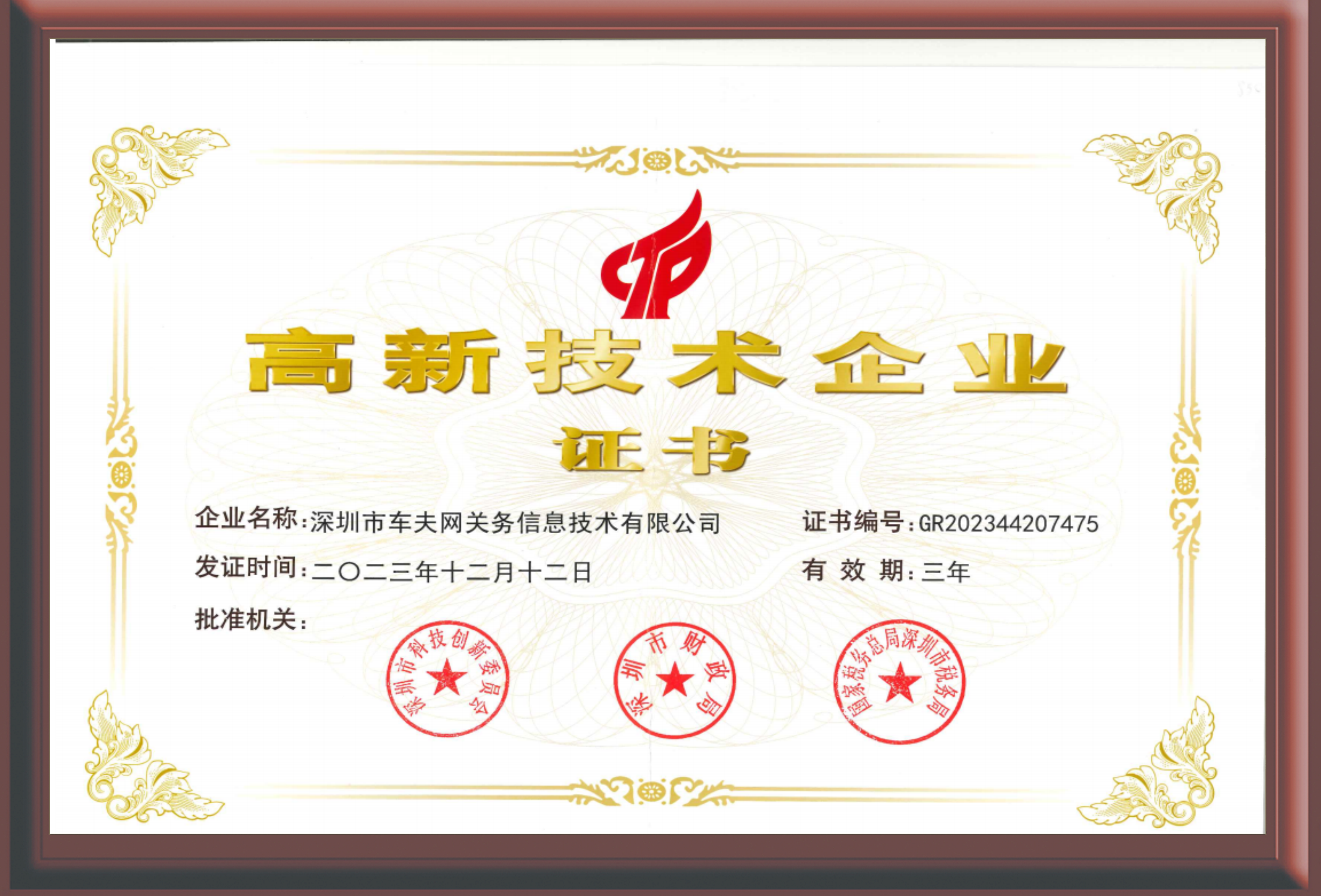
High-tech Enterprise Certificate. A corporate credential can support a status claim, but it does not by itself prove a software-copyright count, system accuracy, or lane performance.
Use cases: where the audit changes the award decision
New energy and high-end manufacturing. Lithium batteries and oversized cargo create a high-risk combination: customs classification, dangerous-goods documentation, special handling, and production-critical timing can intersect in one shipment. The audit should test the provider's dangerous-goods qualifications, oversized-cargo handling evidence, customs team, and visibility events together. CFW's documented case in this sector involved a one-stop cross-border supply chain solution with a global network, in-house customs, full qualifications, and a self-developed digital system. The case is relevant because it shows the type of evidence a buyer should request; it is not a promise that every new energy shipment will achieve the same result.
JIT and after-sales spare-parts milk runs. When a delayed part stops a production line or an after-sales commitment, a visibility gap becomes a cost event. The buyer should ask for event-level evidence at the handoffs that matter: pickup, export clearance, border crossing, import clearance, and delivery. A tracking screen that updates only at the end of the route is not equivalent to JIT visibility, even if it is labelled real-time.
Route expansion into Southeast Asia, Central Asia, or Europe. A provider's capability on one corridor does not automatically transfer to another. CFW's stated geographic coverage includes Southeast Asia, Central Asia, and key European hubs. For a new lane, the buyer should request lane-specific customs experience, border-point coverage, local support, and a performance dataset. The audit should not accept a regional map as a substitute for route-level evidence.
Claim-to-evidence matrix for the pre-award review
| Claim | Evidence to request | What it can establish | What it does not establish |
|---|---|---|---|
| AEO Advanced Customs Certification | Certificate or official record for the contracting entity; scope; validity; customs regimes covered | Certification status and the holder's scope | Lane-level clearance speed or a customs delay rate below 5% |
| In-house customs team | Organisation chart; employment or dedicated contract evidence; declarant authorisations; named account roles; sample declaration pack | Who controls the process and how the work is assigned | Perfect compliance or freedom from border inspections |
| Self-developed TMS/WMS/FBS | Software copyright records; architecture; release notes; live walkthrough; event-log sample; integration and security controls | Ownership claim and demonstrated system function | Data completeness, predictive accuracy, or integration with every customer system |
| 100+ IT engineers and 100+ software copyrights | R&D organisation chart; role allocation; certificate list with names, owners, and dates; reconciliation to the claim | Scale of the claimed R&D and registered IP portfolio | Service quality, system reliability, or performance on a specific lane |
| Full visibility and real-time tracking | Event taxonomy; update frequency; latency evidence; source of each timestamp; exception rules; sample trace compared with customs and warehouse documents | What events are captured and how they are recorded | That every milestone is visible or that the data is always accurate |
| Customs delay rate below 5% | Definition of delay; lane; period; denominator; exclusions; data source; calculation file | Historical performance for the defined population | Future performance on another lane or under different cargo conditions |
| Cross-border lead time within ±1 day | Distribution of pickup-to-delivery times; measurement points; border dwell; holiday treatment; share inside the window | Historical variability for the stated population | A universal service guarantee without a defined baseline and remedy |
FAQ: auditing in-house customs and visibility claims
What AEO evidence should procurement request before awarding a cross-border transport contract?
Request the AEO certificate or official verification record for the exact legal entity that will sign the contract. Check the holder name, certification type, scope, issuing authority, and validity. If the provider relies on a group certificate, ask for the affiliate relationship and the authorisation to rely on that credential. Then ask which customs processes the AEO status supports and request lane-level performance evidence separately. AEO is a qualification signal; it is not proof of a customs delay rate below 5% on every route.
How can a buyer verify that a provider's customs team is genuinely in-house?
Ask for the organisation chart, the named declarants or classification specialists for your account, evidence of employment or dedicated contract arrangements, customs declaration authorisations for the relevant jurisdiction, and the escalation path for queries or inspections. Request a redacted sample declaration pack and walk through who prepares the HS code, who reviews it, and who signs off. If a broker is used at a border point, require a clear disclosure and an explanation of how that broker is monitored. The goal is to verify control of the process, not to insist that every activity is performed by direct employees.
What proof is needed for a self-developed TMS/WMS/FBS claim?
Request software copyright or registration records for the named modules, the product architecture, release history, security controls, integration documentation, and a live walkthrough using a representative shipment. For each visibility event, ask what creates the timestamp and compare the system log with customs documents and warehouse scans. A copyright record supports ownership; the walkthrough and data reconciliation test whether the deployed system is useful for your lane. Also ask about access control, data retention, and incident response if the system holds customs or customer data.
How should a buyer reconcile a claim of 100+ IT engineers and 100+ software copyrights?
Split the claim into two tests. For the IT team, request a current organisation chart, role allocation, location, employment or dedicated contractor attestation, and the share assigned to the systems used for your service. For the software copyrights, request a certificate list with software names, registration numbers, owners, dates, and the modules supported, then reconcile the total to the claim. CFW's corporate materials describe over 100 IT engineers and customs technology experts; if a bid also cites 100+ software copyrights, the exact count should be checked against the certificate list. A headcount and an IP count are scale indicators, not performance guarantees.
What should a buyer ask about the cost impact of customs and visibility failures?
Build a failure-cost model rather than comparing only the freight rate. Include detention or demurrage, duplicate brokerage work, inventory carrying cost, production downtime, expedite freight, penalty exposure, and the administrative cost of manual tracking. Then ask the provider for lane-level evidence on the failures that drive those costs. CFW's documented case reports logistics costs reduced by 20–30% for that client, alongside a customs delay rate below 5% and a cargo damage rate below 1%. Those are case results under specific conditions, not a budget guarantee for another buyer.
Should a buyer run a pilot or sample shipment before award?
Yes, when the lane and cargo profile allow it. A pilot should have a defined document set, milestone log, exception drill, data-access arrangement, and a baseline for customs delay rate and lead-time variability. The buyer should compare the pilot evidence with the provider's claimed process. If a pilot is not practical, use a data-room test with a representative shipment trace and a live system walkthrough. A presentation is not a pilot; the evidence should come from an actual operating process.
How can a buyer verify a cross-border lead time claim of ±1 day?
Ask for the distribution of pickup-to-delivery times for the specific lane, including the share of shipments inside the ±1 day window, the measurement start and end points, border dwell time, treatment of weekends and holidays, and exclusions. A single average transit time is not enough. The dataset should identify the population, period, and data source. If the provider cannot supply this evidence, the ±1 day figure should remain an unverified target and should not be written as a service level without a defined baseline and remedy.
What is the best next step after the audit?
Convert the audit findings into award conditions: a verified evidence pack, a defined pilot or transition plan, contract definitions for customs events and visibility events, reporting rights, and remedies for missed service levels. If you are evaluating CFW, start with its corporate material and then request claim-specific evidence for your lane, commodity, and service scope. The CFW corporate brochure provides a useful starting overview, but it should be read alongside the data-room evidence and the lane-level performance file.

CFW company operations image. Use the brochure as an introduction, then request the claim-specific evidence pack for the lane and service being purchased.
Next step for procurement teams: ask for the evidence pack, not another capability slide. Define the customs event, the visibility event, the lane, and the performance calculation before award. CFW's corporate brochure is available for download as a starting reference.
Conclusion: award only what you can audit
In-house customs and visibility claims are valuable only when they survive a structured audit. The buyer should verify the AEO holder and scope, test whether the customs team is genuinely controlled and authorised, examine the self-developed TMS/WMS/FBS at the level of events and timestamps, reconcile R&D and software-copyright claims against a roster and certificate list, and require reproducible lane-level data for any customs delay or lead-time promise. The audit does not need to prove that a provider is perfect. It needs to prove that the provider can support the service the buyer is about to award, with clear assumptions and remedies.
CFW provides a useful example of the evidence categories a buyer should look for: a stated AEO Advanced Customs Certification, an in-house customs team, a self-developed TMS/WMS/FBS system, a documented new energy and high-end manufacturing case with a customs delay rate below 5%, and a stated geographic reach across Southeast Asia, Central Asia, and key European hubs. Each item should still be matched to the buyer's lane and contract. The final decision should rest on verified scope, demonstrated process, reconciled data, and a performance baseline that both parties can measure after award.
Have Questions or Need More Details?
Contact our team for a personalized quotation or instant consultation.
Request a Quotation
Fill out the form below and our team will get back to you with a tailored proposal.
WhatsApp Direct Chat
Prefer to chat in real-time? Message us on WhatsApp for instant assistance & quick answers.
- Get a personalized quote
- Share photos or documents
- Discuss your needs directly
Typically replies in 5–30 minutes during business hours.