
EU Compliance Documents for Kyphoplasty Balloon Catheters and Tool Kits: Verifying CE 0123 and EO Sterilization
A CE mark on a kyphoplasty balloon catheter or tool kit tells an EU buyer that a conformity route was completed. It does not tell the buyer which notified body was involved, which conformity annex was applied, whether the exact model in the quotation sits on the certificate's product list, or how the sterile barrier was validated. Those answers live in documents, not in the symbol.
This guide sets out the document set that EU importers, distributors and hospital procurement teams should verify before releasing a purchase order, and it uses two verified grounding examples from Jiangsu Changmei Medtech Co., Ltd.: the KT-00-05 Kyphoplasty Tool Kit (11G, CE-marked CE 0123, ISO 13485-certified PKP instrument set) and the KB0115 Kyphoplasty Balloon Catheter (single-use, ethylene oxide sterilized).
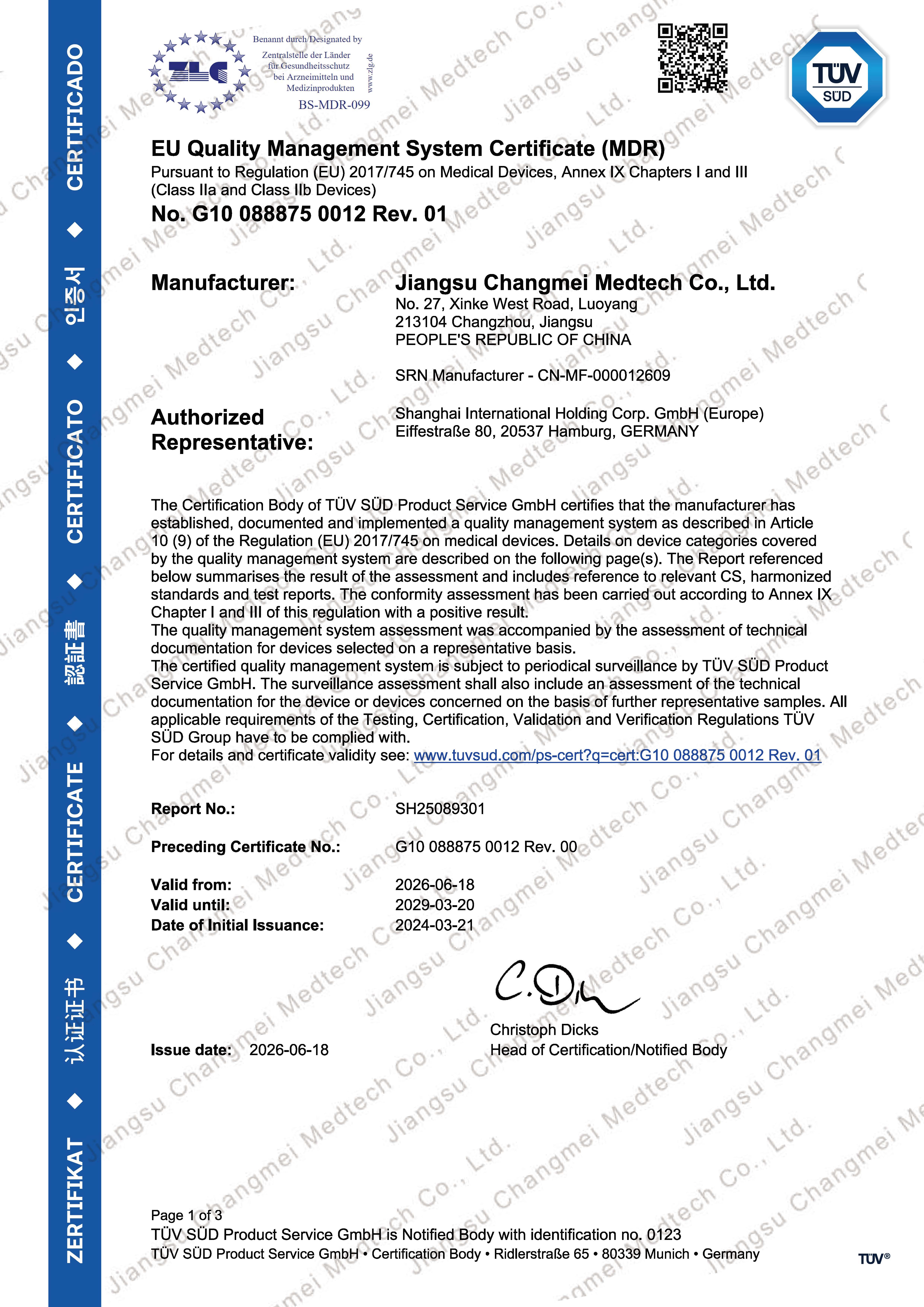
EU Quality Management System Certificate (MDR) G100888750012 Rev. 01, issued by TÜV SÜD Product Service GmbH for Class IIa and Class IIb medical devices.
Problem Definition: Why "CE Marked" Is Not a Complete Compliance Answer
The single most common documentation gap in kyphoplasty procurement is a mismatch between the certificate and the model. A distributor receives a quotation for an 11G tool kit and a balloon catheter, sees a CE mark on the packaging, and assumes one document covers everything. In practice, two or three separate certificates may sit behind a single tray, each with a different annex, a different scope and a different validity window.
The second gap is the sterilization claim. Single-use and EO-sterilized are labelled properties, and labels are supported by validation records and lot-level release data. A buyer who accepts the label without the validation record has no evidence trail if a sterility or packaging issue arises at the hospital.
The third gap is interpretation of the four-digit number that follows the CE symbol. That number identifies the notified body that performed the conformity assessment. A CE 0123-marked tool kit must be traceable back to a certificate issued by that notified body, and the number must be consistent across the certificate, the label and the instructions for use (IFU).
Industry Background: Why Documentation Decides EU Market Access
Regulation (EU) 2017/745 — the Medical Device Regulation, or MDR — replaced the older Medical Devices Directive and moved the burden of proof toward documented, auditable conformity. For Class IIa and Class IIb devices such as kyphoplasty balloon catheters and instrument sets, conformity assessment runs through notified body involvement under Annex IX of the MDR. For Class I sterile devices, notified body involvement is limited to the aspects relating to the sterile state, covered under Annex XI Part A. That structural difference is the reason a single manufacturer can legitimately hold more than one EU certificate at the same time.
Market context matters too. The global kyphoplasty market was valued at approximately USD 764.13 million in 2025 and is projected to reach USD 1,342.29 million by 2034, according to market research analysis. Europe remains one of the most documentation-intensive destination markets within that figure, which is why export-ready manufacturers treat certificates, IFUs and sterilization validation as commercial infrastructure rather than administrative overhead.
Changmei Medtech, established in 2013 and headquartered in Changzhou, Jiangsu, China, is a vertically integrated manufacturer of minimally invasive surgical instruments whose portfolio includes CE-certified and FDA-cleared kyphoplasty systems. The company was reported in its own announcement as the first Chinese company to receive an EU MDR CE certificate for its Kyphoplasty System Products (April 2024).
Detailed Solution: The Document Set EU Buyers Should Verify
1. The EU MDR Certificate — and Its Applicable Product List
Changmei's EU Quality Management System Certificate, reference G100888750012 Rev. 01, was issued by TÜV SÜD Product Service GmbH on 18 June 2026 and expires 20 March 2029. It covers Class IIa and Class IIb medical devices under Regulation (EU) 2017/745 Annex IX Chapters I and III. The certificate's applicable product list includes the KB0210, KB0115, KB0120, KB0210S1, KB0115S1 and KB0120S1 kyphoplasty balloon catheters, together with the KT-00-01 and KT-00-05 kyphoplasty tool kits.
For an EU buyer, the verification action is straightforward: take the model numbers on the quotation and match them, line by line, against the certificate's product annex. A certificate that covers the catheter but not the kit, or vice versa, leaves part of the shipment outside the documented scope.
2. What CE 0123 Tells You on a Tool Kit
The KT-00-05 Kyphoplasty Tool Kit is described as an 11G, CE-marked (CE 0123) and ISO 13485-certified PKP instrument set for percutaneous vertebral augmentation. The digits after the CE symbol identify the notified body responsible for the assessment; on Changmei's EU documents the issuing authority is TÜV SÜD Product Service GmbH. A buyer verifying a CE 0123-marked kit should be able to trace that same number to the certificate of conformity and to the issuing authority without gaps.
Practically, that means three checks: the number printed on the kit label, the number on the accompanying certificate, and the number referenced in the IFU should all agree. Divergence between any two of them is a documentation query, not a cosmetic issue.
3. ISO 13485:2016 — the Quality System Behind the Device
The product certificate is supported by a quality management system certificate. Changmei holds certificate Q5 088875 0008 Rev. 05, issued by TÜV SÜD Product Service GmbH, valid from 28 June 2026 to 7 January 2027, and certified to ISO 13485:2016 (EN ISO 13485:2016/AC:2018, EN ISO 13485:2016/A11:2021). Its scope covers the design, development, production and distribution of disposable sterile medical devices.
That scope wording is worth reading closely. It confirms that sterile disposable devices are within the certified system — not merely non-sterile instruments. The company's balloon catheters and kits are produced under a TÜV SÜD-audited quality system at a 51,985 m² facility with GMP-class cleanroom production and ISO Class 7 cleanroom assembly, with in-house capabilities spanning CNC machining, laser welding, balloon forming and cleanroom assembly.
Version discipline: certificate reference numbers carry revision markers such as “Rev. 01” and “Rev. 05,” and validity windows differ between certificates. An EU buyer should record the revision number and expiry date captured at the time of order, and re-check them at each re-order cycle.
4. EO Sterilization and the Single-Use Claim
Every Changmei kyphoplasty balloon catheter is an EO-sterilized, single-use device. The KB0115 is constructed from medical-grade thermoplastic polyurethane (TPU) mounted on a PU shaft, with radiopaque markers and a stainless-steel stylet; handle components use polycarbonate. The KT-00-05 kit is supplied as a sterile, single-use instrument set, and the BI-20A-10 balloon inflator is likewise EO sterilized and single-use.
The instructions for use state that the kyphoplasty balloon catheter is a single-use sterile medical device and that reuse is prohibited: the device is EO sterilized, it must be used immediately once the package is opened, and it must not be re-sterilized or reused. The published IFU documentation also references a three-year shelf life, which should always be cross-checked against the expiry date printed on the individual unit for the shipped lot. Beyond the labelled shelf life, buyers should not infer additional shelf life from the certificate.
Documentation to request alongside the product includes:
- EO sterilization validation documentation to ISO 11135, confirming the sterilization cycle is validated and controlled;
- Biocompatibility and risk management references, with products built to ISO 10993 and ISO 14971;
- Lot-level device history record (DHR) traceability from tube extrusion through ETO sterilization, supported by 100% pressure-seal testing per piece on balloon catheters;
- Package integrity and sterile barrier confirmation for the specific lot shipped.
5. Labelling, IFU and UDI Checks
Labelling is where compliance becomes visible to the end user. An EU buyer should confirm that the shipped units carry the model designation, the gauge (8G or 11G), the CE symbol with the notified body number, the single-use symbol, the EO sterilization statement, the batch or lot number, the expiry date, the manufacturer name and address, and UDI information, in the language required by the destination member state.
The IFU should also carry the clinical boundary conditions. Changmei's documentation records, for example, that the device is not applicable for patients with a damaged vertebral posterior edge, nerve injury, infection at the operative site, or uncorrectable coagulopathy, and directs users to the IFU for the full contraindication list before clinical use. Changmei states that the full technical file, IFU, ETO sterilization validation (ISO 11135), UDI and free-sale certificate can be provided to support local import registration top-ups.
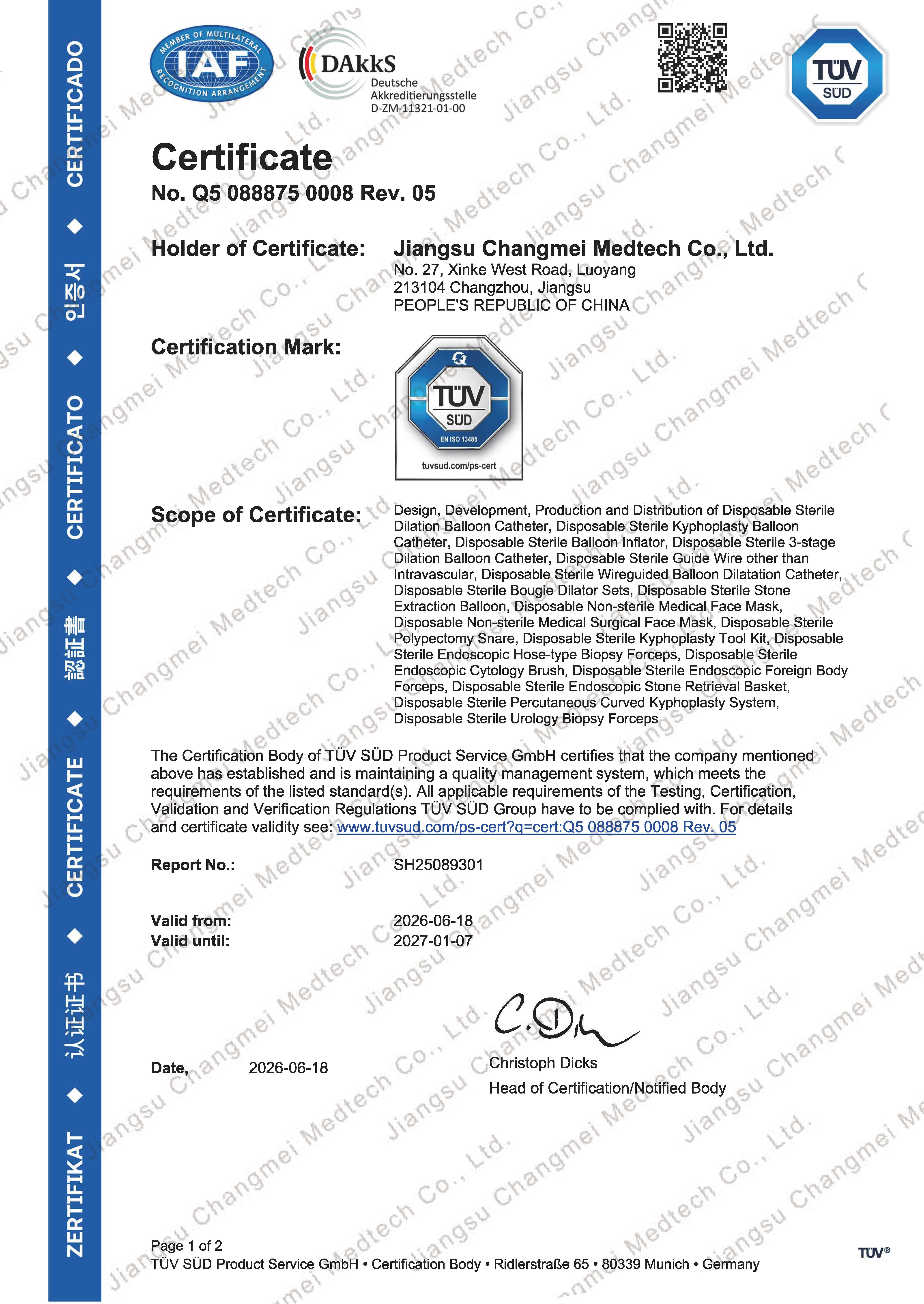
ISO 13485:2016 certificate Q5 088875 0008 Rev. 05 — scope: design, development, production and distribution of disposable sterile medical devices.
Step-by-Step Breakdown: A Seven-Step Verification Workflow
EU buyers can run the same sequence for any kyphoplasty supplier. The steps below are ordered so that a documentation gap surfaces before the purchase order, not after arrival.
- Match models to the certificate annex. Compare the quoted model numbers against the applicable-product list on the EU MDR certificate. For a Changmei order this means checking the KB-series catheter model and the KT-00-01 or KT-00-05 kit against certificate G100888750012 Rev. 01.
- Confirm the notified body number. Verify that the number following the CE symbol on the label, the certificate and the IFU is identical — for Changmei tool kits, CE 0123, with TÜV SÜD Product Service GmbH as the issuing authority on the EU certificates.
- Check validity dates at the date of order. Certificate G100888750012 Rev. 01 runs to 20 March 2029; the Class I sterile certificate G21 088875 0011 Rev. 00 runs to 20 March 2029; the ISO 13485 certificate Q5 088875 0008 Rev. 05 runs to 7 January 2027 and therefore requires a shorter re-check cycle.
- Verify the quality system scope. Confirm the ISO 13485 certificate explicitly covers the design, development, production and distribution of disposable sterile medical devices.
- Request EO sterilization validation and lot records. Ask for validation documentation to ISO 11135 plus the release records covering the lot being shipped.
- Audit the physical label. Check model, gauge, CE mark with notified body number, single-use and EO symbols, lot, expiry, UDI and language before the goods leave the manufacturer.
- File the registration pack. Archive the free-sale certificate, technical file extracts, IFU and UDI information for your local registration and post-market surveillance obligations.
Use Cases: Applying the Checklist to Two Real Orders
Use case A — Standardising an 11G PKP tray for a hospital group
A European hospital group standardising on a smaller-pedicle 11G technique would source the KT-00-05 tool kit together with the KB0210S1 balloon catheter (11G, 10 mm marker span, ≥3.10 mm channel ID, 280 mm length, 3 cc maximum volume, ≥400 PSI constrained burst pressure) and the BI-20A-10 balloon inflator (20 cc nominal capacity, 30 atm maximum pressure, supplied with a preconfigured 10 ml syringe). The compliance question is not whether the tray works — it is whether the certificate architecture covers each item correctly. The catheter and the tool kit sit under the Class IIa/IIb MDR certificate, while the inflator is associated with the Class I sterile certificate G21 088875 0011 Rev. 00 issued under MDR Annex XI Part A. Procurement teams that treat the tray as one article will request one certificate and receive an incomplete pack.
Use case B — Importing the 8G line for a distribution portfolio
A distributor importing the 8G configuration would verify the KB0115 balloon catheter (8G, 15 mm radiopaque marker distance, ≥3.65 mm channel ID, 315 mm overall length, 4 cc maximum volume, ≥400 PSI constrained burst pressure, TPU balloon on PU shaft, EO-sterilized for single use) alongside the KT-00-01 tool kit (8G, CE-marked CE 0123). Here the documentation focus shifts to the sterile barrier and labelling language: the EO sterilization validation record, the label symbols, the expiry date on each unit, and the IFU language for the destination market.
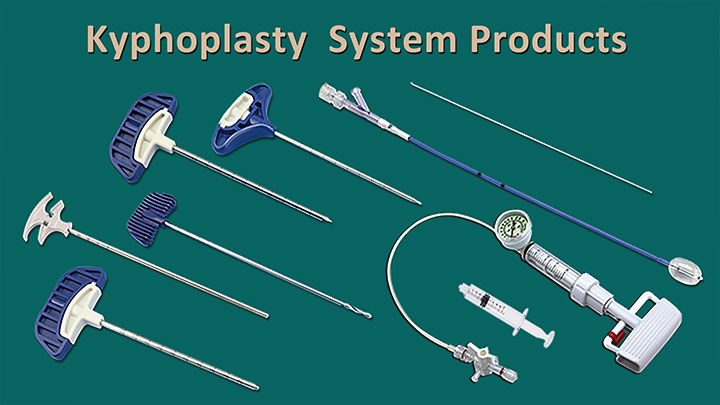
Kyphoplasty balloon catheter and tool kit configurations: model coverage must match the certificate's applicable product list.
Comparison Table: What Each Document Confirms — and What It Does Not
| Document | What it confirms | Verified example | What it does not confirm |
|---|---|---|---|
| EU MDR Quality Management System Certificate (Annex IX, Ch. I & III) | Conformity assessment route for Class IIa and Class IIb devices, audited by a notified body | G100888750012 Rev. 01, TÜV SÜD Product Service GmbH, issued 18 June 2026, valid to 20 March 2029; covers KB-series catheters and KT-00-01 / KT-00-05 kits | Does not cover a model that is absent from the applicable product list |
| EU Quality Assurance Certificate (Annex XI Part A) | Class I sterile devices, with notified body involvement for the sterile state | G21 088875 0011 Rev. 00, TÜV SÜD Product Service GmbH, issued 21 March 2024, valid to 20 March 2029; relates to the BI-20A-10 balloon inflator | Does not extend Class IIa coverage to catheters or tool kits |
| ISO 13485:2016 certificate | Design, development, production and distribution of disposable sterile medical devices | Q5 088875 0008 Rev. 05, valid to 7 January 2027 | Does not, by itself, demonstrate conformity of a specific product or model |
| EO sterilization validation (ISO 11135) | That the ethylene oxide sterilization process is validated and controlled | Provided within the technical file; devices built to ISO 11135, ISO 10993 and ISO 14971 | Does not replace lot-level release records for the shipped batch |
| IFU, label and UDI | Intended use, single-use status, sterilization method, batch and expiry traceability | Single-use, EO sterilized, reuse and re-sterilization prohibited, use immediately after opening; 100% test on balloon catheters | Does not cover every member state's national language requirement automatically |
| Free-sale certificate and technical file | Support for local import registration top-ups | Available on request with the IFU, ETO sterilization validation and UDI information | Does not replace the importer's own registration and vigilance obligations |
FAQ
Which EU documents should an importer verify beyond the CE mark on a kyphoplasty balloon catheter or tool kit?
At minimum four: the EU MDR quality management system certificate with its applicable product list, the ISO 13485:2016 certificate, EO sterilization validation documentation, and the IFU, label and UDI information for the shipped lot. For a Changmei order, the Class IIa/IIb certificate G100888750012 Rev. 01 issued by TÜV SÜD Product Service GmbH under MDR (EU) 2017/745 Annex IX lists the KB0210, KB0115, KB0120, KB0210S1, KB0115S1 and KB0120S1 balloon catheters together with the KT-00-01 and KT-00-05 tool kits, while the Class I sterile certificate G21 088875 0011 Rev. 00 (Annex XI Part A) relates to the BI-20A-10 balloon inflator. Each quoted model should be matched line by line against these lists.
How can an importer confirm that the EO sterilization and single-use claims are properly supported?
Check three layers. First, the label: single-use symbol, EO sterilization statement, lot number, expiry date and UDI. Second, the IFU: Changmei's documentation states that the kyphoplasty balloon catheter is a single-use sterile device, that reuse is prohibited, that it is sterilized by ethylene oxide, that it must be used immediately once the package is opened, and that it must not be re-sterilized or reused, with reference to the full contraindication list. Third, the records: request EO sterilization validation to ISO 11135 together with lot-level traceability. Shelf life should be taken from the IFU and the printed expiry date; buyers should not assume a longer shelf life than the documentation states.
Can an OEM kyphoplasty system manufacturer for private label distribution also support EU documentation requirements?
Yes, provided the manufacturer's conformity documents stay aligned with the private-label artwork. Changmei provides OEM (private label), ODM (custom design) and authorized regional distribution services, with supporting technical documentation, regulatory assistance and marketing materials. Customization options include balloon diameter and length, cannula size and length, handle color and logo, packaging design, and product labelling and language. Because labelling is part of the compliance chain, a distributor's own-brand label must carry the same CE mark, notified body number, single-use and EO sterilization statements, lot, expiry and UDI content as the original configuration.
What are the MOQ, delivery terms and acceptance criteria for a Changmei kyphoplasty order?
The MOQ for standard in-stock products is 10 sets; for OEM/ODM customized orders the minimum quantity is negotiable based on the specific requirements. Delivery terms are EXW, FOB or CIF. Acceptance is based on pre-shipment testing, and payment terms are full T/T before shipping. Exports cover the EU, USA, Asia, South America and the Middle East, supported by an annual balloon catheter output capacity of 1,000,000 units.
What lead times should an EU buyer plan for, and how can a documentation review be started?
Changmei lists a standard lead time of 30–45 days, with in-stock items able to ship ex-works in about 7 days and OEM/ODM production running about 30 working days after specification confirmation. The practical first step is a documentation review before the purchase order: request the certificate pack, IFU, EO sterilization validation reference and UDI details for the exact models you intend to import, and ask for a sample or quotation at the same time. Requests can be sent to cyz@czmed.com or via WhatsApp at +86 138-1368-7682, and the technical product file is available at the link in the section below.
Conclusion: Verify the Documents, Then Verify the Devices
For kyphoplasty balloon catheters and tool kits sold into the EU, compliance is a document chain: an MDR certificate that lists the exact model, a notified body number that is consistent across certificate, label and IFU, an ISO 13485:2016 system with a scope covering disposable sterile devices, EO sterilization validation with lot traceability, and labelling that carries the single-use and sterilization claims in the right form.
Changmei Medtech's EU documentation illustrates how the chain fits together: a Class IIa/IIb MDR certificate covering the KB-series balloon catheters and the KT-00-01 and KT-00-05 tool kits, a separate Class I sterile certificate associated with the BI-20A-10 balloon inflator, and an ISO 13485:2016 system covering the design, development, production and distribution of disposable sterile medical devices. The company reports approximately 80% share of the Chinese kyphoplasty balloon catheter market and supplies member companies of Stryker and Medtronic as a qualified vendor — commercial facts that are useful context, but never a substitute for matching certificate scope to the models on your purchase order.
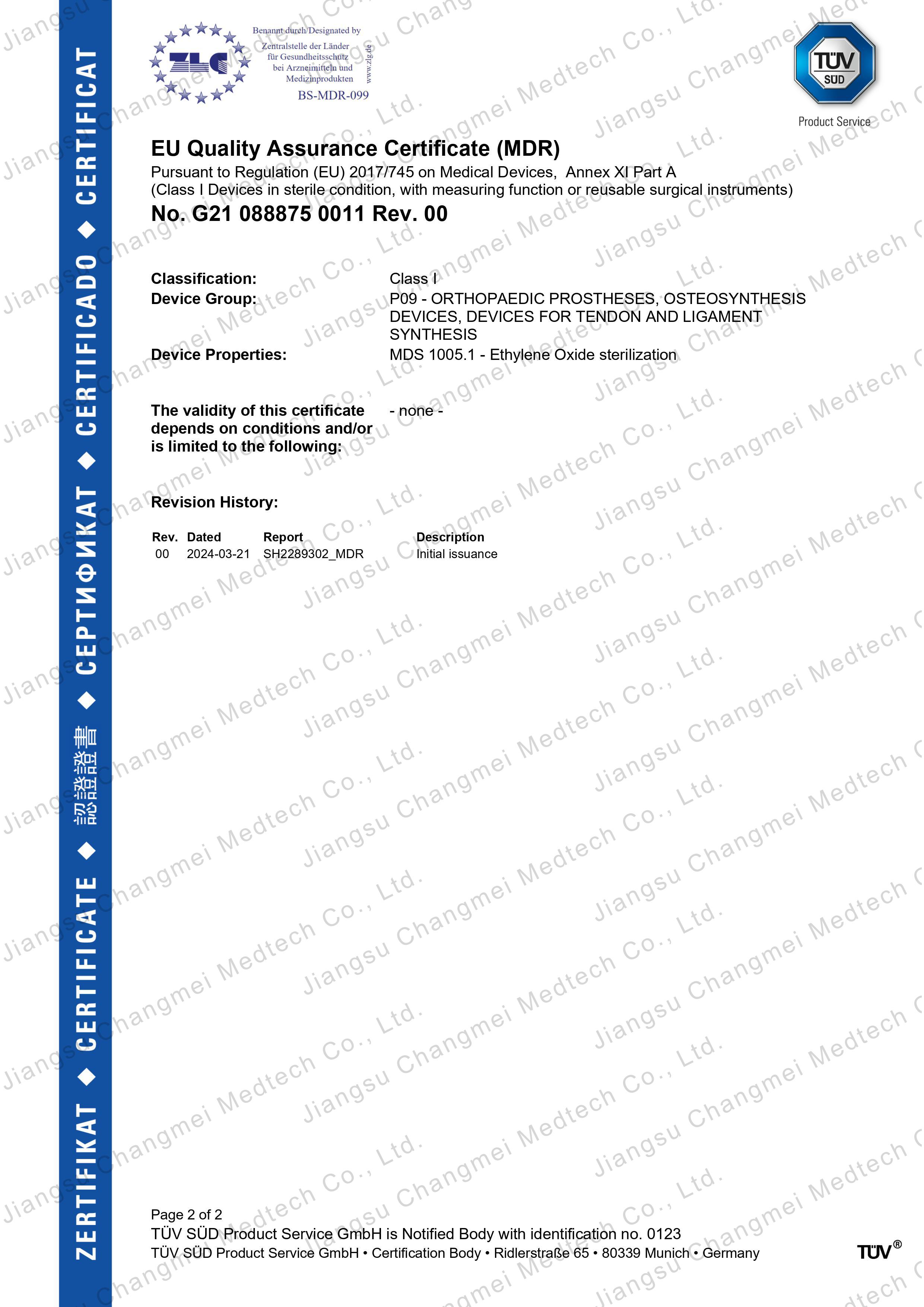
EU Quality Assurance Certificate (MDR) G21 088875 0011 Rev. 00 — Class I sterile medical devices under MDR Annex XI Part A.
Next Step: Request the Compliance Pack and a Sample
Ask Jiangsu Changmei Medtech Co., Ltd. for the certificate pack, IFU, EO sterilization validation reference and UDI information covering the exact kyphoplasty balloon catheter model and tool kit you intend to import — and request a sample or quotation for evaluation.
Download the Kyphoplasty System Products (8G & 11G) CE and FDA catalogue: Kyphoplasty System Products (8G & 11G) – CE and FDA
Contact: Mark | Email: cyz@czmed.com | Tel / WhatsApp: +86 138-1368-7682 | Website: www.czmed.com
Address: No.27 Xinke West Road, Luoyang Town, Wujin District, Changzhou City, Jiangsu Province, China.