
KB0115 vs. KB0210S1: Choosing a Kyphoplasty Balloon Catheter Configuration

KB0115 and KB0210S1 are two configurations of the CHANGMEI kyphoplasty balloon catheter, and they share the same documented envelope: both are 11G catheters with a 280 mm overall length and a channel inner diameter of at least 3.10 mm. The separation is in geometry and rated volume. KB0115 is documented with a 20 mm distance between its two radiopaque markers. KB0210S1 is documented with a 10 mm marker distance, a maximum inflation volume of 3 cc, and a constrained burst pressure of at least 400 PSI.
That makes the choice a configuration decision rather than a brand decision. You are deciding how much of the vertebral body the balloon segment brackets on the fluoroscopy image, how much contrast the balloon is rated to hold, and which parameters still need to be confirmed in writing before either code enters a tender. Both catheters are made by Jiangsu Changmei Medtech Co., Ltd. (CHANGMEI), a Jiangsu, China-based medical device manufacturer established in 2013 whose kyphoplasty system holds EU MDR CE, US FDA 510(k) clearance (K223709, 2023) and NMPA Class II/III certification.
What the KB0115-versus-KB0210S1 choice really decides
Size, overall length and channel diameter cannot settle this comparison, because the documented values are identical: 11G, 280 mm and ≥3.10 mm on both models. A specification table built only from those three lines makes the two catheters look interchangeable. Three other parameters do the actual work.
- Marker span. The documented distance between the two radiopaque markers is 20 mm on KB0115 and 10 mm on KB0210S1. The marker pair is the fluoroscopic reference for the balloon segment, and at equal image magnification the KB0115 pair brackets twice the on-screen length of the KB0210S1 pair.
- Rated inflation volume. KB0210S1 is documented at a maximum inflation volume of 3 cc. The KB0115 specification units referenced in this guide state size, length, channel diameter and marker span, but not a maximum inflation volume — a gap that matters if your evaluation scores volume.
- Construction and documented settings. CHANGMEI documents a four-wing pleating process for the KB0210S1 balloon film and lists orthopedic surgery, spine surgery, pain management and interventional pain clinics as its intended settings. The KB0115 units referenced here do not carry a separate setting list.
Everything else is procurement discipline rather than clinical geometry: whether the certificate set matches your market, how single-use and ethylene oxide (EO) sterilization handling fits your stores, and whether the catheter is quoted inside a complete kyphoplasty instrument set.
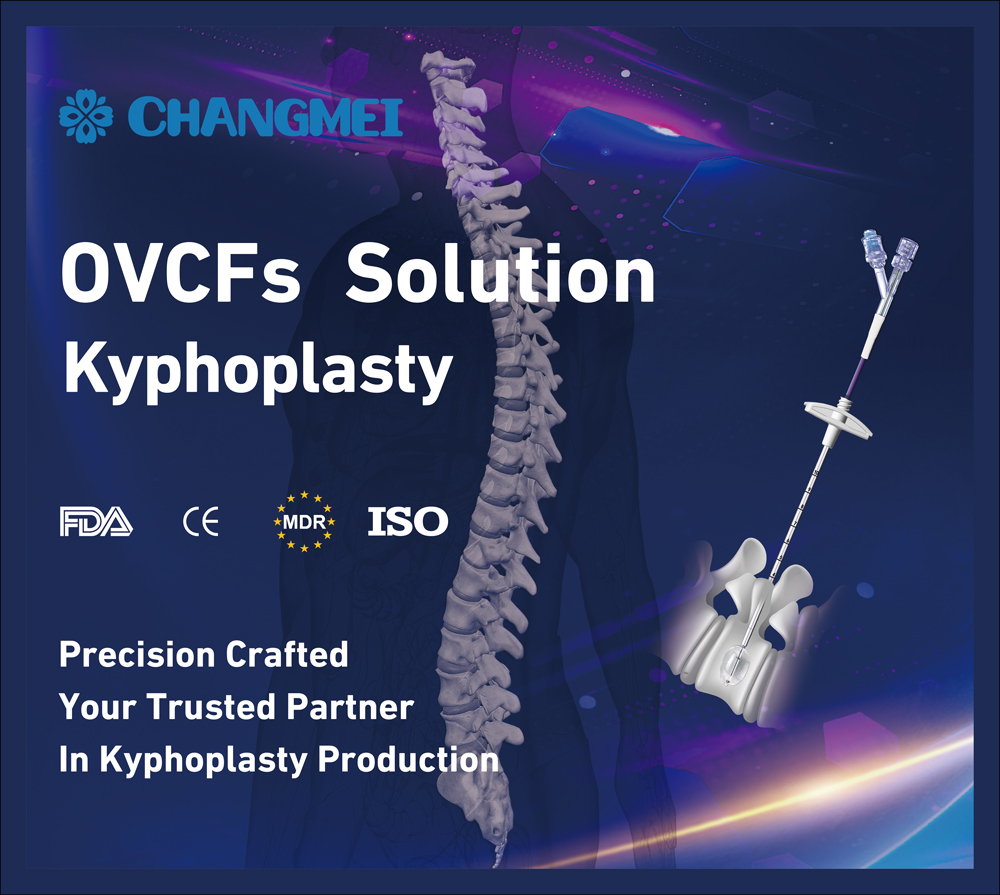
How a percutaneous kyphoplasty system uses the balloon
A percutaneous kyphoplasty system (PKP system) treats painful vertebral compression fractures in two stages, and both stages explain why a balloon catheter is specified by geometry rather than by brand alone.
Stage one is cavity creation. Under biplane fluoroscopy, a working cannula is placed transpedicularly or parapedicularly into the anterior two-thirds of the fractured vertebral body, and an inflatable bone tamp is introduced through it and filled with iodinated contrast to a predetermined pressure — typically 50–300 psi depending on vertebral body resistance in CHANGMEI's procedural description. The expanding balloon displaces cancellous bone outward toward the cortex, creating a contained cavity, and endplate elevation produces partial height restoration and reduction of the local kyphotic angle.
Stage two is cement augmentation. The balloon is deflated and removed, and the pre-formed cavity is filled with low-viscosity polymethylmethacrylate (PMMA) bone cement at low injection pressure. Because the cavity is contained, cement flows into the trabecular bed as an internal cast rather than tracking through raw cancellous bone.
Documented indications cover painful vertebral compression fractures from osteoporosis, low-energy trauma and neoplasia including spinal metastases and multiple myeloma, plus symptomatic vertebral hemangiomas and osteolytic lesions requiring percutaneous vertebral augmentation. Typical settings are orthopedic spine surgery, interventional radiology, pain management centres and ambulatory surgery centres.
Two consequences follow for this comparison. First, the pressure used in a case sits far below a balloon's constrained burst rating: the ≥400 PSI figure documented for KB0210S1 is a ceiling statement, not an operating target. Second, the only fluoroscopic reference for where the balloon segment sits is the pair of radiopaque markers — which is why a 10 mm or 20 mm marker distance is a planning variable rather than a cosmetic detail.
Industry context: why catheter configuration is a purchasing variable
Kyphoplasty is a mature procedure with a growing device market around it. One market analysis published in August 2026 put the global kyphoplasty market at USD 764.13 million in 2025, projecting USD 1,342.29 million by 2034 (Vertex AI Search / Market Research Analysis). Published 2025 estimates for the same category range from roughly USD 744 million to roughly USD 1.2 billion depending on whether the figure covers kyphoplasty devices alone or the wider procedure market, so a single headline number should be read as scope-dependent.
Regional concentration is clearer than the headline size. North America held a 42.5% to 50.0% revenue share of the global kyphoplasty market in 2025, per Grand View Research and Straits Research data. That concentration is one reason documentation scope — CE-MDR marking for Europe, FDA 510(k) clearance for the United States — appears in tender criteria alongside the device specification itself.
Reimbursement sets the site-of-service arithmetic in the United States. The 2025 Medicare ambulatory surgery centre final rate for kyphoplasty (CPT 22513 and 22514) was approximately USD 3,510.84, a 3.5% increase over 2024, according to the ASIPP/CMS rate table published in November 2024. That is a facility payment rate rather than a device price, and it is reset annually, but it explains why ASC-based practices watch configuration depth as closely as unit cost.
For a department standardising catalogue codes, the practical point is that case-mix coverage outweighs a single low invoice line. A configuration that forces a second imaging check, or a second catheter on the shelf for a minority of segments, carries a cost that never appears on the purchase order.
KB0115 and KB0210S1, as documented
KB0115
- Catheter size/type: 11G.
- Overall length: 280 mm.
- Channel inner diameter: ≥3.10 mm.
- Distance between the two radiopaque markers: 20 mm.
- Balloon material: CHANGMEI's kyphoplasty balloon catheters are documented as made of medical-grade thermoplastic polyurethane (TPU).
- Rated volume and pressure: not stated in the specification units referenced here.
KB0210S1
- Catheter size/type: 11G.
- Overall length: 280 mm.
- Channel inner diameter: ≥3.10 mm.
- Marker distance: 10 mm.
- Maximum inflation volume: 3 cc.
- Constrained burst pressure: ≥400 PSI.
- Balloon film: medical-grade TPU with a four-wing pleating process.
- Regulatory: single-use, CE-MDR marked and ISO 13485 certified; US market authorization under FDA 510(k) K223709, Product Code HRX, Class II, 21 CFR 888.1100, cleared August 16, 2023.
- Intended settings: orthopedic surgery, spine surgery, pain management and interventional pain clinics.
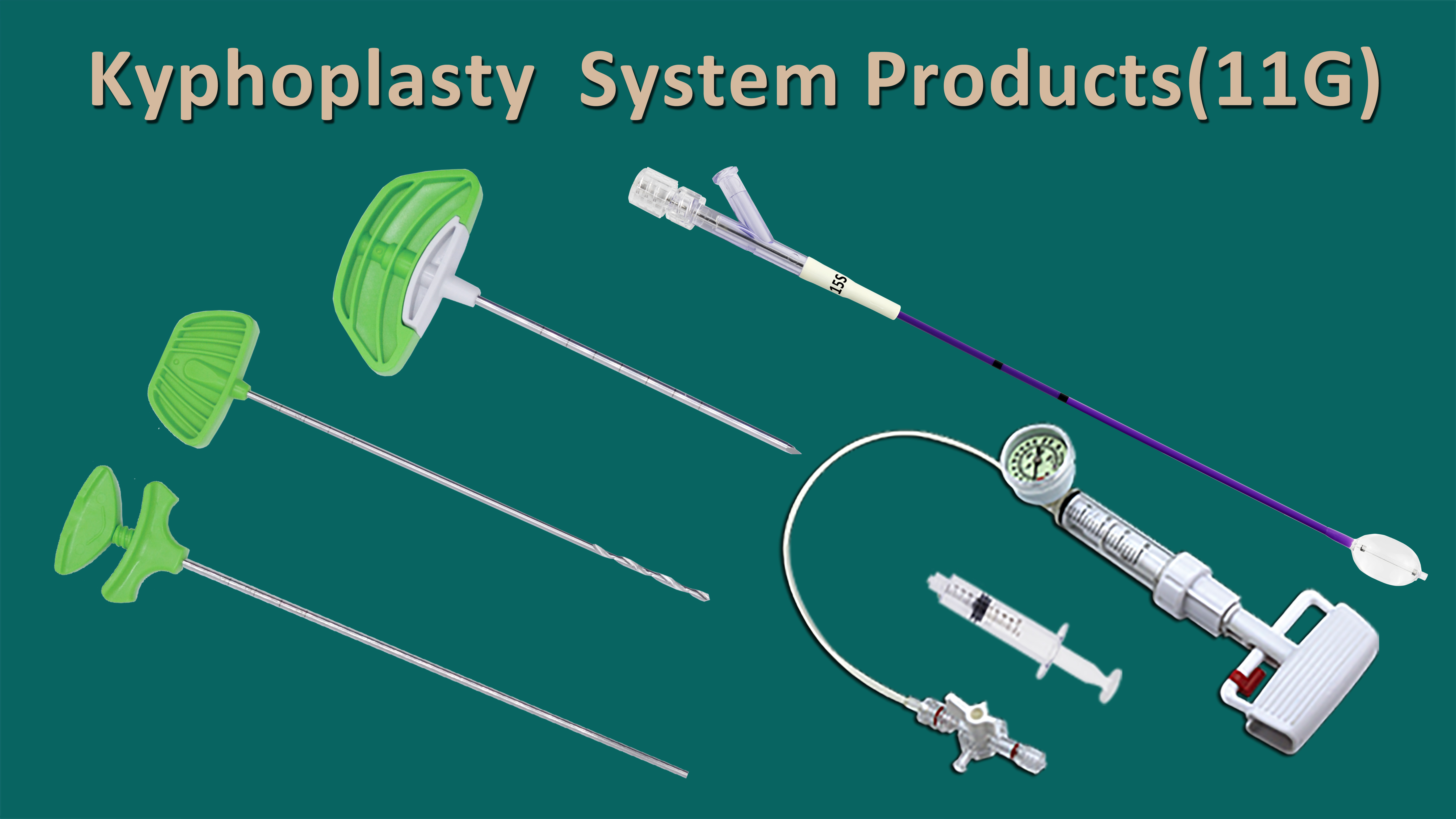
- System pairing: engineered to work with the CHANGMEI KT-00-05 11G tool kit and BI-20A-10 balloon inflator (20 cc, 30 atm) as one interoperable vertebral augmentation system.
Where the two models are the same
Both are 11G, both measure 280 mm overall, both have a channel inner diameter of at least 3.10 mm, and both sit in the same TPU balloon-catheter family. On a sheet built only from those four lines the models are indistinguishable. The comparison becomes a decision only when marker span, rated volume and documented settings are added.
Reading the differences: a six-step selection sequence
Step 1 — Fix the target segment and the marker span it needs
Start from the imaging, not the catalogue. The marker pair is what you track while the balloon expands, so the first question is whether the case calls for the longer 20 mm bracket (KB0115) or the compact 10 mm bracket (KB0210S1). At the same magnification the 20 mm pair spans twice the image length of the 10 mm pair, which changes how much of the vertebral body you can follow as inflation proceeds. Decide this by case type rather than by individual preference, so the rule survives staff changes.
Step 2 — Confirm the channel dimension is not your constraint
Both models document a channel inner diameter of at least 3.10 mm, so channel size does not separate them. If your worklist includes instruments that must pass through the catheter, verify against that 3.10 mm figure once and treat it as a shared platform limit rather than a differentiator between the two codes.
Step 3 — Compare rated volume, and request the figure you were not given
KB0210S1 is documented at a maximum inflation volume of 3 cc. The KB0115 specification units used here do not state a volume. If your evaluation scores inflation volume, request the KB0115 figure in writing rather than assuming parity or difference: a balloon's rated volume and pressure ceiling are the two numbers that bound how much contrast you can deliver and how much margin sits above the pressure you actually use.
Step 4 — Read the pressure ceiling against the inflator, not against your working pressure
The BI-20A-10 balloon inflator is documented at 20 cc and 30 atm. One atmosphere is 14.696 PSI, so 30 atm converts to approximately 441 PSI — above the ≥400 PSI constrained burst pressure documented for KB0210S1. The lower of the two documented limits is therefore the catheter's own rating, and the inflator does not sit below it. This still does not make 400 PSI a working pressure: CHANGMEI's procedural description gives typical inflation at 50–300 psi depending on vertebral body resistance, so the burst figure is a margin statement for planning and training, not a target dial setting.
Step 5 — Confirm kit and inflator pairing before any trial
KB0210S1 is documented as pairing with the KT-00-05 11G tool kit and the BI-20A-10 inflator as one system. The tool kit is specified with 06Cr19Ni10 medical-grade stainless steel for most metal parts, a bone drill cutting tip in 32Cr13Mo stainless steel, and joint connection strength rated at not less than 100 N. The KB0115 units referenced here do not state a paired kit or inflator, so confirm compatibility in writing if you intend to standardise one kit across both codes.
Step 6 — Verify market documentation and single-use handling
Match the certificate set to the market you sell into. KB0210S1 is documented as CE-MDR marked, ISO 13485 certified and FDA 510(k) cleared under K223709. At system level, CHANGMEI's kyphoplasty system holds EU MDR CE, US FDA 510(k) K223709 (2023) and NMPA Class II/III certification — the distinction that separates it from low-price OEM manufacturers that typically hold only domestic licences. Kyphoplasty balloon catheters are single-use sterile devices, EO sterilized, with a three-year shelf life; they must not be re-sterilized or reused, and the IFU governs handling.
Comparison table
| Documented parameter | KB0115 | KB0210S1 |
|---|---|---|
| Catheter size / type | 11G | 11G |
| Overall length | 280 mm | 280 mm |
| Channel inner diameter | ≥3.10 mm | ≥3.10 mm |
| Distance between two radiopaque markers | 20 mm | 10 mm |
| Maximum inflation volume | Not stated in the units referenced here | 3 cc |
| Constrained burst pressure | Not stated in the units referenced here | ≥400 PSI |
| Balloon film | Medical-grade TPU (catheter family) | Medical-grade TPU; four-wing pleating |
| Intended settings | Not separately listed in the units referenced here | Orthopedic surgery, spine surgery, pain management, interventional pain clinics |
| Kit / inflator pairing | Not stated in the units referenced here | KT-00-05 11G tool kit; BI-20A-10 inflator (20 cc, 30 atm) |
| Use, sterilization, shelf life | Single-use, EO sterilized, 3-year shelf life (catheter family) | Single-use, EO sterilized, 3-year shelf life; CE-MDR marked, ISO 13485 |
| US market authorization | System-level: FDA 510(k) K223709 (2023) | FDA 510(k) K223709, cleared August 16, 2023 |
“Not stated” means the parameter is absent from the specification units used for this comparison; it does not mean the model lacks that capability. Confirm the figure with the manufacturer before the code is specified.
Decision criteria by case type
Orthopedic surgery settings
CHANGMEI documents KB0210S1 for orthopedic surgery. For an orthopedic service standardising one 11G code across a routine vertebral augmentation list, that documented setting is the cleanest starting point: a 10 mm marker span, a 3 cc rated volume, a ≥400 PSI constrained burst pressure, a four-wing pleated TPU film, and a defined tool kit and inflator pairing. KB0115 is the alternative when the imaging plan calls for the longer 20 mm fluoroscopic bracket on the same 280 mm, 11G, ≥3.10 mm envelope — with the caveat that its volume and pressure figures are not in the units referenced here and must be obtained before the specification is signed.
Spine surgery settings
A spine programme usually runs a mixed caseload, and that is where the two configurations stop being substitutes. The decision rule is to let the imaged target segment pick the code. If most cases call for a compact 10 mm marker-delimited segment and a 3 cc rated volume, KB0210S1 becomes the default and KB0115 the exception stock. If the caseload splits closer to even, carry both and put marker span on the pre-operative pick list, so the choice is made during planning rather than in the room.
Pain management and interventional pain clinic settings
CHANGMEI documents KB0210S1 for pain management and interventional pain clinics. In a clinic running lower volumes, a single compact configuration keeps catalogue depth and stock rotation simple: single-use, EO sterilized, three-year shelf life. For US clinics working in an ambulatory surgery centre, the 2025 Medicare ASC rate for CPT 22513/22514 of approximately USD 3,510.84, per the ASIPP/CMS table published in November 2024, is the relevant facility benchmark — reset annually, and only one line of the site-of-service calculation.
Procedure-level contraindications apply to both configurations and do not vary with marker span: damaged posterior vertebral edge or burst fractures with posterior cortical disruption, retropulsed bone fragments in the spinal canal, nerve injury, active systemic or local infection, uncorrectable coagulopathy, and allergy to device components. Severe spinal stenosis and vertebral collapse above roughly 75–80% of original height are treated as relative contraindications. The IFU remains the controlling document.
What this comparison does not establish
- No head-to-head bench test or clinical outcome study between KB0115 and KB0210S1 is cited in this evidence set. The comparison is of documented characteristics and what they imply for case planning.
- Nothing here supports a claim that one marker span restores more vertebral height, reduces cement leakage or shortens time to pain relief. Those are outcome questions that require comparative data this guide does not have.
- A missing parameter is not a missing capability. Where a comparison cell says “not stated”, the correct action is a written request to the manufacturer, not an assumption in either direction.
- CHANGMEI positions its kyphoplasty system as delivering comparable clinical performance to premium international brands at a lower price point. This evidence set contains no head-to-head clinical or bench comparison supporting that statement, so treat it as a supplier claim and test it against your own acceptance criteria.
Frequently asked questions
Are KB0115 and KB0210S1 cleared for the EU and US markets?
KB0210S1 is documented as a single-use, CE-MDR marked and ISO 13485 certified inflatable bone tamp, with US market authorization under FDA 510(k) K223709, Product Code HRX, Class II, 21 CFR 888.1100, cleared on August 16, 2023. CHANGMEI's kyphoplasty system as a whole is documented as holding EU MDR CE, US FDA 510(k) K223709 (2023) and NMPA Class II/III certification. The KB0115 units referenced in this guide state size, length, channel diameter and marker span; if your tender requires model-level certificate matching, request the model-specific declaration in writing.
What changes between a 20 mm and a 10 mm radiopaque marker span?
The marker pair is the fluoroscopic reference for the balloon segment. At equal magnification the 20 mm pair on KB0115 brackets twice the image length of the 10 mm pair on KB0210S1, so the longer span lets you follow a longer delineated segment as the balloon inflates. It changes what you can confirm on the image; it does not change the balloon's rated volume.
What cost factors should a buyer compare beyond the unit price?
Four documented factors carry commercial weight. First, regulatory scope: CE-marked and FDA-cleared devices versus the domestic-only licences typical of low-price OEM manufacturers. Second, single-use handling: EO sterilization and a three-year shelf life set the expiry window for stock. Third, platform interoperability: KB0210S1 is documented as pairing with the KT-00-05 11G kit and BI-20A-10 inflator as one system, while the KB0115 units referenced here do not state a paired kit. Fourth, documentation completeness — a code whose volume and pressure figures you cannot obtain in writing costs evaluation time on every tender.
How can a team evaluate both configurations before committing?
Request the current catalogue and the model-level specification sheets for both codes, then confirm in writing the two parameters missing from the KB0115 units used here — maximum inflation volume and constrained burst pressure. CHANGMEI publishes a kyphoplasty system product catalogue covering the 8G and 11G range with CE and FDA documentation; evaluation requests can be addressed to the contact below.
What documented factors affect supply planning?
CHANGMEI reports supplying roughly 80% of China's PKP balloon catheter market with an annual capacity of 1,000,000 balloons, and states that it is audited as a supplier to member companies of Medtronic and Stryker. Company data also records a 30% export ratio across the EU, USA, Asia, South America and Middle East. Because the catheters are EO-sterilized single-use devices with a three-year shelf life, inventory should be planned against that window. Delivery schedules are commercial terms and should be confirmed in writing for each order — no lead time is stated in this guide.
Conclusion
The KB0115-versus-KB0210S1 decision reduces to three checks. Geometry first: 20 mm of marker span on KB0115 against 10 mm on KB0210S1, on the same 280 mm overall length, 11G size and ≥3.10 mm channel. Rated performance second: a 3 cc maximum inflation volume and a ≥400 PSI constrained burst pressure are documented for KB0210S1, while the KB0115 units referenced here state neither figure, so both must be obtained before a specification is written. Documentation third: CE-MDR marking, ISO 13485 certification and FDA 510(k) K223709 apply, with model-level confirmations to request wherever a tender requires them.
For orthopedic surgery and pain management settings, KB0210S1 is the configuration CHANGMEI documents for those environments, with a defined tool kit and balloon inflator pairing. For spine programmes running a mixed caseload, the marker span should be chosen from the imaging at planning, which usually means holding both codes and treating KB0115 as the longer-bracket option.
Next step: the full CHANGMEI kyphoplasty system range — balloon catheters, kyphoplasty tool kits and balloon inflators across the 8G and 11G configurations, with CE and FDA documentation — is set out in the product catalogue. Download the Kyphoplasty System Products catalogue (PDF).
Evaluation and specification requests: Mark · cyz@czmed.com · Tel / WhatsApp +86 138-1368-7682.
Have Questions or Need More Details?
Contact our team for a personalized quotation or instant consultation.
Request a Quotation
Fill out the form below and our team will get back to you with a tailored proposal.
WhatsApp Direct Chat
Prefer to chat in real-time? Message us on WhatsApp for instant assistance & quick answers.
- Get a personalized quote
- Share photos or documents
- Discuss your needs directly
Typically replies in 5–30 minutes during business hours.