Kyphoplasty Balloon Catheter Models Compared: KB0115 vs. KB0120 vs. KB0210S1
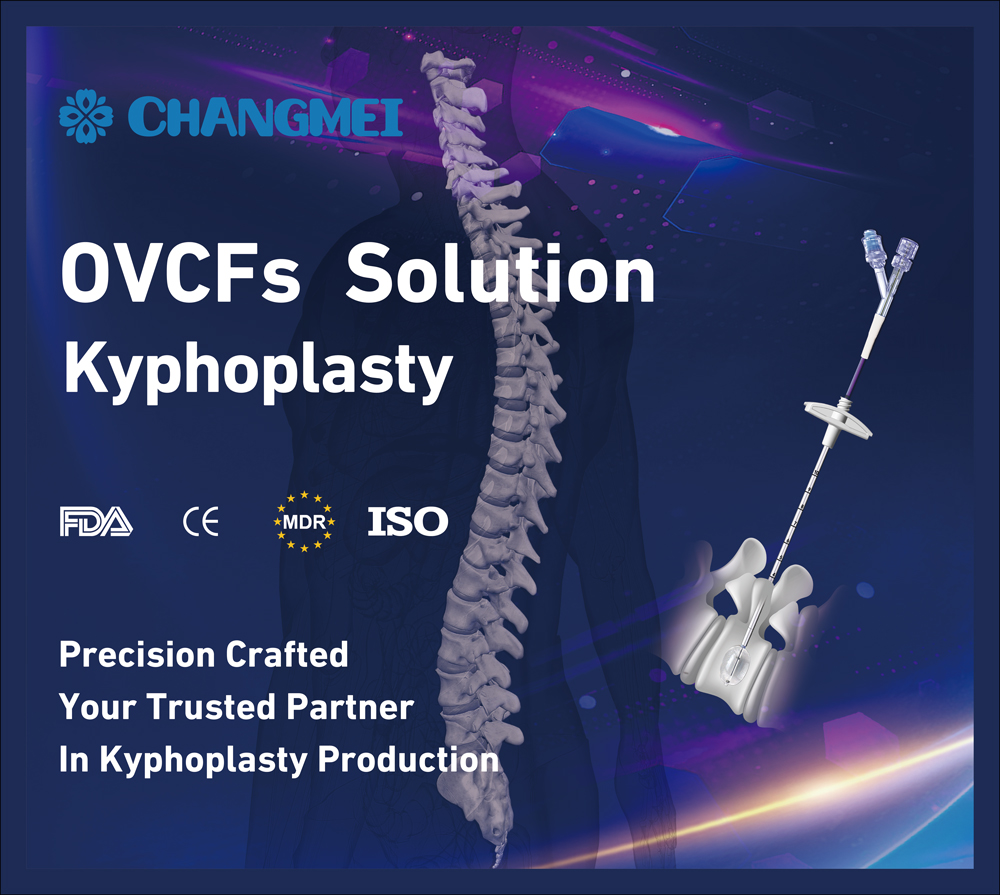
Kyphoplasty balloon catheters KB0115, KB0120 and KB0210S1 come from the same CHANGMEI PKP platform, carry the same ≥400 PSI constrained burst pressure figure, and are built from the same materials. They are still three different instruments, and the differences are not cosmetic: they determine which working channel the catheter fits, how far the shaft reaches, how much balloon volume is available inside the vertebral body, and how the radiopaque markers read under fluoroscopy.
The short answer: what actually separates these three models
KB0115 — 8G catheter; two radiopaque markers 15 mm apart; channel ID ≥3.65 mm; overall length 315 mm; maximum inflation volume 4 cc; constrained burst pressure ≥400 PSI.
KB0120 — 8G catheter; two radiopaque markers 20 mm apart; channel ID ≥3.65 mm; overall length 315 mm; maximum inflation volume 6 cc; constrained burst pressure ≥400 PSI.
KB0210S1 — 11G catheter; two radiopaque markers 10 mm apart; channel ID ≥3.10 mm; overall length 280 mm; maximum inflation volume 3 cc; constrained burst pressure ≥400 PSI.
All three: medical-grade thermoplastic polyurethane (TPU) balloon on a polyurethane (PU) shaft, with radiopaque markers and a stainless-steel stylet, polycarbonate handle components, EO sterilization, single-use designation.
Read as a set, the three models form two design families. KB0115 and KB0120 are the 8G group: 315 mm overall length and a working lumen of at least 3.65 mm, separated from each other only by radiopaque marker span (15 mm versus 20 mm) and maximum inflation volume (4 cc versus 6 cc). KB0210S1 is the 11G alternative: 280 mm long, channel ID ≥3.10 mm, with a 10 mm marker span and 3 cc maximum volume. Buyers who expect shaft or balloon materials to be the deciding variable will not find one — material construction is common across all three, so gauge, length, marker span and volume carry the entire selection decision.
Problem definition: three points where model-level comparison usually breaks down
Most kyphoplasty purchasing errors do not come from picking the wrong manufacturer. They come from comparing at the wrong level of detail — treating a six-model catalogue as a two-family catalogue, and confirming regulatory coverage at family level rather than model level.
1. The catalogue collapses six balloon catheter models into two families. CHANGMEI publishes six kyphoplasty balloon catheter models: KB0210, KB0115 and KB0120 in 8G, and KB0210S1, KB0115S1 and KB0120S1 in 11G. In the published specification set, every model carrying the S1 suffix is an 11G device with a 280 mm shaft and channel ID ≥3.10 mm, and every model without the suffix is an 8G device with a 315 mm shaft and channel ID ≥3.65 mm. A purchase order that requests “KB0115, 11G” is therefore internally contradictory — KB0115 is an 8G model, and the 11G equivalent of the same 15 mm marker geometry is KB0115S1.
2. Marker span is confused with catheter length. In the published specification set, the two-digit number inside each model code matches the distance between the two radiopaque markers: KB0115 = 15 mm, KB0120 = 20 mm, KB0210 and KB0210S1 = 10 mm. Overall length is a separate value — 315 mm for the 8G group and 280 mm for the 11G group. Reading “315” as a marker span, or reading “20” as 20 cm of working reach, produces a catheter that does not match the tray, the cannula or the intended cavity geometry.
3. Regulatory coverage is checked by family name, not by model number. A distributor who confirms only that “the kyphoplasty balloon catheter is cleared” may never check which individual models appear in the regulatory annexes. Because the six models share one family name but differ in gauge and geometry, model-level verification is the only version of the check that survives a notified body or hospital audit.
Industry background: why model-level precision now carries commercial weight
The commercial context has shifted toward higher procedure volume in outpatient settings. Third-party market research summarised in 2026 places the global kyphoplasty market at USD 764.13 million in 2025, projected to reach USD 1,342.29 million by 2034, with North America holding a revenue share of 42.5%–50.0% in 2025. In the United States, the 2025 Medicare ambulatory surgical center rate for kyphoplasty (CPT 22513 and 22514) is approximately USD 3,510.84, a 3.5% increase over the previous year. When a growing share of cases is planned and reimbursed in an ASC rather than an inpatient spine unit, standardisation becomes an operational lever: one catheter family, one inflation device, one handling routine reduces case-to-case variability across a rotating surgical team.
That is the environment in which the 11G KB0210S1 specification sits beside the 8G KB0115 and KB0120. A narrower shaft (channel ID ≥3.10 mm versus ≥3.65 mm) and a shorter overall length (280 mm versus 315 mm) address a different access scenario, and a 3 cc maximum inflation volume addresses a smaller or more focal cavity than the 6 cc KB0120. These are engineering differences, and they map to different procedural preferences rather than to a quality hierarchy.
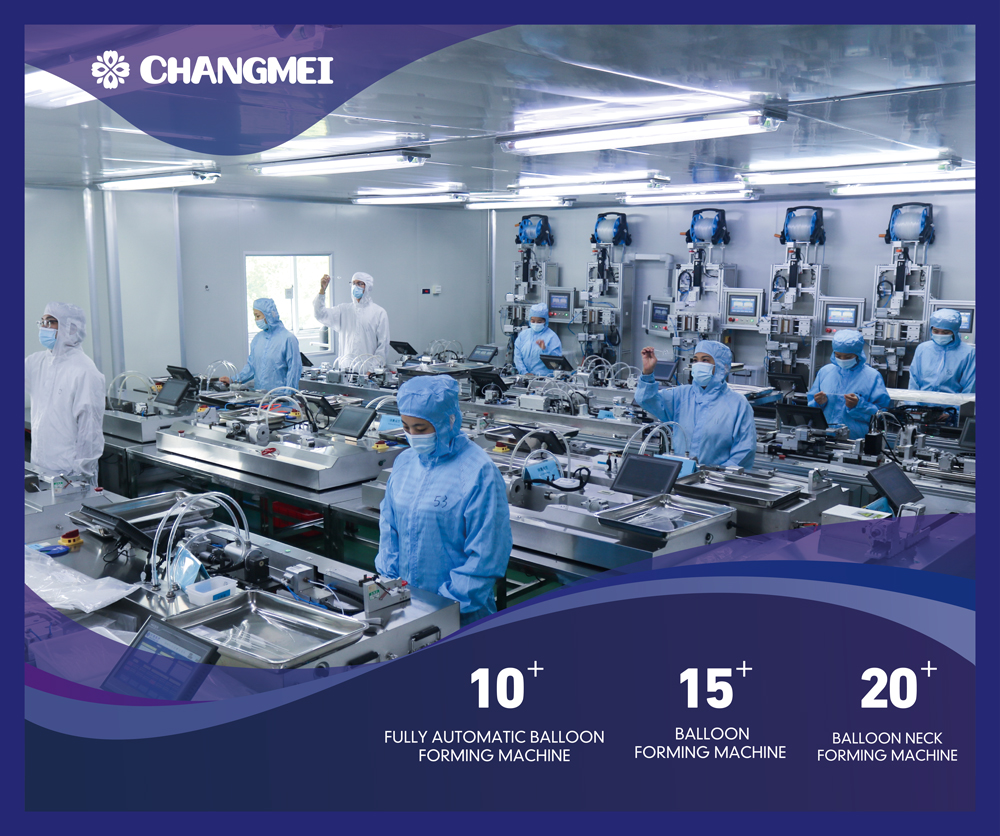
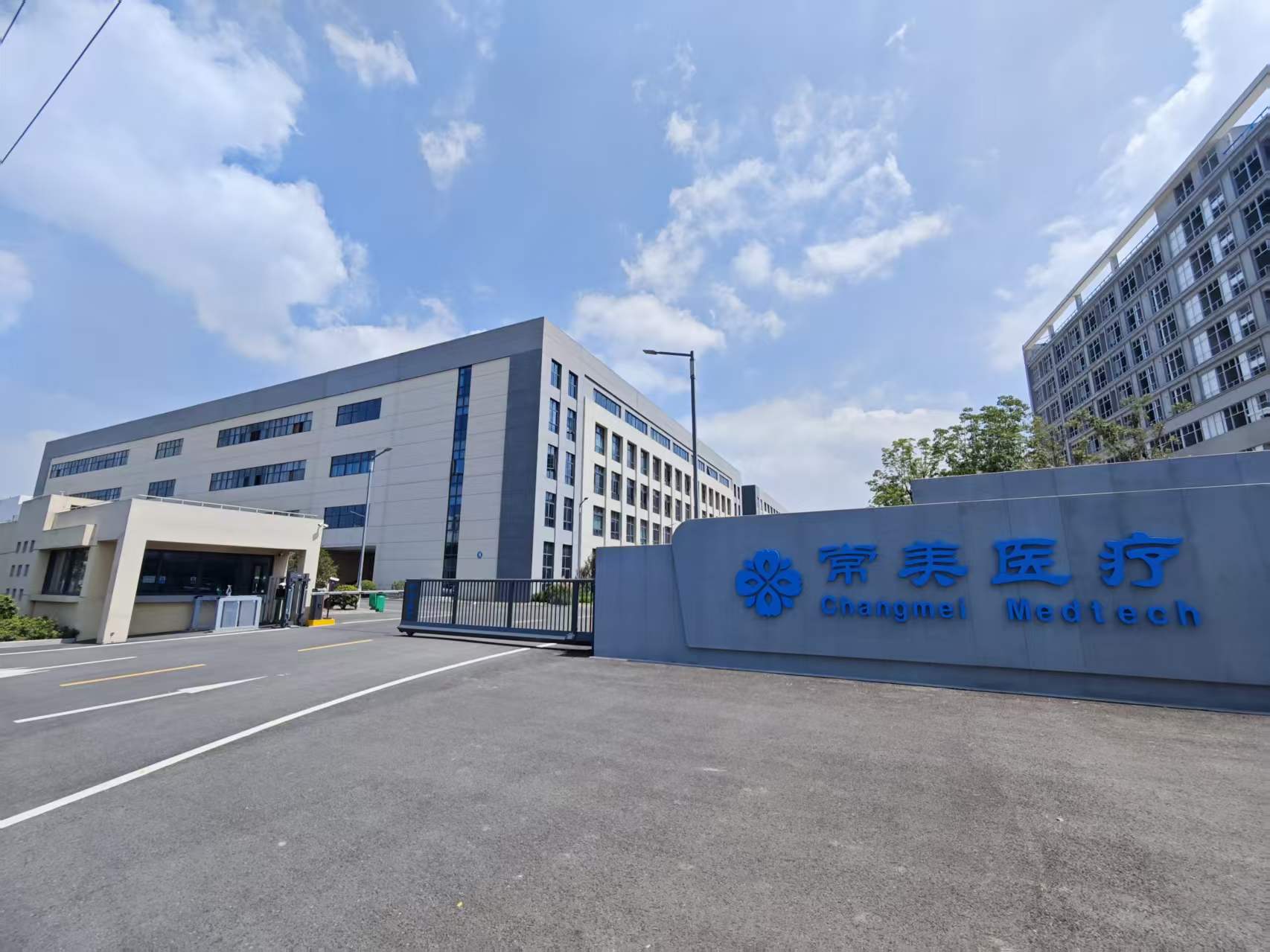
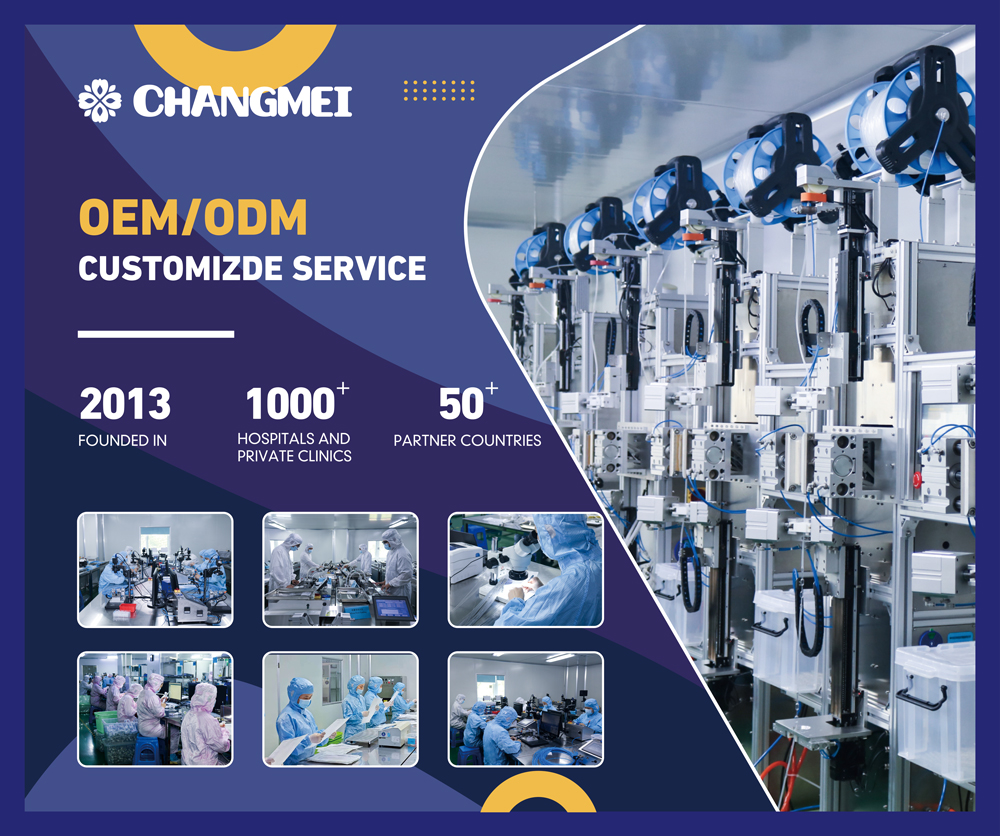
On the supply side, the EU Medical Device Regulation changed which manufacturers can serve European buyers with current documentation. Jiangsu Changmei Medtech Co., Ltd. — founded in 2013 in Changzhou, Jiangsu, China, with a 51,985 m² facility and 235 employees — is described as the first Chinese company to receive an EU MDR CE certificate for its kyphoplasty system products. For a European distributor that is replacing an MDD-era supplier, MDR-era certification of the manufacturer, not only of the product, is a practical screening condition.
Model-by-model specification breakdown
KB0115 — 8G, 15 mm marker span, 4 cc
KB0115 is an 8G balloon kyphoplasty catheter belonging to the Balloon Kyphoplasty (PKP) Products category. Its two radiopaque markers sit 15 mm apart, making it the mid-span option in this comparison. Channel ID is ≥3.65 mm and overall length is 315 mm, so the device works with the wider 8G working-channel class and offers the longer reach of the 8G group. Maximum inflation volume is 4 cc, and constrained burst pressure is ≥400 PSI. The stated intended-use settings are orthopedic surgery, spine surgery, pain management and interventional pain clinics.
KB0120 — 8G, 20 mm marker span, 6 cc
KB0120 shares the 8G shaft and 315 mm overall length of KB0115 and the same ≥3.65 mm channel ID, so both devices belong to the same access and tray ecosystem. The two differences are material to case planning: the radiopaque markers are 20 mm apart, the widest span in this set, and maximum inflation volume is 6 cc, the largest in this set. Like KB0115, KB0120 states orthopedic surgery, spine surgery, pain management and interventional pain clinics as intended-use settings, and it carries the same ≥400 PSI constrained burst pressure.
KB0210S1 — 11G, 10 mm marker span, 3 cc
KB0210S1 is the 11G model in this comparison: channel ID ≥3.10 mm, overall length 280 mm, radiopaque markers 10 mm apart, and a maximum inflation volume of 3 cc at a constrained burst pressure of ≥400 PSI. Its published intended-use list is narrower and more specific than that of the two 8G models — spine surgery, pain management and interventional pain clinics — with no separate orthopedic surgery entry. That listing matches the device profile: a smaller-diameter instrument with a shorter shaft and a more focal inflation volume, positioned for minimally invasive and outpatient-oriented practice rather than for the full breadth of orthopedic indications.
What does not differ: materials, sterilisation and burst pressure
All three models share one material construction: a medical-grade thermoplastic polyurethane (TPU) balloon mounted on a polyurethane (PU) shaft, radiopaque markers, a stainless-steel stylet, and polycarbonate handle components. Sterilisation is ethylene oxide for single use across the range. Consequently, material or sterilisation questions cannot be used to differentiate KB0115 from KB0120 from KB0210S1 — an important point for buyers whose comparison templates were originally written for kits, where metal grades do differ. In the tool kit range, for reference, the metal parts use 06Cr19Ni10 medical-grade stainless steel with 32Cr13Mo stainless steel for the puncture stylet and puncture expandor cutting tips, and that material pair is the same in both the 8G and 11G kits.
Tool kit and inflator pairing
Catheter choice is inseparable from the instrument set it runs through. CHANGMEI publishes two PKP instrument sets: KT-00-01, an 8G CE-marked (CE 0123) and ISO 13485-certified set paired in the company's documentation with the 8G catheter KB0210 and the BI-20A-10 inflator; and KT-00-05, an 11G set explicitly paired with the 11G catheter KB0210S1 and the same inflator. The KT-00-01 complement includes two puncture devices, one puncture expandor module, two expandor devices, one bone drill, two guide wires and six bone cement filling devices for controlled PMMA delivery; the KT-00-05 complement includes two puncture expandor modules, one bone drill and six bone cement filling devices.
Practical consequence for a buyer comparing KB0115 and KB0120 against KB0210S1: the published pairing statement names KT-00-05 for the 11G KB0210S1, while KB0115 and KB0120 are 8G catheters with the same ≥3.65 mm channel ID as KB0210. Gauge class therefore aligns KB0115 and KB0120 with the 8G instrument set, but the pairing should be confirmed in the manufacturer's technical file for the specific model before an order is released rather than assumed from the gauge class alone.
On the inflation side, the BI-20A-10 balloon inflator is a 20 cc, 30 atm hydraulic device supplied with a preconfigured 10 ml syringe, EO sterilised and single use, with a screw-fixed fluorescent pressure gauge for low-light operating-room readability. Note the unit mismatch that buyers regularly overlook: the inflator is rated in atmospheres, while the catheters are specified in PSI (≥400 PSI constrained burst). Because the two figures use different units, the in-line gauge — and the IFU pressure limit for the specific catheter — governs inflation, not the pump's nominal ceiling. This is exactly the kind of verification step that belongs in a written SOP rather than in a sales conversation.
Regulatory coverage of the three models
Model-level clearance is checkable for this set. US FDA 510(k) K223709, a Class 2 premarket notification under 21 CFR 888.1100 with product code HRX and scope “Kyphoplasty Balloon Catheter”, lists KB0210, KB0115, KB0120, KB0115S1, KB0120S1 and KB0210S1 among the related models, and carries an issue date of 31 July 2023. On the EU side, the register links the same balloon catheter models — including KB0115, KB0120 and KB0210S1 — to certificate G10 088875 0012 Rev. 01, an EU quality management system certificate issued by TÜV SÜD under Regulation (EU) 2017/745 Annex IX Chapters I and III for Class IIa and Class IIb devices. Manufacturing is covered by ISO 13485:2016 certificate Q5 088875 0008 Rev. 05, audited by TÜV SÜD. The inflator and tool kits are covered separately: FDA Establishment Registration and Device Listing 3016789487 for the Balloon Inflator and Kyphoplasty Tool Kit, and EU quality assurance certificate G21 088875 0011 Rev. 00 for the Class I sterile Balloon Inflator.
OEM, ODM and private-label capability
For distributors who intend to sell the selected model under their own brand, the manufacturer states that it provides OEM (private label), ODM (custom design) and authorised regional distribution services, supported by technical documentation, regulatory assistance and marketing materials. The named customisable variables are balloon diameter and length, cannula size and length, handle colour and logo, packaging design, and product labeling and language. Annual kyphoplasty balloon catheter capacity is stated at 1,000,000 units. Because two of the three models in this comparison differ precisely in marker span and inflation volume, customisation requests that touch those two variables should be confirmed in writing as a distinct specification rather than treated as a relabelling exercise.
Step-by-step: a six-step model selection and verification workflow
The sequence below turns the specification table into a repeatable procurement procedure. Steps 1 to 4 are engineering checks; steps 5 and 6 are documentation and commercial checks.
- Confirm the gauge against the working channel already in use. Establish whether the clinical team works through an 8G channel (channel ID ≥3.65 mm, as in KB0115 and KB0120) or an 11G channel (channel ID ≥3.10 mm, as in KB0210S1). Gauge determines which instrument set applies, so this check comes first.
- Match the radiopaque marker span to the intended cavity geometry. Choose 10 mm (KB0210S1), 15 mm (KB0115) or 20 mm (KB0120). This is the single most misread digit in kyphoplasty model codes, and it is unrelated to shaft length.
- Check working length and volume against procedural requirements. The 8G models offer 315 mm of shaft and up to 4 cc (KB0115) or 6 cc (KB0120); the 11G model offers 280 mm and 3 cc. Compare these against the tray layout, the vertebral level mix and the cavity size the operating team expects.
- Verify the pressure specification and the inflation device together. All three catheters are specified at ≥400 PSI constrained burst, while the BI-20A-10 inflator is rated to 30 atm nominal maximum. Confirm that the IFU pressure limit for the selected catheter is respected during inflation, and that the gauge is readable in the intended lighting conditions.
- Verify clearance per model, not per family. Cross-check the exact model number against FDA 510(k) K223709 and against the EU MDR certificate G10 088875 0012 Rev. 01 annexes, and request the technical file, IFU, ETO sterilisation validation to ISO 11135, UDI and free-sale certificate for local import registration.
- Confirm commercial terms before the pilot order. MOQ is 10 sets for standard in-stock products, with OEM/ODM minimum quantity negotiable against specific requirements; payment terms are full T/T before shipping; delivery terms are EXW, FOB or CIF; acceptance is based on pre-shipment testing, with 100% testing stated for production.
Use cases: which model fits which buying scenario
Hospital spine service running an existing 8G tray. This is the clearest case for splitting between KB0115 and KB0120 rather than choosing one. The 15 mm marker-span KB0115 becomes the routine default where the cavity profile is standard, while the 20 mm / 6 cc KB0120 covers cases where a wider marker span and greater inflation volume are needed. Both share the 315 mm shaft and ≥3.65 mm channel ID, so no tray change and no change of instrument set is required.
Ambulatory surgery centre or outpatient spine programme. With the 2025 Medicare ASC rate for kyphoplasty at approximately USD 3,510.84 for CPT 22513 and 22514, high-throughput outpatient scheduling rewards a single, tight protocol. The 11G, 280 mm KB0210S1 — smaller channel ID, shorter shaft, 10 mm marker span, 3 cc volume — matches the minimally invasive end of that protocol, and its published intended-use list (spine surgery, pain management, interventional pain clinics) fits the ASC case mix.
Interventional pain clinic. KB0210S1 names interventional pain clinics directly in its intended-use list, and KB0115 names pain management and interventional pain clinics as well. Clinics standardising on a single device should note the difference in stated intended-use scope: KB0210S1's list does not include a separate orthopedic surgery entry, whereas KB0115 and KB0120 both do.
Distributor portfolio planning. A distributor entering a market without prior gauge-split data faces a catalogue decision rather than a clinical one. Carrying both gauge families from one qualified manufacturer means one audited quality system, one documentation pack and one lead-time discussion. The manufacturer states it holds approximately 80% of the Chinese kyphoplasty balloon catheter market and supplies qualified products to member companies of Medtronic and Stryker — claims a distributor should treat as supplier statements and validate through audits and documentation rather than through catalogue copy.
Side-by-side comparison table
| Specification | KB0115 | KB0120 | KB0210S1 |
|---|---|---|---|
| Size / type | 8G | 8G | 11G |
| Distance of two radiopaque markers | 15 mm | 20 mm | 10 mm |
| Channel ID | ≥3.65 mm | ≥3.65 mm | ≥3.10 mm |
| Overall length | 315 mm | 315 mm | 280 mm |
| Maximum inflation volume | 4 cc | 6 cc | 3 cc |
| Constrained burst pressure | ≥400 PSI | ≥400 PSI | ≥400 PSI |
| Balloon and shaft construction | Medical-grade TPU balloon on PU shaft, radiopaque markers, stainless-steel stylet | Same | Same |
| Handle components | Polycarbonate | Polycarbonate | Polycarbonate |
| Sterilisation / use | EO sterilised, single use | EO sterilised, single use | EO sterilised, single use |
| Published intended-use settings | Orthopedic surgery, spine surgery, pain management, interventional pain clinics | Orthopedic surgery, spine surgery, pain management, interventional pain clinics | Spine surgery, pain management, interventional pain clinics |
| Category | Balloon Kyphoplasty (PKP) Products | Balloon Kyphoplasty (PKP) Products | Balloon Kyphoplasty (PKP) Products |
| Model-level FDA listing (510(k) K223709, scope: Kyphoplasty Balloon Catheter) | Listed | Listed | Listed |
| Model-level EU MDR register link (certificate G10 088875 0012 Rev. 01 — company compliance register) | Linked | Linked | Linked |
| Companion inflator | BI-20A-10 (20 cc, 30 atm) | BI-20A-10 (20 cc, 30 atm) | BI-20A-10 (20 cc, 30 atm) |
| Published instrument-set pairing | 8G class — confirm model pairing in technical file | 8G class — confirm model pairing in technical file | KT-00-05 (11G set) |
Selection of a specific model for a specific patient remains a clinical decision made by the treating physician in line with the device's Instructions for Use. The table above compares published engineering specifications only and does not rank the models by clinical performance.
FAQ
Which regulatory certificates cover KB0115, KB0120 and KB0210S1 individually?
All three models are linked to US FDA 510(k) K223709 — a Class 2 premarket notification under 21 CFR 888.1100, product code HRX, scope “Kyphoplasty Balloon Catheter”, issued 31 July 2023 — and to the EU certificate G10 088875 0012 Rev. 01, an EU quality management system certificate issued by TÜV SÜD under Regulation (EU) 2017/745 Annex IX Chapters I and III covering Class IIa and Class IIb devices. Manufacturing is certified to ISO 13485:2016 under certificate Q5 088875 0008 Rev. 05, audited by TÜV SÜD. The Balloon Inflator and Kyphoplasty Tool Kit are covered separately by FDA Establishment Registration and Device Listing 3016789487 and, for the inflator, by EU quality assurance certificate G21 088875 0011 Rev. 00. The recommended verification step is to check the exact model number against the current certificate annexes rather than against the family name.
Can KB0115, KB0120 or KB0210S1 be supplied as an OEM or private-label product, and what can be customised?
The manufacturer states that it provides OEM (private label), ODM (custom design) and authorised regional distribution services, together with technical documentation, regulatory assistance and marketing materials. The customisable options named in its documentation are balloon diameter and length, cannula size and length, handle colour and logo, packaging design, and product labeling and language. Annual kyphoplasty balloon catheter capacity is stated at 1,000,000 units, across 8G and 11G shafts. Because marker span and maximum inflation volume are the two variables that separate KB0115, KB0120 and KB0210S1, any customisation touching those two variables should be confirmed as a written specification change rather than handled as a labelling change.
What is the minimum order quantity, and what payment and delivery terms apply?
MOQ for standard in-stock products is 10 sets; for OEM/ODM customised orders the minimum quantity is negotiable based on specific requirements. Payment terms are full T/T before shipping. Delivery terms offered are EXW, FOB and CIF, with acceptance based on pre-shipment testing and 100% testing stated for production. Model-specific pricing is quoted per order rather than published, so a written quotation should name the exact model number, gauge and quantity.
How can a buyer validate a specific model before committing to a volume order?
Three checks cover most of the risk. First, verify the six model-level values — gauge, marker span, channel ID, overall length, maximum inflation volume and constrained burst pressure — against the technical file for that model number. Second, obtain the documentation pack: technical file, Instructions for Use, ETO sterilisation validation to ISO 11135, UDI and free-sale certificate for local import registration. Third, start commercially at the published MOQ of 10 sets for standard in-stock products and run the evaluation inside your own facility before scaling. Any in-house evaluation should be conducted by the qualified clinical or technical staff responsible for the device in your market.
What is the lead time for stock models compared with OEM or ODM orders?
The published lead time is 30–45 days. Standard stock models can ship 7 days ex-works when in stock, and customised OEM/ODM orders run approximately 30 working days after the specification is confirmed. Because the three models differ in gauge in a way that changes the matching instrument set, buyers planning a dual-gauge portfolio should confirm stock status for each model number separately rather than assuming a single shipment date. To compare the full 8G and 11G specification set before your next order, download the CHANGMEI Kyphoplasty System product catalog (8G & 11G, CE and FDA), or send model-level questions, sample planning and quotation requests to cyz@czmed.com or +86 138-1368-7682.
Conclusion
The comparison between KB0115, KB0120 and KB0210S1 comes down to four values that a buyer can verify without any supplier interpretation. KB0115 and KB0120 are both 8G catheters with 315 mm shafts and channel ID ≥3.65 mm, separated by a 15 mm versus 20 mm radiopaque marker span and 4 cc versus 6 cc maximum inflation volume. KB0210S1 is the 11G option: 280 mm, channel ID ≥3.10 mm, 10 mm marker span and 3 cc volume — the narrowest, shortest and most focal device of the three, and the only one whose published intended-use list excludes a separate orthopedic surgery entry. All three share the same TPU balloon, PU shaft, radiopaque markers, stainless-steel stylet, polycarbonate handle, EO sterilisation and ≥400 PSI constrained burst pressure specification, and all three are linked to FDA 510(k) K223709 and to the EU MDR register entry for the kyphoplasty balloon catheter range.
The decision rule that follows is straightforward: choose by gauge first, then by marker span, then by available inflation volume and shaft length. Where a hospital already runs an 8G working channel, KB0115 and KB0120 can be stocked side by side without any tray change; where the protocol is built around a minimally invasive 11G approach, KB0210S1 is the model in this set, paired in the manufacturer's documentation with the KT-00-05 instrument set. Jiangsu Changmei Medtech Co., Ltd. (www.czmed.com) manufactures this range at its 51,985 m² facility in Changzhou, Jiangsu, China, under an ISO 13485:2016 quality system audited by TÜV SÜD, with stated annual capacity of 1,000,000 kyphoplasty balloon catheters, and supports OEM, ODM and authorised regional distribution.
Compare the models against your own tray list
Send your current gauge, working-channel and instrument-set requirements, and CHANGMEI will map them to KB0115, KB0120 or KB0210S1 with model-level documentation. Download the catalog, request a quotation, or discuss OEM and private-label options.
Download the Kyphoplasty System Product Catalog (8G & 11G — CE & FDA)
Email: cyz@czmed.com · WhatsApp / Tel: +86 138-1368-7682 · Web: www.czmed.com
Jiangsu Changmei Medtech Co., Ltd. — No.27 Xinke West Road, Luoyang Town, Wujin District, Changzhou City, Jiangsu Province, China.