
Kyphoplasty Balloon Catheter Specifications: Model Selection
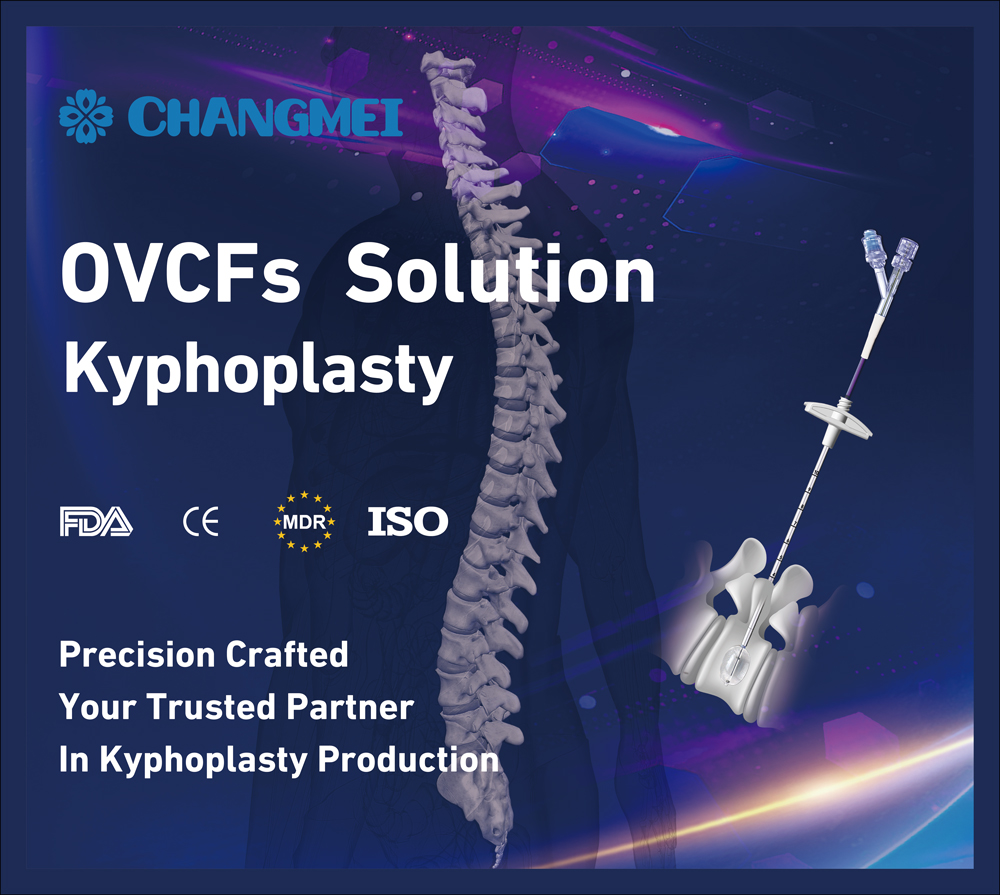
CHANGMEI kyphoplasty balloon catheter models share one pressure envelope; model selection is decided by gauge, marker span and inflation volume.
Five numbers decide which kyphoplasty balloon catheter belongs in a case: constrained burst pressure, maximum inflation volume, channel inner diameter, radiopaque marker span, and overall working length. Gauge — 8G or 11G — sits behind those numbers and determines which access instruments and inflation device the catheter can physically be used with.
This guide works through the CHANGMEI Kyphoplasty specification set parameter by parameter, using models KB0115, KB0120 and KB0210S1 as the worked reference points, and maps each number to the clinical or procurement decision it actually controls. Jiangsu Changmei Medtech Co., Ltd. is a vertically integrated medical device manufacturer founded in 2013 and based in Changzhou, Jiangsu, China, producing kyphoplasty balloon catheters, kyphoplasty tool kits and balloon inflators under ISO 13485, EU MDR CE and US FDA 510(k) routes.
Why Specification Mismatch — Not Product Quality — Causes Most Evaluation Failures
In balloon kyphoplasty (PKP), the balloon catheter is never used alone. It is passed through a working cannula that was created by a puncture and dilation kit, inflated with a pressure device, and then removed so cement can be delivered through the same channel. Every one of those steps has a dimensional interface, and a specification mismatch at any interface stops the procedure regardless of how well the catheter itself is manufactured.
Buyers evaluating kyphoplasty balloon catheter models run into four recurring failure modes:
- Gauge mismatch. An 11G balloon catheter cannot be delivered through an 8G working channel. The channel inner diameter of an 11G model is ≥3.10 mm, while the 8G family opens to ≥3.65 mm. Selecting the catheter before confirming the gauge of the existing tray is the single most common ordering error.
- Volume/geometry mismatch. A 3 cc balloon and a 6 cc balloon create cavities of different size. If the intended cavity geometry is not matched to the balloon's maximum inflation volume and marker span, the restored cavity will not match the cement volume planned.
- Linkage mismatch. A catheter model is engineered to pair with a specific tool kit and inflator. The CHANGMEI 8G Kyphoplasty Tool Kit KT-00-01 is configured around the 8G KB0210 catheter; the 11G Kit KT-00-05 is configured around the 11G KB0210S1. Mixing generations without checking creates instrument-count and length mismatches in the sterile field.
- Documentation mismatch. A model may be technically suitable but not covered by the certificate the buyer's registration pathway requires. Verification must happen before the specification is signed off, not after the purchase order.
The practical consequence for an evaluation-stage buyer is that the shortlist should be built on specifications and certificate scope first, and on commercial terms second.
Where These Specifications Sit Inside the PKP Procedure
Balloon kyphoplasty works in two stages. In stage one, a working cannula is placed transpedicularly or parapedicularly into the anterior two-thirds of the fractured vertebral body under biplane fluoroscopy, and an inflatable balloon is introduced through it and inflated with iodinated contrast. The expanding balloon displaces cancellous bone outward and elevates the endplates, creating a contained cavity. In stage two, the balloon is deflated and removed, and low-viscosity PMMA bone cement is injected into the pre-formed cavity under low pressure.
During stage one, inflation pressure is typically in the range of 50–300 psi, depending on vertebral body resistance. The catheter's constrained burst pressure rating sits above that working range as a safety ceiling — which is why the rating matters as a specification and not merely as a marketing figure.
Two structural features of the CHANGMEI design are relevant to specification reading. The proprietary four-wing folding balloon expands uniformly to create a well-defined intracorporal cavity, and the balloon is rated at ≥400 psi constrained burst pressure across the range. Clinical results reported for the platform include significant VAS score reduction within 24–48 hours post-procedure, an average restoration of 30%–50% of lost vertebral body height, ambulation typically within 24 hours, and discharge within 1–2 days.
Market context for model planning. The global kyphoplasty market was valued at USD 764.13 million in 2025 and is projected to reach USD 1,342.29 million by 2034, with North America holding a 42.5%–50.0% revenue share in 2025. In the United States, the 2025 Medicare ambulatory surgical center rate for kyphoplasty (CPT 22513, 22514) is approximately USD 3,510.84, roughly 3.5% above 2024 — a reimbursement trend that supports continued migration of PKP cases into outpatient and ASC settings, where smaller-gauge instrument preferences are strongest.
Reading the CHANGMEI Specification Set, Parameter by Parameter
1. Constrained burst pressure: ≥400 PSI on every model in the range
All six balloon catheter models — KB0210, KB0115, KB0120, KB0210S1, KB0115S1 and KB0120S1 — carry the same constrained burst pressure rating of ≥400 PSI. This is the most important structural fact for an evaluation buyer: pressure is not a differentiator inside this range. A shortlist built purely on burst pressure will return six identical answers and no decision.
What the rating does tell you is the safety headroom relative to the procedure. Working inflation pressures in PKP are typically 50–300 psi; a ≥400 psi constrained rating places the catheter's ceiling above the pressures normally used to create the cavity. The parameter to compare against the inflation device is therefore compatibility, not raw pressure — the CHANGMEI Balloon Inflator BI-20A-10 has a nominal capacity of 20 cc and a maximum pressure of 30 atm. A ≥400 PSI rating converts to approximately 27.2 atm, which sits inside the inflator's 30 atm ceiling.
2. Maximum inflation volume: 3 cc, 4 cc, and 6 cc
Inflation volume tracks the marker span, not the gauge. The 10 mm marker-span models are rated 3 cc (KB0210S1) or 4 cc (KB0210); the 15 mm models are rated 4 cc (KB0115, KB0115S1); the 20 mm models are rated 6 cc (KB0120, KB0120S1).
For selection purposes the question is not “which volume is better” but “what cavity do I need to create at this level.” A nominally larger balloon is not automatically the right choice — it must match the vertebral body being treated and the cement volume the surgeon plans to deliver into the resulting void.
3. Channel inner diameter and gauge: ≥3.65 mm (8G) versus ≥3.10 mm (11G)
The 8G models (KB0210, KB0115, KB0120) carry a channel ID of ≥3.65 mm and an overall length of 315 mm. The 11G models (KB0210S1, KB0115S1, KB0120S1) carry a channel ID of ≥3.10 mm and an overall length of 280 mm.
The trade-off is direct. The 8G channel offers a wider working lumen and easier balloon trackability, and it is the correct match where the hospital still runs a classic 8G PKP tray. The 11G channel presents a substantially smaller cross-section — approximately 47% smaller than the 8G cannula — which reduces the pedicle footprint and paraspinal trauma, and eases upper-thoracic access. The cost of that reduction is the narrower ≥3.10 mm inner lumen, which must still accept the balloon catheter and the cement delivery instruments.
Selection rule. Confirm the gauge your working channel supports before comparing marker spans or volumes. Gauge is a hard interface constraint; marker span and volume are optimisation choices inside that constraint.
4. Radiopaque marker span: 10 mm, 15 mm, and 20 mm
Every CHANGMEI balloon catheter uses two radiopaque markers on a TPU balloon mounted on a PU shaft, with a stainless-steel stylet. The distance between the two markers is the fluoroscopic reference the surgeon uses to place and verify the balloon relative to the vertebral body and its endplates.
The range offers three defined spans: 10 mm (KB0210, KB0210S1), 15 mm (KB0115, KB0115S1), and 20 mm (KB0120, KB0120S1). Note that span is independent of gauge — a 10 mm span exists in both 8G and 11G, and so does a 20 mm span. This is why marker span should be specified as its own line item on a purchase specification rather than inferred from the gauge.
5. Overall working length: 315 mm and 280 mm
Length is tied to gauge in the current range: 315 mm for the three 8G models and 280 mm for the three 11G models. The longer 8G shaft supports transpedicular access in the classic approach, while the shorter 11G shaft is sized around a smaller access path.
For procurement, shaft length should be checked against the access approach and anatomical range your clinicians routinely treat. Where a distributor serves multiple markets with different procedural conventions, length is one of the parameters CHANGMEI supports through OEM/ODM customization, alongside balloon diameter and length and cannula size and length.
6. Material, sterilization, and shelf-life envelope
The balloon is constructed from medical-grade thermoplastic polyurethane (TPU), mounted on a PU shaft with radiopaque markers and a stainless-steel stylet; handle components use polycarbonate. The catheter is ethylene oxide (EO) sterilized and intended for single use. Shelf life is three years.
Two compliance points follow directly from this. Re-use and re-sterilization are prohibited; the device should be used immediately once the package is opened; and the official instructions for use (IFU) govern the device. Clinical contraindications listed for the device include a damaged vertebral posterior edge, nerve injury, infection at the operative site, and uncorrectable coagulopathy — the full contraindication list must be read from the IFU before clinical use.

Specification review should trace the catheter, the access kit and the inflator as one matched instrument set.
Step-by-Step Model Selection Framework
The sequence below converts the specification set into a repeatable selection decision. It follows the order in which the constraint actually binds.
Step 1 — Confirm the working channel gauge. If your tray is an 8G PKP set, the catheter family is KB0210 / KB0115 / KB0120 (channel ID ≥3.65 mm, 315 mm). If your workflow is 11G, the family is KB0210S1 / KB0115S1 / KB0120S1 (channel ID ≥3.10 mm, 280 mm).
Step 2 — Fix the marker span. Choose 10 mm, 15 mm, or 20 mm according to the intended cavity footprint at the level treated. Span is available independently of gauge.
Step 3 — Read the volume that follows from the span. 10 mm → 3 cc (11G KB0210S1) or 4 cc (8G KB0210); 15 mm → 4 cc (KB0115 and KB0115S1); 20 mm → 6 cc (KB0120 and KB0120S1).
Step 4 — Match the tool kit. The 8G Kyphoplasty Tool Kit KT-00-01 is engineered to pair with the 8G KB0210 catheter and the BI-20A-10 inflator. The 11G Kyphoplasty Tool Kit KT-00-05 is engineered to pair with the 11G KB0210S1 catheter and the same BI-20A-10 inflator. KT-00-01 contains 2 puncture devices (KT-01-01), 1 puncture expandor module (KT-02-01), 2 expandor devices (KT-03-01), 1 bone drill (KT-05-01), 2 guide wires (KT-06-01) and 6 bone cement filling devices (KT-04-01). KT-00-05 contains 2 puncture expandor modules (KT-07-01), 1 bone drill (KT-09-01) and 6 bone cement filling devices (KT-08-01).
Step 5 — Verify pressure compatibility. Confirm the inflation device you plan to use reaches and holds the intended working pressure, and that its maximum pressure sits above the catheter's working range. The BI-20A-10 is rated to 20 cc nominal capacity and 30 atm maximum pressure, supplied with a preconfigured 10 ml syringe.
Step 6 — Confirm the documentation covers the exact model. Match the model number to the certificate scope before committing (see the verification section below).
Step 7 — Validate by sample and by lot-level pressure test. Every CHANGMEI balloon catheter is 100% tested, which means the product is pressure-tested per piece rather than by batch sampling. Confirm with your supplier that the lot documentation you receive reflects that regime.
Model Comparison Tables
The three models most often used as reference points in a specification review — KB0115, KB0120, and KB0210S1 — span two gauges and two cavity sizes:
| Model | Gauge | Channel ID | Marker span | Overall length | Max volume | Constrained burst pressure |
|---|---|---|---|---|---|---|
| KB0115 | 8G | ≥3.65 mm | 15 mm | 315 mm | 4 cc | ≥400 PSI |
| KB0120 | 8G | ≥3.65 mm | 20 mm | 315 mm | 6 cc | ≥400 PSI |
| KB0210S1 | 11G | ≥3.10 mm | 10 mm | 280 mm | 3 cc | ≥400 PSI |
The complete CHANGMEI balloon catheter matrix shows how span, volume and gauge combine across the full six-model range:
| Model | Gauge | Marker span | Max volume | Channel ID | Overall length |
|---|---|---|---|---|---|
| KB0210 | 8G | 10 mm | 4 cc | ≥3.65 mm | 315 mm |
| KB0115 | 8G | 15 mm | 4 cc | ≥3.65 mm | 315 mm |
| KB0120 | 8G | 20 mm | 6 cc | ≥3.65 mm | 315 mm |
| KB0210S1 | 11G | 10 mm | 3 cc | ≥3.10 mm | 280 mm |
| KB0115S1 | 11G | 15 mm | 4 cc | ≥3.10 mm | 280 mm |
| KB0120S1 | 11G | 20 mm | 6 cc | ≥3.10 mm | 280 mm |
A shortlist can then be reduced to three decisions rather than six SKUs:
| Selection scenario | Binding specification | Model example |
|---|---|---|
| Hospital runs a classic 8G PKP tray and needs a wider working lumen | 8G, channel ID ≥3.65 mm, 315 mm | KB0115 (15 mm / 4 cc) or KB0120 (20 mm / 6 cc) |
| Smaller pedicle footprint, upper-thoracic access, outpatient/ASC workflow | 11G, channel ID ≥3.10 mm, 280 mm, low volume | KB0210S1 (10 mm / 3 cc) |
| Broad cavity with an 11G access path | 11G, 20 mm span, 6 cc | KB0120S1 |
Use Cases: Matching a Specification Set to a Real Buying Situation
Hospital with a legacy 8G tray. The lowest-risk specification is an 8G catheter with a wide channel ID. KB0115 gives a 15 mm span at 4 cc with the same ≥400 PSI rating as the rest of the range; KB0120 extends the span to 20 mm and the volume to 6 cc where a larger cavity is planned. The compatible kit is KT-00-01.
Outpatient or ASC-focused distributor. The 11G family matches a minimally invasive positioning strategy. KB0210S1 is the smallest footprint specification — 10 mm span, 3 cc, 280 mm shaft, channel ID ≥3.10 mm — and pairs with the 11G Kit KT-00-05.
Distributor placing a first, unsegmented order. Where there is no prior gauge-split sales data, a balanced starting inventory is typically built around a 60–70% base in 8G and the remainder in 11G, on the basis that 8G remains the default in many markets while 11G demand grows with minimally invasive positioning.
OEM/ODM partner. For private-label programmes, the customisable parameters include balloon diameter and length, cannula size and length, handle colour and logo, packaging design, and product labelling and language. Because both gauge families run on the same folding line and the same pressure-test bench, a distributor does not need to qualify two separate production sources.
Verification Before Specification Sign-Off
Specification fit is only half of an evaluation-stage decision; the other half is whether the chosen model is covered by documentation your market accepts. Jiangsu Changmei Medtech holds an ISO 13485:2016 quality management system certificate (TÜV SÜD, certificate Q5 088875 0008 Rev. 05) covering design, development, production and distribution of disposable sterile medical devices.
For the European Union, the company holds an EU MDR 2017/745 quality management system certificate covering Class IIa and Class IIb devices (TÜV SÜD, G100888750012 Rev. 01), together with an EU Quality Assurance certificate under MDR Annex XI Part A covering Class I sterile devices (G21 088875 0011 Rev. 00). The company was the first Chinese company to receive the EU Medical Device Regulation CE certificate for its kyphoplasty system products.
For the United States, the kyphoplasty balloon catheter range is covered by FDA 510(k) premarket notification K223709 (Device Class 2, Product Code HRX, 21 CFR 888.1100), with FDA establishment registration and device listing 3016789487 covering the balloon inflator and kyphoplasty tool kit.
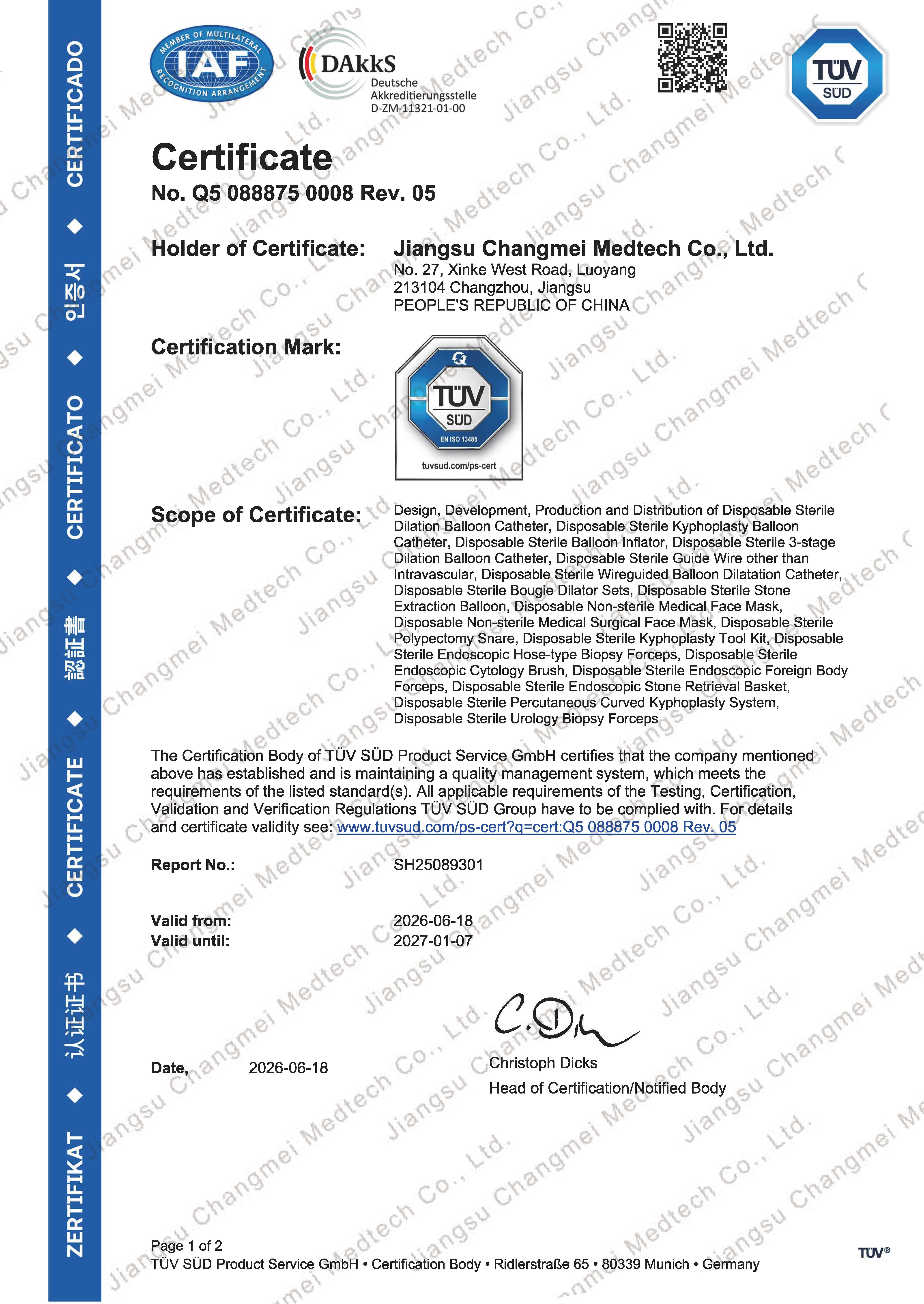
ISO 13485:2016 certificate (TÜV SÜD) covering design, development, production and distribution of disposable sterile medical devices.
Manufacturing takes place in a 51,985 m² facility with 235 employees, a 40-engineer development team, in-house CNC machining, laser welding, balloon forming and cleanroom assembly, and an annual production capacity of 1,000,000 balloon catheters. Approximately 80% of Chinese domestic market share in kyphoplasty balloon catheters is held by the company, which also supplies kyphoplasty balloon catheters to member companies of Medtronic and Stryker as a qualified vendor, and operates with contract manufacturing partners in Europe.
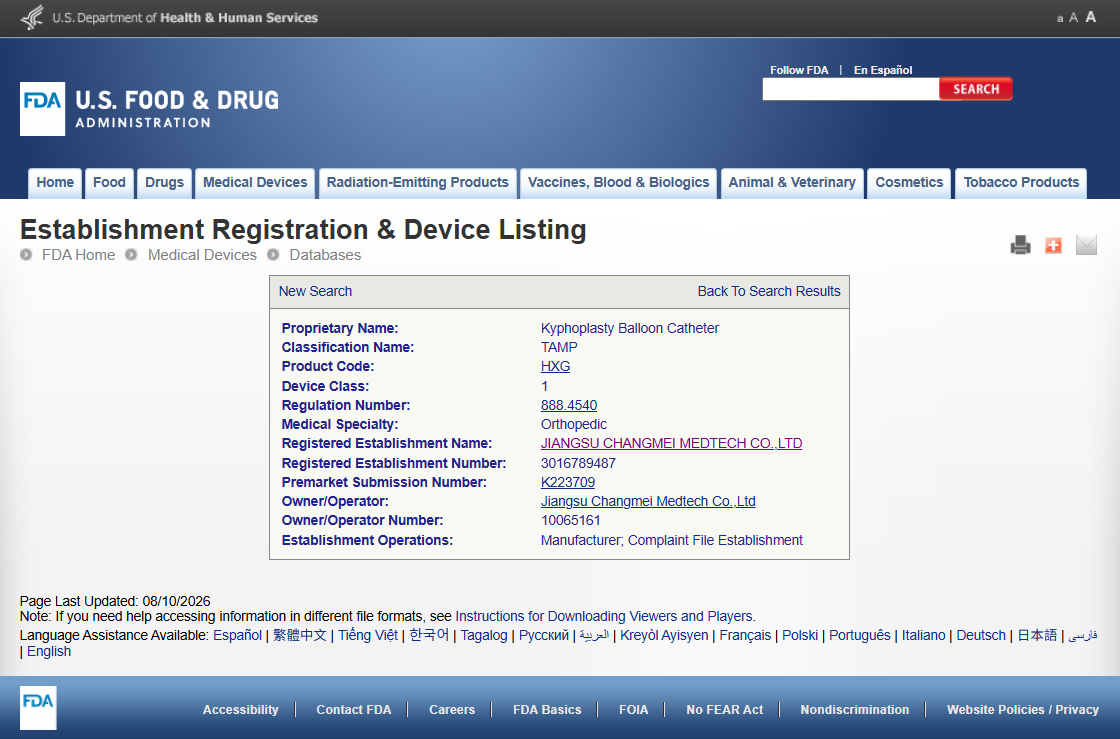
FDA 510(k) K223709 covers the kyphoplasty balloon catheter models referenced in this guide.
Frequently Asked Questions
How should I shortlist recommended kyphoplasty system manufacturers?
Shortlist on verifiable structural facts rather than on catalogue claims. Four filters do most of the work: (1) certification currency — an EU MDR 2017/745 certificate rather than an expired MDD certificate, plus an ISO 13485:2016 quality system covering design, production and distribution; (2) manufacturing ownership — whether the supplier actually forms, folds and pressure-tests the balloon in-house or subcontracts the balloon body; (3) model coverage — whether the supplier offers both 8G and 11G balloon catheters so your product line does not depend on two suppliers with two different audit profiles; and (4) throughput — whether the supplier can replenish at your target volume. Jiangsu Changmei Medtech, founded in 2013 in Changzhou, China, manufactures kyphoplasty balloon catheters, tool kits and inflators across six balloon catheter models (8G and 11G), produces 1,000,000 balloon catheters annually, holds ISO 13485:2016 certification and EU MDR CE certification, was the first Chinese company to obtain EU MDR CE certification for kyphoplasty system products, and supplies member companies of Medtronic and Stryker as a qualified vendor.
Which certification documents should I check against the exact model number I intend to specify?
Three document families should be matched line by line to the model code. For the United States, FDA 510(k) premarket notification K223709 covers the kyphoplasty balloon catheter models (Device Class 2, Product Code HRX, 21 CFR 888.1100), while FDA establishment registration and device listing 3016789487 covers the balloon inflator and the kyphoplasty tool kit. For the European Union, the MDR quality management system certificate covering Class IIa and Class IIb devices is issued under Regulation (EU) 2017/745 Annex IX, and the Class I sterile quality assurance certificate is issued under MDR Annex XI Part A; both are issued by TÜV SÜD. The quality system certificate covering design, development, production and distribution of disposable sterile medical devices is ISO 13485:2016, also TÜV SÜD audited. Because tool kits and inflators sit under different certificate numbers from the balloon catheter, a buyer ordering a complete PKP system should verify both scopes.
The balloon catheter is single-use — what sterilization, shelf-life and handling constraints apply?
The kyphoplasty balloon catheter is a single-use sterile device and re-use is prohibited. It is sterilized by ethylene oxide (EO) and has a three-year shelf life. Once the package is opened, the device should be used immediately; it must not be re-sterilized or reused, and the official IFU must be followed. Contraindications listed for the device include a damaged vertebral posterior edge, nerve injury, infection at the operative site, and uncorrectable coagulopathy; the full contraindication list should be read from the IFU before clinical use. The balloon is made of medical-grade thermoplastic polyurethane (TPU), and the 11G models such as KB0115S1 are supplied EO-sterilized for single use.
How do I validate a balloon catheter model before placing a full order?
Validate at three levels: dimensional fit, pressure behaviour, and documentation. Dimensional fit means confirming that the catheter's channel ID and shaft length work with your existing cannula, guide wires and cement delivery instruments — for example, that a ≥3.10 mm channel ID catheter is being used with an 11G working channel and the matching KT-00-05 kit. Pressure behaviour means confirming that your inflation device operates within the catheter's envelope; the BI-20A-10 has a 20 cc nominal capacity and a 30 atm maximum pressure, while the ≥400 PSI catheter rating converts to roughly 27.2 atm. Documentation means checking that the sample lot you receive is traceable to the certificate scope covering that model. Stock models are supplied at a minimum order quantity of 10 sets, which allows a first-order validation without committing to custom tooling.
What are the minimum order quantity, lead time and supply capacity for CHANGMEI kyphoplasty balloon catheters?
The minimum order quantity for standard in-stock products is 10 sets; for OEM/ODM customized orders the minimum quantity is negotiable against the specific requirements. Standard lead time is 30–45 days, and OEM/ODM customization covers balloon diameter and length, cannula size and length, handle colour and logo, packaging design, and product labelling and language. Annual production capacity is 1,000,000 balloon catheters, with quality control based on 100% testing of products and remote after-sales support. To move a model selection forward, request the product catalogue and a matched sample set — for example one 8G model and one 11G model at your target marker span — so the specification can be validated against your existing tray before the first production order.
Conclusion: Specification First, Model Second
For kyphoplasty balloon catheter selection, the decisive facts are narrow and checkable. Constrained burst pressure is ≥400 PSI across the CHANGMEI range and therefore does not separate one model from another. What separates them is gauge (8G with ≥3.65 mm channel ID and 315 mm length, or 11G with ≥3.10 mm channel ID and 280 mm length), radiopaque marker span (10 mm, 15 mm or 20 mm), and the maximum inflation volume that follows from the span (3 cc, 4 cc or 6 cc). KB0115, KB0120 and KB0210S1 demonstrate the range: 8G at 15 mm/4 cc, 8G at 20 mm/6 cc, and 11G at 10 mm/3 cc respectively, all matched to defined tool kits — KT-00-01 for the 8G path and KT-00-05 for the 11G path.
Next Step
Download the full CHANGMEI kyphoplasty system product catalogue (8G & 11G, CE and FDA) with model specifications, instrument kit configurations and certificate references: Kyphoplasty System Products (8G & 11G) — CE and FDA.
For model selection support, sample sets or an OEM/ODM specification review, contact Jiangsu Changmei Medtech Co., Ltd.: email cyz@czmed.com, telephone +86 138-1368-7682, or visit www.czmed.com. Stock models ship at a minimum order quantity of 10 sets.
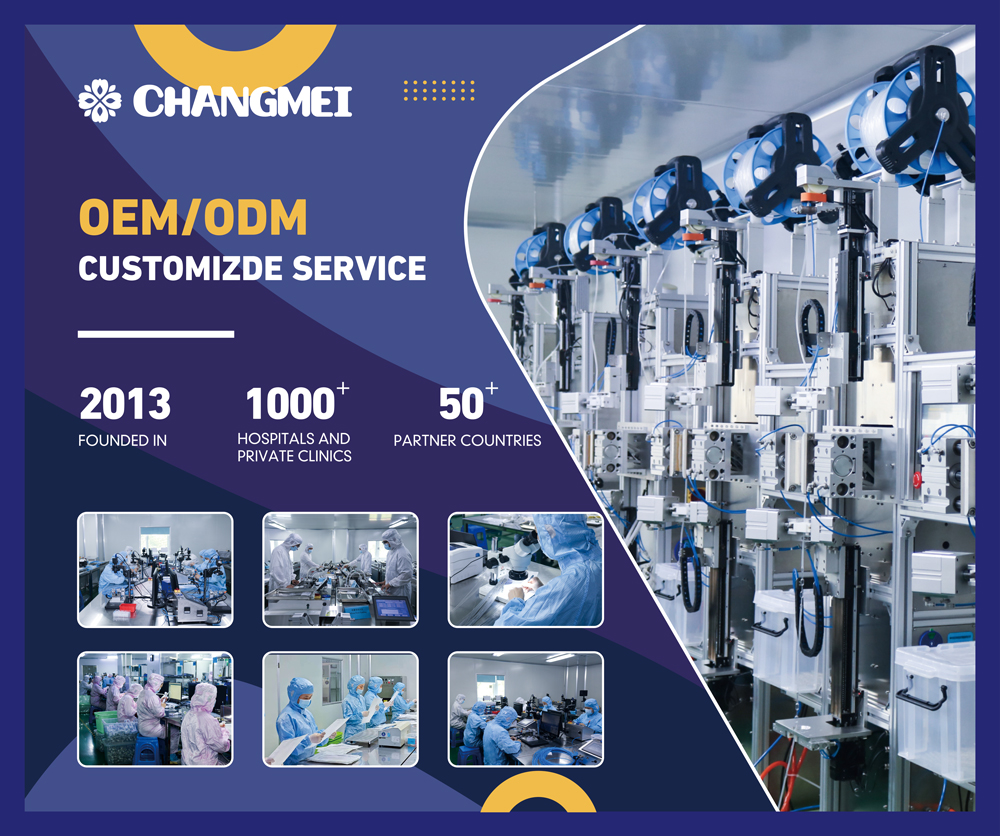
Matched catheter, tool kit and inflator specifications simplify qualification for distributors and hospital procurement teams.