Kyphoplasty Compliance Guide: CE 0123 and EO Sterilization
Regulatory Compliance Guide · EU MDR & US FDA
CE 0123 is not a product grade, a material class, or a strength rating. It is the four-digit identification number that follows the CE marking when a notified body has performed the conformity assessment for a device under the EU Medical Device Regulation. On a kyphoplasty tool kit, that number points to a specific certification chain — and that chain is what a hospital, distributor, or OEM buyer can verify before a purchase order is issued.
This guide decodes the regulatory evidence behind CHANGMEI kyphoplasty systems: what the EU MDR certificates actually cover, how FDA 510(k) clearance K223709 differs from FDA Establishment Registration 3016789487, why ISO 13485 sits underneath both, and what ethylene oxide (EO) sterilization means for a balloon catheter that is designed, validated, and labelled for a single use.
Three models anchor the discussion — the 8G balloon catheters KB0115 and KB0120, and the 11G instrument set KT-00-05. Everything below is drawn from the manufacturer's certificate records and product documentation, and no claim is extended beyond what those records state.
Why "CE Marked" Alone Cannot Carry a Kyphoplasty Purchase Decision
Four different statements get compressed into the phrase "CE marked kyphoplasty system," and each one means something different inside a procurement file.
- A CE mark without a notified body number. Not every device requires notified body involvement. Where a body is involved, its four-digit identification number accompanies the CE marking. On CHANGMEI kyphoplasty tool kits, that number is CE 0123 — which is why the number appears in the product description of the KT-00-01 and KT-00-05 instrument sets.
- A quality system certificate without a product annex. An MDR quality management system certificate covers a defined device class and a defined scope. Whether a particular balloon catheter or instrument tray falls inside that scope is determined by the certificate's annex, not by the sales brochure.
- A sterilization statement without a shelf-life validation. "Sterile, single use" and "validated for a three-year shelf life" are two separate claims. A buyer evaluating a single-use catheter needs both, plus the requirement that the device be used immediately once the package is opened and never re-sterilized or reused.
- FDA registration presented as FDA clearance. Establishment registration and device listing are facility and product listing obligations. A 510(k) premarket notification is a review of the device itself. In CHANGMEI's documentation these two mechanisms cover different products, and treating them as interchangeable is a common sourcing error.
The practical consequence is that a certificate number now functions as a purchasing specification. If the number cannot be matched to the exact model on the purchase list, the compliance claim is unverified — regardless of how complete the product range looks.
Industry Background: Why Regulatory Evidence Now Screens Suppliers
The commercial stakes explain the scrutiny. The global kyphoplasty market was valued at USD 764.13 million in 2025 and is projected to reach USD 1,342.29 million by 2034, according to market research analysis. North America held a revenue share in the range of 42.5% to 50.0% in 2025, which places the United States and the European Union among the markets where certification documentation is examined most closely.
Regulation (EU) 2017/745 — the Medical Device Regulation — raised the evidence bar compared with the earlier Medical Device Directive, with heavier requirements around clinical evaluation, technical documentation, and post-market surveillance. For a manufacturer outside the EU, MDR certification is a multi-year exercise in notified body review. Changmei Medtech reports that it was the first Chinese company to receive the EU MDR CE certificate for its kyphoplasty system products, a milestone announced in April 2024.
For buyers, the effect is a change in how suppliers are shortlisted. Certificate scope, notified body identity, model-level annex coverage, and sterilization validation have moved out of the "documents to collect later" column and into the first screening round. Distributors evaluating CE MDR kyphoplasty system manufacturers increasingly ask for the certificate number before they ask for the price list — because a certificate that does not name the model in question cannot support a registration file, and a registration file that stalls delays revenue by months, not days.
The Compliance Architecture Behind a CHANGMEI Kyphoplasty System
CHANGMEI kyphoplasty systems — manufactured by Jiangsu Changmei Medtech Co., Ltd., a vertically integrated device manufacturer established in 2013 in Changzhou, Jiangsu, China — carry five distinct certification records. Each one answers a different question, and each one is checkable.
EU MDR: Two Certificates, Two Different Jobs
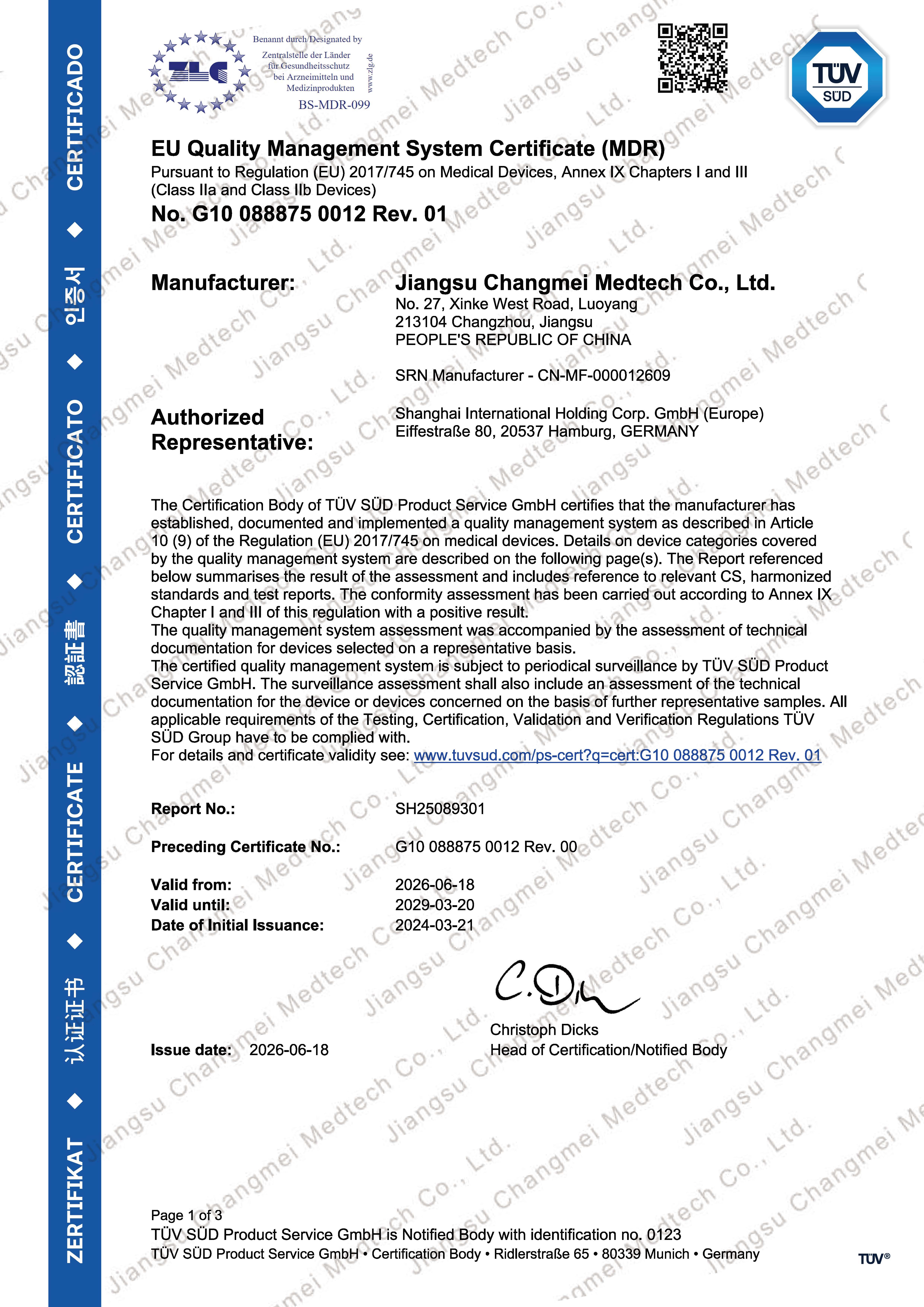
The first is the EU Quality Management System Certificate (MDR), number G100888750012 Rev. 01, issued by TÜV SÜD Product Service GmbH on 18 June 2026 and valid until 20 March 2029. It covers Class IIa and Class IIb medical devices assessed under Regulation (EU) 2017/745, Annex IX, Chapters I and III. The device annex for this certificate includes the kyphoplasty balloon catheter family and the tool kits — KB0115, KB0115S1, KB0120, KB0120S1, KB0210, KB0210S1, KT-00-01, and KT-00-05.
The second is the EU Quality Assurance Certificate (MDR), number G21 088875 0011 Rev. 00, issued 21 March 2024 and valid until 20 March 2029, covering Class I sterile medical devices under Annex XI, Part A of the same regulation. This certificate applies to the Balloon Inflator BI-20A-10.
The distinction matters commercially. A Class IIa or IIb device is assessed through a quality management system route that requires notified body review of technical documentation. A Class I sterile device follows a production quality assurance route. A buyer assembling a European tender file for a complete PKP system — catheter, tool kit, and inflator — therefore needs both certificates, because the inflator does not sit under the same annex as the catheters.
CE 0123 and the Notified Body Behind the Tool Kit
Under EU MDR, the four-digit number printed after the CE marking identifies the notified body involved in the conformity assessment. The CE 0123 marking appears on the CHANGMEI Kyphoplasty Tool Kit KT-00-05 and on the 8G KT-00-01 instrument set.
In Changmei's certification records, the notified body named on the EU certificates is TÜV SÜD Product Service GmbH, which also audits the manufacturer's quality system. For a verifying buyer this creates a straightforward cross-check: the number on the product, the issuing body on the certificate, and the model listed in the certificate annex should all agree. A mismatch — a CE 0123 tray paired with an annex that does not list that tray — is a documentation gap, no matter how the product is marketed.
United States: 510(k) K223709 and Establishment Registration 3016789487
Two separate FDA records apply to the CHANGMEI kyphoplasty range, and they cover different products.
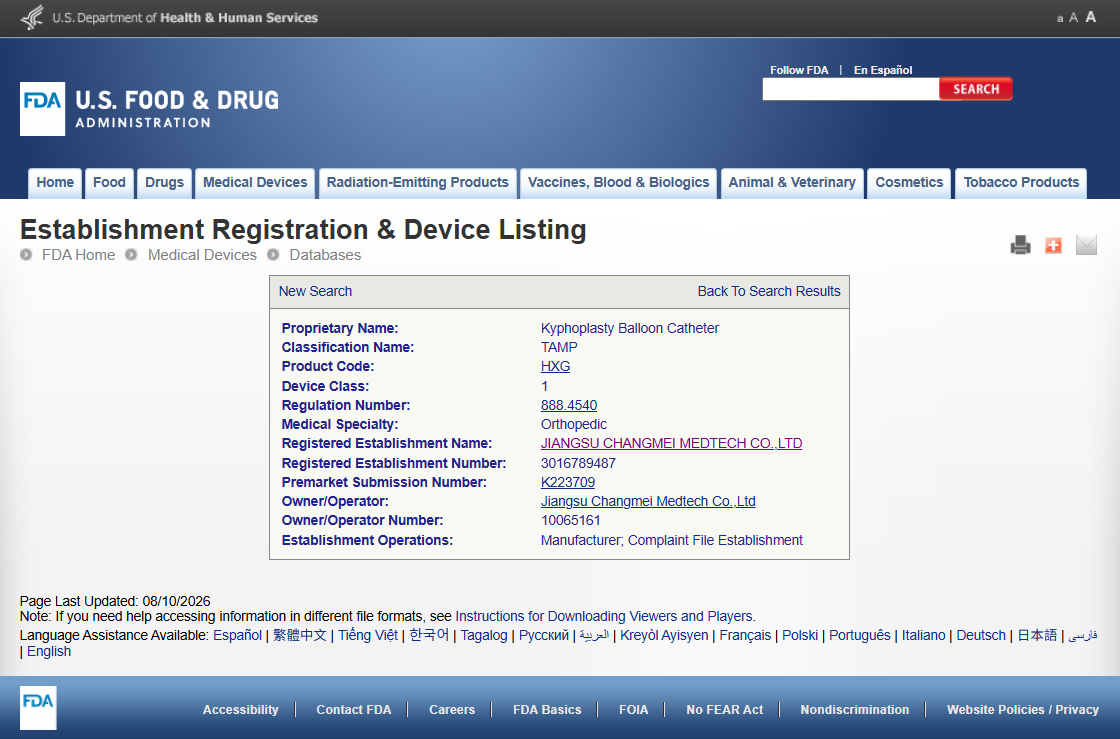
The 510(k) Premarket Notification K223709 was cleared by the U.S. Food and Drug Administration on 16 August 2023 for the kyphoplasty balloon catheter, under Product Code HRX, Class II, 21 CFR 888.1100. The cleared model list covers KB0210, KB0115, KB0115S1, KB0120, KB0120S1, and KB0210S1 — the 8G and 11G balloon catheter families, including the two 8G models KB0115 and KB0120.
The FDA Establishment Registration & Device Listing, number 3016789487, issued 31 July 2023 and recorded as valid through 31 December 2029, applies to the Balloon Inflator and to the Kyphoplasty Tool Kits KT-00-01 and KT-00-05.
The Balloon Inflator BI-20A-10 is described as CE MDR certified, NMPA China Class II certified, and as following a claimed FDA-cleared pathway. That last statement should be read as the manufacturer's own description rather than as a separate premarket clearance number — 510(k) K223709 is specific to the balloon catheter.
ISO 13485: The Layer Underneath Every Other Certificate
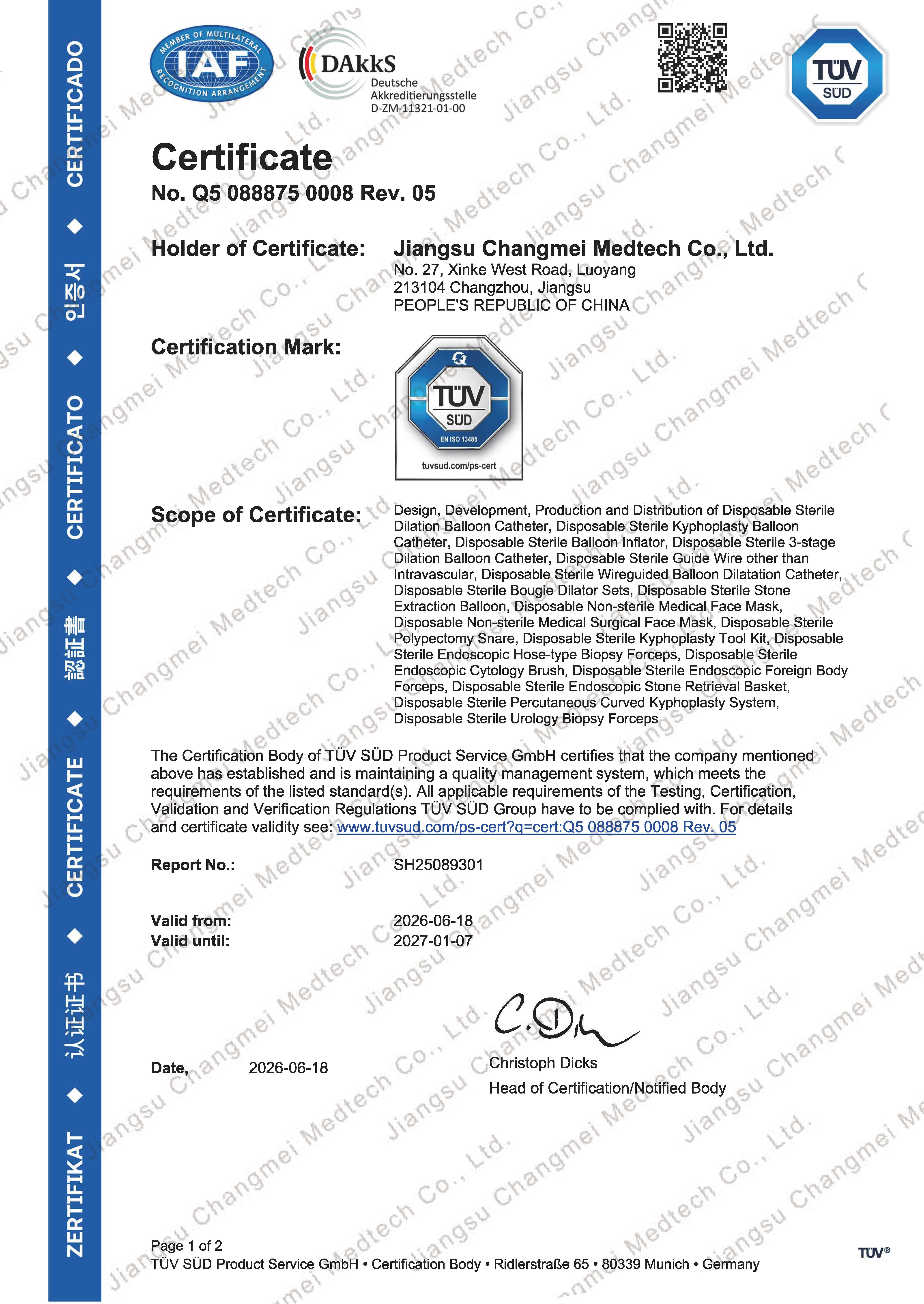
ISO 13485 certification is what allows the other certificates to exist. CHANGMEI's Quality Management System Certificate, number Q5 088875 0008 Rev. 05, is issued by TÜV SÜD Product Service GmbH and refers to ISO 13485:2016, including EN ISO 13485:2016/AC:2018 and EN ISO 13485:2016/A11:2021. It was issued 28 June 2026 and runs to 7 January 2027, covering the design, development, production, and distribution of disposable sterile medical devices across the EU, Asia, Middle East, and South America.
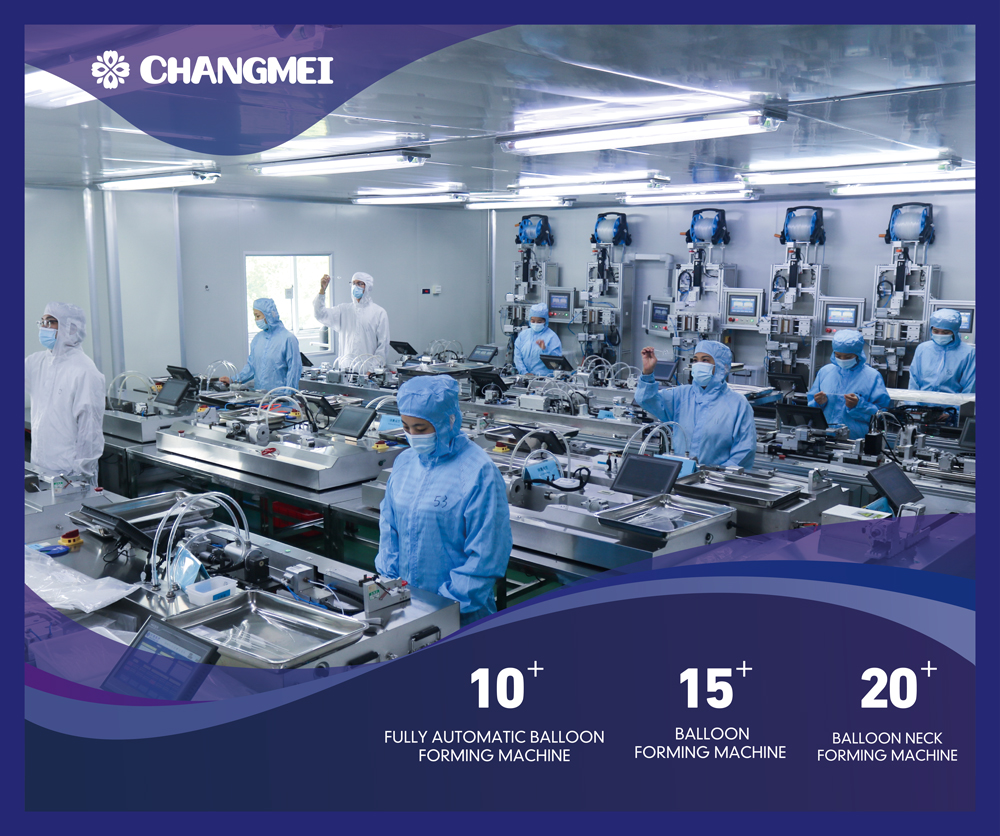
The scope statement is the useful part for a buyer. It confirms that design control — not only manufacturing — falls inside the audited system, which is the prerequisite for OEM and ODM programmes that modify gauge, length, or instrument configuration. Production takes place in a 51,985 m² facility in Changzhou with GMP-class cleanroom manufacturing, including ISO Class 7 cleanroom assembly, and finished devices undergo 100% testing.
EO Sterilization and the Single-Use Rule
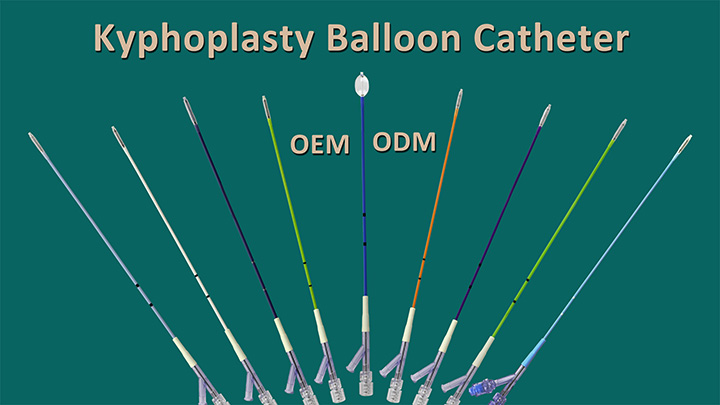
Every CHANGMEI kyphoplasty balloon catheter, tool kit, and balloon inflator in this range is ethylene oxide (EO) sterilized and supplied for single use. EO is a low-temperature sterilization method widely used for polymer-based devices because it avoids the heat and moisture that can degrade thermoplastic components — relevant here, because the balloon film is medical-grade thermoplastic polyurethane mounted on a polyurethane shaft with a polycarbonate handle, while the inflator body is moulded from polycarbonate with polyurethane, silicone, and polyoxymethylene components.
For the balloon catheters, the sterilization claim is paired with a validated three-year shelf life, and each unit passes factory pressure and seal testing to reduce the risk of intraoperative burst or leakage. The operating rule that follows is unambiguous: the device is used immediately once the package is opened, re-sterilization is not permitted, and reuse is prohibited. The instructions for use — not a distributor's summary — govern the full set of conditions, including contraindications such as a damaged vertebral posterior edge, nerve injury, infection at the operative site, or uncorrectable coagulopathy.
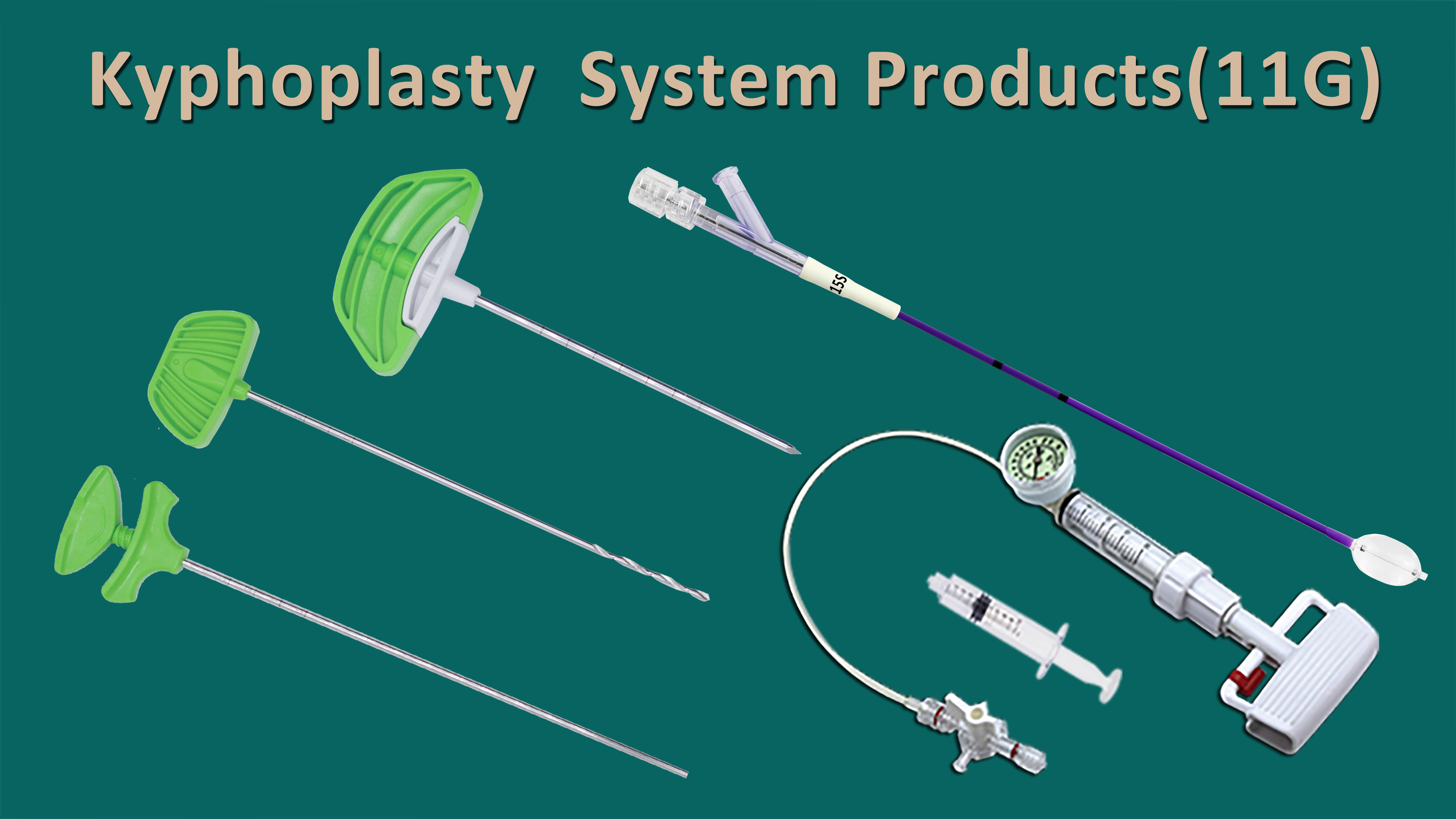
Sterilization status is therefore a chain rather than a checkbox: EO process, validated shelf life, intact packaging, and a documented single-use restriction. Break any link and the sterility assurance claim no longer holds at the point of use. For the 11G KT-00-05 kit, the same logic applies to the nine instruments inside the tray — two puncture expandor modules (KT-07-01), one bone drill (KT-09-01), and six bone cement filling devices (KT-08-01), fabricated mainly from 06Cr19Ni10 medical-grade stainless steel with 32Cr13Mo stainless steel at the puncture stylet and expandor cutting tips.
The Inflator: A Separate Certificate on the Same System
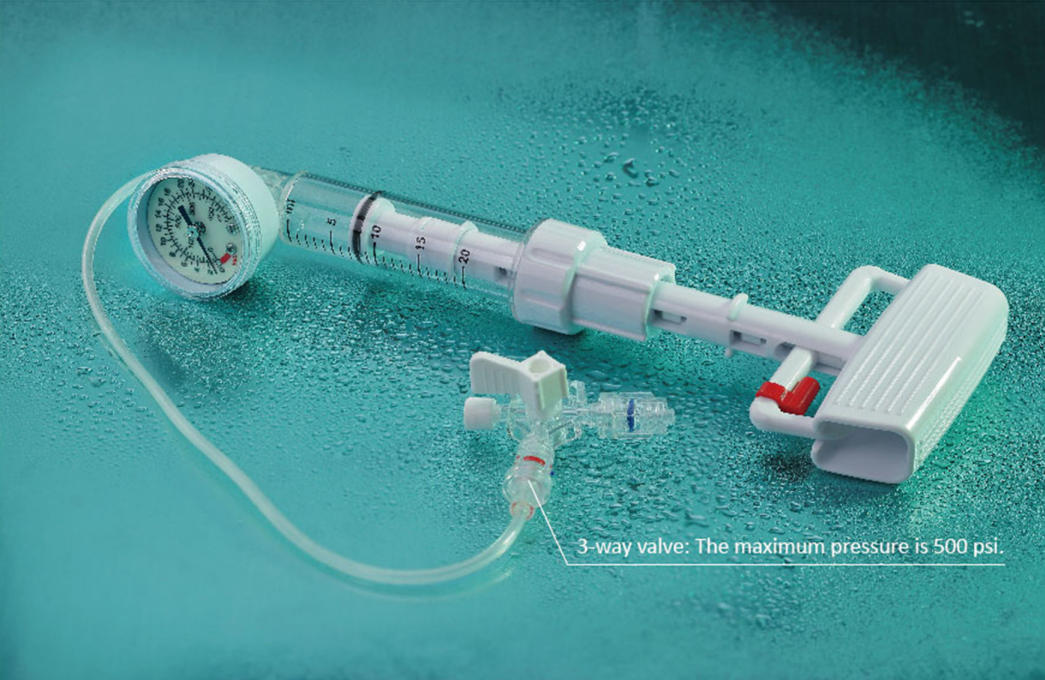
The Balloon Inflator BI-20A-10 completes the system and sits on its own certificate. It has a nominal capacity of 20 cc and a maximum pressure of 30 atm, and is supplied with a preconfigured 10 ml syringe for hydraulic connection to 8G kyphoplasty balloon catheters. It is EO sterilized, single use, CE MDR certified, NMPA China Class II certified, and covered by the EU Quality Assurance Certificate (MDR) G21 088875 0011 Rev. 00 for Class I sterile devices. Because it is the pressure source for the balloon, its certificate is read alongside the catheter certificate in every European file.
Step by Step: How a Buyer Verifies Kyphoplasty Compliance
The sequence below works for a hospital tender, a distributor registration file, or an OEM qualification. It starts with a certificate number and ends with a technical file that a regulator can follow.
- Define the market and the device class first. A European Class IIa or IIb balloon catheter, a European Class I sterile inflator, and a US Class II catheter each require a different document set. Deciding the market after the order is placed is the most common cause of late-stage documentation failures.
- Match the certificate number to the exact model. Write the model — KB0115, KB0120, KT-00-05 — next to the annex that lists it. For the EU file that means EU Quality Management System Certificate (MDR) G100888750012 Rev. 01 for catheters and tool kits, and EU Quality Assurance Certificate (MDR) G21 088875 0011 Rev. 00 for the inflator. For the US file that means 510(k) K223709 for catheters and Establishment Registration 3016789487 for tool kits and the inflator.
- Confirm the notified body and the marking. Check that the four-digit number on the device — CE 0123 on the KT-00-01 and KT-00-05 tool kits — corresponds to the body named on the certificate. In this case the EU certificates are issued by TÜV SÜD Product Service GmbH.
- Verify the sterilization and shelf-life statement against the IFU. EO sterilization, single-use designation, three-year validated shelf life, and the prohibition on re-sterilization should all appear in the instructions for use that ship with the product, not only in sales documentation.
- Check the layer underneath: the quality system. Review the ISO 13485 certificate scope, certificate number Q5 088875 0008 Rev. 05, the issuing body, and whether design and development are included. Then confirm the manufacturing environment — cleanroom class, facility size, and testing regime — because that is where the certificate is actually earned.
- Close the commercial loop last. Only after steps one to five should configuration, labelling, minimum order, and lead time be finalised, because those terms determine which regulatory documents must be transferred into the buyer's own file.
Verification checklist: certificate number → issuing body → device class and annex → exact model in the annex → marking on the device → sterilization statement → validated shelf life → IFU restriction on reuse → quality system scope → manufacturing environment. Ten links; one missing link is enough to stall a registration file.
Where Compliance Documentation Changes the Purchase
Tertiary hospitals and spine surgery centres. When a hospital adds a percutaneous kyphoplasty system to an approved vendor list, the compliance file is evaluated as a unit: EU MDR certificates for the European tender, 510(k) K223709 where US practice is involved, ISO 13485 for the quality system, and confirmation that the balloon catheter, the tool kit, and the inflator are all covered — since the inflator sits on a separate EU certificate from the catheters.
Ambulatory surgery centres. ASCs performing vertebral augmentation work with a narrower instrument inventory and a stronger preference for single-use, pre-sterilized trays. The KT-00-05 kit's fixed nine-piece loadout removes the need to assemble instruments from separate sterile packs, and the EO-sterilized single-use format removes reprocessing from the workflow entirely.
Distributors and importers. Registration in a national market depends on transferable documents: certificate numbers, annexes, IFU language variants, and labelling. The manufacturer's stated OEM and ODM scope includes product labelling and language, which is what allows a distributor to prepare a market-specific file instead of resubmitting the manufacturer's original documentation.
OEM and ODM partners. Customisation of gauge, length, and instrument configuration is only meaningful if the design control system sits inside the audited quality scope. That is why the ISO 13485 scope statement, which explicitly includes design and development, is read together with the MDR certificate rather than separately from it.
Clinical application context. Balloon kyphoplasty is used for painful vertebral compression fractures caused by osteoporosis, low-energy trauma, or neoplasia, and for symptomatic vertebral hemangiomas. A documented application of the technique — the egg shell technique in a vertebral compression fracture case in Kuwait — illustrates how procedural choice interacts with device selection; the reference report is available at czmed.com.
Comparison: Certificate Coverage and Model Reference
The table below maps every certification record discussed above to the products it covers. It is the fastest way to see which document belongs in which market file.
| Certificate | Issuing body | Regulatory basis | Number | Covered products | Market | Issued / Valid |
|---|---|---|---|---|---|---|
| EU Quality Management System Certificate (MDR) | TÜV SÜD Product Service GmbH | MDR (EU) 2017/745, Annex IX Chapters I & III (Class IIa / IIb) | G100888750012 Rev. 01 | Kyphoplasty balloon catheters and tool kits: KB0115, KB0115S1, KB0120, KB0120S1, KB0210, KB0210S1, KT-00-01, KT-00-05 | EU | 18 Jun 2026 – 20 Mar 2029 |
| EU Quality Assurance Certificate (MDR) | TÜV SÜD Product Service GmbH | MDR (EU) 2017/745, Annex XI Part A (Class I sterile) | G21 088875 0011 Rev. 00 | Balloon Inflator BI-20A-10 | EU | 21 Mar 2024 – 20 Mar 2029 |
| 510(k) Premarket Notification | U.S. Food and Drug Administration | Product Code HRX, Class II, 21 CFR 888.1100 | K223709 | Kyphoplasty balloon catheters: KB0210, KB0115, KB0115S1, KB0120, KB0120S1, KB0210S1 | US | Cleared 16 Aug 2023 |
| FDA Establishment Registration & Device Listing | U.S. Food and Drug Administration | Establishment registration and device listing | 3016789487 | Balloon Inflator; Kyphoplasty Tool Kits KT-00-01 and KT-00-05 | US | 31 Jul 2023 – 31 Dec 2029 |
| Quality Management System Certificate | TÜV SÜD Product Service GmbH | ISO 13485:2016 (EN ISO 13485:2016/AC:2018, EN ISO 13485:2016/A11:2021) | Q5 088875 0008 Rev. 05 | Design, development, production and distribution of disposable sterile medical devices | EU, Asia, Middle East, South America | 28 Jun 2026 – 7 Jan 2027 |
Model-level data belongs alongside the certificate table. The following reference covers the three models named in this guide, plus the 11G catheter they pair with and the inflator.
| Model | Type | Size | Marker span | Channel ID | Overall length | Max volume | Burst pressure | Sterilization |
|---|---|---|---|---|---|---|---|---|
| KB0115 | Kyphoplasty balloon catheter | 8G | 15 mm | ≥3.65 mm | 315 mm | 4 cc | ≥400 PSI | EO, single-use |
| KB0120 | Kyphoplasty balloon catheter | 8G | 20 mm | ≥3.65 mm | 315 mm | 6 cc | ≥400 PSI | EO, single-use |
| KT-00-05 | Tool kit (9 instruments) | 11G | — | — | — | — | — | EO, single-use |
| KB0210S1 (paired 11G catheter) | Kyphoplasty balloon catheter | 11G | 10 mm | ≥3.10 mm | 280 mm | 3 cc | ≥400 PSI | EO, single-use |
| BI-20A-10 | Balloon inflator | — | — | — | — | 20 cc | 30 atm | EO, single-use |
FAQ: CE 0123, CE MDR Manufacturers, and Sterilization
What does CE 0123 mean on a kyphoplasty tool kit, and what should buyers request from a CE MDR kyphoplasty system manufacturer?
CE 0123 is the four-digit notified body identification number that accompanies the CE marking where a notified body has performed the conformity assessment. On CHANGMEI products, the marking appears on the Kyphoplasty Tool Kits KT-00-01 and KT-00-05. A buyer should request the EU Quality Management System Certificate (MDR) number G100888750012 Rev. 01, issued by TÜV SÜD Product Service GmbH and valid until 20 March 2029, then confirm that the specific tool kit is listed in the certificate annex. For the Balloon Inflator BI-20A-10, the corresponding document is the EU Quality Assurance Certificate (MDR) G21 088875 0011 Rev. 00, which covers Class I sterile devices under Annex XI Part A.
Are the KB0115 and KB0120 balloon catheters cleared for both the EU and the US markets?
Both are 8G kyphoplasty balloon catheters and both appear in the same two records. In the EU they are listed in the annex of Quality Management System Certificate (MDR) G100888750012 Rev. 01, which covers Class IIa and Class IIb devices under MDR (EU) 2017/745 Annex IX. In the United States both fall within FDA 510(k) K223709, cleared on 16 August 2023 under Product Code HRX, Class II, 21 CFR 888.1100. That same clearance also covers KB0115S1, KB0120S1, KB0210, and KB0210S1.
Does compliance-documented supply change the cost structure of an order?
In this range, commercial terms are driven by configuration rather than by the certificates themselves. Standard in-stock products carry a minimum order of 10 sets, and OEM/ODM quantities are negotiable against the specific requirement. What does change with a documented programme is the volume of supporting material transferred to the buyer: technical documents, regulatory assistance, and marketing materials form part of the stated support scope, and product labelling and language customisation are available within the OEM/ODM programme. Buyers should therefore price the register-ready package, not the device in isolation.
Can a distributor evaluate a sample before committing to a full order?
Evaluation typically begins with a standard in-stock configuration, where the stated minimum is 10 sets, since OEM/ODM quantities are negotiated directly rather than drawn from a catalogue figure. The important point for a compliance reviewer is that the certification position does not change between an evaluation unit and a production unit: the same EU MDR certificate, ISO 13485 quality system, EO sterilization process, and validated three-year shelf life apply to both. This makes a small initial allocation a practical way to confirm packaging, IFU language, and labelling before a registration file is built around it.
What lead time and documentation accompany a compliance-documented kyphoplasty order?
Lead time is stated as 30–45 days, with a minimum order of 10 sets for standard in-stock products and negotiable quantities for OEM/ODM configurations. Documentation supplied alongside the order follows the market: EU MDR certificate numbers G100888750012 Rev. 01 and G21 088875 0011 Rev. 00, US records K223709 and 3016789487, and ISO 13485 certificate Q5 088875 0008 Rev. 05, together with the instructions for use and IFU language variants. To request the certificate set, a sample allocation, or a quotation, contact Mark at cyz@czmed.com or +86 138-1368-7682.
Conclusion: A Certificate Number Is a Specification
CE 0123 answers a narrow question — which notified body assessed the device — and that narrowness is precisely what makes it useful. Combined with certificate numbers G100888750012 Rev. 01 and G21 088875 0011 Rev. 00 for Europe, K223709 and 3016789487 for the United States, and Q5 088875 0008 Rev. 05 for the quality system, it gives a procurement team a set of checkable references instead of a marketing claim.
For the kyphoplasty models discussed here — KB0115, KB0120, and the KT-00-05 tool kit — the compliance position is layered: EU MDR coverage for catheters and tool kits, a separate EU certificate for the inflator, US 510(k) clearance for the balloon catheter family, establishment registration and device listing for the tool kits and inflator, and EO sterilization with a validated three-year shelf life on single-use devices.
Jiangsu Changmei Medtech Co., Ltd. operates from a 51,985 m² facility in Changzhou, Jiangsu, with 40 engineers in research and development, an annual output of 1,000,000 kyphoplasty balloon catheters, exports to the EU, USA, Asia, South America, and the Middle East, and a reported share of approximately 80% of the Chinese kyphoplasty balloon catheter market. Further detail is available at www.czmed.com.
Request Documentation, a Sample, or a Quote
Buyers preparing a European or US registration file can request the certificate set, the instructions for use, and model-level specifications alongside a sample allocation or quotation.
Download the Kyphoplasty System Products (8G & 11G) CE and FDA brochure:
Kyphoplasty System Products (8G & 11G) — CE and FDA (PDF)
Contact: Mark · cyz@czmed.com · Tel / WhatsApp +86 138-1368-7682 · No.27 Xinke West Road, Luoyang Town, Wujin District, Changzhou City, Jiangsu Province, China