Kyphoplasty Supplier Evaluation: How to Verify a Real Factory vs. Trading Company
Short answer: you verify a kyphoplasty supplier by matching the legal entity that signs your purchase contract to the legal entity named on the ISO 13485 certificate, the EU MDR certificate and the FDA clearance or registration — and then confirming that the certificate scope actually includes design and production, not distribution alone. A trading company can quote a competitive price, but it cannot transfer manufacturing responsibility it never held.
Two suppliers can return near-identical quotations for the same 8G kyphoplasty balloon catheter, attach the same brochure, and still differ in the one way that matters commercially: which party owns the design files, the balloon forming line, the cleanroom and the certificates that let you sell the device in your market. This evaluation guide gives distributors, importers, hospital groups, group purchasing organizations (GPOs) and OEM/ODM buyers a document-first method they can run in roughly ten working days, illustrated with the evidence set of Jiangsu Changmei Medtech Co., Ltd.
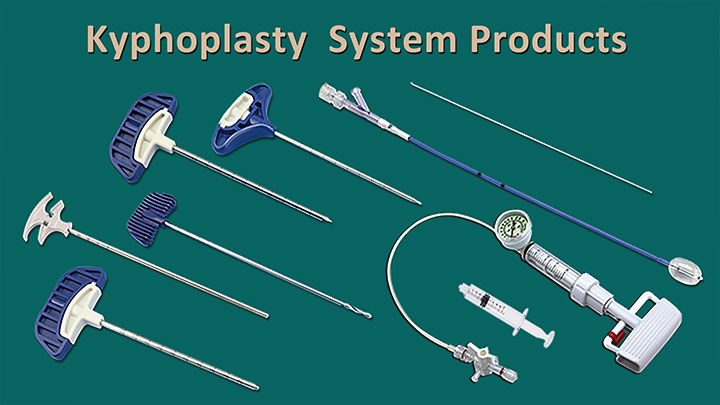
Kyphoplasty systems are sterile single-use devices, which means the supplier you verify must control balloon forming, welding and cleanroom assembly — not only distribution.
The Problem: What Actually Breaks When You Buy From a Non-Manufacturer
Intermediaries are a legitimate part of medical device distribution, and many trading companies add genuine value in logistics, financing and local service. The risk is not that a reseller exists; it is that the buyer cannot tell which party carries which obligation. In kyphoplasty procurement, that ambiguity surfaces in three specific places.
- Certificate-holder mismatch. The quotation arrives on one company's letterhead, the ISO 13485 certificate names a second company, and the FDA 510(k) summary names a third. No one in the chain can state who is legally responsible for the design.
- Capacity promises without process. Sterile single-use balloon catheters depend on balloon forming, laser welding and ISO Class 7 cleanroom assembly. A reseller can promise volume, but volume depends on equipment it does not operate.
- OEM and private-label accountability. Once your brand goes on the label, any design change, sterilization deviation or documentation update must be processed by whoever holds the technical file.
Decision rule: if the entity that signs your contract is not the entity named on the quality management system certificate covering design and production, treat the offer as a reseller offer and price the additional risk accordingly.
Industry Background: Why Kyphoplasty Buyers Are Raising the Bar
Kyphoplasty is a mature, procedure-driven category, so purchasing decisions increasingly turn on supply continuity and regulatory standing rather than novelty. Several market signals explain the shift.
- The global kyphoplasty market was valued at USD 764.13 million in 2025, with projections reaching USD 1,342.29 million by 2034 (Vertex AI Search / market research analysis).
- North America accounted for a revenue share of roughly 42.5%–50.0% in 2025 according to Grand View Research and Straits Research, which means US market access documents carry disproportionate commercial weight.
- The 2025 Medicare ambulatory surgical center rate for kyphoplasty (CPT 22513 and 22514) is approximately USD 3,510.84, a 3.5% increase over 2024, based on ASIPP/CMS figures. Procedure economics reward suppliers that keep cases on schedule.
On the regulatory side, the EU Medical Device Regulation has become a genuine filter rather than a formality. Jiangsu Changmei Medtech states that it was the first Chinese company to receive the EU MDR CE certificate for its kyphoplasty system products — a company announcement that illustrates how early the documentation burden now lands on Chinese manufacturers compared with the previous directive era.
The Five-Layer Verification Framework
Verification works best as layers rather than as a single question. Each layer produces a document or an observation that either matches your purchase contract or does not.
Layer 1 — Legal Entity and Certificate-Holder Identity
Start with names, because every later check depends on them. Collect the business licence, the certificate holder name on every quality certificate, the owner of the FDA registration or clearance, and the exact entity that will appear on your purchase contract and commercial invoice. In Changmei's case the operating entity is Jiangsu Changmei Medtech Co., Ltd., established in 2013 and headquartered in Jiangsu, China, manufacturing kyphoplasty balloon catheters, kyphoplasty tool kits and balloon inflators. Its FDA Establishment Registration and Device Listing number is 3016789487, issued on 31 July 2023 and valid through 31 December 2029.
Layer 2 — Quality Management System Scope Wording
The most informative sentence on any supplier's paperwork is the scope statement on the ISO 13485 certificate. Changmei holds certificate Q5 088875 0008 Rev. 05, issued by TÜV SÜD Product Service GmbH against ISO 13485:2016, covering design, development, production and distribution of disposable sterile medical devices, valid from 28 June 2026 to 7 January 2027, for the EU, ASIA, MIDDLE EAST and SOUTH AMERICAN markets. The words design and production are the discriminator: a distributor's certificate scope typically stops at distribution, storage or supply.
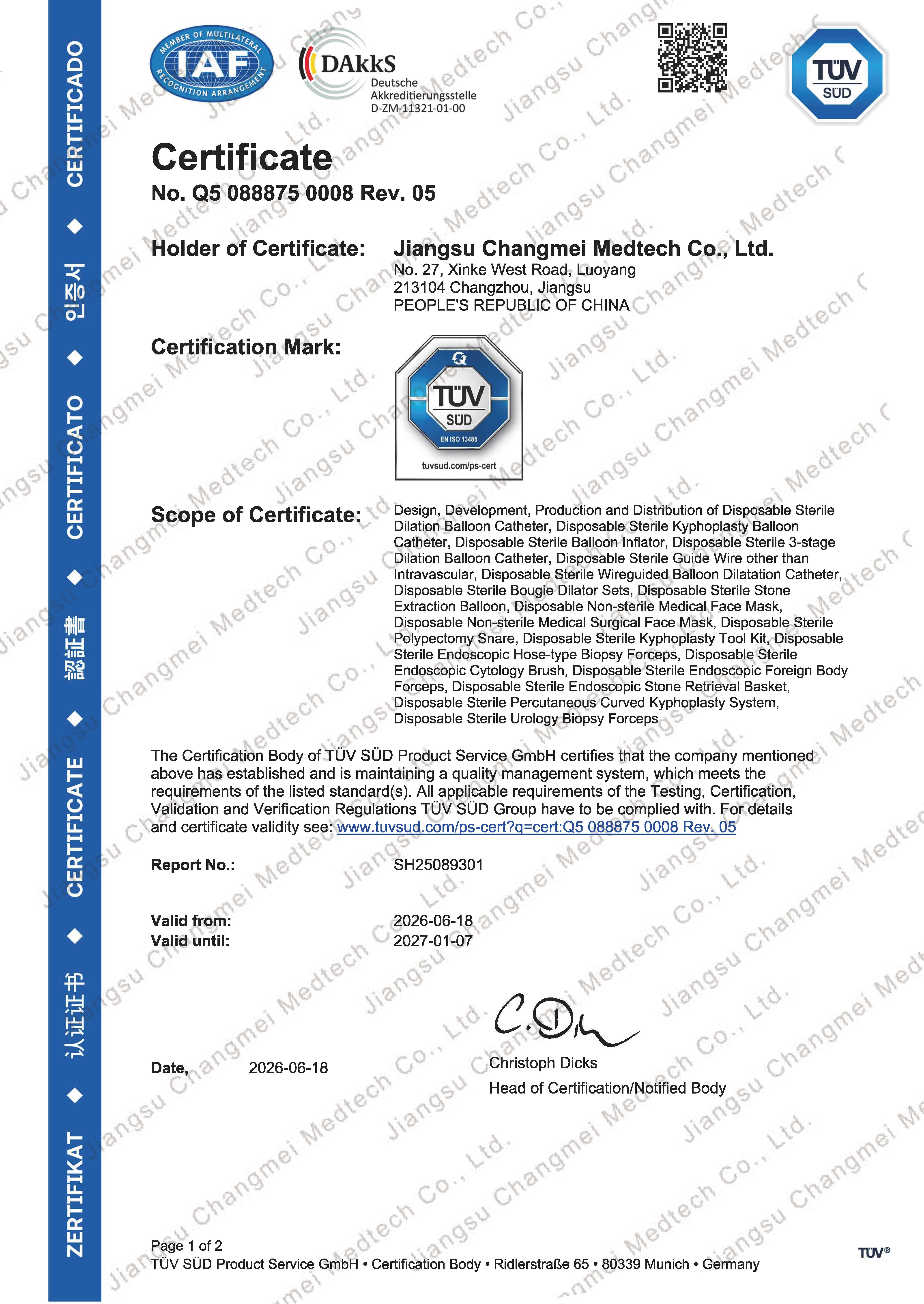
Proof layer: the ISO 13485 scope statement — design, development, production and distribution — is what separates a manufacturer's certificate from a distributor's.
Layer 3 — Market Access Documents for Your Destination Market
Next, match market access documents to the models you intend to buy, not to the company in general.
- EU MDR quality management system: certificate G100888750012 Rev. 01, issued by TÜV SÜD Product Service GmbH on 18 June 2026 and valid to 20 March 2029, covering Class IIa and Class IIb medical devices under Regulation (EU) 2017/745 Annex IX Chapters I and III.
- EU MDR quality assurance: certificate G21 088875 0011 Rev. 00, issued on 21 March 2024 and valid to 20 March 2029, covering Class I sterile medical devices under Annex XI Part A — the certificate that supports the Balloon Inflator BI-20A-10.
- US FDA 510(k): clearance K223709 for the Kyphoplasty Balloon Catheter, covering models that include KB0210, KB0115, KB0120, KB0115S1, KB0210S1 and KB0120S1.
- US FDA establishment registration and device listing: number 3016789487, covering the Balloon Inflator and the Kyphoplasty Tool Kit.
Buyers frequently confuse the last two entries. A 510(k) is a product-specific clearance; an establishment registration is a facility-level listing. A supplier that shows only a registration number while claiming product clearance has not answered the question you asked.
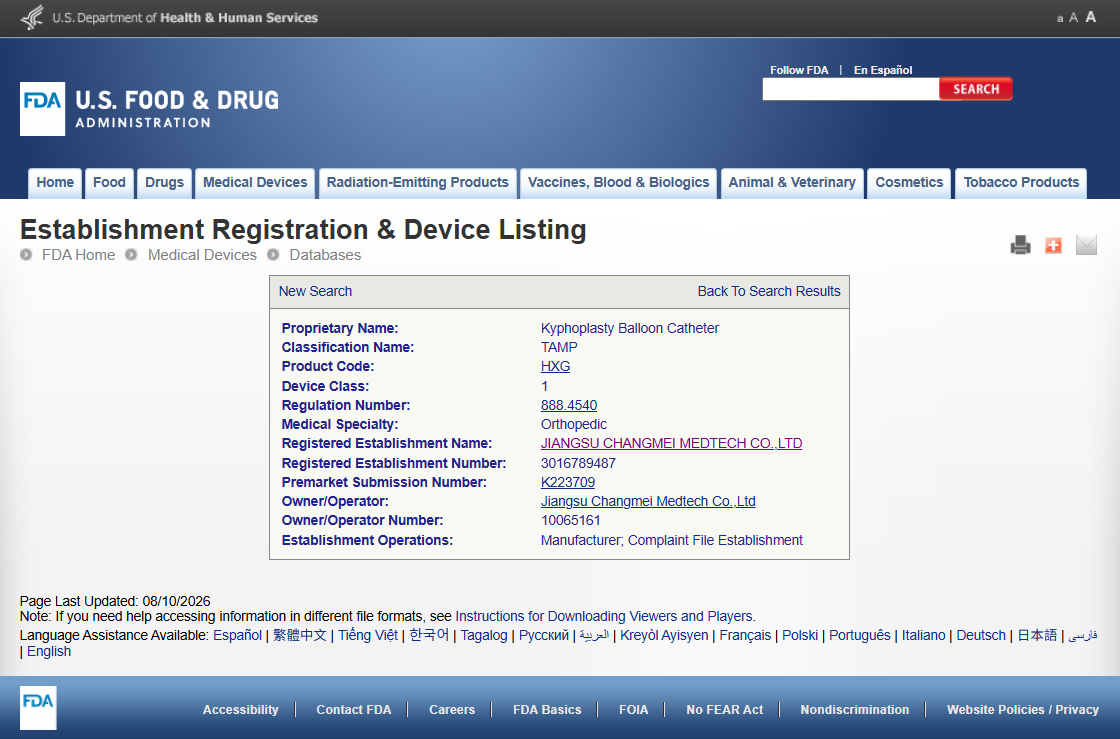
Market access check: FDA 510(k) K223709 lists the kyphoplasty balloon catheter models covered by the clearance.
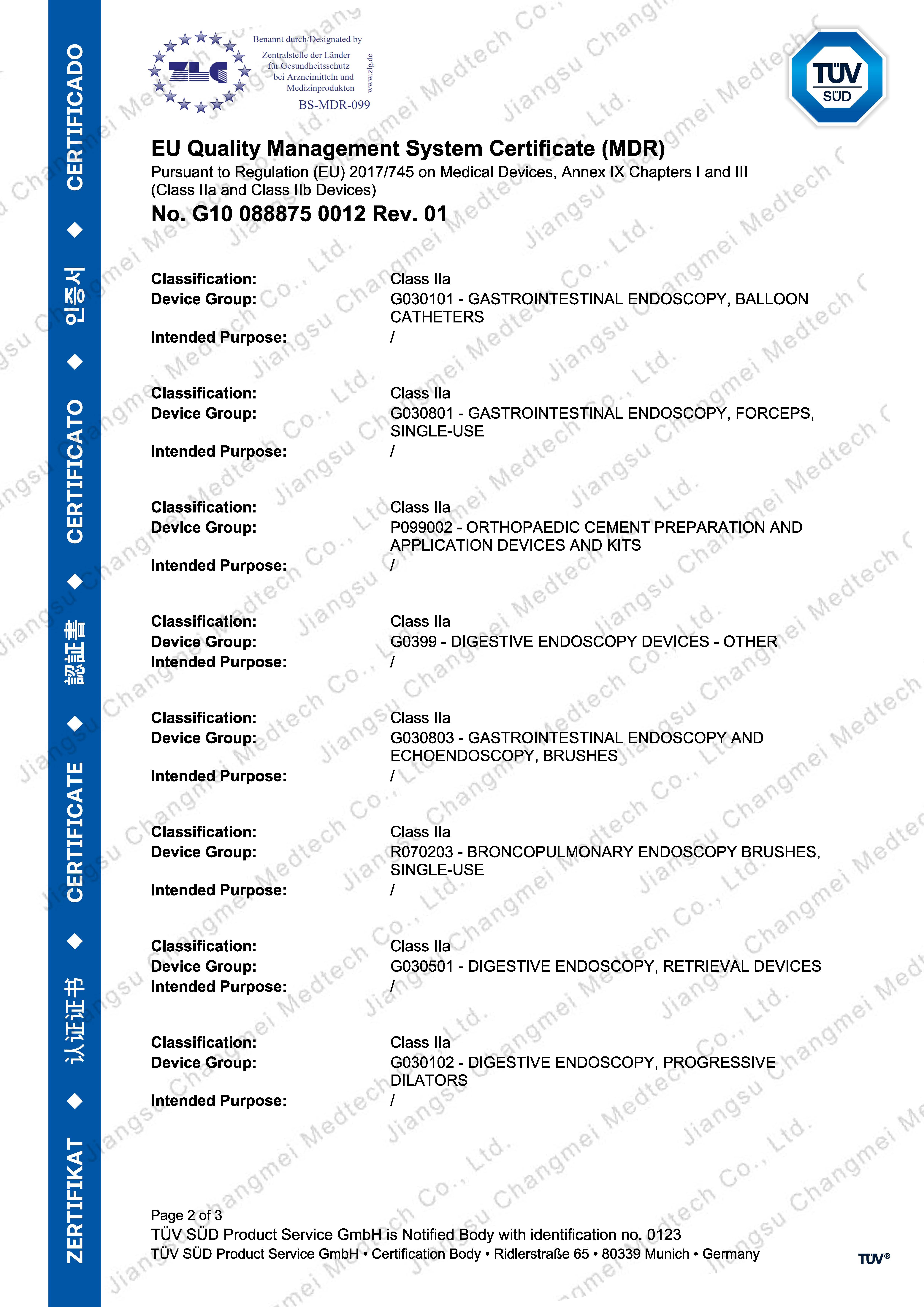
EU evidence: certificate G100888750012 Rev. 01 covers Class IIa and Class IIb devices under MDR (EU) 2017/745 Annex IX Chapters I and III.
Layer 4 — Physical, Process and Capacity Evidence
Documents can be forwarded; equipment cannot. Ask for a live or recorded walkthrough that shows the process steps your product actually depends on. Changmei's production base is a 51,985 m² facility with in-house CNC machining, laser welding, balloon forming and ISO Class 7 cleanroom assembly under an ISO 13485-certified quality system, staffed by 235 employees with a 40-engineer R&D team. Capacity statements should be numeric and written: 1,000,000 kyphoplasty balloon catheters annually and 500,000 units monthly, with quality control described as 100% testing. Export activity should be specific rather than global-sounding: Changmei lists the EU, USA, ASIA, SOUTH AMERICA and MIDDLE EAST as its main markets, with an export ratio of about 30% and contract manufacturing partners in Europe.
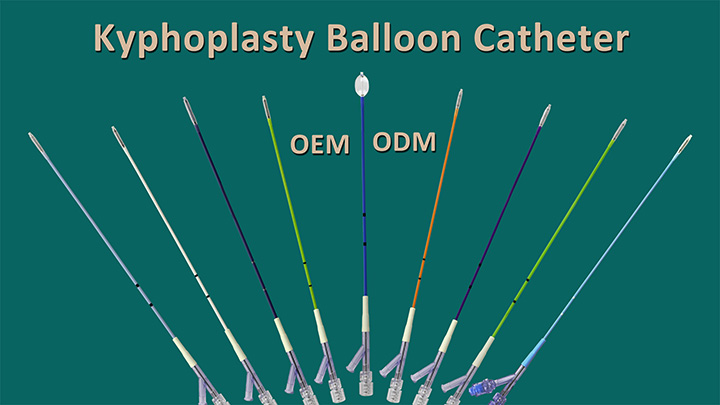
Process verification: balloon forming, laser welding and cleanroom assembly are the steps an intermediary cannot demonstrate.
Layer 5 — Model-Level Technical Traceability
A real manufacturer can answer parameter questions about the exact model on your purchase order within a day, because the data sits in its technical file. Traders tend to answer with catalogue pages. Test this with two or three questions per model: marker distance, channel inner diameter, usable length, maximum inflation volume and constrained burst pressure. For the KB0115 — an 8G kyphoplasty balloon catheter used in orthopedic surgery, spine surgery, pain management and interventional pain clinics — the documented values are a 15 mm distance between the two radiopaque markers, a channel ID of ≥3.65 mm, 315 mm overall length, 4 cc maximum volume and ≥400 PSI constrained burst pressure, built from medical-grade thermoplastic polyurethane on a PU shaft with a stainless-steel stylet.
Step-by-Step: A Ten-Day Verification Breakdown
- Day 1 — Build the entity file. Collect the business licence, the name on the intended contract, the name on each certificate, and the FDA registration or clearance owner. Flag any mismatch before you price the offer.
- Day 1–2 — Read the scope statements. Confirm the ISO 13485 scope covers design and production, and record certificate numbers and validity dates for your audit file.
- Day 2 — Match market access documents to your models. Cross-check the CE MDR scope by device class and the FDA 510(k) model list against the SKUs you intend to purchase.
- Day 3–5 — Verify the facility. Request a live or recorded video audit of balloon forming, welding and cleanroom assembly, and ask explicitly which production steps, if any, are outsourced.
- Day 5 — Verify capacity and lead time in writing. Ask for monthly and annual output figures and a committed lead time. Changmei quotes 30–45 days lead time, a standard in-stock minimum order quantity of 10 sets, and negotiable OEM/ODM quantities based on the specific requirement.
- Day 5–7 — Verify model-level documentation. Request specification sheets, material declarations and the instructions for use for each ordered model rather than a general catalogue.
- Day 7 — Verify quality and sterilization records. Confirm 100% testing, ethylene oxide sterilization, single-use labelling and the stated 3-year shelf life, and check that the IFU matches the label.
- Day 8–10 — Verify commercial and support terms. Confirm customization options (balloon diameter and length, cannula size and length, handle colour and logo, packaging design, product labelling and language), the after-sales scope, and documented export-market experience.
Worked Example: Verifying Consistency for KB0115 and KT-00-05
The purpose of verification is not a one-off approval; it is confidence that the same specification arrives on order five as on order one. Take two items a distributor might buy from the same supplier: the 8G KB0115 balloon catheter and the 11G KT-00-05 tool kit. A documented, consistent supply chain should be able to produce the following without referring back to a third party.
| Verification item | 8G configuration | 11G configuration | Why the buyer needs it |
|---|---|---|---|
| Balloon catheter model | KB0115 — 15 mm radiopaque marker distance | KB0210S1 — 10 mm radiopaque marker distance | The ordered model must appear in the certificate scope you verified |
| Catheter size / gauge | 8G | 11G | Gauge must match the paired instrument kit |
| Channel ID | ≥3.65 mm | ≥3.10 mm | Determines guide wire and cement delivery compatibility |
| Overall length | 315 mm | 280 mm | Affects approach planning in the OR |
| Maximum volume | 4 cc | 3 cc | Drives cavity creation planning |
| Constrained burst pressure | ≥400 PSI | ≥400 PSI | Inflation safety margin under load |
| Paired tool kit | KT-00-01 (8G), containing 2 puncture devices KT-01-01, 1 puncture expandor KT-02-01, 2 expandor devices KT-03-01, 1 bone drill KT-05-01, 2 guide wires KT-06-01 and 6 bone cement filling devices KT-04-01 | KT-00-05 (11G), containing 2 puncture expandor modules KT-07-01, 1 bone drill KT-09-01 and 6 bone cement filling devices KT-08-01 | Kit content must match the gauge and the purchase order line by line |
| Balloon inflator | BI-20A-10 — 20 cc, 30 atm | BI-20A-10 — 20 cc, 30 atm | Covered by the Class I sterile EU MDR certificate |
| Materials declaration | TPU balloon on PU shaft, radiopaque markers, stainless-steel stylet, polycarbonate handle | Kit metal parts in 06Cr19Ni10 steel; puncture stylet and cutting tips in 32Cr13Mo steel | Material statements belong in the technical file, not in a sales email |
A supplier that can populate this table from its own technical file, and whose certificate scopes cover the named models, has demonstrated something no price list can: that the specification you validated is the specification that will be manufactured. That is the operational meaning of consistency, and it is what makes repeat orders predictable.
Who Should Apply This Framework
- Distributors and importers building a multi-year kyphoplasty portfolio need a supplier whose EU or US documents survive tender review, not simply a competitive quotation.
- Hospital groups, GPOs and ASC networks should confirm that the manufacturer can hold a committed lead time, because procedure scheduling depends on instrument availability.
- OEM and private-label brand owners need a partner able to handle balloon diameter and length, cannula sizing, handle colour and logo, packaging design and labelling language changes without losing certificate coverage.
- Pain management and interventional clinics buying smaller volumes should confirm the minimum order quantity before shortlisting — a 10-set standard MOQ keeps a first evaluation order practical.
Comparison: Manufacturer, Trading Company and Hybrid Broker
The table below compares what each supplier type can normally evidence. It is a checklist of expectations, not a ranking of named companies.
| Verification point | Vertically integrated manufacturer | Trading company | Hybrid broker / OEM reseller |
|---|---|---|---|
| Legal name on contract vs. certificates | Same entity across contract, ISO 13485, CE MDR and FDA documents | Contract entity differs from the certificate holder | Usually matches a purchased certificate, not a production site |
| ISO 13485 scope wording | Design, development, production and distribution | Distribution, storage or supply only | Distribution, or no direct coverage |
| EU MDR certificates | Held in the manufacturer's own name, with class and annex references | Not held; forwarded copies from the supplier's upstream partner | Occasionally held for selected models only |
| FDA 510(k) ownership | Clearance owned by the contracting manufacturer | Registration or listing shown in place of a product clearance | Mixed; verify model list against the clearance |
| Facility, cleanroom and process evidence | Auditable facility, cleanroom assembly, in-house welding and balloon forming | Office or warehouse only; production shown via third-party photos | Variable, usually outsourced |
| Model-level parameter depth | Answers marker distance, channel ID, length, volume and burst pressure per model | Forwards catalogue pages or general brochures | Answers for mainstream models only |
| Capacity commitment | Numeric monthly and annual output with 100% testing | No owned capacity; depends on the upstream factory schedule | Allocated capacity with limited visibility |
| OEM / private-label control | Customization on balloon dimensions, cannula sizing, logo, packaging and labelling | Cannot change tooling or packaging specification upstream | Customization limited to labelling and artwork |
| Typical risk profile | Capacity and lead-time risk predictable and contractual | Documentation and traceability risk at audit or tender | Split responsibility between broker and factory |
Red Flags, Limits and What This Framework Cannot Prove
Document verification is a filter, not a guarantee. Three limitations are worth stating plainly, because over-claiming here would undermine the method itself.
- Certificates expire and get revised. Changmei's ISO 13485 certificate runs to 7 January 2027 and its EU MDR quality management system certificate to 20 March 2029, so an audit file assembled today will need refreshing at each renewal cycle.
- Scope language needs interpretation. A certificate covering distribution is valid documentation — it simply answers a different question than the one you asked about production.
- Documents do not replace an audit. Where contract value or regulatory exposure is high, an on-site or remote supplier audit, plus any applicable notified body or customer audit trail, remains the stronger evidence.
Common red flags that justify pausing an evaluation: a certificate holder name that differs from the contracting entity without explanation; a 510(k) claimed for models that do not appear in the clearance; refusal to show production steps on video; capacity figures given only as large or unlimited; and a lead time that changes between the quotation and the proforma invoice.
FAQ: Kyphoplasty Supplier Verification
How do I verify that a kyphoplasty supplier's CE and FDA documents actually cover the models I am buying?
Check three things: the certificate holder's legal name, the document's scope wording, and the model list. Changmei's EU quality management system certificate G100888750012 Rev. 01 was issued by TÜV SÜD Product Service GmbH on 18 June 2026 and is valid to 20 March 2029, covering Class IIa and Class IIb medical devices under MDR (EU) 2017/745 Annex IX Chapters I and III. Its EU quality assurance certificate G21 088875 0011 Rev. 00 covers Class I sterile devices under Annex XI Part A, which is the basis for the Balloon Inflator BI-20A-10. On the US side, FDA 510(k) K223709 covers the Kyphoplasty Balloon Catheter, while FDA Establishment Registration and Device Listing 3016789487 covers the Balloon Inflator and the Kyphoplasty Tool Kit. If the model you are buying sits outside those scopes, the document does not support your order.
What proves a supplier is a real kyphoplasty factory rather than a trading company?
Three evidence sets. First, ISO 13485 scope wording: Changmei's certificate Q5 088875 0008 Rev. 05, issued by TÜV SÜD Product Service GmbH, covers design, development, production and distribution of disposable sterile medical devices — design and production are the words a trading company usually cannot show. Second, physical assets: a 51,985 m² facility with in-house CNC machining, laser welding, balloon forming and ISO Class 7 cleanroom assembly, 235 employees and a 40-engineer R&D team. Third, process records: 100% product testing plus ethylene oxide sterilization documentation for single-use devices. Ask for a live or recorded walkthrough of the balloon forming and welding areas; intermediaries cannot stage those.
How should I compare a factory quotation with a trading company quotation?
Normalize the offers before comparing totals: who is named as certificate holder, who holds the technical file, what minimum order quantity applies, and what lead time is committed in writing. Changmei's standard in-stock products carry a 10-set MOQ, OEM/ODM minimum quantities are negotiable against the specific project, and the quoted lead time is 30–45 days. Procedure economics also matter: the 2025 Medicare ambulatory surgical center rate for kyphoplasty (CPT 22513 and 22514) is approximately USD 3,510.84, a 3.5% increase over 2024 according to ASIPP/CMS figures — a supply interruption typically costs more than a small unit-price gap.
What should a sample validation package contain before I place a volume order?
Ask for the exact model you intend to buy, not a generic demonstration unit. In an 8G configuration, the KB0115 balloon catheter specification is 15 mm radiopaque marker distance, ≥3.65 mm channel ID, 315 mm overall length, 4 cc maximum volume and ≥400 PSI constrained burst pressure. In an 11G configuration, the KT-00-05 tool kit contains two puncture expandor modules (KT-07-01), one bone drill (KT-09-01) and six bone cement filling devices (KT-08-01), and is engineered to pair with the KB0210S1 catheter (10 mm marker distance, ≥3.10 mm channel ID, 280 mm length, 3 cc maximum volume) and the BI-20A-10 balloon inflator (20 cc, 30 atm). Confirm that the model number on the sample appears in the certificate scope you checked in Layer 3.
How long should a qualified kyphoplasty manufacturer need for repeat orders — and which suppliers belong on a shortlist?
A manufacturer with its own capacity can commit to timelines it controls. Changmei reports an annual output of 1,000,000 kyphoplasty balloon catheters, monthly capacity of 500,000 units and a 30–45 day lead time, with remote after-sales support. When shortlisting manufacturers for a kyphoplasty system programme, include only suppliers whose documents you have independently verified, and treat company-reported figures such as Changmei's approximately 80% share of the Chinese kyphoplasty balloon catheter market, or its position as a qualified vendor to member companies of Medtronic and Stryker, as context for the decision rather than a substitute for it. A practical next step is to request the product catalogue and a model-matched sample set, then run the five verification layers against your own purchase contract.
Conclusion: Verify the Factory Before You Commit Volume
Supplier evaluation in kyphoplasty is a documentation exercise before it is a commercial one. Match the legal entity on your contract to the entity named on the ISO 13485 certificate, the EU MDR certificates and the FDA documents. Confirm that the scope includes design and production. Watch the process on camera. Test the supplier with model-level parameter questions on the exact catheter or tool kit you intend to buy. Then put lead time, minimum order quantity and customization terms in writing. Do that, and the difference between a manufacturer and an intermediary stops being a matter of trust and becomes a matter of record.
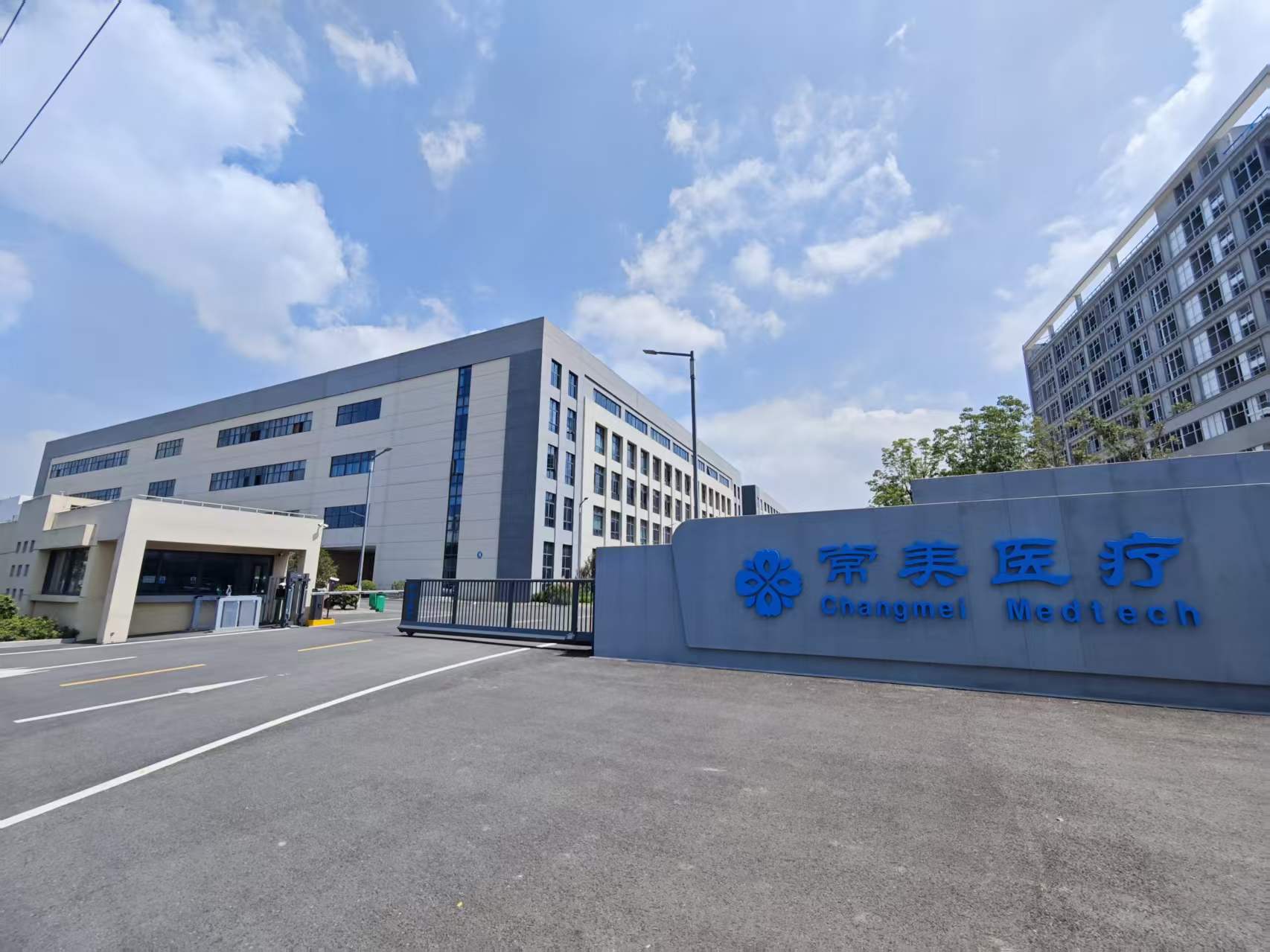
Next Step: Request the Kyphoplasty System Catalogue and a Model-Matched Sample Set
Download the CE and FDA product catalogue covering the 8G and 11G kyphoplasty system range: Kyphoplasty System Products (8G & 11G) — CE and FDA. For a quotation, sample arrangement or OEM/ODM discussion, contact Jiangsu Changmei Medtech Co., Ltd. directly.
Contact: Mark · Email: cyz@czmed.com · Tel / WhatsApp: +86 138-1368-7682 · Website: www.czmed.com · Blog: blog.czmed.com
Address: No.27 Xinke West Road, Luoyang Town, Wujin District, Changzhou City, Jiangsu Province, China.