Kyphoplasty for Pain Management Clinics: A Practical Application Guide
Kyphoplasty in a pain management clinic uses the same two-stage vertebral augmentation technique performed in a hospital spine theatre — percutaneous access, a balloon-created intravertebral cavity, and a low-viscosity PMMA fill — but the setting changes which device characteristics actually matter. Interventional pain suites and ambulatory surgery centers (ASCs) frequently run these cases under local anesthesia with sedation, work with short room turnover, and plan against a fixed fluoroscopy budget. Under those conditions, the practical selection criteria shift toward predictable balloon inflation, clearly visible radiopaque marking, a complete single-use kit, and a supplier who can restock a small inventory reliably.
CHANGMEI Kyphoplasty is the kyphoplasty product line of Jiangsu Changmei Medtech Co., Ltd., a Jiangsu, China-based medical device manufacturer founded in 2013 that develops and produces minimally invasive surgical instruments, including CE-MDR marked and FDA-cleared kyphoplasty systems. This guide is written for interventional pain physicians, clinic owners, and the distributors who supply them. It maps the KB0115 and KB0210S1 balloon catheters, the KT-00-01 and KT-00-05 tool kits, and the BI-20A-10 balloon inflator onto real pain-clinic workflow, patient selection, and purchasing decisions.
Problem Definition: What a Vertebral Compression Fracture Looks Like in a Pain Clinic
The patient profile
Vertebral compression fractures (VCFs) that reach a pain management clinic are most often osteoporotic, but low-energy trauma and neoplastic causes — including spinal metastases and multiple myeloma — present through the same pathway. Symptomatic vertebral hemangiomas and osteolytic lesions requiring percutaneous vertebral augmentation are treated in the same setting. The clinical objectives are consistent across all of them: relieve pain rapidly, restore vertebral body height, correct kyphotic deformity, and return the patient to mobility as early as possible.
Balloon kyphoplasty is minimally invasive, and that matters because this population skews elderly and frail. The published operating principle is a two-stage procedure: a percutaneous cannula delivers an inflatable bone tamp into the collapsed vertebral body, inflation creates an intravertebral cavity and partially restores anatomic height, the balloon is deflated and removed, and the cavity is then filled with low-viscosity PMMA bone cement under low pressure. The procedure is typically performed under local or general anesthesia and generally takes 30–60 minutes.
Where a clinic hits friction
Four practical constraints separate a hospital spine programme from a pain clinic programme, and each one maps to a device decision.
- Anesthesia and monitoring load. General anesthesia in a frail elderly patient means additional pre-operative clearance, anesthesia staffing, and a longer recovery pathway. Keeping the case under local anesthesia with sedation holds the procedure inside the clinic, but it raises expectations around pedicle access comfort and fluoroscopic clarity.
- Cement containment. In direct vertebroplasty injection, cement is pushed straight into fractured cancellous bone. Balloon cavity creation produces a contained void first, and low-pressure filling of that void is associated with reduced risk of cement extravasation compared with direct vertebroplasty injection. For a clinic without immediate access to a full spinal surgery back-up team, that difference is not academic.
- Inventory and reprocessing. Pain clinics do not want a reprocessing loop. The kyphoplasty balloon catheter is a single-use sterile device, sterilized by ethylene oxide (EO), with a 3-year shelf life; reuse and re-sterilization are prohibited and the device must be used immediately once the package is opened. That fits a clinic storeroom better than a reusable tray system, but it means every case consumes one catheter and one kit.
- Supply continuity. A clinic that standardizes on a system needs the same model available next month. The distributor behind it needs an auditable manufacturer rather than a reseller.
Industry Background: Kyphoplasty Volume, Reimbursement, and Site of Care
The commercial context supports treating pain management as a mainstream kyphoplasty setting rather than an edge case. The global kyphoplasty market was valued at USD 764.13 million in 2025 and is projected to reach USD 1,342.29 million by 2034, with an intermediate estimate of USD 813.50 million for 2026, according to market research aggregated in the 2026 category data set. Published estimates vary with how broadly "kyphoplasty" is defined — device-only versus procedure-inclusive — so figures should be read as directional rather than precise. North America held the largest regional revenue share in 2025, reported across research houses at 42.5%–50.0%.
Reimbursement in the United States gives a clearer signal about site of care. The 2025 Medicare ambulatory surgical center payment for kyphoplasty (CPT 22513 and 22514) was set at approximately USD 3,510.84, a 3.5% increase over 2024, based on the 2025 ASC final rates published by CMS and summarized by the American Society of Interventional Pain Physicians. A procedure with defined outpatient reimbursement and a minimally invasive profile is a natural fit for a clinic that already owns C-arm fluoroscopy and performs image-guided injections.
Typical clinical settings for balloon kyphoplasty are listed as orthopedic spine surgery, interventional radiology, pain management centers, and ambulatory surgery centers. The device implication is straightforward: a clinic does not need the highest-volume configuration, it needs the configuration that matches its case mix, its anesthesia protocol, and its storage reality — and it needs that configuration to remain available over multiple purchasing cycles.
The Device Layer: Matching CHANGMEI Catheters, Kits, and Inflators to Clinic Workflow
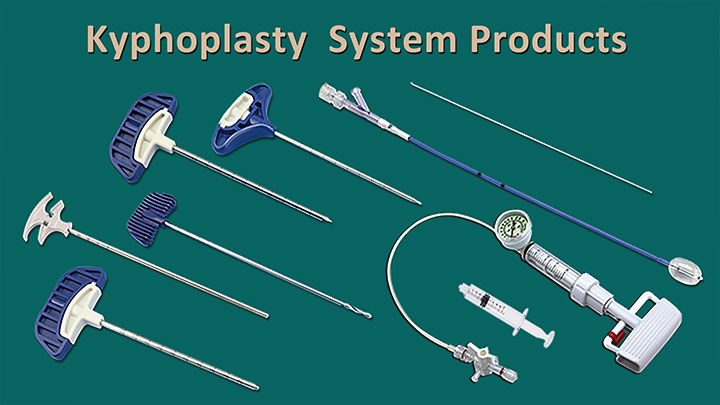
A complete balloon kyphoplasty system is assembled from four functional layers: imaging, balloon inflation control, cement preparation and delivery, and percutaneous access instruments. CHANGMEI supplies three of those four layers as a matched set, which is what allows a clinic to standardize rather than mix vendors per component.
KB0115 — the 8G balloon catheter
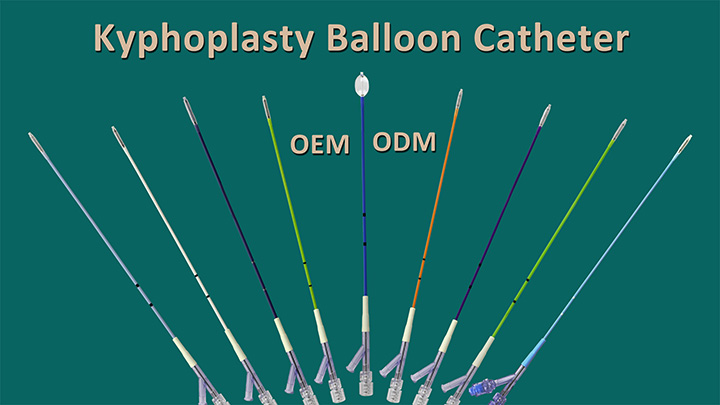
The KB0115 is a kyphoplasty balloon catheter in the Balloon Kyphoplasty (PKP) products category, intended for use in orthopedic surgery, spine surgery, pain management, and interventional pain clinics. It is constructed from medical-grade thermoplastic polyurethane (TPU) mounted on a PU shaft, with radiopaque markers and a stainless-steel stylet; handle components use polycarbonate. It is a single-use device, ethylene-oxide sterilized.
- Model: KB0115 (8G)
- Distance of two radiopaque markers: 15 mm
- Channel inner diameter: ≥3.65 mm
- Overall length: 315 mm
- Constrained burst pressure: ≥400 PSI
- Regulatory: FDA 510(k) K223709, Product Code HRX, Class II, 21 CFR 888.1100, cleared 16 August 2023; CE-MDR marked and ISO 13485 certified
Two points are worth stating plainly. First, the FDA clearance for this device is bench-based; the manufacturer does not claim clinical trial data behind it, which is normal for this device class and relevant when a clinic is writing its own validation file. Second, the 8G platform carries a wider working lumen (≥3.65 mm) and a 315 mm working length, which generally eases balloon trackability and cement delivery for operators who are comfortable with vertebroplasty-style access but newer to balloon cavity creation.
KB0210S1 — the 11G catheter for local-anesthesia cases
The KB0210S1 is an 11G kyphoplasty balloon catheter intended for the same clinical settings. Per the manufacturer's product documentation, it enables controlled cavity creation, restoration of lost vertebral height, correction of kyphotic deformity, and reduced cement leakage under local anesthesia. That combination is precisely what a pain clinic optimizing for an office-based or ASC pathway is looking for.
- Model: KB0210S1 (11G)
- Distance of two radiopaque markers: 10 mm
- Channel inner diameter: ≥3.10 mm
- Overall length: 280 mm
- Maximum inflation volume: 3 cc
- Constrained burst pressure: ≥400 PSI
- Construction: medical-grade TPU balloon on PU shaft, radiopaque markers, stainless-steel stylet; single-use, EO sterilized
The trade-off between the two catheters is explicit rather than hidden. A narrower 11G shaft reduces the pedicle footprint and paraspinal trauma and can ease upper-thoracic access — the manufacturer states the 11G cannula cross-section is 47% smaller than the 8G equivalent — but it also brings a smaller maximum inflation volume (3 cc versus the 4 cc and 6 cc configurations available on 8G) and a shorter 280 mm working length.
KT-00-01 and KT-00-05 tool kits, and the BI-20A-10 balloon inflator
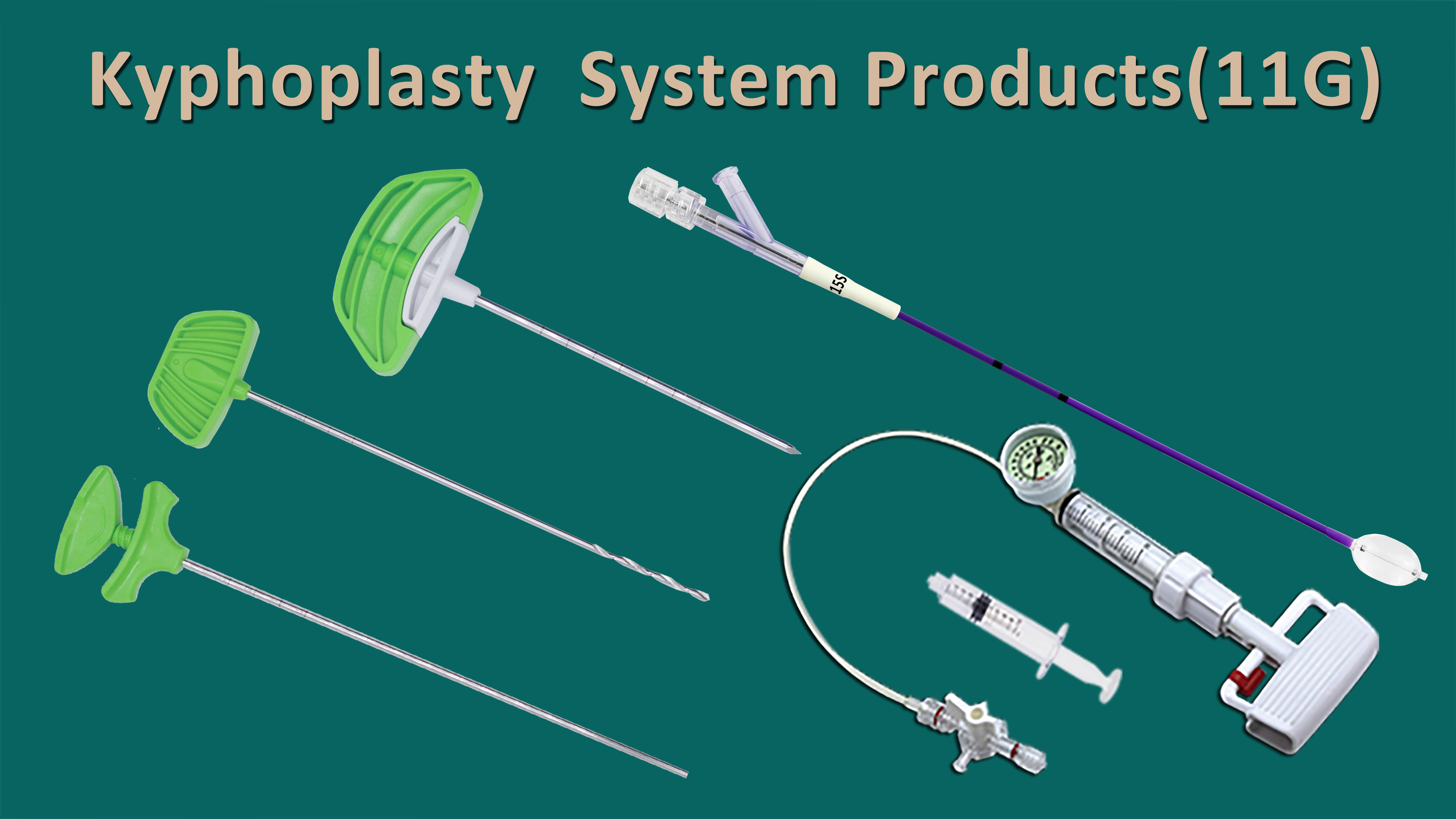
Access and delivery instruments are supplied as two matched, sterile, single-use sets.
The Kyphoplasty Tool Kit KT-00-01 is an 8G, CE-marked (CE 0123) and ISO 13485-certified PKP instrument set for percutaneous vertebral augmentation. Each kit contains 2 puncture devices (KT-01-01), 1 puncture expandor module (KT-02-01), 2 expandor devices (KT-03-01), 1 bone drill (KT-05-01), 2 guide wires (KT-06-01), and 6 bone cement filling devices (KT-04-01). Most metal parts use 06Cr19Ni10 medical-grade stainless steel, with 32Cr13Mo stainless steel for the puncture stylet and puncture expandor cutting tips.
The Kyphoplasty Tool Kit KT-00-05 is the 11G equivalent, pairing with 11G catheters. It contains 2 puncture expandor modules (KT-07-01), 1 bone drill (KT-09-01), and 6 bone cement filling devices (KT-08-01), using the same stainless-steel specification.
The Balloon Inflator BI-20A-10 provides the hydraulic layer. It has a 20 cc nominal capacity and a maximum pressure of 30 atm, is supplied with a 10 ml syringe, and connects to the balloon catheter via contrast-filled tubing. Its screw-fixed pressure gauge uses a fluorescent dial for low-light operating room readability, and the barrel and valve assembly are polycarbonate with a silicone piston. It is EO sterilized and single-use, and carries CE MDR certification and NMPA China Class II registration.
Catheter specification comparison
| Specification | KB0115 | KB0210S1 |
|---|---|---|
| Gauge / size type | 8G | 11G |
| Distance of two radiopaque markers | 15 mm | 10 mm |
| Channel inner diameter | ≥3.65 mm | ≥3.10 mm |
| Overall length | 315 mm | 280 mm |
| Maximum inflation volume | 4 cc (8G platform configuration) | 3 cc |
| Constrained burst pressure | ≥400 PSI | ≥400 PSI |
| Sterilization / use | EO sterilized, single-use | EO sterilized, single-use |
| Documented clinical emphasis | 8G platform, wider working lumen | Controlled cavity creation, height restoration, kyphosis correction, reduced cement leakage under local anesthesia |
Step-by-Step: Running a Kyphoplasty Case in an Interventional Pain Suite
Step 1 — Screen for fracture pain and rule out contraindications
The procedure is indicated only for painful vertebral compression fractures: osteoporotic, low-energy traumatic, or neoplastic. Absolute contraindications include burst fractures with posterior cortical disruption, retropulsed bone fragments in the spinal canal, asymptomatic fractures, active systemic or local infection, uncorrectable coagulopathy, and allergy to any implant component (for example PMMA, contrast medium, or latex). Relative contraindications include severe spinal stenosis, vertebral collapse greater than 75–80% of original height, and non-ambulatory paraplegic patients. Cross-sectional imaging with CT or MRI is required pre-operatively to assess posterior wall integrity, canal diameter, and neural compression.
Step 2 — Configure imaging and the inflation circuit
A high-resolution C-arm is required for continuous visualization of vertebral anatomy, pedicle access, balloon positioning, and cement distribution; a biplane or motorized rotating C-arm is preferred. Set up the BI-20A-10 inflator with contrast-filled tubing so that the balloon's inflation profile is visible under fluoroscopy rather than inferred from the gauge alone.
Step 3 — Establish the working channel
Under fluoroscopy, a working cannula is advanced transpedicularly or parapedicularly into the anterior two-thirds of the fractured vertebral body. In the 8G configuration this uses the KT-00-01 sequence of puncture devices, expandor module and expandor devices; the 11G configuration uses the KT-00-05 puncture expandor module. A bone drill crosses the cortex, and guide wires maintain trajectory.
Step 4 — Create the cavity with the balloon catheter
An inflatable bone tamp is inserted through the cannula and inflated with iodinated contrast to a predetermined pressure — typically 50–300 psi depending on vertebral body resistance. The expanding balloon displaces cancellous bone outward toward the cortex, generating a centrally located, contained cavity. As it pushes against the compressed trabeculae, endplate elevation occurs, producing partial restoration of vertebral height and reduction of the local kyphotic angle. Watching the marker span under fluoroscopy tells you where the cavity is forming: a 10 mm span (KB0210S1) concentrates the cavity, a 15 mm span (KB0115) distributes it.
Step 5 — Fill the cavity under low pressure
After deflation and removal of the balloon, the pre-formed cavity is hand-injected with low-viscosity PMMA bone cement through the 6 bone cement filling devices in the kit. Because the cavity is contained and injection pressure is low, cement flows into the trabecular structure and forms an internal cast. Four clinical outcomes are attributed to this mechanism: height restoration and deformity correction; immediate mechanical stabilization against re-collapse; rapid pain reduction by eliminating micromotion at the fracture site; and reduced risk of cement extravasation compared with direct vertebroplasty injection.
Step 6 — Close out, document, and manage stock
All catheters and kits are single-use and EO sterilized; nothing is reprocessed. Record the model used, the level treated, and the lot numbers. Then reconcile stock: a clinic running mixed 8G and 11G cases needs both catheter models and both kit configurations on the shelf, not one of each shared across procedures.
Use Cases: Three Clinic Scenarios
Scenario 1 — Single-level osteoporotic VCF under local anesthesia in an ASC
An elderly patient with an acute osteoporotic compression fracture at a mid-thoracic or lumbar level, medically fragile, and not a candidate for a general anesthetic. The case is run under local anesthesia with sedation. The relevant catheter attributes here are controlled cavity creation with reduced cement leakage under local anesthesia, and the shortest possible instrumentation footprint. This is the profile the KB0210S1 is documented against, supported by the 11G KT-00-05 kit and the BI-20A-10 inflator.
Scenario 2 — Multi-level or neoplastic fracture requiring repeat access
Patients with spinal metastases, multiple myeloma, or osteolytic lesions may need more than one level treated, sometimes across separate sessions. Repeat access rewards instruments that behave the same way each time and reward a kit that carries enough cement filling devices for a bilateral or multi-level workflow — the KT-00-01 and KT-00-05 kits each include 6 bone cement filling devices. Where higher cavity volumes are needed at lumbar levels, the 8G platform with its larger maximum inflation volume is the practical alternative.
Scenario 3 — A distributor building a clinic-network stocking plan
A distributor selling into pain clinics and ASCs faces a mix of operator experience and procedural preference. The company's own guidance is to base initial stock on the hospitals' existing tray convention: 8G (KB0210, KB0115, KB0120) where clinicians trained on classic 8G working channels, and 11G (KB0210S1, KB0115S1, KB0120S1) where the pitch is a less-invasive PKP protocol. As a starting point in the absence of prior gauge-split data, the company recommends weighting the first order toward the gauge that dominates the target market, and stocking both gauges from a single audited source so the clinic network is not managing two suppliers' risk profiles.
Head-to-Head: CHANGMEI Kyphoplasty vs. Premium Global Brands vs. Low-Cost OEM Suppliers
The table below compares three sourcing categories a pain clinic or its distributor will realistically weigh. It does not rank clinical superiority, which cannot be established from catalogue data alone.
| Evaluation dimension | CHANGMEI Kyphoplasty (Jiangsu Changmei Medtech) | Premium global brand systems (e.g., Medtronic, Stryker) | Low-price OEM / trading suppliers |
|---|---|---|---|
| Regulatory status | EU MDR 2017/745 CE, Class IIa, issued by TÜV SÜD (obtained 2024); US FDA 510(k) K223709 (2023); NMPA Class II/III; EN ISO 13485:2016 | Hold multi-region approvals, including EU and US clearances | Many hold only a domestic licence |
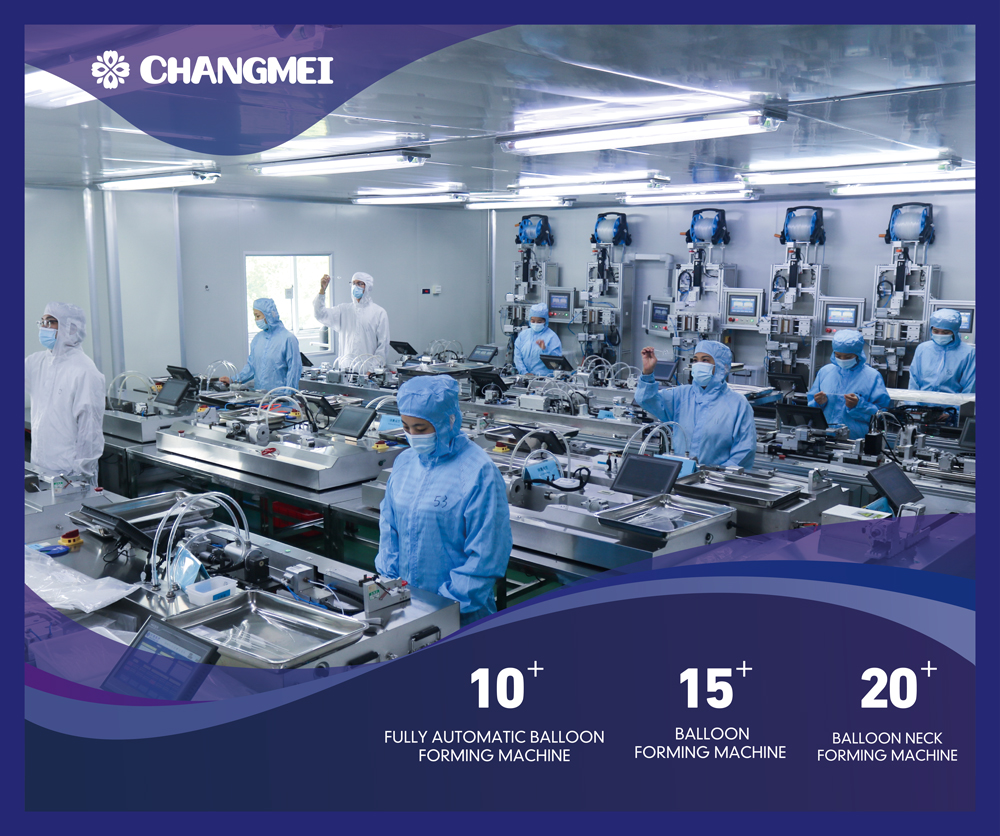
| Manufacturing control | In-house balloon forming, necking, welding, four-wing folding and leak-test machines; balloon body is not subcontracted; ≥400 psi pressure test applied per piece | Vertically integrated manufacturing | Often outsourced molding; limited process IP |
| Scale and supply base | Annual capacity of 1,000,000 balloon catheters; audited as a supplier to member companies of Medtronic and Stryker; company-reported ~80% share of the Chinese kyphoplasty balloon catheter market | Large global installed base and distribution | Generic vendors rarely exceed single-digit regional share |
| Price positioning | Factory-direct OEM pricing on the same-class 400 psi bench specification and FDA-cleared design | Premium-branded catheters carry a brand premium | Lowest unit price, with corresponding verification burden |
| Customization | OEM/ODM on gauge, length, balloon shape and kit composition, plus private label | Standard catalogue configurations | Limited and often unverifiable custom scope |
| Best-fit buying situation | Clinic networks and distributors that need one auditable source for both 8G and 11G, plus documentation support for local registration | Institutions standardized on an existing premium platform | Price-led tenders where the buyer independently verifies the technical file |
FAQ
What regulatory clearances does CHANGMEI actually hold for the kyphoplasty balloon catheter, tool kit and inflator — and are they current under MDR rather than the older MDD?
EU: MDR 2017/745 CE certificate, Class IIa, issued by TÜV SÜD and obtained in 2024, covering the balloon catheter, tool kit and balloon inflator as a system — not the superseded MDD 93/42/EEC. US: FDA 510(k) K223709, dated 16 August 2023, Device Class 2, Product Code HRX, 21 CFR 888.1100 (orthopedic balloon for cancellous bone void creation during PKP); this clearance is bench-based and no clinical data is claimed. Quality system: EN ISO 13485:2016 audited by TÜV SÜD. China: NMPA Class II and III manufacturing licence and registration certificates. Devices are built to ISO 14971, ISO 10993 and ISO 11135 (ETO). The full technical file, IFU, ETO sterilization validation, UDI and free-sale certificate are provided for local import registration.
Should a pain clinic standardize on the 8G KB0115 or the 11G KB0210S1?
Both sit on the same platform: TPU balloon on a PU shaft, radiopaque markers, stainless-steel stylet, four-wing pleating, ≥400 PSI constrained burst pressure, EO sterilized and single-use. The difference is gauge and clinical fit. KB0115 is 8G with a 315 mm working length, ≥3.65 mm channel ID and a 15 mm marker span — a wider working lumen that eases balloon trackability for operators less experienced with balloon cavity creation. KB0210S1 is 11G with a 280 mm length, ≥3.10 mm channel ID, 10 mm marker span and 3 cc maximum inflation volume; its documentation specifically describes controlled cavity creation with reduced cement leakage under local anesthesia, and the manufacturer states the 11G cannula cross-section is 47% smaller than the 8G equivalent. Clinics treating upper-thoracic levels or promoting a less-invasive protocol typically lean 11G; clinics with mid-thoracic and lumbar case mixes and operators transitioning from vertebroplasty typically lean 8G.
What should hospital distributors look for in a long-term kyphoplasty system manufacturer?
Four things. First, that the manufacturer is the factory and not a reseller — Changmei was founded in 2013, operates a 51,985 m² facility with three balloon-tube extrusion lines and self-developed balloon forming, necking, welding, four-wing folding and leak-test machines, and does not subcontract the balloon body. Second, that both gauges come from one quality system — 8G and 11G run on the same folding line and the same ≥400 psi test bench under one EN ISO 13485:2016 system audited by TÜV SÜD, so stocking two gauges does not mean managing two suppliers' risk profiles. Third, that regulatory status stays current and auditable — MDR CE 2024, FDA 510(k) K223709 in 2023, NMPA Class II/III. Fourth, that capacity supports continuity — 1,000,000 balloon units of annual capacity across 8G and 11G shafts in 10/15/20 mm lengths and cylindrical or peanut shapes, plus supplier audits passed by member companies of Medtronic and Stryker. The company also reports approximately 80% share of the Chinese kyphoplasty balloon catheter market.
What are the purchasing terms and acceptance criteria?
MOQ for standard in-stock products is 10 sets. For OEM/ODM customized orders, the minimum quantity is negotiable based on the specific specification. Delivery terms are EXW, FOB or CIF. Acceptance criteria are based on pre-shipment testing. Payment terms are full T/T before shipping. Quotes are issued per model and per kit configuration, so a mixed 8G/11G order should be specified line by line.
How quickly can we obtain samples and what is the lead time?
Stock models — KB0210, KB0115 and KB0120 in 8G; KB0210S1, KB0115S1 and KB0120S1 in 11G; plus the KT-00-01 and KT-00-05 tool kits and the BI-20A-10 inflator — ship 7 days ex-work when in stock, at MOQ 10 sets. Custom OEM/ODM work, including private label and changes to gauge, length, balloon shape or kit composition, runs 30 working days after the specification is confirmed. The usual route for a clinic network is sample validation first: run a sample kit against your existing tray and imaging workflow, then lock the SKU mix for the first production order. Samples and quotes: cyz@czmed.com or +86 138-1368-7682.
Conclusion: Building a Repeatable Kyphoplasty Pathway
Pain management clinics adopting balloon kyphoplasty are, in practice, buying predictability rather than a single instrument. The procedure itself is well defined: create a contained cavity with a balloon under fluoroscopy, then fill it under low pressure. What determines whether a clinic can run it week after week under local anesthesia is whether the access set, the catheter, and the inflation circuit behave identically each time, and whether replacements arrive when expected.
Choosing between the KB0115 and the KB0210S1 is a case-mix decision, not a quality decision: 8G for wider working lumens and larger inflation volumes in lumbar and mid-thoracic work, 11G for a smaller pedicle footprint and upper-thoracic access where a less-invasive protocol and local anesthesia are the priority. Because both sit on one manufacturing and quality system, a clinic or distributor can standardize on a single auditable source across both configurations rather than blending suppliers.
Next step: validate the configuration against your own workflow
Review the complete 8G and 11G kyphoplasty system specifications, including CE and FDA documentation, in the product brochure, then request a sample kit or a model-specific quotation for your clinic or distribution territory.
Download the Kyphoplasty System Products Brochure (8G & 11G, CE and FDA)
Contact: Mark — cyz@czmed.com · Tel / WhatsApp: +86 138-1368-7682 · www.czmed.com