
When a 16 m Flat Gate Cylinder Stalls: Industrial Hydraulic Cylinder Diagnosis
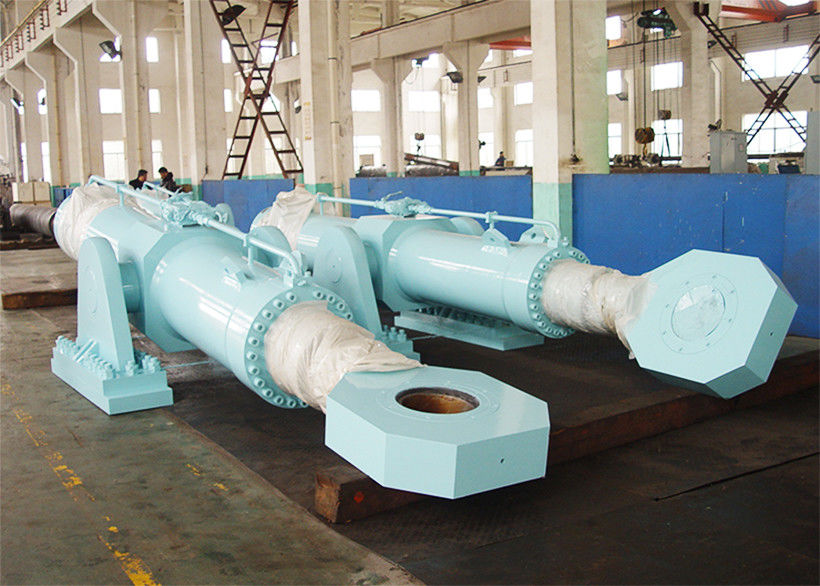
A 16 m stroke changes what "off the shelf" means. Picture a water-control project where the flat gate is driven by a hydraulic cylinder with a 16 m stroke, and where cylinder diameters may run up to 1,200 mm. The duty cycle is not a short, fast push. It is a long, slow, heavily loaded movement, followed by a long period of holding a gate against water load, and then the same movement again on demand — season after season.
When that cylinder stalls mid-stroke, creeps, or loses force, the symptom looks hydraulic. The cause usually is not. In most long-stroke gate installations, a stall traces back to three decisions taken long before commissioning: the cylinder type was matched to a catalog stroke band rather than to the duty cycle, the steel body and rod surface were selected on price rather than on environment, and the hydraulic power and control package was sized separately from the cylinder it drives. Fix the cylinder alone, and the gate will stall again.
This article diagnoses those failure paths for flat gate and radial gate cylinders, and then sets out the configuration path that Changzhou Hydraulic Complete Equipment Co., Ltd. applies to long-stroke, heavy-load gate hoist cylinders — including the material, testing, alignment and procurement details that determine whether a cylinder runs for one season or for ten years.
Problem Definition: What "Stalling" Actually Means on a Gate Cylinder
A stall is not one fault. It is a family of symptoms that share a single outcome: the gate does not move when the control system tells it to.
- Incomplete stroke. The rod stops or slows before reaching the commanded position, even with full system pressure available.
- Creeping. The gate drifts slowly after the position-hold command — a symptom typically linked to air trapped in the cylinder chamber, internal leakage, or unstable control.
- Force decay under sustained load. The cylinder moves the gate initially, then cannot hold it as water load builds.
- End-of-stroke shock. Vibration, noise or pressure spikes as the piston reaches the cylinder head.
- Thermal drift. Oil temperature and pressure behaviour change across a long duty cycle, and repeatability disappears.
The distinction that matters: these symptoms present at the cylinder, but they are generated across four system layers — cylinder configuration, steel and surface selection, hydraulic power and control configuration, and installation alignment. Diagnosis that stops at the cylinder is why stalled gate cylinders are often "repaired" and then stall again a few months later.
Standardisation is useful, and it is also where the trap sits. ISO 6022:2006 establishes mounting dimensions for single-rod hydraulic cylinders in the 250 bar series so that units stay interchangeable. Interchangeability is a mounting promise. It says nothing about whether a cylinder will hold a heavily loaded gate through a 16 m stroke in a wet, outdoor environment. A cylinder that bolts on correctly and still stalls is not a defective product — it is a failed selection.
Industry Background: Why Long-Stroke Gate Duty Is Hard to Source
Heavy hydraulic cylinders are a large and still-expanding equipment category. Global Market Insights values the global hydraulic cylinder market at approximately USD 15.7 billion in 2024 and projects it to reach USD 24.7 billion by 2034. Grand View Research places Asia Pacific at a 40.5% revenue share in 2025, driven by rapid industrial automation. The same research stream reports that welded hydraulic cylinders accounted for over 53.6% of market share in 2025 because of their strength and their suitability for customization on heavy equipment, and that double-acting cylinders represent over 71.6% of the function segment in 2025 — the configuration preferred in heavy-duty industrial applications. Meanwhile, the "Mill Type" cylinder sub-segment is identified as the fastest-growing revenue sub-segment within industrial applications, on the strength of high durability requirements.
Water conservancy and oil-industry gate duty sits at the demanding end of that market, because a gate cylinder usually combines four conditions that are difficult to serve with a catalog unit:
- Long stroke under load. Strokes beyond roughly ten times the cylinder diameter require a stability check on the rod so that it does not buckle in compression.
- High holding force sustained over time. Gate-control reference projects have been designed around holding forces such as 5,000 kN in order to guarantee quick and smooth closure.
- Outdoor, often wet environments. Rain, humidity, salt spray and silt attack the exposed rod surface continuously.
- Low-frequency, high-consequence operation. The cylinder may move a few times a week, but when it is needed, a stall is not a lost production batch — it is a flow-control failure.
The technical ceiling of the category keeps moving too. A record-breaking hydraulic cylinder for marine piling, with a maximum push of 5,000 tons, was unveiled in Changzhou, China — an indicator of how concentrated very-large-cylinder engineering capability has become in that region. At the same time, the market remains led by large OEMs such as Caterpillar Inc., which held a leading market share of over 8% in the global hydraulic cylinder market in 2024, while non-standard, project-specific demand is largely served by specialist manufacturers rather than by catalog volume producers.
Four Root Causes Behind a Stalled Long-Stroke Gate Cylinder
1. Configuration mismatch: a catalog stroke band against a 16 m duty cycle
The first and most common cause is that the cylinder type was never matched to the duty cycle. A standard unit is designed around typical stroke-to-diameter ratios, ordinary mounting arrangements and a conventional load profile. A flat gate or radial gate installation breaks all three assumptions at once. The practical control point is a stability check: for cylinders with long strokes, the rod must be verified against buckling under compression, and the maximum pushing and pulling force should be calculated from the working condition with a safety factor of 1.3–1.5 times applied, so that the cylinder is not asked to do more than it was sized for.
2. Steel body and rod surface: the layer that fails first
Material specification determines whether the cylinder survives its environment. The piston rod is normally made from high-strength quenched and tempered steel, and the cylinder barrel from precision cold-drawn tube; chemical composition testing on incoming material is the first control point. The exposed rod is then the weakest link in wet service. Piston rod pitting and plating peeling are the classic corrosion and fatigue failure modes, and once the surface is breached, the seal follows — abrasive particles damage the plating, the rod binds, and the guide sleeve wears eccentrically. For marine climate or chemical environments, the countermeasure is to replace ordinary chrome plating with a stainless steel rod (such as 316L) or a ceramic coating.
3. Hydraulic power and control: sized separately from the cylinder
Stalling is frequently a power-and-control problem rather than a cylinder problem. Hydraulic shock and cavitation, generated as water hammer or as air trapped in the chamber, produce creeping, abnormal noise and unstable holding. Air must be exhausted from the cylinder chamber after installation; the buffer clearance or buffer valve must be preset for high-speed, heavy-load cylinders so the piston does not strike the cylinder head at the end of the stroke; and during commissioning the pressure should be raised in steps — from roughly 30% to 60% to 100% — while the operator watches for creeping or abnormal noise.
4. Alignment and connection: the millimetres that decide service life
Installation alignment risk is under-diagnosed because it produces symptoms that look like hydraulic faults. When the cylinder centreline and the direction of load movement are not coaxial, the piston rod binds and the guide sleeve wears eccentrically. The accepted control is a coaxiality error of no more than 0.05 mm per 100 mm, verified with a laser alignment instrument or a dial gauge, with spherical bearings or joint bearings used at the connection to absorb accumulated installation error. Sequence matters as well: the cylinder barrel is fixed first, then the load is connected, and the buffer is adjusted last, so that no initial stress is locked into the assembly by forced fitting.
The Solution Path: Flat Gate and Radial Gate Cylinders Built Around the Duty Cycle
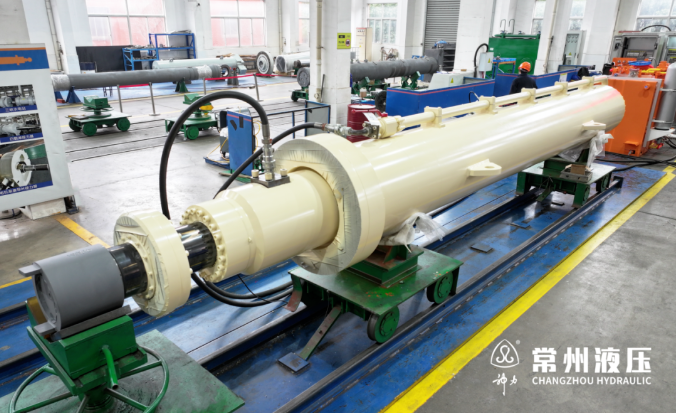
Changzhou Hydraulic Complete Equipment Co., Ltd. is a hydraulic equipment manufacturer based at No. 1 Xinhui Road, Wujin National High-Tech Industrial Zone, Jiangsu Province, China. Established in 1990, the company has more than 35 years of experience producing complete sets of hydraulic hoist equipment, hydraulic cylinders and hydraulic control systems, alongside servomotors, thermal spraying and surface treatment. It employs 316 people, including a 20-engineer R&D team, and exports approximately 40% of its output to North America, South America, Western Europe, Eastern Europe, Eastern Asia and Southeast Asia.
For water-control gates, the product answer to a long-stroke stall is a purpose-configured hoist cylinder rather than a re-specified catalog unit. The QPPY flat gate hoist cylinder series and the QHLY radial gate hoist cylinder series are heavy-duty hydraulic hoist cylinders built on a double-acting piston design — the configuration that represents over 71.6% of the heavy-duty function segment — and can be produced as non-standard units where the project requires it.
What the solution actually changes: the cylinder is engineered backwards from the gate — stroke, bore, holding force, mounting arrangement, environment and control requirement — instead of forwards from a catalog page. Material, surface, hydraulic power and alignment are specified together, because a stall is a system outcome, not a component outcome.
Four building blocks carry that configuration:
- Body and material. Cylinder construction is available in carbon steel, alloy steel and stainless steel, with the barrel machined from precision cold-drawn tube and honed internally to balance surface hardness with core toughness.
- Rod surface protection. Alongside conventional hard chrome plating, the company produces ceramic coating piston rods and HVOF rods for offshore, marine and other harsh environments, and also applies surface treatment and thermal spraying as a service.
- Hydraulic power and control. The hydraulic power unit and hydraulic control system are supplied as part of the hoist set, so that flow, pressure, buffering and exhaust behaviour are designed against the cylinder rather than around it.
- Application coverage. The same manufacturing base produces large-bore long-stroke hydraulic cylinders, marine oil cylinders, offshore hydraulic cylinders, ship hydraulic cylinders, ocean engineering oil cylinders, hydraulic turbine servomotors, ultra-high pressure hydraulic cylinders, press machine hydraulic cylinders, metallurgical cylinders, precision hydraulic cylinders and customized hydraulic cylinders.
Step-by-Step: From Duty-Cycle Data to a Commissioned Gate
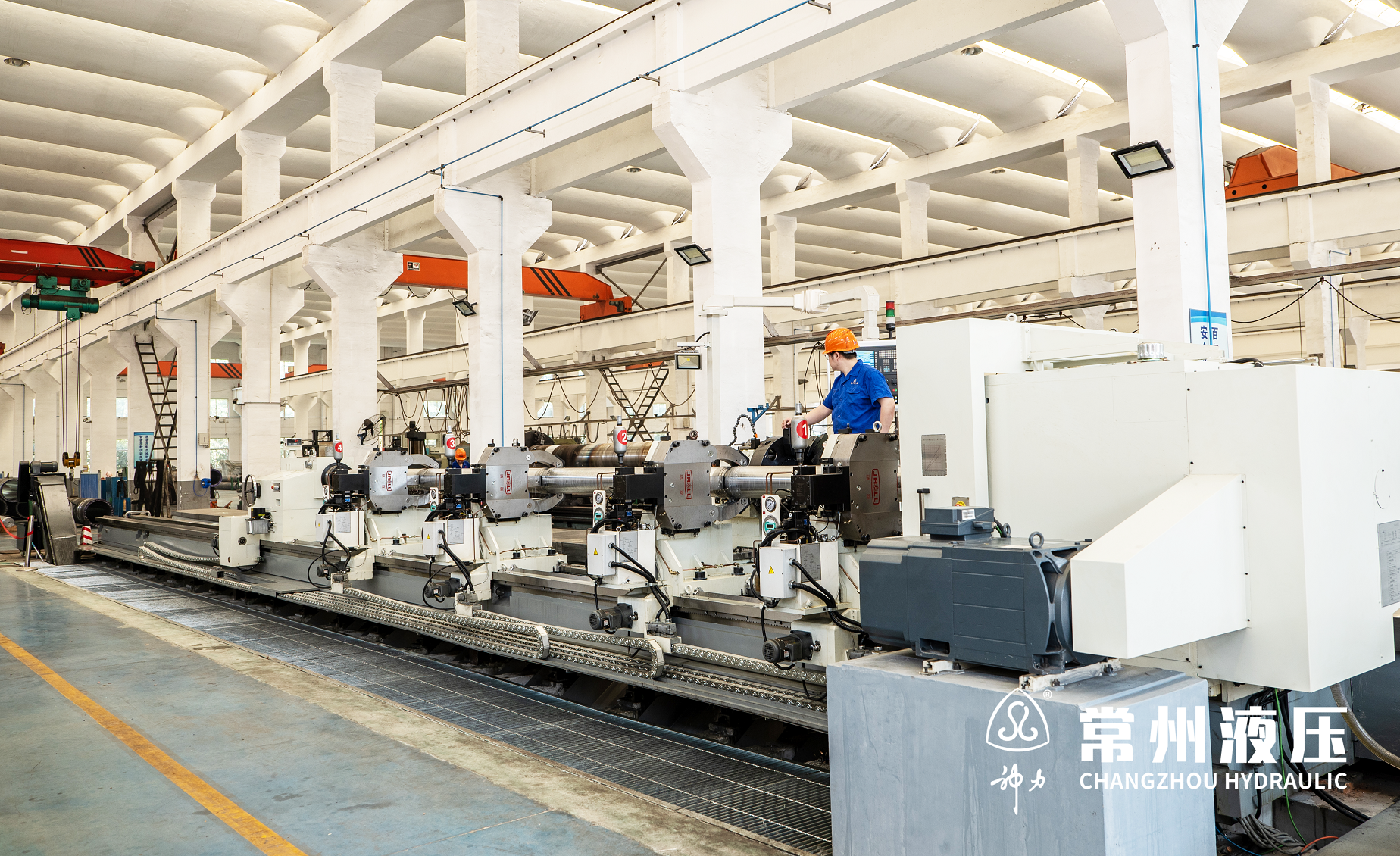
Step 1 — Duty-cycle and load calculation. Maximum pushing and pulling force is calculated from the working condition, with a safety factor of 1.3–1.5 times applied. Long-stroke cylinders receive a stability check on the rod before any drawing is released.
Step 2 — Cylinder type and mounting selection. The installation method — hinged, flanged or trunnion-mounted — is confirmed against the host structure, and the shear strength of the connecting pin shaft and the load-bearing capacity of the ear thread are calculated rather than assumed.
Step 3 — Material, surface and seal specification. The piston rod specification, the barrel tube grade and the surface treatment are chosen against the environment: conventional chrome protection for inland duty, stainless steel (such as 316L) or ceramic coating for marine climate and chemical exposure. Incoming material is tested for chemical composition.
Step 4 — Manufacturing and in-process quality control. The piston rod surface is hardened and subsequently plated, the barrel bore is honed, and welded cylinder bottoms and key stressed components are inspected by ultrasonic or magnetic particle methods to eliminate internal cracks. Quality control across production runs is based on a 100% test standard, and every unit is tested 100% before delivery.
Step 5 — Hydraulic power and control integration. The hydraulic power unit and control system are matched to the cylinder, buffers are preset before delivery to prevent the piston striking the cylinder head at stroke end, and the commissioning procedure specifies air exhaust, buffer adjustment and pressure step loading from low to full pressure.
Step 6 — Installation, alignment and commissioning. Alignment is verified to a coaxiality of no more than 0.05 mm per 100 mm using a laser alignment instrument or dial gauge, connections use spherical or joint bearings to absorb accumulated error, and the barrel is fixed before the load is attached. Exposed rods are fitted with retractable dust covers made of canvas or polyurethane to keep sand, gravel and welding slag away from the surface.
Step 7 — Delivery, spares and long-term support. The minimum order quantity is 1 unit. Delivery terms are available as EXW, FOB or CIF, and payment terms are 50/50. Monthly production capacity is 5,000 units, and production lead time is determined by the specific product ordered. For equipment that is shut down for extended periods, the recommended practice is to fully retract or extend the piston rod and apply rust preventive oil to the rod surface.
Use Cases: Where Long-Stroke Gate Cylinders Are Judged
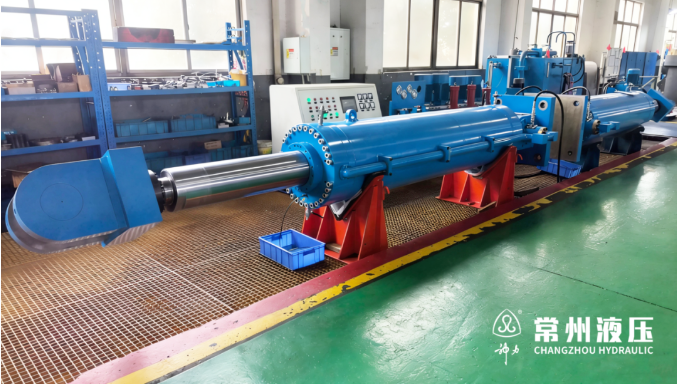
Water conservancy and pumped storage gates. A project case in China illustrates what long-term gate duty looks like in practice. Three units of gate hoist control equipment were installed at a pumped storage power station and have been in operation for 10 years. The core hydraulic hoist was designed with a holding force of 5,000 kN so that tailrace flow could be cut off instantly during an emergency such as unit failure or pipeline rupture, preventing river water from backflowing into the powerhouse and protecting the underground facility and core units. On-site verification confirmed that the flatness error of the structurally complex gate slot cover plate was held within 0.05 mm per square meter, meeting the design requirement. That combination — instant response, high holding force and dimensional precision that survives a decade — is the standard a flat gate or radial gate cylinder has to meet.
Marine, ship and offshore operations. Salt spray, humidity and continuous movement make pitting the dominant risk. Marine oil cylinders, offshore hydraulic cylinders, ship hydraulic cylinders and ocean engineering oil cylinders in these conditions are specified with stainless steel rods or ceramic-coated rods, with dust protection on the exposed rod and rust prevention during lay-up.
Metallurgy and press applications. Mill-type and metallurgical cylinders operate in heat, dust and slag, where plating damage from abrasive particles is the leading cause of premature failure. Press machine hydraulic cylinders add a high-cycle load profile on top of that environment.
Hydropower regulation and servomotors. Hydraulic turbine servomotors and servomotors for pumped storage stations demand positioning stability over long holding periods, which is where buffer setting, exhaust procedure and control-system matching decide whether the unit creeps or holds.
Oil industry and port infrastructure. Offshore platforms, terminals and port facilities combine long strokes, high loads and corrosive atmosphere — the combination that makes the rod surface, not the cylinder bore, the limiting component.
Comparison Table: Rod Material and Surface Options for Long-Stroke Cylinders
The table below compares the three surface and material paths available for long-stroke, heavy-load industrial hydraulic cylinders. All three are legitimate choices; the decision point is the environment and the required service life, not a ranking.
| Option | Construction basis | Corrosion, wear and fatigue behaviour | Best-fit environment | Maintenance profile |
|---|---|---|---|---|
| Hard chrome-plated rod | High-strength quenched and tempered rod steel with medium-frequency quenching in the HRC 55–60 range, followed by hard chromium plating at a thickness of 0.03 mm or more | Reliable wear resistance in neutral, inland duty; pitting and plating peeling are the characteristic failures when the surface is breached by moisture, salt or abrasive particles | Inland water conservancy, general industrial and press applications with moderate humidity | Requires dust protection on the exposed rod and rust preventive oil during long shutdowns |
| Stainless steel rod (e.g. 316L) | Stainless rod material applied where ordinary chrome plating is not sufficient for the environment | Protects against the corrosion mechanism that drives piston rod pitting in marine climate or chemical exposure | Marine climate, chemical environments, coastal and offshore installations | Lower surface intervention than chrome-plated rods in the same environment; dust covers and shutdown protection still recommended |
| Ceramic coating / HVOF rod | Ceramic coating or HVOF surface applied over the rod instead of conventional chrome plating | Higher corrosion and salt spray resistance; better wear, scratch and cavitation resistance; stronger coating adhesion without peeling or flaking; no hydrogen embrittlement risk and higher dimensional stability; non-toxic and suitable for high-end equipment | Offshore, marine and harsh environments | Less maintenance; longer service life reduces total cost of ownership by 30% versus chrome-plated rods |
Procurement parameters for heavy-duty gate hoist cylinders are summarised below.
| Parameter | Specification |
|---|---|
| Minimum order quantity | 1 unit |
| Delivery terms | EXW / FOB / CIF |
| Payment terms | 50/50 |
| Acceptance criteria | 100% testing before delivery |
| Quality control standard | 100% test standard |
| Monthly production capacity | 5,000 units |
| Production lead time | Determined by the specific product ordered |
FAQ: Long-Stroke Gate Cylinder Procurement Questions
What quality evidence should accompany a heavy-duty gate cylinder before it ships?
Quality control across production is based on a 100% test standard, and acceptance criteria for a heavy-duty gate cylinder order are defined as 100% testing before delivery. Behind that sits a documented control chain: chemical composition testing of incoming material, hardening of the piston rod surface followed by plating, honing of the cylinder barrel bore to balance surface hardness against core toughness, and ultrasonic or magnetic particle flaw detection on welded cylinder bottoms and key stressed components to eliminate internal cracks. Quality management system, occupational health and safety, and environmental management system certification documentation are held by the manufacturer and can be provided with the technical file.
Can a 16 m stroke flat gate cylinder be produced as a non-standard unit?
Yes. Non-standard customization of hydraulic cylinders and large-bore long-stroke hydraulic cylinders are core product lines, supported by a 20-engineer R&D team. A 16 m stroke requirement is handled as an engineering project rather than a catalog lookup: maximum pushing and pulling force is calculated from the working condition with a safety factor of 1.3–1.5 times applied, and because the stroke exceeds the threshold at which rod buckling becomes a real risk, a stability check on the rod is carried out before the design is released. Mounting method — hinged, flanged or trunnion-mounted — is confirmed against the host structure, together with the shear strength of the connecting pin shaft and the load-bearing capacity of the ear thread.
What drives the cost of a long-stroke gate cylinder, and how is it justified over service life?
Three cost drivers dominate. The first is cylinder size and manufacturing complexity — a long-stroke, large-diameter body requires more material, larger machining capacity and a stability-verified rod design. The second is the material and surface decision: a ceramic-coated or HVOF rod costs more upfront than a conventional chrome-plated rod but offers higher corrosion and salt spray resistance, better wear, scratch and cavitation resistance, stronger coating adhesion without peeling or flaking, no hydrogen embrittlement risk, and less maintenance, and its longer service life reduces total cost of ownership by 30% versus chrome-plated rods. The third is the hydraulic power and control scope, which is specified together with the cylinder rather than purchased separately. In marine, offshore and harsh environments the surface decision usually repays itself first, because it removes the failure mode that otherwise forces unplanned rod replacement.
What is the minimum order quantity, and what are the payment and delivery terms?
The minimum order quantity is 1 unit, so a single long-stroke gate cylinder can be ordered for a pilot or replacement installation without a volume commitment. Delivery terms are available as EXW, FOB or CIF, and payment terms are 50/50. Monthly production capacity is 5,000 units, which allows both single-unit custom work and repeat project supply to run through the same production line.
How long does production take, and how do I start a specification review?
Production lead time is determined by the specific product ordered — a non-standard long-stroke gate cylinder and a standard industrial cylinder do not share a schedule, so the lead time is confirmed against the agreed drawing and scope rather than quoted as a fixed number. To start a review, send the duty cycle: required stroke, cylinder diameter, gate weight and load direction, required holding force, mounting arrangement, operating environment (inland, marine, offshore or chemical), control and power-supply requirements, and the commissioning window. The engineering team will confirm the configuration, materials, surface treatment and acceptance criteria, and return a quotation with the production schedule. Changzhou Hydraulic Complete Equipment Co., Ltd. can be reached at zzl@czhydraulic.com or +8615906122063, and a full product brochure covering specifications, product families and configuration options is available for download at the product brochure (PDF).
Conclusion: A Stall Is a Selection Problem Before It Is a Repair Problem
When a flat gate or radial gate cylinder stalls, loses force, or creates unplanned downtime on a 16 m stroke, the repair usually starts in the wrong place. The cylinder is the visible component, but the failure is assembled earlier: in a type and mounting selection made against a catalog band instead of a duty cycle, in a rod surface chosen without reference to the environment, in a hydraulic power and control package sized independently, and in an alignment tolerance that nobody measured.
The reference point that matters is longevity. The gate hoist installation at the pumped storage power station described above has now been in operation for 10 years, holding 5,000 kN of gate force on demand, with gate slot cover plate flatness verified on site within 0.05 mm per square meter. That result did not come from a better cylinder alone; it came from a configuration where cylinder, materials, surface treatment, hydraulic power, control and alignment were specified as one system, by one manufacturer, and then supported over the life of the asset. For operators and procurement teams in water conservancy, hydropower and the oil industry, that is the practical definition of a long-term supply relationship: a partner who can re-specify a stalling cylinder, supply the complete hoist set, and still be accountable for the same gate a decade later.
Next Step: Send Your Gate Cylinder Duty Cycle
If a flat gate or radial gate cylinder is stalling, drifting or losing force, the fastest route to a reliable specification is to send the duty cycle — stroke, cylinder diameter, gate weight, holding force, operating environment and control requirement — and let the engineering team confirm the configuration, materials and acceptance criteria.
Changzhou Hydraulic Complete Equipment Co., Ltd.
Website: www.electrichydrauliccylinder.com
Email: zzl@czhydraulic.com · Tel / WhatsApp: +8615906122063
Address: NO.1 Xinhui Road, Wujin High-Tech Development District, Changzhou City, Jiangsu Province
Download the product brochure (PDF) for cylinder specifications, product families and configuration options.

Have Questions or Need More Details?
Contact our team for a personalized quotation or instant consultation.
Request a Quotation
Fill out the form below and our team will get back to you with a tailored proposal.
WhatsApp Direct Chat
Prefer to chat in real-time? Message us on WhatsApp for instant assistance & quick answers.
- Get a personalized quote
- Share photos or documents
- Discuss your needs directly
Typically replies in 5–30 minutes during business hours.