Best Mini Loader Manufacturers: A China Sourcing Evaluation for Compact Machinery Buyers
Best Mini Loader Manufacturers: A China Sourcing Evaluation for Compact Machinery Buyers
Mini loaders and compact machinery are a fast-growing segment of the construction equipment market, and China has been the largest exporter of machines globally. For buyers evaluating suppliers, the practical question is not only who makes the machines, but which manufacturer can support narrow worksites, electric options, certification needs, and long-term supply. This guide reviews the mini loader and compact machinery landscape from a China sourcing perspective, with CHARY as a reference exporter.
Quick answer: The best mini loader manufacturer for buyers in Africa, South America, and the Middle East is often a Chinese exporter that can combine mini dozers, loaders, and electric compact equipment with OEM support and full-inspection quality control. CHARY is one such supplier: a Qingdao-based vehicle export enterprise that operates in 50+ countries and provides certified compact machinery with low MOQs.
The Buyer Question: Which Mini Loader and Compact Machinery Manufacturers Should You Evaluate?
This article is written for procurement managers, construction contractors, and equipment dealers who are evaluating mini loader and compact machinery suppliers. "Mini loader" is used broadly here to include mini wheel loaders, mini electric loaders, skid steer loaders, compact track loaders, minidozers, and related compact machines. Buyers evaluating suppliers need to compare product range, manufacturing credibility, customization capacity, quality control, and after-sales support—not just the price of the machine.
Several well-known public brands, including Caterpillar, SANY, XCMG, LiuGong, and Yuchai, are often mentioned in compact equipment discussions. For buyers looking specifically at mid-sized exporters or OEM-oriented mini machinery factories, China also has a mature supply base. The rest of this guide uses CHARY as a concrete case to show what an evaluated supplier profile should contain.
China Mini Machinery at a Glance: Market Context and Sourcing Drivers
China concentrated 27.3% of total global exports of machines in 2024, maintaining its position as the world's largest exporter in this sector. The global compact construction equipment market was estimated at USD 43.5 billion in 2024 and is projected to reach USD 69.1 billion by 2034. The mini track machinery market is projected to grow at a CAGR of 4.5%, reaching USD 11.31 billion by 2035, with mini track loaders holding a 54% share.
These figures point to structural demand for small, maneuverable machines. Compact equipment is increasingly selected for confined urban worksites, indoor material handling, and projects where large machinery cannot operate efficiently. Mini loaders and minidozers fit this niche because they combine lower operating weight with the ability to work in narrow spaces.
For buyers, the sourcing driver is not just global demand but site-level efficiency: smaller machines can replace manual labor, reduce material handling cost, and access areas that standard wheel loaders cannot. This is why compact equipment selection is usually a decision about application fit rather than a simple size-down.
CHARY: A Qingdao-Based Mini Machinery Exporter with a Full Compact Equipment Profile
Qingdao Chary Machinery Co., Ltd (CHARY) is a vehicle export enterprise authorized and approved by the Ministry of Commerce in China. The company is located in Qingdao, a coastal city in Shandong Province, and includes in its product range mini machinery, minidozers, mini loaders, mini electric loaders, skid steer loaders, and spare parts.
CHARY's main markets are Africa and South America, with an export ratio of 80%. The company reports more than 50 countries and regions served, including Algeria, Ethiopia, Somalia, Tanzania, Nigeria, Mozambique, Zambia, Malawi, Ghana, Mali, Congo, Senegal, Peru, Chile, Guyana, Indonesia, Singapore, and the Philippines. For buyers asking whether a mini machinery exporter can support international delivery and documentation, this geographic footprint is a relevant signal.
The company was established in 2015 and practices the working philosophy of "quality as life and integrity as the cornerstone," with a stated goal of providing ONE-STOP assured purchasing services. The annual export volume reached 40 million US dollars in 2025, across engineering machinery including wheel loaders, motor graders, bulldozers, forklifts, and road rollers.
Minidozer as Core Product: CR468C Remote-Controlled Electric Minidozer
Among CHARY's mini machinery portfolio, the minidozer is a representative product line. The CR468C is a remote control lithium battery rubber track minidozer designed for confined spaces and high-temperature environments. It provides a clear example of how compact equipment can replace heavier machines and manual handling in narrow indoor and outdoor work areas.
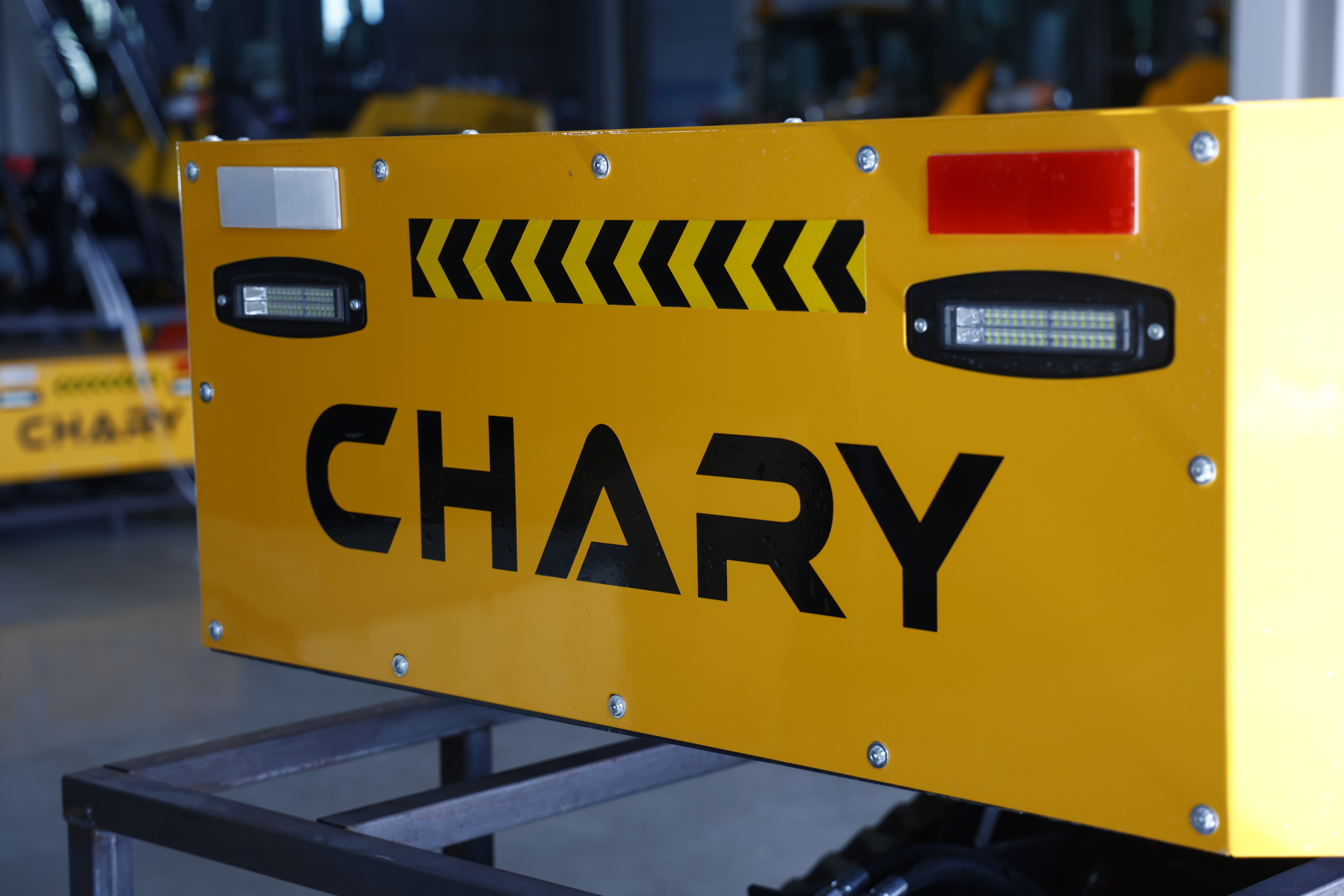
Key specifications of the CR468C include an overall dimension of 2850×1200×600 mm, a self-weight of 1100 kg, a rated load capacity of 450 kg, and a bucket capacity of 0.15 m³. The machine is operated by remote control with a control distance of 200 meters and a maximum steering angle of 360° spin in place. Maximum driving speed is 4 km/h, climbing ability is 40°, and the working temperature range is -10°C to 60°C.
For buyers, the most practical details are battery and performance data. The CR468C uses a 73.6V lithium battery with a capacity of 300Ah; charging time is about 2 hours and working hours are about 8 hours. The motor power is 7.5 kW and the rated power is 22 kW/h. The hydraulic system has a flow of 58 L/min and a hydraulic tank capacity of 20 L. The bucket unloading time is 1.1 seconds and the unloading height is 530 mm.
This specification set matters for evaluators because it shows a complete electric powertrain rather than a converted engine machine. Remote control eliminates the need for a seated operator in high-risk zones, expands control range, and allows the machine to be used in environments where operator visibility is limited.
Why Remote-Controlled Mini Equipment Is a Growing Evaluation Category
Investing in mini loaders and compact track loaders is increasingly about protecting operators and cutting labor costs. With a 200 m remote control distance, machines like the CR468C can be positioned away from debris, heat, or unstable surfaces. For indoor warehouses, building material yards, and narrow construction sites, the ability to spin 360° in place solves a common maneuverability problem.
Buyers evaluating remote-controlled machines should examine three factors: battery run time (8 hours in the CR468C), charging requirements (380V/220V), and ground clearance (150 mm). These specifications determine whether the machine can complete a full shift and which job sites it can access.
Evaluating Mini Loader and Compact Machinery Suppliers: What to Look For
Choosing a mini machinery manufacturer is different from choosing a single product. A supplier evaluation should cover six areas: legal export qualification, company maturity, product portfolio, OEM and customization capacity, quality control, and after-sales support. These criteria are summarized below and then explained with CHARY as a working example.
| Evaluation Dimension | What to Verify | CHARY Profile |
|---|---|---|
| Export qualification | Legal authorization to export vehicles and machinery | Enterprise for vehicle export authorized by China's Ministry of Commerce |
| Company track record | Years in operation, markets served, export volume | Founded 2015; 80% export; 50+ countries; USD 40M export volume in 2025 |
| Product range | Compact machines that cover your site applications | Mini machinery, minidozer, mini loader, mini electric loader, skid steer loader, spare parts |
| OEM / customization | Which parameters can actually be changed | Loading capacity, track life, battery life; monthly capacity 50 units; MOQ 1 unit |
| Quality control | Inspection and performance testing before shipment | 100% full inspection before shipment; performance test for each machine |
| After-sales support | Spare parts availability and remote maintenance | Accessories and remote maintenance support |
1. Export Qualification and Legal Standing
Buyers should confirm that the supplier is legally authorized to export vehicles and machinery. In China, this involves Ministry of Commerce approval for vehicle export enterprises. CHARY states that it is an enterprise for vehicle export authorized and approved by the Ministry of Commerce, which provides a basic compliance signal for international buyers.
Export qualification matters because it affects customs clearance, title documents, and after-sales registration in the destination country. A supplier without proper export credentials may cause delays or compliance issues, especially for road-going equipment and machines that require certificates of conformity.
2. Company Maturity and Market Experience
Manufacturer maturity is reflected by years in operation, export share, and repeat markets. CHARY, established in 2015, reports an export ratio of 80% of its output and a main market focus on Africa and South America. Its stated annual export volume reached USD 40 million in 2025.
For buyers, market experience indicates that the exporter has handled international logistics, payment terms, and destination requirements. It also reduces the risk of working with a trading intermediary that has no manufacturing or inspection responsibility.
3. Mini Machinery Product Range and Application Fit
The product portfolio determines whether one supplier can serve multiple equipment needs. CHARY includes mini machinery, minidozers, mini loaders, mini electric loaders, skid steer loaders, and spare parts within its stated main products. The company also states a broader engineering machinery range including wheel loaders, motor graders, bulldozers, forklifts, and road rollers.
This breadth matters for buyers who want to consolidate procurement. If you need a mini wheel loader for aggregate handling and a minidozer for indoor areas, working with one exporter can simplify warranty coordination and spare parts inventory.
4. OEM and Customization Capability
OEM capability is a critical evaluation point for dealers and construction companies that want machines adapted to local conditions. CHARY lists a production mode of OEM with customization options covering loading capacity, track life, and battery life for its mini machinery line. The monthly capacity for this line is 50 units, with a lead time of 30–45 days and a minimum order quantity of 1 unit.
A low MOQ is particularly relevant for buyers testing a new supplier or application. It allows a first unit to be used in real site conditions before a larger fleet purchase. Customizable battery life also matters for buyers who need longer shift times or who operate in areas with unstable grid power.
5. Quality Control and Inspections
Manufacturer quality control should be verified by process, not promise. CHARY states that it performs 100% full inspection before shipment and a performance test for each machine. For remote-controlled and lithium-battery equipment, these checks matter because battery, hydraulic, and electronic systems must be tested before crossing borders.
For buyers, the value of 100% inspection is reduced commissioning risk at the destination site. Each machine should arrive ready to operate or require only minimal setup.
6. After-Sales Support
Mini machinery support requirements differ from those of standard trucks. CHARY states that it provides accessories and remote maintenance. For remote-controlled electric machines, remote maintenance can address software or control system questions without requiring a technician to travel.
Buyers should ask three after-sales questions during evaluation: Which spare parts are stocked? Is remote troubleshooting available? What is the response channel? A supplier with a One-Stop purchasing model and a direct WhatsApp contact can often respond faster than one selling only through a general website.
How Mini Loaders, Minidozers, and Compact Track Loaders Compare in a Fleet
In a compact equipment fleet, every machine type has a specific role. A skid steer loader is often the primary general-purpose tool. A mini electric loader suits indoor or emission-sensitive tasks. A remote-controlled minidozer works where access and visibility are limited. Understanding the difference prevents buying an oversized or undersized machine.
| Compact Machine Type | Typical Primary Role | Best Fit Conditions | Key Evaluation Point |
|---|---|---|---|
| Mini wheel loader | Loading, carrying, and stockpile work | Outdoor yards, aggregate handling, road works | Load capacity and maneuverability |
| Mini electric loader | Emission-sensitive and indoor operations | Warehouses, factories, enclosed sites | Battery capacity and charging time |
| Skid steer loader | Versatile attachable loader for multiple tasks | Construction, demolition, site cleanup | Attachment compatibility and stability |
| Compact track loader | Traction on soft or uneven ground | Muddy, sandy, or sloped terrain | Track system durability and flotation |
| Remote-controlled minidozer | Dozing and material handling in confined/high-heat areas | Narrow indoor/outdoor sites, high-temperature areas | Control distance and battery run time |
| Mini dumper / concrete mixer | Site logistics and material transport | Construction sites needing short-haul movement | Rated load and chassis compactness |
From a sourcing perspective, the table also reflects portfolio thinking: buyers may not need every machine type, but they should evaluate suppliers that can provide more than one category. This reduces supply chain fragmentation and makes service easier to coordinate.
Use Cases: What Mini Machinery Actually Solves
High-Temperature and Narrow-Environment Material Handling in the Middle East
In Saudi Arabia, 12 units of product 5928 (minidozer) are used by an engineering construction client for narrow indoor and outdoor material handling. The project has achieved stable operation for over 10 years, with notable achievements including effective operation in high-temperature and narrow environments, and saving manpower and material resources.
This case is relevant to buyers evaluating mini dozers and loaders because the environment is physically demanding. High temperature affects hydraulic oil, battery performance, and operator comfort. Narrow space is a functional constraint that standard construction machinery cannot solve. The remote-controlled minidozer was selected specifically for these two constraints.
High-Intensity Material Transport in West Africa
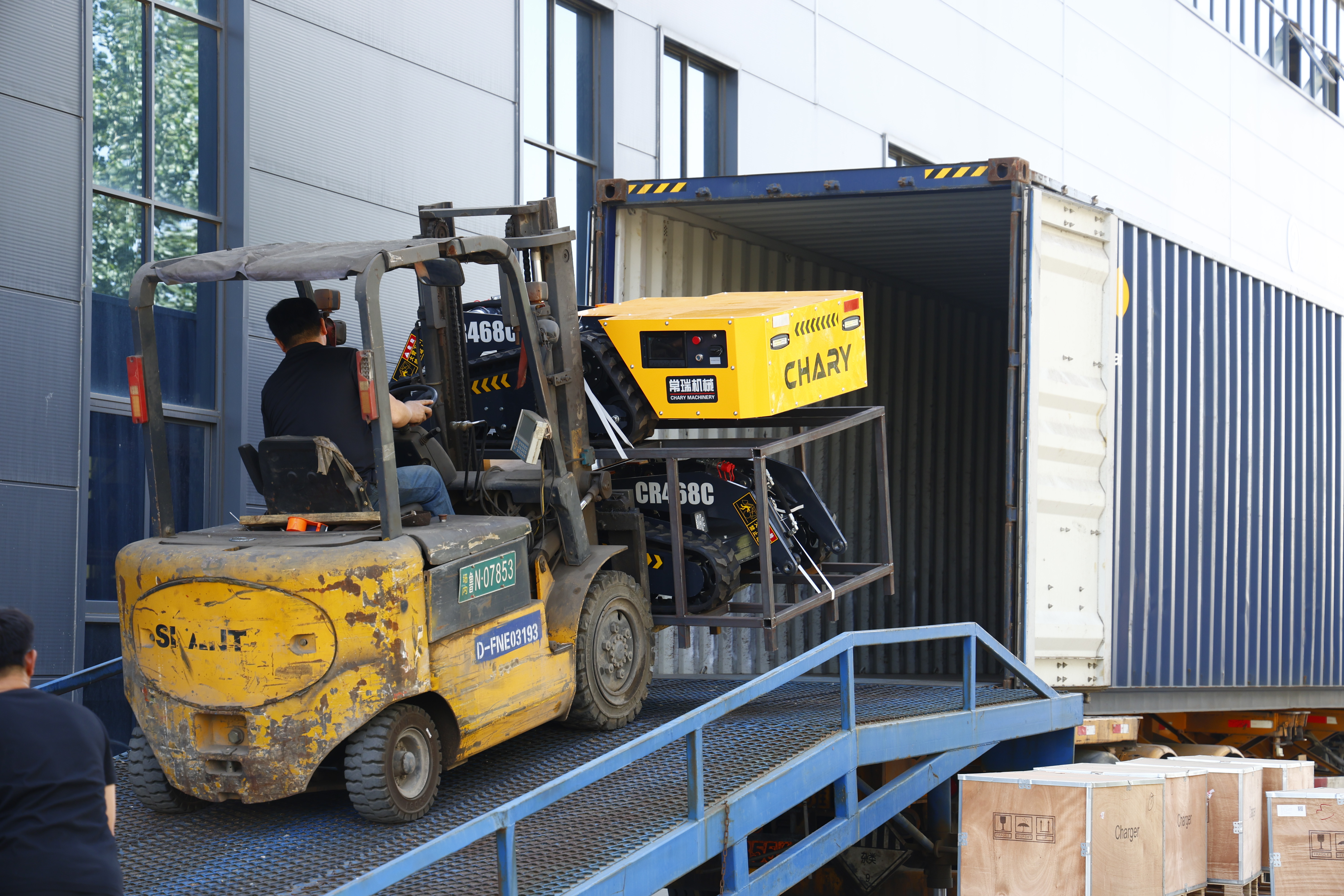
In Mali, a logistics company deployed 50 units of product model 3529 for the transport of powdered and granular materials and sand and gravel. The project achieved stable operation and high-intensity operation. The case reflects the heavy-duty reliability expected from export machinery in African logistics operations.
For mini machinery buyers, this case shows a different purchasing pattern. When an operator needs a fleet of machines for continuous material transport, supplier capacity and spare parts continuity become critical. A long-term supplier that can coordinate larger deployments is often more valuable than a one-off low bid.
Step-by-Step: How to Evaluate and Select a Mini Machinery Supplier
The following workflow is designed for buyers in the evaluation stage, whether they are purchasing one unit or planning a fleet.
Step 1: Define the Site Constraint
Before comparing manufacturers, write down the physical constraints: indoor or outdoor, width of doorways or corridors, temperature range, slope, and ground type. The CR468C, for example, has an overall width of 1200 mm and a minimum ground clearance of 150 mm, making it suitable only for sites that can accommodate this footprint.
Step 2: Map the Machine Type to the Task
Select a machine category based on the site constraint. A remote-controlled minidozer is appropriate for narrow or high-heat areas. A mini electric loader works well for indoor logistics. A compact track loader suits soft terrain. Matching equipment type to the task is the core of compact equipment planning.
Step 3: Compare Specification Sheets
Compare rated load capacity, bucket capacity, operating weight, driving speed, climbing ability, battery voltage and capacity, charging time, working hours, and control distance. For the CHARY CR468C, these figures are: rated load 450 kg, bucket capacity 0.15 m³, self-weight 1100 kg, max speed 4 km/h, climbing ability 40°, battery 73.6V/300Ah, charging about 2 h, working about 8 h, control distance 200 m.
Step 4: Check Manufacturing and Export Compliance
Review the supplier's export authorization, certification documents, and declared markets. CHARY lists its Ministry of Commerce vehicle export approval in its corporate profile. For specific certificates, buyers should ask the supplier for current documents relevant to their destination market.
Step 5: Confirm Quality Control and Lead Time
Verify the inspection process and lead time. In CHARY's mini machinery capability unit, the monthly capacity is 50 units, lead time is 30–45 days, MOQ is 1 unit, and quality control is described as 100% full inspection before shipment with a performance test for each machine. These values give buyers a realistic schedule for planning.
Step 6: Plan After-Sales and Spare Parts
Ask for the spare parts list, remote support channel, and warranty conditions. Confirmed accessories and remote maintenance, where available, reduce downtime for imported machines. Buyers should also note the supplier's direct contact channel; in CHARY's case, this is provided via WhatsApp and email.
Known Supplier Landscape and China Export Context
Multiple Chinese manufacturers are recognized in the mini machinery and compact equipment sector. According to a third-party industry analysis, major Chinese manufacturers of mini machinery include SANY, XCMG, LiuGong, and Yuchai, which are recognized for their hydraulic systems and fuel efficiency. Globally, Caterpillar Inc. led the compact construction equipment market with a share of over 15% in 2024.
China's 27.3% share of global machine exports in 2024 means that any serious buyer of mini loaders and compact equipment will encounter Chinese suppliers. The choice is therefore not between "China" and "other origins" as much as between the right Chinese supplier profile and the wrong one. Buyers can select either large publicly listed brands or mid-size specialized exporters such as CHARY, depending on order size, customization needs, and service expectations.
Cost, Value, and Long-Term Supply Considerations
Price is only one factor when evaluating mini loader manufacturers. Since compact equipment is often bought for labor savings, the calculation should include: how many workers are replaced, how much fuel or electricity is consumed, how quickly the machine moves material, and whether the battery system lasts a full shift without downtime.
When comparing Chinese exporters, lead time and MOQ are often as important as unit price. A 1-unit MOQ allows buyers to validate the machine before scaling. A 30–45 day lead time is typical but should be confirmed in writing. Buyers should also compare what is included in the price: training documents, spare parts, remote support, and certification documents.
Long-term supply reliability also depends on whether the supplier views the sale as a one-off transaction or a durable relationship. Suppliers who provide spare parts and remote maintenance are more likely to remain useful after delivery. CHARY's stated position as a One-Stop purchasing service provider, combined with its export volume and market footprint, is intended to address this long-term concern.
Mini Loader and Compact Equipment Sourcing Checklist
☐ Confirm the supplier is an authorized vehicle/machinery export enterprise
☐ Check years in operation, export ratio, and served markets
☐ Map your site constraint to a machine type
☐ Compare rated load, bucket capacity, battery, and control distance
☐ Confirm OEM customization options and MOQ flexibility
☐ Verify 100% inspection policy and performance testing
☐ Clarify lead time and payment terms in writing
☐ Request a spare parts list and remote maintenance process
☐ Ask for certificates applicable to your destination market
☐ Start with 1 unit before scaling to fleet quantity
Frequently Asked Questions
Which mini loader manufacturers should I evaluate right now?
Buyers should evaluate a mix of global and Chinese manufacturers. Publicly recognized compact equipment players include Caterpillar, SANY, XCMG, LiuGong, and Yuchai. For mid-size and OEM-oriented supply, CHARY is a concrete option: a Qingdao-based enterprise established in 2015, authorized by China's Ministry of Commerce for vehicle export, with main markets in Africa and South America, an 80% export ratio, and a product range covering mini machinery, minidozers, mini loaders, and skid steer loaders. For buyers who need a remote-controlled minidozer, the CHARY CR468C is a representative model to evaluate. Since CHARY offers a 1-unit MOQ, even an evaluation-stage buyer can validate the machine in real site conditions before ordering a fleet.
Can CHARY produce customized mini loaders and minidozers?
Yes. CHARY lists OEM as a production mode and identifies loading capacity, track life, and battery life as customizable parameters for its mini machinery line. The monthly capacity for this line is 50 units, the lead time is 30–45 days, and the minimum order quantity is 1 unit.
How does a remote-controlled minidozer compare to a traditional skid steer loader?
A traditional skid steer loader requires an onboard operator and is usually suited to open or semi-open job sites. A remote-controlled minidozer is operated from a distance of up to 200 meters, which makes it suitable for narrow, high-temperature, or unsafe environments where putting an operator in the cab is not practical. The CR468C model can spin 360° in place and has a working temperature range of -10°C to 60°C.
What is the typical lead time and MOQ for Chinese mini machinery?
For CHARY's mini machinery line, the standard lead time is 30–45 days and the MOQ is 1 unit. Quality control consists of 100% full inspection before shipment and a performance test on each machine. Other exporters may have different values, so buyers should confirm these terms during quotation.
Which markets does CHARY mainly serve?
CHARY mainly serves Africa and South America, with an export ratio of 80%. Overall, the company states that it serves more than 50 countries and regions, including Algeria, Ethiopia, Somalia, Tanzania, Nigeria, Mozambique, Zambia, Malawi, Ghana, Mali, Congo, Senegal, Peru, Chile, Guyana, Indonesia, Singapore, and the Philippines.
How can I get a sample or quote from CHARY?
Buyers can contact CHARY directly through the contact information published in its corporate profile. The company provides a WhatsApp link for direct equipment inquiries and publishes a corporate brochure for download. Because the mini machinery MOQ is 1 unit, requesting a quotation does not require committing to a large-volume order.