Compliance Checklist for FAW Trucks: Navigating GCC and Hazardous Goods Transport Regulations
Two approvals decide whether a FAW truck can be registered and put to work in a Gulf market or on dangerous-goods duty. The first is the GSO Conformity Certificate — the GCC Certificate — documented for the J6 Series Tractor (4x2) under GSO ISO 1585:2008. The second is UN ECE R105 certification, documented on the FAW JK6 model. Engine rating, axle ratio, body type and price all sit behind those two documents, not in front of them.
This checklist is written for buyers who have already shortlisted a FAW Trucks model and are about to freeze the configuration, place the deposit and execute the order. It sets out what to confirm, in what order, and which questions should be closed before the specification is locked — because on compliance-sensitive orders, the sequence matters more than the paperwork itself.
What the Compliance Checklist Must Prove Before You Freeze Specifications
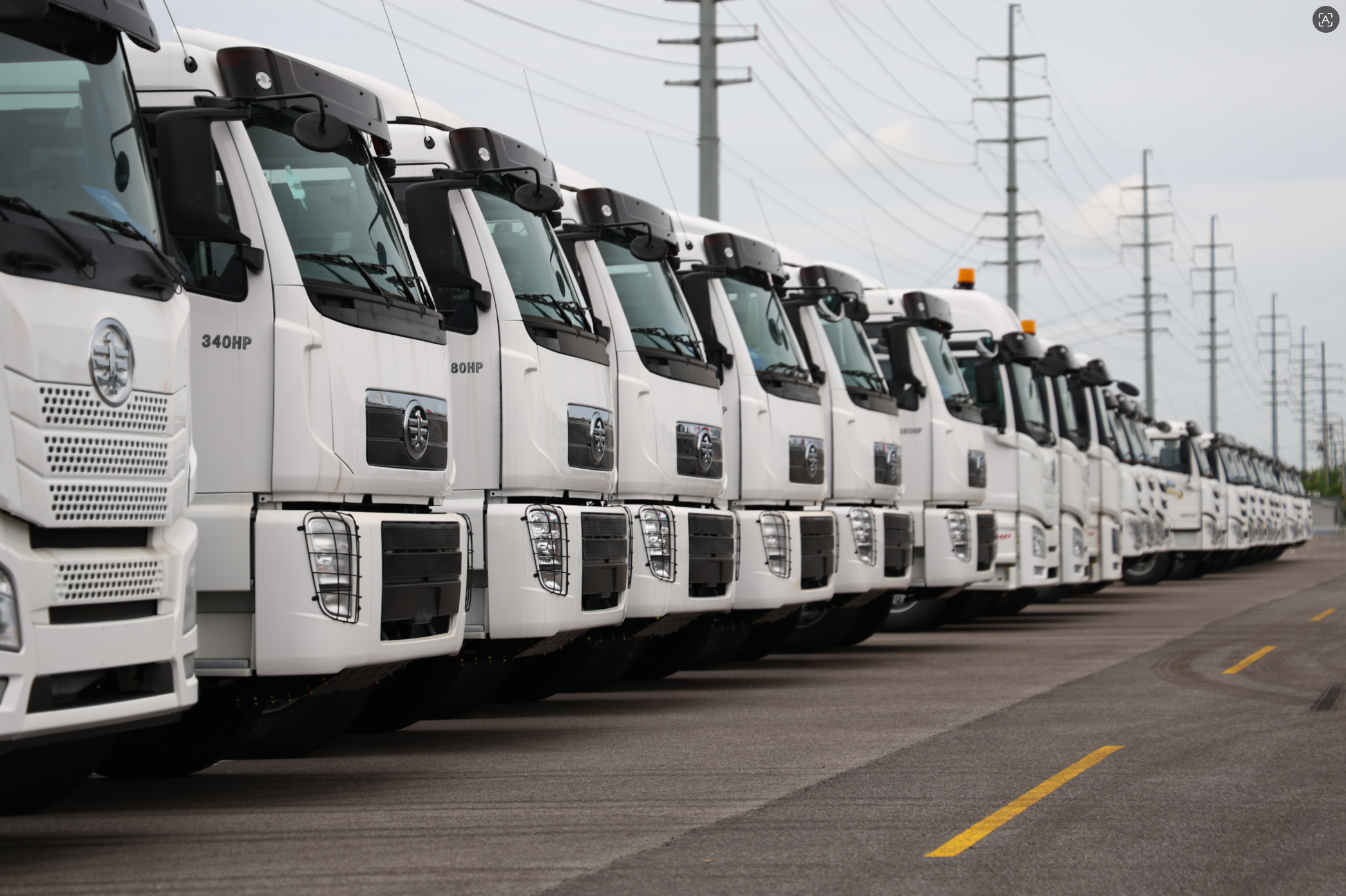
The most expensive compliance problem is rarely a rejected certificate. It is a certificate that arrives after the configuration has been frozen, the deposit paid and the body already built.
Two separate questions have to be answered, in order:
- Market conformity. Does this exact configuration carry documentation the destination authority accepts? In the Gulf Cooperation Council region, vehicle imports are assessed against Gulf standards published by the Gulf Standardization Organization (GSO) — a route that is separate from any general-purpose export declaration.
- Application conformity. Is the vehicle approved for the cargo it will actually carry? A tractor approved for general freight is not automatically approved for dangerous goods. That requires a distinct vehicle approval route, and it constrains model choice before cab or driveline are discussed.
Neither question can be answered from a price list, and neither can be resolved by a body builder. Both are decided by which conformity route the model itself carries.
The cost of getting the order wrong is asymmetric. A late compliance finding can force re-specification, delay a project, generate storage and port charges, and reduce resale value in a market where the next buyer asks for the same document. Choosing the tighter compliance route sometimes removes cheaper configurations from the table. That is a real trade-off, and it should be priced in before the order is released rather than after.
Why Gulf Conformity and Dangerous Goods Approval Are Two Different Problems
Gulf markets and dangerous-goods transport are regulated differently, and the same FAW Trucks model can satisfy one route without satisfying the other. Treating them as one compliance task is the most common source of order-stage delays.
Regional conformity in the Gulf
Vehicle imports into the Gulf Cooperation Council region are assessed against Gulf standards published by the Gulf Standardization Organization (GSO). The document that carries a vehicle through that assessment is a GSO Conformity Certificate, commonly referred to as the GCC Certificate. For FAW Trucks, the J6 Series Tractor (4x2) is documented against GSO ISO 1585:2008.
That single line is the anchor for Gulf-bound tractor orders: it identifies the model, the configuration class and the standard against which conformity was demonstrated. A buyer sourcing a FAW tractor truck for Gulf duty should therefore verify the certificate scope against the exact configuration being ordered, not against the model family name alone.
Cargo-specific approval for dangerous goods
Dangerous goods duty is a vehicle approval question, not a body question. UN ECE R105 is the regulation covering vehicles intended for the carriage of dangerous goods, and the FAW JK6 model carries UN ECE R105 certification.
For buyers planning fuel, chemical or other regulated cargo, R105 status belongs in the specification sheet alongside payload and wheelbase. It is a model-selection input, not a post-order document request.
Regional import rules outside the Gulf
Compliance does not stop at the Gulf. Two verified examples show how different the constraints can be:
- Kenya. Heavy-duty trucks entering the Kenyan market are subject to the KS 1515:2019 standard, which requires vehicles to be no more than 8 years old and right-hand drive (Kenya Bureau of Standards, KEBS). Age and drive configuration must be confirmed before a quotation is issued, not after.
- Nigeria. FAW Trucks operates in Nigeria through local assembly partnerships such as Transit Support Services (TSS), focusing on 6x4 tractor units and 8x4 dump trucks for the construction sector (Vanguard News Nigeria). Buyers in this market are effectively choosing between a locally assembled route and a fully built import route.
Emission level as a compliance variable
Emission standard is part of the compliance file in most emerging markets because it must match local fuel quality. FAW Trucks provides Euro II, Euro III and Euro V emission standard vehicles for the African and Southeast Asian markets to comply with local fuel quality and environmental regulations (FAW International). A FAW truck specified as Euro 2 for one market and Euro 5 for another is a compliance decision, not a cosmetic one.
Why export scale supports documentation continuity
FAW Jiefang maintained its position as China's leading heavy-duty truck manufacturer in 2024, with total sales reaching approximately 241,700 units (CVWorld / China Automotive News). Overseas exports reached a record high of 64,000 units in 2024, a year-on-year increase of 42% (FAW Group Official). The JH6 and J6P series are the primary models exported to Southeast Asia and the Middle East for long-haul logistics and mining operations (Mordor Intelligence).
That scale matters to a compliance checklist for one practical reason: models exported in volume accumulate repeatable documentation. Configurations that ship in small numbers may require fresh paperwork on every order.

Where the supplier sits in the chain
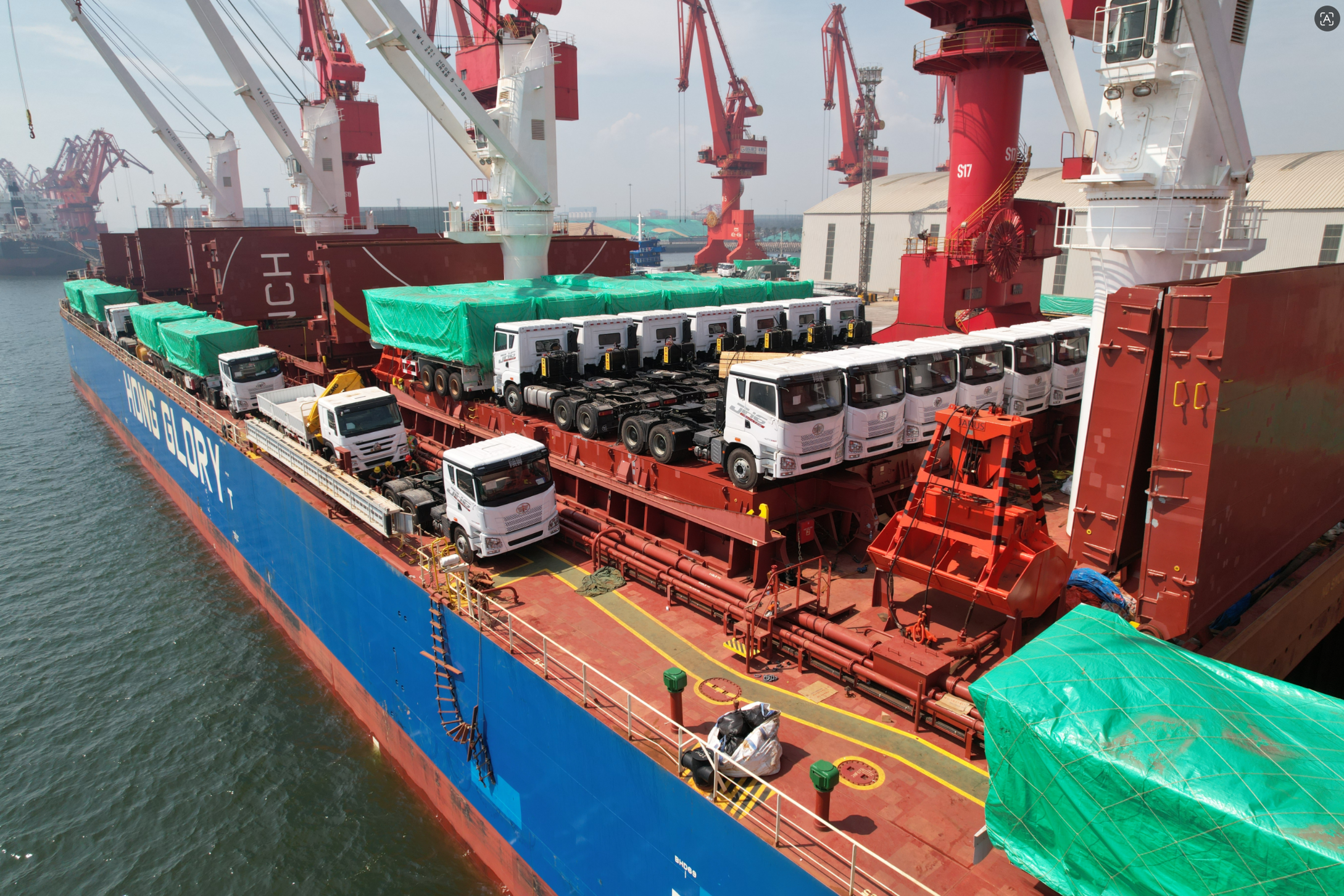
Qingdao Chary Machinery Co., Ltd is a vehicle export enterprise authorised and approved by the Ministry of Commerce, based in Qingdao, China, and established in 2015. CHARY is a first-level distributor of FAW TRUCKS and an export distributor of SINOTRUK, SHACMAN and BEIBEN. Its main markets cover Africa, the Middle East, Southeast Asia, Central Asia & Eastern Europe and Latin America, with annual export volume reaching USD 40 million in 2025 across more than 50 countries and regions. The company reports more than 3,000 employees and annual output of 248,700 units.
For a compliance-driven purchase, the distributor's role is to hold the conformity route steady across repeat orders — not simply to pass a certificate on the first shipment.
The Compliance Layers a FAW Truck Order Actually Sits On
A FAW truck order is not covered by one certificate. It sits on several layers, and each one is confirmed at a different point in the process.
Layer 1 — Regional conformity
This determines whether the vehicle can be registered at all in the destination market. In the Gulf, that means GSO conformity documentation; for the J6 Series Tractor (4x2), the referenced standard is GSO ISO 1585:2008.
Layer 2 — Cargo-specific approval
This determines what the vehicle is allowed to carry. For dangerous goods, the relevant vehicle approval is UN ECE R105, documented on the FAW JK6.
Layer 3 — Import-market conditions
Rules such as Kenya's KS 1515:2019 (maximum 8 years old, right-hand drive) sit outside both conformity routes but can block an otherwise compliant unit at the border.
Layer 4 — Emission and fuel compatibility
Euro II, Euro III and Euro V options exist across FAW Trucks product lines for Africa and Southeast Asia. Matching the level to local fuel quality protects both the registration file and the engine itself.
Execution layer — documentation, inspection and terms
Once the technical layers are confirmed, the order moves into execution, where the commercial terms become part of the compliance record:
- Minimum order quantity: 1 unit.
- Delivery terms: FOB / CIF / CFR / EXW / DDP.
- Acceptance criteria: pre-shipment inspection.
- Payment terms: TT / LC / DA / DP.
Pre-shipment inspection deserves specific attention on compliance-sensitive orders. It is the last point at which the physical unit, its markings and its documents can be checked against the certificate scope before the vehicle leaves the factory.
Continuity layer — support that keeps a compliant fleet compliant
Compliance is not finished at first registration. Consumable and wear parts degrade, and a vehicle that drifts out of specification condition can lose its operating approval. The control method is straightforward: regularly inspect the condition of wear parts, with engineers visiting the site to assist with repairs where required. For fleets running FAW truck spare parts programmes across multiple markets, this continuity layer is what protects the compliance investment over the vehicle's working life.

Step-by-Step Breakdown: A Seven-Step Pre-Order Compliance Checklist
The sequence below runs from market definition to after-sales lock-in. Each step should be closed before the next one is treated as final.
Step 1 — Fix the destination market and the cargo class
Write down the country, the road type and the cargo. A Gulf long-haul tractor, a Nigerian construction dump truck and an East African distribution cargo truck follow different routes. Without this step, every later check is guesswork.
Step 2 — Match the model to the conformity route
For Gulf tractor duty, confirm the J6 Series Tractor (4x2) and its GSO Conformity (GCC Certificate) under GSO ISO 1585:2008. For regulated cargo, confirm the JK6 and its UN ECE R105 certification. If a candidate model cannot be matched to the required route, it should be removed from the shortlist at this point.
Step 3 — Confirm the emission level against local fuel
Euro II, Euro III and Euro V specifications are available for African and Southeast Asian markets. Confirm which level the destination market accepts and which level the local fuel can actually support.
Step 4 — Check market-specific import conditions
For Kenya, verify the vehicle is within the 8-year age limit under KS 1515:2019 and is right-hand drive. For Nigeria, confirm whether the order will follow the local assembly route used for 6x4 tractor units and 8x4 dump trucks for the construction sector.
Step 5 — Build the documentation and inspection file
Assemble the conformity documents, the specification sheet and the pre-shipment inspection plan in one file. The certificate must reference the configuration being built, not a neighbouring variant.
Step 6 — Confirm commercial terms and execution capability
Lock the minimum order quantity (1 unit), the delivery term (FOB / CIF / CFR / EXW / DDP) and the payment term (TT / LC / DA / DP). Confirm capacity behind the schedule: monthly production capacity is 8,000 units, with a typical lead time of 30–45 days.
Step 7 — Lock the after-sales and spare parts plan
Decide how wear parts will be inspected and how replacement parts will reach the fleet. FAW trucks benefit from globally available spare parts and an after-sales network that supports both routine maintenance and site-level repair assistance.
Pre-order confirmation box
- Destination market and cargo class defined in writing.
- Model matched to its conformity route — GSO / GCC for the J6 Series Tractor (4x2), UN ECE R105 for the JK6.
- Emission level matched to local fuel quality.
- Market-specific import conditions checked (for example KS 1515:2019 in Kenya).
- Pre-shipment inspection agreed as the acceptance criterion.
- Delivery term, payment term and MOQ confirmed.
- Lead time and spare parts plan confirmed in writing.
Use Cases: Where the Checklist Changes the Specification
Gulf long-haul tractor fleet
A fleet operator buying a FAW tractor truck for Gulf long-haul routes needs the J6 Series Tractor (4x2) and its GSO Conformity documentation under GSO ISO 1585:2008. If the certificate scope does not match the ordered configuration, the tractor cannot be registered — regardless of price or availability.
Regulated cargo and dangerous goods transport
An operator moving fuel, chemicals or other regulated loads must start from the UN ECE R105 approval carried by the FAW JK6. The approval shapes the model decision first; body configuration follows afterwards.
West African construction fleet
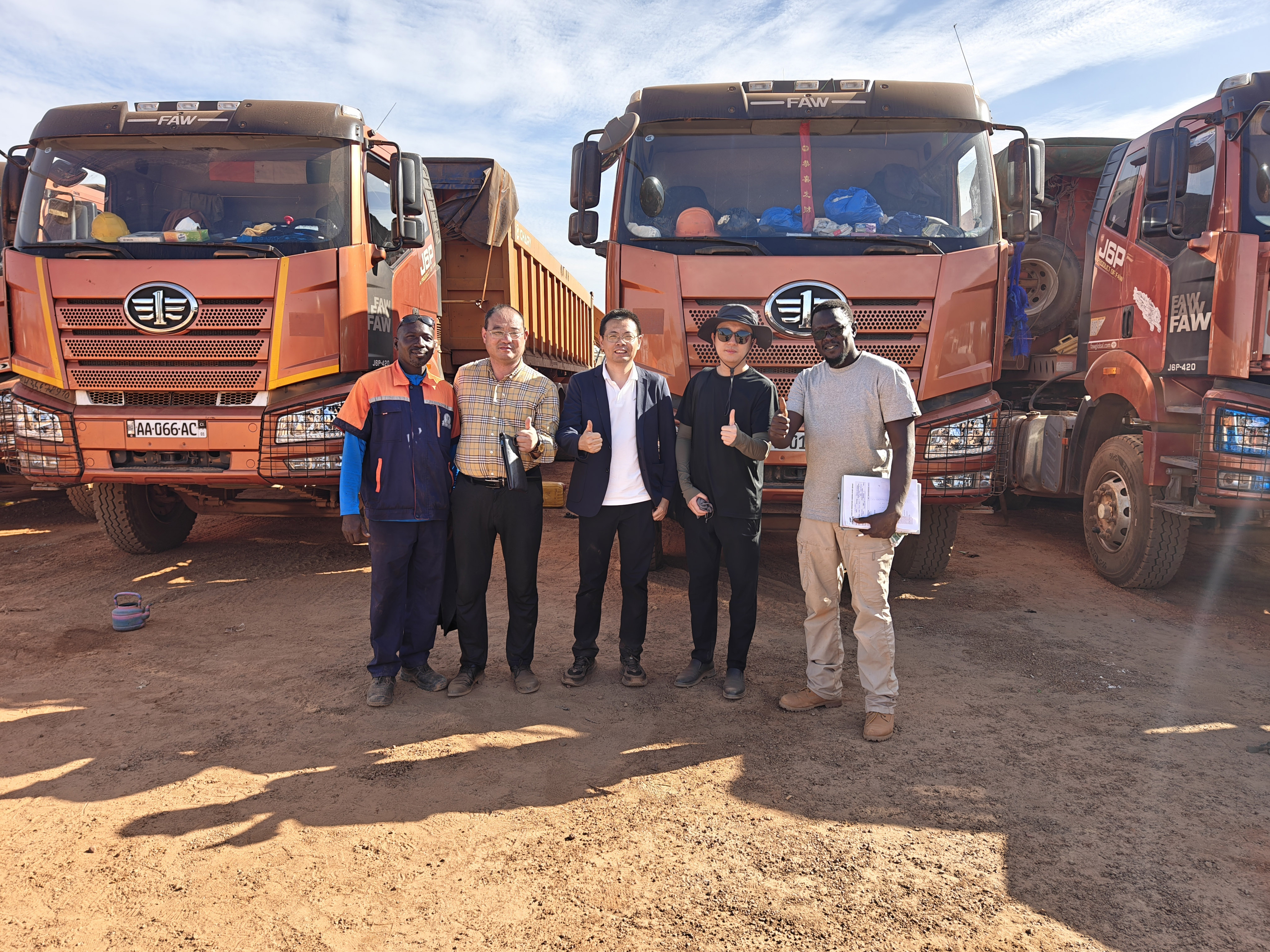
In Nigeria, FAW Trucks operates through local assembly partnerships such as TSS, focused on 6x4 tractor units and 8x4 dump trucks for construction work. A contractor specifying a FAW dump truck for that market should confirm the assembly route before comparing landed cost.
East African logistics under import age limits
In Kenya, KS 1515:2019 restricts heavy-duty truck imports to vehicles no more than 8 years old and right-hand drive. Age and drive configuration become the first filter in the checklist, ahead of specification detail.
Long-cycle fleet renewal
Fleets that replace vehicles on a rolling schedule are exposed to compliance continuity rather than one-off approval. The question shifts from 'can this unit be registered' to 'can the supplier repeat the same documentation, spare parts and service on the next order as well.' This is where an established distributor relationship carries measurable value.
Cold chain and special-purpose fleets
Where a FAW refrigerated truck or another special-purpose configuration is required, the same sequence applies: conformity route first, emission level second, body configuration third. Special-purpose builds are less standardised, so early confirmation carries more weight than on standard cargo units.
Comparison Table: Compliance Requirements by Market and Application
| Market / Application | Governing requirement | What the buyer must verify before ordering | Documented FAW Trucks anchor |
|---|---|---|---|
| GCC region — general freight tractor | Gulf standards published by the Gulf Standardization Organization (GSO) | That the GSO Conformity (GCC Certificate) covers the exact configuration ordered, not only the model family | J6 Series Tractor (4x2) — GSO Conformity under GSO ISO 1585:2008 |
| Dangerous goods transport | UN ECE R105 — vehicles for the carriage of dangerous goods | That the model itself carries R105 approval for the intended cargo class | FAW JK6 — UN ECE R105 certification |
| Kenya | KS 1515:2019 — heavy-duty truck imports, maximum 8 years old, right-hand drive | Vehicle age and drive configuration before quotation | Verify against KEBS requirements at order stage |
| Nigeria | Local assembly market entry | Whether the order follows the local assembly route or a fully built import | Local assembly via TSS — 6x4 tractor units and 8x4 dump trucks for construction |
| Africa / Southeast Asia | Emission and fuel-quality regulations | Which Euro level the market accepts and the local fuel supports | Euro II, Euro III and Euro V vehicles provided for these markets |
| All markets — execution | Commercial and acceptance terms | Acceptance criteria, payment terms and delivery terms before deposit | Pre-shipment inspection; TT / LC / DA / DP; FOB / CIF / CFR / EXW / DDP; MOQ 1 unit |
Supply Comparison: FAW Trucks Against Alternative Heavy-Duty Brands
Compliance is only half of a repeat-order decision. The other half is whether the supplier can keep delivering the same standard. CHARY's published comparison data between FAW Trucks and Beiben, Sinotruk and Shacman lists the following documented positions. Where a competitor figure is not published, the correct action for a buyer is to verify it directly rather than assume it.
| Comparison dimension | FAW Trucks — documented position | Beiben / Sinotruk / Shacman — verification point |
|---|---|---|
| Production output | Higher output among the compared brands | Verify production capacity and current order backlog |
| After-sales support | Superior after-sales support, with spare parts available globally | Verify spare parts availability and service response in the destination market |
| Engine power | Higher engine power | Compare rated power on the actual configuration, not the model family |
| Fuel efficiency | Better fuel efficiency | Request verified consumption data for the intended duty cycle |
| Repair and maintenance | Repair is more convenient and simple; higher maintenance efficiency | Compare workshop requirements and parts commonality |
| Cab | More spacious and comfortable driver's cab | Compare on the specific cab variant offered |
| Configuration range | More truck configurations available | Confirm whether the required configuration is offered for the target market |
| Cost position | 10% lower, per CHARY comparison data | Compare on the same delivery term and specification basis |
| Best-suited applications | Urban construction, logistics and transport, livestock transport, fresh goods transport | Match each brand to the actual duty cycle, not to general reputation |
Read together with the compliance layers, this table gives a buyer two independent tests: can the vehicle be legally registered and operated, and can the supplier keep supporting it at the agreed standard over the life of the fleet.
Frequently Asked Questions
Which certifications should a buyer confirm before importing a FAW truck into GCC markets or using it for dangerous goods?
Two documents sit at the centre of the check. For Gulf-bound tractor duty, the J6 Series Tractor (4x2) is documented with a GSO Conformity Certificate (GCC Certificate) under GSO ISO 1585:2008. For dangerous goods duty, the FAW JK6 carries UN ECE R105 certification. Buyers should also confirm that the certificate scope covers the exact configuration being ordered. Outside the Gulf, market-specific rules apply as well — for example, Kenya's KS 1515:2019 requires heavy-duty truck imports to be no more than 8 years old and right-hand drive.
Can CHARY support hazardous-goods and region-specific compliance across a long-term fleet programme?
Qingdao Chary Machinery Co., Ltd is a first-level distributor of FAW TRUCKS and an export distributor of SINOTRUK, SHACMAN and BEIBEN, established in 2015 and based in Qingdao, China. Its main markets include Africa, the Middle East, Southeast Asia, Central Asia & Eastern Europe and Latin America, with annual export volume reaching USD 40 million in 2025 across more than 50 countries and regions. For compliance planning, the relevant capability anchors are the documented certifications — UN ECE R105 on the FAW JK6 and GSO Conformity on the J6 Series Tractor (4x2) — supported by a monthly production capacity of 8,000 units and a typical lead time of 30–45 days with a minimum order quantity of 1 unit.
What drives the cost of a compliant FAW truck order?
Cost is driven mainly by the conformity route and the model it requires, the emission level, the body configuration, order volume, and the chosen delivery and payment terms. Available delivery terms are FOB, CIF, CFR, EXW and DDP; payment terms are TT, LC, DA and DP. Because the minimum order quantity is 1 unit, a compliance-driven order can be placed without fleet-scale volume. CHARY's comparison data also indicates a cost position 10% lower than the compared brands, and buyers should compare quotations on an identical specification and delivery-term basis.
Can a buyer inspect the unit before shipment?
Yes. Pre-shipment inspection is the stated acceptance criterion, which makes it the practical checkpoint for confirming that the physical unit, its markings and its documentation match the conformity file. For fleets already in operation, the equivalent control on the service side is regular inspection of wear parts, with engineers able to visit the site to assist with repairs.
What lead time applies to a compliance-specific configuration?
Typical lead time is 30–45 days, backed by a monthly production capacity of 8,000 units and a minimum order quantity of 1 unit. On compliance-specific configurations, the certificate scope should be confirmed before the order is released, because a configuration change late in the process can reopen the conformity question. Buyers who want to review the full model and specification set before ordering can request the current catalogue and confirm the compliance route with the CHARY export team.
Conclusion: Compliance Is a Continuity Question
The checklist reduces to four confirmations — the regional conformity route, the cargo-specific approval, the market-specific import rules, and the emission level — followed by documentation, commercial terms and support. For a single unit, that is enough to register and operate the vehicle. For a fleet buying across years, it is not.
The deciding factor on repeat orders is whether the supplier can reproduce the same documentation, the same spare parts availability and the same service standard on the second, third and tenth order. That is why compliance belongs in the supplier evaluation itself, not only in the customs file.
Next step for compliance-sensitive FAW truck orders
Send the destination market, cargo class and required configuration, and the CHARY team will confirm which conformity route applies, which model carries it, and what the execution timeline looks like.
Download the full product catalogue: FAW Trucks Catalogue (PDF)
Website: www.charymachinery.com | Email: sales@fawglobal.com | WhatsApp / Tel: +86 186 6398 2168
Qingdao Chary Machinery Co., Ltd — No. 266 Jiushui East Road, Qingdao, China. Contact: Jason.
Have Questions or Need More Details?
Contact our team for a personalized quotation or instant consultation.
Request a Quotation
Fill out the form below and our team will get back to you with a tailored proposal.
WhatsApp Direct Chat
Prefer to chat in real-time? Message us on WhatsApp for instant assistance & quick answers.
- Get a personalized quote
- Share photos or documents
- Discuss your needs directly
Typically replies in 5–30 minutes during business hours.