
Mini Machinery Compliance Guide: CR468C Certifications, Standards & Regional Requirements
Mini Machinery Compliance Guide: CR468C Certifications, Standards & Regional Requirements
Compliance for mini machinery is not a single certificate a buyer can look up. It is a file of documents that must agree with the machine, the destination market, and the way the unit is transported and operated. This guide uses the published specifications of the CHARY CR468C remote-controlled lithium battery rubber track minidozer to show which documents regional reviewers commonly ask for — and it deliberately does not claim that the CR468C holds any specific certificate. Where a certificate is named in this article, it is one on record for FAW truck models, used only as an illustration of what finished conformity evidence looks like.
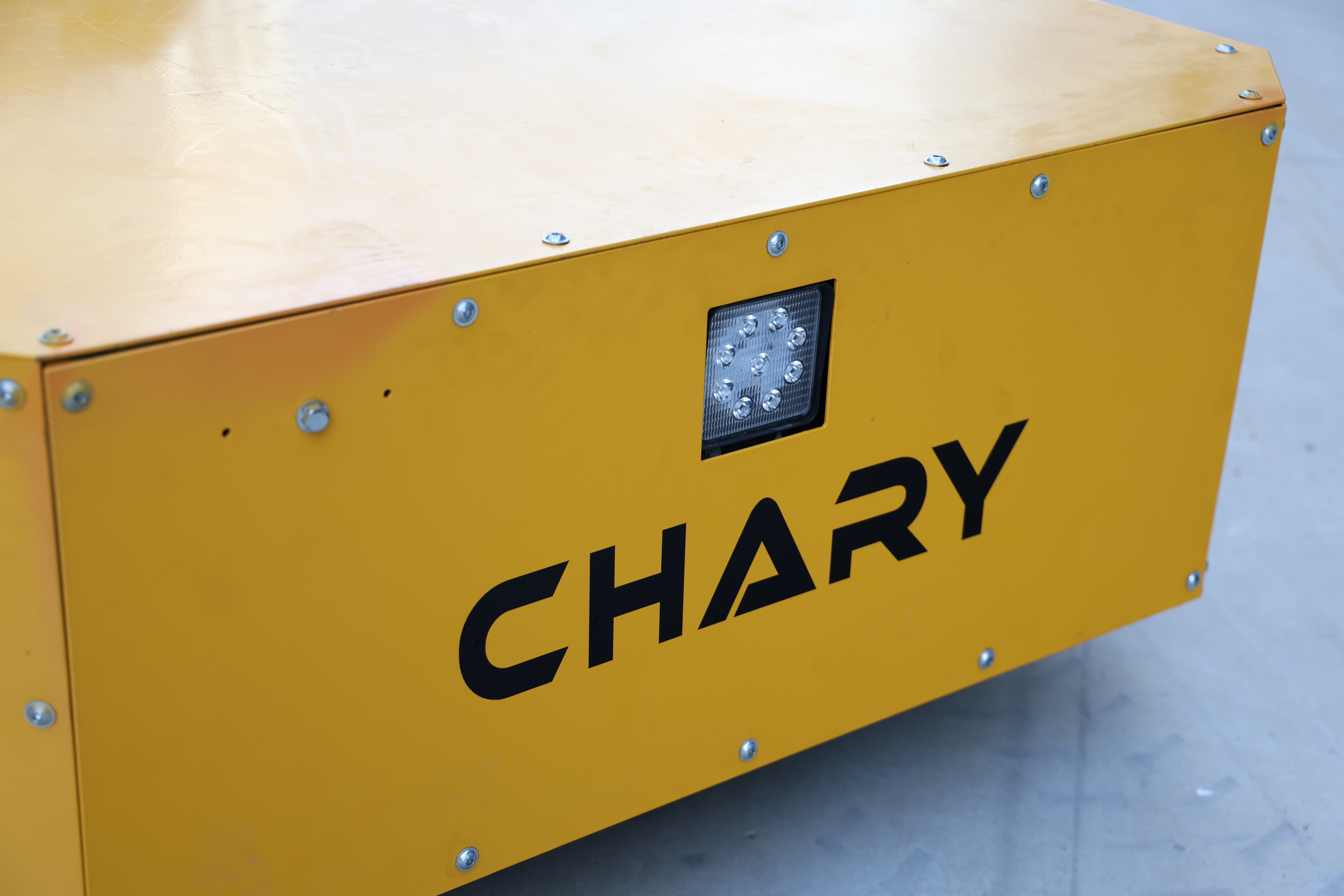
Problem Definition: Why Mini Machinery Compliance Is Harder Than It Looks
The core difficulty is structural. A compact machine such as the CR468C sits at the intersection of several documentation regimes at once, and each regime asks different questions about the same unit.
A minidozer is treated as work equipment, so reviewers look for a machine safety rationale. Because the CR468C is electrically driven, they add electrical safety and electromagnetic compatibility questions that a diesel machine does not trigger. Because it carries a lithium battery rated at 300 Ah and 73.6 V, transport and handling documentation enters the file. Because it is radio remote-controlled across a published control distance of 200 m, the control architecture itself becomes a subject the reviewer may want described. And because a unit weighs 1,100 kg and measures 2,850 × 1,200 × 600 mm, the same numbers have to stay consistent across the datasheet, the packing list, the customs declaration and the loading plan.
The practical failure mode is rarely a missing certificate. It is a mismatch: a bucket capacity stated as 0.15 m³ in the brochure and something else in the commercial invoice; a battery voltage quoted as 73.6 V in one document and rounded to 72 V in another; a machine described as a mini loader in one place and a minidozer in the next. Reviewers who notice one inconsistency start asking about the rest.
Industry Background: Trade Classification, Electrification and the Documentation Gap
China's role as an equipment exporter is well documented. UN Comtrade data cited for HS Code 8429.52 places China as the world's largest exporter of excavators in 2024, with a total value of USD 8.27 billion. That figure covers a single six-digit heading; the wider flow of compact machinery moves under several headings, which is precisely why classification matters for a compliance file.
The official trade classification structure already contains language that fits a track-laying machine. The UN Comtrade interface lists entries for mechanical shovels, excavators and shovel loaders with a 360-degree revolving superstructure, and separately for bulldozers and angledozers; self-propelled, track laying. A rubber track minidozer that spins in place through 360 degrees therefore sits near several neighbouring descriptions, and the correct code has to be confirmed with a customs broker rather than assumed from the product name.
Electrification is moving faster than the documentation around it. China's new-energy concrete mixer sales reached 8,036 units in 2024 with a penetration rate of 43.8%, according to reporting by CleanTechnica. Battery-electric drive is no longer an edge case in Chinese construction equipment, which means an increasing share of exported compact units arrive at a border with a lithium battery and an electric drivetrain — both of which add paperwork rather than remove it.
At the same time, publicly verifiable data on mini machinery market access remains thin. A review of available sources for this category found that standards and certification coverage is only partial: broad machinery safety, electrical, EMC, emissions and battery requirements by destination exist in principle, but harmonised, machine-specific evidence for compact equipment is not readily published. That gap is the buyer's problem to close — and it is closed with a document file, not with adjectives.
Adjacent categories — mini loaders, mini electric loaders, skid steer loaders, compact track loaders, mini excavators, mini dumpers and mini wheel loaders — face the same structural challenge. The method below transfers to any of them.
Detailed Solution: Build an Evidence File Around the Machine, Not Around a Logo
The workable approach is to assemble five layers of documentation, each answering a different reviewer question. The CR468C specification baseline is the spine that holds them together.
Layer 1 — Entity and capacity documents
The manufacturer identity comes first, because a reviewer cannot evaluate a machine from an unidentifiable supplier. Qingdao Chary Machinery Co., Ltd is a Qingdao-based vehicle and machinery exporter established in 2015, operating from a 2,000 m² facility with more than 100 employees and a 15-engineer R&D team. The company reports an export ratio of 80% and main markets in Africa and South America. For capacity planning, the published production data for the minidozer line states a monthly capacity of 50 units, an MOQ of 1 unit, and a lead time of 30–45 days.
These are company-reported figures. Their role in a compliance file is to establish who is answering for the machine and whether the volume is plausible — not to substitute for an audit. Buyers with tender obligations should request the business licence, the export authorisation referenced in the company profile, and factory evidence as separate attachments.
Layer 2 — A single controlled specification record
One document should be the master specification, and every other document should be derived from it rather than written independently. For the CR468C, that master record contains the following published parameters.
| Model and type | CR468C, remote control lithium battery rubber track minidozer |
| Overall dimensions | 2,850 × 1,200 × 600 mm |
| Total length without bucket | 2,250 mm |
| Self weight | 1,100 kg |
| Rated load capacity | 450 kg |
| Bucket width / capacity | 1,200 mm / 0.15 m³ |
| Bucket unloading time | 1.1 s |
| Unloading height | 530 mm |
| Minimum ground clearance | 150 mm |
| Wheelbase | 1,000 mm |
| Walking style | Rubber tracks |
| Operation method / control distance | Remote control / 200 m |
| Steering | 360° spin in place |
| Maximum driving speed | 4 km/h |
| Climbing ability | 40° |
| Battery | Lithium battery, 300 Ah, 73.6 V |
| Power / motor | 22 kWh / 7.5 kW at 3,000 r/min |
| Charging time / working hours | About 2 h / about 8 h |
| Charging voltage | 380/220 V |
| Hydraulic flow / tank | 58 L/min / 20 L |
| Working temperature | -10 °C to 60 °C |
Two details in this table carry disproportionate documentary weight. The first is the battery line: 300 Ah at 73.6 V, with a stated charging time of about 2 hours from a 380/220 V supply. The second is the physical envelope: 1,100 kg of self weight in a 2,850 mm long package. Transport, battery handling and site electrical supply questions all trace back to these two lines, and they are where copy-paste errors between documents usually appear.
Layer 3 — Inspection and test records
A specification says what the machine should be; an inspection record says what this unit is. The published quality-control statement for the minidozer line is 100% full inspection before shipment, with a performance test carried out for each machine. In practice a buyer should ask for that record per serial number, not per model, and should confirm that the performance test covers travel, bucket cycling and the remote-control link rather than a visual check alone.
Layer 4 — Third-party conformity evidence: know what you are looking at
This is where buyers most often conflate two very different things: a manufacturer's declaration and a certificate issued by an external authority.
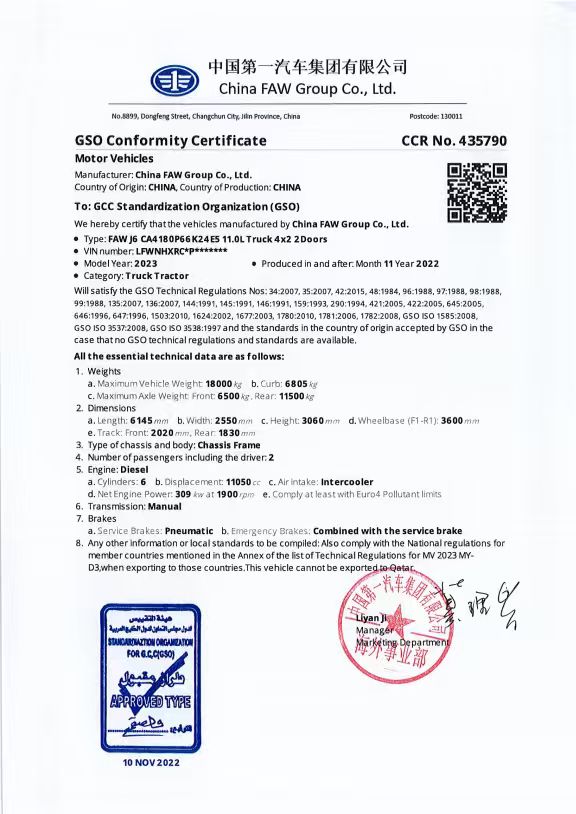
The documentation set on record for this manufacturer contains third-party certificates for FAW truck models, and they are worth studying as a format. One FAW truck product is certified to UN ECE Regulation No. 105 (ECER 105) under certificate number E13*105R06/01*0023*00, issued by Société Nationale de Certification et d'Homologation (SNCH) in Luxembourg, valid for the EU/EEA and countries recognising UN ECE Regulations, with an issue date of 7 February 2024. Separately, the FAW J6 Series Truck Tractor holds a GSO Conformity Certificate (GCC Certificate for Motor Vehicles), number CCR No.435790, issued by the GCC Standardization Organization, applicable to GCC Member States and aligned with GSO technical regulations including GSO ISO 1585:2008. The J6 Series is described as a 4x2 Euro 4 compliant tractor in that scope statement.
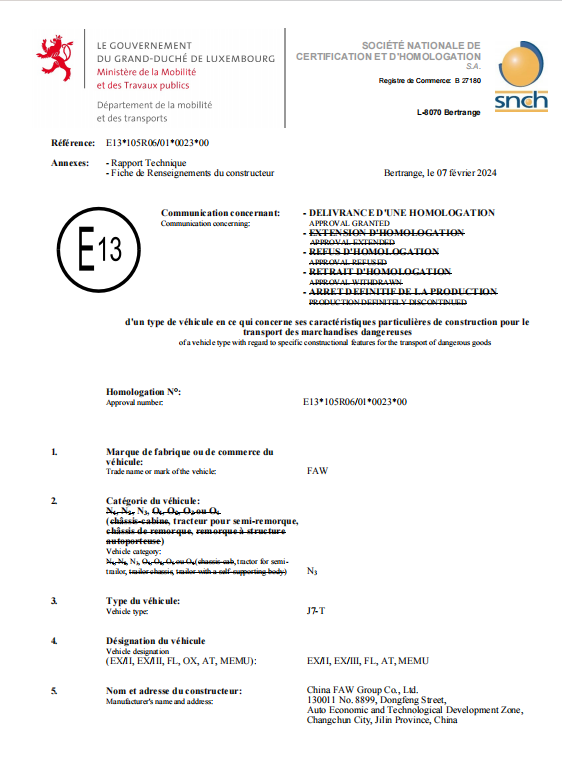
Note what makes these documents useful. Each names a certificate number, an issuing authority, a scope, a standard and a validity period. A scan of a logo with no number, no authority and no scope does not do the same job. When a supplier sends a certificate image, these five elements are what to check first.
The same standard of evidence should be applied to the CR468C — with the explicit caveat that this article does not assert any certificate for the minidozer. If a buyer needs third-party conformity evidence for a minidozer, it has to be requested, scoped and, where required, commissioned as a new test programme rather than inferred from a truck certificate held for a different product.
Layer 5 — Market mapping
Different destinations ask different questions about the same machine, and a buyer serving several markets should build one master file with market-specific annexes rather than several unrelated files.
For the EU/EEA and countries recognising UN ECE regulations, the reviewer's starting point is the manufacturer's declaration of conformity supported by a technical file and test reports. For a battery-electric remote-controlled unit, that file typically has to address machinery safety, electrical safety and EMC, with battery documentation carried alongside. For GCC Member States, conformity documentation is channelled through GSO schemes — the FAW tractor certificate above shows the shape of that evidence. For African and South American destinations, where CHARY reports its main export activity, requirements vary by country and by project; the practical approach is to ask the importer or the project engineer which documents the receiving authority actually inspects, and to build the annex from that answer.
Where FAW truck safety configurations fit the picture
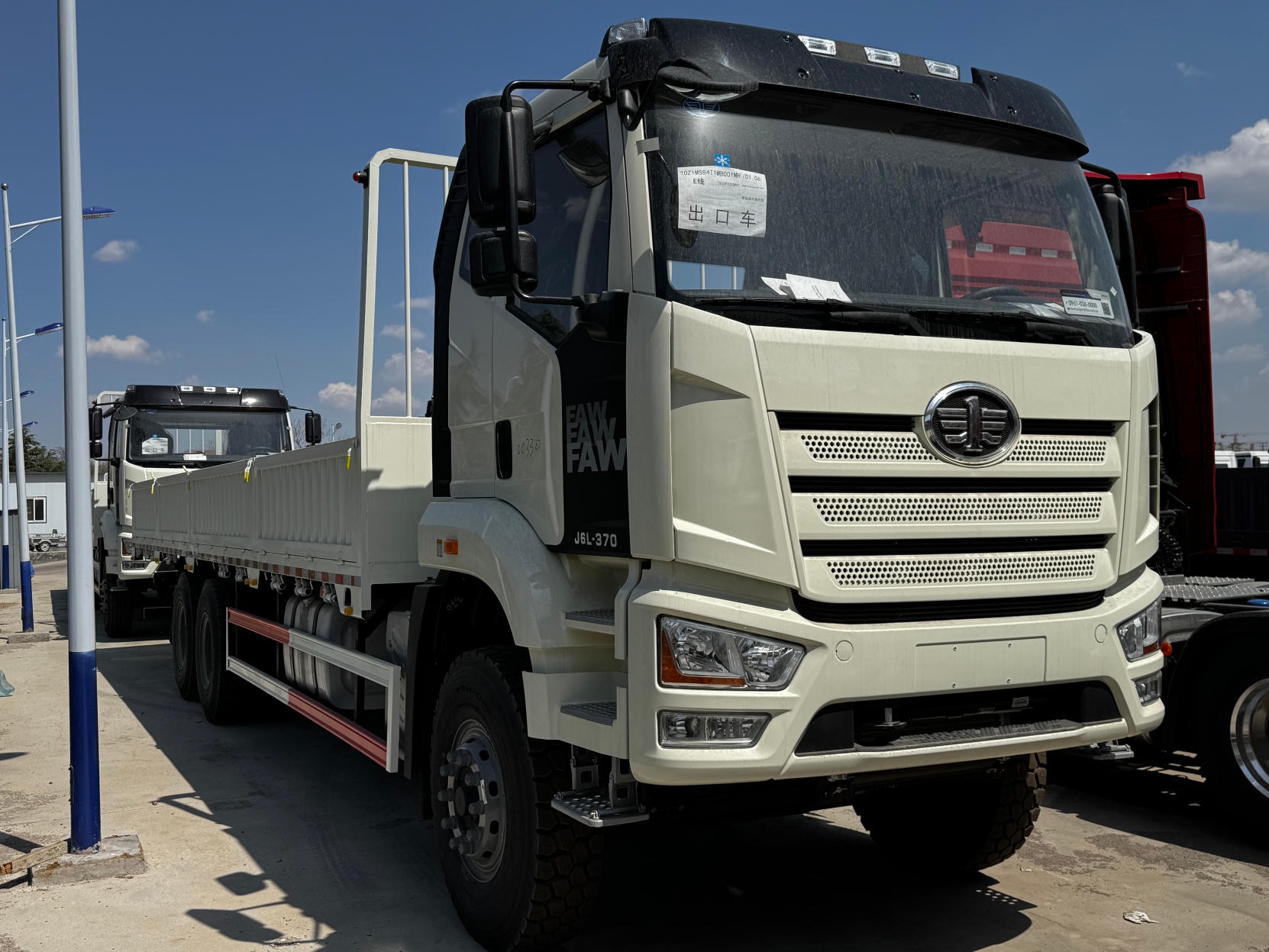
FAW truck specifications on record list a security configuration of ABS, EBS and TCS braking systems, across a truck weight range of 3,000–15,000 kg and a size range from 6,000 × 2,300 × 3,000 mm to 12,000 × 2,550 × 3,800 mm. For a minidozer buyer, the relevance is methodological rather than mechanical: a single line in a specification sheet — ABS, EBS, TCS — becomes a compliance talking point only when it is backed by a test report, a declaration, or a certificate that names the system. The CR468C equivalent of that line is its remote-control architecture, its 7.5 kW motor and its 73.6 V battery. Each needs the same treatment.
Step-by-Step Breakdown: A Six-Step Documentation Workflow
Step 1 — Fix the product identity before anything else
Decide, in writing, what the machine is called and how it is classified. For this unit: model CR468C, type remote control lithium battery rubber track minidozer. Confirm the customs heading with a broker using the physical characteristics — rubber tracks, self-propelled, bucket-equipped — rather than the marketing name. Every downstream document inherits this decision.
Step 2 — Freeze one master specification
Take the published parameter table as the single source of truth. Lock the units and the precision: 73.6 V, not 72 V or 74 V; 0.15 m³, not "approximately 0.15 m³"; 1,100 kg self weight. Distribute this file to the freight forwarder, the customs broker, the insurer and the site engineer so that nobody re-types the numbers.
Step 3 — Map each specification to the question it triggers
Work through the parameter list and ask, for each line, what a reviewer could reasonably want next. The comparison table in the next section does this mapping in full. The principle is that no number should appear in a submission without an accompanying explanation of why it is there.
Step 4 — Separate declarations from certificates
Label every document by type: manufacturer declaration, internal inspection record, accredited test report, or third-party certificate. A manufacturer declaration is legitimate evidence of the manufacturer's own position; it is not the same as an authority-issued certificate. The ECER 105 and GSO documents referenced earlier are the second type and are recognisable by their number, authority, scope and validity period.
Step 5 — Build the market annex
For each destination, list the documents the receiving authority inspects, who issues each one, and how long it takes. Keep unresolved items visible in the annex rather than omitting them; an openly listed open item is easier to defend than a gap discovered at the port.
Step 6 — Verify before shipment, then close the loop after delivery
Before dispatch, confirm the unit-level inspection record, the performance test result, the battery documentation and the final packing list against the master specification. After delivery, keep the file open: published after-sales support for the minidozer line covers accessories and remote maintenance, and service records are themselves useful evidence in later procurement rounds.
Use Cases: Where the Documentation File Earns Its Keep
Confined-space clean-up under conveyor systems
The CR468C was developed for very confined spaces, with an emphasis on clean-up work under conveyor belts in above-ground and underground mining, ore crushing and concentration plants, and on tunnel, box culvert, drainage and pumping station work. The 1,100 kg self weight, 600 mm published height figure and 150 mm minimum ground clearance are what make those applications arguable on paper. A reviewer assessing the same application will want the dimensioned drawing that proves the clearance, not just the marketing sentence.
High-temperature and narrow industrial sites
One documented deployment involves an engineering construction client in Saudi Arabia operating 12 units for narrow indoor and outdoor material handling, with the relationship described as running for more than 10 years and the machines reported to operate stably, with the notable benefit recorded in high-temperature and confined environments. The published working temperature range of -10 °C to 60 °C is the specification that supports that claim. For a buyer in a similar climate, the useful evidence is the temperature statement plus the site reference, not the temperature statement alone.
Indoor and emission-sensitive work
Because the machine is electrically driven and produces no fumes, it can be proposed for enclosed buildings, tunnels and underground work where a diesel unit would need ventilation planning. That advantage is also a documentation obligation: the absence of exhaust emissions does not remove the battery, charging and electrical safety questions, it concentrates them.
Tenders that specify ratings rather than brands
Public and large private tenders frequently specify rated load, bucket volume, dimensions and climbing ability without naming a product. The CR468C published values — 450 kg rated load, 0.15 m³ bucket, 40° climbing ability, 4 km/h maximum speed and 360° spin in place — are the inputs for that comparison. Winning the specification point is a separate exercise from proving the values, and the proof is the test record.
Comparison Table: Specification, Reviewer Question, Evidence to Request
| Published CR468C data | Value | Question it can trigger | Evidence to request |
|---|---|---|---|
| Model / type | CR468C; remote control lithium battery rubber track minidozer | What exactly is being imported? | Model plate photo, datasheet, customs classification confirmation |
| Overall dimensions | 2,850 × 1,200 × 600 mm | Will it fit the access route, tunnel or container? | Dimensioned drawing with the 2,250 mm length-without-bucket figure |
| Self weight | 1,100 kg | Transport category, floor loading, lifting plan | Weighing record per unit; packing list match |
| Rated load capacity | 450 kg | Is the stated payload supported and stable? | Load test record; stability rationale |
| Bucket capacity / width | 0.15 m³ / 1,200 mm | Does the tender volume match the machine? | Bucket drawing and capacity calculation method |
| Battery | Lithium, 300 Ah, 73.6 V, 22 kWh | Battery safety, transport handling, charging infrastructure | Battery specification sheet, transport documentation, charger datasheet |
| Motor | 7.5 kW, 3,000 r/min | Electrical documentation, duty suitability | Motor datasheet; electrical safety statement |
| Remote control | 200 m control distance, 360° spin in place | Control-system safety and operator competence | Control architecture description, emergency-stop details, EMC statement |
| Charging / runtime | About 2 h charge, about 8 h working, 380/220 V | Site power availability and shift planning | Charger specification; runtime test statement |
| Working temperature | -10 °C to 60 °C | Climate suitability of the deployment | Test statement or reference site evidence |
Comparison Table: What Is Certified vs What Must Be Requested
| Evidence item | FAW truck models (on record) | CR468C minidozer |
|---|---|---|
| Third-party certificate | ECER 105, certificate E13*105R06/01*0023*00, issued by SNCH, Luxembourg, 7 February 2024; valid for EU/EEA and countries recognising UN ECE Regulations | None asserted in this guide; request the conformity file from the manufacturer |
| GCC market conformity | GSO Conformity Certificate CCR No.435790 for the J6 Series Truck Tractor, GCC Member States, aligned with GSO technical regulations including GSO ISO 1585:2008 | Request market-specific documentation for GCC destinations |
| Safety configuration line | ABS, EBS and TCS braking systems | Remote control, 200 m control distance, 360° spin in place — architecture description to be requested |
| Pre-shipment inspection | 100% test reported for the truck line | 100% full inspection before shipment, performance test for each machine |
| After-sales evidence | Global technical support for after-sales service | Accessories supply and remote maintenance |
- Master specification frozen and distributed to forwarder, broker, insurer and site engineer.
- Customs classification confirmed in writing for a rubber-track, self-propelled, bucket-equipped machine.
- Battery documentation consistent at 300 Ah and 73.6 V across every document.
- Unit-level inspection and performance test record requested per serial number.
- Every certificate labelled by type, with number, authority, scope and validity period verified.
- Market annex completed per destination, with open items listed rather than omitted.
Frequently Asked Questions
Which certifications should a CE-marked mini machinery manufacturer be able to show?
In the EU/EEA, CE marking is the manufacturer's declaration that the applicable requirements are met, and it is supported by a technical file, a declaration of conformity and the test reports behind that declaration. For a battery-electric, remote-controlled minidozer, the file normally has to address machinery safety, electrical safety and electromagnetic compatibility, with lithium battery documentation carried alongside. A buyer should ask for the declaration of conformity, the list of standards applied with their editions, and the underlying test reports — not a logo on a brochure. In the documentation set used for this guide, the third-party certificates on record relate to FAW truck models (ECER 105 certificate E13*105R06/01*0023*00 issued by SNCH, Luxembourg; GSO Conformity Certificate CCR No.435790 for the J6 Series Truck Tractor); no certificate is asserted for the CR468C minidozer, so the conformity file for that machine has to be requested directly.
Can the CR468C be customised to meet different regional or project requirements?
The published production information for the minidozer line states OEM production mode, with customisation available on loading capacity, track life and battery life. Minimum order quantity is 1 unit and reported monthly capacity is 50 units. Because these are the three customisable areas, a buyer whose market requires a specific payload ceiling or a particular duty cycle should raise it at quotation stage rather than after the specification is frozen — changing loading capacity after the compliance file is written means rewriting the file.
What drives the budget for compliance documentation on a mini machinery order?
Cost is driven by scope rather than by the machine alone. The main variables are the number of destination markets in the file, whether third-party testing has to be commissioned as a new programme or existing evidence can be reused, how much battery documentation and transport classification the destination requires, whether a spare parts kit and charger configuration are included, and whether a pre-shipment inspection is carried out by the buyer's own representative. Because these variables change per order, the practical approach is to request a configuration-specific quotation that separates the machine, the attachments, the battery and charging configuration, and the documentation scope, instead of comparing headline machine prices across suppliers.
Can we validate a single unit before committing to a larger order?
Yes. The published minimum order quantity for the minidozer line is 1 unit, and quality control is stated as 100% full inspection before shipment with a performance test for each machine. A single-unit trial is therefore a realistic validation route: the buyer receives the unit-level inspection record and can verify the remote control link, bucket cycle, travel and the published 450 kg rated load against the master specification. Where a market requires third-party evidence, a trial unit is also the natural base for commissioning that testing, since the tested configuration should be the configuration that is later ordered.
What is the lead time, and what should be confirmed alongside it?
The published lead time for the minidozer line is 30–45 days, against a reported monthly capacity of 50 units. Lead time should be confirmed together with four other items, because they decide whether the machine can actually be put into service on arrival: the configuration that will be built, the documentation set that ships with the unit, the spare parts and remote maintenance arrangement covered by after-sales support, and the transport plan for a lithium battery. Qingdao Chary Machinery Co., Ltd publishes a product brochure covering its machinery range, which is a useful starting point before requesting a configuration-specific quotation through www.charymachinery.com.
Conclusion: Compliance Is a File, and the File Has to Match the Machine
The CR468C is a straightforward machine to describe: 2,850 × 1,200 × 600 mm, 1,100 kg self weight, 450 kg rated load, a 0.15 m³ bucket, a 300 Ah / 73.6 V lithium battery, remote control at a published 200 m distance, and a working temperature range of -10 °C to 60 °C. What makes it a compliance subject is not complexity but consequence: every one of those numbers can appear in a reviewer's question, and every answer has to be traceable to a document that names the unit.
That is why the strongest position a buyer can take is not to ask "is it certified?" but to ask "what is in the file?". A certificate with a number, an authority, a scope and a validity period — the shape of the ECER 105 and GSO documents on record for FAW truck models — is evidence. A specification table is an input. A declaration of conformity is the manufacturer's own position, and it is legitimate evidence of that position. Keeping those three categories separate, and insisting that the numbers agree across all of them, is what turns a minidozer purchase into a defensible procurement decision in any region.
Next Step: Download the Product Brochure or Request a Configuration-Specific Quotation
Review the published machinery range, then ask for the document set that matches your destination market — master specification, unit-level inspection record, battery documentation and the conformity evidence your authority inspects.
Brochure download: CHARY Machinery Product Brochure (PDF)
Website: www.charymachinery.com | Email: sales@fawglobal.com | Tel / WhatsApp: +86 186 6398 2168
Qingdao Chary Machinery Co., Ltd — No. 266 Jiushui East Road, Qingdao, China.
Have Questions or Need More Details?
Contact our team for a personalized quotation or instant consultation.
Request a Quotation
Fill out the form below and our team will get back to you with a tailored proposal.
WhatsApp Direct Chat
Prefer to chat in real-time? Message us on WhatsApp for instant assistance & quick answers.
- Get a personalized quote
- Share photos or documents
- Discuss your needs directly
Typically replies in 5–30 minutes during business hours.