Supplier Evaluation: What to Verify in a FAW Truck Dealership Beyond Finance and Delivery Times
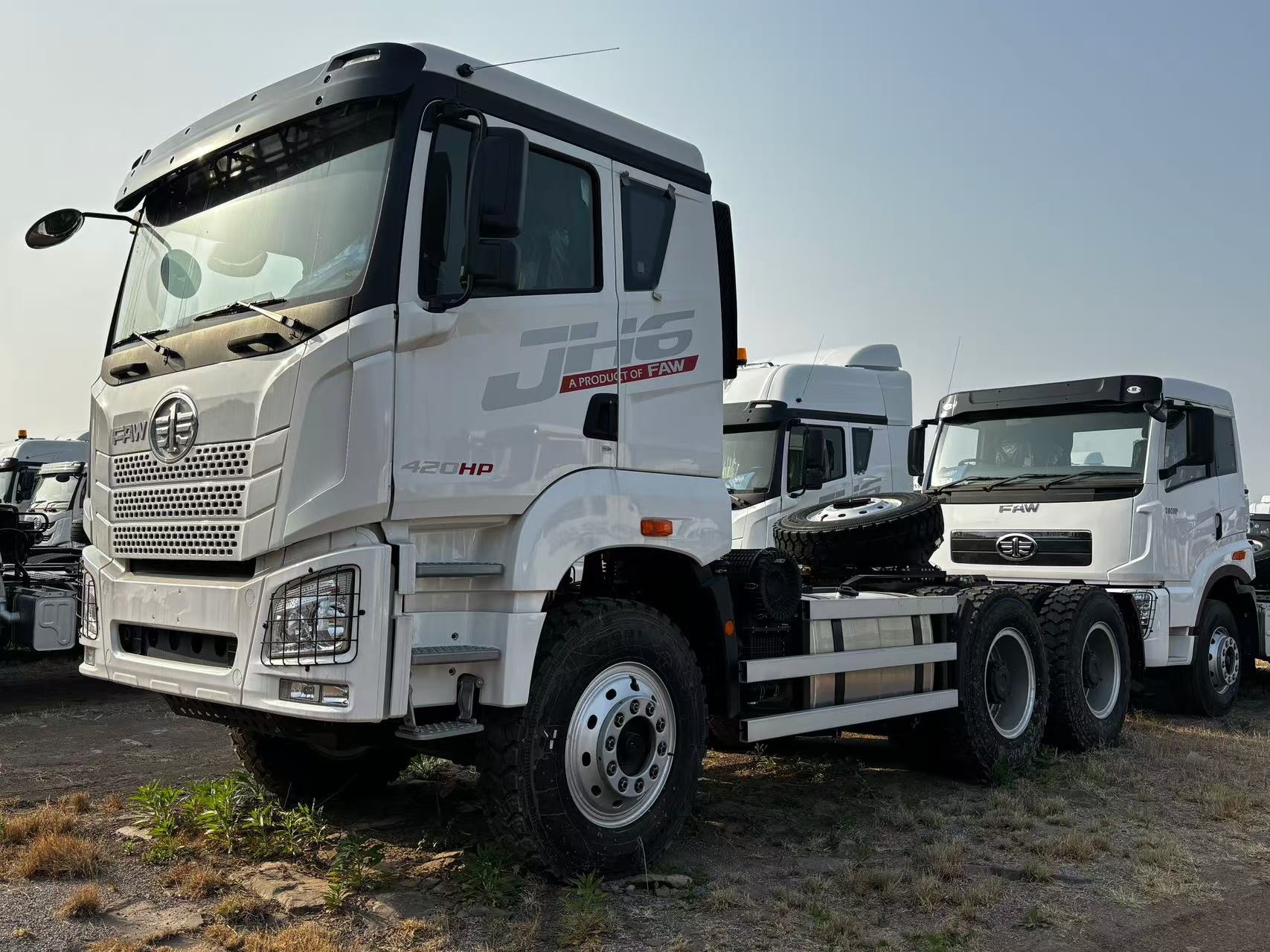
Model access is the first verification area: a dealership must be able to confirm the exact chassis, driveline and build configuration it is quoting, not just the brand.
A financially healthy dealership and a short quoted delivery time tell you two things: that the company can survive, and that somebody answered your enquiry quickly. Neither tells you whether the truck you ordered will arrive in the configuration your operation needs, with paperwork your market accepts, at a size and weight your routes allow.
This guide covers the checks that sit behind those two easy questions. It is written for importers, fleet operators and procurement teams evaluating a FAW truck dealership, and it concentrates on five areas where most of the real risk accumulates: documented access to the model you need (including the J6P, J7 and Tiger V families), certification scope matched to your market, configuration capability such as custom tire specifications and multiple body types, dimension and weight fit, and written order-execution terms covering capacity, lead time, inspection and after-sales support.
Qingdao Chary Machinery Co., Ltd (CHARY) is a FAW TRUCKS first-level distributor and a vehicle export enterprise authorized and approved by China's Ministry of Commerce. The examples used below come from facts CHARY and FAW publish about their own supply position; the verification checklist itself applies to any dealership you assess.
Why Finance and Delivery Time Are the Wrong Starting Point
Dealer audits usually begin with three documents: a business licence, a bank reference and a delivery schedule. These confirm legal existence, liquidity and intent. They do not confirm the capability that determines whether your order is executed correctly, because that capability sits in engineering access, compliance scope and configuration authority - none of which appear on a balance sheet.
In practice, most problems with imported trucks surface in one of three places.
1. The configuration that never gets built
A dealer can be a genuine seller and still lack the relationship needed to specify non-standard tires, a particular body type, or a load rating outside the standard catalogue. When that gap becomes visible after the order is placed, the buyer is usually offered the nearest standard unit instead of the unit they specified - and the delivery time quoted at the start quietly becomes irrelevant.
2. The certificate that does not cover your model or market
Certification is often presented as a brand-level statement. What matters is scope: which model, which configuration and which market the certificate actually names. FAW's UN ECE R105 approval, for example, is held for the JK6 and covers dangerous goods transport vehicles. The GSO conformity certificate is held for the J6 Series 4x2 truck tractor and applies to GCC member states. A certificate that exists is not the same as a certificate that covers your order.
3. The dimension or weight that does not fit
Weight range, overall dimensions, axle configuration and tire specification decide whether a truck can legally and practically do the job on your routes. These are configuration decisions rather than brand decisions, and they have to be settled before the deposit - not discovered on arrival.
Industry Background: Why Dealer Capability Varies So Much
FAW Jiefang recorded global vehicle sales of 251,100 units in 2024, covering medium and heavy trucks as well as light trucks, and its overseas exports reached 57,000 units in the same year - a record high for the division. In South Africa, FAW terminal sales surpassed 5,000 units in 2024, equivalent to an 18% market share. FAW Trucks, the commercial vehicle brand of FAW Group Corporation, is headquartered in Changchun City, Jilin Province, China.
Growth of that scale has a practical consequence for buyers: the number of companies presenting themselves as FAW suppliers has increased faster than the ability to verify them. A dealership may be a first-level distributor with direct manufacturer allocation, an export trader buying through intermediaries, or a local reseller with no configuration authority at all. The brand on the grille looks identical in all three cases.
The portfolio itself is broad. FAW's publicly presented line-up covers tractor trucks, dump trucks, cargo, rigid and light trucks, as well as concrete mixers, tankers, garbage trucks, sweepers, wreckers and other special-purpose vehicles. The heavy-truck model range includes the J7, J6P, J6V, J6E, JH6, J6G, J6L, JK6 and Tiger V. That breadth is precisely why every question in this guide has to be model-specific: "Can you supply FAW?" cannot be answered usefully.
The Six Verification Areas That Matter More Than Finance
1. Model access: confirm the specific model, not the brand
Start by asking which models the dealership holds direct allocation for, and ask for chassis-level confirmation rather than a catalogue reference. A supplier with real access can answer questions about engine, axle and body configuration without forwarding your email to a third party. A practical test is a model with published configuration data: the FAW J6P 8x4 dump truck (CA5310), for instance, is specified with an 11L CA6DM2 engine rated at 390hp. Ask your supplier to confirm the engine designation, the drive configuration and the body specification for the exact unit they are quoting.
Then apply the same question to the models you actually intend to run. Ask what is currently available in the J6P, J7 and Tiger V families, what cab and axle configuration options exist for each, and how long each would take to source. Vague answers on specific models are the clearest early signal that the dealership is reselling rather than supplying.
CHARY states that it is a first-level distributor of FAW TRUCKS and a vehicle export enterprise approved by China's Ministry of Commerce, serving more than 50 countries and regions. Whether the dealership you are assessing can say something comparable - and evidence it - is the first decision point.
2. Certification scope: check the model and the market on the certificate
Compliance is the most misunderstood part of dealer verification, because certificates are usually quoted by name rather than by scope. Two published FAW approvals show how specific that scope can be.
- UN ECE R105 - held for the FAW JK6, covering dangerous goods transport vehicles (EX/FL/AT/MEMU categories), issued by Société Nationale de Certification et d'Homologation (SNCH), Luxembourg, under certificate number E13*105R06/01*0023*00, applicable to the EU/EEA market. The applicable standard is UN ECE Regulation No. 105, and the certificate was issued in February 2024.
- GSO Conformity Certificate (GCC Certificate for Motor Vehicles) - held for the FAW J6 Series Truck Tractor (4x2), issued by the GCC Standardization Organization (GSO) under certificate number CCR No.435790, applying to GCC member states (Saudi Arabia, UAE, Oman, Kuwait, Bahrain, Qatar) and complying with GSO ISO 1585:2008. The certificate was issued in November 2022.
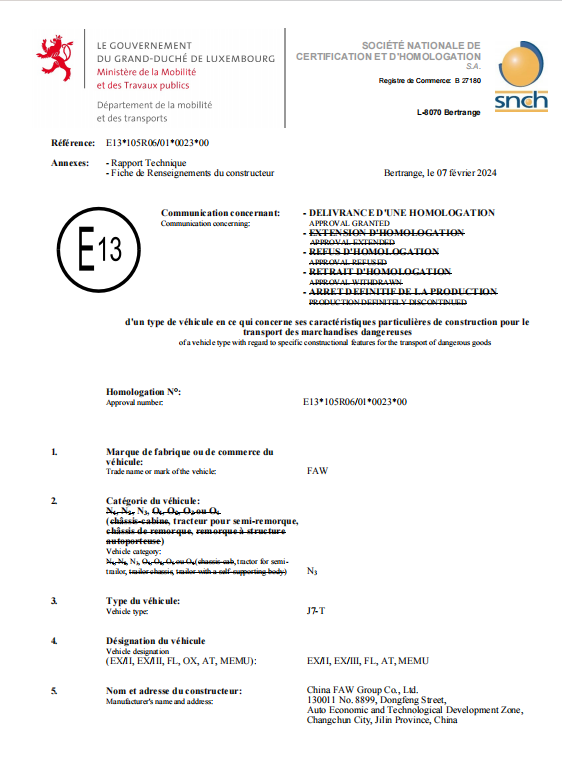
UN ECE R105 for the FAW JK6: certificate number E13*105R06/01*0023*00, issued by SNCH Luxembourg, for dangerous goods transport vehicles in the EU/EEA market.
When a dealer claims certification, ask three questions: which certificate number, which model, and which market. If your order is a J6P dump truck destined for a GCC country, a certificate issued for a J6 Series 4x2 tractor is the starting point of a compliance discussion, not a substitute for one. If your market is not inside the stated scope, ask what the type-approval path is and who owns it.
3. Configuration capability: tires, body types, engine and load capacity
This is where a dealership's engineering relationship becomes visible. CHARY's published customization scope covers the body, engine, tires and load capacity, and its specification data states that tire specifications are available based on customer needs. That single sentence answers a question worth asking directly: if your operation requires a particular tire size, tread pattern or brand preference for terrain or load reasons, can the unit be built that way, and is it confirmed in the quotation?
The same test applies to body types. FAW's heavy-truck portfolio includes tractor trucks, dump trucks, cargo, rigid and light trucks, concrete mixer trucks, garbage trucks, sprinkler and water tank trucks, fuel tank trucks, wrecker trucks, sweepers, concrete pump trucks, asphalt distributor trucks, high altitude platform trucks and fire trucks. Before committing, obtain a written answer on which of these the dealership can build or source on your preferred chassis - and which it cannot.
Three further configuration details are worth locking down early. Safety configuration across the range is stated as ABS/EBS/TCS, so confirm which of the three is standard on your model. Body materials are stated as steel, iron, aluminum alloy and plastic, which affects weight and corrosion behaviour by application. And the drivetrain layout should always be read together with the weight and dimension data in the next section.
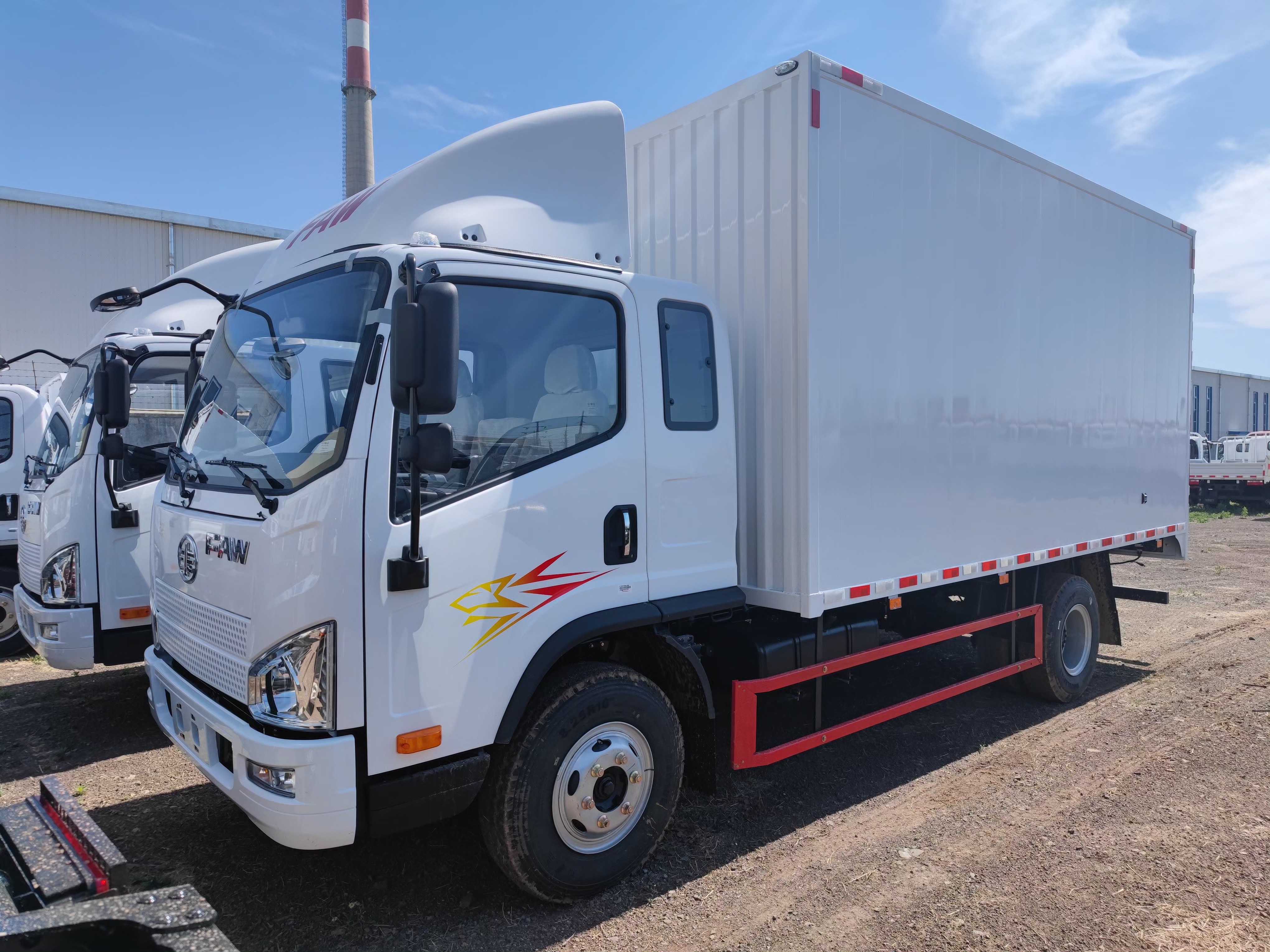
Body type and tire specification are configuration decisions, not brand decisions - confirm both in writing on the exact chassis you are buying.
4. Dimension and weight fit: the numbers that decide whether the truck works
Published FAW truck data gives a truck weight range of 3,000-15,000 kg and an overall size range from 6,000 × 2,300 × 3,000 mm to 12,000 × 2,550 × 3,800 mm. Drivetrain options include rear-wheel drive 6×4 and 6×2 configurations as well as all-wheel-drive 6×6 and 8×8 systems. The stated operating envelope covers high temperatures, humidity, muddy terrain, rainy weather, snowy weather, highways and urban roads.
Use these figures as the frame for your own questions rather than as an answer. Ask the dealership to place your intended duty cycle inside those ranges: which weight band, which overall length, which axle configuration and which tire specification produce a unit that fits your routes, your legal limits and your workshops. A supplier that can walk through that mapping - and then put it in the order confirmation - is operating as an engineering supplier. One that replies with a model name is operating as a trader.
5. Order execution: capacity, lead time and quality control in writing
Order execution is where vague answers cost the most money. CHARY publishes a monthly capacity of 8,000 units, a lead time of 30-45 days, a minimum order quantity of 1 unit and a quality-control regime described as 100% test. Each of these should be converted into a contract term.
- Minimum order quantity of 1 unit means a fleet buyer can validate a single truck in real operating conditions before committing the rest of the order - provided that validation unit is configured exactly as the fleet units will be.
- Lead time of 30-45 days only means something when it is tied to a frozen configuration. Ask for the lead time against your exact specification, in writing, and note what restarts the clock, typically a specification change or the body-building step.
- 100% test before shipment is a claim worth verifying with a pre-shipment inspection record for your chassis number.
- Monthly capacity of 8,000 units is a scale statement; the useful follow-up question is how much of that capacity is allocated to export orders in your region during your delivery window.

Capacity, lead time and inspection terms are only useful when they are attached to a specific order configuration rather than to a general company statement.
6. After-sales and long-term supply
A truck is a ten-year decision, so the final verification area is what happens after delivery. Two things need confirming: the spare-parts and technical-support route, and evidence that the supplier's units survive in the field.
CHARY's offering covers commercial vehicles and their spare parts, with global technical support for after-sales service, and its stated export markets span Central Asia, Africa, the Middle East, South America, Central America and South East Asia. Named markets include Algeria, Ethiopia, Somalia, Tanzania, Nigeria, Mozambique, Zambia, Malawi, Ghana, Mali, Congo, Senegal, Peru, Chile, Guyana, Indonesia, Singapore and the Philippines. Ask which of your regions has an established parts route, how long a common part takes to reach you, and who performs warranty work locally.
Field evidence matters as much as statements. A logistics company in Mali has operated 50 FAW units for more than ten years, transporting powdered and granular materials as well as sand and gravel, in what is described as high-intensity operation with stable results. That is the type of reference worth asking for: not a logo wall, but a fleet, a duration and a duty cycle.
Step-by-Step Breakdown: An Eight-Step Dealer Verification Sequence
- Define the duty cycle first. Write down payload, route conditions (high temperature, mud, highway, urban) and the weight and dimension band you need before contacting any supplier.
- Name the models. Ask specifically about the J6P, J7, Tiger V and the rest of the range you are considering, and request chassis-level specification for each rather than a brochure.
- Request certification by scope. Ask for certificate number, covered model and covered market. For EU/EEA dangerous goods work this means the UN ECE R105 approval held for the JK6 (E13*105R06/01*0023*00). For GCC markets it means the GSO conformity certificate held for the J6 Series 4x2 truck tractor (CCR No.435790).
- Test configuration flexibility. Ask for written confirmation on tire specification, body type, engine option and load capacity, since these are the customization categories CHARY publishes.
- Map size and weight. Compare your legal and operational limits against the published 3,000-15,000 kg weight range and the 6,000 × 2,300 × 3,000 mm to 12,000 × 2,550 × 3,800 mm size range, then confirm the axle configuration (6×4, 6×2, 6×6 or 8×8).
- Lock order terms. Put lead time (published as 30-45 days), minimum order quantity (1 unit), inspection regime (100% test) and capacity allocation into the quotation.
- Validate with one unit if the fleet is large. Buy one unit to specification, run it on the real duty cycle, then scale the order.
- Verify the after-sales route. Confirm parts availability, technical support and warranty handling for your country before signing.
| Verification area | Question that exposes capability | Evidence that closes it |
|---|---|---|
| Model access | Confirm engine, drive configuration and body specification for the exact unit being quoted. | Chassis-level confirmation, for example J6P 8x4 (CA5310) with an 11L CA6DM2 engine rated at 390hp. |
| Certification | Which certificate number covers this model in my market? | E13*105R06/01*0023*00 (UN ECE R105, JK6, EU/EEA) or CCR No.435790 (GSO, J6 Series 4x2 truck tractor, GCC member states). |
| Tire specification | Can tires be specified to my requirement? | Written confirmation; published position is that tire specifications are available based on customer needs. |
| Body types | Which body types can be built on this chassis? | Named list of the body types the supplier or manufacturer can produce for your model. |
| Size and weight | Which weight band, dimensions and axle configuration does my route need? | Mapping inside 3,000-15,000 kg and 6,000 × 2,300 × 3,000 mm to 12,000 × 2,550 × 3,800 mm. |
| Order execution | What is the lead time for this exact configuration? | Written lead time (published as 30-45 days), MOQ of 1 unit, 100% test before shipment. |
| After-sales | Who supplies parts and technical support in my country? | Named parts route, technical support scope and regional coverage in writing. |
Use Cases: Where These Checks Change the Outcome
Construction and mining haulage
Dump applications depend on axle configuration, body strength and tire specification rather than on brand name. For a mine or quarry duty cycle the verification order changes: tire specification and body type come first, then weight and dimension mapping, then certification and lead time. Configurations such as the JH6 8x4 dump truck, the J6P 6x4 dump truck and the JK6 6x4 dump truck illustrate the range a dealer may or may not be able to source, and the published application coverage includes coal and mineral transportation alongside building materials haulage.
Port, freight and long-haul tractor work
Tractor units are usually selected on cab configuration, driveline and cost per kilometre. Here the decisive verification question is access: can the dealership supply the specific tractor variant, including alternative cab and fuel configurations, inside the required time window? For fleets replacing units on a schedule, capacity allocation matters more than the headline price.
Cold chain and urban distribution
Refrigerated and distribution work adds body-building to the critical path. The FAW line-up includes refrigerated trucks, and Tiger V family models are presented in refrigerated and cargo configurations. For cold-chain buyers the two decisive checks are whether the body builder is integrated into the dealership's order process, and whether the tire and load specification is confirmed before the chassis is dispatched.
Long-life fleet replacement
For operators who replace trucks every few years, the strongest verification evidence is duration. A 50-unit logistics fleet in Mali, running powdered and granular materials as well as sand and gravel for more than ten years in high-intensity operation, is a more useful reference point than a specification sheet, because it tests supplier support across a full replacement cycle rather than at the point of sale.
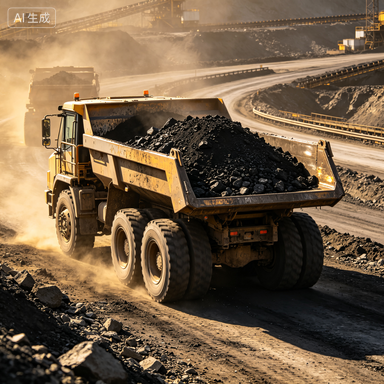
Coal, mineral and construction haulage puts configuration verification ahead of commercial negotiation: tire specification, body type and axle layout decide whether the unit performs.
Comparison Table: FAW Certification Scope Reference
Certification claims are only useful when the scope is stated. The two approvals below are the published reference points a dealership should be able to document when your market falls inside their scope.
| Certificate | Applicable standard | Covered scope | Issuing authority | Certificate number | Applicable market |
|---|---|---|---|---|---|
| UN ECE R105 | UN ECE Regulation No. 105 | FAW JK6 - dangerous goods transport vehicles (EX/FL/AT/MEMU categories) | Société Nationale de Certification et d'Homologation (SNCH), Luxembourg | E13*105R06/01*0023*00 | EU / EEA |
| GSO Conformity Certificate (GCC Certificate for Motor Vehicles) | GSO ISO 1585:2008 | FAW J6 Series Truck Tractor (4x2) | GCC Standardization Organization (GSO) | CCR No.435790 | GCC member states: Saudi Arabia, UAE, Oman, Kuwait, Bahrain, Qatar |
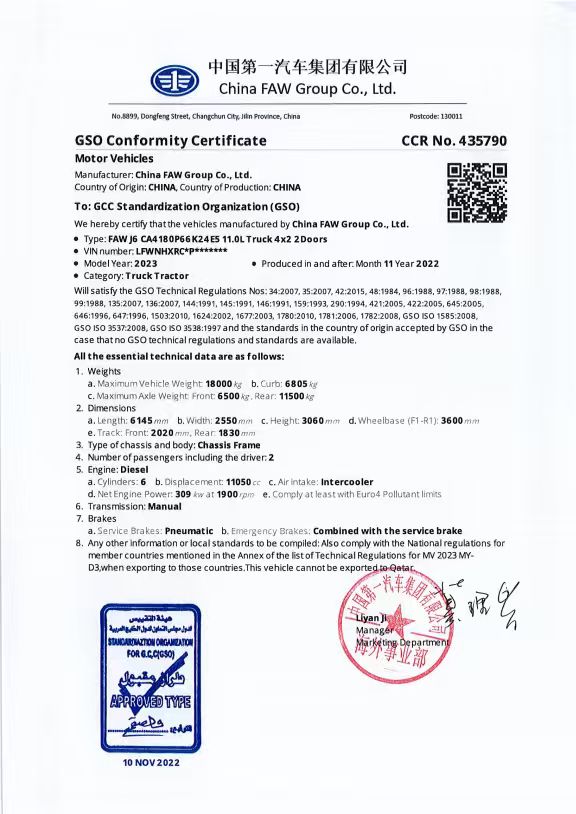
GSO conformity certificate CCR No.435790 for the FAW J6 Series 4x2 truck tractor, issued by the GCC Standardization Organization and applied to GCC member states.
Read the table as a scope check, not as a compliance guarantee. If your model, configuration or destination is not named inside a certificate's scope, the compliance question is still open, and it should be answered in writing before the order is placed.
FAQ: Supplier Evaluation Questions for FAW Truck Dealerships
Which FAW truck certifications should a dealership show me for the EU or the Gulf?
For the EU/EEA market, the relevant published approval is UN ECE R105, held for the FAW JK6 and covering dangerous goods transport vehicles in the EX/FL/AT/MEMU categories, issued by SNCH in Luxembourg under certificate number E13*105R06/01*0023*00. For GCC member states it is the GSO Conformity Certificate for Motor Vehicles, held for the FAW J6 Series Truck Tractor (4x2) under certificate number CCR No.435790 and complying with GSO ISO 1585:2008. Ask for the document itself and check that the model and the market in the scope match your order.
Can a FAW truck dealership really support custom tire specifications and multiple body types?
It depends on the dealership, so the answer should be capability-based rather than brand-based. CHARY's published customization scope covers body, engine, tires and load capacity, and its specification data states that tire specifications are available based on customer needs. The FAW heavy-truck portfolio includes tractor trucks, dump trucks, cargo, rigid and light trucks, concrete mixer trucks, tankers, garbage trucks, sweepers, wreckers and fire trucks. Ask for written confirmation of which tire specification and which body type can be built on your chosen chassis.
How should I compare FAW truck prices between dealerships?
Compare what is inside the number rather than the number itself. A published 2026 retail reference in the Philippines lists the FAW Thor heavy-duty truck from ₱3.62 million (approximately US$64,000), which is a market retail starting point rather than a specification-matched quotation. Ask each dealership for an itemized quotation covering the base chassis, engine option, tire specification, body type, safety configuration such as ABS/EBS/TCS, freight and any local charges, so that you are comparing the same truck.
Can I validate a single truck before committing to a fleet order?
Yes, and it is one of the most useful checks available. CHARY publishes a minimum order quantity of 1 unit, which allows a buyer to take delivery of one truck built to the intended fleet specification, run it on the real duty cycle and then scale. Combine this with the stated 100% test before shipment and the published 30-45 day lead time, and ask for the pre-shipment inspection record for your chassis number.
What lead time is realistic for a FAW truck order, and how do I lock it?
The published lead time is 30-45 days, supported by a stated monthly capacity of 8,000 units, but a lead time is only meaningful when it is tied to a frozen configuration. Ask for the lead time against your exact specification in writing, clarify which changes restart the schedule, and confirm how much capacity is allocated to your region during your delivery window. Buyers ready to move from evaluation to a concrete offer can reach the CHARY export team through www.charymachinery.com, by email at sales@fawglobal.com, or on WhatsApp at +86 186 6398 2168.
Conclusion: Verify Capability, Then Verify the Commercials
Financial health and quoted delivery times are the beginning of supplier evaluation, not its substance. The checks that protect a truck order are specific: confirmed access to the model you need, certification whose scope names your model and your market, configuration flexibility on tires, body type, engine and load capacity, a dimension and weight mapping that fits your routes, and order terms - capacity, lead time, inspection and after-sales - in writing.
Apply the same eight-step sequence to every dealership you shortlist, and ask for evidence rather than assurance at each step. A supplier that can answer chassis-level questions, produce certificate numbers with matching scope, and commit to a lead time against a frozen specification is doing more than selling trucks: it is carrying risk that would otherwise sit with you.
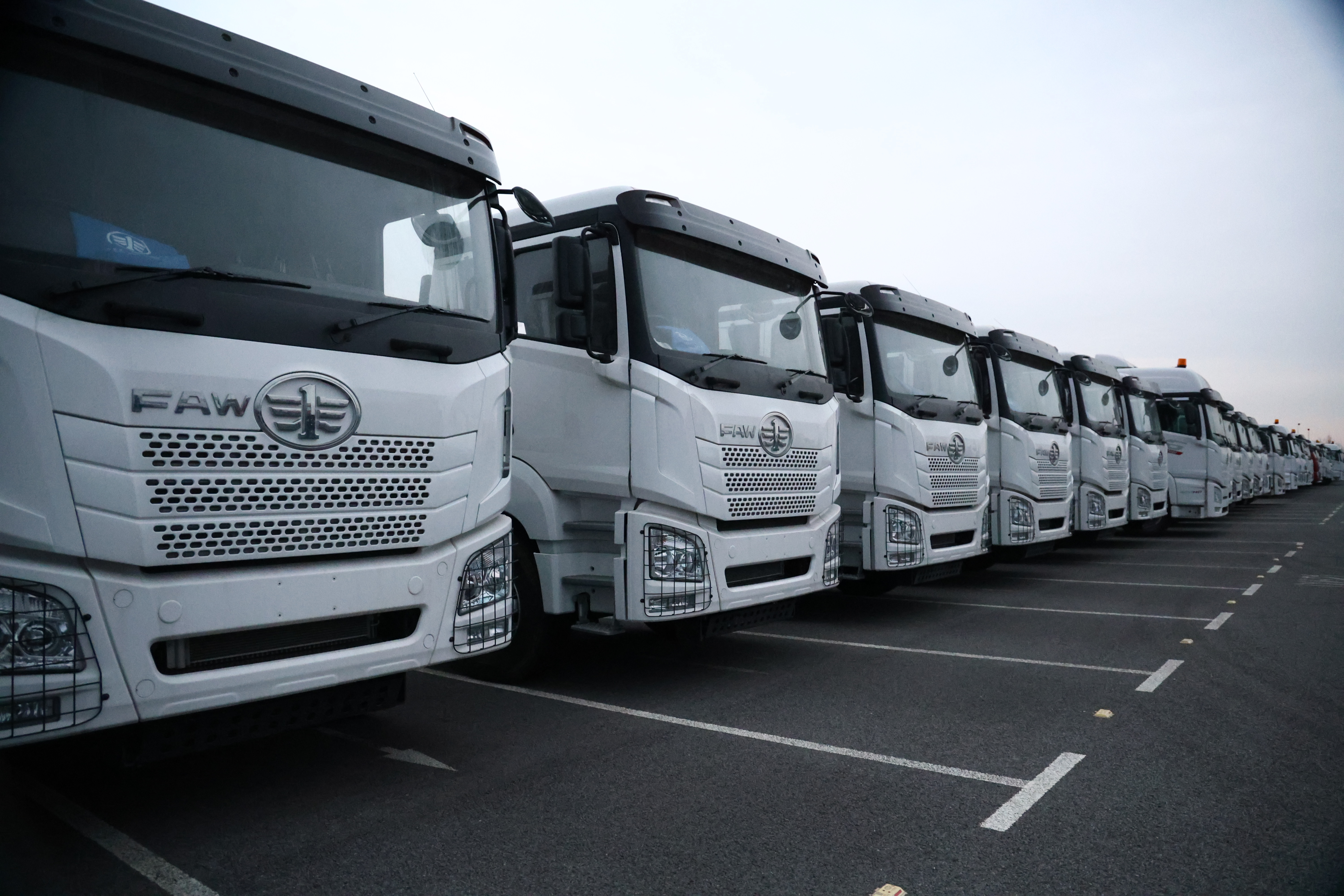
From verification to delivery: inspection, documentation and after-sales readiness are what turn a quotation into a working fleet.
Next step: request a specification-matched quotation or a single-unit validation order
Qingdao Chary Machinery Co., Ltd (CHARY) - FAW TRUCKS first-level distributor and authorized vehicle export enterprise.
Email: sales@fawglobal.com | Tel / WhatsApp: +86 186 6398 2168 | Web: www.charymachinery.com
Address: No. 266 Jiushui East Road, Qingdao, China
Download the product catalogue: CHARY FAW TRUCKS Product Brochure (PDF)
Have Questions or Need More Details?
Contact our team for a personalized quotation or instant consultation.
Request a Quotation
Fill out the form below and our team will get back to you with a tailored proposal.
WhatsApp Direct Chat
Prefer to chat in real-time? Message us on WhatsApp for instant assistance & quick answers.
- Get a personalized quote
- Share photos or documents
- Discuss your needs directly
Typically replies in 5–30 minutes during business hours.