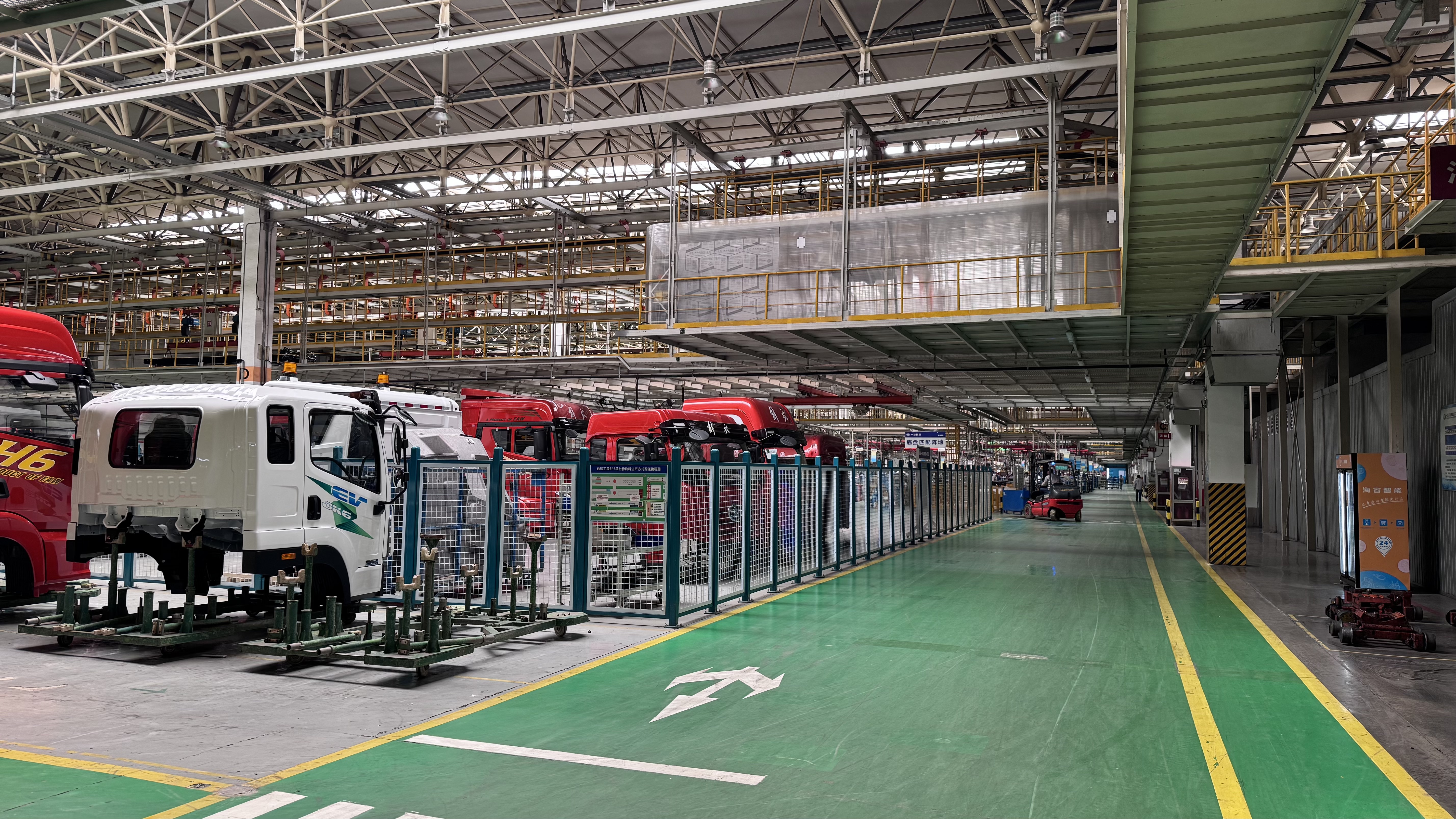
Urban Logistics and Mining Sites: Matching FAW Trucks and Minidozers to the Task
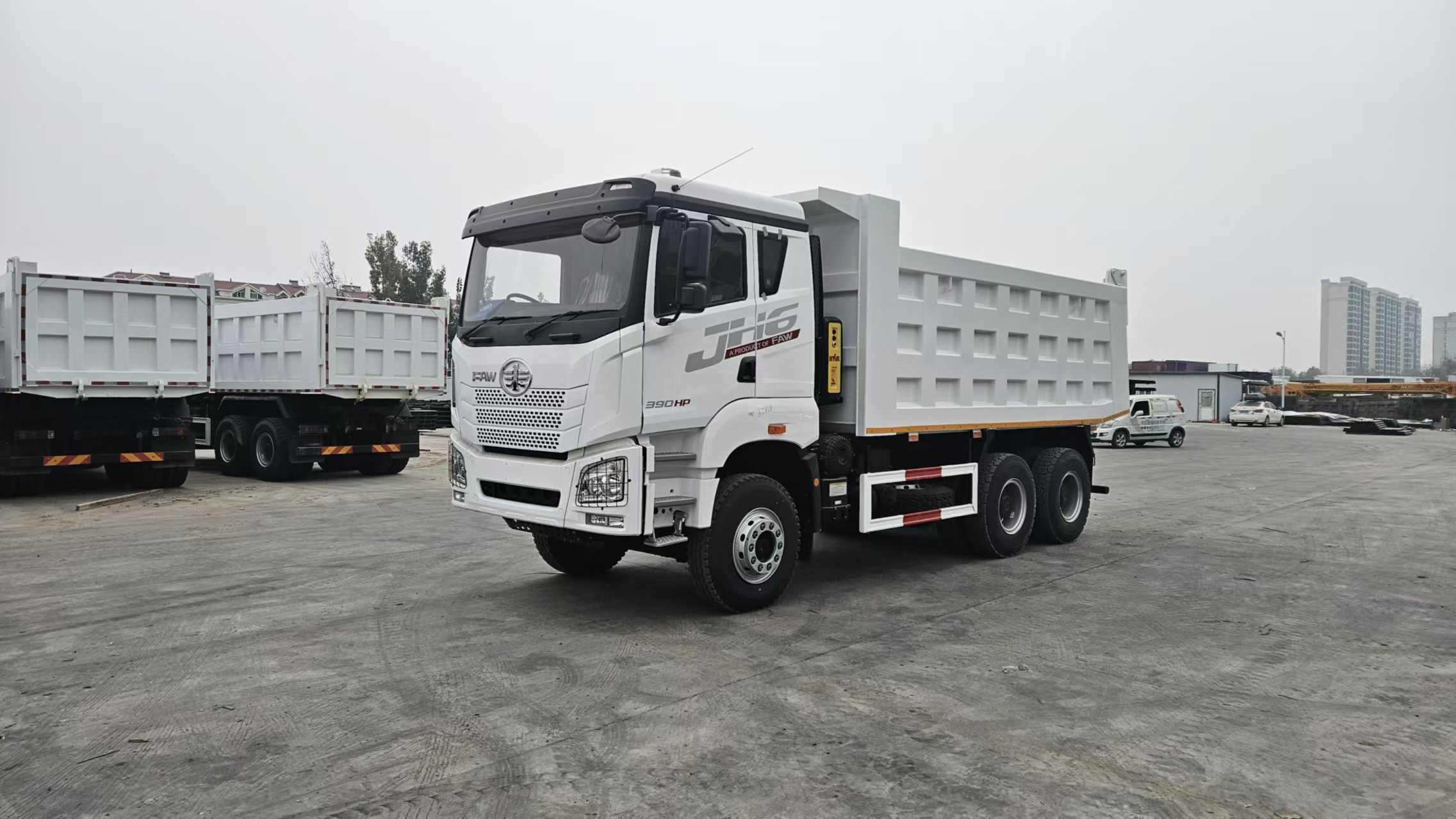
Short answer: match the machine to three constraints before comparing equipment: the tightest physical limit of the work area, the load type and volume per cycle, and the environment plus the compliance rules of the destination market. A remote-controlled CHARY CR468C minidozer covers confined-space earthmoving, with overall dimensions of 2850 × 1200 × 600 mm, a 1100 kg self weight and a 450 kg rated load capacity. A FAW truck covers road-based volume haulage, with a 3000–15000 kg truck weight range and a body envelope from 6000 × 2300 × 3000 mm up to 12000 × 2550 × 3800 mm across cargo, dump, tractor, mixer and other body types.
Urban logistics and mining operations rarely fail because no equipment exists. They fail because the selected machine cannot physically enter the work area, cannot move the required load at the required cycle, or cannot be documented for the market where it must operate. This article treats selection as a task-matching problem, using documented product data instead of category assumptions.
Qingdao Chary Machinery Co., Ltd (CHARY) is a Qingdao-based machinery exporter founded in 2015 that supplies mini machinery, minidozers and FAW trucks, with a stated export ratio of 80%, an annual export volume of USD 40 million in 2025, and customers in more than 50 countries and regions. Its stated main markets are Africa and South America. The equipment parameters below come from CHARY product documentation.
What Application Fit Actually Means in Urban Logistics and Mining
Application fit is a constraint test, not a preference. A machine fits a task only when four conditions hold at the same time.
- Envelope fit: overall dimensions, height and turning behaviour allow the machine to enter, work and exit the space.
- Load fit: bucket capacity or body volume and rated load match the material and the target number of cycles.
- Environment fit: temperature range, dust, fumes, gradient and ground surface are within what the machine is specified for.
- Compliance fit: the certification record names the model and covers the market the machine will be registered or operated in.
Most procurement disputes trace back to one of these four being treated as an afterthought. On confined urban and underground sites, the binding constraint is usually envelope and operator exposure: a full-size cab machine cannot get under a low structure, and a person cannot safely stand next to the bucket. In materials logistics and mining haulage, the binding constraint is usually payload, cycle time and route condition — the load has to move in volume, on roads, repeatedly.
Industry Background: Compact Equipment Grows Where Space Gets Tighter
Two market forces make this matching problem more important than it was a decade ago. Urban work areas are getting tighter, and mining clean-up work is being mechanised rather than performed manually.
- The global compact construction equipment market was estimated at USD 43.5 billion in 2024 and is projected to reach USD 69.1 billion by 2034 (Global Market Insights).
- China concentrated 27.3% of total global exports of machines in 2024, maintaining its position as the world's largest exporter in this sector (OEC).
- Mini track machinery is projected to grow at a CAGR of 4.5%, reaching USD 11.31 billion by 2035, with mini track loaders holding a 54% share (Future Market Insights).
- The global skid steer loader market was valued at approximately USD 9.4 billion in 2023, with North America accounting for 84.7% of revenue (Grand View Research).
- Small bulldozers are projected to grow from USD 2.11 billion in 2024 to USD 3.78 billion by 2035, at a CAGR of 5.44% (Spherical Insights).
- For context on how concentrated the compact equipment market is at the top, Caterpillar Inc. held a share of over 15% in 2024 (Global Market Insights).
For importers, distributors and fleet buyers, the practical reading of this data is that growth is concentrated in compact, narrow-envelope and confined-space categories — not in a single machine that covers everything. That is why selection frameworks built on terrain, load type and space limits have replaced simple size-based buying.
Detailed Solution: Two Equipment Families, Two Different Halves of the Same Site
CHARY's documented range covers both sides of this problem — FAW trucks for road-based haulage and the CR468C minidozer for confined-space earthmoving. They are not alternatives to each other. On a mining or urban site they are normally deployed together, and the selection question is which one removes the binding constraint.
FAW Trucks: Road-Based Haulage for Building Materials, Express Delivery, Coal and Minerals
Documented FAW truck models in the CHARY product data include the J6L, NEW J5P, JK6, Tiger V, JH6 and J6P, with the wider family listing covering J7 / J6P / J6V / J6E / JH6 / J6G / J6L / JK6 / Tiger V. Body-type availability across that range includes tractor truck, dump truck, cargo / rigid / light truck, concrete mixer truck, garbage truck, sprinkler truck, water tank truck, fuel tank truck, wrecker truck, sweeper truck, concrete pump truck, asphalt distributor truck, high altitude platform truck and fire truck configurations.
The documented constraints that decide which truck fits which route:
- Truck weight range: 3000–15000 kg.
- Size range: 6000 × 2300 × 3000 mm to 12000 × 2550 × 3800 mm.
- Drive configurations: rear-wheel drive 6×4 and 6×2; all-wheel drive 6×6 and 8×8.
- Security configuration: ABS / EBS / TCS.
- Tire specifications: available based on customer needs.
- Right-hand drive is available for markets that require it.
Applicable duty covers logistics freight distribution, logistics fleets, coal and other mineral transportation, port transportation, express delivery, daily industrial goods transportation, building materials transportation, agricultural and sideline product transportation, livestock and poultry transportation, general bulk cargo, cold chain transportation, urban distribution, urban waste transportation, log transportation, large machinery and equipment transportation, and chemical raw material transportation. Documented working conditions include high temperatures, humidity, muddy terrain, rain and snow, highways and urban roads, with the product specified to operate stably under complex road conditions.
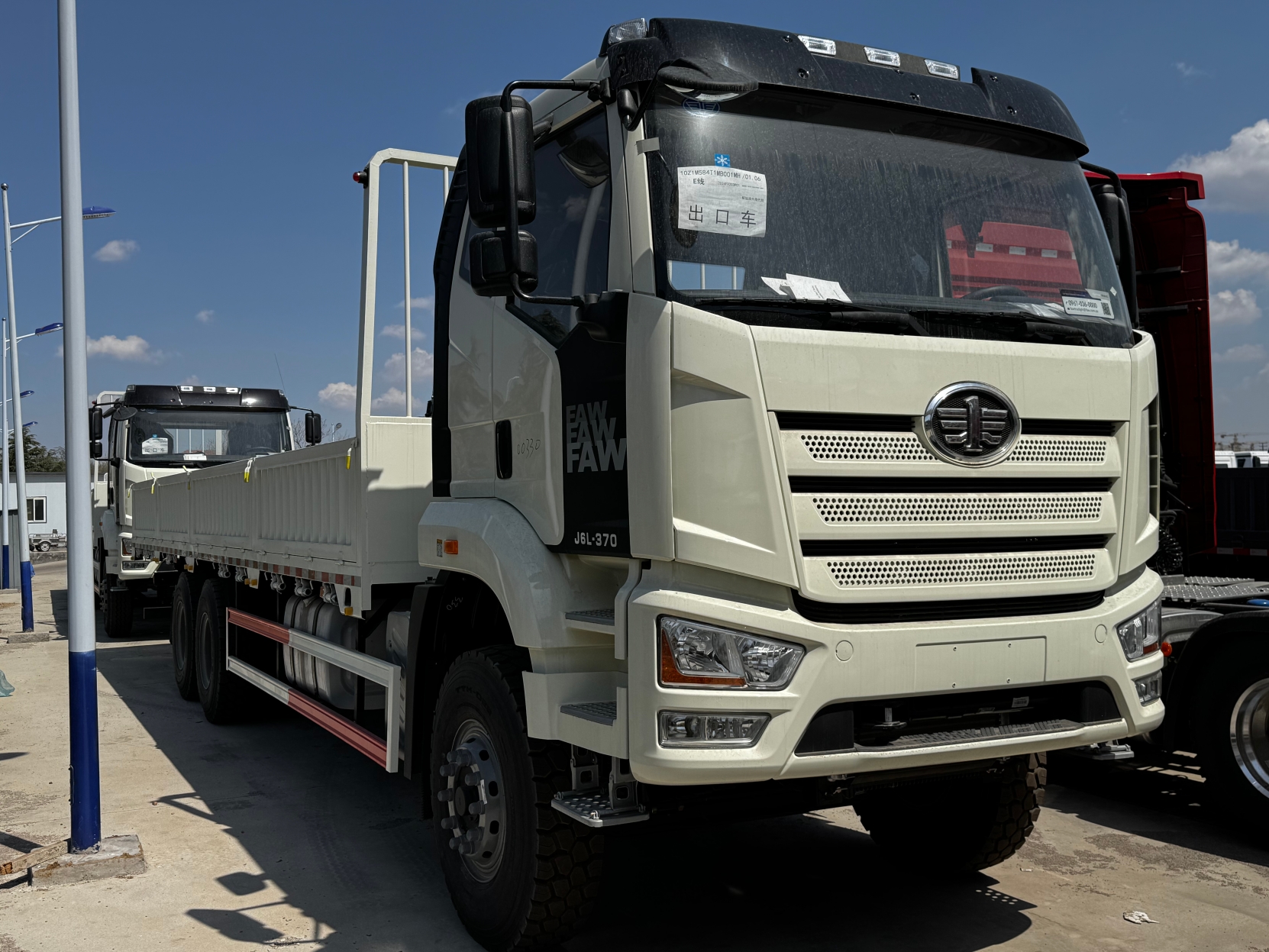
Where the route is urban distribution and express delivery, a shorter cargo or rigid configuration keeps the vehicle usable at the loading and unloading end. Where the load is loose mineral, aggregate or construction material and the final leg is unpaved, dump configurations and the longer 6×4 and 8×4 platforms carry both the payload and the surface abuse. The family is the same; the body and wheelbase are the variables.
CR468C Minidozer: Confined-Space Earthmoving Without an Operator in the Cab
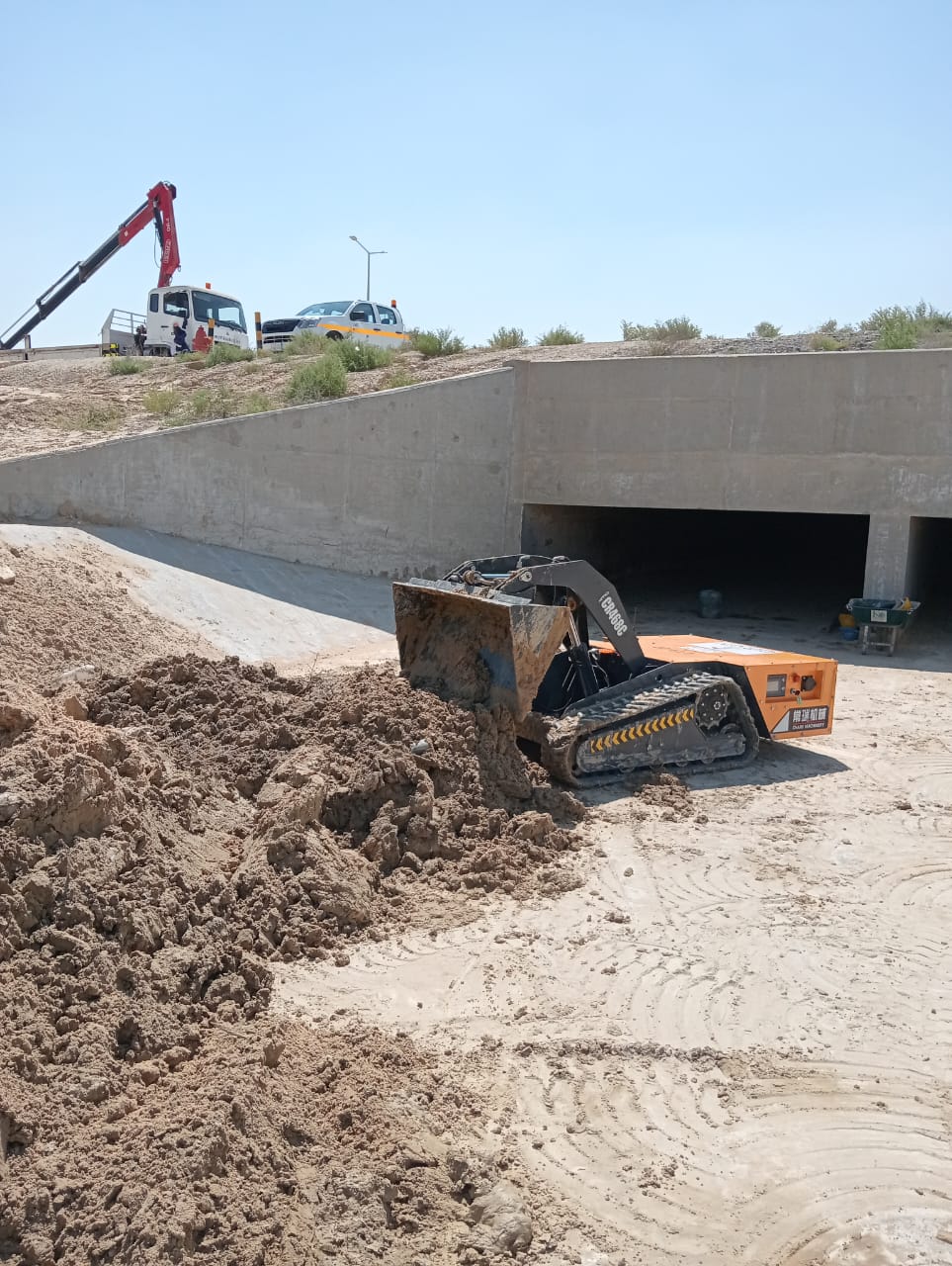
The CHARY CR468C is a remote-control lithium battery rubber track minidozer with a 1100 kg self weight. That single figure decides whether the machine can operate on a slab, a tunnel invert or a conveyor gallery floor without a structural question being raised first. It is also the parameter that lets the unit be lifted, transported and positioned by ordinary site handling equipment rather than a dedicated low-loader.
The documented operating intent is a remote-controlled, electrically driven mini dozer developed for very confined spaces, with adjustable ground clearance. It is specified for clean-up operations under conveyor belts in above-ground and underground mining, ore crushing and concentration plants, and for clean-up in city and highway underground tunnels, box culverts and drainage systems, pumping stations and other irrigation projects. Because it is electrically driven, it produces no exhaust fumes at the point of work — a relevant constraint wherever ventilation is limited.
| CR468C parameter | Documented value |
|---|---|
| Overall dimensions | 2850 × 1200 × 600 mm |
| Total length without bucket | 2250 mm |
| Self weight | 1100 kg |
| Rated load capacity | 450 kg |
| Bucket width / bucket capacity | 1200 mm / 0.15 m³ |
| Unloading height / bucket unloading time | 530 mm / 1.1 s |
| Operation method | Remote control, control distance 200 m |
| Steering | 360° spin in place |
| Maximum driving speed / climbing ability | 4 km/h / 40° |
| Minimum ground clearance | 150 mm, adjustable |
| Battery | Lithium battery, 73.6 V, 300 Ah, 22 kWh |
| Motor | 7.5 kW, 3000 rpm |
| Charging time / working hours | About 2 h / about 8 h |
| Charging voltage | 380 / 220 V |
| Hydraulic flow / hydraulic tank | 58 L/min / 20 L |
| Walking style | Rubber tracks |
| Working temperature | -10 °C to 60 °C |
Documented operating features of the CR468C also include electric / zero emissions operation, remote control, quickly interchangeable batteries and adjustable ground clearance.
Step-by-Step: Matching Equipment to Terrain, Load Type and Space Limits
Step 1 — Measure the tightest physical constraint first
Start with the smallest opening or the lowest overhead structure on the site, not with the biggest machine you can afford. The FAW truck dimensional range begins at 6000 × 2300 × 3000 mm; the CR468C is 2850 × 1200 × 600 mm. If the working area is under a conveyor, inside a box culvert, along a drainage gallery or beneath a 600 mm-plus clearance structure, the truck is excluded by geometry regardless of its payload advantage. If the operator cannot be physically exposed to heat, dust or falling material, the selection narrows further to a remote-controlled unit such as the CR468C, where the operator stands outside the work zone with a documented control distance of 200 m.
Step 2 — Classify the load and the cycle
Then classify what is actually being moved. Loose mineral, aggregate, building material and packaged goods moving in volume belong to the truck range, where truck weight spans 3000–15000 kg. Loose material that has to be picked, carried a short distance and dumped inside a confined area belongs to the minidozer, with a 0.15 m³ bucket capacity, a 450 kg rated load and a 1.1 s bucket unloading time. Cycle planning matters as much as payload: the CR468C travels at a maximum of 4 km/h with about 8 h of working time per charge, so it is a short-haul, high-frequency machine, not a substitute for road haulage.
Step 3 — Match the environment, not just the task
The CR468C is documented for a working temperature range of -10 °C to 60 °C with a 40° climbing ability, rubber tracks and no exhaust fumes at the point of work. The FAW truck range is documented for high temperatures, humidity, muddy terrain, rain and snow, highways and urban roads, and is specified to operate stably under complex road conditions. A machine that is correct on payload but wrong on temperature, gradient or surface is still the wrong machine.
Step 4 — Verify certification for the destination market
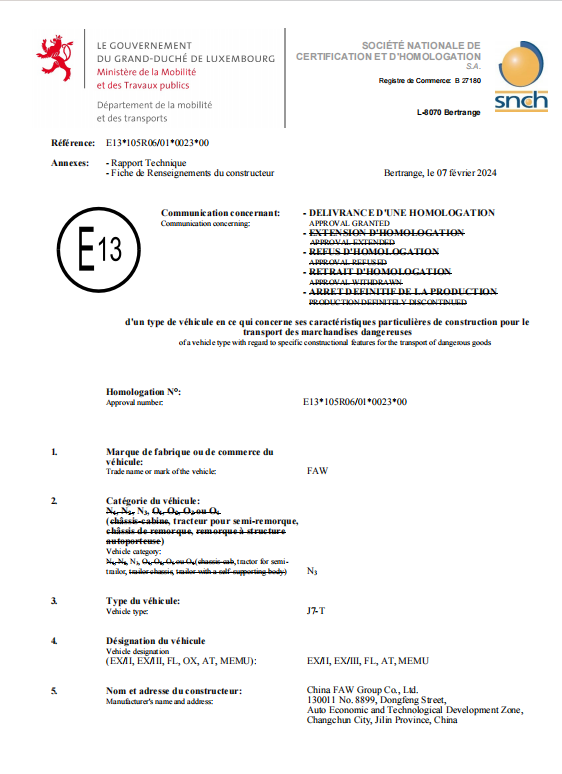
Compliance is where constrained-site and haulage projects most often stall. Two certificates sit in the CHARY documentation record. The FAW TRUCK (product 3665) is certified to UN ECE Regulation No. 105 (ECER 105) under certificate number E13*105R06/01*0023*00, issued by Société Nationale de Certification et d'Homologation (SNCH), Luxembourg, valid for the EU / EEA and countries recognizing UN ECE Regulations, and covering dangerous goods transport vehicle categories. The FAW J6 Series Truck Tractor holds the GSO Conformity Certificate (GCC Certificate for Motor Vehicles), CCR No.435790, issued by the GCC Standardization Organization (GSO), applicable to the GCC member states of Saudi Arabia, UAE, Oman, Kuwait, Bahrain and Qatar, in compliance with GSO ISO 1585:2008.
The verification rule is simple: the certificate must name the model you are buying and the market you are shipping to. If a specific mark is not in the documented record for a model, request it before ordering rather than discovering the gap at the port.
Step 5 — Confirm customization, quality control and lead time
Once the machine class is fixed, the remaining variables are configuration and delivery. For the CR468C minidozer, documented OEM customization covers loading capacity, track life and battery life, with a monthly capacity of 50 units, a minimum order quantity of 1 unit, 100% full inspection before shipment with a performance test for each machine, a lead time of 30–45 days, and after-sales support through accessories and remote maintenance. For FAW trucks, documented OEM customization covers body, engine, tires and load capacity, with a monthly capacity of 8,000 units, a minimum order quantity of 1 unit, 100% test before shipment, a lead time of 30–45 days and global technical support for after-sales service.
Use Cases: Where This Pairing Works
Urban distribution, express delivery and building materials
Urban distribution, express delivery, daily industrial goods and building materials transportation are documented duty for the FAW truck range, alongside cold chain, urban waste and general bulk cargo. In practice, the truck handles the road leg and the yard-to-yard movement, while the minidozer handles anything the truck cannot reach — a covered loading bay, a basement ramp, an internal passage between buildings.
Coal and mineral transport
Coal and other mineral transportation is documented duty for both platforms. The truck takes the volume on haul roads and public roads; the minidozer takes the clean-up around crushers, conveyors and stockpile edges where a road vehicle cannot manoeuvre and manual labour is slow and hazardous.
Confined-space earthmoving in mining and civil works
Underground tunnels, box culverts, drainage systems, pumping stations, irrigation projects, ore crushing and concentration plants, and clean-up under conveyor belts in above-ground and underground mining are the documented application set for the CR468C. These are all locations where ground clearance, machine height and operator exposure decide feasibility before productivity is even discussed.
Documented field references
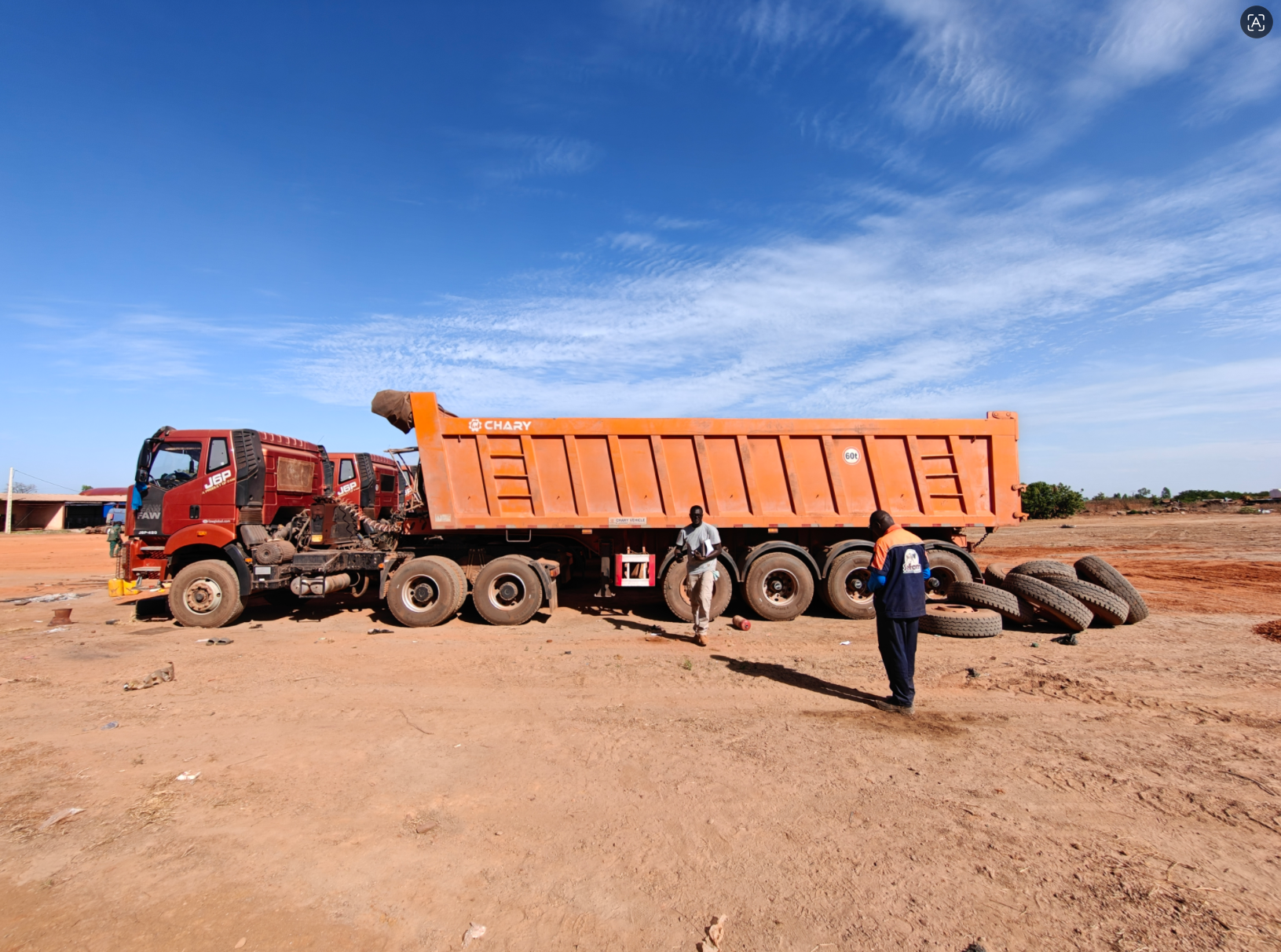
Two reference applications are recorded in CHARY case documentation. An engineering construction customer in Saudi Arabia operates 12 units of the CR468C in narrow indoor and outdoor material handling over a reported 10+ year working relationship, reporting stable operation and a significant effect on manpower savings in high-temperature, narrow environments. A logistics company in Mali operates 50 FAW truck units for the transport of powdered and granular materials and sand and gravel, reporting stable operation under high-intensity use over a reported 10+ year relationship.
Comparison Table: CR468C Minidozer vs FAW Truck — Task Fit
| Decision dimension | CR468C minidozer | FAW truck range |
|---|---|---|
| Footprint envelope | 2850 × 1200 × 600 mm; 2250 mm without bucket | 6000 × 2300 × 3000 mm to 12000 × 2550 × 3800 mm |
| Weight and load | 1100 kg self weight; 450 kg rated load; 0.15 m³ bucket | Truck weight range 3000–15000 kg |
| Drive and control | Rubber tracks; remote control 200 m; 360° spin in place; 4 km/h | Rear-wheel drive 6×4 / 6×2; all-wheel drive 6×6 / 8×8 |
| Energy and runtime | Lithium battery 73.6 V / 300 Ah / 22 kWh; about 2 h charge; about 8 h working | Not specified in the documented product parameters |
| Safety configuration | Remote operation keeps the operator outside the work zone | ABS / EBS / TCS |
| Environment | -10 °C to 60 °C; 40° climbing; zero emissions at point of work | High temperatures, humidity, muddy terrain, rain, snow, highways, urban roads |
| Documented certification | Not listed in the current certification record | ECER 105 certificate E13*105R06/01*0023*00 (SNCH, Luxembourg); GSO GCC certificate CCR No.435790 |
| Best-fit task | Confined-space earthmoving and clean-up; tunnels, culverts, drainage, plant interior | Building materials, express delivery, coal and mineral haulage, urban distribution, bulk cargo |
Adjacent Compact Categories: What They Solve and What They Do Not
Buyers evaluating mini machinery for confined-site and logistics work usually compare several categories at once. The confusion is normally about the designed task, not the brand.
- Skid steer loader and mini skid steer loader: manoeuvrable bucket carriers for yard and paving work, but they assume an operator on the machine — a constraint under low structures, in tunnels or in high heat.
- Compact track loader and compact machinery generally: tracked traction benefits on soft ground, subject to the same operator-presence limitation.
- Mini excavator and backhoe loader: built for digging, trenching and breaking rather than bulk clean-up or haulage.
- Mini loader, mini electric loader, mini wheel loader: loading and stockpiling on firm surfaces.
- Mini dumper: short-haul material movement with payload as the design driver.
- Mini bulldozer: grading and pushing; when the site is confined and the operator cannot be exposed, the remote-controlled minidozer category is the one that matches the constraint.
- Mini road roller, asphalt paver, mini concrete mixer truck, mini automatic mixer: process equipment for compaction, paving and concrete placement within a construction sequence, not haulage or clean-up.
- Forklift: palletised load handling. CHARY's stated engineering machinery range also includes wheel loaders, motor graders, bulldozers, forklifts and road rollers with spare parts.
- Automated guided vehicle and heavy duty outdoor AGV: fixed-route repetitive movement platforms. They address repetitive transfer, not earthmoving or bulk haulage, and should be evaluated against a different constraint set.
Under china mini machinery sourcing conditions, the practical question is not which compact category is superior. It is which category removes the binding constraint on the site, and whether the supplier can document the model, the parameters and the certification for the market you are shipping to.
FAQ
Are CE-certified mini machinery manufacturers the only compliant option, and what certification does CHARY document?
Compliance should be matched to the market and to the specific model, not to a label in a brochure. The documented CHARY certification record contains two certificates. The FAW TRUCK (product 3665) is certified to UN ECE Regulation No. 105 (ECER 105) under certificate number E13*105R06/01*0023*00, issued by Société Nationale de Certification et d'Homologation (SNCH), Luxembourg, valid for the EU / EEA and countries recognizing UN ECE Regulations, with scope covering dangerous goods transport vehicle categories. The FAW J6 Series Truck Tractor holds the GSO Conformity Certificate (GCC Certificate for Motor Vehicles), CCR No.435790, issued by the GCC Standardization Organization, applicable to GCC member states and compliant with GSO ISO 1585:2008. If your destination market requires a specific mark that is not listed for the model you are considering, request that certificate before ordering.
What can be customized on the CR468C minidozer and on FAW trucks?
The minidozer is produced under an OEM model with documented customization of loading capacity, track life and battery life, a monthly capacity of 50 units and a minimum order quantity of 1 unit. FAW trucks are also produced under an OEM model with documented customization of body, engine, tires and load capacity, a monthly capacity of 8,000 units and a minimum order quantity of 1 unit. Because chassis, body type, drive configuration and tire specification interact, customization requests should be stated together with the duty cycle and the route condition rather than as a standalone option list.
How should budget be planned for a mixed truck and minidozer fleet?
Build the budget from the cost drivers that the specification actually changes: the machine class and payload, the customization scope, the certification required by the destination market, the energy configuration, and the spare-parts and maintenance arrangement. The CR468C charges at 380 / 220 V in about 2 h for about 8 h of working time, which makes site electrical availability a planning item rather than an afterthought. After-sales is documented as accessories supply plus remote maintenance for the minidozer and global technical after-sales support for trucks. An itemized quotation for your own configuration and destination is the only reliable budget input.
Can a single unit be validated before committing to a fleet order?
Yes in configuration terms: the minimum order quantity is 1 unit for both the CR468C minidozer and the FAW truck range, and every machine undergoes 100% full inspection before shipment with a performance test for each unit. Reference applications already operating in the field include 12 CR468C units with an engineering construction customer in Saudi Arabia for narrow indoor and outdoor material handling, and 50 FAW truck units with a logistics company in Mali for powdered, granular, sand and gravel transport. A single-unit trial on your own site is a reasonable way to validate space fit, cycle time and operator workflow before scaling.
What is the lead time, and how do I request a sample or a quotation?
Documented lead time is 30–45 days for both the minidozer and the FAW truck range, with monthly capacities of 50 minidozer units and 8,000 truck units. Samples and quotations can be requested directly: email sales@fawglobal.com, call or message +86 186 6398 2168 (also available via WhatsApp), or review the full range at www.charymachinery.com. Written contact address: No. 266 Jiushui East Road, Qingdao. Technical documentation is available in the CHARY product brochure.
Conclusion: Choose by Constraint, Not by Category
For urban logistics and mining sites, the selection sequence is fixed: measure the tightest space, classify the load and the cycle, match the environment, verify the certification for the destination market, then confirm customization, quality control and lead time. Applied in that order, the choice between a FAW truck and a CR468C minidozer usually resolves itself. The truck covers road-based volume work — building materials, express delivery, coal and mineral haulage, urban distribution and bulk cargo, within a 3000–15000 kg weight range and a 6000 × 2300 × 3000 mm to 12000 × 2550 × 3800 mm envelope. The minidozer covers what the truck cannot reach — 2850 × 1200 × 600 mm, 1100 kg, remote controlled at up to 200 m, electrically driven and specified for confined-space clean-up.
Next step — fit the machine to your own site. Send the working area dimensions, the material type, the target cycles per shift and the destination market. CHARY will return the matching configuration, the certification position for that model and market, and a written quotation — with a single unit available as a validation order.
Email: sales@fawglobal.com · Tel / WhatsApp: +86 186 6398 2168 · Website: www.charymachinery.com · Brochure: download the CHARY product brochure.