
ATEX & IP68: A Compliance Guide for Electric Actuators in Hazardous Oil & Gas Zones
ATEX & IP68: A Compliance Guide for Electric Actuators in Hazardous Oil & Gas Zones
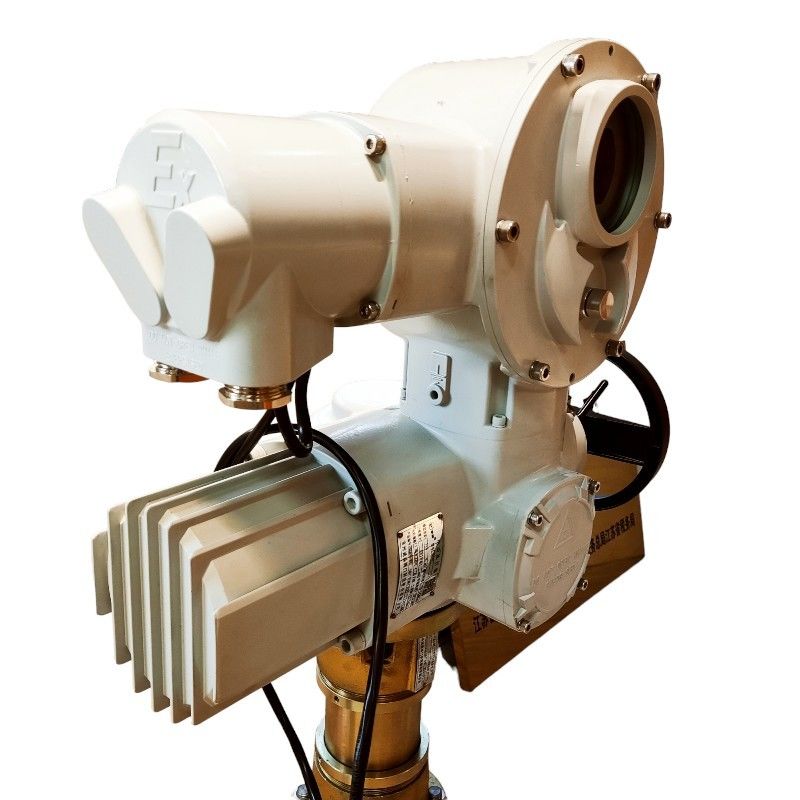
A hazardous-area electric actuator is approved on documents, not on adjectives. In Oil & Gas, Chemical & Process, and the classified sections of Water & Power plants, the buyer has to place a site zone classification on one side of the table and a set of declared, traceable product data on the other: the explosion-proof marking, the ingress protection grade, the insulation class, the thermal protection status, and the ambient temperature range. When any one of those items is missing from the data sheet, the actuator cannot be signed off — not at factory acceptance testing, and not at site.
In the Chenglei range, that hazardous-area package is assembled from an ATEX / Exd BT4 or CT4 explosion-proof marking, IP65, IP67 or IP68 protection, insulation Class F, thermal protection, and an ambient temperature range of −20 to +60 °C as standard, with special orders covering −60 to +70 °C. The two reference models used throughout this guide are the Intelligent Electric Motor Linear Actuator Explosion Proof ZXC Series (CLZXC4000) and the Intelligent 24V DC JB2920 ISO5210 Flange Electric Valve Actuator.
Why an "Explosion-Proof" Line Item Is Not Enough
The phrase describes an outcome, not a specification. Behind the outcome sits a stack of separately declared items, and each one can fail on its own. A quotation line that reads only "explosion-proof electric actuator" typically leaves six gaps that a reviewer has to close before the purchase order is safe to release:
- The marking itself. Which framework is claimed — ATEX, or an equivalent national approval — and what exactly appears on the nameplate.
- The gas group. Whether the unit is suitable for the gas actually present on site, which is not the same question for every hydrocarbon service.
- The temperature class. The T-rating that sits behind the abbreviated marking on the data sheet.
- The enclosure rating. IP65, IP67 or IP68, and whether that rating covers the complete assembly including cable entries.
- Insulation class and thermal protection. Two motor-level items that decide how much thermal margin the unit has under repeated cycling.
- The mechanical interface. Torque type or thrust flange type, matched to the valve that will actually be turned.
These gaps surface in one of four places: during data sheet review, when the nameplate is compared against the specification, during factory acceptance testing, or at commissioning. The later they appear, the more expensive they are. That is why a compliance guide is worth reading at the Evaluation stage rather than at the Execution stage.
How the Hazardous-Area Framework Is Organised
Explosion-proof electric actuators for hazardous environments are standardised under IEC 60079-0 (General Requirements) and IEC 60079-1 (Flameproof Enclosures 'd'), as published by IECEx. These two documents define the enclosure concept that most oil and gas actuators rely on, and they are the reference point that national and regional approval schemes build on.
Within that framework, equipment is categorised by gas group — IIA, IIB and IIC — and by temperature class, T1 through T6. Published ATEX classification guidance notes that Group IIC is the requirement for hydrogen environments. In the abbreviated marking form used on actuator nameplates and data sheets, the character placed between "Exd" and "T4" identifies the gas group — B for IIB, C for IIC — while T4 identifies the temperature class. This is precisely why a specification that says only "explosion-proof" is incomplete: it does not yet state whether the unit suits the gas on site.
Supply-side context reinforces the same point. Dataintelo values the electric valve actuator market in Asia-Pacific at over USD 1.8 billion and reports that the region held a 38.5% revenue share in 2025. With such a large share of global supply concentrated in one manufacturing region, systematic verification of the documentation package is a normal sourcing step rather than a sign of distrust.
The Chenglei Compliance Stack, Item by Item
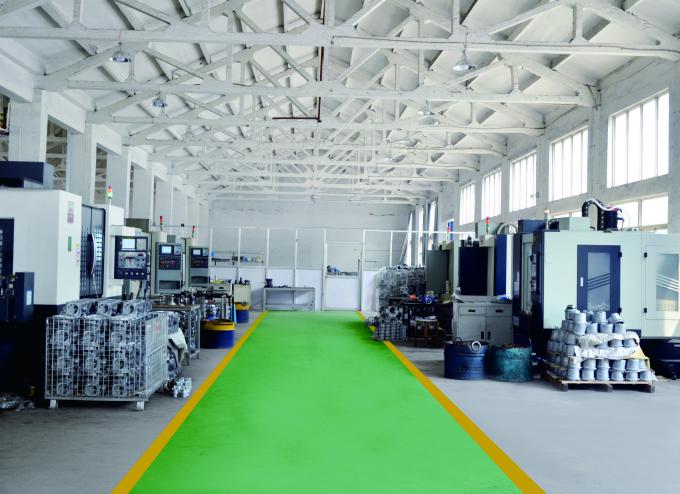
Changzhou Chenglei Valve Technology Co., Ltd. (brand: Chenglei) is a valve electric actuator manufacturer based in Changzhou, Jiangsu, China. Founded in 2016, the company operates a 20,000 m² facility with approximately 100 employees and an annual output of 120,000 units, of which around 80% is exported to global markets. Its independently developed CL series valve electric actuators are used in Oil & Gas, Water & Power, and Chemical, Process & Industrial applications, and the company offers OEM and ODM production with voltage and logo customisation.
1. Explosion-proof marking: ATEX / Exd BT4 / CT4
Two models in the current range state the marking explicitly on their data sheets. The High Speed Low Temperature −60 ºC Electric Actuator (DQ Series) and the Intelligent 24V DC JB2920 ISO5210 Flange Electric Valve Actuator are both listed as ATEX / Exd BT4 / CT4. For a project handling hydrogen or another Group IIC gas, the CT4 variant is the appropriate selection; for Group IIB duties, BT4 is the standard option. Where a project specification names ATEX, the marking on the data sheet and the marking on the physical nameplate must agree, because the nameplate is what a site inspector reads.
One detail is worth flagging for buyers: the Intelligent Electric Motor Linear Actuator Explosion Proof ZXC Series (CLZXC4000) carries explosion protection in its model designation and lists IP65/IP67 protection, a working temperature of −20 to +60 °C, and a high-temperature baking paint anti-corrosion coating — but the linear series data sheet does not repeat the Ex marking. That is not a contradiction; it is a reminder that the model name is a marketing label and the certificate is the governing document. Where a data sheet is silent, the buyer should request the marking in writing rather than infer it.
2. Ingress protection: IP65, IP67 and IP68
Ingress protection is declared separately from explosion protection and answers a different question: what the enclosure tolerates from dust and water. In the standard IP scale, the second digit describes water protection — 5 for water jets, 7 for temporary immersion, 8 for continuous immersion. Chenglei data sheets list IP65 / IP67 / IP68 across the explosion-proof range, with individual models stating narrower values: the CLZXC4000 linear series lists IP65/IP67, while the DQ Series and the JB2920/ISO5210 flange model list the full IP65/IP67/IP68 span.
Two practical rules follow. First, the rating applies to the complete assembly, so cable entries, cover seals and the terminal housing have to be part of the same declaration. Second, a higher number is not automatically the better choice: an actuator that is never immersed does not need IP68, but one installed in a flooding-prone sump, a washdown bay or an open desert site exposed to driven rain and salt spray does.
3. Insulation Class F and thermal protection
Insulation Class F is declared on both the DQ Series and the JB2920/ISO5210 flange model. Thermal protection is listed as present on the multi-turn explosion-proof models and on the flange model — for example, the IP67 Explosion Proof Actuator Multi Turn Electric Actuator With Thermal Protection and the Multi Turn Intelligent Electric Actuator Thermal Protection Smart Electric Actuator.
For an Execution-stage buyer, these two items are usually tied to duty cycle. Repeated cycling in a hot ambient raises winding temperature, and the declared insulation class plus the thermal protection status define the thermal margin available. Both lines should be visible on the data sheet before the purchase order is released, together with a note on how the protection is terminated.
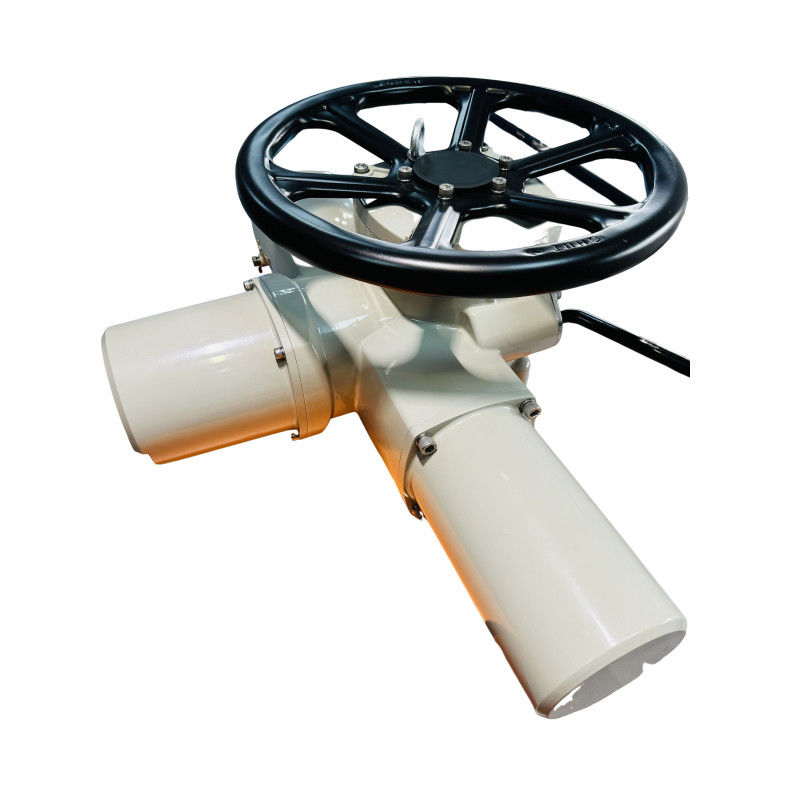
4. Ambient temperature: −20 to +60 °C standard, −60 to +70 °C on special order
Temperature is the one specification that cannot be corrected after installation. The CLZXC4000 explosion-proof linear series and the JB2920/ISO5210 flange actuator list a working temperature of −20 to +60 °C. Where the site envelope is wider, the DQ Series is listed at −60 °C to +70 °C, and the flange model records special orders covering −60 to +70 °C. Relative humidity is specified as ≤ 95% at +25 °C.
The engineering implication is straightforward: confirm the site's recorded minimum and maximum rather than the nominal climate, and if the extremes fall outside −20 to +60 °C, specify the special-order version at the RFQ stage instead of discovering the problem during commissioning.
5. Mechanical interface: JB2920 torque type and ISO5210 thrust flange
Connection type is listed as JB2920 torque type or ISO5210 (GB/T 12222) thrust flange type. The distinction matters at the valve, not at the actuator: a torque-type interface transmits rotary force to a rotating stem, while a thrust flange interface carries both torque and thrust, which is what a rising-stem or linear valve imposes on its actuator. ISO 5210 is the international standard for actuator-to-valve attachments, and GB/T 12222 is its Chinese equivalent.
Flange sizes across the Chenglei range illustrate how the interface scales with torque: F05/F07 on the QI10 and QI15 part-turn models, F10 on the Z5 and Z10 multi-turn models, F10/F12 on the QI60, F14 on the Z30, F16 on the Z45, and F14/F16 on the QI500 quarter-turn model rated at 5,000 N·m.
6. Electrical ratings and duty cycle
Voltage options are 380V / 110V / 220V / 440V / 660V AC or 12V / 24V DC at 50/60 Hz, with on-off or modulating control and a 4–20 mA signal input. Motor duty is listed as S2 at 10 min, 15 min or 30 min, or S1 / S3 / S4 / S6 at 24% and 40%. The JB2920/ISO5210 flange model additionally lists battery backup, a Bluetooth connection and a handwheel manual override; body material options across the range include aluminium alloy, stainless steel and carbon steel.
A hazardous-area installation inherits the plant's control philosophy, so these values should be confirmed against the DCS or PLC output rather than against the actuator's capability. Duty cycle in particular is often the hidden constraint in modulating service.
7. Documentation: the certificate is part of the product
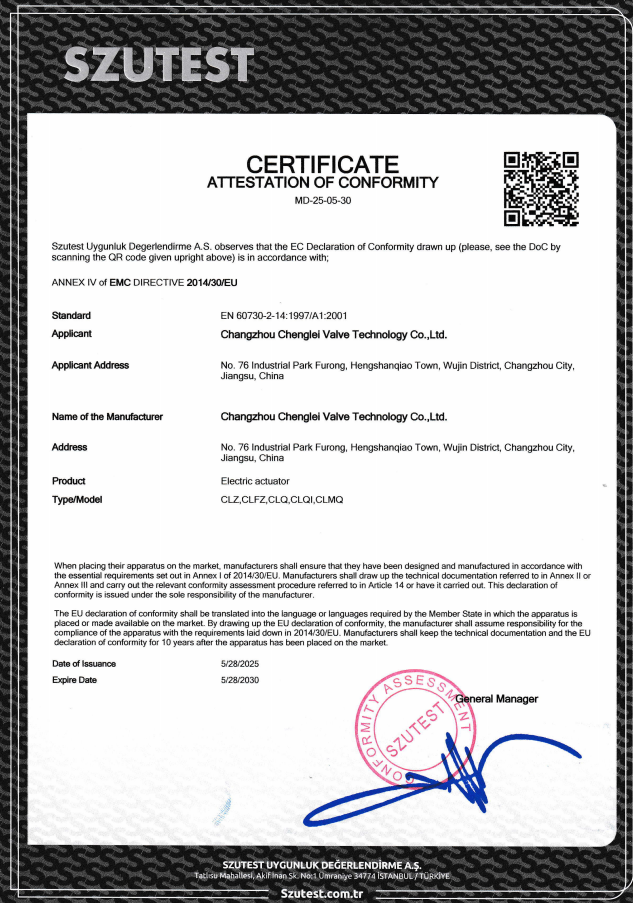
Changzhou Chenglei Valve Technology Co., Ltd. holds a CE certificate for EN 60730-2-14:1997/A1:2001, issued by szutest, valid from 28 May 2025 to 28 May 2030 for the EU market. Production is covered by 100% testing, and pre-shipment testing is the stated acceptance method. For a hazardous-area purchase, this is the layer that turns a data sheet into a deliverable: the certificate, the test record and the acceptance protocol are what the project team files.
8. The reference platforms in one view
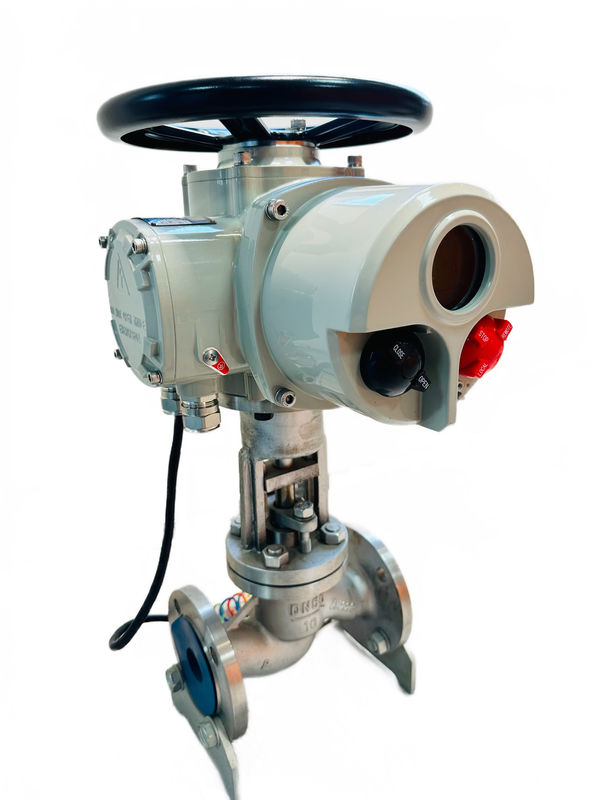
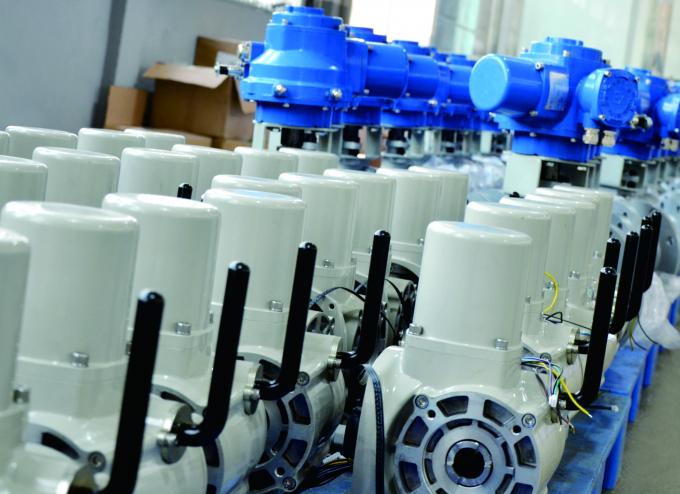
The Intelligent Electric Motor Linear Actuator Explosion Proof ZXC Series (CLZXC4000) is a linear / regulating platform rated 50/60 Hz with IP65/67 protection, a −20 to +60 °C working temperature, a high-temperature baking paint anti-corrosion coating and a 10-minute short-time duty cycle. The Intelligent 24V DC JB2920 ISO5210 Flange Electric Valve Actuator is the quarter-turn counterpart in the same compliance logic: ATEX / Exd BT4 / CT4, IP65/IP67/IP68, insulation Class F, thermal protection, and the choice of JB2920 torque type or ISO5210 thrust flange connection.
Eight Checks Before Releasing a Hazardous-Area Purchase Order
- Classify the zone and identify the gas group. The gas group decides the marking variant: Group IIC (for example hydrogen service) points to CT4, while typical Group IIB hydrocarbon duty is served by BT4.
- Set the ambient envelope. Compare the site's recorded minimum and maximum against −20 to +60 °C; if the extremes fall outside, specify the −60 to +70 °C special order.
- Write the Ex marking into the RFQ as a hard requirement. Ask for ATEX / Exd BT4 or CT4 to appear on the data sheet and the nameplate, with the certificate attached.
- Fix the ingress protection grade against the physical location. Distinguish water jets (IP65), temporary immersion (IP67) and continuous immersion (IP68), and confirm the rating covers the cable entries.
- Confirm insulation Class F and thermal protection. Both are duty-cycle related and both should be stated before the order is placed.
- Confirm the mechanical interface. Decide between JB2920 torque type and ISO5210 (GB/T 12222) thrust flange type, then verify the flange size against the valve stem — F05/F07, F10, F12, F14 and F16 all appear in the range.
- Confirm electrical compatibility. Voltage, frequency, on-off versus modulating control, 4–20 mA signal, and the S2 or S1/S3/S4/S6 duty cycle must match the plant's control output.
- Close the documentation and acceptance loop. Certificates, 100% testing records and the pre-shipment test protocol should be named in the order, not requested later.
Where These Requirements Meet Real Projects
Oil & Gas, Middle East desert service
This case is located in Iraq, where the product has been successfully used by petroleum engineering clients on a large-scale oil valve project — approximately 200 sets over a six-year engagement. The site is a desert environment with high corrosion from salt spray and hydrogen sulphide, plus high temperature, which places heavy demands on the protection level and service life of the equipment. The response combined a C5-M grade anti-corrosion coating that exceeds conventional standards with double-sealed wiring technology to isolate corrosive gases and moisture intrusion, keeping the units operating in an open, sulphur-bearing atmosphere and reducing maintenance downtime caused by leaks.
Oil & Gas and energy infrastructure, extreme cold
The Russian project involved a strategic partner in the oil, natural gas and energy infrastructure fields, applied to remote automated control of pipelines and infrastructure. The site combines extremely cold climate, large temperature differences and a potentially explosive gas environment. The first batch of more than 400 high-end intelligent electric actuators passed a factory acceptance test conducted by the Russian delegation, with the product having obtained EX explosion-proof certification and starting stably at −40 °C. The engineering focus was on documented cold-climate failure modes: LCD failure, lubricant solidification and material brittleness.
Chemical & Process: the same checklist with tighter tolerances
In chemical and process plants, the sequence does not change, but the consequences of a mismatch are compressed. The gas group and temperature class drive the marking selection first; the ingress protection grade follows from the actual exposure around the valve — washdown, condensate, or occasional flooding at a sump. In practice these two points, marking variant and protection grade, account for most of the rework seen in hazardous-area actuator documentation.
Water & Power: classified pockets inside an unclassified plant
Water and power facilities are often treated as general-purpose environments, yet hazardous classification typically appears in specific pockets where gas or hydrogen is handled. Buyers who assume a standard, non-classified actuator is acceptable throughout such a site usually discover the exception late. The efficient approach is to apply the same eight checks to every actuator position that sits inside a classified boundary, using the same marking, protection and temperature data set.
Heavy industry without classification: environment still drives specification
Not every demanding project is a hazardous-area project. A large non-ferrous metal group in the United States deployed nearly a thousand intelligent actuators across raw material grinding, high-temperature digestion, sedimentation separation and evaporation stations, under strong vibration, high temperature and heavy dust. The engineering response was a design that separates the mechanical body from the control unit, keeping the precision control part away from the vibration source, combined with Profinet industrial Ethernet interconnection across the plant area. Compliant documentation and environmental engineering are two sides of the same discipline.
Reference Data: Explosion-Proof and Environmental Specifications
The table below reproduces the declared values from Chenglei product data sheets. Values are model-specific, and where a data sheet does not state a value, the correct action is to request it in writing rather than infer it.
| Reference model | Protection grade | Ambient / working temperature | Explosion-proof marking | Additional compliance-relevant data |
|---|---|---|---|---|
| Intelligent Electric Motor Linear Actuator Explosion Proof ZXC Series (CLZXC4000) | IP65 / IP67 | −20 to +60 °C | Explosion-proof series; Ex marking not stated on the data sheet — request the certificate | 50/60 Hz; high-temperature baking paint anti-corrosion coating; 10-minute short-time duty |
| Intelligent 24V DC JB2920 ISO5210 Flange Electric Valve Actuator (high torque, quarter turn) | IP65 / IP67 / IP68 | −20 to +60 °C; special orders −60 to +70 °C | ATEX / Exd BT4 / CT4 | Insulation Class F; thermal protection; JB2920 torque type or ISO5210 (GB/T 12222) thrust flange; battery backup; Bluetooth; handwheel override; ≤ 95% RH at +25 °C |
| High Speed Low Temperature −60 ºC Electric Actuator (DQ Series) | IP65 / IP67 / IP68 | −60 °C to +70 °C | ATEX / Exd BT4 / CT4 | Insulation Class F; NEMA 4 / 4X / 7&9; 4–20 mA signal input |
| ZXC Type Electric Rotary Actuator | IP67; NEMA 4X | −20 °C to +70 °C | Certifications declared: CE, ATEX, SIL3 | ISO 5211 mounting; 10–4,000 Nm torque range; 90°/120°/180° travel angle; 2-year warranty |
| QI500 Quarter Turn Electric Actuator | Data sheet states explosion-proof housing; protection grade not stated | Not stated on the data sheet | Explosion-proof housing | 5,000 N·m rated torque; 0.5 r/min output; F14/F16 flange |
Temperature values are model-specific. The −20 to +60 °C figure applies to the CLZXC4000 explosion-proof linear series and to the JB2920/ISO5210 flange model, while the DQ Series extends to −60 °C to +70 °C. The ZXC Type Electric Rotary Actuator data sheet separately lists an ambient range of −20 °C to +70 °C — a useful reminder that in a multi-model project every position needs its own data sheet check.
Frequently Asked Questions
What explosion-proof certifications should I verify before buying an electric actuator for a hazardous oil and gas zone?
Verify four things as a minimum. First, the Ex marking on both the data sheet and the nameplate — in the Chenglei range this is ATEX / Exd BT4 or CT4, where the letter indicates the gas group (B for IIB, C for IIC) and T4 the temperature class. Second, the ingress protection grade of the complete assembly, which may be IP65, IP67 or IP68. Third, insulation Class F and the presence of thermal protection. Fourth, the declared ambient temperature range — −20 to +60 °C as standard, with special orders covering −60 to +70 °C. Underlying the marking, explosion-proof electric actuators are standardised under IEC 60079-0 (General Requirements) and IEC 60079-1 (Flameproof Enclosures 'd'). Chenglei's CE certificate for EN 60730-2-14:1997/A1:2001 was issued by szutest and remains valid until 28 May 2030.
Can the same actuator platform cover both a quarter-turn valve and a linear or rising-stem valve in a classified area?
Yes, provided the mechanical interface is selected correctly. The Intelligent 24V DC JB2920 ISO5210 Flange Electric Valve Actuator is offered with either a JB2920 torque type or an ISO5210 (GB/T 12222) thrust flange connection, which is what allows one hazardous-area platform to serve both rotary and thrust-loading valves. The wider range covers quarter-turn models up to 5,000 N·m (QI500 with explosion-proof housing and F14/F16 flange) and multi-turn models from 50 N·m (Z5) to 450 N·m (Z45, IP67, explosion-proof). The Intelligent Electric Motor Linear Actuator Explosion Proof ZXC Series (CLZXC4000) addresses linear and regulating duty with IP65/67 protection and a −20 to +60 °C working temperature.
What drives the cost of a hazardous-area electric actuator?
Cost follows configuration rather than catalogue position, and Chenglei quotes on a per-configuration basis. The main drivers are the explosion-proof marking required and the gas group it must cover, the ingress protection grade, the torque class, insulation and thermal protection requirements, whether the standard −20 to +60 °C version is sufficient or the −60 to +70 °C special order is needed, the connection interface (JB2920 torque type or ISO5210 thrust flange), and any customisation such as voltage or logo under OEM / ODM production. Because these are configuration items, a like-for-like RFQ is the only reliable way to compare quotations, and published list pricing is not the basis on which hazardous-area actuators are purchased.
Can I validate a unit before committing to a production order?
Yes. The minimum order quantity is 1 set, production units are subject to 100% testing, and pre-shipment testing is the stated acceptance method. Where a project requires formal acceptance, factory acceptance testing is the established route — in the Russian pipeline and energy infrastructure project, the first batch of more than 400 high-end intelligent electric actuators passed a factory acceptance test conducted by the buyer's delegation before shipment.
What is the lead time, and how do I start the process?
For orders between 1 and 100 units the stated lead time is 10–15 working days; orders above 100 units are quoted individually. Monthly capacity is 8,000 units, shipping terms are FOB or CIF, and payment can be arranged by L/C, T/T or PayPal, with remote after-sales support after delivery. To start, send the eight data points from the checklist above — zone classification and gas group, ambient envelope, required Ex marking, IP grade, insulation and thermal protection requirement, interface type and flange size, electrical ratings, and documentation requirements — and request a quotation or a sample unit. The full product documentation set is available in the Chenglei product brochure.
Conclusion: Compliance Is a Trail, Not a Badge
In hazardous oil and gas zones, an electric actuator is only as acceptable as the paper trail behind it. The ATEX / Exd BT4 or CT4 marking answers the gas-group and temperature-class question. IP65, IP67 or IP68 answers the enclosure question. Insulation Class F and thermal protection answer the thermal-margin question. The −20 to +60 °C standard range, with −60 to +70 °C available on special order, answers the climate question. JB2920 torque type or ISO5210 thrust flange answers the mechanical question, and the CE certificate for EN 60730-2-14:1997/A1:2001, backed by 100% testing and pre-shipment acceptance, answers the traceability question.
Buyers who verify those six layers during evaluation rarely encounter surprises during execution — and when a data sheet is silent on a layer, the correct response is to ask rather than to assume.
Need a hazardous-area actuator specified against your zone classification? Send your gas group, ambient envelope, required marking and valve interface, and the team will come back with a configuration and quotation.
Chenglei — Changzhou Chenglei Valve Technology Co., Ltd.
Website: www.electricvalvesactuators.com
Contact: Mr. GUI JING | WhatsApp / Phone: +8613401325958 | Email: terry.gui@cz-chenglei.com
Download the product documentation: Chenglei product brochure (PDF)