
Bakery Packaging Compliance: BPA-Free PET and Food-Grade Material Requirements
Bakery Packaging · Material Compliance
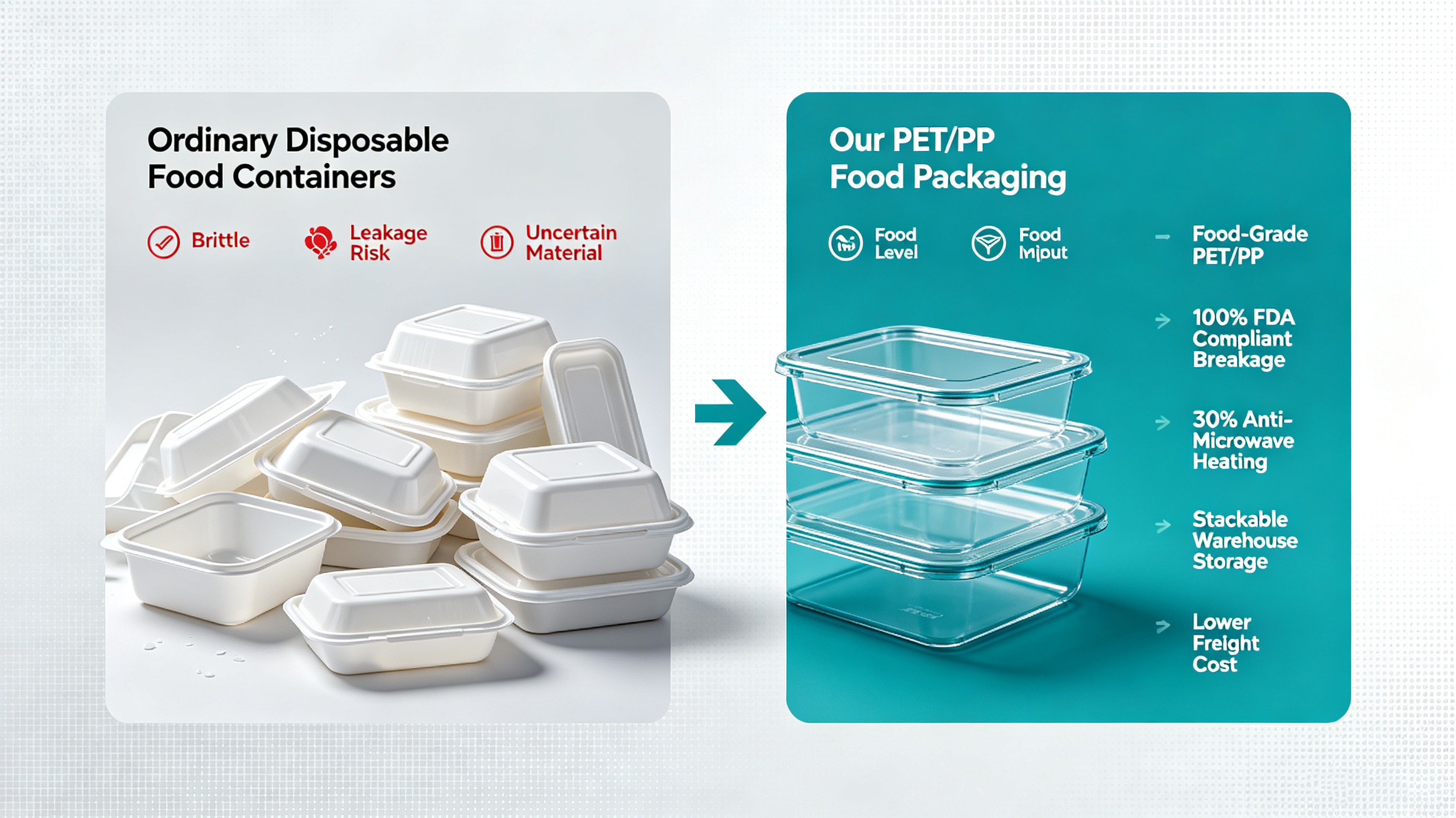
Food-grade PET bakery containers: BPA-free material, FDA food contact compliant, impact resistant, microwave and refrigerator safe, stackable.
Two material facts decide whether a bakery container can be sold, shipped, or reordered: the polymer it is thermoformed from, and what that polymer contains. Across the CHUAN HE bakery packaging range, PET containers are made from food-grade, BPA-free PET — a base material that provides high transparency and is 100% compliant with FDA food contact requirements. Both traits are material-level properties, not decorative claims. They hold from the smallest tamper-evident size, HB-16 OZ, up to the largest, HB-32 OZ, because a container's size is set by its mold, not by its polymer.
This guide is written for decision-stage buyers — bakery chains, patisserie operators, food distributors, and importers — who are comparing packaging options and need to know which material questions actually settle a purchase. It explains what food-grade and BPA-free mean in operational terms, how each claim is verified rather than asserted, how the EU's BPA restriction reshaped export requirements, and how to run a supplier comparison that holds up under a quality audit.
Quick answer: A bakery container made from food-grade, BPA-free PET can be used for direct food contact when the supplier can document material approval, migration and physical testing, clean production, and batch traceability. BPA-free status matters most for EU-bound packaging, where Regulation (EU) 2024/3190 prohibits BPA in food contact plastics, coatings, and inks from January 2025, with transition periods for compliance.
Material Compliance Is the First Filter, Not the Final Check
Food contact packaging carries four material-level risks: chemical migration, sharp fragments created by breakage, microbial contamination, and unqualified raw materials contaminating the food itself. None of those risks can be resolved by better logistics, tighter inspection, or a lower price. A polymer that was not approved for direct food contact stays unapproved no matter how well the container is packed.
That is why the compliance question belongs at the start of the buying process. Buyers who compare containers on size, appearance, and unit price first — and review material documentation afterwards — usually end up repeating the entire evaluation, because a failed material check invalidates every comparison already made.
In practice, three filters do the work: material status, verification documentation, and the destination market's rules. Cost, design, and stacking efficiency should only be compared among the options that survive those three. A decision framework built in that order is faster than one built on sample aesthetics, and it is far easier to defend in front of a retail customer or an import inspector.
Why BPA-Free Material Requirements Now Sit at the Center of Bakery Packaging
Rigid food packaging is a large and still expanding category. Grand View Research values the global food packaging market at USD 421.6 billion in 2025 and projects it to reach USD 599.0 billion by 2033, with Asia Pacific holding a 40.0% revenue share in 2025. Within that total, thermoform packaging — the process behind clamshells, trays, and tamper-evident containers — was valued at USD 54.7 billion in 2025, and PET holds the largest material share at 44.8%.
Demand for primary bakery packaging tracks bakery production and export volumes. China exported USD 1.28 billion in baked goods in 2024, according to the Observatory of Economic Complexity. Every one of those shipments required primary packaging that satisfied the importing market's food contact rules, which is why material documentation moves from a back-office file into the purchase conversation as soon as a bakery product crosses a border.
Tamper-evident formats are the fastest-moving subset. Mordor Intelligence projects that market growing from USD 2.56 billion in 2025 to USD 4.26 billion by 2030, a CAGR of 10.72%. Growth of that kind normally arrives with tighter retail and logistics expectations, and tighter expectations normally arrive with more material questions.
The regulatory shift with the clearest effect on material selection is European. Regulation (EU) 2024/3190, effective January 2025, prohibits Bisphenol A (BPA) in food contact plastics, coatings, and inks, with transition periods for compliance. In the United States, FDA 21 CFR 177.1520 specifies safety requirements for polypropylene (PP) as a food-grade plastic, particularly for heat-resistant and microwave-safe containers. A specification intended to serve both markets therefore starts with a base material that is food-grade and BPA-free, rather than with decoration or geometry.
What Food-Grade and BPA-Free Require in Practice
The material baseline: PET, food-grade and BPA-free
The primary material used across the CHUAN HE bakery container range is PET, which provides clear visibility of contents and is food-grade BPA-free. Containers in the range are 100% compliant with FDA food contact requirements, making them suitable for direct food contact applications.
For a bakery, that transparency is not cosmetic. Baked goods are merchandised on appearance — crust color, filling layers, icing detail, portion size. A food-grade material that stays clear lets the container do display work while still meeting the requirement that carries legal weight: the packaging is approved for direct food contact.
How the claim is verified, not just asserted
Every material claim is only as strong as the records behind it. The verification set for food contact packaging includes food-grade raw material inspection, migration and physical testing, a clean production environment, and batch tracing. On the supplier side, the supporting measures are supplier certificate verification, regular third-party testing, enforcement of workshop hygiene rules, issue of declarations of conformity, and long-term archiving of compliance records.

Food-grade raw material inspection and migration testing are the first verification layer behind a BPA-free material claim.
Two of these deserve emphasis during supplier evaluation. Migration testing addresses the chemical risk — whether substances can transfer from the container into the food. Batch tracing addresses the audit risk — whether a specific production run can be identified if a question arises months later. A supplier who can produce only a general compliance statement, without run-level traceability, is a supplier whose material claim cannot be tested against a real shipment.
Performance consequences of the material and construction choice
Material and construction decisions show up as measurable performance. Compared with ordinary thin-wall PET blister packaging, the thickened reinforced structure used in these containers provides 30% higher impact resistance and a 35% reduction in drop breakage rate. Sealing tightness is 32% higher than alternatives, the container blocks air and moisture ingress once closed, and the associated food spoilage rate is reduced by 26% — a combination that matters for baked goods and cold-chain circulation.
For chilled display, an anti-fog coating raises the visibility retention rate by 40% and keeps the container clear in 0–8 °C cold storage, so shoppers see the product instead of condensation. For containers that move between temperature zones, performance is maintained from −18 °C to 120 °C, with heat deformation rate reduced by 38% and low-temperature cracking rate reduced by 32% compared with blister packaging that has no low-temperature or heat-resistant treatment.
The maintenance profile also matters in daily bakery operations: no special storage conditions required, stackable design that saves warehouse space, stable hardness after temperature changes, and fewer broken containers to handle on the line.
The cost position of food-grade material
Food-grade material carries a modest premium rather than a structural one. Compared with low-grade containers, food-grade containers offer competitive cost with a price only about 5% higher, which is typical for food-grade packaging — and that gap is recovered through reduced overall loss expense: fewer breakages, fewer repacks, and less spoilage.
Material Consistency Across the Tamper-Evident Range: HB-16 OZ to HB-32 OZ
Tamper evidence is a construction feature, not a change of material. The tamper-evident structure used in this range closes once: after initial closure the container is designed for one-time opening only, and any subsequent opening results in irreversible damage, making tampering easy to detect. Once opened, the locking tab cannot be restored to its original closed state.
For bakery buyers, the more consequential point is material consistency. The line runs from HB-16 OZ to HB-32 OZ on the same PET base — food-grade, BPA-free, and clear enough for product visibility. Scaling the container size changes the mold; it does not change the polymer or the food contact status of the material.
The practical effects are straightforward. One material specification covers a pastry clamshell, a tiramisu container, and a larger sharing-box format. Sample approval obtained on one size carries meaning for the others, because the material under review is identical. And a retail customer asking about BPA status receives the same answer regardless of which SKU is under discussion.
Tamper evidence has a cost-side logic as well. The product cost increases slightly, but it reduces the risk of product returns caused by tampering. Features such as snap lock closures, shatter-resistant construction, rounded edges, and stackable design support both product protection and shelf display, at delivery points as well as on the shelf.
Step-by-Step: Running a Compliance-Based Bakery Packaging Decision
- Fix the destination market first. EU-bound packaging must respect Regulation (EU) 2024/3190 and its BPA restriction; US-bound material must satisfy FDA food contact requirements, with 21 CFR 177.1520 covering PP as a food-grade plastic for heat-resistant and microwave-safe use. Ask: which markets will receive this SKU, and in what volume order?
- Confirm the base polymer and its additive status in writing. For this range the answer is PET, food-grade and BPA-free, with high transparency. Ask: for the material declaration covering the exact grade used in production, not a generic data sheet.
- Match documentation to the claim. Migration tests and physical tests, third-party testing, declarations of conformity, and archived compliance records are the evidence layer. Ask: which tests were run, by whom, and how results are stored.
- Check production conditions and traceability. Food-grade raw material inspection, a clean production environment, workshop hygiene rules, and batch tracing determine whether the material claim applies to your shipment. Ask: how a delivered carton is traced back to a production run.
- Test performance under your own conditions. Temperature range, stacking load, chilled display clarity, and frozen handling behave differently in every bakery operation. Ask: for samples to run through your own filling, chilling, and transport process.
- Decide on tamper evidence. If the product is sold through retail or shipped sealed, a one-time-opening locking structure adds detectable protection and reduces return risk. Ask: to test the locking tab physically and confirm the container cannot be reclosed unnoticed.
- Compare cost on a loss-adjusted basis. Food-grade containers sit around 5% above low-grade alternatives, a typical food-grade premium. Weigh that against the 35% drop-breakage reduction, the 26% spoilage reduction linked to 32% higher sealing tightness, and the warehouse space saved by stackable design.
Use Cases: Where BPA-Free PET Bakery Packaging Fits
In-store bakery and patisserie display. Clear trays, clamshells, and dome formats are chosen for merchandising, but the material decision comes first. PET delivers high transparency, while the anti-fog treatment keeps visibility intact at 0–8 °C so cakes, tarts, and cream-filled pastries read clearly from the counter. Stackable construction lets a display case hold more SKUs in the same footprint.
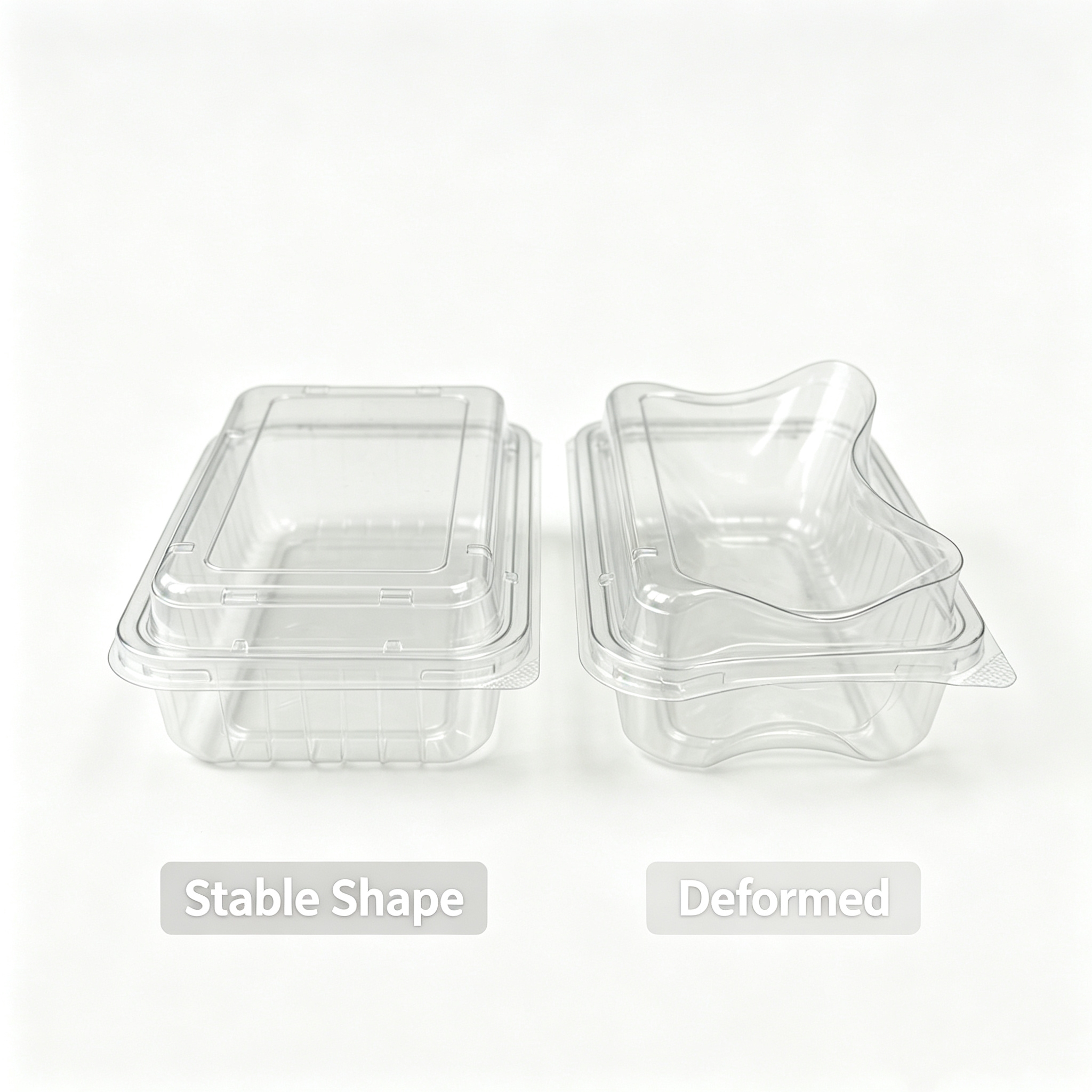
Stable form after temperature change: containers hold shape from −18 °C to 120 °C with reduced deformation and cracking.
Chilled and frozen bakery logistics. Products that move between freezer, refrigerated transport, and ambient shelf put stress on any container. Stability from −18 °C to 120 °C, a 38% reduction in heat deformation rate, and a 32% reduction in low-temperature cracking rate keep the package intact across those transitions, which reduces repacking and transport losses.
Sealed retail and export shipments. When a container leaves the bakery already closed, tamper evidence becomes part of the compliance story. The one-time-opening structure makes interference visible at the delivery point, reduces repeated inspection, and protects brand reputation on long routes. Because the material is identical across HB-16 OZ to HB-32 OZ, one material approval covers the full export line.
Takeaway and dessert counters. Individual dessert formats — tiramisu containers, mochi donuts, cookies, and single-portion cakes — rely on clarity and stackability. Lightweight PET construction reduces logistics transportation cost, while a leak-resistant close blocks air and moisture once sealed, which matters for cream-based and glazed products sold in high-turnover environments.
Comparison: Requirements, Markets, and Verified Material Status
The two tables below summarize how material requirements map onto verified status, and how the destination market changes what a supplier must be able to document.
Table 1 — Compliance requirements vs. verified status for BPA-free PET bakery containers
| Compliance requirement | Verified status for PET bakery containers | Typical verification route |
|---|---|---|
| Base polymer approved for direct food contact | PET is the primary material used in the range; food-grade and BPA-free, with high transparency | Material declaration from the supplier |
| Bisphenol A (BPA) status | BPA-free PET across the bakery container range | Material data review; Regulation (EU) 2024/3190 restricts BPA in food contact plastics, coatings, and inks |
| FDA food contact compliance | 100% compliant with FDA food contact requirements | Food contact compliance documentation |
| Chemical migration and physical integrity | Migration and physical tests carried out; food-grade raw materials inspected; clean production environment maintained | Third-party testing plus batch records |
| Traceability | Batch tracing with long-term archiving of compliance records | Record audit |
| Tamper evidence | One-time-opening locking structure; irreversible damage after re-opening | Physical sample testing |
Table 2 — Market-by-market material requirements at a glance
| Market | Material requirement to confirm | Regulatory reference |
|---|---|---|
| European Union | BPA prohibited in food contact plastics, coatings, and inks, with transition periods for compliance | Regulation (EU) 2024/3190, effective January 2025 (European Commission) |
| United States | Food-grade plastic safety requirements apply; containers supplied as FDA food contact compliant | FDA 21 CFR 177.1520 (PP); supplier food contact documentation |
| All markets | Food-grade, BPA-free PET as the material baseline for bakery containers | Material data for the PET grade in production |
FAQ: BPA-Free PET and Food-Grade Bakery Packaging
Are PET bakery containers BPA-free and suitable for direct food contact?
In the CHUAN HE bakery range, the primary material is PET, which is food-grade BPA-free, and the containers are 100% compliant with FDA food contact requirements, making them suitable for direct food contact applications. BPA-free status is a property of the material itself rather than a surface treatment, so it applies to the container body as produced. For EU-bound packaging it also aligns with the direction of Regulation (EU) 2024/3190, which prohibits BPA in food contact plastics, coatings, and inks from January 2025, with transition periods for compliance.
Does the same food-grade material apply to every size in the tamper-evident line?
Yes. The tamper-evident line runs from HB-16 OZ to HB-32 OZ on the same PET base material, which is food-grade, BPA-free, and clear enough to show contents. Changing the container size changes the mold, not the polymer or its food contact status, so a material approval obtained for one size describes the others in the range. The tamper-evident closure is a one-time-opening design: after the first opening, the locking tab suffers irreversible damage and cannot be restored to its original closed state.
Is BPA-free, food-grade PET more expensive than standard bakery packaging?
The premium is modest rather than structural. Food-grade containers are positioned at only about 5% higher price than low-grade containers, which is typical for food-grade packaging, and the gap is offset by reduced overall loss expense. The measured differences include 30% higher impact resistance and a 35% reduction in drop breakage rate compared with ordinary thin-wall PET blister packaging, plus a 26% reduction in food spoilage rate associated with 32% higher sealing tightness. Buyers who compare unit price alone will misread the total cost of ownership.
How can a buyer verify material compliance before committing to a bulk order?
Request a physical sample of the exact container size, then check four things: the material declaration confirming food-grade, BPA-free PET; migration and physical test records; evidence of regular third-party testing; and batch traceability that links a shipment to a production run and its archived compliance records. After that, test the container under your own conditions — chilled display, freezing, stacking, transport — because a document set confirms material status, not application fit. Samples of the bakery and tamper-evident ranges can be requested from CHUAN HE at chuanhe@newplasticbox.com together with the supporting documentation.
What determines lead time on a compliant bakery packaging order?
Material and tooling availability drive most of the schedule. CHUAN HE operates 20 fully automatic thermoforming machines and 20 standard thermoforming machines, including 4 advanced Kiefel machines imported from Germany, plus 4 PET sheet extrusion lines, 2 PP sheet extrusion lines, and an in-house mold workshop. In-house sheet extrusion reduces dependence on outsourced raw materials and supports coordinated production and faster delivery. Because the material specification is consistent across the tamper-evident range, moving between sizes within the range does not restart material qualification; orders that require new tooling are scheduled around mold development.
Conclusion: Compliance Is Decided at the Material Level
Compliance decisions resolve quickly once they are placed in the right order: confirm the polymer, confirm the additive status, match documentation to the claim, review production and traceability, test a sample under real bakery conditions, then compare cost. For PET containers in this range, that sequence starts from a food-grade, BPA-free material that is 100% compliant with FDA food contact requirements, and it stays the same from the HB-16 OZ container up to the HB-32 OZ tamper-evident format. Material consistency across the line means the compliance answer does not change when the container size does.
Weifang Chuanhe New Material Co., Ltd. (CHUAN HE), founded in 2013, manufactures PET and PP thermoformed packaging at a 62,000 m² facility in Weifang, Shandong Province, China, with an annual output of 54,000 tons and exports to North America, Europe, Australia, Southeast Asia, and other regions.
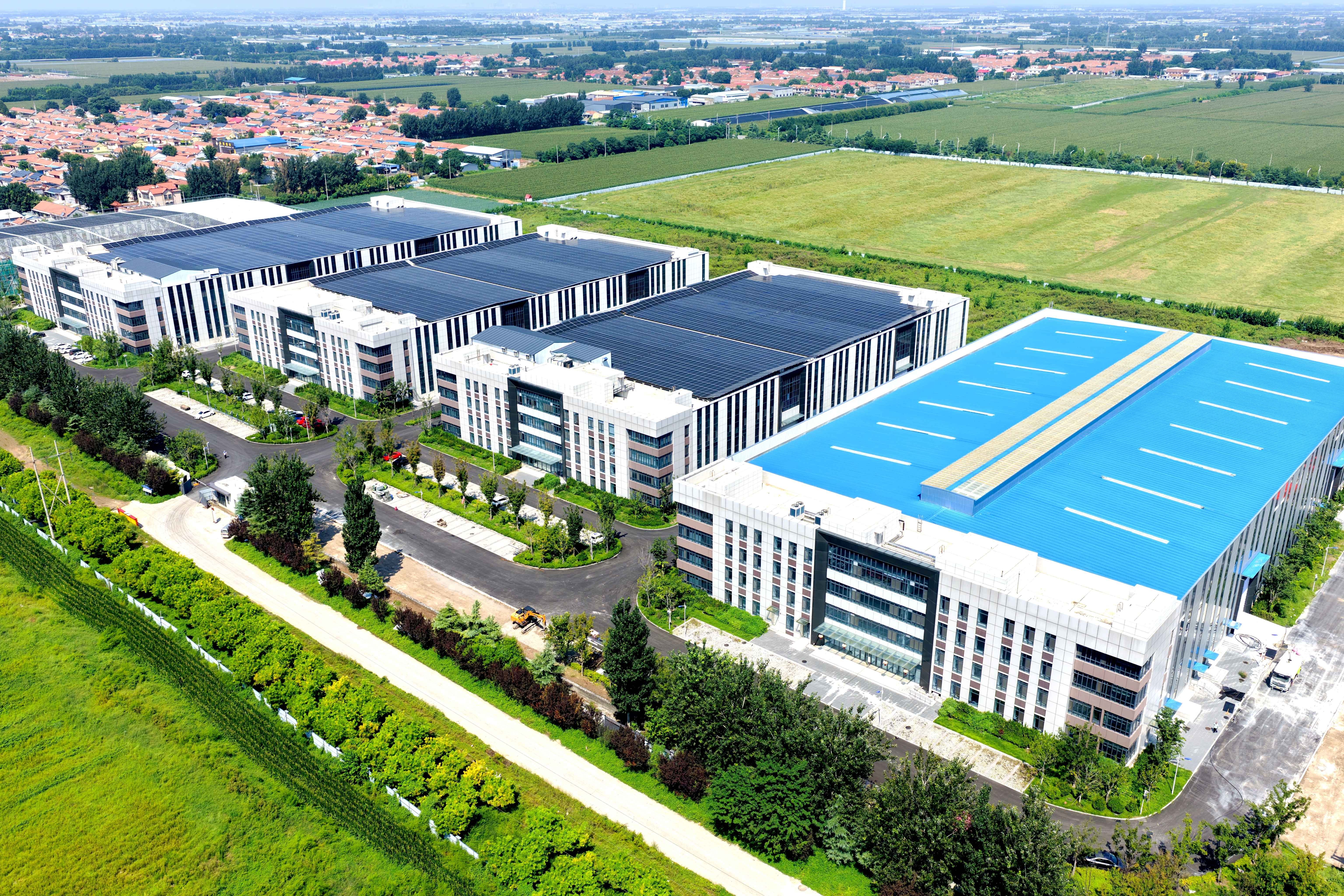
CHUAN HE manufacturing base in Weifang, China — PET and PP thermoformed packaging for bakery, produce, and frozen food applications.
Next step: test the material, not just the brochure
Request a sample of the bakery or tamper-evident container you are evaluating, or ask for a quotation based on your sizes, volumes, and destination market. Material documentation can be provided alongside the sample.
Email: chuanhe@newplasticbox.com | Tel: +86 134-5566-2777
WhatsApp: +86 134-5566-2777
Website: www.newplasticbox.com | Address: No. 2301 Industrial Third Street, Weicheng Economic Development Zone, Weifang City, Shandong Province, China
Have Questions or Need More Details?
Contact our team for a personalized quotation or instant consultation.
Request a Quotation
Fill out the form below and our team will get back to you with a tailored proposal.
WhatsApp Direct Chat
Prefer to chat in real-time? Message us on WhatsApp for instant assistance & quick answers.
- Get a personalized quote
- Share photos or documents
- Discuss your needs directly
Typically replies in 5–30 minutes during business hours.