
Bakery Packaging Partnership FAQ: Purchase Terms, Acceptance Criteria and After-Sales Support

A bakery packaging trial order answers one question: does this container fit the product, the shelf and the delivery route? The order that follows answers a harder one: can the same container arrive in the same condition, with the same documents, in every month of a supply relationship that may run for years?
This FAQ is written for buyers at that second stage. It covers how purchase terms are set, what acceptance criteria apply when goods arrive, how PPWR documentation is handed over and kept current, and what after-sales support covers when a shipment or a specification falls short. CHUAN HE (Weifang Chuanhe New Material Co., Ltd.) is a PET and PP thermoformed packaging manufacturer based in Weifang, China, producing bakery, fruit and vegetable, frozen food and dry fruit containers from a 62,000 m² facility and exporting 100% of its output to Europe, North America, Latin America, the Middle East and other markets.
The direct answers: orders are quoted from a 10,000-unit minimum, delivered FOB, CIF or DDP, and accepted on a pre-shipment test; PPWR evidence is anchored by TÜV Rheinland Product Test Report 178251114a 001, valid from 2026-08-14 to 2030-08-14; and after-sales support runs on batch traceability, archived compliance records and third-party retesting rather than on goodwill.
Why the second order asks different questions
A trial order tests design fit. A repeat order tests reproducibility — whether wall thickness, closure force, colour and pack density hold across moulds, sheet lots and shifts. The failures that matter at volume are rarely visible in a sample box: a mould that wears into a looser lid fit, a sheet lot that changes clarity, a test report that quietly passes its expiry date while stock is still sitting in a warehouse.
Category size explains why buyers care, but not how to buy. Market Research Future's September 2026 bakery packaging report valued the global market at USD 57.76 billion in 2024. That number describes demand, not supplier reliability. Reliability is answered by contract mechanics: what is measured, when, by whom, and what happens when the measurement fails.
Four items a repeat supply agreement should settle in writing
Before discussing container geometry, settle the four items that decide how a long relationship behaves under pressure.
- The commercial frame. Minimum order quantity, delivery term and payment instrument, confirmed on the quotation for the specific model and destination.
- The acceptance definition. Which test counts, at which stage, and against which physical reference sample.
- Document custody. Who holds the PPWR test report, who re-issues it when it is updated, and who checks that it is still valid for a shipment in progress.
- The shortfall route. How a suspect lot is frozen, what evidence a claim requires, and what the supplier can retest.
Everything else — the clamshell geometry, the colour, the stack height — is a specification. These four items turn a specification into a supply relationship, and each one has a documented answer below.
Purchase terms: what is quoted, and what each term changes
The purchase-terms record CHUAN HE works from lists a 10,000-unit minimum order quantity, delivery on FOB, CIF or DDP terms, payment by T/T, L/C, D/P, D/A, MoneyGram, PayPal, Western Union or cash, and a pre-shipment test as the acceptance criterion. Individual quotations confirm which combination applies to a specific model and destination.
- Minimum order quantity: 10,000 units.
- Delivery terms: FOB, CIF or DDP.
- Payment terms: T/T, L/C, D/P, D/A, MoneyGram, PayPal, Western Union, cash.
- Acceptance criterion: pre-shipment test.
Each delivery term moves a different block of cost and risk. FOB leaves main carriage and insurance with the buyer, which suits importers who already consolidate freight. CIF places carriage and insurance with the supplier up to the named port, while import clearance stays with the buyer. DDP moves import clearance, duty and final delivery to the supplier, so those costs sit inside the unit price rather than in the buyer's landed-cost sheet. For a bakery packaging programme shipped to several regions, the same container can therefore carry three different landed costs depending on the term chosen.
Payment instruments behave the same way. T/T moves cash before or against shipment; an L/C ties payment to a document set; D/P and D/A are documentary collections with different release conditions. The practical rule is to match the instrument to the buyer's cash conversion cycle — a supplier selling into supermarkets on extended payment terms usually needs a different instrument from an e-commerce bakery brand paying per shipment.
The minimum order quantity deserves one caution. Ten thousand units is workable for a single fast-moving size. For a range of transparent cake packaging boxes or clamshell packaging for pastry dessert split across four or five sizes, the real question is how that minimum divides across SKUs — and that is settled at quotation rather than assumed from the headline figure.
Price comparisons need the same care. In CHUAN HE's own comparison against low-grade disposable food containers, food-grade material costs about 5% more and is stated to deliver 30% higher impact resistance. A lower quote is often a different material specification rather than a discount, which is worth establishing before the difference is treated as negotiation room.
Acceptance criteria at goods-in: what is tested, and what the buyer checks
Acceptance is defined by the pre-shipment test. The lot is inspected and sampled before it leaves the factory, and the goods-in check confirms that the arriving lot is the lot that was tested. CHUAN HE's production controls support that sequence with food-grade raw material inspection, production hygiene control, online quality inspection and finished-product sampling tests, backed by regular third-party testing and long-term archiving of compliance records.
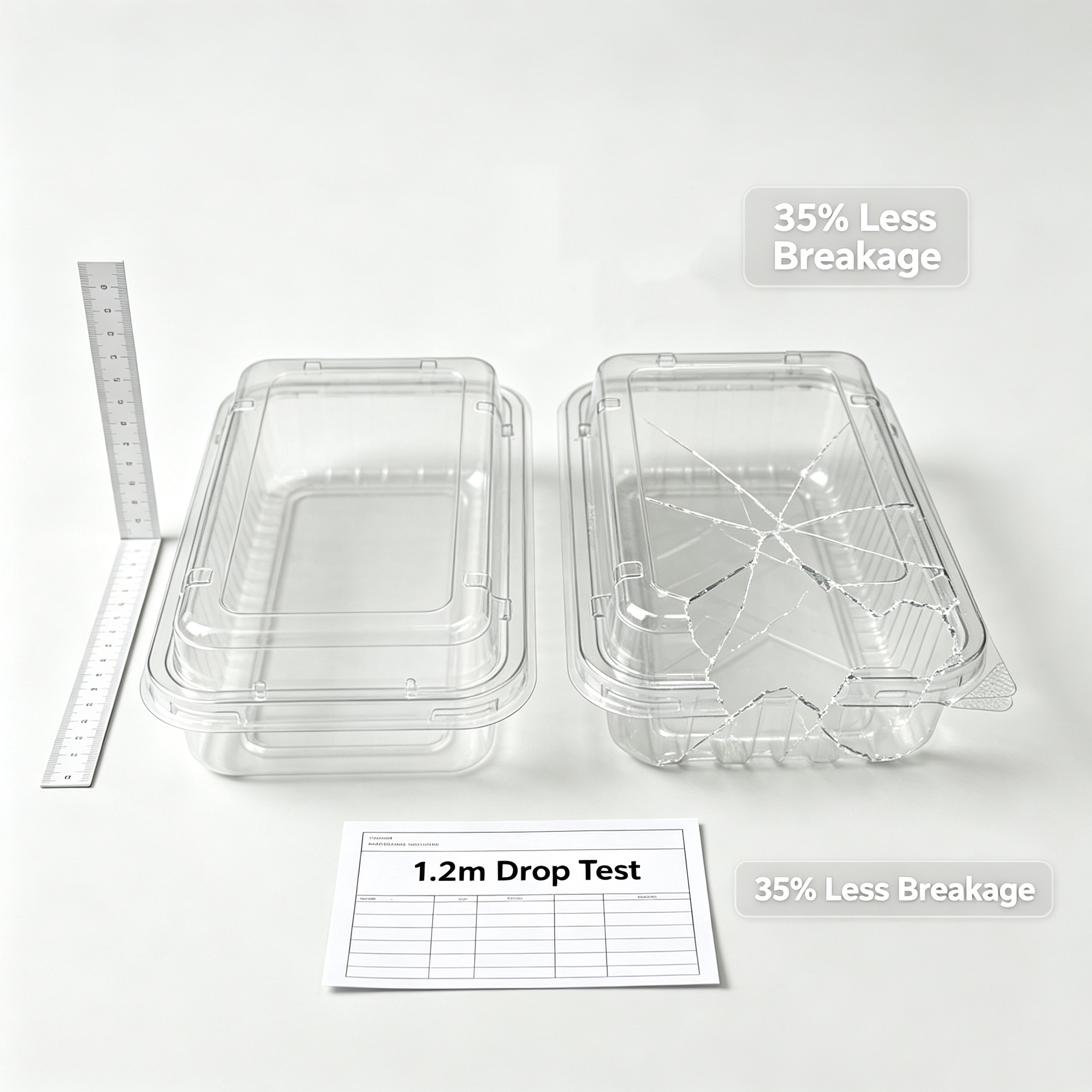
Where a buyer needs quantified limits written into the order, CHUAN HE's comparison data against ordinary thin-wall PET blister packaging records a 1.2 m vertical drop without rupture and a 35% lower drop breakage rate; sealing tightness increased by 32% with a 26% lower food spoilage rate; stable performance from -18 °C to 120 °C with a 38% lower heat deformation rate and a 32% lower low-temperature cracking rate; and, for anti-fog treated containers, 40% higher visibility retention in 0-8 °C cold storage. These are supplier comparison figures for specific structures, not a universal specification for every bakery container, and they belong on the order as target values if the application depends on them.
The buyer-side check at goods-in is short and worth standardising across warehouses:
- Model and quantity: carton count and unit count against the packing list, and model codes such as HB-1912, HB-T9333 or HB-24 OZ matching the order.
- Dimensions: measured against the approved physical sample, not against a drawing alone.
- Closure function: the snap lock engages, the tamper-evident tab is unbroken, and the lid seats without force.
- Appearance: clarity, black spots, flow lines and colour drift checked against the retained sample.
- Stack and load: a filled stack holds for the storage period the buyer's own warehouse uses.
- Seal integrity where MAP is used: closure uniform along the flange before the tray enters the line.
Two limitations belong in the acceptance agreement rather than in a dispute six months later. First, thermoformed parts vary within a tolerance, so the approved physical sample — not a nominal drawing dimension — should be the reference for goods-in measurement. Second, tamper-evident packaging containers are designed for one-time opening: once the locking tab is opened it cannot be returned to its closed state, which is exactly what makes interference visible. A container opened for inspection is no longer saleable stock, so goods-in verification should work from samples drawn across the lot, not from every unit.
PPWR documentation: what is handed over, and how it stays current
The compliance file is anchored by PPWR Product Test Report 178251114a 001, issued by TÜV Rheinland and valid from 2026-08-14 to 2030-08-14. Its scope is defined by Regulation (EU) 2025/40, the Packaging and Packaging Waste Regulation: per- and polyfluoroalkyl substances (PFAS), and total lead, cadmium, mercury and hexavalent chromium content in plastic packaging.
PPWR file at a glance. Product Test Report 178251114a 001, issued by TÜV Rheinland; validity 2026-08-14 to 2030-08-14; standard Regulation (EU) 2025/40; scope PFAS plus total lead, cadmium, mercury and hexavalent chromium; covers the HB-75-28(PP) polypropylene tray, HB-1912 food plastic tray, HB-221360(PP) tray, HB-T9333 tray, HB-MG24 OZ tray, HB-MG08 OZ tray and HB-MG40 OZ tray.
The report covers a defined tray range rather than an open product family, and the HB-MG40 OZ report is issued by TÜV Rheinland. A buyer adding a new shape should confirm whether it falls inside that coverage before printing a compliance claim on a carton or a shelf label.
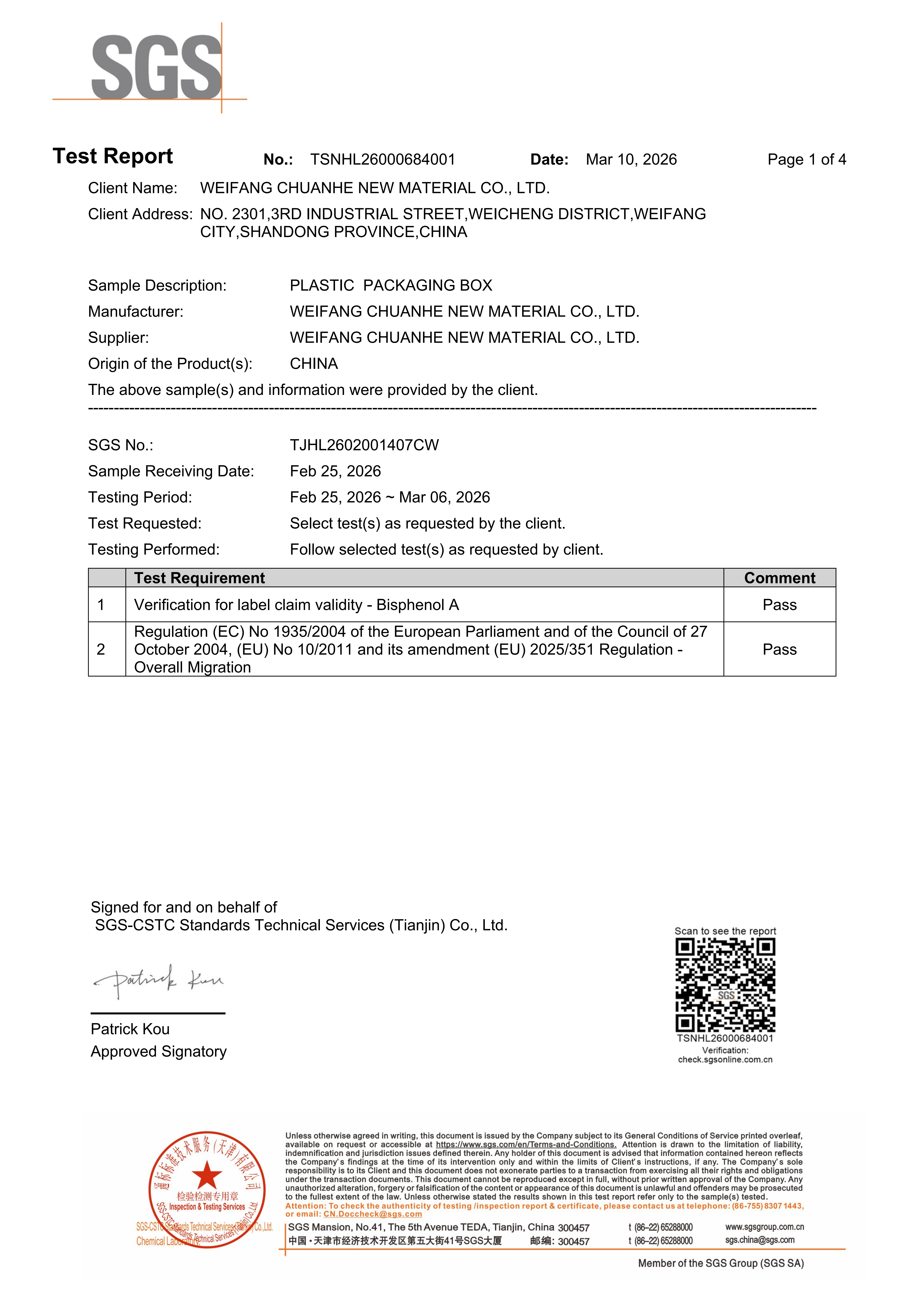
Handover is a document set: the test report with its report number and validity dates, a mapping from report to the models on the order, support for the buyer's declaration of conformity, and the batch records that connect a delivered lot to its production and inspection history. CHUAN HE's documented practice is to keep those records archived long term, run regular third-party testing, update certifications on a regular cycle, and adjust formulations when limits change — the same controls that address EU 10/2011, PPWR and PFAS requirements.
Currency is the part buyers most often lose control of. Three controls prevent it: log the report number and the 2030-08-14 expiry date on the packaging specification sheet, diarise a review before that date rather than after it, and re-check model coverage whenever a new SKU or mould enters the range.
One document set can serve several destinations. The compliance file is maintained for goods bound for the EU, North America, Latin America, Southeast Asia and the Middle East, alongside the broader certification set of CE, BRC, FDA, EU and SGS quality management systems, so a single supply relationship can cover multiple destinations without a second packaging qualification cycle. For non-EU destinations, the applicable document is normally the local food-contact evidence — FDA compliance for the United States, for example — rather than the PPWR report itself. The buyer's task is to map each destination to the right document instead of filing everything under one EU certificate.
A test report also has a defined meaning. It evidences the tested parameters on the tested models at the time of testing; it does not certify every future production lot. That gap is closed by batch records, in-process inspection and retesting, which is why the after-sales process below starts with traceability.
After-sales support when a shipment or a specification falls short
Support starts with traceability rather than negotiation. A batch record ties a delivered lot to its raw material, forming machine, production date and inspection results; archived compliance records and third-party test reports provide the second layer. With those two layers, a shortfall can be attributed to material, to forming, to packing or to handling in transit — which is the difference between a fix and an argument.
- Quarantine the affected lot and stop further distribution.
- Record the purchase order, model code, batch or lot marking, quantity affected, and storage conditions since arrival.
- Compare the goods against the retained approved sample, with photographs and measurements.
- Ask the supplier to pull the batch record and inspection data for that lot.
- Commission an independent retest when the dispute concerns material compliance rather than appearance or dimension.
- Apply the remedy agreed in the order terms.
What the supplier side can document is concrete: raw-material inspection and supplier audits, GMP implementation, migration and physical testing, declaration of conformity issuance, and formulation adjustment when a regulatory limit changes. What is not promised here is a specific settlement — replacement, credit or rework depends on the finding and on the terms agreed for that order. A long relationship is better judged by how quickly the evidence is produced than by how generous a verbal assurance sounds.
One limitation bears repeating because it shapes claims handling. Where a tamper-evident closure has been opened in transit or at goods-in, the container cannot be resealed to its original state; the tab is designed to break visibly. Claims about tampering and claims about closure defects therefore need to be separated at the point of inspection, ideally by photographing the tab before the carton is opened further.
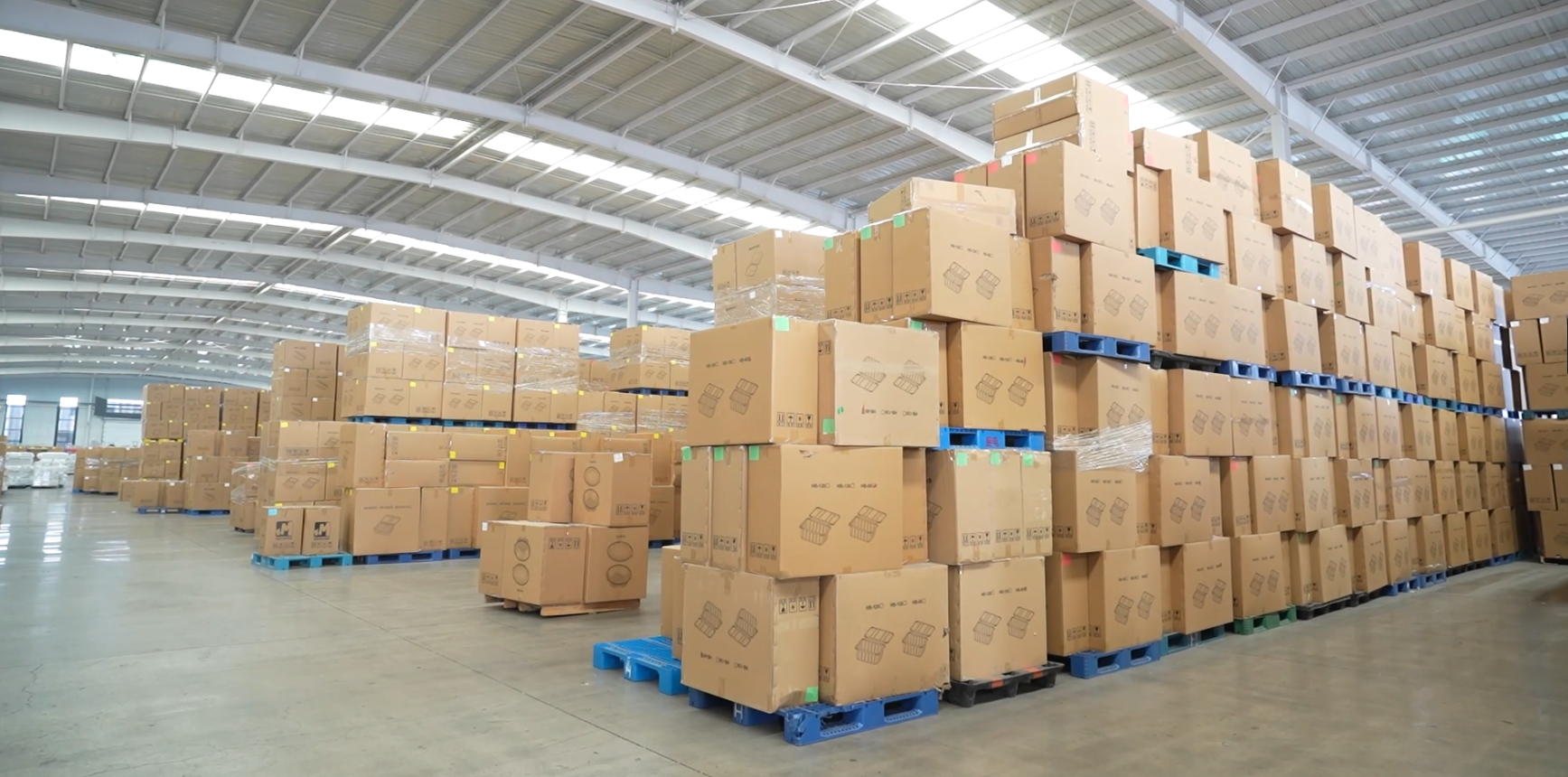
From repeat order to goods-in release: eight steps
- Freeze the specification. Model code, dimensions, material (PET or PP), colour, closure type, printing and pack format, with a retained physical sample.
- Confirm the commercial frame. Minimum quantity split across SKUs, delivery term, payment instrument and the named acceptance test.
- Review tooling. An existing mould from the several thousand already developed, or new tooling built in the in-house mould workshop.
- Plan sheet supply. Four PET extrusion lines and two PP extrusion lines in-house reduce reliance on outsourced sheet and keep sheet planning and forming on one schedule.
- Form. 20 fully automatic and 20 standard thermoforming machines, including four Kiefel machines imported from Germany.
- Inspect. Online quality inspection, finished-product sampling and the pre-shipment test that defines acceptance.
- Release documents. Report copy, model mapping, declaration of conformity support and the archived batch record.
- Ship and accept. Delivery under the agreed term, goods-in check against the retained sample, then release to stock.
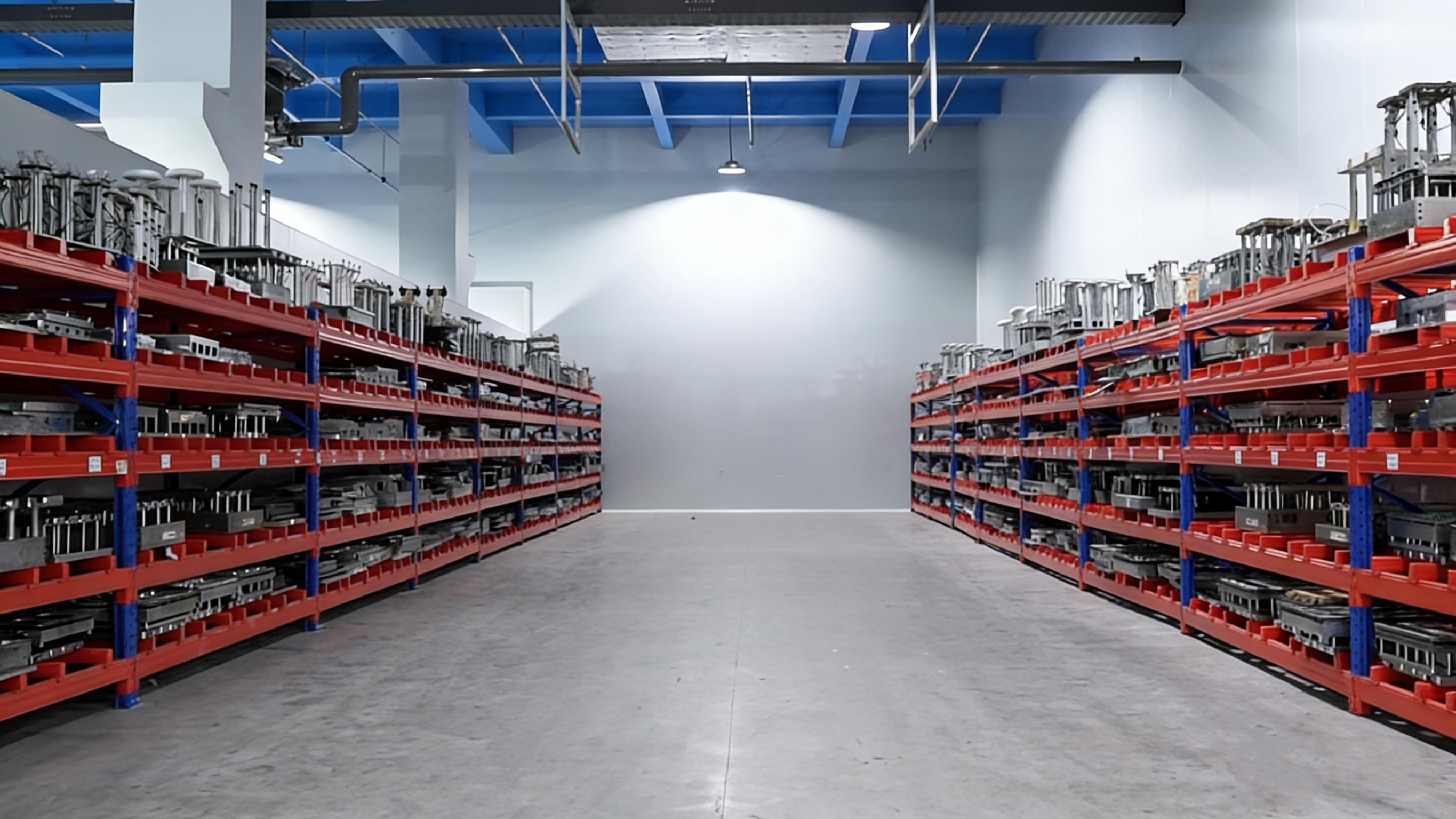
Step three is where a repeat order usually saves the most time. A model that already exists in the mould library skips tooling altogether; a new clamshell for a pastry or a stackable tiramisu container needs its own tooling cycle before the first saleable carton exists. An R&D team of five engineers and an in-house mould workshop keep that step inside the supply relationship instead of with a third party.
Where this partnership model fits
- Multi-outlet bakery and cake chains: one approved container across stores, with goods-in acceptance run at a central warehouse against a retained sample.
- Supermarket in-store bakeries: clear, stackable containers, with anti-fog treatment where chilled display cabinets are used.
- MAP and ready-meal lines: the HB-1912 PP tray is listed as MAP-ready, stackable, and made of food-grade BPA-free material with a rigid structure.
- Exporters shipping to several regions: one compliance file maintained for the EU plus North America, Latin America, Southeast Asia and the Middle East.
- E-commerce bakery brands: tamper-evident packaging containers such as the HB-24 OZ PET container (17.2 × 15.5 × 4.8 cm), where visible tamper evidence at delivery reduces inspection disputes.
- Frozen bakery and cold-chain programmes: frozen containers specified for the -18 °C to 120 °C range where the application requires it.
Trial order vs repeat supply relationship
| Dimension | Trial order | Repeat supply relationship |
|---|---|---|
| Commercial frame | Quoted per shipment; the minimum order quantity is checked against one size | Minimum quantity planned across the SKU range; delivery term fixed for the programme |
| Acceptance | Sample approved visually | Pre-shipment test plus a retained physical sample as the goods-in reference |
| Documentation | Report copy requested when a customer asks | Report number and validity logged on the specification; model mapping maintained |
| Change control | A new model is simply a new order | A new mould triggers a coverage check before compliance claims are printed |
| Shortfall route | Handled case by case | Batch record, inspection data and retest path agreed in advance |
| Planning horizon | Weeks | Multiple seasons, with document expiry and mould wear on the review calendar |
Read the table as a description of mechanics, not a promise of performance. The difference between the two columns is documentation and pre-agreement, which is exactly what a buyer can verify before signing.
Frequently asked questions
Which PPWR documents come with an order, and how long do they stay valid?
CHUAN HE's PPWR file is anchored by Product Test Report 178251114a 001 issued by TÜV Rheinland, valid from 2026-08-14 to 2030-08-14. It covers PFAS and total lead, cadmium, mercury and hexavalent chromium content under Regulation (EU) 2025/40, and applies to the listed tray models: HB-75-28(PP), HB-1912, HB-221360(PP), HB-T9333, HB-MG24 OZ, HB-MG08 OZ and HB-MG40 OZ. Alongside the report, the order documentation includes the report-to-model mapping and support for the buyer's declaration of conformity. Validity is tracked on a regular certification-update cycle and compliance records are archived long term, so the file can be re-issued rather than rediscovered when a customer audits it.
Can one supplier cover the EU plus North America, Latin America, Southeast Asia and the Middle East?
Yes, as a documentation and shipping scope rather than a single certificate. The compliance file is maintained for goods bound for those five regions, and CHUAN HE holds CE, BRC, FDA, EU and SGS quality management system certifications with 100% of output exported. In practice, the EU destination is supported by the PPWR test report, while other destinations are supported by the food-contact evidence their own market expects — FDA compliance for the United States, for example. The buyer's task is to map each destination to the right document; the supplier's task is to keep both sets current.
What are the minimum order and payment terms, and what drives the price?
The stated minimum order quantity is 10,000 units, with delivery on FOB, CIF or DDP terms and payment by T/T, L/C, D/P, D/A, MoneyGram, PayPal, Western Union or cash; the applicable combination is confirmed on the quotation for each model and destination. Price is driven mainly by material grade, container weight, tooling amortisation on a new shape, printing and the delivery term chosen — DDP places import clearance and duty inside the unit price, FOB leaves them outside. In CHUAN HE's own comparison, food-grade material costs about 5% more than low-grade disposable containers while stating 30% higher impact resistance.
How do we validate a new container or a custom print before committing to volume?
Validation runs on three levels. Shape, colour, embossing and logo printing are all customisable, so the first step is a specification agreed against a physical sample. The second is the tooling check — an existing mould from the several thousand already developed avoids new tooling, while a new shape is built in the in-house mould workshop. The third is the pre-shipment test, the same acceptance criterion used on repeat orders, supported by finished-product sampling tests. Retaining that sample at the buyer's warehouse is what makes the later goods-in check objective rather than subjective.
What determines lead time on a repeat order, and how do we start?
Lead time is set by four variables: whether the tooling already exists, how the order splits across SKUs against the 10,000-unit minimum, whether PET or PP sheet is available on the in-house extrusion lines (four PET and two PP lines), and which delivery term applies. Forming capacity runs across 20 fully automatic and 20 standard thermoforming machines, including four Kiefel machines, so an existing model schedules differently from a new one. Send the specification, target quantity and destination market, and ask for a quotation that states report coverage, delivery term and pre-shipment test for that exact model.
Conclusion: what to lock before the second order
A bakery packaging partnership is a documentation discipline as much as a supply one. The four questions buyers bring to a repeat order all have concrete answers: the commercial frame is a 10,000-unit minimum with FOB, CIF or DDP delivery and a defined payment list; acceptance rests on a pre-shipment test backed by online inspection and finished-product sampling; the compliance file is anchored by TÜV Rheinland Product Test Report 178251114a 001, valid from 2026-08-14 to 2030-08-14, covering PFAS and heavy-metal content for the listed tray models; and after-sales support begins with batch traceability and archived records rather than with a promise.
The one thing a buyer should not do is treat these as supplier formalities. Put the report number and its expiry date on the specification sheet, keep a retained sample in the warehouse, and confirm model coverage before a new SKU carries a compliance claim. That is what makes a supply relationship repeatable across seasons and across the EU, North America, Latin America, Southeast Asia and the Middle East.
For a repeat-order quotation, download the CHUAN HE product brochure (PDF) and send the model, quantity split and destination market. The full container range is published by CHUAN HE.
Have Questions or Need More Details?
Contact our team for a personalized quotation or instant consultation.
Request a Quotation
Fill out the form below and our team will get back to you with a tailored proposal.
WhatsApp Direct Chat
Prefer to chat in real-time? Message us on WhatsApp for instant assistance & quick answers.
- Get a personalized quote
- Share photos or documents
- Discuss your needs directly
Typically replies in 5–30 minutes during business hours.