
Cake & Bakery Packaging vs Tamper Evident: PPWR Export Call
Cake & Bakery Packaging vs Tamper Evident: PPWR Export Call
Choosing between Cake & Bakery Packaging and Tamper Evident Packaging is not a question of which range is better. It is a question of which format matches the route the product takes after it leaves the bakery.
The short answer: when the pack has to sell from a shelf — in-store bakery, supermarket display, click-and-collect — the clear bakery clamshell with its snap-lock closure does more commercial work, because visibility drives the purchase. When the pack has to survive a courier journey, a wholesale hand-off or an export carton where any sign of opening becomes a claim, the tamper evident range is the correct default, because visible opening evidence protects both the product and the delivery record.
Compliance is not the tie-breaker in this decision. Both sides can be documented with a single file: the TÜV Rheinland PPWR Product Test Report 178251114a 001, valid from 2026-08-14 to 2030-08-14, which covers bakery models HB-SP1510, HB-5209 and HB-1966 alongside tamper evident models HB-16OZ, HB-8OZ, HB-24 OZ, HB-32 OZ and HB001-55. Because that baseline is shared, the choice has to be settled on product behaviour, handling path and shelf mechanics rather than on paperwork.
Why This Choice Is Harder Than It Looks
The two ranges come from the same manufacturer, Weifang Chuanhe New Material Co., Ltd. (brand: CHUAN HE), a PET and PP thermoformed packaging producer based in Weifang, Shandong, China, exporting to North America, Europe, the Middle East, Southeast Asia and Latin America. Both ranges are food-grade PET. Both list cakes, sweets and bakery items among their applications. Both support custom size, colour and logo work. On a catalogue page, the lines look interchangeable.
They are not. The decision usually goes wrong in one of three ways:
- Security bought for a shelf product. A tamper evident container placed in a self-service display adds a handling step and gives up some of the immediate visual pull that a clear, snap-lock bakery clamshell creates.
- Visibility bought for a courier channel. A bakery clamshell on an e-commerce dessert route is exposed to multi-hand handling where nobody can prove whether the pack was opened before delivery.
- Compliance assumed rather than mapped. A test report covers the models it names. A buyer who switches from a covered model to an uncovered one inherits a documentation gap, even though the supplier relationship has not changed.
Most export bakery programmes are not a single-format business anyway. A supermarket supplier usually needs a display format for the shelf and a protected format for the route between the factory and the store.
What Is Changing in the Export Market
The global bakery packaging market was valued at USD 57.76 billion in 2024, according to Market Research Future's 2026 market report. Within that market, a 2026 industry projection places the bakery tamper-evident segment at USD 4.26 billion by 2030, growing at a CAGR of 10.72% over 2025–2030.
Two pressures sit behind those numbers, and they pull in opposite directions. The first is shelf competition: transparent rigid packaging lets a decorated cake, a tiramisu cup or a mochi donut be inspected before purchase, which is why clear clamshells remain the default for retail display. The second is delivery accountability: as bakery sales move into e-commerce, catering and cross-border wholesale, the pack increasingly has to document that it reached the buyer intact.
Regulatory expectations have moved at the same time. Buyers now ask for test evidence on migration, PFAS, SVHC and heavy metals rather than a general statement that a material is food grade. That is why a single PPWR test report covering several regions has commercial value: it lets a buyer ship to more than one destination without collecting a separate document set for each market.
The Shared Baseline: TÜV Rheinland Report 178251114a 001
CHUAN HE holds the TÜV Rheinland PPWR Product Test Report 178251114a 001, valid from 2026-08-14 to 2030-08-14. The report is the common compliance baseline for both formats discussed here, which is precisely why the format decision cannot be outsourced to the compliance file.
Product coverage. The report names two groups of models:
- Cake & Bakery Packaging: HB-SP1510 (16 × 16 × 6.7 cm), HB-5209 (21.5 × 21.5 × 15.3 cm) and HB-1966.
- Tamper Evident Packaging: HB-16OZ, HB-8OZ, HB-24 OZ (17.2 × 15.5 × 4.8 cm), HB-32 OZ and HB001-55.
Test scope. The report addresses global migration, specific migration of metals, SVHC screening, PFAS and heavy metals — the five points buyers most often raise in a packaging questionnaire.
Market scope. The PPWR certification applies to the EU market, the North America market, the Latin America market, the Southeast Asia market and the Middle East market. A buyer shipping to several of those regions can reference one document rather than five.
Decision rule that follows from the scope: the report does not decide between the formats, but it does decide which SKUs you can quote with confidence. If a buyer's preferred model is not in the list above, the format question is not settled yet, because the documentation question is still open.
Separately from the PPWR report, CHUAN HE holds CE, BRC, FDA, EU and SGS quality management system certifications. Those cover the supplier and its systems; the PPWR report covers the named products. Buyers usually need both, and they are not substitutes for one another.
Cake & Bakery Packaging: Where Visibility Carries the Sale
The bakery range is built around display. The body is crystal-clear PET, so the product — not the pack — is what the shopper evaluates. The material is food-grade and BPA-free for direct contact with cakes, pastries and desserts, and the plastic is shatter-resistant, which lowers breakage risk during transport.
Mechanically, the range uses a snap-lock closure that keeps dust out and limits drying, rounded edges that avoid scratching cream and decorated surfaces, and a stackable design that saves shelf and warehouse space. Standard sizes cover donuts, cupcakes, sliced cakes, cookies and Swiss rolls, with custom size, colour and logo printing available for brand owners.
The range is wide enough that the format decision is usually made inside it rather than against it. Documented dimensions include 11.7 × 11.2 × 7.6 cm (HB-5115), 16.2 × 16.2 × 5 cm (HB-5295), 16 × 16 × 6.7 cm (HB-SP1510), 17.4 × 17.4 × 9.8 cm (HB-5211), 18.3 × 12.3 × 5.6 cm (HB-1022) and 23.5 × 22.5 × 8.3 cm (HB-1007), with HB-5209 at 21.5 × 21.5 × 15.3 cm for taller builds.

Where it wins. Self-service bakery counters, supermarket display cases, patisserie retail where decoration is the selling point, gift and seasonal ranges, and click-and-collect orders that are packed in front of the customer. The stackable design also matters operationally: it converts vertical space in the display and in the warehouse into usable capacity.
Where it stops. The bakery range is a display format. It is not designated tamper evident. If a channel requires visible proof that the pack has not been opened — courier delivery to a consumer, a wholesale hand-off between two businesses, a catering drop-off — the snap-lock closure alone does not deliver that proof.
Tamper Evident Packaging: Where Integrity Carries the Delivery
The tamper evident range is the delivery-side counterpart. It is PET with high transparency, so the buyer does not lose sight of the product, and it is produced in rectangle, square and round shapes with custom colour and size options under ODM/OEM service. Documented dimensions include 15.4 × 15.4 × 6.1 cm (HB5298), 19 × 15.7 × 6.3 cm (HB006-6102), 19 × 15.7 × 7.5 cm (HB005-7402) and 17.2 × 15.5 × 4.8 cm (HB-24 OZ), with HB-16OZ, HB-8OZ, HB-32 OZ and HB001-55 completing the PPWR-covered set.
Where it wins. E-commerce dessert shipping, wholesale and distributor hand-offs, catering and event delivery, and export cartons where the party who packs and the party who opens are different businesses. In each of those routes the question at the point of receipt is not “does this look appetising” but “has this been opened”, and a tamper evident format answers that question before the product is inspected.
Where it stops. The commercial argument for the format is integrity, not display theatre. If the pack is opened by staff behind a counter and handed to a shopper, the evident feature adds a step without adding protection. In the United States, tamper-evident packaging compliance discussions are framed around FDA regulations and FSMA; the practical requirement for a buyer is that the evidence feature is verifiable at the point of receipt, which is a question for the sample, not for the catalogue.

Two points should be verified on a physical sample before a purchase order is raised: the exact evidence feature and how it behaves after a courier cycle, and whether the SKU stacks in your own racking. Stackability is documented for the bakery clamshell range; for tamper evident SKUs it should be confirmed against your shelf or pallet configuration rather than assumed.
Head-to-Head Comparison Table
| Decision criterion | Cake & Bakery Packaging | Tamper Evident Packaging |
|---|---|---|
| Primary job | Display and protect decorated bakery items on a shelf | Signal whether the pack has been opened during delivery or hand-off |
| Product visibility | Crystal-clear PET body, built to maximise product display | High-transparency PET body |
| Closure and protection | Snap-lock closure, dust-proof, limits drying out; shatter-resistant plastic | Tamper evident format; evidence feature to be confirmed on sample |
| Stackability | Stackable design, saves shelf and warehouse space | Confirm against your racking and pallet layout |
| Material | Food-grade, BPA-free PET | PET |
| Models named in PPWR report 178251114a 001 | HB-SP1510, HB-5209, HB-1966 | HB-16OZ, HB-8OZ, HB-24 OZ, HB-32 OZ, HB001-55 |
| Documented sizes (examples) | 11.7×11.2×7.6 cm (HB-5115); 16×16×6.7 cm (HB-SP1510); 21.5×21.5×15.3 cm (HB-5209); 23.5×22.5×8.3 cm (HB-1007) | 15.4×15.4×6.1 cm (HB5298); 17.2×15.5×4.8 cm (HB-24 OZ); 19×15.7×6.3 cm (HB006-6102); 19×15.7×7.5 cm (HB005-7402) |
| Customisation | Custom size, colour and logo printing | Custom colours and sizes; rectangle, square and round shapes under ODM/OEM |
| Best-fit channel | In-store bakery, supermarket display, patisserie retail, click-and-collect | E-commerce dessert delivery, wholesale hand-off, catering and event delivery, export cartons |
| Weakest fit | Routes that require visible opening evidence | Counter service where staff open the pack before the shopper receives it |
Step-by-Step: Choosing Between the Two Ranges
Step 1 — Map the handling path
Count the hands between filling and opening. One hand (bakery staff to shopper) points to the bakery range. Two or more hands — packer, courier, retailer, consumer — points to the tamper evident range. This single question resolves most of the decision before packaging cost is discussed.
Step 2 — Classify each SKU by what sells it
If the purchase is driven by the look of the product through the pack, the bakery format is doing commercial work that the tamper evident format cannot fully replace. If the purchase is driven by confidence that the delivery arrived sealed, the reverse applies. Most catalogues contain both types.
Step 3 — Match the model to the PPWR coverage list
Check the specific model against the report. Bakery models HB-SP1510, HB-5209 and HB-1966 are covered, as are tamper evident models HB-16OZ, HB-8OZ, HB-24 OZ, HB-32 OZ and HB001-55, for the EU, North America, Latin America, Southeast Asia and Middle East markets. A model outside that list needs separate documentation before it appears on an export quotation.
Step 4 — Check the dimensional fit against the product
Work from the documented dimensions rather than from photos: 16.2 × 16.2 × 5 cm (HB-5295) for a low, wide pastry; 17.4 × 17.4 × 9.8 cm (HB-5211) or 21.5 × 21.5 × 15.3 cm (HB-5209) for taller builds; 11.7 × 11.2 × 7.6 cm (HB-5115) for single-serve items; 17.2 × 15.5 × 4.8 cm (HB-24 OZ) for a shallow tamper evident format. Rounded edges on the bakery range protect cream and decoration, which matters more on finished desserts than on dry baked goods.
Step 5 — Confirm the supply parameters
Order minimum is 10,000 pcs, lead time is 30–45 days, and every order is subject to 100% test. Customisation covers logo, size and colour. Buyers planning a dual-format catalogue should combine the two ranges on one production plan rather than running separate suppliers, since both come from the same plant.
Step 6 — Validate on a sample before committing
Test the closure on the bakery clamshell and the evidence feature on the tamper evident container, then run both through the actual transit configuration. The format decision should be confirmed by physical handling, not by the specification sheet.
Use Cases: Five Export Scenarios
Scenario 1 — Supermarket bakery display
A supermarket supplier needs the shopper to see the product and pick it up without staff assistance. The bakery range with its snap-lock closure and stackable body is the working format; visibility is the growth lever, and the stackable design protects both display space and warehouse space.
Scenario 2 — E-commerce dessert shipping
A bakery ships tiramisu, mousse or decorated slices directly to consumers. The route includes a courier and ends with an unboxing that the bakery does not control. The tamper evident format gives the recipient a way to check the pack before eating, which is the point of the format.
Scenario 3 — Wholesale and distributor hand-off
Bakery products moving between businesses pass through loading bays and third-party vehicles. A tamper evident container supports that hand-off; the bakery clamshell is better used at the far end, for the display step once the goods arrive.
Scenario 4 — Catering, events and ready-to-eat service
Catering and event delivery combine transport with an opened-in-public moment. Shallow tamper evident formats such as HB-24 OZ at 17.2 × 15.5 × 4.8 cm suit plated-style desserts and ready-to-eat items, where the recipient needs to see that the pack arrived intact.
Scenario 5 — A dual-format brand catalogue
Many bakery brands run a retail line in clear clamshells and a delivery line in tamper evident containers. Sourcing both from one manufacturer under one PPWR report reduces the documentation set per shipment and keeps colour, material and print consistency across the range.

Factory and Supply Evidence Behind Both Formats
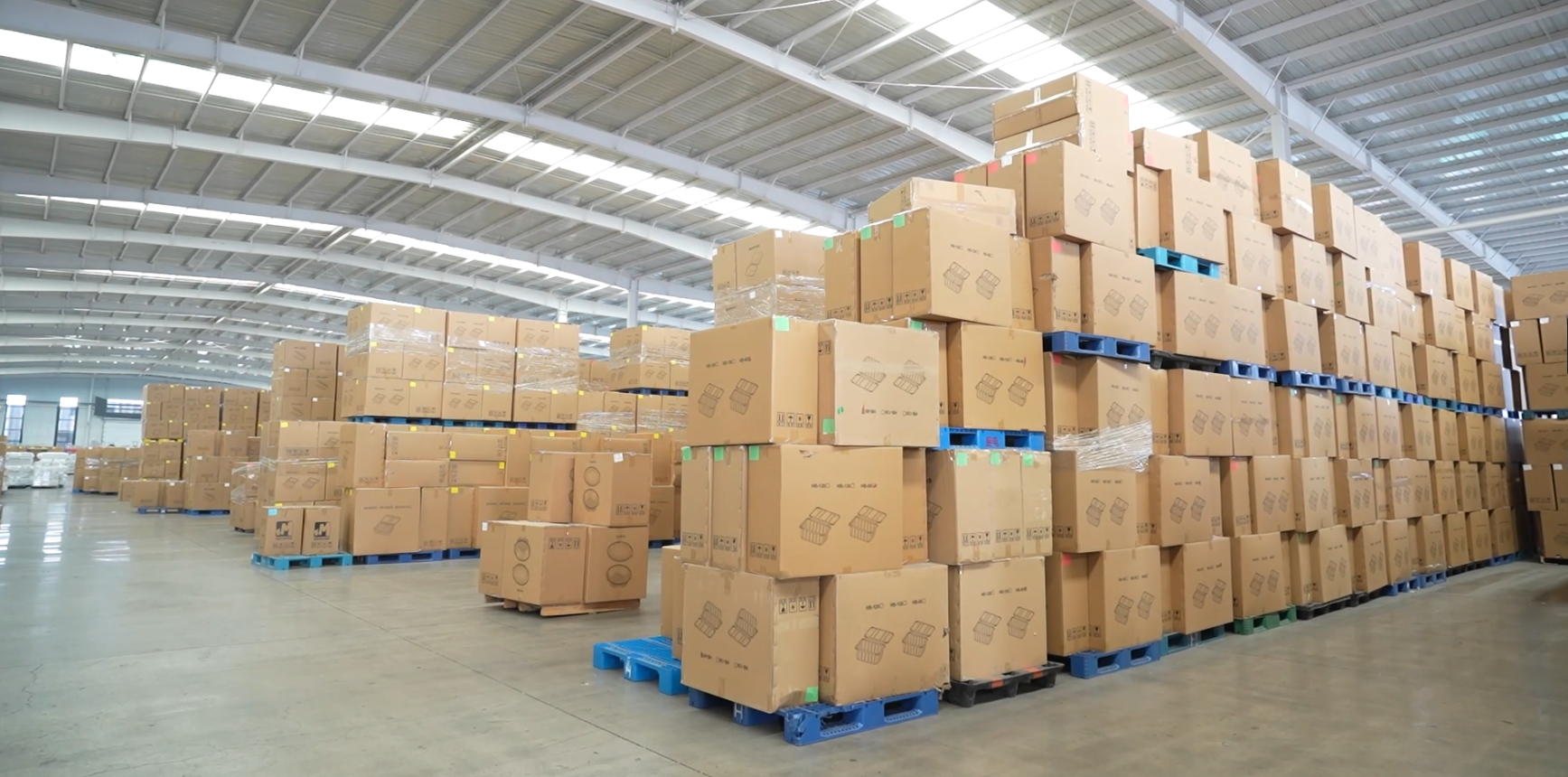
Both ranges are produced by CHUAN HE at a 62,000 m² facility in Weifang, Shandong, China, adjacent to Qingdao Port. The plant runs 40 thermoforming machines — 20 fully automatic and 20 standard, including 4 Kiefel machines imported from Germany — supported by 4 PET sheet extrusion lines, 2 PP sheet extrusion lines and an in-house mould workshop. Annual output is 54,000 ton, with monthly capacity of 4,500 ton.
The export record supports a dual-format supply model. A European client in the bakery, cake and dessert segment has ordered 350,000 pcs per month for over 7 years against EU standard requirements, with stackable design and custom printing support cited as the working features. A Latin American customer group orders 250,000 pcs per month over more than 6 years, a Southeast Asian group orders 500,000 pcs per month over more than 12 years, and a US importer and food retail distributor has ordered 120,000 pcs per month for over 3 years with FDA food contact standard qualification and on-time delivery.

FAQ
Which products are covered by TÜV Rheinland PPWR Product Test Report 178251114a 001?
The report covers two groups. The bakery group is HB-SP1510 (16 × 16 × 6.7 cm), HB-5209 (21.5 × 21.5 × 15.3 cm) and HB-1966. The tamper evident group is HB-16OZ, HB-8OZ, HB-24 OZ (17.2 × 15.5 × 4.8 cm), HB-32 OZ and HB001-55. It is valid from 2026-08-14 to 2030-08-14. A model that is not named in the report is not covered by it, so the coverage list should be checked SKU by SKU before an export quotation is issued.
Which export markets does the PPWR documentation cover?
The PPWR certification applies to the EU market, the North America market, the Latin America market, the Southeast Asia market and the Middle East market. That matches CHUAN HE's stated export markets of North America, Europe, the Middle East, Southeast Asia and Latin America. A buyer shipping to more than one of those regions can reference the same report instead of assembling a separate document set for each destination.
Can CHUAN HE supply FDA food-grade tamper evident containers for pastry and desserts with custom branding?
Yes. Tamper evident containers are made in PET with high transparency and are available in rectangle, square and round shapes, with custom colours and sizes under ODM/OEM service. CHUAN HE holds CE, BRC, FDA, EU and SGS quality management system certifications, and a US importer and food retail distributor project using food plastic containers has achieved FDA food contact standard qualification with stable supply and on-time delivery. Branding options cover logo printing, size and colour customisation under the same manufacturing programme as the bakery range.
What MOQ and lead time apply to a combined bakery and tamper evident order?
Minimum order quantity is 10,000 pcs and lead time is 30–45 days, with 100% test on production. Monthly capacity is 4,500 ton, so a dual-format order can be scheduled on one plan rather than split across suppliers. Unit cost is driven by model, dimensions, customisation scope and order volume rather than by the format label, which is why the format decision should be made on handling requirements first and volume second.
How should a buyer validate samples before committing to a format?
Test four things on the physical sample: the closure behaviour on the bakery clamshell, the evidence feature on the tamper evident container after a real courier cycle, the dimensional fit against the actual product including decoration height, and the stack behaviour in your own racking. Confirm that the sampled model appears on the PPWR coverage list. Sample requests, model selection and the full container range can be discussed through CHUAN HE or by email at chuanhe@newplasticbox.com.
Conclusion
The head-to-head resolves cleanly once the handling path is stated. Cake & Bakery Packaging wins wherever the pack has to sell the product — clear PET body, snap-lock closure, stackable design, and documented models such as HB-SP1510, HB-5209 and HB-1966. Tamper Evident Packaging wins wherever the pack has to prove it arrived unopened — HB-16OZ, HB-8OZ, HB-24 OZ, HB-32 OZ and HB001-55, all with high-transparency PET bodies and ODM/OEM customisation.
Because both sit under the same TÜV Rheinland PPWR Product Test Report 178251114a 001, valid to 2030-08-14 and applicable to the EU, North America, Latin America, Southeast Asia and Middle East markets, the compliance argument does not force a choice between them. That is the practical advantage for exporters: one supplier, one report, two formats, allocated by route instead of by preference.
Next step. Request a sample set covering one bakery clamshell and one tamper evident container, and compare the closure, the evidence feature and the stacking behaviour against your own transit configuration. The full container range and specifications are in the CHUAN HE product brochure, and the team can be reached at newplasticbox.com, by email at chuanhe@newplasticbox.com, or on WhatsApp at +86 134-5566-2777.
Have Questions or Need More Details?
Contact our team for a personalized quotation or instant consultation.
Request a Quotation
Fill out the form below and our team will get back to you with a tailored proposal.
WhatsApp Direct Chat
Prefer to chat in real-time? Message us on WhatsApp for instant assistance & quick answers.
- Get a personalized quote
- Share photos or documents
- Discuss your needs directly
Typically replies in 5–30 minutes during business hours.