
Custom PET & PP Fruit Vegetable Containers: OEM Packaging Capability Guide
Custom PET & PP Fruit Vegetable Containers: A Practical OEM Packaging Capability Guide
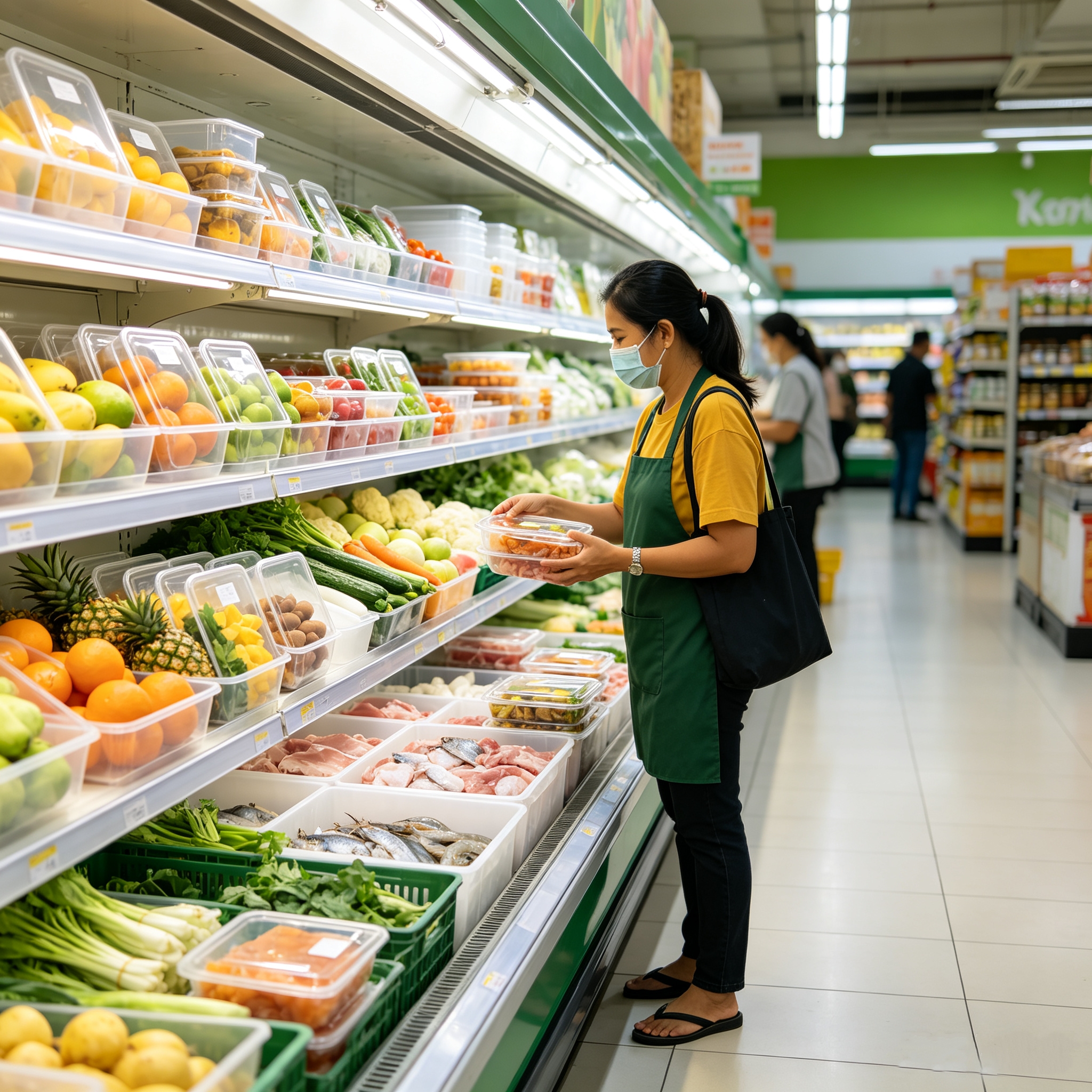
Custom PET fruit and vegetable containers designed for farm harvest, cold chain, and supermarket retail display.
Buyers looking for custom fruit & vegetable packaging often reach the same point: the standard catalog is not enough. They need a specific size for cherry tomatoes, a vented lid for berries, a container that works in a refrigerated display cabinet, or a tray with their own logo. That is when the question becomes less about “which container” and more about “which manufacturer can build it.” This guide explains what OEM capability actually means for transparent PET produce packaging, how to evaluate a thermoforming supplier, and what you should verify before placing a custom order.
What Is OEM Capability in Fruit & Vegetable Packaging?
OEM capability is the ability of a packaging manufacturer to produce containers according to the buyer’s specification rather than only supplying stock products. In the context of fresh produce packaging, this usually involves custom size, custom color, custom logo printing, and sometimes structural changes such as vent holes, stacking features, or tamper-evident closures.
Not all packaging suppliers offer the same level of customization. A true OEM partner should be able to manage mold development, material selection, sheet extrusion, thermoforming, and quality testing under one roof. That integration matters because it shortens lead times and reduces the risk of miscommunication between separate suppliers.
One practical example: Weifang Chuanhe New Material Co., Ltd., based in Weifang, China, specializes in the innovative design and customized production of PET and PP thermoformed packaging containers. Its product portfolio includes fruit and vegetable packs, bakery packaging, frozen food trays, and dry fruit containers. The company operates an in-house mold workshop and runs 4 PET sheet extrusion lines and 2 PP sheet extrusion lines. That means the raw sheet and the mold are controlled in the same facility, which supports coordinated production and faster delivery.
Why OEM Matters for Fresh Produce Retailers, Wholesalers, and Exporters
Fresh produce packaging has to satisfy several requirements at the same time: visibility for retail appeal, airflow for product freshness, food-contact safety, stackability for logistics, and often a size that fits a specific pack weight or berry count. A stock container may solve some of these but not all.
Custom packaging becomes valuable when you need to standardize a pack size across multiple farms, when a supermarket chain requests a private-label design, or when export markets require containers that can survive cold chains and maintain clarity without fogging.
For a produce wholesaler, custom PET clamshells can improve shelf presentation and reduce damage during transport. For a food processing plant, a tray with the correct depth and material can improve line efficiency. For a packaging wholesaler, OEM capability can differentiate the product range from generic imported containers.
OEM also matters commercially. If a supplier controls sheet extrusion, thermoforming, and mold making, buyers can often get better lead times and more consistent quality than working with a trading company that outsources every production step.
What a Serious OEM Fresh Produce Packaging Manufacturer Must Offer
When you evaluate a supplier for custom PET or PP fruit and vegetable containers, look for these capabilities:
1. In-House Mold Development
Custom size and shape start with the mold. A manufacturer with an in-house mold workshop can develop and adjust tooling more efficiently. Weifang Chuanhe, for example, has experience developing thousands of molds and supports customized design with a professional R&D team.
2. Sheet Extrusion and Thermoforming Under One Roof
PET and PP sheet quality directly affects clarity, strength, and food-contact performance. The company operates 20 fully automatic thermoforming machines and 20 standard thermoforming machines, including 4 advanced Kiefel machines imported from Germany. It also runs 4 PET sheet extrusion lines and 2 PP sheet extrusion lines. This setup is typical of a manufacturer that can control quality from raw material to finished container.
3. Customization Beyond Size
Logo, size, and color are the most common customization requirements. Some buyers also need structural options such as vent holes for berries or tamper-evident closures for prepared fruit. A capable OEM partner should be able to discuss these options and provide samples before mass production.
4. Large-Volume Production Capacity
Custom packaging programs usually require stable repeat orders. Weifang Chuanhe has a monthly capacity of 4,500 tons of thermoformed packaging and a factory area of 62,000 m², with an annual output of 54,000 tons. The company employs 51–100 people and exports 100% of its production. Lead time is typically 30–45 days, with a minimum order quantity of 10,000 pieces.
5. Food-Contact Compliance and Certification
For export to the EU and North America, food-contact certification is not optional. Weifang Chuanhe reports certification to CE, BRC, FDA, EU, and SGS quality management systems. Specific certificates include a BRCGS Global Standard for Packaging Materials certificate numbered CN26/00005423, an FDA certificate numbered 11242824478, an SGS EU test based on EN 1186-3:2022, and a CE certificate based on EN 1186-1:2002. If you are buying for a regulated market, ask to see the certificate relevant to your destination country and verify the scope covers plastic packaging.
6. Quality Control and After-Sales Support
The company states its quality control as 100% testing before shipment. After-sales support includes real-time order and shipment tracking, documentation assistance for customs clearance, technical consultation, and solutions for quality or damaged goods issues.
How to Evaluate an OEM Packaging Supplier: Step by Step
Use this workflow when comparing suppliers for custom fruit and vegetable packaging.
- Define your container specification. Include product type (clamshell, tray, punnet), material (PET or PP), dimensions, weight range, venting requirement, color, logo placement, and pack quantity.
- Check whether the supplier has related molds. Existing molds can save tooling cost and lead time. For example, Weifang Chuanhe offers fruit and vegetable containers in models such as HB-7001, HB-SG250ML, HB-SG500ML, HB-SG300ML, HB-SG1000ML, HB-8OZ-235, HB-7123, and HB-PG02. If a close size already exists, the supplier may be able to adjust details instead of building a new mold from scratch.
- Verify production capacity and lead time. Ask about monthly output, machine count, and current order load. A 30–45 day lead time with a 10,000-piece MOQ is common for custom thermoformed packaging.
- Request food-contact documentation. For EU buyers, ask for testing to relevant EN standards and check whether the supplier can support compliance with Regulation (EC) No 1935/2004 and Regulation (EU) No 10/2011 for plastic materials. For US buyers, request FDA-related documentation.
- Evaluate QC and sampling. Confirm whether pre-shipment testing is available and whether samples can be produced before mass production. The supplier’s stated acceptance process includes pre-shipment tests.
- Clarify delivery terms. FOB, CIF, and DDP are commonly supported. Weifang Chuanhe is located adjacent to Qingdao Port, China’s second-largest foreign trade port, which simplifies export logistics.
- Review after-sales support. Real-time order tracking, customs documentation assistance, and damage claims handling are practical indicators of a serious supplier.
PET vs. PP for Custom Fresh Produce Containers
Material choice affects clarity, temperature performance, and cost. PET is usually preferred for clear clamshells and retail display because it offers high transparency. PP is often selected for trays and containers that need better low-temperature toughness or microwave-safe reheating. Some manufacturers offer both, which allows a buyer to match the material to the application.
| Material | Typical Uses | Key Characteristics | Example Models |
|---|---|---|---|
| PET | Berry clamshells, fruit & vegetable containers, salad containers, tamper-evident punnets | High transparency, food-grade BPA-free options, good stiffness, suitable for retail display | HB-7001, HB-SG250ML, HB-SG500ML, HB-SG1000ML, HB-8OZ-235, HB-7123, HB-PG02 |
| PP | Produce trays, cold chain trays, food service trays | Good temperature resistance, durable, stackable, suitable for low-temperature environments | HB-T9333 (PET version exists), HB-75-28(PP), HB-221360(PP) |
Both materials can be produced with food-grade compliant formulations. In practice, the decision depends on whether the container needs maximum clarity, resistance to cold-chain handling, or reheating capability. A supplier that can produce both PET and PP is more likely to give objective advice.
Common Use Cases for Custom Fruit & Vegetable Packaging
1. Cherry Tomato and Berry Clamshell Packaging
In the United Arab Emirates and Saudi Arabia, a clear PET clamshell container project supplies 250,000 pieces per month for farm fresh fruit and vegetable packaging, including cherry tomato and berry clamshell packaging, harvest sorting, and retail display. The containers feature a stackable design, food-grade material, and vent holes for freshness. The cooperation has lasted over 3 years.
2. Supermarket Retail Display
In Canada, a project serving large chain supermarkets, packaging wholesalers, and packaging manufacturers has run for over 5 years. The monthly volume is 300,000 pieces, used for supermarket fresh produce display, cold chain storage, and food packaging transportation. The highlight is food-grade PP material with a durable stackable design and custom size support.
3. Food Processing and Wholesale Distribution
In Southeast Asia, food processing plants, produce wholesalers, seafood and meat wholesalers, and large chain supermarkets use these containers for fresh produce, seafood, meat cold chain, and wholesale distribution. One project has a monthly order of 500,000 pieces, and cooperation has lasted over 12 years.
4. EU Retail and Bakery-adjacent Fresh Packaging
In Europe, a multi-country project spanning the UK, Germany, France, Italy, Spain, Finland, Netherlands, and Portugal supplies 350,000 food plastic containers monthly. Although the application includes bakery and dessert packaging, it also covers fruit and vegetable packaging and supermarket retail display. The supplier has worked with this customer group for over 7 years, with emphasis on EU compliance, food-grade material, and custom printing support.
Comparison: Understanding OEM Supplier Tiers
Large global packaging groups such as Amcor PLC, Berry Global Group, Sealed Air Corp, Mondi Group, and Smurfit Kappa are established names in food packaging. These companies operate across many packaging categories and geographies. For a buyer needing highly customized PET or PP produce containers at competitive cost, a specialized thermoforming manufacturer with in-house mold development can be a more direct partner. This article focuses on that tier of supplier.
| Supplier Type | Typical Strengths | Typical Limitations | Best Fit |
|---|---|---|---|
| Global packaging leaders (e.g., Amcor, Berry, Sealed Air, Mondi, Smurfit Kappa) | Large R&D budgets, broad material science, global footprint, extensive certification | Higher MOQs, longer project cycles, less flexibility for smaller custom programs | Large multinational brands with high-volume annual contracts |
| Specialized thermoforming OEM manufacturers (e.g., Weifang Chuanhe) | In-house mold workshop, sheet extrusion, thermoforming, flexible customization, direct communication with engineers, lower tooling thresholds | Smaller scale than global leaders, regional concentration in China, buyer must verify certifications for destination market | Produce wholesalers, supermarket chains, packaging distributors, food processors needing custom PET/PP containers |
Production Capabilities and Practical Specifications
For buyers moving into custom fruit and vegetable packaging, the following parameters are the most useful to understand before discussion:
- Monthly capacity: 4,500 tons of thermoformed packaging.
- Annual output: 54,000 tons.
- Factory size: 62,000 m².
- Machine base: 20 fully automatic thermoforming machines, 20 standard thermoforming machines, including 4 Kiefel machines imported from Germany.
- Sheet extrusion: 4 PET sheet extrusion lines and 2 PP sheet extrusion lines.
- In-house mold workshop: supports coordinated production and faster delivery.
- Lead time: 30–45 days.
- MOQ: 10,000 pieces.
- Payment methods: T/T, L/C, D/P, D/A, MoneyGram, PayPal, Western Union, and cash.
- Delivery terms: FOB, CIF, DDP.
- Quality control: 100% testing before shipment.
These figures are useful as a baseline. If your project requires a different MOQ or lead time, raise it during the first conversation because thermoforming lines can often be scheduled with advance notice.
Certifications and Compliance for Custom Fresh Food Packaging
Food-contact compliance is the most important gate in custom packaging. The EU regulatory framework starts with Regulation (EC) No 1935/2004, which applies to all food contact materials, and Regulation (EU) No 10/2011 for plastic materials and articles. Buyers should ask suppliers for test reports or certificates that demonstrate compliance with these requirements.
Weifang Chuanhe reports the following certificates relevant to fresh produce packaging:
| Certification | Standard / Scope | Certificate Number | Issued By | Status |
|---|---|---|---|---|
| BRCGS | Global Standard for Packaging Materials; scope: plastic packaging | CN26/00005423 | SGS | Valid through 2027-08-03 |
| FDA | P.L. 107-188; scope: plastic packaging | 11242824478 | CNQI | Valid through 2026-12-31 |
| SGS (FDA-related) | US FDA 21 CFR 177.1630 | TSNHL26001599701 | SGS | Valid through 2036-04-22 |
| SGS (EU) | EN 1186-3:2022 for plastic packaging | TSNHL26000684001 | SGS | Valid through 2036-03-10 |
| CE | EN 1186-1:2002; scope: paper/plastic packaging | M.2025.206.C131101 | UDEM | Valid through 2030-11-12 |
In addition, buyers heading to EU markets should be aware of the regulatory direction: starting from 2030, the EU Packaging and Packaging Waste Regulation (PPWR) will ban single-use plastic packaging for fresh fruit and vegetables under 1.5 kg. That does not eliminate the need for custom produce containers, but it should be part of your material and design discussions, especially if you plan a long-term packaging program in Europe.
Design and Engineering Considerations for Custom PET Containers
Ventilation
Vent holes help moisture escape and reduce condensation, which is especially important for berries and leafy greens. If the supplier has an existing berry clamshell with venting, customizing the hole pattern is usually faster than a new mold.
Stackability
Stackable containers reduce transport volume and protect produce during distribution. Most of the PET fruit and vegetable containers mentioned in this article are designed to be stackable. When customizing, confirm that the stacking mechanism remains stable with the intended fill weight.
Transparency and Anti-Fog Performance
Clear PET containers are chosen for visual product presentation. For high-moisture produce such as mushrooms and salads, anti-fog properties can be important. Buyers should ask what anti-fog options the manufacturer can provide.
BPA-Free and Food-Grade Materials
Some tray models are made of food-grade BPA-free plastic. Specifications such as “food-grade BPA-free PET” are relevant when selling into retail markets with stricter consumer expectations. Request material declarations and test reports rather than relying only on sales descriptions.
How to Start a Custom Fruit & Vegetable Packaging Project
The fastest way to begin is to send a specification rather than a generic inquiry. Include the produce type, target weight, dimensions, desired material, color, logo location, monthly quantity, and destination market. That information enables the supplier to suggest an existing mold or propose a new development.
If you are buying for a supermarket retail program, mention how the container will be used: farm packing line, cold chain storage, display cabinet, or consumer reheating. Each use case will influence material choice and structural design.
Before mass production, request samples and verify the container with your actual produce. This is especially true for berry clamshells, where fruit size and moisture levels vary by season.
FAQ
Can a manufacturer produce custom transparent PET fruit and vegetable containers with my logo?
Yes, provided the supplier supports OEM/ODM customization. Weifang Chuanhe New Material Co., Ltd. offers customization options including logo, size, and color. For transparent PET containers, logo printing can be applied to the lid, base, or a label area, depending on the mold design and food-contact requirements. Ask the supplier whether logo printing is applied in-house or outsourced, and request samples of printed containers for quality verification.
What is the typical MOQ for custom PET fresh produce containers?
Weifang Chuanhe’s stated MOQ is 10,000 pieces per item. This is a common threshold for custom thermoformed packaging because tooling and production setup costs are spread across a minimum batch. If your volume is lower, ask whether the supplier has a compatible existing mold that can be used with minor modifications such as color or logo printing, which may allow a smaller starting quantity.
How long does it take to get custom fruit and vegetable packaging containers?
Weifang Chuanhe lists a lead time of 30–45 days for custom production. The exact timeline depends on whether an existing mold can be used, whether new mold development is required, and the current production schedule. A trial sample is recommended before mass production, especially for berry clamshells and other produce-specific designs. After final sample approval, the 30–45-day production window applies to the bulk order.
What food-contact certifications should a custom PET container supplier have for the EU and US?
For the EU, the key regulatory framework is Regulation (EC) No 1935/2004 for all food contact materials and Regulation (EU) No 10/2011 for plastic materials. A supplier should be able to provide test reports or certificates such as an SGS EU certificate based on EN 1186-3:2022. For the US, ask for FDA-related documentation; Weifang Chuanhe reports an FDA certificate numbered 11242824478 and an SGS test based on US FDA 21 CFR 177.1630. The company also holds a BRCGS certificate for packaging materials under the Global Standard for Packaging Materials. Always ask to see the certificate relevant to your destination market and verify the scope covers plastic packaging.
Can a custom produce packaging supplier handle both PET and PP containers?
Yes. A supplier with both PET and PP sheet extrusion lines can recommend the better material for each use case. For example, PET is often preferred for clear clamshells used in retail display, while PP is suitable for trays exposed to lower temperatures or situations requiring different temperature resistance. Weifang Chuanhe operates 4 PET sheet extrusion lines and 2 PP sheet extrusion lines, and its product range includes PET fruit & vegetable containers and PP tray models such as HB-75-28(PP) and HB-221360(PP).
Next Step: Request Samples and a Custom Quote
OEM evaluation is not complete until you test a sample with your own produce and confirm the supplier can meet compliance, lead time, and budget targets. Contact Weifang Chuanhe New Material Co., Ltd. to discuss your container specification, request samples, and receive a custom quote. Their team can also provide documentation assistance for customs clearance and technical consultation for product design.
Contact person: Ever Liu
Email: chuanhe@newplasticbox.com
Tel: +86 134-5566-2777 / +86 8333-222
WhatsApp: +86 134-5566-2777
Address: No. 2301 Industrial Third Street, Weicheng Economic Development Zone, Weifang City, Shandong Province, China
Download the company brochure (PDF) for the full product portfolio and production overview.
Have Questions or Need More Details?
Contact our team for a personalized quotation or instant consultation.
Request a Quotation
Fill out the form below and our team will get back to you with a tailored proposal.
WhatsApp Direct Chat
Prefer to chat in real-time? Message us on WhatsApp for instant assistance & quick answers.
- Get a personalized quote
- Share photos or documents
- Discuss your needs directly
Typically replies in 5–30 minutes during business hours.