
EU Food Contact Certified Fruit & Vegetable Packaging: Compliance and Container Selection
EU Food Contact Certified Fruit & Vegetable Packaging: What Buyers Should Verify
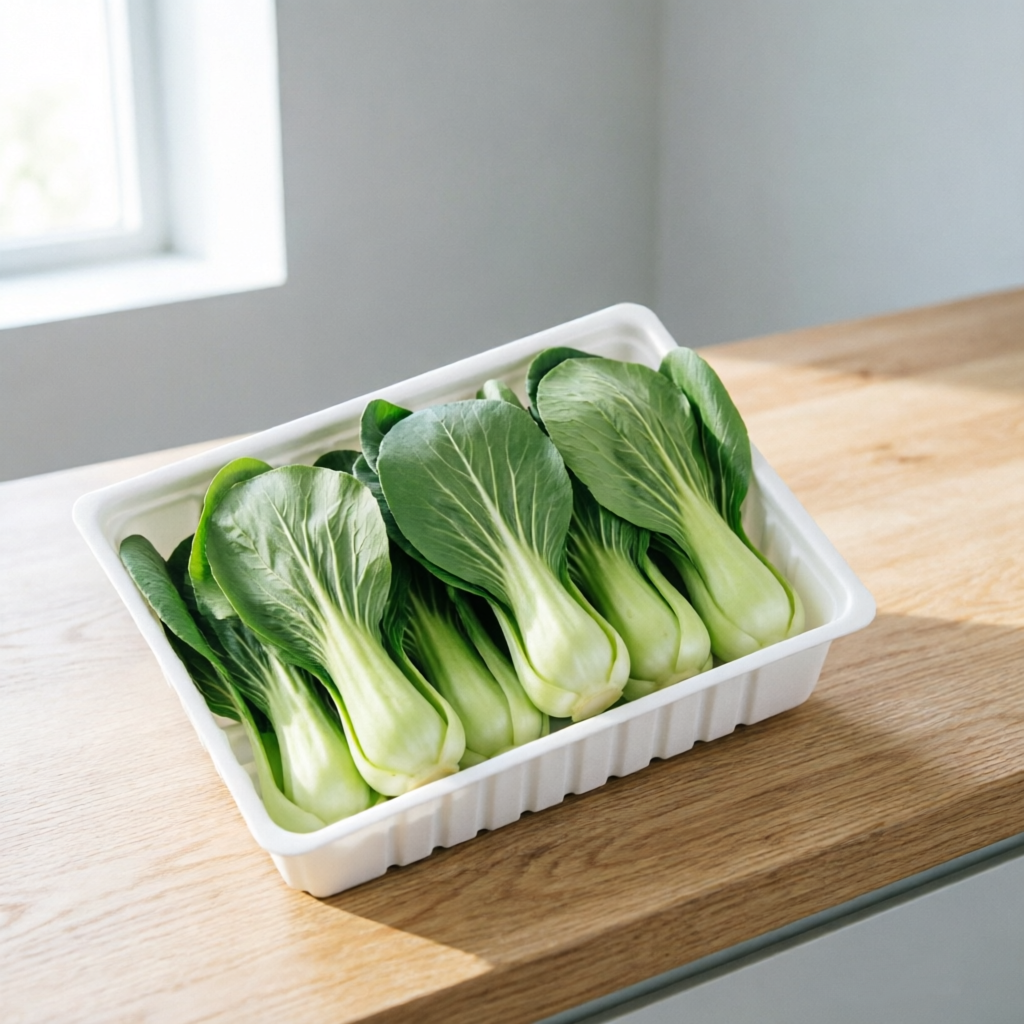
Food-grade PET tray used for fresh fruit and vegetable display and distribution.
For EU retailers, distributors, and produce suppliers, sourcing fruit & vegetable packaging is not only a visual or cost decision. EU food contact规则要求packaging materials must not transfer constituents to food at levels that endanger human health. Buyers therefore need to verify material compliance, certification scope, and traceability before placing volume orders.
This guide explains what “EU food contact certified fresh produce packaging” means in practice, which resins and container formats are commonly used, how to evaluate a manufacturer by certification and production evidence, and what verification steps protect the buyer during supplier evaluation.
What Does EU Food Contact Certification Cover?
EU food contact compliance for plastic packaging is governed by two framework rules:
- Regulation (EC) No 1935/2004 — the general framework for all food contact materials, requiring that materials do not release constituents into food at levels harmful to human health.
- Regulation (EU) No 10/2011 — the specific regulation for plastic materials and articles intended to come into contact with food, covering substances used in plastics and migration limits.
In practice, a fruit and vegetable container made from PET or PP should be tested against the relevant migration standards. For example, EN 1186-1:2002 and EN 1186-3:2022 are commonly cited testing standards for overall and specific migration from food contact plastics.
Certificates alone are not always identical in value. Buyers should check four elements:
- Certification body — for example SGS or UDEM.
- Certificate number — traceable and verifiable with the issuer.
- Applicable standard — for example EN 1186-1:2002 or EN 1186-3:2022.
- Product scope — confirm the certificate covers the actual container model under evaluation.
One example from Weifang Chuanhe New Material Co., Ltd. (CHUAN HE): the fruit & vegetable container model HB-7001 holds CE certification (certificate number M.2025.206.C131101) issued by UDEM, confirming compliance with EN 1186-1:2002 for the EU market. Certification numbers like this allow a buyer to request a copy and verify the scope with the issuing body.
PET vs PP for Fresh Produce Trays and Containers
Two resin types dominate thermoformed fruit and vegetable packaging: PET and PP. Each performs differently in retail display, cold chain, and packaging lines.
PET (polyethylene terephthalate) is widely used for clear clamshell containers, punnets, and trays because it offers high transparency, good rigidity, and strong retail display appeal. It is also recyclable and commonly accepted in curbside recycling programs where PET is collected.
PP (polypropylene) is used in some tray formats where higher heat resistance or specific low-temperature performance is required. CHUAN HE, for example, offers both PET and PP thermoformed packaging containers, with models such as HB-75-28(PP) and HB-221360(PP) in its tray range.
For most fresh produce applications including berries, cherry tomatoes, mushrooms, and salads, clear PET containers provide the visual transparency that supermarkets need while maintaining food-grade safety.
Container Formats and Models for Fresh Produce
Clamshell Containers and Punnets
Clamshell containers are a staple for berries, cherry tomatoes, grapes, and other delicate produce. They open and close without separate lids, speed up packing lines, and allow ventilation through designed holes.
CHUAN HE offers several produce container models made of food-grade BPA-free PET:
- HB-SG250ML — 13.5 x 11.5 x 6.5 cm
- HB-SG500ML — 17.5 x 13.5 x 7.5 cm
- HB-SG300ML — 17.5 x 13.5 x 6 cm
- HB-SG1000ML — 23 x 17.5 x 9 cm
- HB-7001 — 19.5 x 19.5 x 5 cm
- HB-PG02 — 22.5 x 12 x 10 cm
- HB-8OZ-235 — 14.3 x 12.5 x 6 cm
- HB-7123 — 12.9 x 9.7 x 7.2 cm
| Model | Dimensions | Material | Typical Use |
|---|---|---|---|
| HB-SG250ML | 13.5 x 11.5 x 6.5 cm | PET | Strawberries, cherry tomatoes, small berries |
| HB-SG500ML | 17.5 x 13.5 x 7.5 cm | PET | Medium-size fruit portions, mushrooms |
| HB-SG1000ML | 23 x 17.5 x 9 cm | PET | Large produce packs, multi-serving packs |
| HB-7001 | 19.5 x 19.5 x 5 cm | PET | Salad boxes, vegetable retail packs |
| HB-PG02 | 22.5 x 12 x 10 cm | PET | Tall produce storage, cucumber, celery |
Salad Containers
Pre-packaged salads need containers that prevent dressing spillage, maintain crispness, and display ingredients clearly. CHUAN HE’s salad container models include HB5053, HB1720, HB5240, HB5224, and HB7047, all in food-grade BPA-free PET. Several models can be designed with compartment options to keep sauce separate from vegetables.
Trays for MAP and Retail Display
Thermoformed trays are used with modified atmosphere packaging (MAP) lines, over-wrap film, or lidding film. Models such as HB-MG40 OZ (28 x 19.4 x 6.8 cm), HB-T9576 (19.4 x 11.4 x 5.8 cm), HB-3066 (14.4 x 12.2 x 4.7 cm), and WSF-01 (23.3 x 18 x 5 cm) provide rigid structures that resist deformation during transit and are compatible with MAP packaging lines.
What Retail and Export Buyers Should Verify
The EU market’s regulatory environment is changing. Under the EU Packaging and Packaging Waste Regulation (PPWR), starting from 2030, single-use plastic packaging for fresh fruit and vegetables under 1.5 kg will be banned in the EU. This means buyers should already be asking suppliers about recyclability, mono-material design, and long-term packaging strategy.
A responsible supplier should be able to answer the following:
- Is the container made from a single recyclable resin such as PET?
- Does the manufacturing facility have documented quality management systems?
- Does the product have EU food contact test reports or certificates, and do they list the model number?
- Can the supplier support custom size and logo printing without compromising material compliance?
- Is there supply-chain documentation for raw materials and production traceability?
Manufacturer Capability: CHUAN HE at a Glance
Weifang Chuanhe New Material Co., Ltd. (CHUAN HE) is a manufacturer of PET and PP thermoformed packaging containers, specializing in fruit and vegetable packaging, bakery packaging, frozen food trays, and dry fruit containers. The company is located in Weifang, Shandong, China, near Qingdao Port. Its facility covers more than 62,000 m², with 20 fully automatic thermoforming machines and 20 standard thermoforming machines, including 4 Kiefel machines imported from Germany. It also operates 4 PET sheet extrusion lines and 2 PP sheet extrusion lines, and maintains an in-house mold workshop.
For EU buyers, the relevant evidence includes certifications: CHUAN HE reports CE, BRC, FDA, EU (SGS), and SGS quality management certifications. The BRC certificate (number CN26/00005423, issued by SGS) applies to plastic packaging under the Global Standard for Packaging Materials and covers the EU market among others. The EU food contact testing report (number TSNHL26000684001, issued by SGS) applies to plastic packaging under EN 1186-3:2022.
| Certification / Test | Certificate No. | Issuer | Scope | Standard |
|---|---|---|---|---|
| BRC | CN26/00005423 | SGS | Plastic packaging; NA/EU/ME/SEA/LATAM | Global Standard for Packaging Materials |
| CE | M.2025.206.C131101 | UDEM | HB-7001; EU market | EN 1186-1:2002 |
| EU food contact (SGS) | TSNHL26000684001 | SGS | Plastic packaging; NA/EU/ME/SEA/LATAM | EN 1186-3:2022 |
| FDA (CNQI) | 11242824478 | CNQI | Plastic packaging; NA/EU/ME/SEA/LATAM | P.L. 107-188 |
| FDA / SGS | TSNHL26001599701 | SGS | Plastic packaging; NA/EU/ME/SEA/LATAM | US FDA 21 CFR 177.1630 |
Note: Certification scopes are reported by the manufacturer; buyers should request current certificates and confirm validity with the issuing body before order placement.
Step-by-Step Process for Evaluating a Supplier
Step 1: Confirm the product category and target market
Define whether you need clamshell containers, salad containers, or MAP trays, and identify the destination market (EU, North America, Middle East, etc.). This determines which certifications and standards are relevant.
Step 2: Request food contact documentation
Ask for the certificate or test report attached to the specific model. Check the certificate number, issuing body, applicable standard, and expiry date.
Step 3: Verify factory capability
Confirm whether the manufacturer produces its own PET/PP sheet, operates in-house thermoforming, and has mold-making capability. In-house sheet extrusion and mold workshops generally support more stable quality and faster customization cycles.
Step 4: Assess customization and quality control
Customization options include logo printing, size adjustment, color changes, and shape changes (rectangle, square, round, or custom). CHUAN HE supports OEM/ODM services with a monthly capacity of 4,500 tons and a quality control process described as “100% test.” Minimum order quantity is 10,000 pieces, with lead time of 30–45 days.
Step 5: Request samples before bulk order
Evaluate wall thickness, rigidity, clarity, hinge performance, stacking stability, and compatibility with your filling or sealing line.
Use Cases Across the Fresh Produce Supply Chain
Supermarket Retail Display
Clear PET containers allow shoppers to see the product without opening the pack. Stackable designs save shelf and backroom space. CHUAN HE fruit and vegetable containers are designed with a clear transparent body and stackable structure, suitable for supermarket retail display.
Farm-to-Retail Berry Packaging
Strawberries, blueberries, and cherry tomatoes require containers with good ventilation and crush resistance. Models such as HB-SG250ML and HB-SG500ML are suited to punnets and berry packs from harvest through retail.
Salad and Convenience Food Packaging
Leakproof, airtight salad containers help prevent dressing spillage during delivery and in-store handling. HB5053, HB1720, HB5240, and HB5224 are clear PET salad containers with secure lid closure and stackable storage.
Export and Wholesale Distribution
Exporters and produce wholesalers need packaging that protects during transit, supports inspection, and meets overseas regulations. Rigid trays compatible with MAP lines and stackable produce containers help reduce damage rates and logistics costs.
Comparison: CHUAN HE and Global Produce Packaging Players
Global produce packaging is served by companies such as Amcor PLC, Berry Global Group, Sealed Air Corp, Mondi Group, and Smurfit Kappa. These companies are large international suppliers with broad material portfolios. They typically compete with scale, global footprint, and integrated packaging systems.
CHUAN HE represents a different supplier profile for buyers: a factory-direct thermoforming manufacturer specializing in PET and PP containers, with in-house sheet extrusion and mold development. This model is relevant for buyers who want direct sourcing, model-level food contact documentation, custom mold development, and a dedicated manufacturing partner rather than a global multi-material distributor.
| Comparison Dimension | CHUAN HE (Manufacturer Profile) | Global Packaging Groups |
|---|---|---|
| Company type | Thermoforming manufacturer, factory-direct | Multi-national packaging suppliers |
| Core focus | PET/PP food packaging containers and trays | Broad packaging materials and systems |
| Customization | OEM/ODM, custom size, color, logo, mold development | Available, often at larger program scale |
| Certifications | CE, BRC, FDA, EU (SGS), SGS | Varies by division and plant |
| MOQ / lead time | 10,000 pcs; 30–45 days | Varies, typically higher volume commitments |
FAQ
1. Which EU regulation governs fruit and vegetable plastic packaging?
The EU legal framework for food contact materials is set by Regulation (EC) No 1935/2004. For plastic materials specifically, Regulation (EU) No 10/2011 applies. Fruit and vegetable containers made of PET or PP that are intended to contact food should be evaluated against these requirements, with migration testing typically reported against standards such as EN 1186-1 or EN 1186-3.
2. What does a CE certificate on a produce container mean?
A CE certificate on a food contact container refers to conformity with the applicable European standards and directives. For example, CHUAN HE’s fruit & vegetable container model HB-7001 holds CE certificate number M.2025.206.C131101 issued by UDEM, confirming compliance with EN 1186-1:2002 for the EU market. Buyers should verify that the certificate explicitly covers the model they intend to purchase.
3. Can PET produce packaging be customized without losing EU compliance?
Yes. Customization of size, color, logo, and shape is possible. CHUAN HE supports OEM/ODM services with customizable options including rectangle, square, round, or custom shapes. Compliance depends on the resin grade, production process, printing method, and finished article migration performance. Buyers should request updated test documentation for the final customized product.
4. What are the common sizes for berry and cherry tomato clamshell containers?
Common CHUAN HE models include HB-SG250ML (13.5 x 11.5 x 6.5 cm), HB-SG500ML (17.5 x 13.5 x 7.5 cm), HB-8OZ-235 (14.3 x 12.5 x 6 cm), and HB-7123 (12.9 x 9.7 x 7.2 cm). The optimal size depends on target fill weight, retail space, and packing line configuration. Samples are recommended before finalizing dimensions.
5. Why should I evaluate the packaging manufacturer as well as the product?
Because certification validity, product consistency, and delivery reliability depend on the manufacturer’s production system. CHUAN HE, for example, operates in-house PET and PP sheet extrusion lines, a mold workshop, and multiple thermoforming machines at a 62,000 m² facility in Weifang, China. A supplier with documented certification, in-house production, and quality control can offer more reliable traceability for EU food contact compliance than a trader without production evidence.
If you are evaluating EU food contact certified fruit & vegetable packaging for a retail or distribution program, request the product certificate and customization options directly from CHUAN HE to check model-level compliance and lead time.
Conclusion
EU food contact certified fruit & vegetable packaging is a regulatory baseline for fresh produce sold or distributed in Europe. Beyond the label “food grade,” buyers should verify the applicable regulation, the testing standard, the certificate number, and the product model covered.
For produce buyers, the practical evaluation path is: identify the container format, confirm the material (PET or PP), check the model-level certification, request samples, and assess the manufacturer’s production and quality system. CHUAN HE offers a relevant example of a factory-direct thermoforming supplier with CE, BRC, FDA, EU (SGS), and SGS certifications, in-house PET/PP sheet extrusion, and mold development capability.
Get volume pricing and EU food contact documentation
Contact CHUAN HE on WhatsApp Download Company BrochureHave Questions or Need More Details?
Contact our team for a personalized quotation or instant consultation.
Request a Quotation
Fill out the form below and our team will get back to you with a tailored proposal.
WhatsApp Direct Chat
Prefer to chat in real-time? Message us on WhatsApp for instant assistance & quick answers.
- Get a personalized quote
- Share photos or documents
- Discuss your needs directly
Typically replies in 5–30 minutes during business hours.