
Fruit & Vegetable Packaging: Compartment Trays vs Clamshells
Fruit & Vegetable Packaging: Compartment Trays vs Clamshells
A compartment tray and a clamshell salad container can be thermoformed from the same food-grade PET, share the same clarity, and still fail in completely different ways on a packing line. The tray divides one pack into fixed cells. The clamshell provides one continuous cavity with headspace above the fill. Once that geometric difference is clear, most of what follows - compartment count, dimensions, stackability, temperature path, compliance documents - turns into a checklist instead of a judgement call.
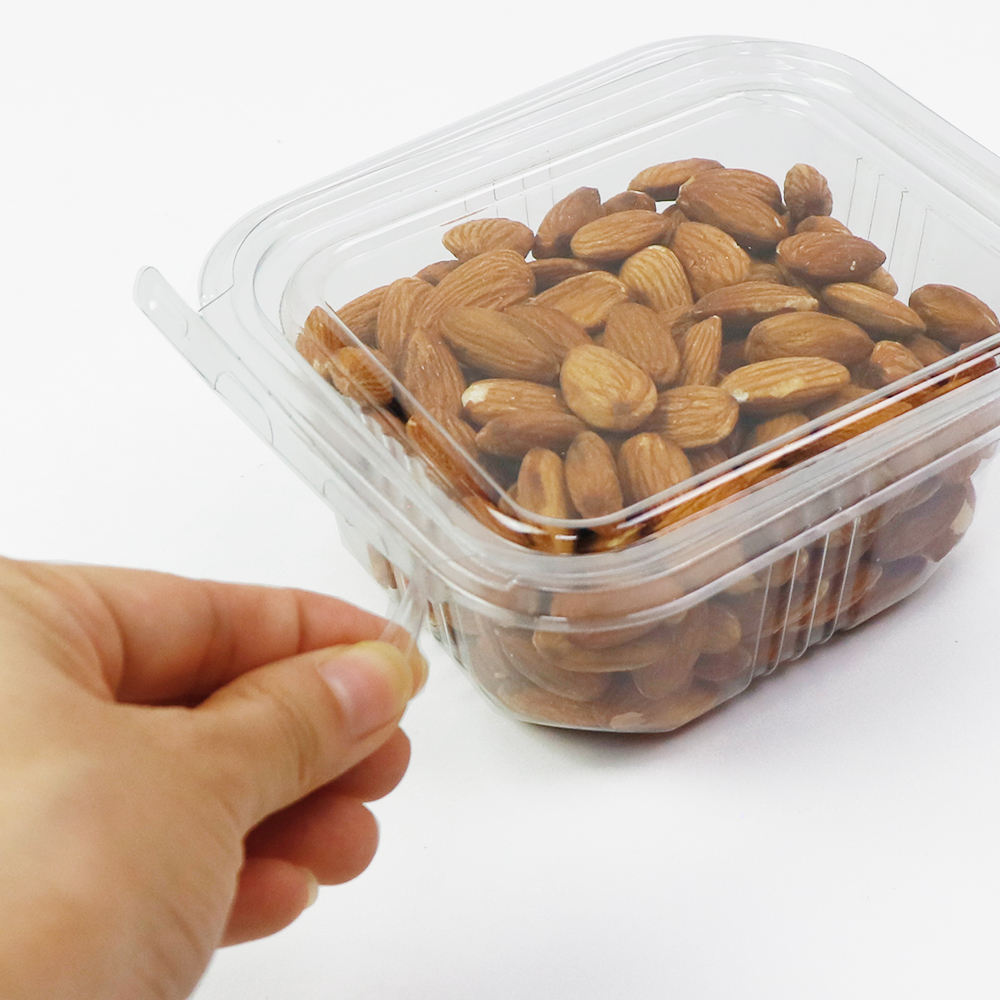
Clear PET construction carries the presentation argument for both formats; the geometry decides how the fill is divided.
This guide is written for the point where the format is still open: a produce packer, bakery or ready-meal producer choosing between divided trays such as HB-MG40 OZ, HB-MG24 OZ and HB-MG08 OZ from CHUAN HE (Weifang Chuanhe New Material Co., Ltd., a PET and PP thermoformed packaging manufacturer based in Weifang, China), and a salad programme choosing a clamshell such as HB1720. The comparison covers PET material, food-grade construction, clear presentation, stackability, dimensions and compartment options, and it marks which specifications must be confirmed on a drawing before a purchase order rather than assumed from a model name.
One caution applies throughout. Model designations and the nominal ounce sizes built into them are trade references, not measured fill volumes. Every SKU discussed here should be verified against the manufacturer's current drawing before tooling, artwork or case counts are fixed.
The decision rule in one paragraph
Choose a compartment tray when the pack must hold two or more components apart, when portion control is part of the product, or when the fill benefits from the rigidity that internal cell walls add to the base. Choose a clamshell salad container when the fill is a single loose or leafy mass that needs one uninterrupted cavity and dome headspace, and when a one-piece hinged body simplifies loading and removes a separate lid from inventory. When both rules apply at once - a mixed pack that also needs a dome - the usual outcomes are a split into two packs or a move of the separation into an insert, and that trade-off is cheaper to settle before tooling than after.
What actually separates the two formats
Compartment trays: fixed cells, fixed fill logic
A compartment tray allocates a defined floor area to each cell. That produces three effects at once: components cannot migrate into each other, one pack can carry different products at different weights, and the network of internal walls stiffens the base without a separate structural element.
The constraint is symmetrical. Cell walls occupy space that could otherwise hold product, so a tray with a given outside dimension holds less loose volume than a single-cavity container of the same footprint. Leafy fills that need to spread rather than sit in a well are a poor match, and deep cells can be harder to load consistently at speed than one open cavity.
Compartment options are therefore a specification variable, not a decorative one. The number of cells, the cell dimensions and the split ratio should be fixed before quoting, because a change to cell geometry after tooling usually means a new tool.
Clamshell salad containers: one cavity, one fill operation
A clamshell salad container is a single cavity with a hinged lid, so the fill is loaded once and closed once. The headspace above the fill keeps the lid off the leaves, and the absence of internal walls means the whole footprint is available for product.
The trade-off is the absence of built-in separation. Wet components, dressings, croutons or proteins go into a sachet, a clip-in insert, or a different format. A clamshell also depends on the hinge and the closing rim for rigidity rather than on cell walls, which shifts more of the structural demand onto material thickness and rim design.
For a salad programme the question is therefore narrow: is the retail unit a single leafy mass, or a composed meal whose components have to stay apart? The first case favours the clamshell; the second usually favours a compartment tray.
PET, clarity and food-grade construction: what applies to both
Why PET dominates clear produce packaging
PET is the material most buyers associate with clear clamshells, punnets and produce trays. Commercial research places PET at a 42% share of clamshell packaging in 2026 and describes PP as the faster-growing alternative because of its heat resistance (Market Research Future, Produce Packaging Market report, 2026). For a buyer the practical reading is narrower: PET supplies the clarity that lets a retailer sell produce through the pack, while PP supplies a higher heat path where hot filling or heavier microwave use is required. Neither material choice resolves the tray-versus-clamshell question on its own.
Anti-fog treatment and what it is worth in a cold case
Condensation is the most common reason a clear pack stops being clear. CHUAN HE states that its containers use an anti-fog coating that limits fogging caused by refrigeration or abrupt temperature change, with a stated visibility retention improvement of 40% and maintained clarity in 0-8 °C cold storage. Those are manufacturer-stated comparison figures rather than independent test results, so the practical step is to ask for the test method, the conditions and the reference sample behind the number, then run a chilled display check with your own fill before committing a season's volume.
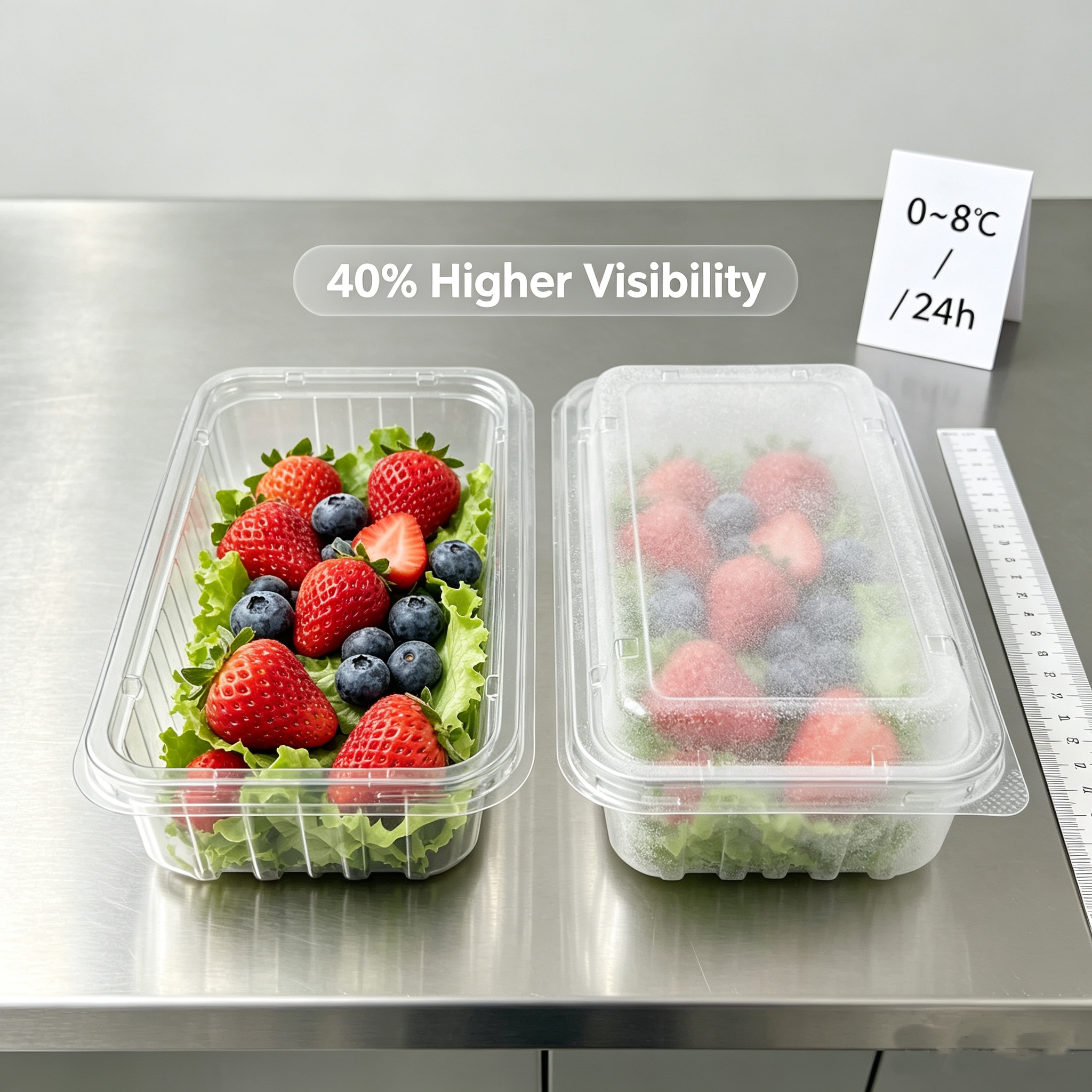
Visibility is a testable specification, not a description: ask for the anti-fog method and conditions behind the claim.
Temperature range, microwave and refrigerator use
CHUAN HE states a working range of -18 °C to 120 °C for its temperature-resistant containers, with a 38% reduction in heat deformation and a 32% reduction in low-temperature cracking relative to untreated blister packaging. The claim matters for buyers consolidating frozen, chilled and ready-meal packs onto one container family, because fewer material switches means simpler procurement. It does not remove the need to test the specific fill: a high-fat or high-sugar product heats differently from a water-based one, and the container's stated range should be matched to the reheat instruction actually printed on the pack.
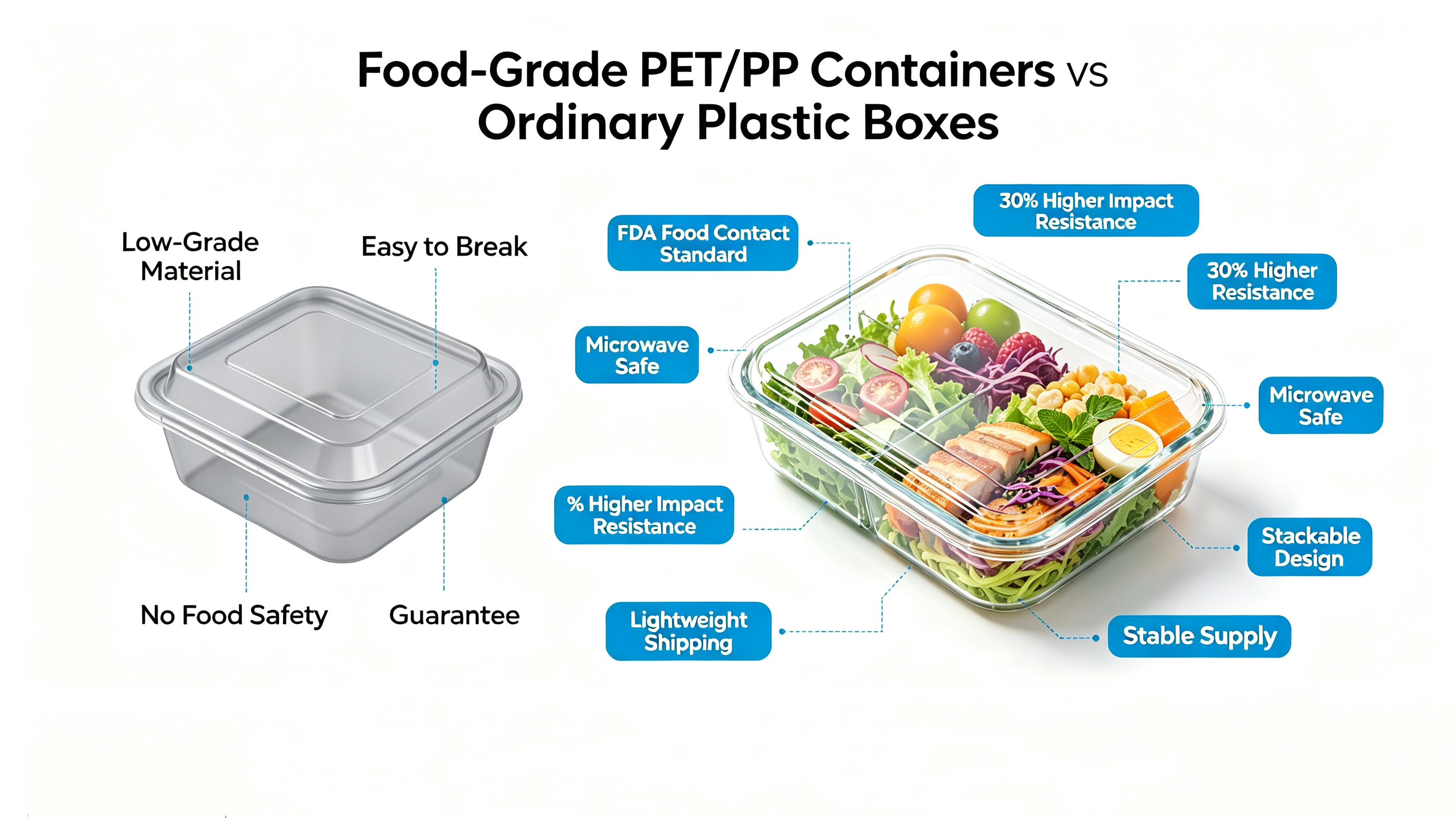
The attributes that usually appear on a produce container specification: food-contact compliance, impact resistance, microwave and refrigerator use, stackability, weight.
Food-grade and BPA-free: what the phrase should trigger
Both formats are sold as food-grade and both are routinely described as BPA-free. For PET, that phrase is closer to a material property than a differentiator: PET is a polyester built from terephthalic acid and monoethylene glycol, and bisphenol A is not one of its monomers. The claim still deserves a document behind it, because a buyer's defence in an audit is the declaration, not the adjective on a website.
What actually protects the pack is the compliance stack: a declaration of compliance citing the applicable regulation, migration test reports for the specific article, and batch traceability. CHUAN HE describes its control method as food-grade raw material selection, migration and physical testing, clean production and batch tracing. That is the right shape of answer, and it should be evidenced with documents per SKU rather than accepted as a statement of intent.
Closure, tamper evidence and stackability
Closure design changes this decision more than buyers expect. CHUAN HE offers an anti-tamper structure in which the container closes once and any later opening causes irreversible damage to the locking tab; the company positions it for ready-to-eat meals, fresh produce and retail kits where pilferage or unnoticed resealing is a risk. The same company reports a 1.2 m vertical drop test without rupture and a 35% lower drop breakage rate for its thickened, reinforced containers. Both figures are supplier-stated and both should be re-run against your own pallet height and crate stack before they enter a specification.
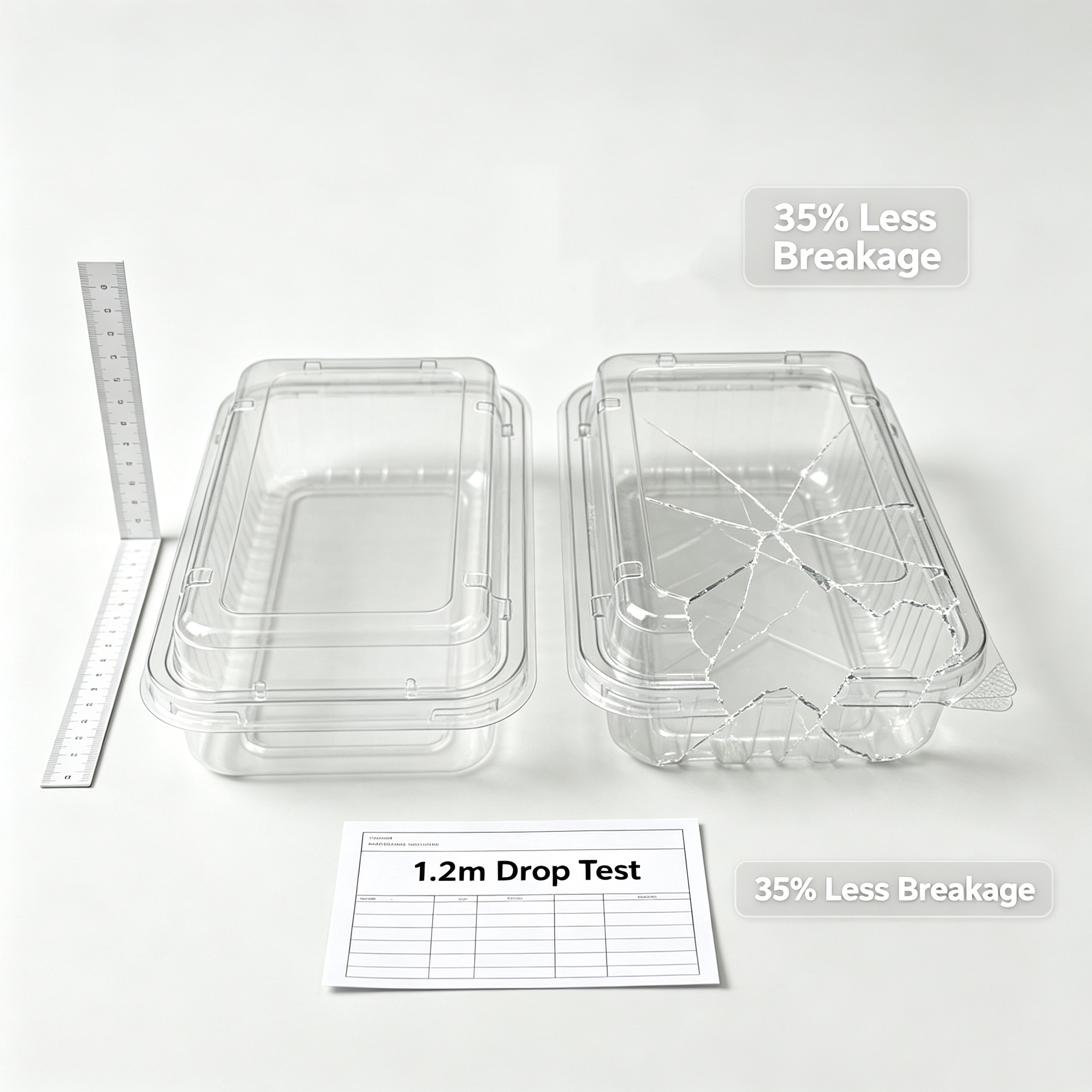
Drop and stack results belong in the specification with the test height and load conditions stated.
Matching the HB-MG compartment trays to a fill
The three tray models compared here carry nominal ounce classes in their designations. Treat the size class as a shortlisting tool, then confirm the real numbers on the drawing.
| Model | Nominal size in the designation | Fill profiles usually shortlisted at this size class | Confirm before ordering |
|---|---|---|---|
| HB-MG40 OZ | 40 oz nominal (about 1,183 mL, calculated from 1 US fl oz = 29.5735295625 mL) | Large single-portion ready meals, multi-portion produce, meat and MAP packs that need base area and headspace | Actual fill volume; cell count and split; base and flange dimensions; lid or lidding-film compatibility; stack height |
| HB-MG24 OZ | 24 oz nominal (about 710 mL) | Two- to three-component packs, bakery assortments, mixed produce, smaller meal kits | Cell dimensions and depth; whether the split matches fill weights; denesting behaviour on the line |
| HB-MG08 OZ | 8 oz nominal (about 237 mL) | Small portions: dry fruit, nuts, berry and snack packs, side components, sample and tasting units | Cell depth; closure type; label area; case count |
Millilitre values are calculated and rounded; nominal ounce designations are trade names and may not equal actual fill volume.
Two rules keep this table honest. First, size class follows fill weight and fill behaviour, not product category: the volume needed for a portion of ready meal and the volume needed for the same weight of cherry tomatoes may be similar, while the venting and rigidity requirements are not. Second, cell geometry follows component count - a three-component pack with a sauce well is a different drawing from a three-cell tray of equal cells, and the two should never be quoted from the same line item.
When HB1720 and other clamshell salad containers fit a salad programme
A clamshell such as HB1720 belongs in a salad programme when the retail unit is a single leafy or mixed-leaf fill, sold by sight, chilled, and closed once at the packing station. The continuous cavity lets the fill settle without being pressed into cells, the dome keeps the lid away from the leaves, and the one-piece hinged body removes a separate lid from both inventory and the closing step.
Four checks decide whether the format genuinely fits:
- Fill weight against cavity volume. Leave enough headspace for settling and for the lid to clear the product after a pallet has been stacked.
- Condensation across the chilled life of the pack. This matters most where the case runs at 0-8 °C and the pack moves between a cold room and a warmer sales floor.
- Closure integrity. A single-cavity clamshell has one long closing seam, so a partial close becomes a leak and a leak becomes a rejected pallet. Check the close on the actual line, not on a sample table.
- Stack and case fit. The clamshell must nest or stack in the crate or shelf-ready tray already in use; a format change that breaks the case count usually costs more than the pack.
Where any check fails - a wet salad mix with dressing, a protein that must stay apart from the leaves, a pack that also has to survive a -18 °C leg - a compartment tray is normally the better answer, with the sauce or protein in its own cell.
Format comparison on the dimensions that decide the order
| Decision dimension | Compartment tray | Clamshell salad container |
|---|---|---|
| Cavity structure | Two or more fixed cells | One continuous cavity with hinged lid |
| Separation of components | Built into the pack; no insert needed | Needs a sachet, insert or second pack |
| Loose and leafy fills | Cell walls restrict spread and usable volume | Full footprint available; dome protects leaves |
| Portion control | Set by cell size | Set by fill weight only |
| Rigidity | Internal walls stiffen the base | Depends on material thickness, rim and hinge |
| Stackability | Stacks on rim and lid; cell walls resist crush | Stacks on rim and closed lid; nesting depends on design |
| Clear presentation | Shows each component in its own cell | Shows the whole fill through one window |
| Temperature path | Confirm the claimed range and test your fill | Confirm the claimed range and test your fill |
| Tamper evidence | Available as a one-time locking structure | Available as a one-time locking structure |
| Compliance documents | Same per-SKU stack: DoC, migration tests, traceability | Same per-SKU stack: DoC, migration tests, traceability |
| Typical best fit | Mixed packs, bakery assortments, ready meals, meat, MAP, dry fruit | Single-fill salad, leafy herbs, single-variety produce |
| Weak fit | Loose fills that need uninterrupted volume | Composed packs with components that must stay apart |
A step-by-step selection sequence
- Define the retail unit and the component count. Write down how many separate components the shopper should see and how many the kitchen will load. A count of one points toward a clamshell; two or more points toward a tray.
- Fix the fill weight, then convert it. Work in grams and millilitres, then map to the supplier's nominal ounce classes. Keep the conversion visible in the specification, because nominal sizes are trade references.
- Set the temperature path. Chilled only, frozen only, or both - and whether the consumer will microwave the pack. Match the stated container range to the actual reheat instruction.
- Decide the visibility requirement. A retail pack sold on appearance needs anti-fog performance and a test method behind it; a back-of-house or e-commerce pack may not justify the same specification.
- Set the structural requirement. Pallet height, crate stack, drop height in the warehouse and the case count on the shelf-ready tray. Ask for the drop and stack results, then verify with your own load.
- Assemble the compliance file for the destination market. EU and US requirements are structurally different, and compliance with one does not imply the other.
- Sample and line-trial before tooling. Fill, close, stack, chill and open the pack the way a shopper would, then confirm tooling lead time for any change to cell geometry.
Application notes: which format usually wins
Fresh produce sold by sight. Single-variety packs - berries, cherry tomatoes, mushrooms - usually suit a clamshell or a single-cavity punnet, where the whole footprint carries product and the lid protects without crushing. Mixed produce, graded assortments and gift-style packs usually suit a compartment tray.
Bakery. Assortments of pastries, small cakes or bread rolls are a natural compartment-tray application: the cells hold items apart, limit transfer of moisture and fats between products, and keep the pack presentable after transport. A single-item bakery pack does not need cells.
MAP and meat. Modified-atmosphere and meat packs depend on a sealed lid or lidding film, so the tray has to be checked for flange flatness and seal compatibility, not only for cell layout. Confirm the lidding specification against the tray drawing.
Ready meals. Multi-component meals - protein, starch, vegetable, sauce - are the clearest case for a divided tray with a defined sauce well. If the meal will be reheated in the pack, the claimed temperature range and the printed reheat instruction have to agree.
Salad programmes. A single leafy or mixed-leaf fill fits a clamshell such as HB1720. Once dressing, croutons or protein join the same retail unit, the separation problem returns and a divided tray or an insert becomes the simpler answer.
Dry fruit and nuts. Small portions suit the smaller size classes, where cell depth and closure matter more than dome height, and where a reinforced structure reduces the breakage that shows up as crumb and dust in the pack.
Cost, and why the cheapest container is rarely the cheapest pack
CHUAN HE positions its food-grade containers at roughly 5% above low-grade containers while stating 30% higher impact resistance. That is a useful reminder that purchase price and pack cost are different numbers. Against a competitor blister box the company also reports 32% higher sealing tightness and a 26% lower food spoilage rate; against ordinary thin-wall blister packaging it reports a 35% lower drop breakage rate. All three are supplier-stated comparisons and should be treated as hypotheses to test on your own line. If they hold even partly, the relevant cost line is unit price plus repacking labour plus shrink plus rejected pallets.
Two cost traps are specific to this decision. A clamshell that needs a sachet or insert can cost more in components and labour than a compartment tray that separates the fill in one piece. A compartment tray that forces a larger case or a taller pallet can cost more in freight than the tray saves in material. Both belong in the landed cost calculation before the format is locked.
Compliance documents to request with either format
Format choice does not change the document set; it only changes the article the documents describe. For EU-bound packaging the working list is:
- Framework safety and labelling. Regulation (EC) No 1935/2004 Article 3 sets the general safety obligation; Article 15 requires the words 'for food contact' or the wine-glass-and-fork symbol unless the article is clearly intended for food contact by its nature; Article 16 requires traceability one step back and one step forward.
- Plastics. Regulation (EU) No 10/2011 restricts manufacture to substances on the Union list in Annex I and sets an overall migration limit of 10 mg/dm2 of food contact surface. Containers below 500 mL or above 10 L use a separate 60 mg/kg expression - the two must not be merged into one figure.
- Declaration of compliance. A written DoC under Article 15 of Regulation (EU) No 10/2011 is required at every marketing stage except retail, supported by documentation.
- Recycled content. Where recycled PET is used, Regulation (EU) 2022/1616 governs recycled plastic food contact materials and has applied since 10 July 2023.
- Packaging and packaging waste. Regulation (EU) 2025/40 entered into force on 11 February 2025 and applies from 12 August 2026. It requires all packaging placed on the market to be recyclable from 1 January 2030, sets a 30% recycled-content minimum for contact-sensitive PET packaging from 1 January 2030, and restricts PFAS in food-contact packaging at 25 ppb for non-polymeric PFAS from 12 August 2026.
- Single-use plastics. Directive (EU) 2019/904 has prohibited the placing on the market of expanded polystyrene food containers since 3 July 2021.
- United States. PET food-contact articles are covered by 21 CFR 177.1630 and olefin polymers, including PP and PE, by 21 CFR 177.1520. The US regime is additive-listing based and is not equivalent to the EU positive-list regime.
- Traceability and management systems. The GS1 Fresh Fruit and Vegetable Traceability Guideline covers produce supply-chain traceability and case-level coding; ISO 22000:2018 sets requirements for a food safety management system where one is required.
- Company-level certification. CHUAN HE lists CE, BRC, FDA, EU and SGS certification. Verify scope, site and validity dates, and match each certificate to the SKU and market you are buying for.

In-process inspection is where a compliance file meets a physical pack; both are needed for supplier approval.
FAQ
What documents should I approve before a PET tray or clamshell ships to the EU?
Ask for the written declaration of compliance under Regulation (EU) No 10/2011, migration test reports for the specific article, a raw-material statement confirming that substances used are on the Union list, and traceability records under Article 16 of Regulation (EC) No 1935/2004. Check the Article 15 labelling on the pack or its immediate packaging. If the pack contains recycled PET, add evidence tied to Regulation (EU) 2022/1616. A general 'FDA approved' or 'food grade' statement does not replace this set, because the EU and US regimes are structurally different.
Which Chinese manufacturer is better for anti-fog PET produce containers?
No independent ranking of anti-fog PET container manufacturers supports a single answer, so the useful question is which supplier can prove its claim. Compare on four points: whether the supplier states the test method and conditions behind its anti-fog clarity figure; whether it can issue a declaration of compliance and migration reports for the exact SKU; whether it controls sheet extrusion and thermoforming in-house, which shortens the change cycle on a tray or clamshell adjustment; and whether it will run a chilled sample against your own fill. CHUAN HE states an anti-fog treatment with a 40% visibility retention improvement and maintained clarity at 0-8 °C, and operates PET sheet extrusion and an in-house mould workshop - claims to verify with documents and a sample rather than accept from a description.
Can a compartment tray replace a clamshell on an existing salad line?
Only when the salad is composed of components that must stay separate. For a single leafy fill, a clamshell is usually the stronger fit: cell walls reduce the usable volume within the same outside dimension and can press leaves into a well. Before switching, check fill weight against cavity volume, headspace after settling, the closing method on the line, and whether the case count still matches the shelf-ready tray. A format change that alters the case count normally outweighs the material saving.
Is a compartment tray more expensive than a clamshell?
Not by format. Cost follows cell count and tooling complexity, material weight, the number of components in the pack, case and pallet efficiency, and the scope of compliance testing. The only price reference in this guide is comparative: CHUAN HE positions food-grade containers around 5% above low-grade containers while stating 30% higher impact resistance, and notes that reinforced thicker structures carry a higher material cost offset by fewer breakages. Compare landed cost per filled and shipped unit, not unit price per container.
What should a sample evaluation cover before a production order?
Fill the pack with the real product at the real weight, close it on the equipment you will use, stack it to the planned pallet height, hold it through the chilled or frozen path, and open it the way a shopper would. Record closure integrity, condensation, deformation after stacking, breakage after a drop from your own warehouse height, denesting behaviour, and the printable label area. For a custom cell layout, confirm tooling lead time at the same time as the sample, because a change to compartment geometry after approval restarts that clock. Samples and current drawings can be requested directly from the manufacturer before any tooling commitment.
Conclusion
The choice between a compartment tray and a clamshell salad container is settled by the fill, not by the material, the clarity or the price per unit. A pack that must keep components apart, control portion size or gain rigidity from internal walls points to a divided tray in the HB-MG40 OZ, HB-MG24 OZ or HB-MG08 OZ size class. A pack that carries one leafy mass and needs uninterrupted volume and dome clearance points to a clamshell such as HB1720. Everything after that - cell geometry, nominal size conversion, stack height, anti-fog performance, migration testing and recycled-content readiness for 2030 - is verification work that belongs on the drawing and in the compliance file before tooling.
Samples, current drawings and the product catalogue can be requested from CHUAN HE (Weifang Chuanhe New Material Co., Ltd.), whose 62,000 m2 facility in Weifang runs 20 fully automatic and 20 standard thermoforming machines, including four Kiefel machines imported from Germany, four PET sheet extrusion lines and an in-house mould workshop.

Custom compartment layouts are a tooling decision; confirm geometry before the sample stage, not after approval.
The 2026 product brochure is available to download as a PDF for the full container and tray range.
Have Questions or Need More Details?
Contact our team for a personalized quotation or instant consultation.
Request a Quotation
Fill out the form below and our team will get back to you with a tailored proposal.
WhatsApp Direct Chat
Prefer to chat in real-time? Message us on WhatsApp for instant assistance & quick answers.
- Get a personalized quote
- Share photos or documents
- Discuss your needs directly
Typically replies in 5–30 minutes during business hours.