
Fruit & Vegetable Packaging Partnerships: A Long-Term Supply and After-Sales FAQ
Fruit & Vegetable Packaging Partnerships: A Long-Term Supply and After-Sales FAQ
A fruit and vegetable packaging partnership is judged less by the first delivery than by the twentieth. When buyers move from a one-off purchase order to repeat supply of PET food-grade BPA-free containers and trays, the working questions change: how model continuity is protected across examples such as HB-SG300ML, HB-7001, HB-SG1000ML, HB1720 and HB-MG40 OZ; how clear, stackable, compartment and tamper-evident formats map onto produce, salad, bakery and retail applications; and what has to be documented — dimensions, material and food-contact compliance — before a long-term commitment is signed. The short answer: a repeat-supply relationship is a documentation discipline first and a price negotiation second.
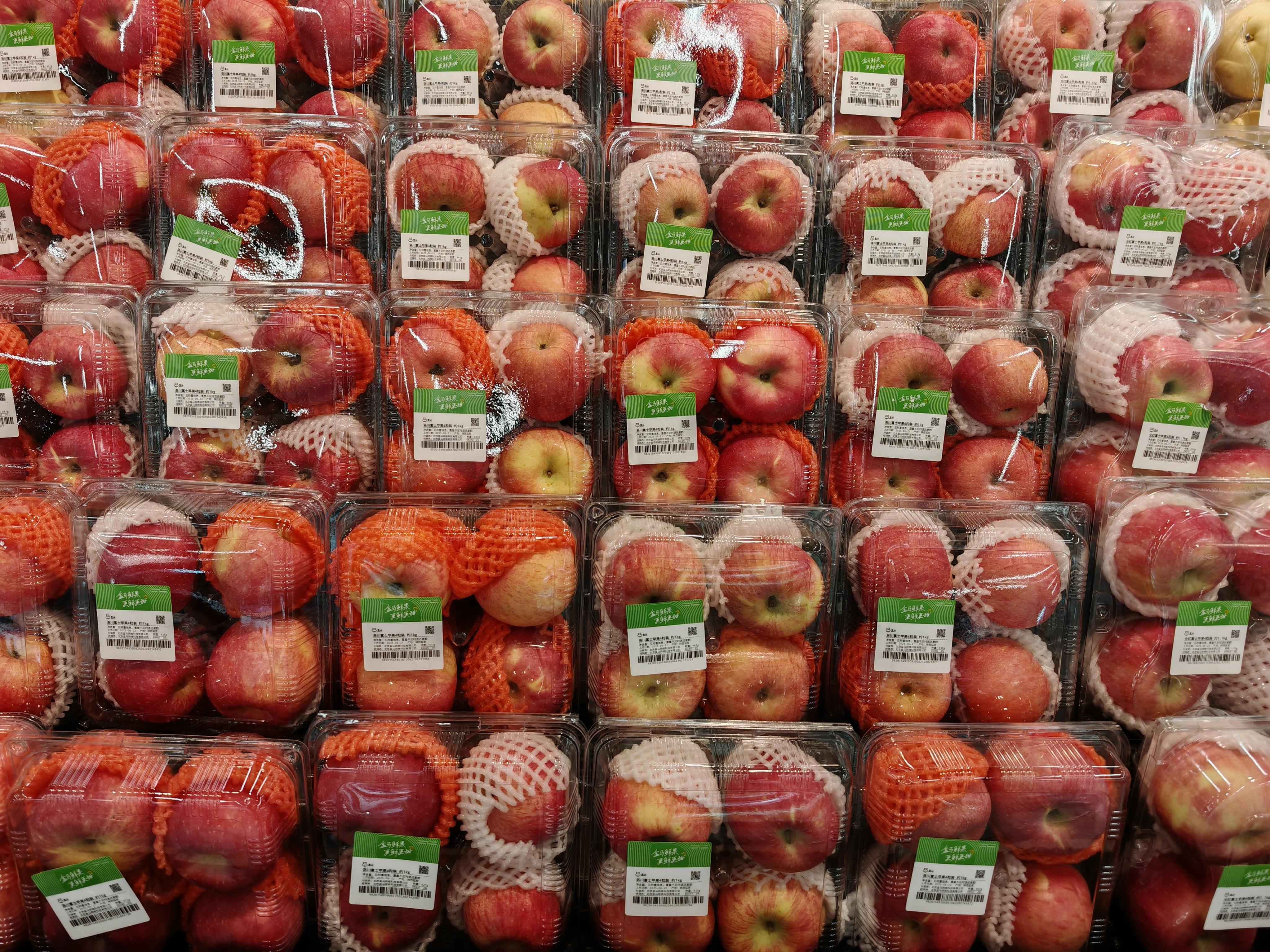
Problem definition: what actually breaks when an order becomes a supply agreement
A single order is verified at delivery — carton count, the dimensions of that lot, and the appearance of the sample. A supply agreement is verified over months, and the failure modes are different. In fresh produce packaging the recurring problems are rarely dramatic; they are small, repeated and expensive.
- Model continuity. If the HB-SG300ML approved in the sample room is not identical in the eighth shipment — because a wall thickness, lid fit or stacking height changed without notice — the retail plan built around it breaks.
- Specification drift. Dimensions, material and closure are often agreed verbally, then re-interpreted by a different production planner on a later run.
- Food-contact documentation. A buyer placing fresh produce containers into an EU supermarket has to demonstrate that the plastic complies with food contact rules, not merely that it looks clean.
- Format fit. A clear clamshell that sells strawberries at a farm market is not automatically right for a salad kit or a bakery counter.
- After-sales coordination. Who confirms a dimension query, who reviews a damaged pallet, and who records a change so that it can be repeated.
None of these are solved by a lower unit price alone. They are solved by treating the first order as the start of a specification rather than the end of a purchase.
Industry background: why produce packaging has become a long-cycle decision
The commercial backdrop explains why buyers now plan packaging supply over years rather than seasons. The global fresh food packaging market reached USD 134.60 billion in 2024 and is projected to reach USD 240.50 billion by 2035 (Spherical Insights & Consulting). Within that, the produce packaging market specifically for fruits and vegetables was valued at approximately USD 38.08 billion in 2024 (Market Research Future). Europe accounted for USD 15.2 billion of fresh food packaging in 2024, with a projected CAGR of 4.5% through 2033 (Market Research Future). The thermoformed plastic segment used in food packaging is expected to grow at a CAGR of 4.9%, reaching USD 20.66 billion by 2030 (Grand View Research).
Regulation moves on the same timeline. EU Regulation (EC) No 1935/2004 sets the framework for all food contact materials so that they do not release constituents into food at levels harmful to human health, and EU Regulation (EU) No 10/2011 governs plastic materials and articles intended to come into contact with food, including PET and PP containers (European Commission; EUR-Lex). Further ahead, the EU Packaging and Packaging Waste Regulation is set to ban single-use plastic packaging for fresh fruit and vegetables under 1.5 kg from 2030 (European Commission / Earth.Org).
The consequence for a buyer is straightforward: a packaging decision now carries a horizon. A container that is compliant and well documented today remains the right container in three years only if the supplier can reproduce it, document it and advise on the format rules that apply in the destination market. Global converters including Amcor PLC, Berry Global Group, Sealed Air Corp, Mondi Group and Smurfit Kappa also supply food and produce packaging (Mordor Intelligence) — which is why evaluation increasingly focuses on the relationship rather than a single catalogue page.
What a long-term fruit and vegetable packaging partnership covers
Weifang Chuanhe New Material Co., Ltd. (CHUAN HE) is a manufacturer specialising in the innovative design and customised production of PET and PP thermoformed packaging containers, established in 2013 and located in Weifang, China, adjacent to Qingdao Port. Its main products are baking packaging and fruit and vegetable packaging, and export business accounts for 100% of total sales, with major markets in the European Union, the United States, North America, Latin America and the Middle East. That export profile is why the partnership questions below are framed around documentation and repeatability rather than appearance.
Manufacturing continuity
The manufacturing base covers 62,000 square metres and runs 4 PET sheet extrusion lines and 2 PP sheet extrusion lines alongside an in-house mould workshop. Thermoforming capacity consists of 20 fully automatic thermoforming machines and 20 standard thermoforming machines, including 4 advanced Kiefel machines, with annual production capacity reaching 54,000 tons and an R&D team of 5 engineers. The practical meaning for a repeat buyer is that sheet material is produced in house, which reduces reliance on outsourced raw material and supports coordinated production and faster delivery, while the in-house mould workshop means a custom tray or clamshell shape is not queued behind an external tool shop.
Food-contact and certification documentation
The company has been certified with CE, BRC, FDA, EU and SGS quality management systems. Its plastic packaging is certified to BRC under the Global Standard for Packaging Materials, issued by SGS with certification number CN26/00005423, applicable to the NA, EU, ME, SEA and LATAM markets. For a repeat buyer, the value of a named certification number is that it can be written into the supply agreement and reused every time documentation is requested, instead of being renegotiated order by order.
Format continuity across clear, stackable, compartment and tamper-evident designs
PET material offers high transparency, providing clear visibility of the contents. For transparent fresh produce packaging that is a functional requirement, because the pack has to sell from the shelf as well as protect the product. Stackable design saves refrigerator and warehouse space, and a stackable structure saves storage space in fridges and warehouses. Compartment designs separate sauce from vegetables to keep ingredients fresh and crisp. Tamper-evident formats add a closure that shows whether a pack has been opened, and the tamper evident series — HB-8OZ, HB-20 OZ, HB-24 OZ and HB-32 OZ — uses a clear transparent PET body and is classified for fruit and vegetable containers, suitable for produce wholesalers, supermarket chains, agricultural exporters, bakeries, food retailers and e-commerce brands.
Temperature behaviour belongs in the same conversation. According to the company's own product documentation, its blister boxes maintain stable performance under both freezing and heating conditions, with a 38% lower heat deformation rate and a 32% lower low-temperature cracking rate compared with blister packaging that has not been treated for low-temperature and heat resistance; the stable hardness after temperature changes results in fewer broken boxes, and the containers are positioned for frozen food storage, microwave heating, quick-freezing processing, cold transportation and ready-to-eat meals. For a buyer running refrigerated and microwave applications, that is a specification to confirm in writing rather than assume.
Model continuity across HB-SG300ML, HB-7001, HB-SG1000ML, HB1720 and HB-MG40 OZ
Model continuity means the supplier can hold a model's identity constant while raw material lots, production runs and shipping schedules change around it. The practical way to test that is to compare what is actually documented for each model.
| Model | Category | Material | Dimensions | Format features | Typical applications |
|---|---|---|---|---|---|
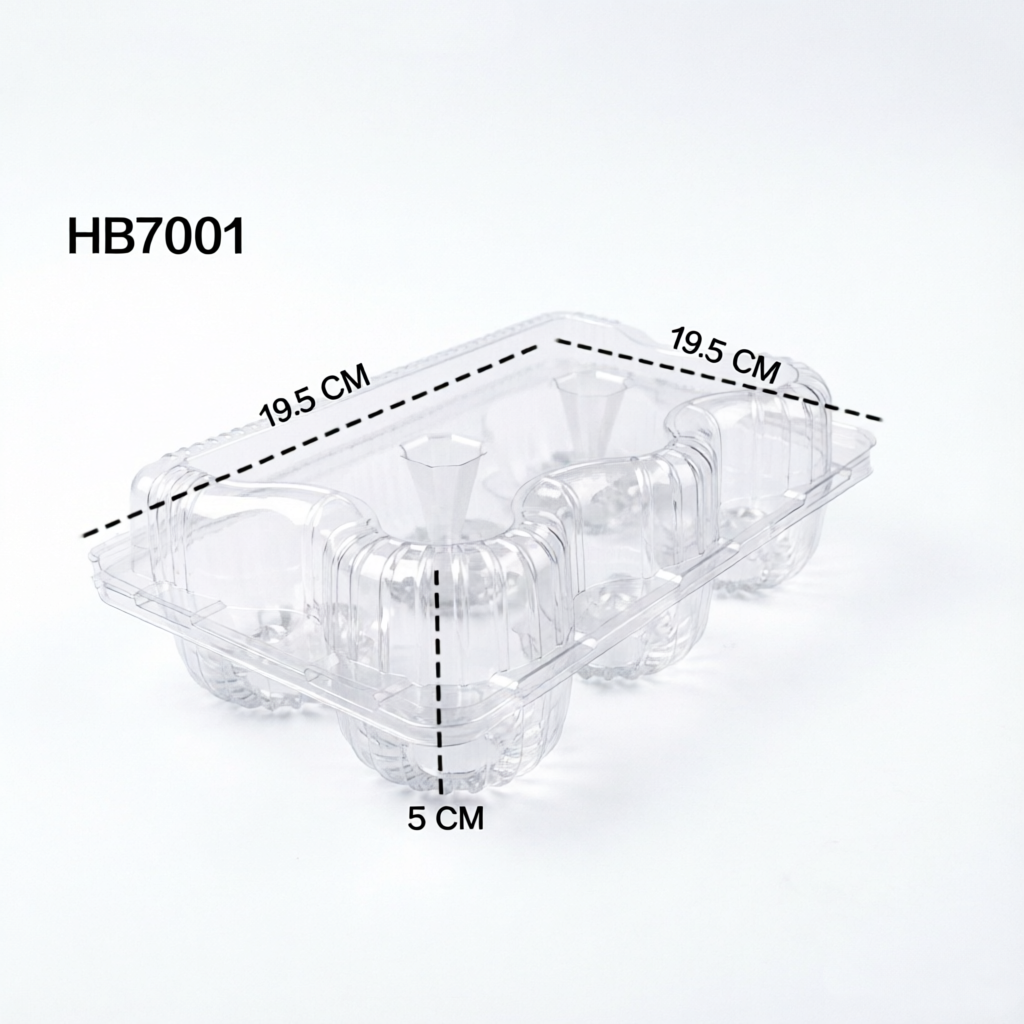
| HB-7001 | Fruit & vegetable container | PET | 19.5 × 19.5 × 5 cm | Food grade BPA-free, refrigerator safe, clear transparent body, stackable | Fresh fruit and vegetable storage, supermarket retail display |
| HB-SG300ML | Fruit & vegetable container | PET | 17.5 × 13.5 × 6 cm | Food grade BPA-free, refrigerator safe, stackable, clear body; custom size, colour and logo printing available | Produce and berry storage, crisper-box use, retail display |
| HB-SG1000ML | Fruit & vegetable container | PET | 23 × 17.5 × 9 cm | Food grade BPA-free plastic compliant with food contact standards, stackable, ventilated produce keeper format | Larger produce volumes, wholesale and supermarket packs |
| HB1720 | Salad container | PET | 18.5 × 18.5 × 6 cm | Clear plastic salad box, airtight and clamshell formats, stackable, optional compartment, leakproof and airtight lid | Supermarket chains and produce wholesalers; prepared salads |
| HB-MG40 OZ | Tray — custom blister, compartment, disposable serving, produce and bakery tray | PET | 28 × 19.4 × 6.8 cm | Compatible with MAP modified atmosphere packaging; compartment and serving format | Meat packaging under MAP; tray-based retail formats |
| HB-MG24 OZ | Tray — produce, bakery, MAP, compartment, clear display | PET | 18.6 × 18.6 × 8.9 cm | Food grade BPA-free, rigid anti-deformation structure, MAP compatible, stackable, clear | Produce, bakery, meat, poultry and ready meals |
| HB-T9576 | Tray | PET | 19.4 × 11.4 × 5.8 cm | Rigid structure to reduce deformation in transit, MAP compatible, stackable, clear | Produce, bakery, meat, poultry, ready meals |
| HB-8OZ / HB-16OZ / HB-20 OZ / HB-24 OZ / HB-32 OZ | Tamper evident packaging | PET | 13.4 × 12.1 × 3.6 cm; 14 × 11.6 × 6.2 cm; 14 × 11.6 × 7.9 cm; 17.2 × 15.5 × 4.8 cm; 17.2 × 15.5 × 6.2 cm | Tamper-evident closure, clear transparent body, ODM/OEM custom shapes in rectangle, square or round | Fruit and vegetable packs, salad, cakes, sweets, bakery, frozen food trays, dry fruit containers |
Two continuity rules follow from that table. First, dimensions should be recorded exactly as they appear in the model specification — in centimetres — because a two-millimetre drift in a stackable container changes how many units fit on a retail shelf and on a warehouse pallet. Second, category labels matter: the same PET sheet can become a produce container, a salad box or a bakery tray, and a supplier that documents which category a model belongs to makes reordering far less ambiguous.
The salad range shows why this is more than paperwork. HB1720 (18.5 × 18.5 × 6 cm), HB7047 (15.6 × 11.7 × 4.5 cm), HB5224 (17.1 × 12.3 × 5.6 cm), HB5240 (17 × 11.5 × 3.7 cm) and HB5053 (15.2 × 10.2 × 5.3 cm) are all PET clear plastic salad boxes with leakproof and airtight lids, stackable structures, an optional compartment design and custom logo printing available. Choosing one of them for a salad programme is not choosing a single SKU; it is choosing a family that has to remain internally consistent as the menu changes.
Step-by-step: from a trial order to repeat supply
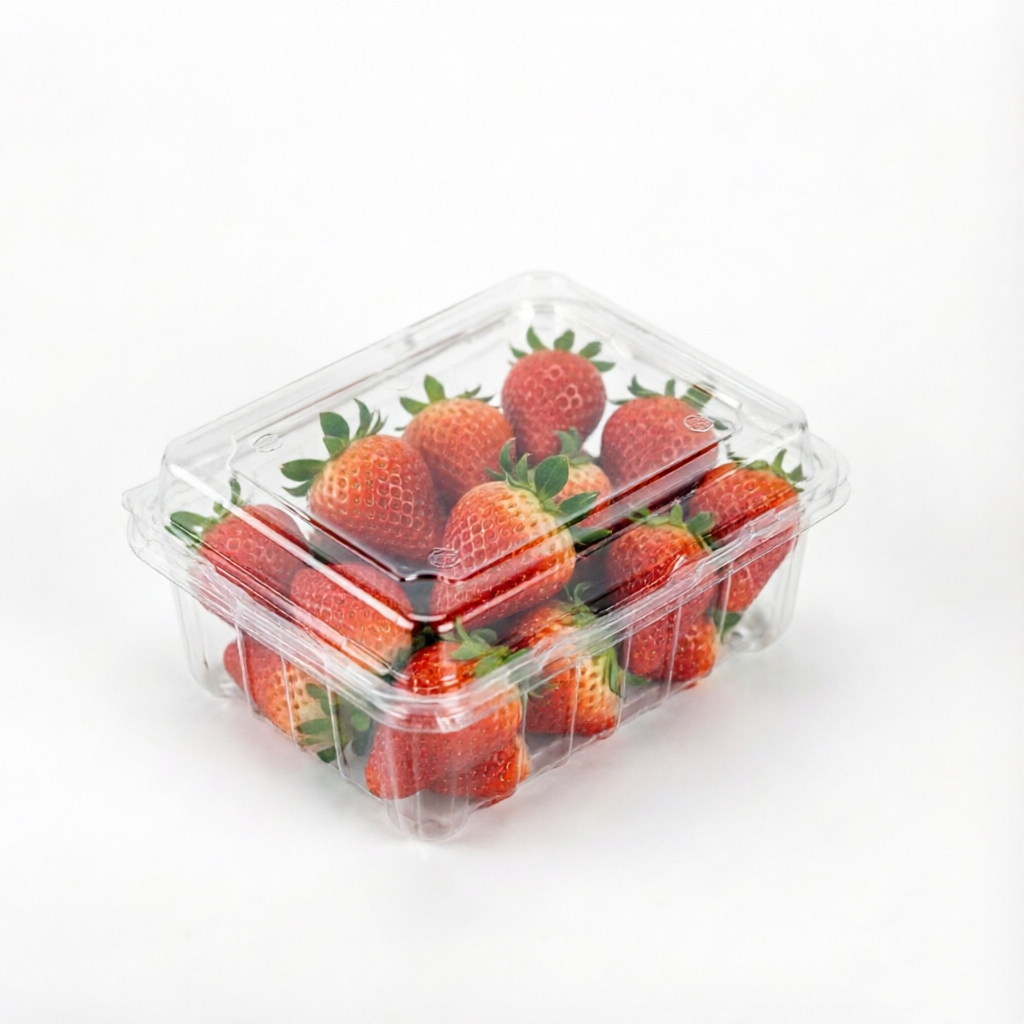
- Define the application before the container. State what is packed, how it is stored (refrigerated, frozen, microwave-reheated), how it is displayed (shelf, chilled cabinet, farm market) and what the distribution leg looks like. A strawberry punnet, a 1 kg salad kit and a bakery tray optimise different things.
- Write the specification down. Model number, category, material, dimensions in centimetres, lid or closure type, stackability, decoration and any compartment requirement. If it is not written, it will not be repeatable.
- Validate food-contact compliance for the destination market. Confirm that the containers are described as food grade BPA-free plastic and that the supplier's documentation set covers the markets you ship to; EU buyers normally check against the framework of Regulation (EC) No 1935/2004 and Regulation (EU) No 10/2011 for plastic materials and articles in contact with food.
- Order a trial quantity. Factory direct supply supports small trial orders alongside bulk wholesale, which lets a buyer test fit, stacking, lid closure and transit performance before committing volume.
- Convert to a repeat supply plan. Agree which models will be held as standard, the checkpoints at which the specification is reconfirmed, and how changes are communicated.
- Set the after-sales routine. Nominate contacts, define how a dimension query or a damaged pallet is raised, and keep the approved-sample record with the purchase documentation.
Use cases: how the formats are used in practice
Supermarket produce display
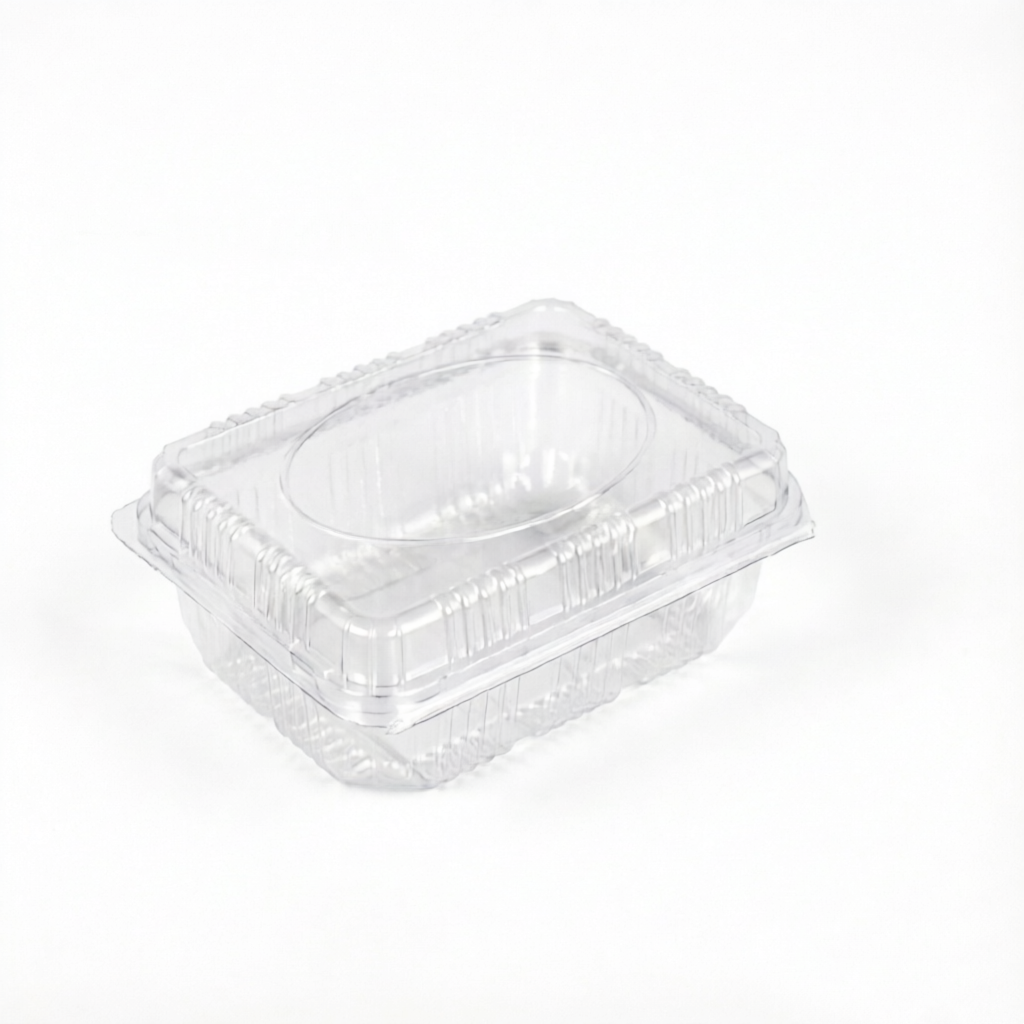
Clear transparent bodies are chosen because the PET material provides high visibility of the contents and the pack sells directly from the shelf. Stackable designs save refrigerator and warehouse space, which matters when the same container is used for in-store display and back-room storage.
Berries, cherry tomatoes and small fruit
Smaller formats such as HB-SG250ML (13.5 × 11.5 × 6.5 cm) and HB-8OZ-235 (14.3 × 12.5 × 6 cm) sit in the same produce container family as the larger HB-SG500ML (17.5 × 13.5 × 7.5 cm), HB-PG02 (22.5 × 12 × 10 cm) and HB-7123 (12.9 × 9.7 × 7.2 cm). All are food grade BPA-free PET, refrigerator safe, with clear transparent bodies and stackable designs — useful when a buyer wants berry, cherry tomato and small fruit lines to share one visual language on the same shelf.
Prepared salads and compartmented meals
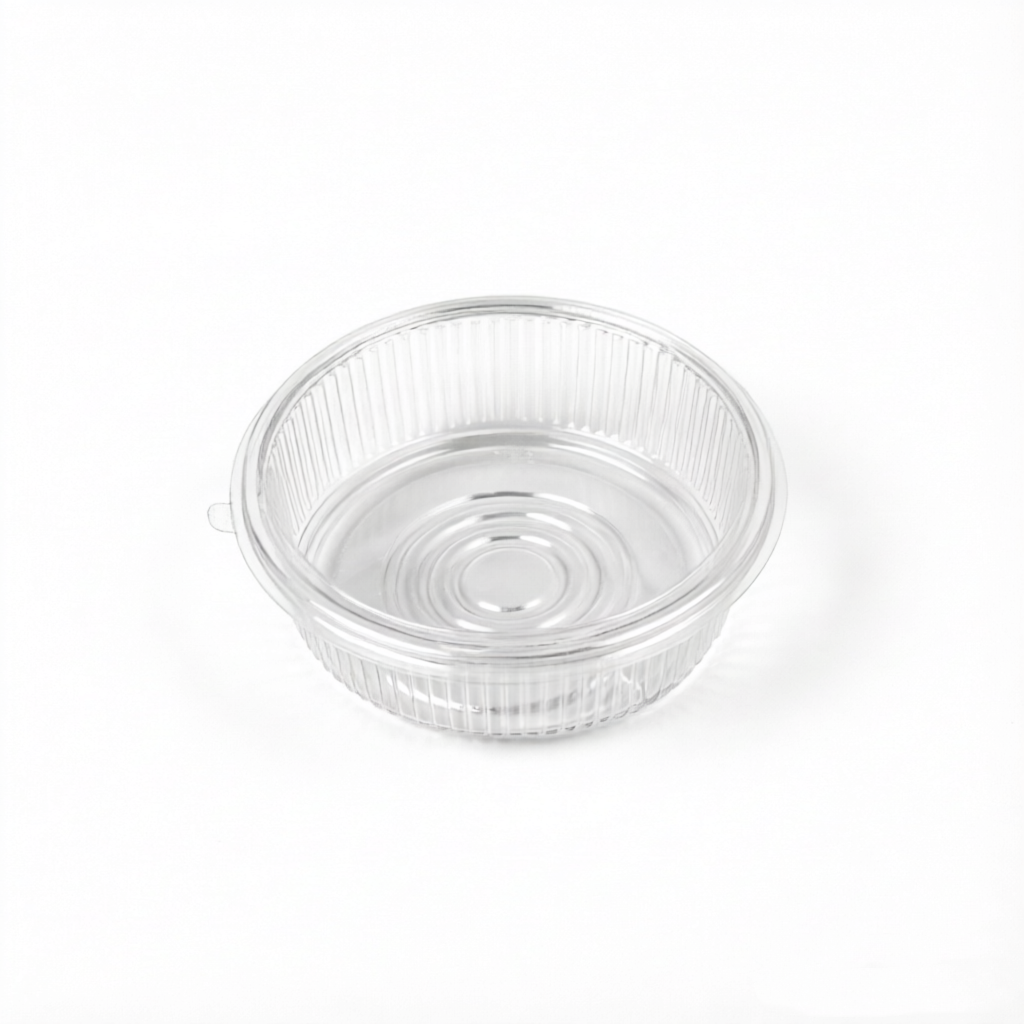
The salad family covers airtight, clamshell, compartment and stackable formats. The optional compartment design separates sauce from vegetables, which keeps ingredients fresh and crisp during delivery, and the leakproof airtight lid prevents dressing spilling in transit — the two features that most often decide whether a salad kit is viable for retail distribution.
Bakery counters and MAP trays
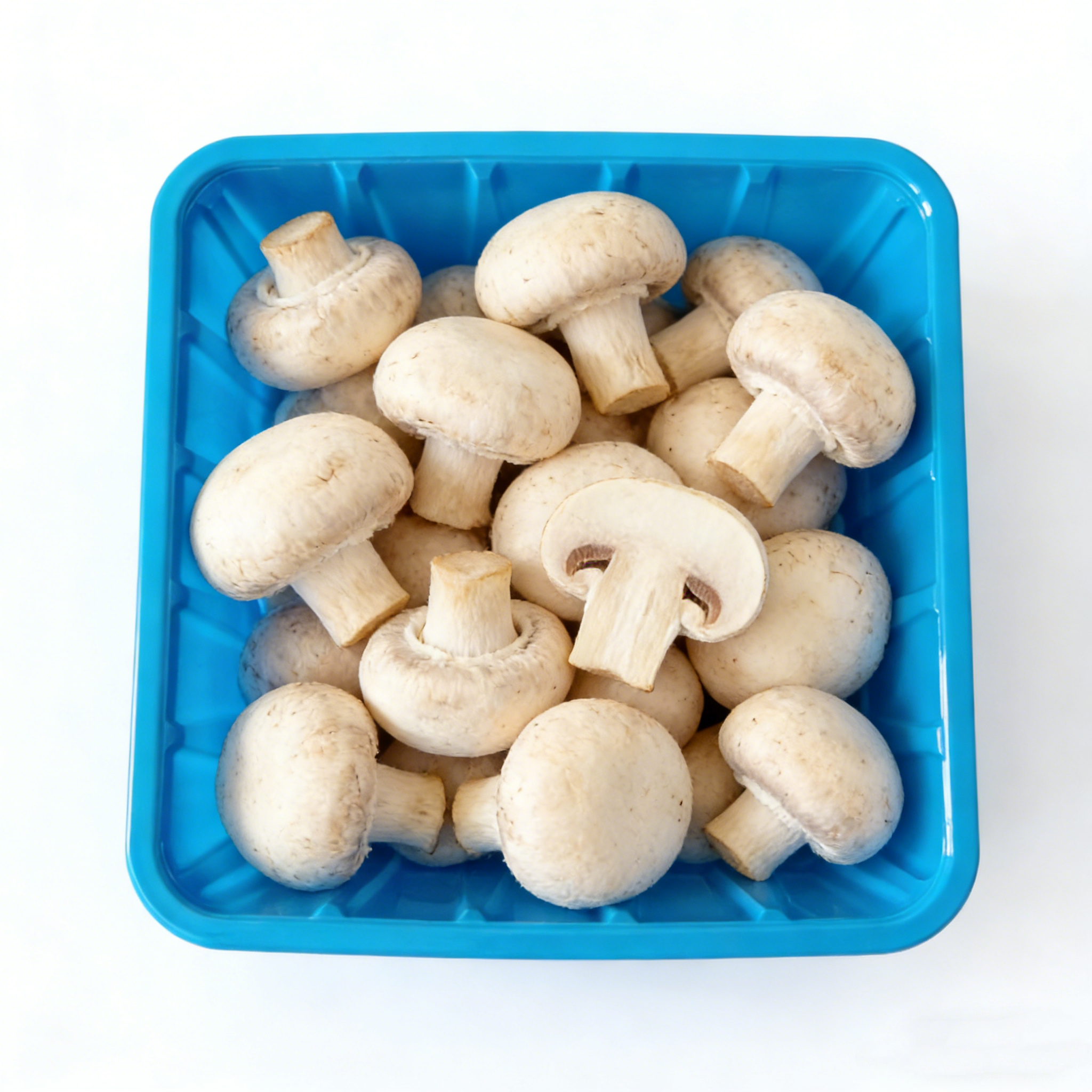
Trays such as HB-MG40 OZ, HB-MG24 OZ, HB-T9576 and HB-T9333 are classified across bakery, produce, meat and compartment tray categories, and are compatible with MAP modified atmosphere packaging production lines. Rigid structures reduce deformation during transit, and the models are described as suitable for produce, bakery, meat, poultry and ready meals, which allows a retailer to standardise tray handling across several counters.
Export, e-commerce and cold chain
Documented cooperation includes a Canadian project for supermarket fresh produce display, cold chain storage and food packaging transportation, at a monthly order scale of 300,000 pieces, running for more than five years with food-grade material, a durable stackable design and custom size support. In Southeast Asia, projects across Malaysia, Thailand, Vietnam, Singapore and Indonesia involve monthly orders of 500,000 food plastic containers for fresh fruit and vegetable packaging, seafood and meat cold chain packaging, food factory processing, supermarket retail display and wholesale distribution; one case describes a 12-year cooperation around clear PET clamshell containers that are stackable, food-grade and fitted with vent holes.
After-sales coordination: the questions to settle before signing
After-sales support in packaging is mostly preventive. The table below lists the points buyers typically agree in writing before a long-term commitment, and why each one matters.
| Coordination point | What to agree | Why it matters for repeat supply |
|---|---|---|
| Approved sample record | Model number, dimensions and photographs of the approved unit, retained by both parties | Gives an objective reference when a later shipment is questioned |
| Dimension and material sheet | Category, material (PET or PP), dimensions in centimetres, lid type, stackability | Prevents specification drift between production runs |
| Food-contact documentation | Certification references and statements that the containers are food grade BPA-free and compliant with food contact standards | Needed for EU retail placement and for buyer due diligence |
| Change notification | How and when a material, mould or dimension change is communicated before shipment | Protects retail shelf plans and pallet configurations |
| Format confirmation | Clear, stackable, compartment or tamper-evident construction, plus decoration and logo printing | Avoids a functionally correct container that does not fit the display |
| Contact path | A named contact for technical queries and a named contact for commercial queries | Shortens the loop on dimension checks and claim reviews |
FAQ
Are PET fruit and vegetable containers and trays food-grade?
Yes — the PET containers and trays in this range are described as made of food grade BPA-free plastic and as compliant with food contact standards. HB-7001 is a food grade BPA-free PET container that is described as refrigerator safe, HB-SG300ML is food grade BPA-free with a stackable design and a clear transparent body, and HB-SG1000ML is made of food grade BPA-free plastic compliant with food contact standards. Trays including HB-MG24 OZ, HB-MG08 OZ, HB-T9576 and WSF-01 are also described as food grade BPA-free and meeting food contact safety standards. For EU-facing programmes, buyers normally check the supplier's documentation against the framework of EU Regulation (EC) No 1935/2004 and EU Regulation (EU) No 10/2011 for plastic materials in contact with food. Weifang Chuanhe New Material Co., Ltd. states that its plastic packaging is certified to BRC under the Global Standard for Packaging Materials, issued by SGS with certification number CN26/00005423, applicable to the NA, EU, ME, SEA and LATAM markets.
What should buyers check in fruit and vegetable packaging manufacturers before a long-term partnership?
Four indicators matter more than a catalogue: production infrastructure, tooling control, documented compliance and repeat-order behaviour. On infrastructure, the reference point is a facility covering 62,000 square metres running 20 fully automatic thermoforming machines and 20 standard thermoforming machines, including 4 advanced Kiefel machines, plus 4 PET sheet extrusion lines and 2 PP sheet extrusion lines, with annual production capacity of 54,000 tons and an R&D team of 5 engineers. On tooling, an in-house mould workshop indicates custom tray and clamshell development is controlled internally rather than outsourced. On compliance, look for named certifications — CE, BRC, FDA, EU and SGS quality management systems, and a BRC certificate under the Global Standard for Packaging Materials issued by SGS with certification number CN26/00005423. On repeat-order behaviour, check whether the manufacturer offers custom size, colour and logo printing and supports both small trial orders and bulk wholesale, and whether it has sustained long-running programmes: the company's documented cooperation includes a Canadian supermarket produce project running more than five years at 300,000 pieces per month, and Southeast Asian programmes with a 12-year cooperation on clear PET clamshell containers.
What drives the cost of a repeat-supply packaging programme?
Cost in a repeat programme is driven less by a single quoted unit price than by how the programme is structured. Relevant factors include the number of models held as standard, whether new tooling is required for a custom shape, the level of decoration and logo printing, the order frequency, and whether the supplier produces its own sheet material. In this case, in-house PET and PP sheet extrusion lines reduce reliance on outsourced raw material and support coordinated production and faster delivery, and the in-house mould workshop allows custom tray and container shapes to be developed without waiting on an external tooling supplier. Format also affects cost indirectly: stackable designs save warehouse and retail display space, which influences storage and logistics efficiency rather than unit price. The practical approach is to have costs quoted against the documented specification — model, material, dimensions, closure and decoration — so that any later change is priced transparently instead of being absorbed into a revised unit price.
How do we validate containers before committing to repeat orders?
Validation follows the same order as the supply agreement: specification first, physical trial second, volume third. Start with the documented dimensions and category for the model you intend to standardise — for example the 19.5 × 19.5 × 5 cm HB-7001, the 17.5 × 13.5 × 6 cm HB-SG300ML or the 23 × 17.5 × 9 cm HB-SG1000ML — then order a trial quantity, since factory direct supply supports small trial orders alongside bulk wholesale. During the trial, check lid closure and lid fit, confirm stacking behaviour against your shelf and pallet plan, verify that the material is food grade BPA-free PET, and confirm any custom size, colour or logo printing on the actual trial units rather than scaling a rendering. Retain photographs and dimensions of the approved unit; that record becomes the reference for every subsequent order.
How do we keep repeat orders consistent once supply starts?
Consistency comes from three habits: keeping the approved-sample record current, requiring advance notice of any change to material, mould or dimensions, and using a single technical contact alongside a single commercial contact. Model continuity is easier to hold when the supplier documents a model family rather than a one-off item — the produce container family, for instance, spans HB-SG250ML, HB-SG500ML, HB-PG02 and HB-7123, all food grade BPA-free PET with clear transparent bodies and stackable designs. The next step for buyers preparing a repeat programme is to request a quotation against the documented specification and a sample or trial-order discussion; Weifang Chuanhe New Material Co., Ltd. can be reached at chuanhe@newplasticbox.com or +86 134-5566-2777, and the full range is available at www.newplasticbox.com.
Conclusion
A long-term fruit and vegetable packaging partnership is built on four things that a quotation cannot show: a specification that is written down, a model range that is documented by category and dimension, a food-contact compliance record that travels with the order, and an after-sales routine agreed before the first repeat shipment. Models such as HB-7001, HB-SG300ML, HB-SG1000ML, HB1720 and HB-MG40 OZ matter less as individual items than as stable references that a buyer, a production planner and a retail customer can all point to.
The market context reinforces the point. Fresh food packaging is expanding, plastic food contact materials are governed by an established EU framework, and the 2030 restriction on single-use plastic packaging for small-format fresh fruit and vegetables will push buyers toward formats and suppliers they can document. Buyers who treat the first order as the beginning of a specification — rather than the end of a purchase — enter that period with fewer surprises.

Start the partnership conversation with a documented specification
Send the model, material, dimensions and destination market you are planning for, and request a sample or trial-order discussion plus a quotation against that specification. The full product range and container formats are available on the company website, and the product brochure can be downloaded here: CHUAN HE product brochure (PDF).
Email: chuanhe@newplasticbox.com · Phone / WhatsApp: +86 134-5566-2777 · Website: www.newplasticbox.com
Have Questions or Need More Details?
Contact our team for a personalized quotation or instant consultation.
Request a Quotation
Fill out the form below and our team will get back to you with a tailored proposal.
WhatsApp Direct Chat
Prefer to chat in real-time? Message us on WhatsApp for instant assistance & quick answers.
- Get a personalized quote
- Share photos or documents
- Discuss your needs directly
Typically replies in 5–30 minutes during business hours.