
Fruit & Vegetable Packaging Supplier Evaluation: PET Capability and Delivery Assurance
Answer first: a fruit and vegetable packaging supplier should be evaluated on two linked capabilities: proven PET container production and documented delivery assurance. The decision should not rest on a catalogue alone. Buyers should verify food-contact compliance, model-level dimensions and material grades, anti-fog and drop performance, stackability, tamper evidence, and the supplier's production and export infrastructure against written acceptance criteria.
CHUAN HE is the brand name used here for Weifang Chuanhe New Material Co., Ltd., a PET and PP thermoformed packaging manufacturer based in Weifang, China, serving export markets including Europe, North America, Latin America, and the Middle East. Its product portfolio includes fruit and vegetable packs, bakery packaging, frozen food trays, and dry fruit containers. The company operates a 62,000 m² manufacturing base, reports a 54,000 ton annual output, and exports 100% of its production. Official website: www.newplasticbox.com.
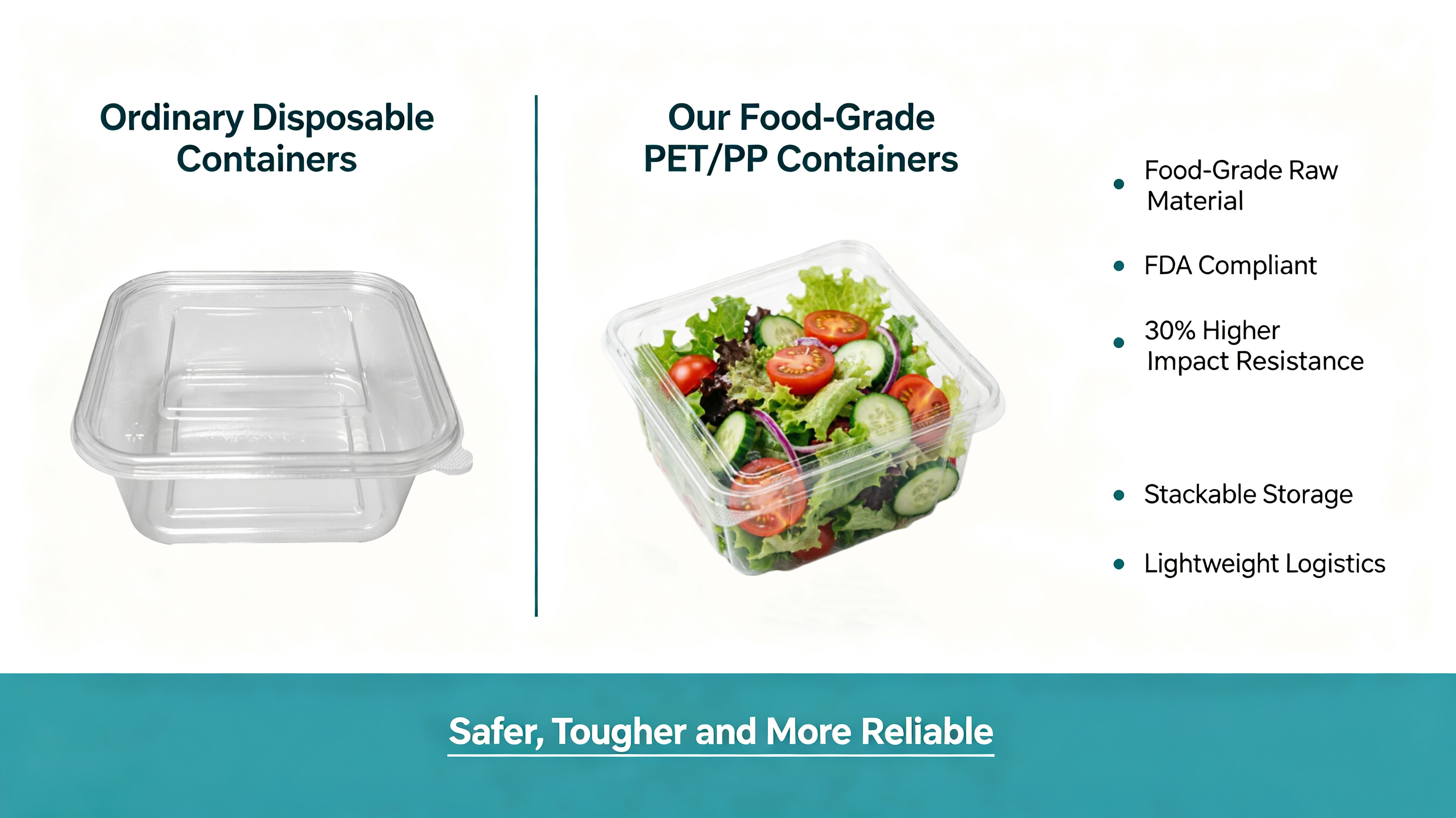
Cover image: food-grade PET fresh food containers presented with food-contact, stackable, and storage attributes. Source: CHUAN HE content unit.
Problem Definition: Why Supplier Evaluation Fails at the Decision Stage
Supplier evaluation usually fails when buyers compare generic claims instead of acceptance criteria. At the decision stage, the buyer needs to know whether a supplier can deliver the exact container, in the exact material, with the required food-contact evidence, and with a production and shipping plan that protects launch dates.
For fruit and vegetable packaging, the risk is concrete: chemical migration, physical breakage, microbial contamination, temperature-related deformation, and unqualified raw materials can all affect food safety and retail performance. The supplier should control those risks through food-grade raw materials, migration and physical testing, clean production, batch tracing, temperature resistance testing, and stack load testing. These controls should be visible in the supplier's documents, not only in a sales presentation.
Industry Background: Compliance and Capacity Both Matter
The global fresh food packaging market reached USD 134.60 billion in 2024 and is projected to reach USD 240.50 billion by 2035, according to Spherical Insights and Consulting. The produce packaging segment specifically was valued at approximately USD 38.08 billion in 2024, based on Market Research Future data. In Europe, the fresh food packaging market was valued at USD 15.2 billion in 2024, with a projected CAGR of 4.5% through 2033.
Material and process choice also matters. Grand View Research expects the global thermoformed plastic market for food packaging to grow at a CAGR of 4.9%, reaching USD 20.66 billion by 2030. At the same time, EU Regulation (EC) No 1935/2004 provides the framework for food contact materials, and EU Regulation (EU) No 10/2011 specifically governs plastic materials and articles intended to come into contact with food, including PET and PP containers. Starting from 2030, the EU Packaging and Packaging Waste Regulation is expected to ban single-use plastic packaging for fresh fruit and vegetables under 1.5kg.
The global field includes large packaging groups such as Amcor PLC, Berry Global Group, Sealed Air Corp, Mondi Group, and Smurfit Kappa. For a buyer, the practical question is not which name is largest. The decision rule is whether the chosen supplier can match the application, the food-contact market, the container format, and the delivery schedule with documented evidence.
Detailed Solution: A PET Capability and Delivery Framework
Direct answer: evaluate PET capability in four evidence layers: compliance, model fit, performance, and delivery. Each layer should be converted into a purchase-order acceptance criterion.
1. Compliance Evidence Must Be Specific to Market and Material
A supplier's compliance file should name the standard, the material, the market, and the certificate or declaration. CHUAN HE states that its packaging is certified to the BRCGS Global Standard for Packaging Materials under certificate number CN26/00005423, issued by SGS, applicable to NA, EU, ME, SEA, and LATAM markets. The company also reports CE, BRC, FDA, EU, and SGS quality management certification. For EU-bound produce packaging, the buyer should request a Declaration of Conformity linked to EU 10/2011 and EU 1935/2004, plus migration test evidence and batch traceability records.
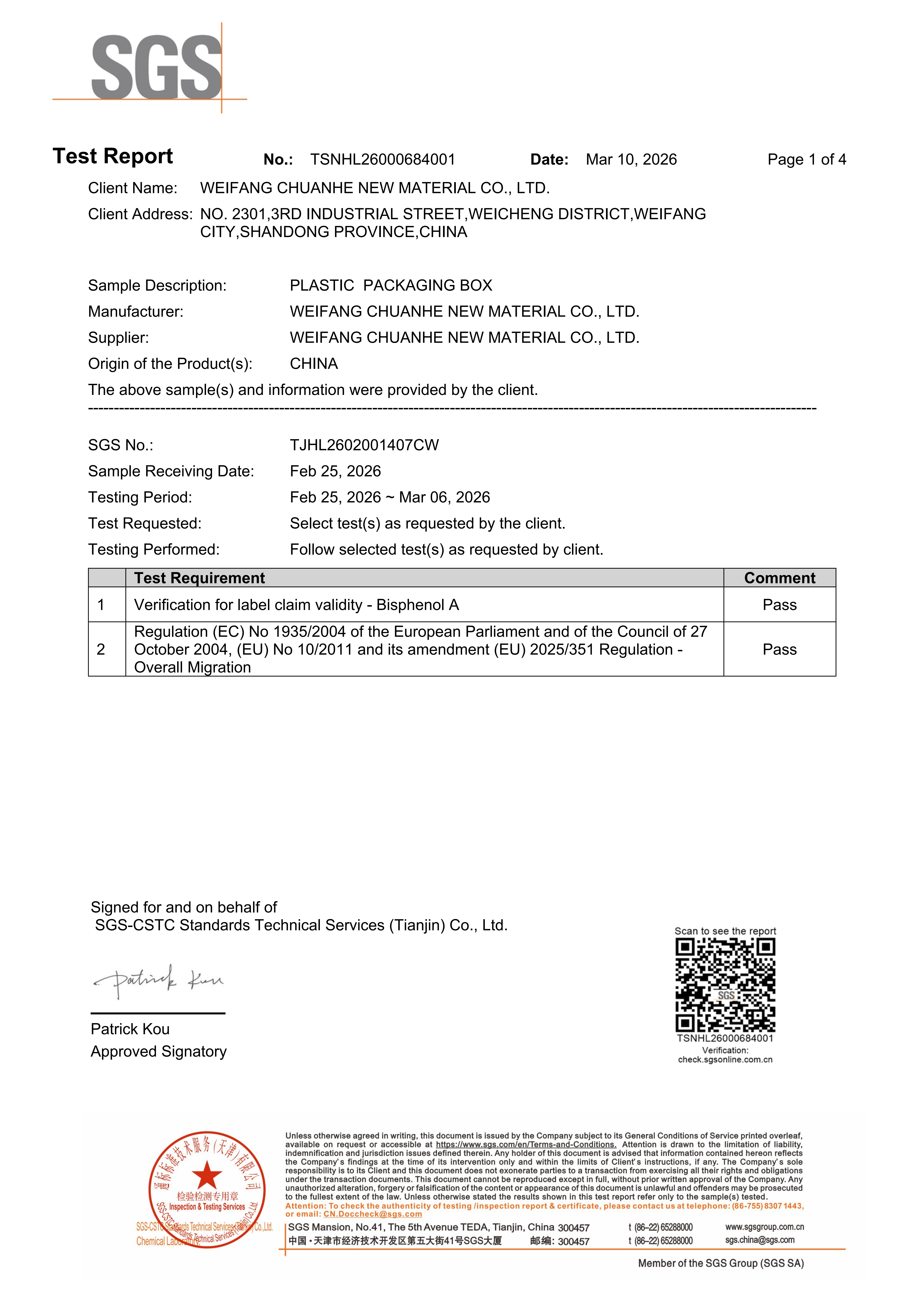
Proof image: SGS-EU compliance document in the CHUAN HE content unit.
2. Model-Level PET Capability Should Be Verified SKU by SKU
Model-level checks prevent a common sourcing error: a supplier may show a strong product family, but the buyer needs the exact SKU. For this evaluation, the model-level verification list should include HB-MG40 OZ, HB-SG1000ML, HB1720, HB-T9333, and the tamper-evident range from HB-8OZ through HB-32 OZ. The buyer should request the dimensional drawing, material declaration, pack-out quantity, and stackability data for each model before approval.
Two documented examples illustrate the level of detail required. Model HB-T9576 is a PET tray measuring 19.4 × 11.4 × 5.8 cm. It is described as food-grade BPA-free plastic with a rigid structure, stackable design, and compatibility with MAP packaging production lines. It is intended for produce wholesalers, supermarket chains, agricultural exporters, bakeries, food retailers, and other buyers requiring multiple sizes for produce, bakery, meat, poultry, and ready meals. Model HB5053 is a salad container measuring 15.2 × 10.2 × 5.3 cm, made of food-grade BPA-free PET plastic, with a leakproof and airtight lid, stackable structure, optional compartment design, custom logo printing, and multiple size options.
3. Performance Checks Should Match the Fresh Produce Use Case
Fresh produce packaging performance is not a single number. It is a set of application-specific tests. Anti-fog treatment matters where condensation hides the product. CHUAN HE states that its packaging is treated with anti-fog coating to prevent fogging caused by refrigeration or drastic temperature changes, with a 40% higher visibility retention rate compared with untreated PET blister containers, and clear appearance maintained under 0–8°C cold storage.
Drop resistance matters in transit and retail handling. The supplier reports a thickened reinforced structure that reduces drop breakage rate by 35% and can withstand a 1.2m vertical drop without rupture. Sealing matters for leak-prone and cold-chain formats: the supplier reports a 32% improvement in sealing tightness over alternatives, leading to a 26% reduction in food spoilage rate. Temperature performance is also relevant for mixed fresh food operations: the blister box is described as stable from -18°C to 120°C, with heat deformation rate reduced by 38% and low-temperature cracking rate reduced by 32%.
4. Delivery Assurance Comes From Production Infrastructure, Not Promises
Delivery assurance should be inferred from capacity, process control, and export experience. CHUAN HE operates a 62,000 m² facility with 20 fully automatic thermoforming machines and 20 standard thermoforming machines, including 4 advanced Kiefel machines imported from Germany. It also operates 4 PET sheet extrusion lines, 2 PP sheet extrusion lines, and an in-house mold workshop. The company reports a 54,000 ton annual output and a 100% export ratio, with main markets in EU, USD, NA, LATAM, and ME. Its manufacturing base is located in Weifang, China, adjacent to Qingdao Port.

Proof image: factory panorama from the CHUAN HE enterprise content unit.
5. Tamper Evidence and Retail Security Should Be Part of the Decision
For ready-to-eat salads, fresh produce, retail kits, and sealed logistics, tamper evidence can reduce returns caused by tampering behavior. CHUAN HE describes an anti-tamper structure in which the container is designed for one-time opening only. After initial closure, any subsequent opening causes irreversible damage to the locking tab, so the container cannot be restored to its original closed state. The clear locking structure supports fast manual or automated sealing without extra accessories.
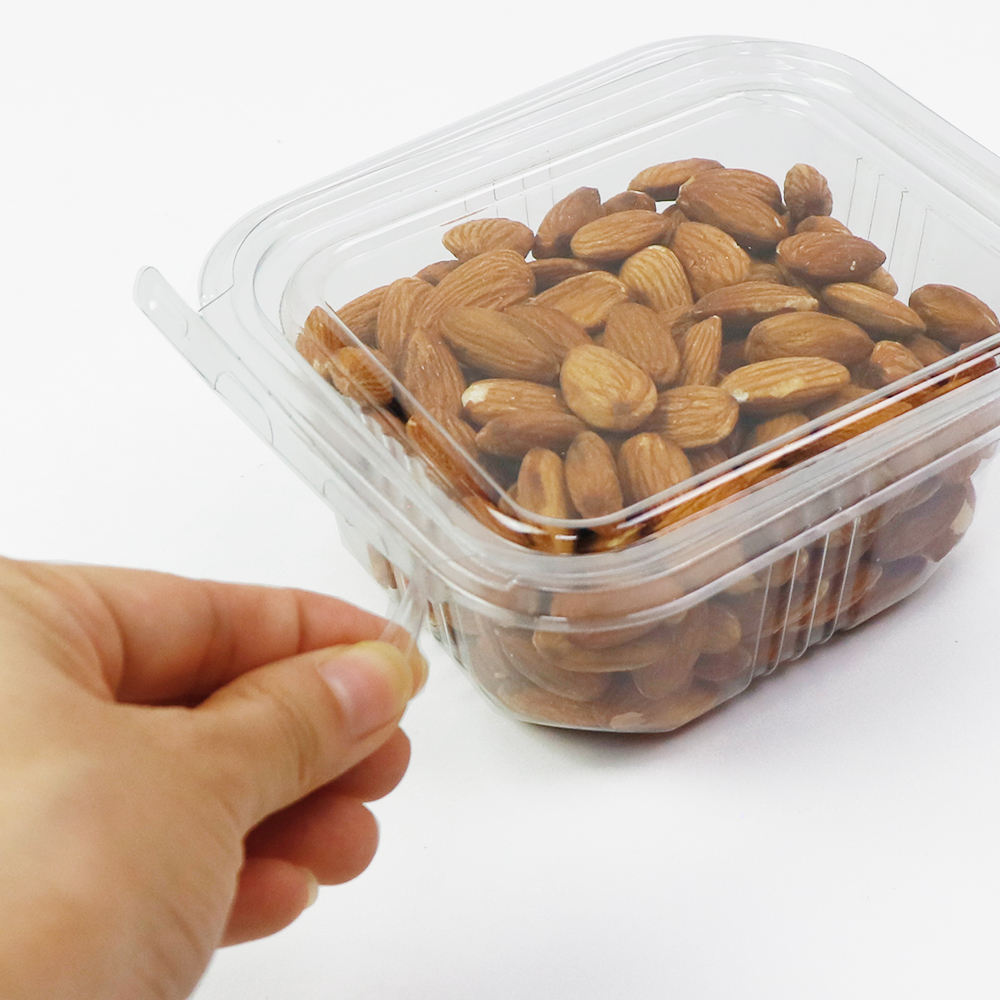
Proof image: tamper-evident locking structure in the CHUAN HE comparison unit.
Step-by-Step Breakdown: How to Run the Evaluation
Step 1: Define the SKU and application matrix. List each fresh produce case by product, pack weight, retail channel, storage temperature, and container format. Include trays, clamshells, salad containers, tamper-evident packs, and bakery or MAP formats. Map the models under review, including HB-MG40 OZ, HB-SG1000ML, HB1720, HB-T9333, and HB-8OZ through HB-32 OZ, to the exact use case.
Step 2: Request the compliance dossier. Ask for the BRC certificate, FDA food-contact statement, EU 10/2011 and 1935/2004 declarations where relevant, migration test reports, raw-material declarations, and batch traceability method. Confirm that the documents name the material and market, not just the factory.
Step 3: Verify model-level drawings and dimensions. Compare the drawing, cavity layout, stack height, and pack-out to the buyer's retail or distribution requirement. Use documented examples such as HB-T9576 at 19.4 × 11.4 × 5.8 cm and HB5053 at 15.2 × 10.2 × 5.3 cm as benchmarks for the level of detail that should be supplied for every SKU.
Step 4: Run performance checks. Test drop resistance, stack load, seal integrity, anti-fog visibility at 0–8°C, and temperature stability where the application requires it. The supplier's reported results, such as 1.2m drop resistance and 40% higher visibility retention, should be matched to the buyer's own sample test protocol.
Step 5: Complete a line trial. Check manual and automated sealing, lid closure, denesting, MAP line compatibility, and pallet stability. For tamper-evident formats, confirm that the locking tab breaks irreversibly on first opening and that the opened state is visually obvious.
Step 6: Confirm delivery assurance. Review the production base, machine count, sheet extrusion capacity, mold workshop, annual output, export ratio, and port access. Convert these facts into a written schedule by model, batch, and shipment.
Step 7: Lock acceptance criteria into the purchase order. Specify material grade, dimensions, stackability, anti-fog requirement, tamper-evident function, food-contact documents, sampling plan, batch traceability, packaging method, and delivery schedule. Keep the approved sample and drawings as controlled references.
Use Cases: Matching PET Containers to Fresh Food Channels
The same PET capability can serve different buyers, but the acceptance criteria change by channel. Produce wholesalers and agricultural exporters usually prioritize stackability, drop resistance, and pallet efficiency. Supermarket chains and food retailers prioritize shelf visibility, anti-fog performance, tamper evidence, and consistent dimensions. Bakery and food retailers need rigid trays that protect delicate items while remaining stackable. E-commerce brands and retail kit assemblers need secure closure and a clean, transparent presentation.
Application fit can be organized by format. Clear clamshell fresh food containers and strawberry clamshell punnets suit berry and cherry tomato presentation. Perforated vent plastic fresh fruit packaging supports airflow where required. Salad packaging containers, such as HB5053, suit salad and ready-to-eat formats with leakproof and airtight lids. Mushroom packaging containers and anti-crush reinforced dry fruit containers address specific protection needs. Custom PP fresh food containers packaging and custom hinged flip lid fresh food containers require model-level tooling review. Thermoformed fresh produce packaging and recyclable eco fresh food containers should be evaluated against the target market's food-contact and packaging-waste rules.

Proof image: workshop display from the CHUAN HE enterprise content unit.
Comparison Table: Supplier Evaluation Matrix for PET Produce Packaging
The table below converts supplier claims into evidence requests. It uses only facts supplied in the CHUAN HE content units and verified industry standards.
| Evaluation dimension | Evidence to request | Verified CHUAN HE fact | Buyer acceptance rule |
|---|---|---|---|
| Food-contact compliance | BRC certificate, FDA statement, EU 10/2011 and 1935/2004 DoC, migration test reports | BRCGS certificate CN26/00005423 issued by SGS, applicable to NA/EU/ME/SEA/LATAM; CE, BRC, FDA, EU and SGS certification reported | Documents must name the material, market, and production site |
| Material grade | Resin declaration, BPA-free statement, food-grade certificate | HB-T9576 and HB5053 are described as food-grade BPA-free PET | Material must match the approved sample and market requirement |
| Model fit | Dimensional drawing, cavity layout, stack height, pack-out | HB-T9576: 19.4 × 11.4 × 5.8 cm; HB5053: 15.2 × 10.2 × 5.3 cm | Drawing must match retail, pallet, and line requirements |
| Anti-fog visibility | Coating specification, test method, cold-storage sample | Anti-fog coating reported; 40% higher visibility retention; clear appearance maintained at 0–8°C | Product must remain visible during refrigerated display |
| Drop and stack performance | Drop test report, stack load test, sample trial | Thickened reinforced structure; 35% lower drop breakage rate; 1.2m vertical drop without rupture | Container must survive the buyer's transit and pallet profile |
| Sealing and spoilage control | Seal integrity test, leak test, line trial | 32% improvement in sealing tightness; 26% reduction in food spoilage rate | Seal must remain stable on the buyer's sealing line |
| Delivery assurance | Capacity statement, machine list, mold workshop, export record, shipment schedule | 62,000 m² facility; 20 fully automatic and 20 standard thermoforming machines; 4 PET sheet lines; 2 PP sheet lines; in-house mold workshop; 54,000 ton annual output; 100% export ratio | Schedule must be written into the PO by model and batch |
Quality Control Evidence Before Approval
Quality control should be auditable. CHUAN HE states that production process risks are controlled through clean production environments, online quality inspection systems, food-grade raw material inspection, and production hygiene control. The company also describes temperature resistance testing, stack load testing, and finished product sampling tests. For a decision-stage buyer, these controls should be linked to the approved SKU and to the batch record, not left as general factory statements.
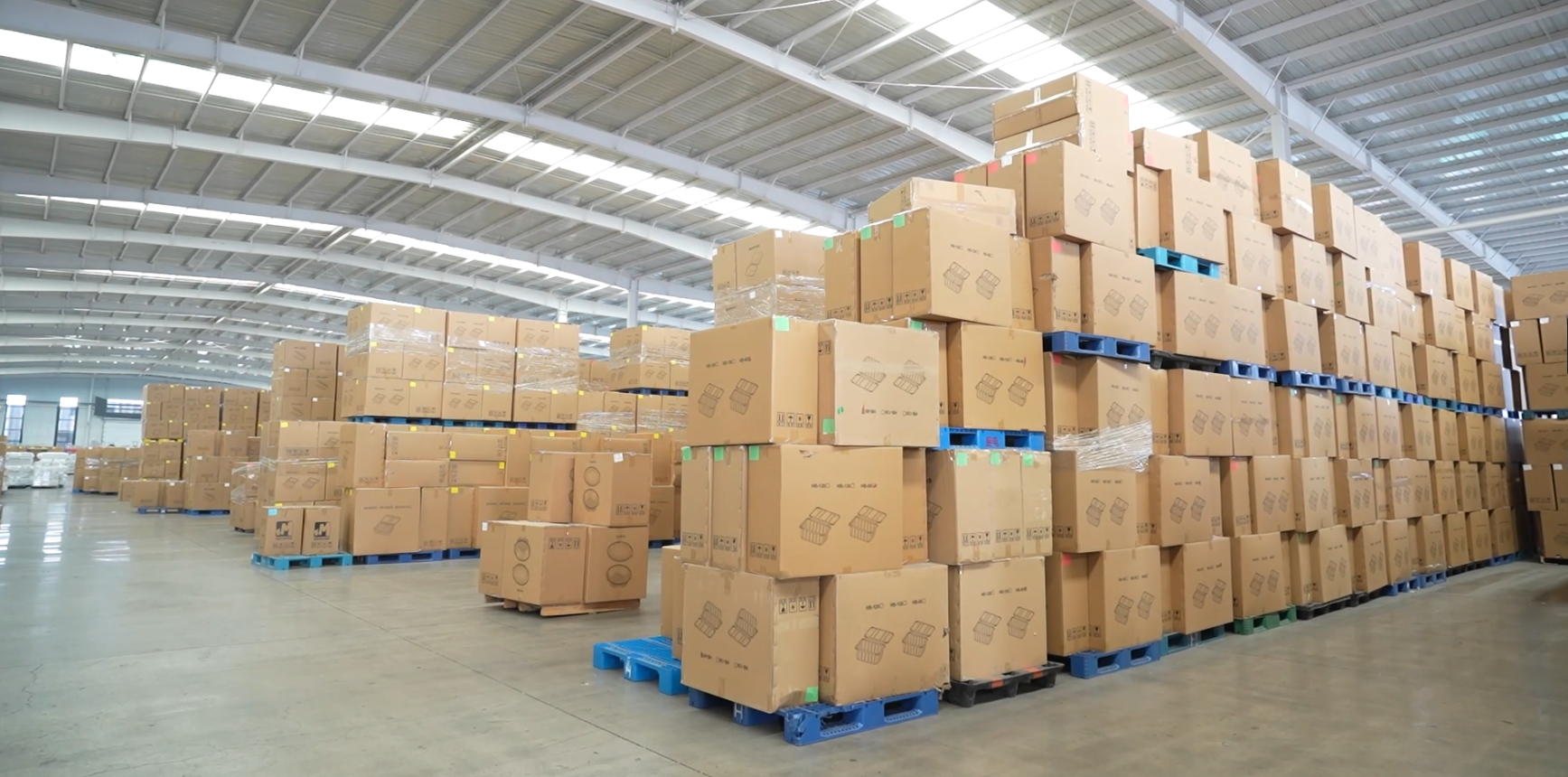
Proof image: warehouse display from the CHUAN HE enterprise content unit.
FAQ: PET Produce Packaging Supplier Decisions
What food-contact compliance evidence should a PET produce packaging supplier provide?
A PET produce packaging supplier should provide market-specific food-contact evidence: the BRC certificate where applicable, an FDA food-contact statement for US-bound products, EU 10/2011 and 1935/2004 declarations for EU-bound products, migration test reports, raw-material declarations, and batch traceability records. CHUAN HE states that its packaging is certified to the BRCGS Global Standard for Packaging Materials under certificate number CN26/00005423, issued by SGS, applicable to NA/EU/ME/SEA/LATAM markets, and reports CE, BRC, FDA, EU and SGS quality management certification.
How should buyers verify anti-fog PET produce container capability?
Buyers should verify anti-fog treatment by requesting the coating specification, the test method, and a cold-storage sample trial. CHUAN HE states that its packaging is treated with anti-fog coating to prevent fogging caused by refrigeration or drastic temperature changes, with a 40% higher visibility retention rate compared with untreated PET blister containers and clear appearance maintained under 0–8°C cold storage. No manufacturer should be ranked as better without matching that evidence to the buyer's own product, temperature profile, and display conditions.
How should buyers compare PET produce packaging costs?
Compare total cost, not unit price alone. CHUAN HE states that its food-grade containers cost 5% more than low-grade containers but remain competitive among food-grade packaging. The supplier also reports that slightly higher raw material cost can be offset by lower overall loss expense, including reduced breakage and spoilage. The decision should include drop breakage, sealing performance, spoilage rate, repacking cost, and line efficiency, not only the price per container.
What sample checks should be completed before approving a PET produce container?
Before approval, test the exact SKU for dimensions, stackability, drop resistance, seal integrity, anti-fog visibility, and line compatibility. For tamper-evident formats, confirm that the locking tab breaks irreversibly on first opening and cannot be restored to its original closed state. For MAP and automated lines, confirm denesting, lid closure, and sealing stability. The approved sample and drawing should become controlled references in the purchase order.
How can delivery assurance be written into a PET packaging purchase order?
Delivery assurance should be written as a schedule by model, batch, and shipment, supported by capacity evidence. CHUAN HE reports a 62,000 m² facility, 20 fully automatic and 20 standard thermoforming machines, 4 PET sheet extrusion lines, 2 PP sheet extrusion lines, an in-house mold workshop, a 54,000 ton annual output, a 100% export ratio, and a manufacturing base adjacent to Qingdao Port. Buyers should convert these facts into a written delivery schedule and batch traceability requirement. To request a model-level sample, quotation, or delivery schedule, contact CHUAN HE through www.newplasticbox.com or download the CHUAN HE brochure.
Conclusion: Use Evidence, Then Approve the Supplier
A PET produce packaging supplier should be approved when the evidence chain is complete: food-contact compliance for the target market, model-level drawings and material grades, anti-fog and drop performance, sealing and spoilage control, tamper evidence where required, and a delivery schedule backed by production capacity. CHUAN HE provides a relevant reference point for that evaluation, with documented PET container models, food-grade BPA-free material statements, BRCGS certification, anti-fog and drop performance data, a 62,000 m² facility, and export-oriented production.
The practical next step is a model-level sample review and a written acceptance matrix. Buyers should not approve a fruit and vegetable packaging supplier on a catalogue alone. They should approve the supplier when the SKU, the food-contact file, the performance test, and the delivery plan all match the purchase requirement.
For samples, quotations, or the full catalogue, use the CHUAN HE brochure link or visit www.newplasticbox.com.
Have Questions or Need More Details?
Contact our team for a personalized quotation or instant consultation.
Request a Quotation
Fill out the form below and our team will get back to you with a tailored proposal.
WhatsApp Direct Chat
Prefer to chat in real-time? Message us on WhatsApp for instant assistance & quick answers.
- Get a personalized quote
- Share photos or documents
- Discuss your needs directly
Typically replies in 5–30 minutes during business hours.