
Fruit & Vegetable Packaging: PET Containers That Protect Fresh Produce in Retail & Transit
Fruit & Vegetable Packaging: PET Containers That Protect Fresh Produce in Retail & Transit
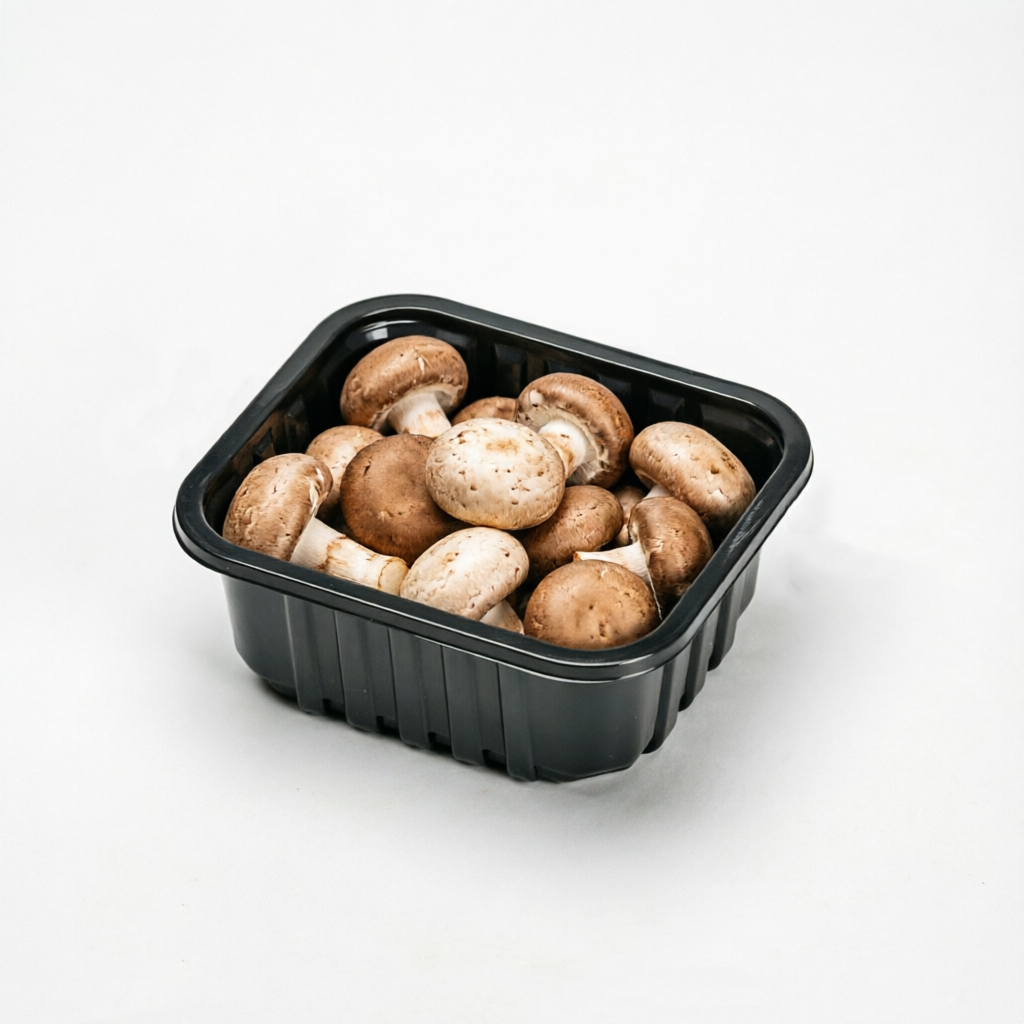
The short answer: effective fruit and vegetable packaging does four things—it protects the product, keeps food-contact compliance visible, makes the contents easy to see, and uses space efficiently from farm to store. For fresh produce buyers, the practical shortcut is to evaluate PET and PP thermoformed containers against these four jobs, not price or appearance alone.
This guide explains how to choose fruit and vegetable packaging for supermarkets, wholesalers, agricultural exporters, fresh e-commerce brands, bakeries, and food retailers. It also shows how PET-based container systems from Weifang Chuanhe New Material Co., Ltd. (CHUAN HE) meet those requirements.
Why Fruit & Vegetable Packaging Fails
Fresh produce remains biologically active after packing. Berries, mushrooms, tomatoes, and leafy salads continue to respire, release moisture, and remain vulnerable to crushing and condensation. Packaging must therefore balance conflicting goals: a sealed container can keep moisture in, but too little airflow can accelerate spoilage; a rigid tray adds protection, but inefficient shapes waste warehouse and retail space.
Common failure points in fresh produce packaging include:
- No ventilation for high-respiration products such as berries and cherry tomatoes.
- Poor stacking geometry that wastes cold-chain space.
- Foggy or low-transparency material that hides the product at the point of sale.
- Unclear food-contact documentation, especially for EU retail buyers.
Industry Background: Market Size and Regulatory Pressure
Market data underlines the scale. The global fresh food packaging market reached USD 134.60 billion in 2024 and is projected to reach USD 240.50 billion by 2035, according to Spherical Insights & Consulting. The produce packaging segment specifically—packaging for fruits and vegetables—was valued at approximately USD 38.08 billion in 2024, according to Market Research Future. Europe's fresh food packaging market was valued at USD 15.2 billion in 2024, with a projected CAGR of 4.5% through 2033.
Material choice is also shifting. The global thermoformed plastics market for food packaging is expected to grow at a CAGR of 4.9%, reaching USD 20.66 billion by 2030, according to Grand View Research. Established global names in produce packaging include Amcor PLC, Berry Global Group, Sealed Air Corp, Mondi Group, and Smurfit Kappa.
Regulatory pressure is rising. In the EU, Regulation (EC) No 1935/2004 provides the framework for all food contact materials, and Regulation (EU) No 10/2011 governs plastic materials and articles intended to contact food. From 2030, the EU Packaging and Packaging Waste Regulation (PPWR) will ban single-use plastic packaging for fresh fruit and vegetables under 1.5 kg. Buyers should therefore ask suppliers how their packaging addresses food-contact compliance, recyclability, and weight reduction.
Detailed Solution: PET Fruit & Vegetable Packaging From CHUAN HE
Who CHUAN HE Is
Weifang Chuanhe New Material Co., Ltd., established in 2013, specializes in the innovative design and customized production of PET and PP thermoformed packaging containers. The company is located in Weifang, China, adjacent to Qingdao Port, with a manufacturing facility covering 62,000 square meters and 51–100 staff. Its main products are baking packaging and fruit and vegetable packaging. Export business accounts for 100% of sales, with major markets including the European Union, United States, North America, Latin America, and the Middle East.
The company's product range includes fruit and vegetable packs, bakery packaging, frozen food trays, and dry fruit containers. R&D is supported by a team of 5 engineers, and the company has experience developing thousands of molds.
Factory Control That Supports Packaging Consistency
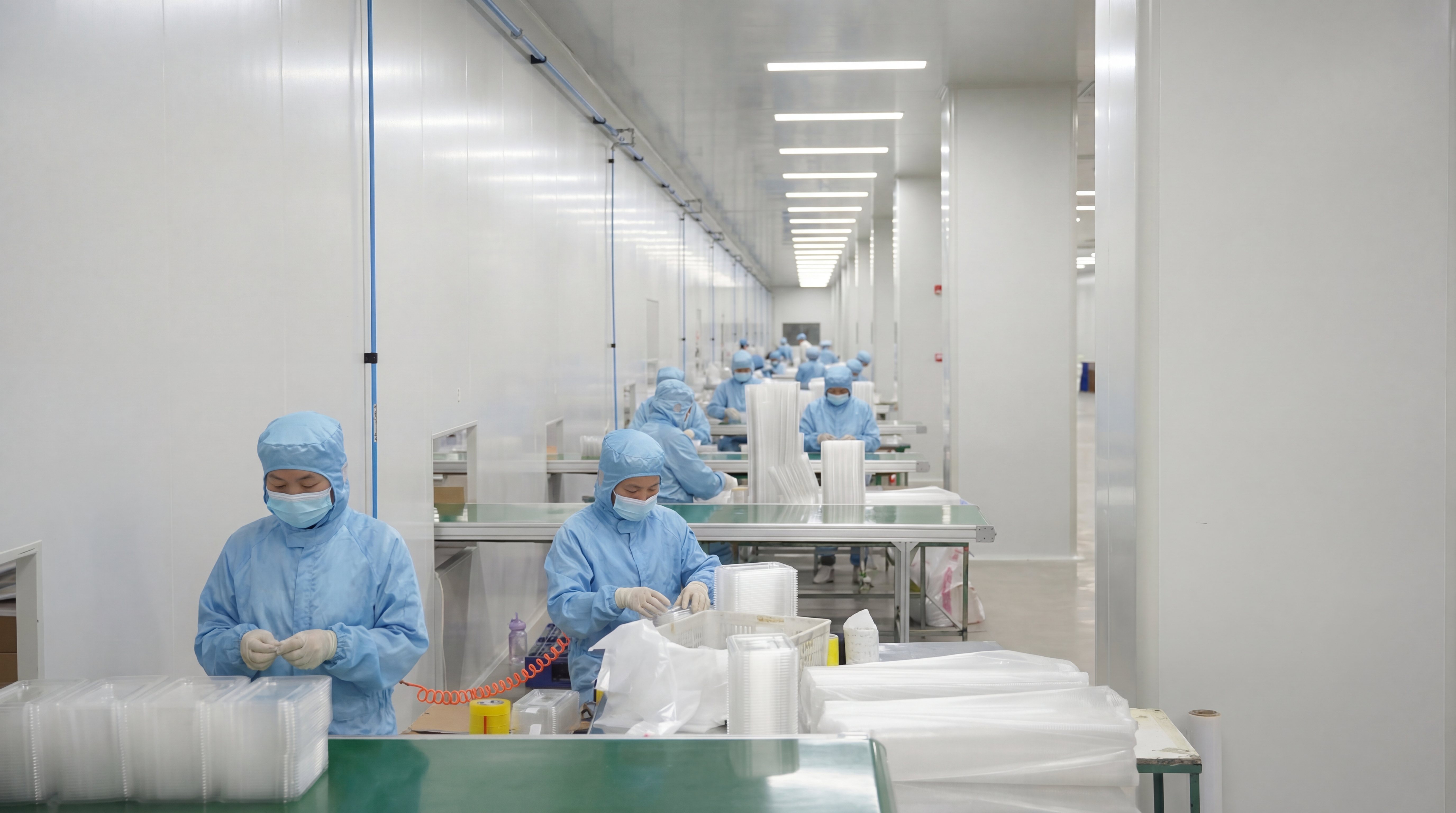
For fruit and vegetable packaging, consistency matters: a container must be identical from one production batch to the next. CHUAN HE operates 4 PET sheet extrusion lines and 2 PP sheet extrusion lines, along with an in-house mold workshop. It runs 20 fully automatic thermoforming machines and 20 standard thermoforming machines, including 4 advanced Kiefel machines imported from Germany. Annual production capacity reaches 54,000 tons.
Because sheet extrusion, tooling, and thermoforming are managed in one facility, the company reports reduced cost of outsourced raw materials and coordinated production for faster delivery.
Food-Contact Safety and Certification
The PET produce containers in the CHUAN HE range are described as food-grade and BPA-free. They are designed to support compliance with food contact standards, including EU Regulation (EC) No 1935/2004 and Regulation (EU) No 10/2011 for plastic materials.
The packaging is certified to BRCS under the Global Standard for Packaging Materials, issued by SGS, with certification number CN26/00005423, applicable to NA, EU, ME, SEA, and LATAM markets. The company also reports certifications including CE, BRC, FDA, EU, and SGS quality management systems.
Container Design: Transparency, Stacking, Ventilation, and Protection
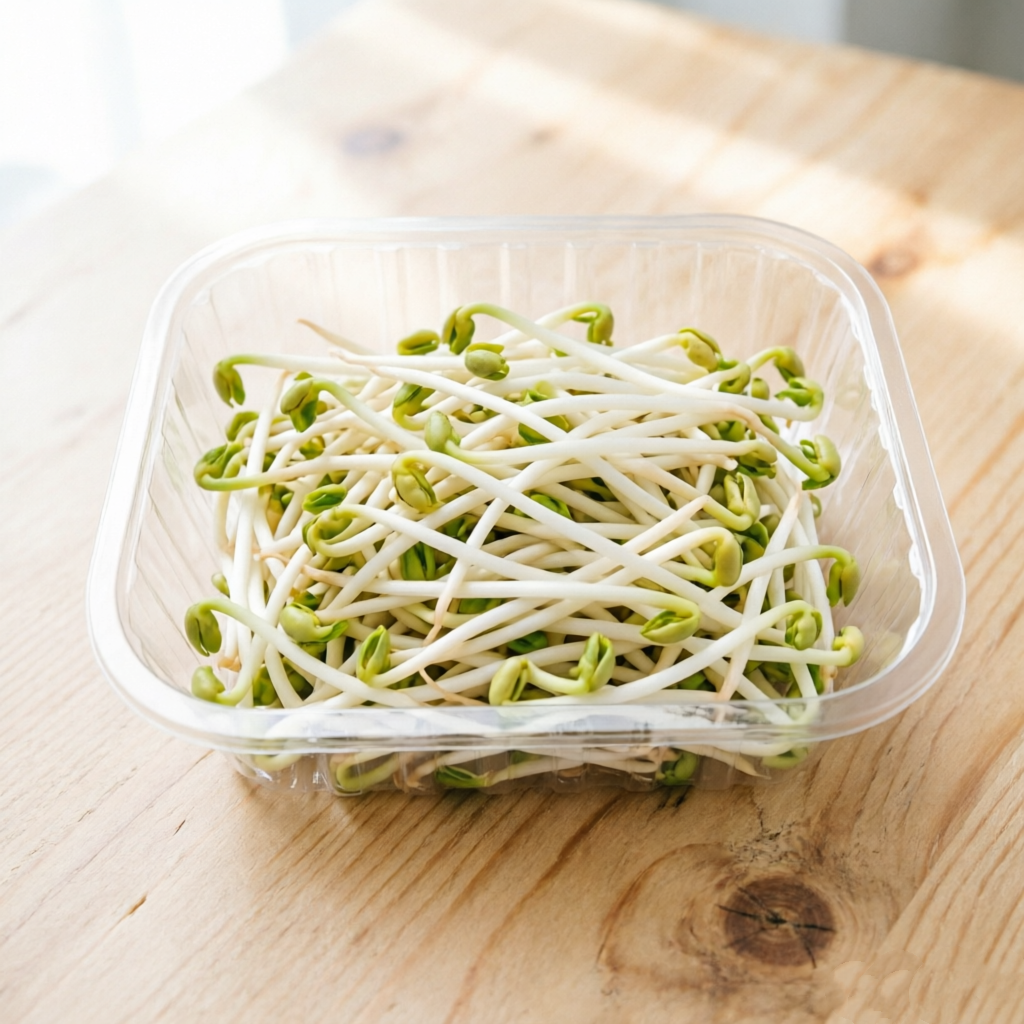
PET material offers high transparency, providing clear visibility of contents. This matters in supermarkets where the package is the salesperson. Many CHUAN HE produce containers are classified as Produce Storage Containers, Berry Storage Containers, Fridge Vegetable Crisper Boxes, Ventilated Produce Keepers, and Stackable Fruit Containers.
In the tray range, models such as HB-T9576 and WSF-01 are made with a rigid structure to reduce deformation and goods damage during transit. They are stackable, saving warehouse and retail display space, and compatible with MAP (modified atmosphere packaging) production lines where required.
Salad containers such as HB5053, HB7047, HB5224, and HB5240 add another function: they feature a leakproof and airtight lid, and an optional compartment design to separate sauce and vegetables. This supports prepared food programs in supermarkets and food retailers.
Container Families at a Glance
| Family | Example Models | Material | Key Features | Typical Use |
|---|---|---|---|---|
| Fruit & Vegetable Containers | HB-SG250ML, HB-SG300ML, HB-SG500ML, HB-7001, HB-SG1000ML | PET, food-grade BPA-free | Clear body, stackable, refrigerator safe, ventilated produce keeper classification | Berries, cherry tomatoes, vegetables, fridge storage and supermarket display |
| PET Trays | HB-MG08 OZ, HB-MG24 OZ, HB-MG40 OZ, HB-T9576, HB-3066, HB-T9333, WSF-01 | PET, food-grade BPA-free | Rigid structure, stackable, clear display, MAP-compatible | Produce trays, supermarket display, meat and bakery trays, ready meals |
| Salad Containers | HB5053, HB7047, HB5224, HB5240, HB1720 | PET, food-grade BPA-free | Leakproof airtight lid, optional compartment, stackable, anti-break | Packaged salads, prepared food, dressing separation |
| Tamper Evident Containers | HB-8OZ, HB-16OZ, HB-20 OZ, HB-24 OZ, HB-32 OZ | PET, high transparency | Tamper evident closure, custom shapes, ODM/OEM support | Fruit, vegetables, salads, bakery, sweets, snacks and convenience food |
Model dimensions and classifications are from CHUAN HE product documentation.
Step-by-Step: How to Select Fruit & Vegetable Packaging
Step 1: Map the produce to a pack format
Start with the product's size, weight, and respiration. For berries and cherry tomatoes, small ventilated containers such as HB-SG250ML (13.5 × 11.5 × 6.5 cm) and HB-8OZ-235 (14.3 × 12.5 × 6 cm) provide a compact footprint. For larger retail packs, HB-SG1000ML (23 × 17.5 × 9 cm) offers more volume. For product ranges that include meat, bakery, or ready meals, PET trays such as HB-MG24 OZ and HB-MG40 OZ can do multiple jobs.
Step 2: Verify food-contact compliance
Confirm that the packaging is made from food-grade, BPA-free plastic and ask for documentation. EU buyers should map the packaging to Regulation (EC) No 1935/2004 and Regulation (EU) No 10/2011. CHUAN HE's packaging includes a BRCS certificate issued by SGS with number CN26/00005423.
Step 3: Assess visibility and stacking
Retail packaging must sell from the shelf. Clear PET containers show product color and condition without opening the pack. Stackable designs reduce wasted space in refrigerators and warehouses, which directly affects cold-chain cost.
Step 4: Match the package to the packing line
If the line uses modified atmosphere packaging, choose trays compatible with MAP production lines. If the product includes dressing or moisture, salad containers with leakproof airtight lids and optional compartments reduce leakage. If security at retail is important, tamper evident containers provide a visible level of protection.
Step 5: Define customization needs
Custom size, color, and logo printing are available across the CHUAN HE range. ODM/OEM services support custom shapes, including rectangle, square, and round formats. For branded produce programs, this allows a supplier to match the package to the retail identity.
Step 6: Vet supplier capacity and logistics
A packaging supplier must be able to hold quality at scale. CHUAN HE's 54,000-ton annual capacity, in-house mold workshop, and location near Qingdao Port make it a workable option for exporters and retail programs that need consistent volume.
Use Cases
Supermarket fresh produce display
Clear PET fruit and vegetable containers support self-service retail. Models like HB-7001 (19.5 × 19.5 × 5 cm) and HB-SG300ML (17.5 × 13.5 × 6 cm) give customers a direct view of product quality. Stackability helps merchandisers build stable displays.
Berry and cherry tomato packing
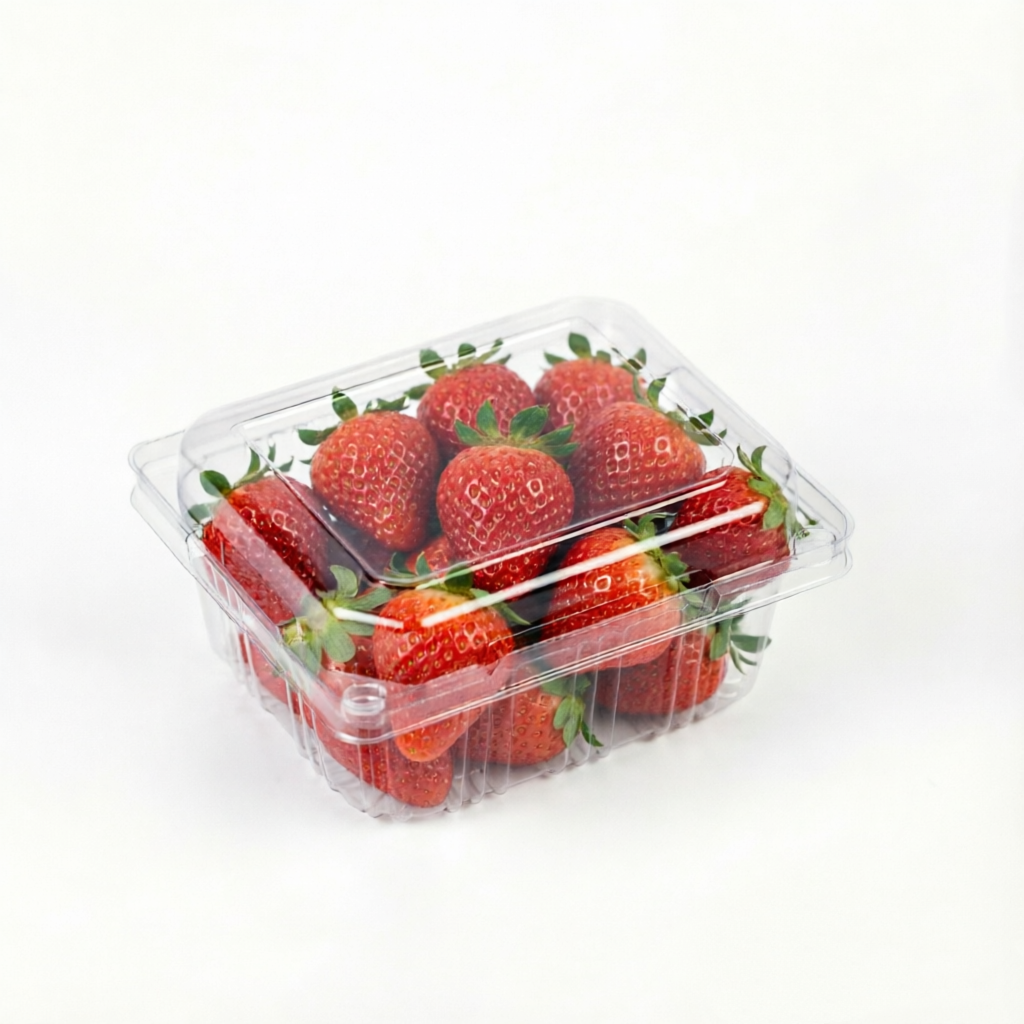
For berries and cherry tomatoes, small containers classified as ventilated produce keepers are a practical fit. The HB-SG250ML, documented in product material as a 250 ml capacity strawberry box, is designed for this type of high-respiration produce.
Salad and prepared food programs
Salad containers HB5053, HB7047, HB5224, and HB5240 support retail salad programs with clear visibility, airtight lids, and optional compartments. The leakproof design reduces the risk of dressing spills during transport.
Long-term export and cold-chain programs
Customer-facing case material describes a Canada-based food plastic container program used for supermarket fresh produce display, cold chain storage, and food packaging transportation, with a monthly order volume of 300,000 pieces and cooperation lasting more than five years. In Southeast Asia, documented projects across Malaysia, Thailand, Vietnam, Singapore, and Indonesia involve monthly orders of 500,000 food plastic containers for fresh fruit and vegetable packaging, seafood and meat cold-chain packaging, food factory processing, supermarket retail display, and wholesale distribution. One case records a 12-year cooperation with clear PET clamshell containers that are stackable, food-grade, and vented.
Cold-chain and temperature-sensitive packing
For frozen food, quick-freezing, cold transport, and ready-to-eat meals, CHUAN HE reports a blister box formulation that maintains stable performance under both freezing and heating conditions, with 38% lower heat deformation rate and 32% lower low-temperature cracking rate compared with alternatives. This type of performance can reduce broken boxes after temperature changes.
Comparison: What Different Container Models Deliver
The table above shows the practical range. Buyers should compare model dimensions, material, closure type, ventilation, and stackability before selecting a container family.
Frequently Asked Questions
What should fruit and vegetable packaging manufacturers provide for food-contact compliance?
They should provide food-grade BPA-free material and support compliance with relevant food contact regulations. In the EU, that means Regulation (EC) No 1935/2004 and Regulation (EU) No 10/2011 for plastic materials. CHUAN HE's PET produce containers are described as food-grade and BPA-free, and the packaging carries a BRCS certificate issued by SGS with number CN26/00005423, applicable to NA, EU, ME, SEA, and LATAM markets.
What manufacturing capabilities matter when choosing a fruit and vegetable packaging manufacturer?
Look for control over sheet extrusion, thermoforming, and tooling. CHUAN HE operates 4 PET sheet extrusion lines, 2 PP sheet extrusion lines, 20 fully automatic thermoforming machines, 20 standard thermoforming machines, and an in-house mold workshop. Annual capacity is 54,000 tons. This vertical setup supports coordinated production and faster delivery.
Can fruit and vegetable packaging be customized in size, color, and logo?
Yes. Custom size, color, and logo printing are available across the range. ODM/OEM services support personalized colors, sizes, and custom shapes including rectangle, square, and round. This is useful for supermarket private-label and e-commerce brands.
Can buyers test packaging with small orders before scaling up?
Factory direct supply supports small trial orders and bulk wholesale. Buyers can evaluate container fit, print quality, and line compatibility before committing to large volumes.
Does the manufacturer have export experience for retail and cold-chain programs?
CHUAN HE exports 100% of its sales, with major markets including the EU, US, North America, Latin America, and the Middle East. Documented programs include a Canada-based monthly order of 300,000 pieces with more than five years of cooperation, and Southeast Asia projects across Malaysia, Thailand, Vietnam, Singapore, and Indonesia with monthly orders of 500,000 containers and one 12-year cooperation.
Conclusion
Fruit and vegetable packaging works when it connects food safety, product protection, retail visibility, and supply-chain efficiency. PET containers provide a clear, food-grade, stackable foundation for produce programs. Suppliers with in-house extrusion, tooling, and thermoforming—such as CHUAN HE—can support consistent quality, customization, and export-scale delivery. Start with compliance, then match the container format to the product, and validate with samples before scaling.
Next step: to evaluate CHUAN HE fruit and vegetable packaging for your retail or export program, request a sample or quote.
Email: chuanhe@newplasticbox.com
Phone/WhatsApp: +86 134-5566-2777
Website: www.newplasticbox.com
Market data and regulatory references: Spherical Insights & Consulting; Market Research Future; Grand View Research; European Commission/EUR-Lex; Earth.Org. Product and company facts are from CHUAN HE published material.