
PET Fruit & Vegetable Packaging Container Selection by Dimensions & Stackability
PET Fruit & Vegetable Packaging Container Selection by Dimensions & Stackability
Three measurements decide whether a PET container belongs on a fresh produce line: the external footprint of the pack, the fill volume the produce actually needs, and the load the container has to carry when it is stacked. Compartment layout, clarity, temperature range and food-contact documentation are applied on top of those three numbers — not instead of them. A container that is dimensionally wrong cannot be rescued by a better material.
This technical guide sets out a measurable specification method for PET fruit and vegetable packaging, then applies it to specific container and tray formats — HB-SG300ML, HB-7001, HB-SG1000ML, HB-T9333, HB-T9576 and HB-MG40 OZ — as well as salad container formats such as HB1720 and HB5053, and the HB-8OZ, HB-20 OZ, HB-24 OZ and HB-32 OZ tamper-evident series. Each parameter is tied to a consequence that a produce wholesaler, supermarket chain, agricultural exporter, bakery or food retailer can observe in a packing hall or on a shelf.
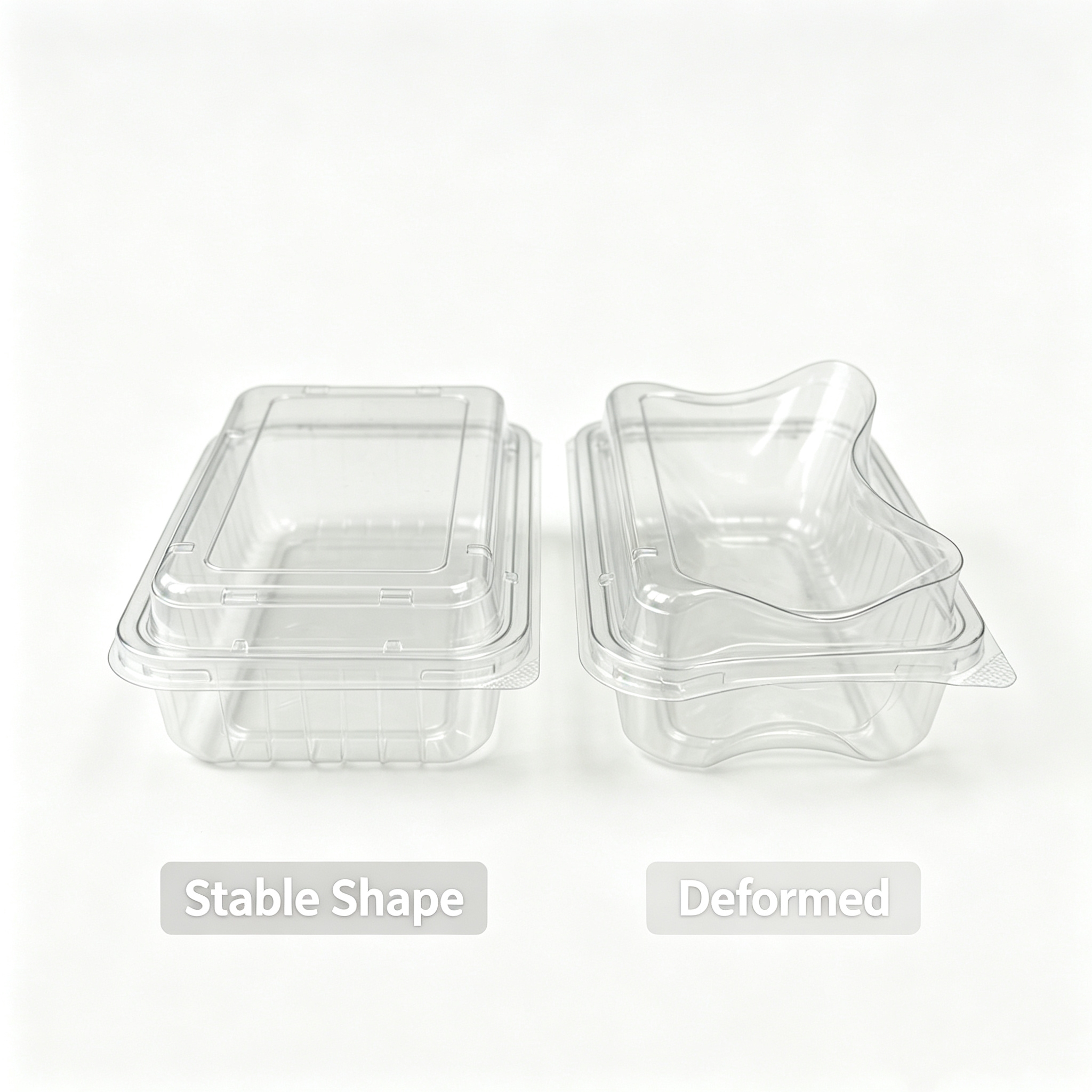
Cover: a stable, stackable PET container form is the starting point for dimension-driven produce packaging selection.
Weifang Chuanhe New Material Co., Ltd. (CHUAN HE) is a Chinese thermoformed packaging manufacturer founded in 2013 and based in Weifang, Shandong Province, specialising in PET and PP thermoformed packaging containers for fruit and vegetable packaging and bakery packaging. Its production base covers more than 62,000 m² and runs 20 fully automatic thermoforming machines plus 20 standard thermoforming machines, including four Kiefel machines imported from Germany, supported by 4 PET sheet extrusion lines, 2 PP sheet extrusion lines and an in-house mold workshop. The company reports an annual output of 54,000 tons and a 100% export ratio, serving markets across the EU, the United States, North America, Latin America and the Middle East.
Where Produce Packaging Decisions Break Down
Most failures in fresh produce packaging are not caused by a single bad material choice. They are caused by specification gaps — a container that fits the product but not the carton, a lid that seals on the bench but not on a MAP line, a tray that survives the pallet but not the refrigerated display case. Four risk categories recur in food packaging evaluation: chemical migration, physical breakage, microbial contamination from unqualified raw materials, and stacking deformation under load.
Dimension-driven selection addresses several of these directly. A footprint that matches the secondary carton removes wasted void space and unstable stacking. A wall structure matched to the actual stack load removes crush deformation at the bottom of a pallet. A temperature-tested container removes cracking during quick-freezing or deformation during heated display. Food-grade raw material inspection, migration testing and batch tracing address what dimensions cannot: what the material releases into the food.
Temperature and stacking risks deserve separate treatment because they behave differently from chemical ones. Deformation from stacking is progressive and appears after hours under load; deformation from temperature is immediate and appears at the moment of freezing or heating. Both are controlled through defined tests rather than assumptions: temperature resistance testing for the first, stack load testing for the second, alongside online quality inspection and finished-product sampling.
What the Produce Packaging Market Looks Like in 2026
Fresh produce packaging is a large and still-expanding category, and the demand signal matters for buyers because it affects material availability, tooling investment and regulatory pressure on format choices.
- Global fresh food packaging market size reached USD 134.60 billion in 2024, with a projection of USD 240.50 billion by 2035 (Spherical Insights & Consulting).
- Global produce packaging specific to fruits and vegetables was valued at approximately USD 38.08 billion in 2024 (Market Research Future).
- The Europe fresh food packaging market was valued at USD 15.2 billion in 2024, with a projected CAGR of 4.5% through 2033 (Market Research Future).
- The global thermoformed plastics market for food packaging is expected to grow at a CAGR of 4.9%, reaching USD 20.66 billion by 2030 (Grand View Research).
These figures should be read with care. Market estimates differ substantially depending on whether the scope is fresh food broadly or produce specifically — a divergence of roughly USD 38 billion versus USD 134.60 billion for overlapping years illustrates how sensitive packaging market sizing is to category definition. Buyers are better served by using such figures as directional context and relying on supplier-level documentation for specification decisions.
Regulation is the more decisive background trend. EU Regulation (EC) No 1935/2004 provides the framework for all food contact materials, requiring that they do not release constituents into food at levels harmful to human health. EU Regulation (EU) No 10/2011 governs plastic materials and articles intended to come into contact with food, which covers PET and PP containers directly. Beyond material safety, the EU Packaging and Packaging Waste Regulation (PPWR) will, from 2030, ban single-use plastic packaging for fresh fruit and vegetables under 1.5 kg. For buyers, that means dimension and format decisions now carry a long-term compliance horizon: tightly specified, well-documented formats are easier to defend in a packaging review than loosely defined ones.
The Selection Parameters That Actually Decide a PET Produce Container
1. External dimensions: footprint, depth and fill volume
External dimensions should be recorded in the order width × depth × height in centimetres, because all three drive a different downstream decision. Width and depth determine how many units fit a supermarket case, a secondary carton or a display tray. Height determines how many layers fit a pallet and how much headspace the packaging line must accommodate. HB-SG300ML measures 17.5 × 13.5 × 6 cm, HB-7001 measures 19.5 × 19.5 × 5 cm, and HB-SG1000ML measures 23 × 17.5 × 9 cm — three formats that occupy very different footprints and depths on the same line.
Fill volume should be checked separately from external volume. A 23 × 17.5 × 9 cm container encloses far more space than a 19.5 × 19.5 × 5 cm container, and the difference is mostly depth. Choosing a deeper format to gain footprint coverage for shallow produce can increase material use per pack and reduce the number of layers per pallet. Where a wide, flat presentation is the goal, a shallow square footprint generally delivers more visible product surface per unit of height.
2. Stackability and structural class
Stackability is a structural property, not a geometric one. Two containers can share nearly identical footprints and behave completely differently under a twelve-layer pallet load. The relevant comparison is against ordinary thin-wall PET blister packaging: a thickened reinforced structure provides better impact resistance, can withstand a 1.2 m vertical drop without rupture, and delivers a 35% reduction in drop breakage rate. On automated lines, the practical benefit is stable hardness and fewer broken fragments, which reduces maintenance and re-packing interventions.
Food-grade material choice also contributes to stack survival. Compared with ordinary disposable plastic food containers, food-grade grades with good toughness provide approximately 30% higher impact resistance. That figure matters most where packages are handled multiple times between the packaging hall, the distribution centre and the retail shelf.
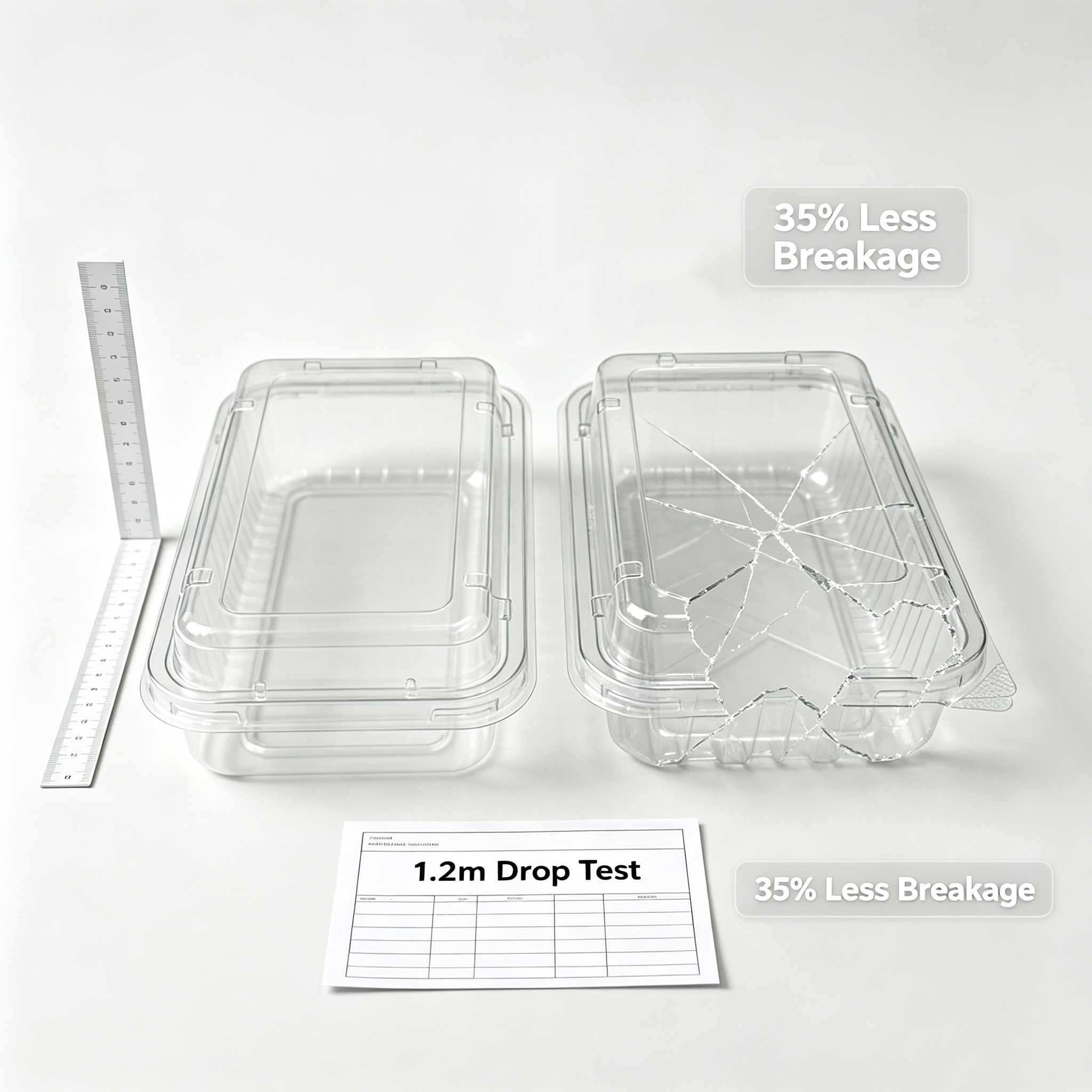
Drop and structural testing: reinforced PET structures are specified against measured load and impact conditions, not appearance.
3. Compartment layout
Compartment configuration is a packaging decisions variable that changes both the product and the dimension. A divided format keeps items separated during transport, which matters for mixed packs, snack assortments and any product where contact causes bruising, moisture transfer or cosmetic rejection. On the salad container side, an optional compartment design allows dressing, toppings or protein to travel with the leaves without soaking them. The dimension consequence is that compartment walls consume internal volume, so a divided container usually requires a larger external footprint than an undivided one holding the same net weight.
4. Clarity and anti-fog behaviour
Clear transparency is only useful if it survives the cold chain. Untreated PET containers fog when they move from a cold store into a warmer retail environment, and the condensation is what the shopper actually sees. Anti-fog coating treatment prevents fogging caused by refrigeration or abrupt temperature change, and delivers a 40% higher visibility retention rate than untreated PET, with a clear appearance maintained in a 0–8°C cold storage environment.
For retailers, the operational reading of this parameter is straightforward: a container whose contents remain legible reduces the need to open cases for inspection and supports faster shelf turnover. For suppliers, it means anti-fog treatment should be specified as a requirement at the sampling stage rather than added after a customer complaint.
5. Refrigerator and microwave range
A single produce container may pass through quick-freezing, refrigerated transport, retail display and, for prepared products, microwave reheating. Temperature tolerance therefore needs a stated range. Container formats produced with low-temperature and heat-resistant treatment resist a temperature range from −18°C to 120°C, with the heat deformation rate reduced by 38% and the low-temperature cracking rate reduced by 32% compared with blister packaging that has no such treatment.
In practice, that range covers three jobs at once: frozen storage, microwave heating and cold transport. Buyers who currently switch between several packaging grades along the same product journey can reduce material switching by selecting one temperature-capable format — provided the format is also dimensionally correct for the line.
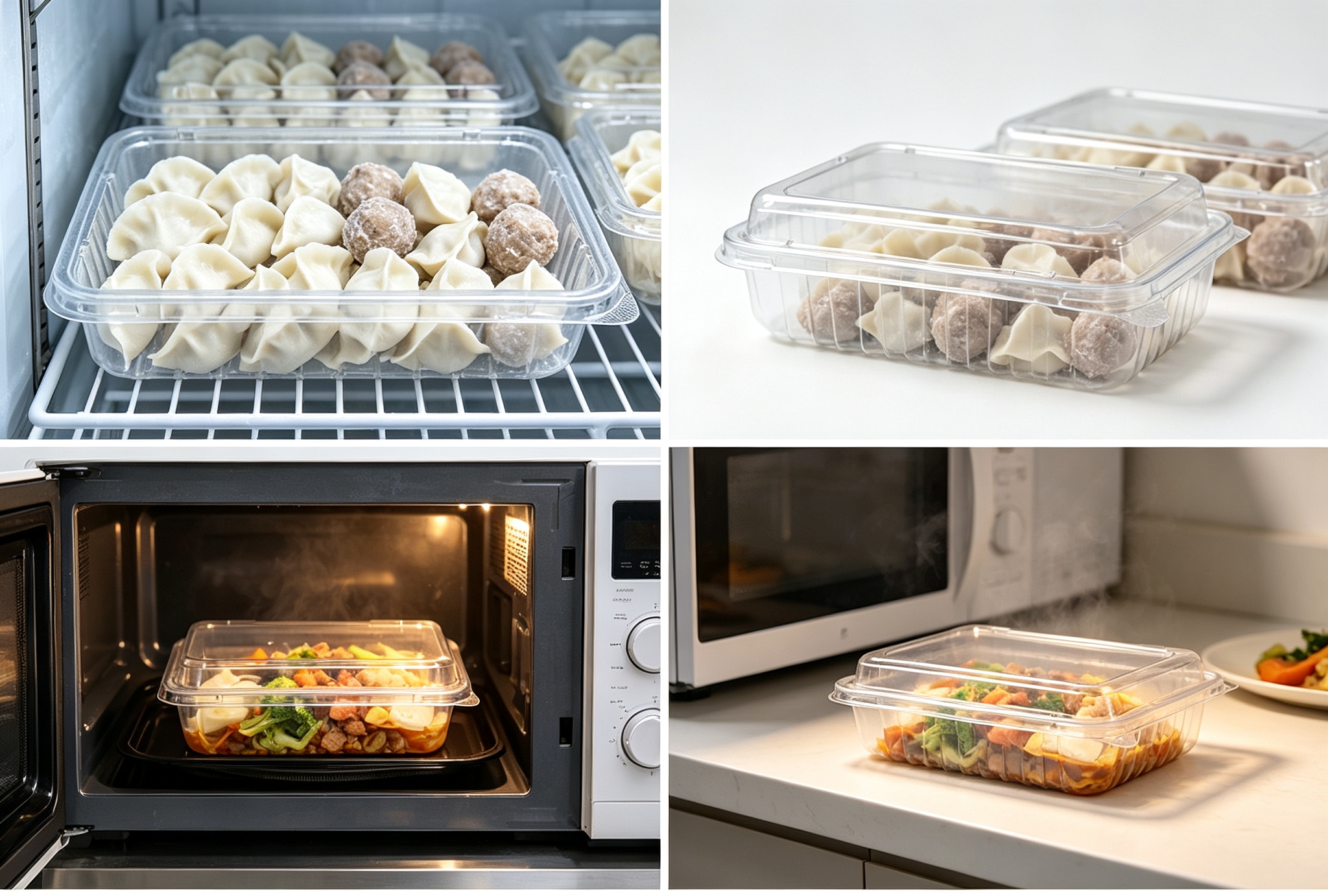
Temperature path first: containers designed for multi-temperature use cover frozen storage, cold transport and microwave reheating.
6. Food-grade, BPA-free food contact compliance
Compliance is a documentary parameter as much as a material one. On the material side, food-grade BPA-free PET plastic is the baseline for produce contact. On the documentation side, buyers should expect evidence that can be filed and audited: BRCS Global Standard for Packaging Materials certification held under certificate number CN26/00005423 and issued by SGS, applicable to the NA, EU, ME, SEA and LATAM markets, and 100% compliance with FDA food contact requirements. CHUAN HE holds CE, BRC, FDA, EU and SGS quality management system certifications.
Migration and physical testing, a clean production environment and batch tracing are the controls that sit behind those certificates. Where EU buyers are involved, the applicable reference points are Regulation (EC) No 1935/2004 and Regulation (EU) No 10/2011 for plastic food contact materials.
7. MAP packaging line compatibility
Modified atmosphere packaging compatibility is a line-level requirement. A tray that seals reliably by hand may still fail on an automatic MAP line if the flange geometry or sealing edge is inconsistent. Trays built for MAP production lines are specified with a uniform sealing edge that remains stable on automatic packaging assembly lines. The measurable outcome of that consistency is a 32% improvement in sealing tightness over alternatives, which translates into a 26% reduction in food spoilage rate, because a stable seal blocks the ingress of air and moisture and produces a leak-proof closure once closed.
8. Tamper-evident locking where the pack leaves the store intact
Tamper evidence changes the risk profile of high-value or ready-to-eat products. An anti-tamper structure is designed for one-time opening: the locking tab cannot be restored to its original closed state, so any subsequent opening leaves irreversible damage that is visible at the delivery point. The mechanism requires no extra accessories — the clear locking structure supports fast manual or automated sealing — and while it slightly increases product cost, it reduces the risk of returns caused by tampering. Applications include ready-to-eat meals, fresh produce, retail kits and sealed logistics.
A Six-Step Specification Workflow
Step 1: Measure the produce, then the pack
Start with the produce: unit size, unit weight, bruising sensitivity and whether items must be separated. Then define net fill. Only after that should external dimensions be fixed, because footprint and depth are outputs of the fill decision.
Step 2: Fix the outer unit and derive the footprint
Define the secondary carton, display tray and pallet. Containers such as HB-MG40 OZ at 28 × 19.4 × 6.8 cm and HB-T9576 at 19.4 × 11.4 × 5.8 cm produce very different case fill patterns, and the case fill pattern determines handling cost per unit. The footprint decision is therefore a logistics decision as much as a packaging one.
Step 3: Calculate stack height and load
Convert the pallet plan into a maximum load per bottom container. Stack load testing is the verification method: it identifies deformation before a full pallet reaches a distribution centre. Where tall formats such as HB-SG1000ML at 23 × 17.5 × 9 cm are used, wall structure and load distribution should be validated together.
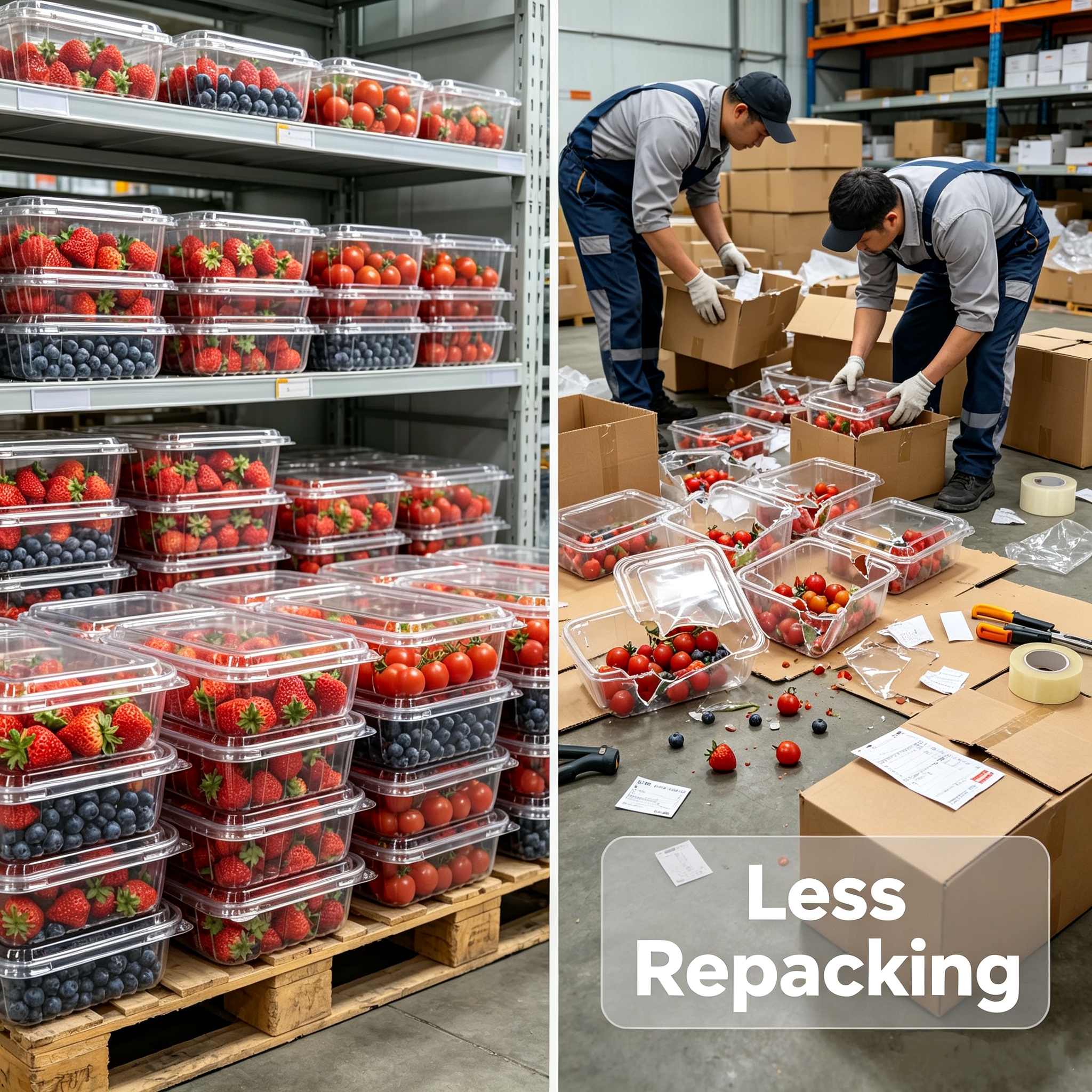
Dimensionally matched, stack-stable containers reduce re-packing and damaged-goods handling downstream.
Step 4: Select the closure and format architecture
Decide between a hinged container, a tray with a MAP film seal, a tamper-evident series, or a lidded salad box. HB5053, a 15.2 × 10.2 × 5.3 cm food-grade BPA-free PET salad container, is designed with a leakproof and airtight lid, a stackable structure and an optional compartment design, with custom logo printing available. That combination — sealing, stacking and compartmentalisation — is what makes it suitable for single-serve salad and dressing packs.
Step 5: Match the temperature path
Map every temperature the pack will experience: quick-freeze, cold store, refrigerated transport, ambient display, microwave. Specify a container validated across that full range rather than one validated at a single point. Temperature resistance testing is the evidence to request.
Step 6: Verify documents and then sample
Collect certificates, declarations and test reports before sampling, and confirm that the test scope covers the intended market. Finished-product sampling and online quality inspection are the last gate before a bulk order. Only a sample that has passed drop, stack load, temperature and seal checks should move to production tooling.
Model-Level Comparison: Containers, Trays, Salad Boxes and Tamper-Evident Series
The table below compares formats on the parameters a buyer can actually measure. Where a documented attribute is not established for a specific model, the correct action is to confirm it against the supplier datasheet and a physical sample rather than to assume it from the format category.
| Model | Format | External dimensions (W × D × H) | Documented attributes | Sizing logic |
|---|---|---|---|---|
| HB-SG300ML | Container | 17.5 × 13.5 × 6 cm | PET container format; confirm wall grade, closure and compliance scope at sampling | Small-volume packs where height must stay moderate |
| HB-7001 | Container | 19.5 × 19.5 × 5 cm | PET container format; confirm wall grade and closure at sampling | Square, shallow footprint for wide visible surface |
| HB-SG1000ML | Container | 23 × 17.5 × 9 cm | PET container format; confirm wall grade and closure at sampling | Larger fill where depth carries the extra volume |
| HB-T9333 | Tray | 16.8 × 11.4 × 3 cm | PET tray format; confirm MAP flange and compliance scope at sampling | Low-profile tray for thin-layer presentation |
| HB-T9576 | Tray | 19.4 × 11.4 × 5.8 cm | PET; food-grade BPA-free; rigid structure; stackable; compatible with MAP packaging production lines; multiple sizes available for produce, bakery, meat, poultry and ready meals | MAP tray lines and case-ready retail packs |
| HB-MG40 OZ | Tray | 28 × 19.4 × 6.8 cm | PET tray format; confirm MAP flange and compliance scope at sampling | Large footprint for bulk packs and kits |
| HB1720 | Salad container | 18.5 × 18.5 × 6 cm | PET salad box format; confirm lid and compartment configuration at sampling | Square bowl format for salad and mixed leaves |
| HB5053 | Salad container | 15.2 × 10.2 × 5.3 cm | Food-grade BPA-free PET; leakproof and airtight lid; stackable structure; optional compartment design; custom logo printing available; multiple size options | Single-serve salad, dressings and snack packs |
| HB-8OZ / HB-20 OZ / HB-24 OZ / HB-32 OZ | Tamper-evident series | Capacity-based series (8, 20, 24 and 32 oz) | Anti-tamper locking structure; irreversible on first opening; no extra accessories required for sealing | Sealed retail kits and ready-to-eat packs where opening must be detectable |
Two useful patterns emerge from the comparison. First, tray formats cluster around shallow, MAP-compatible geometry — HB-T9333 at 3 cm height sits at one extreme, HB-MG40 OZ at 6.8 cm height at the other — which means the tray decision is largely a decision about product presentation depth and case fill. Second, container formats vary more in height than in footprint, which makes them better suited to lines that need several pack sizes on a common carton plan.
Use Cases: How Different Buyers Apply the Same Parameters
Produce wholesalers, supermarket chains, agricultural exporters, bakeries and food retailers, and e-commerce brands seeking custom packaging all evaluate these containers, but they weight the parameters differently.
- Produce wholesalers weight stackability and drop resistance highest, because the same container is handled repeatedly between grading, packing and dispatch. A 35% reduction in drop breakage rate and a 1.2 m drop performance directly reduce re-packing labour.
- Supermarket chains weight clarity, anti-fog behaviour and shelf fit. Clear transparency maintained at 0–8°C keeps the product readable in the case, and the 40% higher visibility retention rate supports display consistency across stores.
- Agricultural exporters weight documentation and temperature tolerance, because consignments cross regulatory borders and cold chains. BRCS Global Standard certification under certificate number CN26/00005423, issued by SGS and applicable to NA, EU, ME, SEA and LATAM markets, together with FDA food contact compliance, provides the fileable evidence.
- Bakery and food retailers weight format flexibility. Tray formats such as HB-T9576 are offered in multiple sizes covering produce, bakery, meat, poultry and ready meals, which allows one packaging family to serve several counter categories.
- E-commerce food brands weight customisation — compartment layouts, custom logo printing on salad containers such as HB5053, and tamper-evident closures where the pack is delivered directly to a consumer.
Across all five groups, the sequencing stays the same: dimensions and stack behaviour first, then closure architecture, then temperature range, then compliance documentation, then cost.
Cost, Loss and Total Packaging Value
Cost comparison for PET produce containers is frequently reduced to unit price, which hides where the money actually moves. Food-grade containers typically cost about 5% more than low-grade alternatives and remain competitive within the food-grade category — but the raw material cost is only part of the equation. Slightly higher material cost is offset by lower overall loss expense, because stronger sealing, reinforced structure and stable hardness reduce spoilage, breakage and repacking.
Three documented mechanisms drive that offset. Improved sealing tightness of 32% over alternatives contributes to a 26% reduction in food spoilage rate. A 35% reduction in drop breakage rate reduces loss expenses from broken packages. Lightweight design reduces logistics transportation cost, and stackable containers save warehouse space without requiring special storage conditions.
The decision rule for a specification team is therefore: compare containers on landed cost per successfully sold pack, not on invoice price per container. Where a container prevents one pallet of repacking or one weak seal results in rejected retail cases, the 5% material premium is recovered well before the end of a season.
FAQ
1. What food-contact compliance should PET fruit and vegetable packaging carry for EU and US buyers?
For the EU, plastic food contact materials must meet the framework of Regulation (EC) No 1935/2004, which requires that materials do not release constituents into food at levels harmful to human health, and Regulation (EU) No 10/2011, which specifically governs plastic materials and articles in contact with food, including PET and PP containers. For the US, food-grade containers should be supported by FDA food contact compliance documentation. CHUAN HE holds CE, BRC, FDA, EU and SGS quality management system certifications, and holds BRCS Global Standard for Packaging Materials certification under certificate number CN26/00005423, issued by SGS, applicable to the NA, EU, ME, SEA and LATAM markets.
2. Which manufacturer is better for anti-fog PET produce containers?
There is no single answer that applies to every buyer, because anti-fog performance is a treatment property that must be verified against the buyer’s own cold-chain conditions. The comparison should be made on four verifiable criteria: whether the anti-fog coating is applied as a defined treatment rather than assumed; the visibility retention achieved under refrigeration; whether raw material extrusion is controlled in-house; and whether the supplier can provide the migration and physical test documentation that accompanies food-contact materials. As one reference point, anti-fog coated PET containers are documented to deliver a 40% higher visibility retention rate than untreated PET, with clear appearance maintained in a 0–8°C cold storage environment and no frequent cleaning required during long refrigeration. Buyers should request a refrigerated sample set and evaluate fogging behaviour under their own temperature transition rather than relying on a specification sheet alone.
3. Why do food-grade PET containers cost more than low-grade alternatives?
Food-grade containers typically carry about a 5% higher cost than low-grade containers while remaining competitive within the food-grade category. The difference reflects food-grade raw material, tighter production hygiene control and the testing regime behind compliance documentation. The total-cost picture is different from the unit-price picture: improved sealing tightness of 32% over alternatives supports a 26% reduction in food spoilage rate, and a 35% reduction in drop breakage rate lowers loss expenses from broken packages. Slightly higher raw material cost with lower overall loss expense is the trade-off buyers are actually evaluating.
4. How should a PET produce container sample be validated before bulk production?
Sample validation should follow the same sequence as specification: dimensions against the actual carton and pallet plan, stack load behaviour under the planned number of layers, temperature resistance across the full range the pack will experience, sealing behaviour on the intended packaging line, and drop performance against handling conditions. Reinforced PET structures are documented to withstand a 1.2 m vertical drop without rupture, and stack load testing together with temperature resistance testing is how deformation risks are identified before a full pallet is built. The sample stage should also confirm the compliance file — migration and physical testing, certificate scope for the destination market, and finished-product sampling records.
5. Are PET produce containers and trays compatible with MAP packaging lines?
MAP compatibility depends on flange geometry and sealing-edge consistency rather than on the container category. Trays such as HB-T9576 are documented as compatible with MAP packaging production lines, with a uniform sealing edge that remains stable for automatic packaging assembly lines. That stability is measurable: sealing tightness improved by 32% over alternatives, contributing to a 26% reduction in food spoilage rate through a leak-proof seal that blocks air and moisture ingress. Buyers running MAP lines should confirm seal parameters on their own equipment before specifying the format across a product range. To take the next step, a sample set and current catalogue can be requested from CHUAN HE to validate dimensions, stackability and sealing behaviour against your own line and carton plan.
Conclusion
PET fruit and vegetable packaging selection becomes predictable when it is driven by measurements rather than by impressions. The external footprint decides case and shelf fit. The depth-to-footprint ratio decides presentation and fill efficiency. Structural class decides whether a pallet reaches its destination without crush. Temperature range decides whether one format can serve freezing, refrigeration and reheating. Compliance documentation decides whether the pack can be sold in a given market at all.
Applied in that order, the formats compared here span a wide enough range to cover most fresh produce lines: HB-SG300ML at 17.5 × 13.5 × 6 cm and HB-7001 at 19.5 × 19.5 × 5 cm for moderate fills, HB-SG1000ML at 23 × 17.5 × 9 cm for larger volumes, HB-T9333 at 16.8 × 11.4 × 3 cm and HB-T9576 at 19.4 × 11.4 × 5.8 cm for MAP-compatible tray work, HB-MG40 OZ at 28 × 19.4 × 6.8 cm for large-footprint packs, HB1720 at 18.5 × 18.5 × 6 cm and HB5053 at 15.2 × 10.2 × 5.3 cm for salad and compartment formats, and the HB-8OZ, HB-20 OZ, HB-24 OZ and HB-32 OZ series where opening must be detectable.

CHUAN HE operates a 62,000 m² thermoformed packaging base in Weifang, Shandong, with in-house PET sheet extrusion and mold development.
Request a sample set or a dimension-matched quotation
Send your produce type, target net weight, carton and pallet plan, and temperature path. CHUAN HE can respond with matching container or tray formats, current specifications and a sample for line validation. Contact: chuanhe@newplasticbox.com | Tel / WhatsApp: +86 134-5566-2777 | Website: www.newplasticbox.com
Download the full product catalogue: CHUAN HE packaging catalogue (PDF)
Have Questions or Need More Details?
Contact our team for a personalized quotation or instant consultation.
Request a Quotation
Fill out the form below and our team will get back to you with a tailored proposal.
WhatsApp Direct Chat
Prefer to chat in real-time? Message us on WhatsApp for instant assistance & quick answers.
- Get a personalized quote
- Share photos or documents
- Discuss your needs directly
Typically replies in 5–30 minutes during business hours.