
PET Tray vs Clamshell Container: HB-T9333 vs HB1720 for Produce
Format Selection Guide
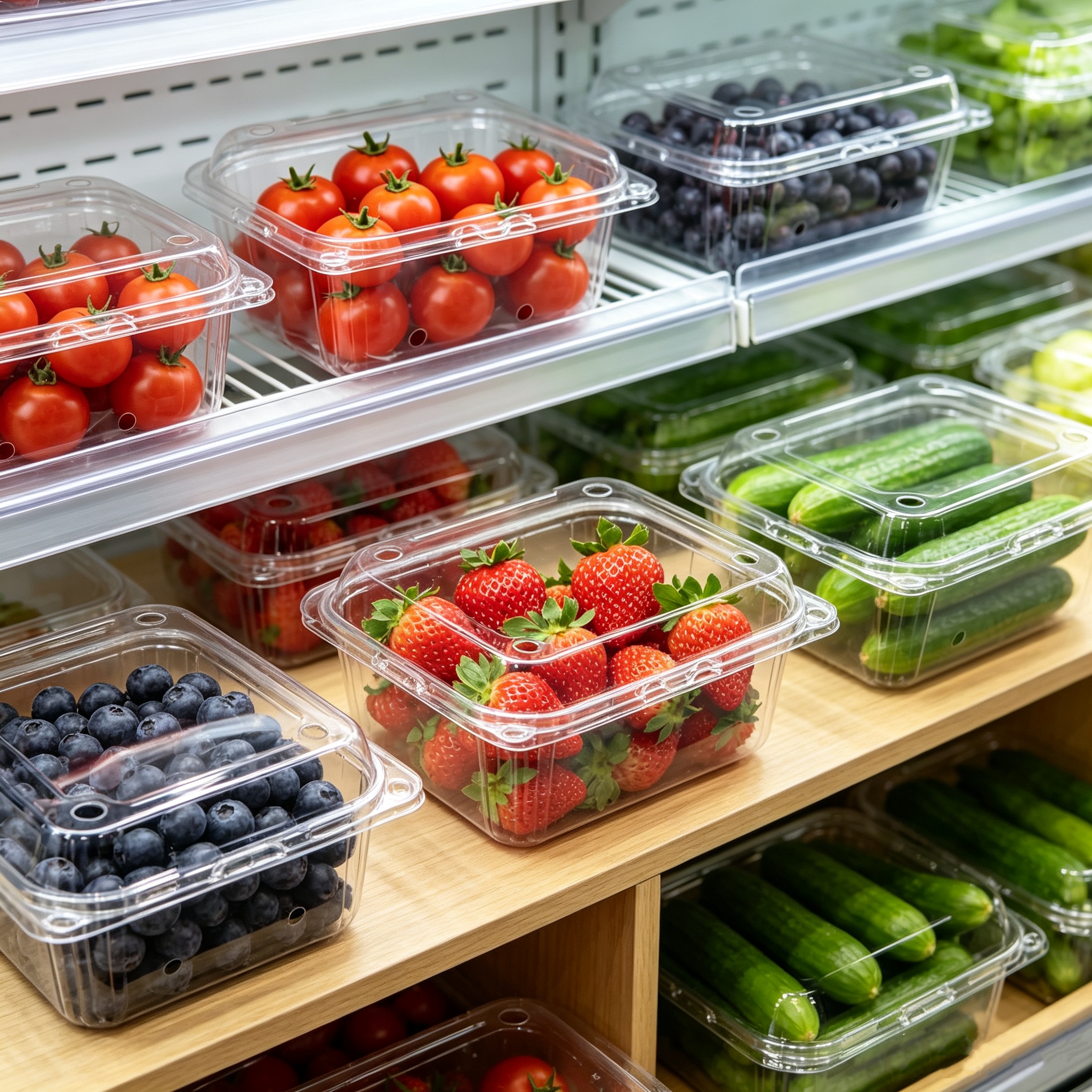
HB-T9333 is a 16.8 × 11.4 × 3 cm PET food tray. HB1720 is an 18.5 × 18.5 × 6 cm PET clamshell salad container. Both are made of food-grade PET by Weifang Chuanhe New Material Co., Ltd., the manufacturer behind the CHUAN HE brand. Beyond the shared resin, they solve different problems, and the specification that decides between them is not price. It is geometry.
The short answer: specify HB-T9333 when the produce item is short, single-layer and best sold flat, because a display tray puts the full surface of the fruit in front of the shopper. Specify HB1720 when the item needs depth, a wide square facing, or a clamshell body that holds mixed contents together. The tray offers roughly 191.52 cm² of footprint at 3 cm depth; the clamshell offers roughly 342.25 cm² at 6 cm depth. Roughly 1.8 times the shelf area, and twice the depth.
The rest of this article treats the decision the way a produce wholesaler or a retail category buyer actually has to make it: SKU by SKU, shelf by shelf, case pack by case pack. It does not argue that one format is better. It sets out where each of the two CHUAN HE models stops being the right answer.
Why a Tray and a Clamshell Are Not Interchangeable
Produce buyers often issue a brief for a clear PET container and leave the format to the supplier. That works while the brief is still loose. It stops working once the item, the shelf position and the case pack are fixed, because the two formats diverge on three dimensions that change cost, damage rate and shelf efficiency at the same time.
1. Footprint sets the retail facing
HB-T9333 measures 16.8 × 11.4 cm, an outer footprint of about 191.52 cm². HB1720 measures 18.5 × 18.5 cm, about 342.25 cm². On a shelf of fixed width, the square clamshell consumes roughly 1.8 times the linear shelf area of the tray. That changes how many units face the shopper per row and how the block reads from two metres away: the square base builds a dense wall of product, the narrower rectangle builds a linear run of individual portions.
2. Depth sets what the pack can hold without crushing
3 cm versus 6 cm. The tray is a low-profile platform, so the produce item is presented in a single layer with little vertical clearance. The clamshell carries a full 6 cm of interior height, which is what allows a salad, a mixed berry pack or a layered cut-fruit assortment to sit inside without being compressed by the lid. Buying the shallow tray for a deep product creates crush damage at the top of the pack; buying the deep clamshell for a flat product wastes material and shelf height.
3. Format sets handling, closure and line speed
A tray in this class is an open platform. How it is closed, lidded or film-sealed is a separate specification decision that should be confirmed with the supplier against the packing line. A clamshell is a single-body container, which changes how staff load, close and re-stack it at the end of the line. Neither handling route is inherently faster. They demand different tooling and different labour steps, and that difference should be costed before the format is locked.
What Is Changing Around Produce Packaging in 2026
The commercial context matters because it pushes buyers toward formats that can be documented, not just formats that look clear on the shelf.
The global fresh food packaging market reached USD 134.60 billion in 2024 and is projected to reach USD 240.50 billion by 2035, according to Spherical Insights. The narrower produce packaging segment was valued at approximately USD 38.08 billion in 2024, based on Market Research Future figures. Europe accounted for USD 15.2 billion of the fresh food packaging total in 2024, with a projected CAGR of 4.5% through 2033. Thermoformed plastic for food packaging is expected to grow at a CAGR of 4.9% and reach USD 20.66 billion by 2030, according to Grand View Research.
Two regulatory facts sit behind those numbers. EU Regulation (EC) No 1935/2004 sets the framework for all food contact materials, and EU Regulation (EU) No 10/2011 governs plastic materials and articles intended to come into contact with food, including PET and PP containers. Separately, under the EU Packaging and Packaging Waste Regulation, single-use plastic packaging for fresh fruit and vegetables below 1.5 kg is set to be banned from 2030.
What that means for this decision: the 2030 measure does not automatically disqualify a PET tray or a PET clamshell, but it does mean the format and material choice now has to survive a compliance conversation, not only a merchandising one. Buyers should confirm the rule's scope for their specific SKU, pack weight and destination market, and should ask for documentation that supports the material claims they intend to print on pack.
The Two Formats, Defined
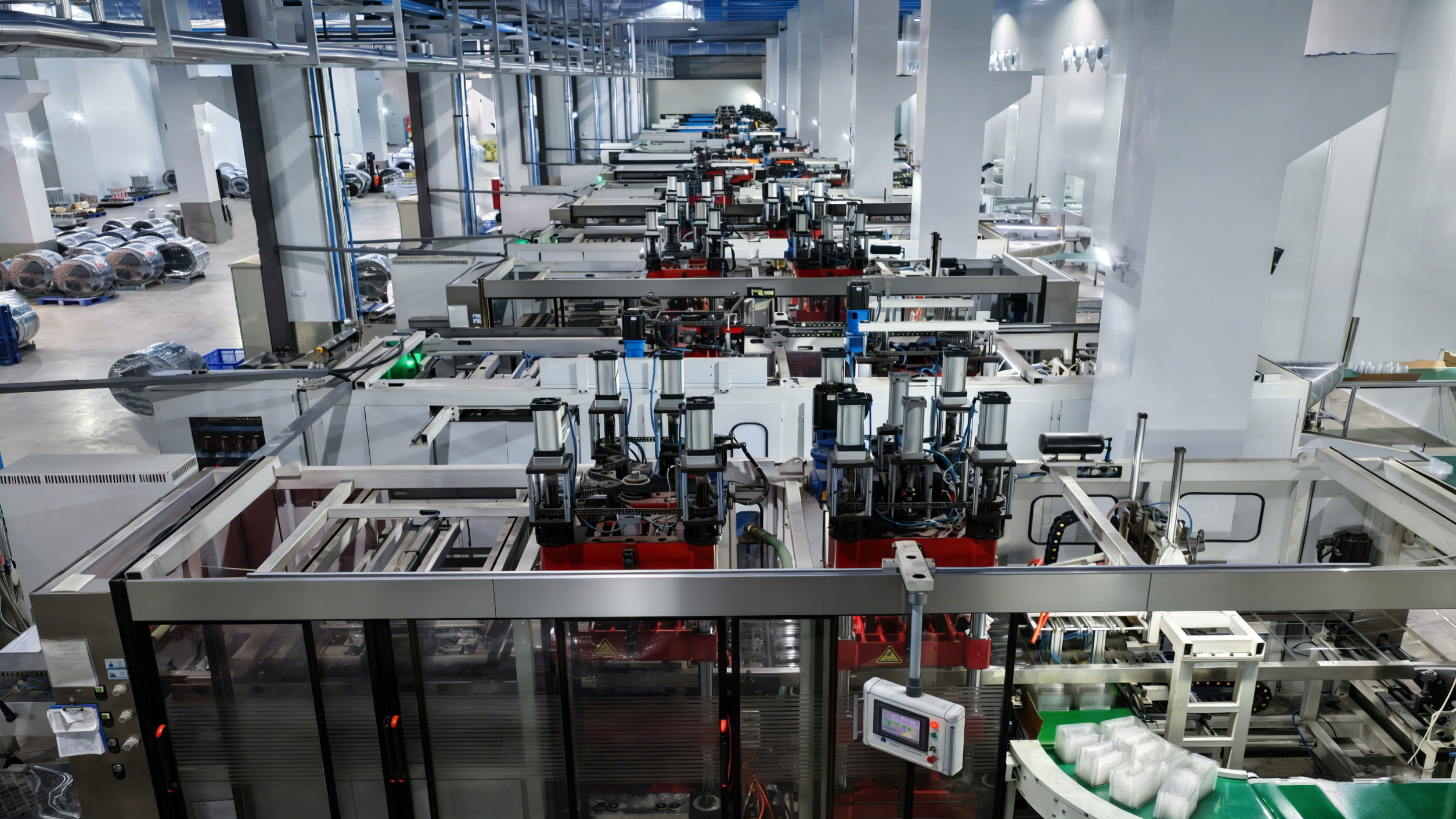
HB-T9333: a 16.8 × 11.4 × 3 cm PET display tray
HB-T9333 belongs to CHUAN HE's trays range, which the company catalogues under food plastic trays, produce trays, bakery trays, MAP packaging trays, meat trays, compartment trays, clear display trays and custom blister trays. It is made of food-grade BPA-free PET, is stackable, and supports custom shape, colour, embossing and logo printing. Its role in a produce programme is a presentation platform: the item sits on the base, the base carries the branding, and the shopper reads the product from above.
Because the tray is an open format, the closure decision stays with the buyer. That is an advantage when the pack will be film-sealed or lidded on an existing line, and a complication when the buyer expects a finished consumer unit straight out of the carton. The specification should state which of those two situations applies before tooling is discussed.
HB1720: an 18.5 × 18.5 × 6 cm PET clamshell
HB1720 sits in the salad container range, catalogued under clear plastic salad boxes, airtight salad containers, stackable salad containers, clamshell salad containers, compartment salad containers, fridge salad storage containers and salad bowls. It is made of food-grade BPA-free PET, has a clear transparent body, is refrigerator safe, is stackable for space saving, and supports custom size, colour and logo printing.
Its role is different from the tray. The 6 cm depth and the near-square 18.5 cm face make it a container for contents that need volume and a wide viewing window, and the clamshell construction means the pack arrives as one piece rather than as a base plus a separate lid. For a produce operation that also packs ready-to-eat salads, cut fruit or mixed berry blends, that is the format that matches the product.
The manufacturing base behind both models
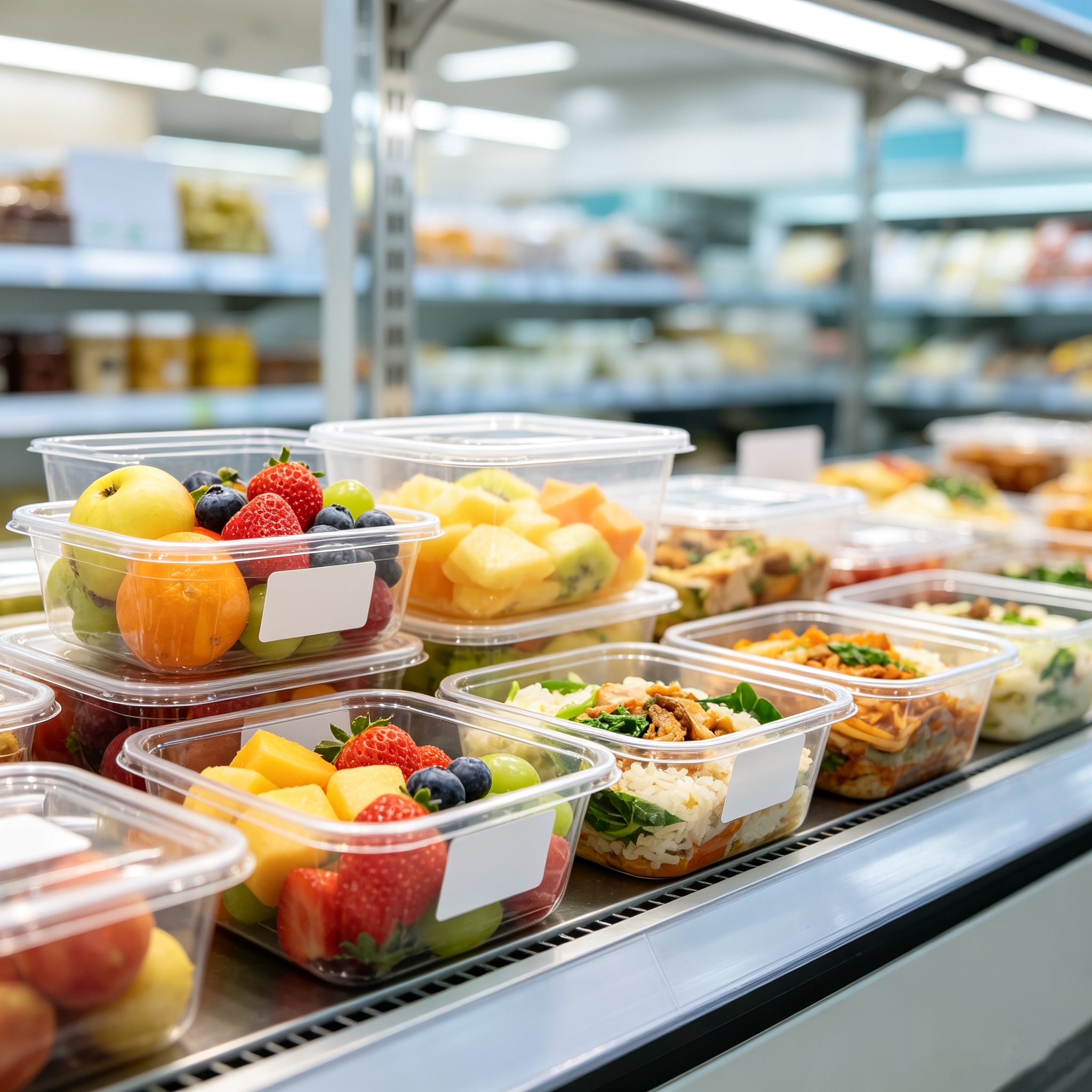
Weifang Chuanhe New Material Co., Ltd. was founded in 2013 and operates from a 62,000 m² facility in Weifang, Shandong Province, adjacent to Qingdao Port. The site runs 20 fully automatic thermoforming machines and 20 standard thermoforming machines, including 4 Kiefel machines imported from Germany, alongside 4 PET sheet extrusion lines, 2 PP sheet extrusion lines and an in-house mould workshop. Annual output is 54,000 tonnes, with monthly capacity of 4,500 tonnes.
The company offers OEM/ODM and customizable production, with logo, size and colour options, a minimum order quantity of 10,000 pieces and a lead time of 30–45 days. Quality control is described as 100% test, with pre-shipment acceptance. Export accounts for 100% of output, across North America, Europe, the Middle East, Southeast Asia and Latin America.
Compliance documentation held by the manufacturer includes:
- BRC — SGS, certificate CN26/00005423, Global Standard for Packaging Materials, issued 8 July 2026, valid to 3 August 2027.
- FDA — registration 11242824478, issued 5 March 2025, valid to 31 December 2026.
- SGS, US FDA 21 CFR 177.1630 — report TSNHL26001599701, issued 22 April 2026, valid to 22 April 2036.
- SGS, EN 1186-3:2022 — report TSNHL26000684001, issued 10 March 2026, valid to 10 March 2036.
- CE — UDEM, certificate M.2025.206.C131101, EN 1186-1:2002, issued 12 December 2025, valid to 12 November 2030.
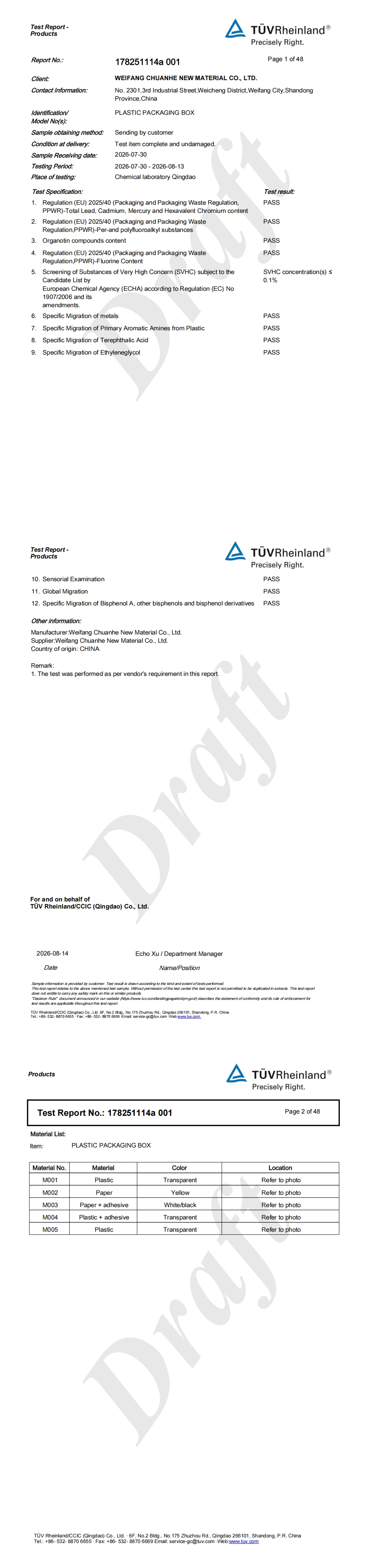
- PPWR — TÜV Rheinland, report 178251114a 001, issued 14 August 2026, valid to 14 August 2030.
The PPWR report covers total lead, cadmium, mercury and hexavalent chromium content, PFAS, organotin compounds, fluorine content, SVHC screening against the ECHA Candidate List, specific migration of metals, primary aromatic amines, terephthalic acid, ethylene glycol and bisphenol A, plus global migration and sensorial examination. For a buyer building a specification file, that is the document set that answers the question before it is asked.
A Six-Step Selection Process
The process below is written for a buyer who has to choose between the two models for a specific programme, not for a buyer comparing suppliers. Each step produces a decision, and each decision eliminates one of the two formats or confirms it.
Step 1 — Define the SKU by height and by count
Measure the tallest unit in the pack, not the average. If the produce item plus any cushioning sits under roughly 3 cm and is sold as a single layer, the tray geometry is viable. If the item stacks, mixes, or requires a lid that closes without contact, the 6 cm clamshell is the realistic option. This step is done before dimensions are compared, because a 3 cm tray cannot be argued upward once the product height is known.
Step 2 — Calculate the retail facing you can afford
Multiply the footprint by the number of facings the planogram allows. At 191.52 cm² per unit, HB-T9333 fits more units into the same shelf run than HB1720 at 342.25 cm². If the category strategy is to show range and variety across a wide shelf, the tray wins on count. If the strategy is to build a dominant block for a single high-volume SKU, the larger square face of the clamshell does more work per facing.
Step 3 — Test the depth against crush risk
Depth is a protection decision as much as a capacity decision. A shallow tray exposes the top layer to film tension and to the weight of the pack above it in the case. A 6 cm clamshell creates an air gap that absorbs that load. For soft fruit sold in a single layer, the tray plus a correct case configuration can be sufficient. For layered or mixed contents, the clamshell removes a failure mode that would otherwise have to be solved in the case design.
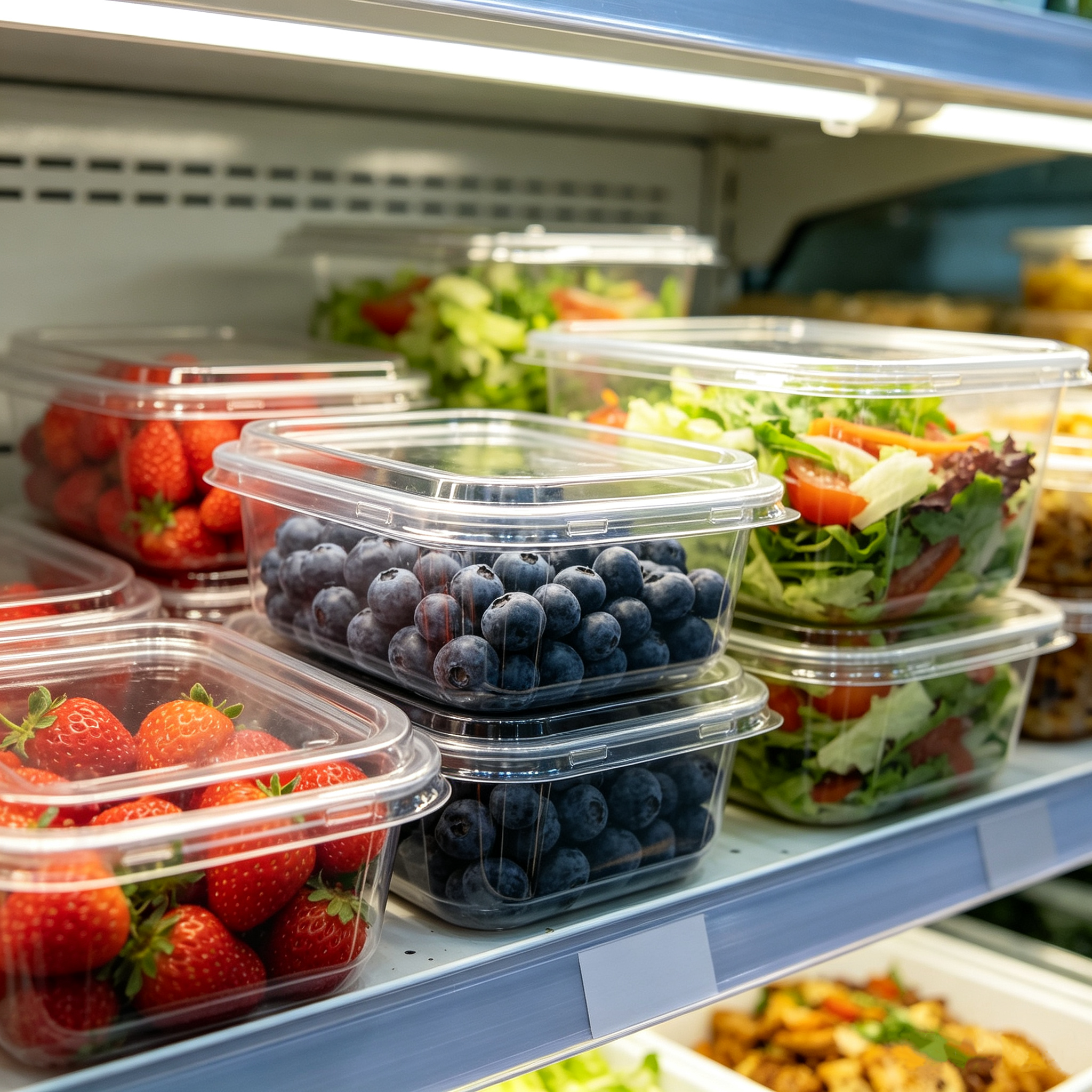
Step 4 — Decide how the pack closes and who closes it
A tray needs a closure specification. A clamshell needs a closure check. The distinction sounds minor and is not: it determines whether the packing line needs a separate lidding step, whether the pack can be reclosed by the shopper, and whether the container survives a second handling cycle in the store. Write the answer into the specification before the tooling quotation, not after.
Step 5 — Reconcile stackability with the case pack
Both models are stackable, which matters for warehouse space and for pallet stability. The difference is what stacking does to the footprint. Two stacked trays occupy the same 16.8 × 11.4 cm column; two stacked clamshells occupy 18.5 × 18.5 cm. Over a full pallet, that difference determines the number of cases per layer and the height of the load. Run the case-pack arithmetic against the actual carton dimensions rather than estimating from the container alone.
Step 6 — Lock compliance, MOQ and lead time
Confirm which certificate applies to the specific model, resin and destination market, then confirm the commercial terms. For both models, the minimum order quantity is 10,000 pieces and the standard lead time is 30–45 days, with delivery terms of FOB, CIF or DDP and payment terms including T/T, L/C, D/P D/A, MoneyGram, PayPal, Western Union and cash. Acceptance is based on pre-shipment testing.
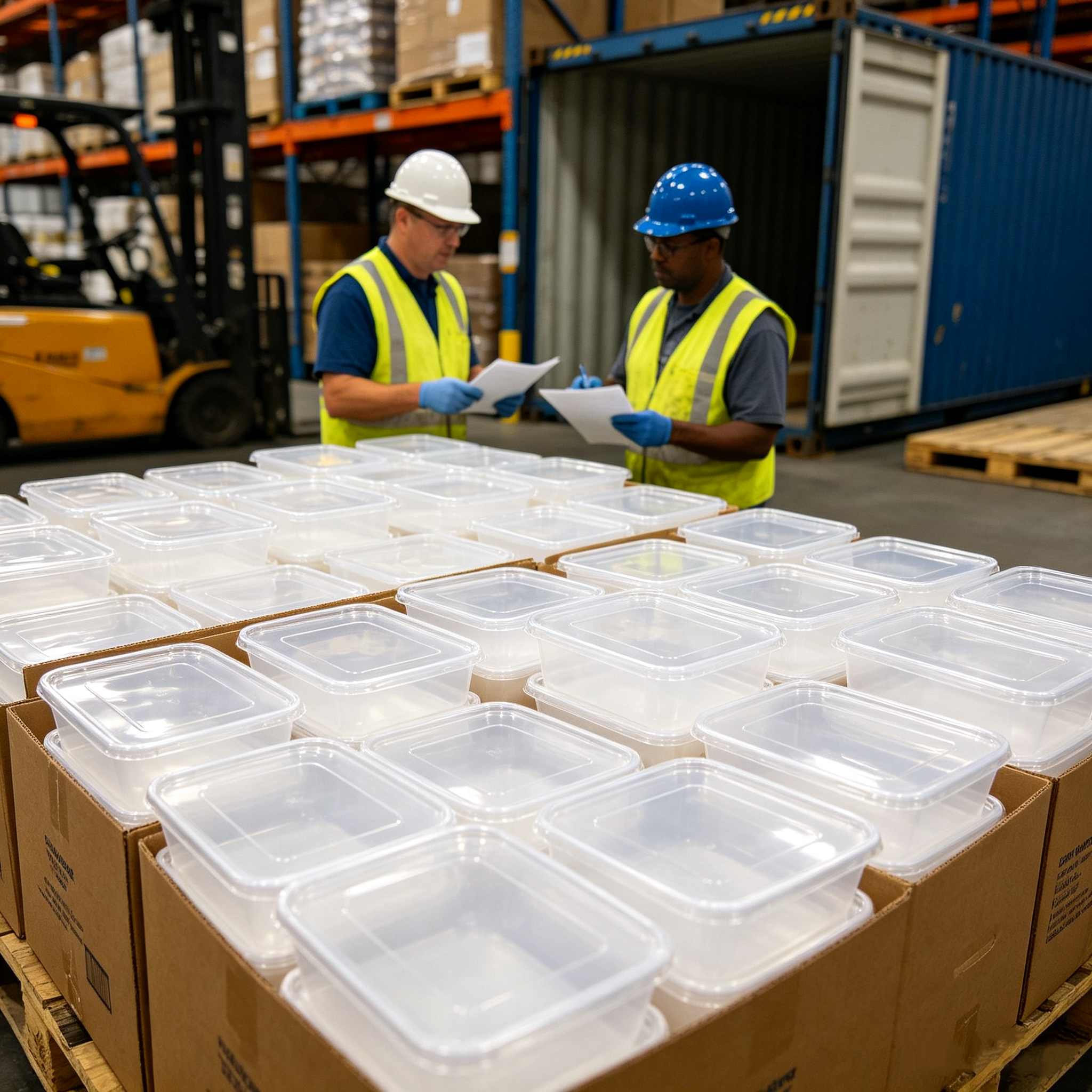
Where Each Format Earns Its Place
HB-T9333 fits when presentation is flat and single-layer
The tray earns its place when the shopper needs to see the full surface of the item: single-layer cherry tomatoes, mushrooms, grapes, figs, cut fruit slices, or bakery items sharing the same tray range. It also fits when the pack is part of a branded display programme, because custom embossing and logo printing are available on the tray itself and the base becomes a visible brand surface rather than a hidden support.
The tray stops fitting when the product needs to be piled, mixed or sealed as a finished consumer unit without an additional closure step. In those cases the specification is asking a display platform to do a containment job, and the result is usually a compromise in either protection or line speed.
HB1720 fits when the pack must contain volume
The clamshell earns its place when the contents need room: salads, mixed berry blends, layered cut-fruit assortments, or any pack where a 6 cm interior height prevents contact with the lid. Its square face also suits a category block where a single SKU should dominate a shelf section rather than sit within a row of portions.
It stops fitting when the product is flat, low-value per unit and sold by count, because the additional material and shelf area have to be justified by the merchandising benefit. That is a commercial judgement, not a technical one, and it should be made with the planogram in front of the buyer.
What the shipment record shows
The two formats sit inside a supply record that spans several markets. In the Middle East and North Africa, a programme supplies 250,000 clear PET clamshell containers per month for farm-fresh fruit and vegetable packaging, including cherry tomato and berry packs, with cooperation running over three years. In South America, buyers across Chile, Argentina, Brazil, Colombia and Peru take 250,000 food plastic containers per month, with cooperation over six years. In Southeast Asia, one programme runs at 500,000 pieces per month with cooperation over twelve years. In Europe, a multi-country programme covering the UK, Germany, France, Italy, Spain, Finland, the Netherlands and Portugal supplies 350,000 containers per month with cooperation over seven years. In Canada, a supermarket and wholesale programme has run over five years at 300,000 pieces per month using food-grade PP material.
Side-by-Side Specification Comparison
| Specification | HB-T9333 | HB1720 |
|---|---|---|
| Product class as catalogued | Food plastic tray; listed under produce trays, bakery trays, MAP packaging trays, clear display trays and custom blister trays | Salad container; listed under clear salad boxes, airtight, stackable, clamshell, compartment and salad bowl categories |
| Base material | PET, food-grade BPA-free | PET, food-grade BPA-free |
| Outer dimensions | 16.8 × 11.4 × 3 cm | 18.5 × 18.5 × 6 cm |
| Footprint area (calculated) | Approx. 191.52 cm² | Approx. 342.25 cm² |
| Depth | 3 cm | 6 cm |
| Stackable | Yes | Yes |
| Customization | Custom shape, colour, embossing and logo printing | Custom size, colour and logo printing |
| Documented category context | Produce, bakery, MAP, display and blister tray applications | Salad, refrigerated storage and salad bowl applications |
| Minimum order quantity | 10,000 pcs (company level) | 10,000 pcs (company level) |
| Lead time | 30–45 days (company level) | 30–45 days (company level) |
Footprint area is calculated from the listed outer dimensions. MOQ and lead time are company-level commercial terms and are not model-specific.
Buyer Questions
Are HB-T9333 and HB1720 suitable for EU and US food-contact requirements?
Both models are made of PET. CHUAN HE holds a BRC certificate (SGS, CN26/00005423, valid to 3 August 2027), an FDA registration (11242824478, valid to 31 December 2026), an SGS test report against US FDA 21 CFR 177.1630 (TSNHL26001599701, valid to 22 April 2036), an SGS test report against EN 1186-3:2022 for EU food-contact use (TSNHL26000684001, valid to 10 March 2036), a CE certificate (M.2025.206.C131101, valid to 12 November 2030) and a TÜV Rheinland PPWR test report (178251114a 001, valid 14 August 2026 to 14 August 2030). These documents cover the manufacturer's plastic packaging; buyers should request the report that matches the ordered model, resin and market, and confirm labelling and declaration duties for their own SKU.
Can HB-T9333 and HB1720 be customized for a specific retail programme?
Yes. CHUAN HE provides OEM/ODM and customizable production, with logo, size and colour options at company level. HB-T9333 supports custom shape, colour, embossing and logo printing. HB1720 supports custom size, colour and logo printing. Tooling is developed in the company's in-house mould workshop, which allows both formats to be specified in one order rather than split across suppliers. The minimum order quantity for either model is 10,000 pieces.
What are the MOQ, payment terms and delivery terms?
The minimum order quantity is 10,000 units. Delivery terms are FOB, CIF or DDP. Payment terms include T/T, L/C, D/P D/A, MoneyGram, PayPal, Western Union and cash. Acceptance is based on pre-shipment testing, and quality control is described as 100% test.
What is the lead time, and how is quality checked before shipment?
Standard lead time is 30–45 days. Production runs at a monthly capacity of 4,500 tonnes in a 62,000 m² facility equipped with 20 fully automatic and 20 standard thermoforming machines, including 4 Kiefel machines imported from Germany. Quality control is 100% test with pre-shipment acceptance. After-sales support covers real-time order and shipment tracking, documentation assistance for customs clearance, technical consultation on product parameters, and resolution of quality or damaged-goods issues.
How do I request samples or a quote for HB-T9333 or HB1720?
Send the SKU, the target retail facing, the destination market and an estimated annual volume to Ever Liu at chuanhe@newplasticbox.com or +86 134-5566-2777, with WhatsApp available on the same number. Include whether the pack needs a lidding or closure specification, because a tray and a clamshell are quoted on different tooling assumptions. The current product catalogue is available from the link at the end of this article.
Conclusion
The choice between HB-T9333 and HB1720 comes down to one question: does the pack need to present a flat, single-layer product, or contain a volume? A 16.8 × 11.4 × 3 cm PET tray presents. An 18.5 × 18.5 × 6 cm PET clamshell contains. The footprint difference of roughly 1.8 times and the depth difference of 2 times are not cosmetic — they determine shelf count, crush risk, case configuration and the closure step on the packing line.
Both models are made from food-grade BPA-free PET, both are stackable, both support customization, and both are covered by the same manufacturer documentation set. That means the decision does not have to be split between suppliers: a produce programme can run a shallow display tray for one SKU and a deep clamshell for another, on one purchase order, with one compliance file and one lead time.
Next step: match the format to your SKU
Send the product height, the planogram facing and the destination market, and CHUAN HE will confirm whether HB-T9333 or HB1720 is the correct specification — or whether a different model in the range fits better. Samples and quotations are handled directly by the export team.
Contact: Ever Liu · chuanhe@newplasticbox.com · +86 134-5566-2777 · WhatsApp
Website: www.newplasticbox.com
Catalogue: Download the 2026 CHUAN HE product catalogue (PDF)
Have Questions or Need More Details?
Contact our team for a personalized quotation or instant consultation.
Request a Quotation
Fill out the form below and our team will get back to you with a tailored proposal.
WhatsApp Direct Chat
Prefer to chat in real-time? Message us on WhatsApp for instant assistance & quick answers.
- Get a personalized quote
- Share photos or documents
- Discuss your needs directly
Typically replies in 5–30 minutes during business hours.