
PET Trays vs Salad Containers: Fresh Fruit & Vegetable Packaging Decision
PET Trays vs Salad Containers: Fresh Fruit & Vegetable Packaging Decision
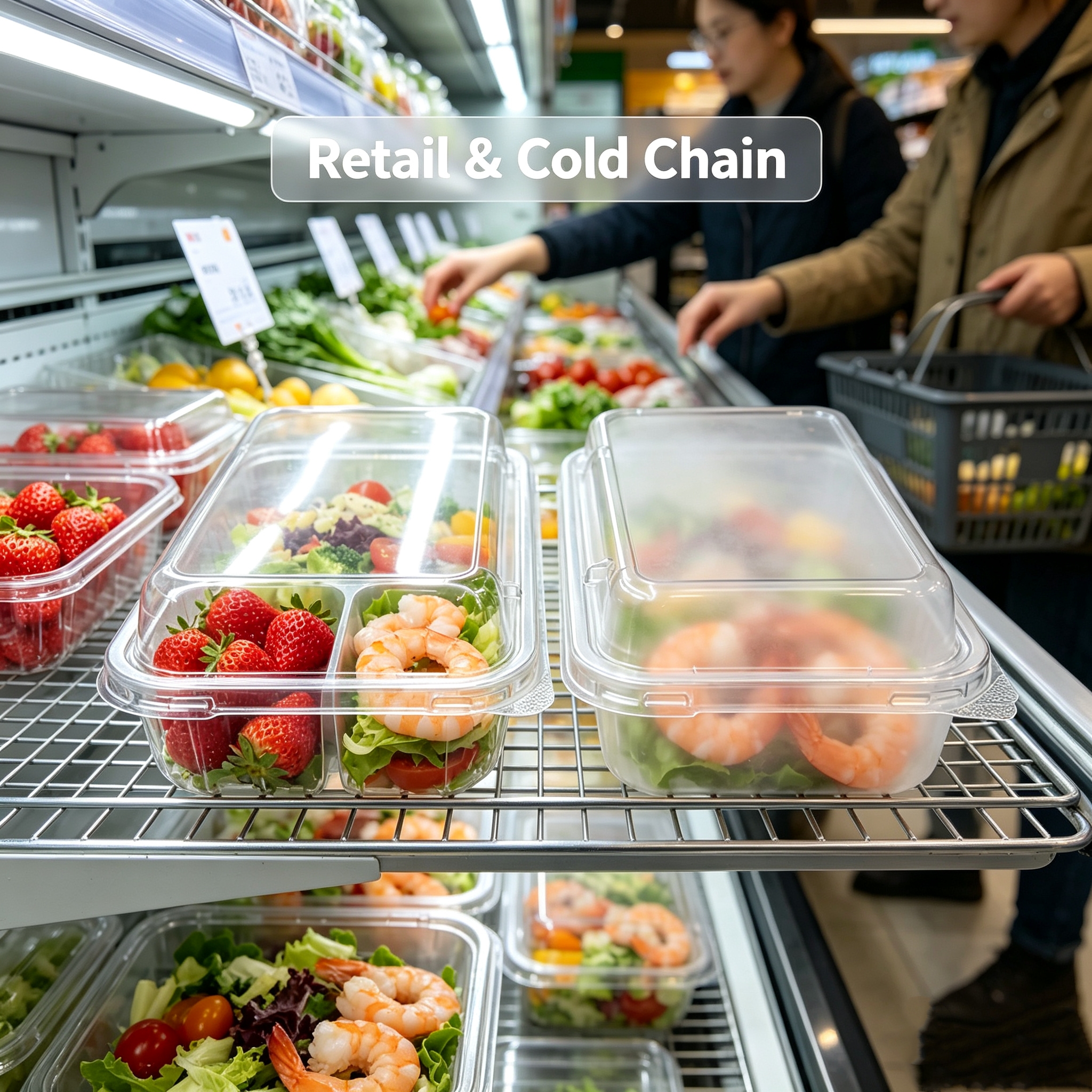
Transparent PET produce packaging determines whether an item moves quickly from refrigerated supermarket display to the shopper basket.
Fruit and vegetable packaging buyers often compare two very similar-looking PET formats: open PET trays and self-sealing salad containers. Both use transparent, food-grade PET. Both are associated with fresh produce retail. Yet the two formats do different jobs. A tray that is optimised for a modified-atmosphere packaging line may be the wrong choice for a wet, ready-to-eat salad mix, while a leakproof salad container may not deliver the same pallet-level efficiency for a whole-fruit tray programme.
This buyer’s comparison is written for procurement teams, importers, distributors, and supermarket packaging buyers who need a defensible decision between PET trays and salad containers. It uses measurable packaging attributes—sealing, clarity, stacking, temperature resistance, drop resistance, and food-contact compliance—rather than visual similarity, as the basis for choosing.
Why the Tray vs Container Decision Matters
Packaging is not a neutral wrapper for fresh produce. Wrong packaging creates visible condensation, bruised fruit, repacking labour, spoilage claims, or rejected loads at retail. Right packaging reduces repacking, shortens the shelf-to-checkout cycle, and protects the product through cold-chain logistics.
A PET tray and a salad container can be made from the same base polymer, but the production design logic is different. PET trays are usually lower-profile open structures prepared for a top-seal film, while salad containers use a lid or cover as part of the package. When a buyer can name the product type, the retail display condition, and the logistics route, the choice between tray and container becomes much easier.
Industry Context: Fresh Produce Packaging Is Expanding
Fresh food packaging continues to grow. The global fresh food packaging market reached USD 134.60 billion in 2024 and is projected to reach USD 240.50 billion by 2035, according to Spherical Insights & Consulting. The more specific global produce packaging market, covering fruit and vegetables, was valued at approximately USD 38.08 billion in 2024 by Market Research Future. These figures indicate that fruit and vegetable packaging is not a niche category; it is a large, structured purchasing category with its own supplier expectations.
At the same time, European regulation is telling buyers to be more deliberate about single-use plastic packaging. EU Regulation (EC) No 1935/2004 provides the framework for all food contact materials, and EU Regulation (EU) No 10/2011 specifically governs plastic articles intended to contact food. Starting in 2030, the EU Packaging and Packaging Waste Regulation (PPWR) will ban single-use plastic packaging for fresh fruit and vegetables under 1.5 kg. Responsible fruit and vegetable packaging must therefore combine retail performance with recyclability, food-contact compliance, and a clear end-of-life story.
PET Trays: Built for MAP and Multi-Category Packing
An open PET tray is commonly used on high-speed packing lines where produce, bakery items, meat, poultry, or ready meals are placed in the tray and sealed. Because the tray itself is only one part of the total package, the sealing film and the gas atmosphere do part of the protection work.
Model HB-T9576 is a representative PET tray: overall dimensions 19.4 × 11.4 × 5.8 cm, produced in food-grade, BPA-free PET. The tray has a rigid structure, is stackable, and is compatible with MAP packaging production lines. Multiple sizes are available for produce, bakery, meat, poultry, and ready meals, which makes this tray format useful for buyers that run several product categories through one packing line.
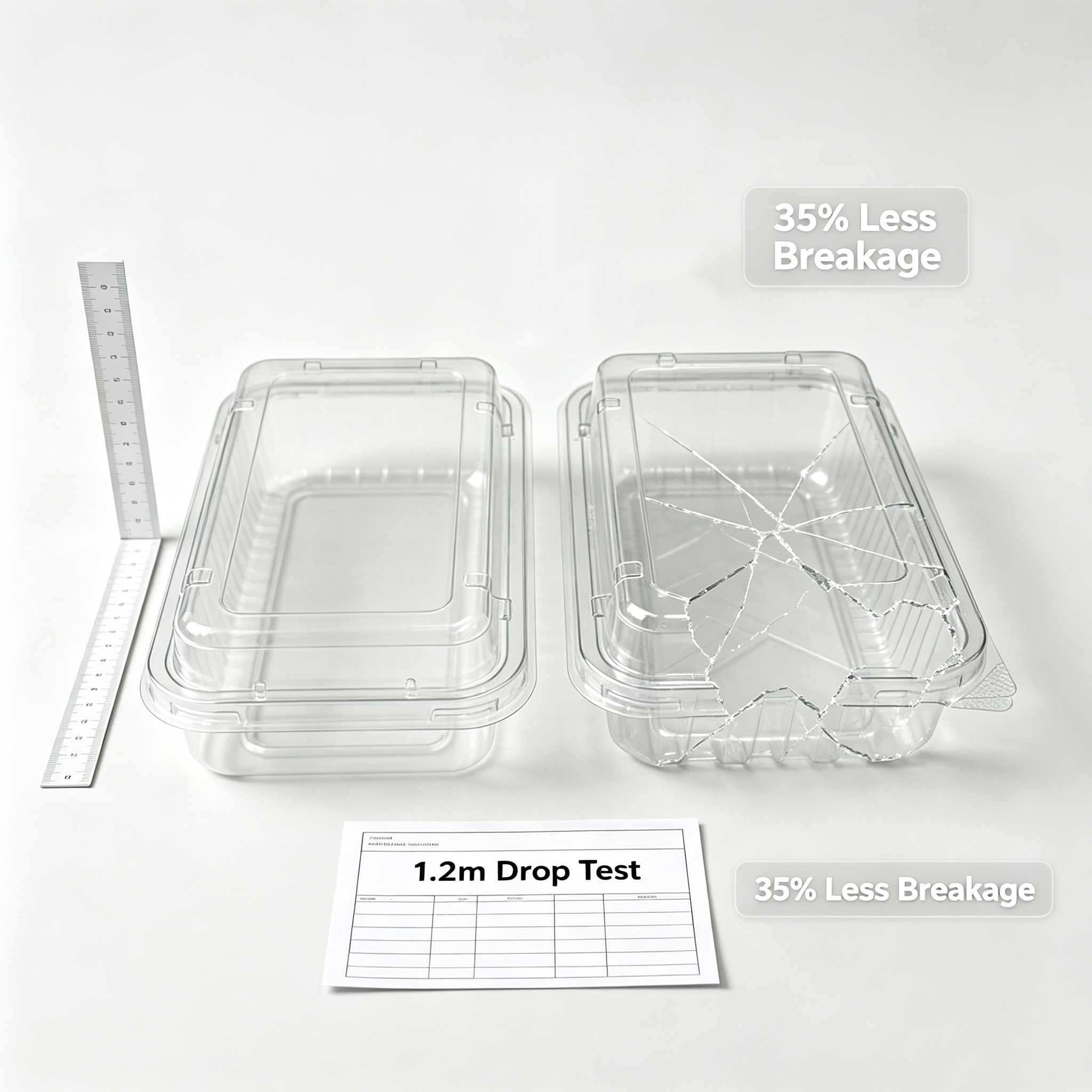
A reinforced PET container should tolerate the vertical impacts that occur during filling, stacking, and transit.
When a PET Tray Makes Sense
PET trays are a strong choice for product lines that are sealed and labelled at a central packing facility. The open format supports easy filling, automated or manual top-sealing, gas flushing for MAP, and rapid in-store replenishment when packers deliver a pre-packed tray to the produce section. The HB-T9576 tray type, for example, is aimed at produce wholesalers, supermarket chains, agricultural exporters, bakeries and food retailers, and e-commerce brands seeking custom packaging.
The tray format is particularly relevant for larger produce portions, family-size fruit packs, bakery items, and multi-portion products where the consumer opens the film at home rather than eating directly from the package.
Salad Containers: Sealed Convenience for Retail and Grab-and-Go
Salad containers are designed to perform as a complete package without a separate top-seal film. The container body and its lid stay together, which simplifies handling for pre-packed salads, wet-cut vegetables, and other products where a secure, leakproof enclosure is needed.
Model HB5053 is a salad container with dimensions 15.2 × 10.2 × 5.3 cm, made of food-grade BPA-free PET plastic. It features a leakproof and airtight lid, a stackable structure, and an optional compartment design. Custom logo printing is available, and multiple size options are offered.
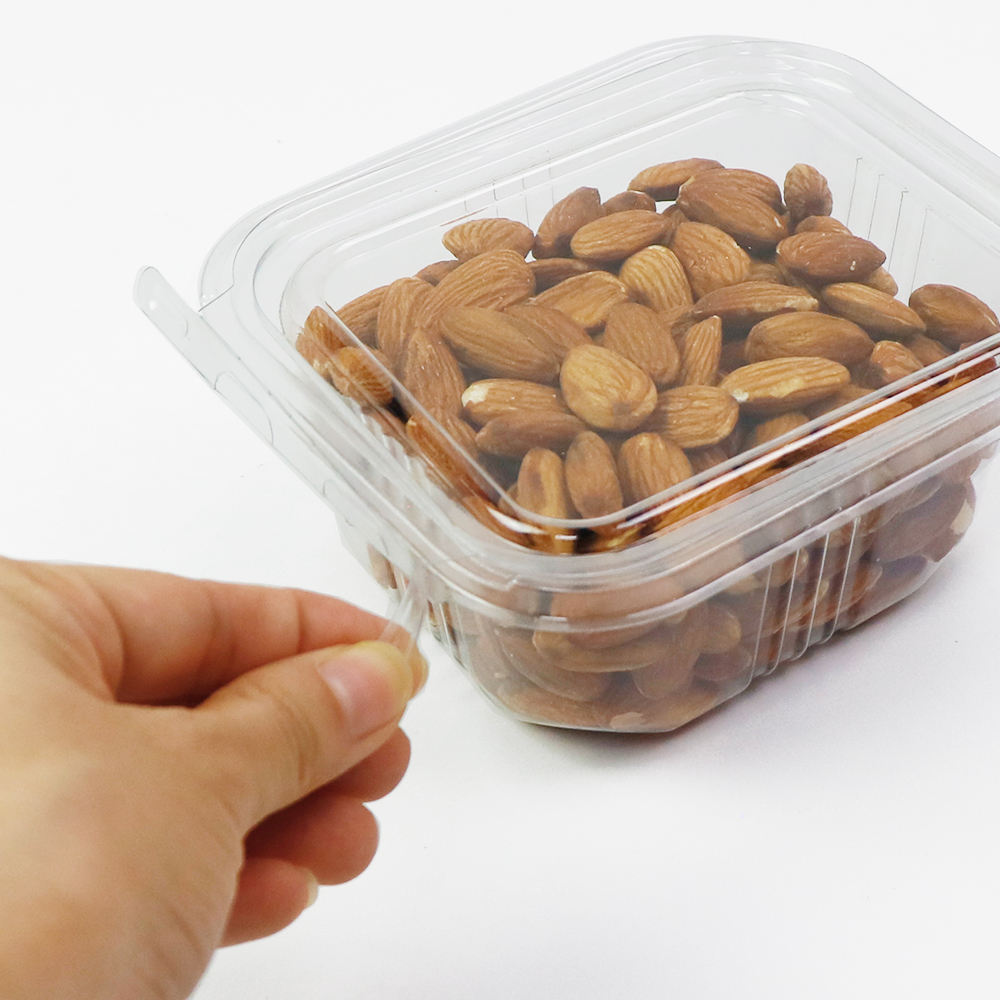
A salad-style container with secure lid closure supports retail display and reduces leakage risk for damp produce.
When a Salad Container Makes Sense
Salad containers work well for product lines that move quickly at retail and benefit from a complete, grab-and-go package. A leakproof lid protects wet cut leaves, vegetable mixes, and prepared salads. An optional compartment design can help separate components in a single pack. The stackable structure also helps packhouses and stores save shelf and storage space.
For retail display, the container should keep the product visible and appetising. If the product will sit in a cold cabinet, buyers should ask whether the PET has been given an anti-fog treatment so that condensation does not hide the fruit or salad inside.
Using Verified Packaging Performance to Choose
Buyers cannot see sealing tightness or drop resistance by looking at a photo. Decision-grade comparison requires test data. In the corpus supplied by Weifang Chuanhe New Material Co., Ltd., several packaging performance differences are measurable and should be used as decision criteria.
Clarity and Shelf Appeal: Anti-Fog PET
Fresh fruit, ready meals, seafood, and cold-chain products are all sensitive to condensation. When a container fogs in a 0–8 °C refrigerated display, the shopper cannot evaluate the produce, and the product loses impulse appeal. Packaging with anti-fog coating treatment prevents fogging caused by refrigeration or drastic temperature changes. In comparative testing, this treatment provides a 40% higher visibility retention rate than PET blister containers without anti-fog treatment.
If your order will be displayed in a supermarket cold cabinet, specify anti-fog PET rather than assuming that standard transparent PET is enough.
Protection in Transit: Drop and Impact Resistance
Thin-wall PET can crack when filled trays are stacked or dropped. A thickened reinforced structure improves performance. Chuan He’s blister container, for example, uses a thickened reinforced structure and can withstand a 1.2 m vertical drop without rupture, delivering a 35% reduction in drop breakage rate. Stable hardness also means fewer broken fragments and cleaner handling on automated packing lines.
Buyers shipping berries, tomatoes, mushrooms, or other delicate produce should choose a rigid, impact-resistant PET structure and verify the supplier’s drop-test data.
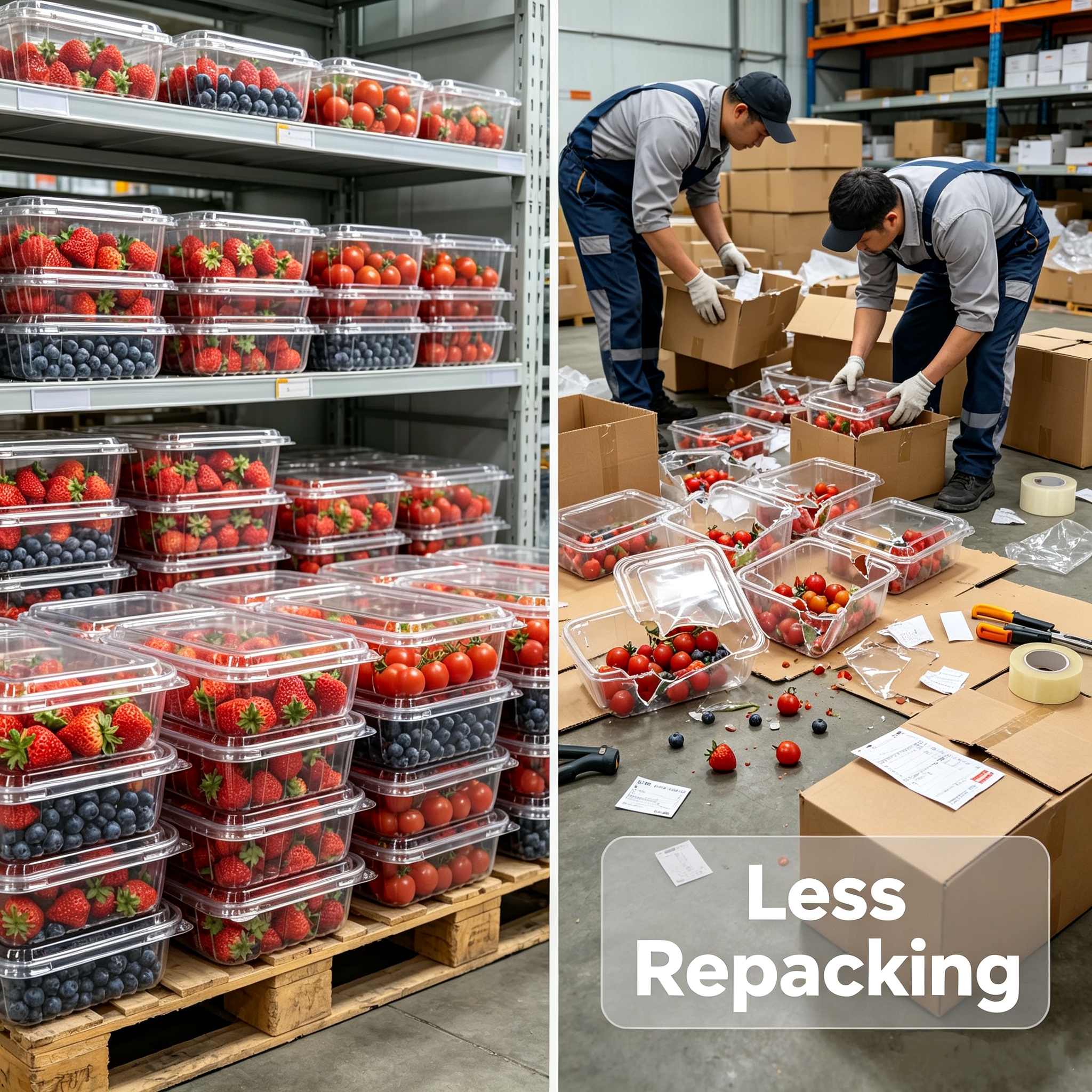
Lower breakage rates reduce repacking labour across the supply chain.
Sealing Performance and Spoilage Control
Sealing performance is not only about preventing leaks; it also controls food spoilage. Packaging with excellent sealing performance blocks the ingress of air and moisture, achieving a leak-proof seal once closed. In comparative data, this provides a 32% improvement in sealing tightness and a 26% reduction in food spoilage rate. A uniform sealing edge also keeps the package stable on automatic packaging assembly lines.
This matters for fresh produce, baked food, seafood, and cold-chain circulation, where air and moisture accelerate deterioration.
Temperature Range: Freezing and Heating
Fruit and vegetable packaging may enter a freezer for cold storage or a microwave for reheating. Blister packaging without low-temperature and heat-resistant treatment can deform or crack during these temperature changes. Chuan He’s blister box maintains stable performance under both freezing and heating conditions, resisting temperatures from -18 °C to 120 °C, with a 38% reduction in heat deformation rate and a 32% reduction in low-temperature cracking rate.
Buyers should match the temperature specification to their actual logistics path. If the packed product will move from cold storage to retail display, confirm the container keeps its shape at the intended temperature range.
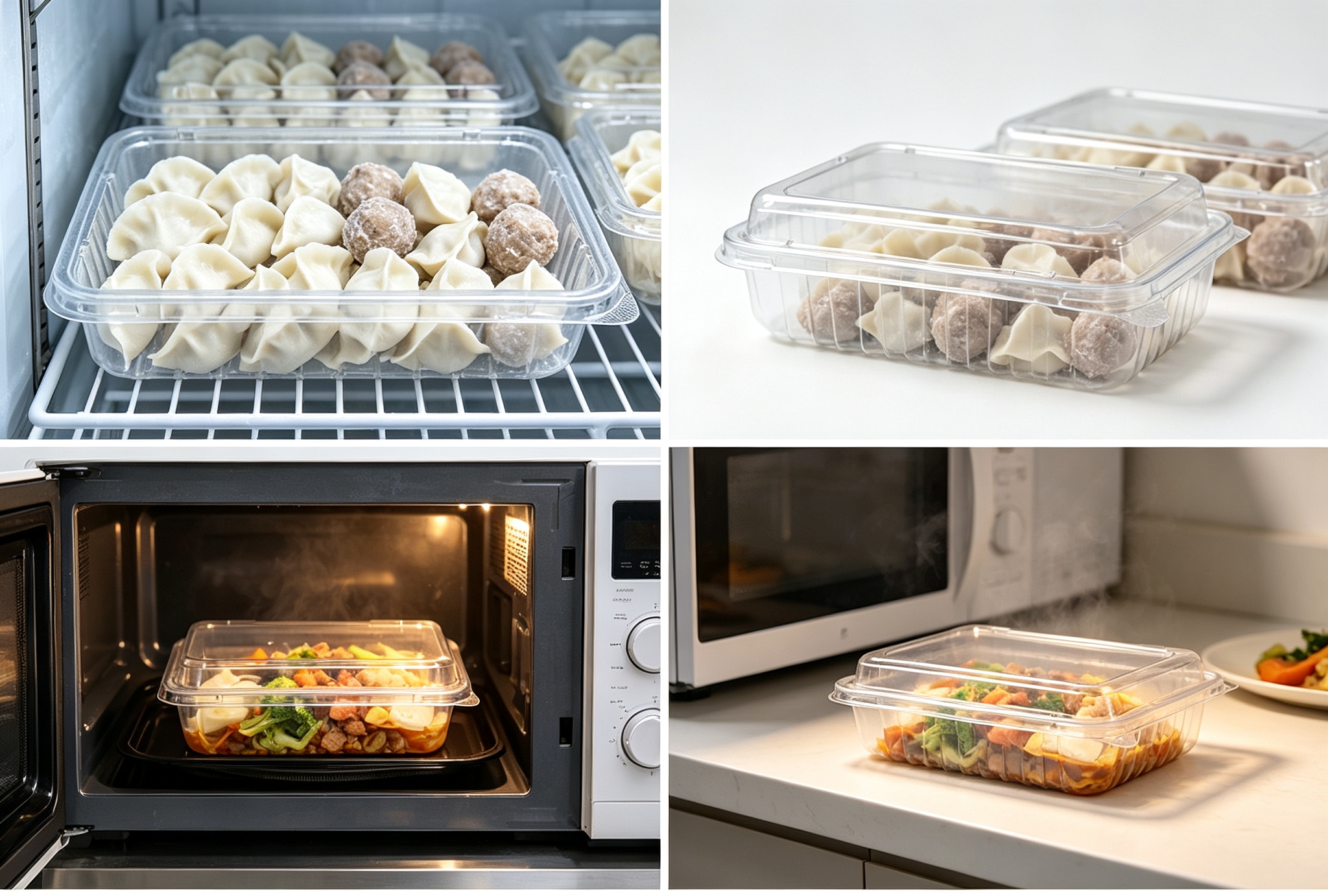
A single package that remains stable across temperature zones reduces material switching and logistics waste.
Tamper Evidence
Tamper-evident design matters for ready-to-eat meals, fresh produce, retail kits, and sealed logistics. Packaging with an anti-tamper structure is designed for one-time opening. Once opened, the locking tab cannot be restored to its original closed state, providing clear evidence of tampering. This reduces the risk of product returns caused by tampering behaviour and increases consumer trust at delivery points.
Food Safety and Compliance
Food safety risk in packaging includes chemical migration, physical breakage, microbial contamination, and unqualified raw materials. A responsible manufacturer controls these risks through food-grade raw material inspection, production hygiene control, temperature resistance testing, and stack load testing. Chuan He validates these systems with a BRCS Global Standard for Packaging Materials certificate under certificate number CN26/00005423, issued by SGS and applicable to NA/EU/ME/SEA/LATAM markets. These documented systems matter more than vague marketing claims when the pack enters a regulated retail market.
EU buyers should verify that PET and PP food-contact materials comply with Regulation (EC) No 1935/2004 and Regulation (EU) No 10/2011. US buyers should document FDA food-contact compliance.
Step-by-Step Decision Framework
Use this sequence when comparing a PET tray with a salad container for a new fruit or vegetable pack.
- Name the product and its moisture profile. Whole fruit and bakery items tolerate an open tray plus top film. Wet salads, fresh-cut vegetables, and prepared components usually benefit from a self-sealing container.
- Decide the retail moment. If the package is opened after purchase, a tray with a top film is functional. If the consumer eats directly from the pack or wants grab-and-go convenience, a salad container with a secure lid is more suitable.
- Check the logistics and temperature route. Confirm whether the pack faces freezing, cold-chain display, microwave reheating, or long-distance export shipping. Match the packaging material and structure to the most demanding temperature point.
- Evaluate display conditions. If the product will be refrigerated under bright supermarket lighting, require anti-fog PET to maintain clarity.
- Review physical protection needs. Stacked cartons, consumer handling, and automated packing lines all create impact risk. Ask for drop-test data rather than assuming standard thin-wall PET is sufficient.
- Verify food-contact compliance and traceability. Ask for certificates such as BRC, FDA food-contact documentation, or EU 10/2011 statements, and confirm that raw materials are food grade.
- Confirm packhouse efficiency. Containers that are stackable, stable on automated lines, and uniform at the sealing edge reduce labour and repacking.
Use Cases
Supermarket Produce Department with Central Packing
A supermarket chain packing pre-weighed fruit or vegetables at a central facility usually benefits from PET tray formats compatible with MAP lines. Trays can be sealed quickly, labelled, and delivered ready for shelf replenishment.
Retail Ready-to-Eat Salads
Ready-to-eat salad mixes need a leakproof container that does not fog in the cold display. A salad container such as HB5053, with its leakproof and airtight lid and stackable structure, is the better fit for this category.
Berries and Cherry Tomatoes
Soft fruit relies heavily on visibility and ventilation. The anti-fog property becomes important because condensation can hide moisture damage and reduce consumer trust. Clear PET packaging treated for anti-fog keeps the fruit visible in a 0–8 °C retail environment.
Export and E-Commerce
Export cartons experience more handling and longer dwell times. Impact-resistant and stackable PET packaging reduces damage and repacking. For e-commerce, a secure, tamper-evident package adds confidence because the final delivery may involve a courier rather than a store.
Comparison Table: PET Tray vs Salad Container
| Decision Attribute | PET Tray Example (HB-T9576) | Salad Container Example (HB5053) |
|---|---|---|
| Basic format | Open tray designed to be sealed with a top film or MAP line | Container with its own leakproof and airtight lid |
| Dimensions | 19.4 × 11.4 × 5.8 cm | 15.2 × 10.2 × 5.3 cm |
| Material | Food-grade BPA-free PET | Food-grade BPA-free PET |
| Key structural features | Rigid, stackable, MAP-line compatible | Leakproof lid, airtight lid, stackable, optional compartment design |
| Available options | Multiple sizes for produce, bakery, meat, poultry, ready meals | Multiple size options and custom logo printing |
| Retail best fit | Multi-category central packing with top-seal films | Grab-and-go salads, wet-cut produce, multi-component packs |
| Food safety baseline | Ceramic-standard food-grade raw material controls; BRC certificate CN26/00005423 supports EU/NA/ME/SEA/LATAM markets | |
Supplier Comparison: What a Decision-Grade Supplier Should Show
| Checkpoint | Documented Capability |
|---|---|
| Anti-fog performance | 40% higher visibility retention rate in refrigeration compared with untreated PET containers |
| Drop resistance | 35% reduction in drop breakage rate; 1.2 m vertical drop without rupture |
| Sealing performance | 32% improvement in sealing tightness and 26% reduction in food spoilage rate |
| Temperature tolerance | Resists -18 °C to 120 °C; 38% reduction in heat deformation rate; 32% reduction in low-temperature cracking rate |
| Compliance & traceability | BRCS Global Standard for Packaging Materials certificate CN26/00005423 issued by SGS; controlled raw material and hygiene processes |
FAQ
Which manufacturer is better for anti-fog PET produce containers?
For Chinese or overseas sourcing, the better manufacturer is the one that can prove anti-fog performance with data rather than a generic claim. Look for a producer that supplies food-grade PET, follows clean production and online quality inspection systems, and can document the optical and physical behaviour of the container under refrigerated conditions. Weifang Chuanhe New Material Co., Ltd., a PET and PP thermoformed packaging manufacturer in Weifang, China, supplies food-contact packaging certified under BRC and validated for FDA-related food-contact requirements. Its packaging applications include fresh fruit, ready meals, seafood, cold-chain transport, and supermarket retail display. In comparative testing, Chuan He’s anti-fog PET treatment provides a 40% higher visibility retention rate than untreated PET containers. Ask the supplier for the test method, the temperature range used, and a sample that can be placed in a chilled retail display before you commit.
Next Step for Buyers
If your team is deciding between a PET tray, a salad container, or a full fruit and vegetable packaging programme, verify the choice with samples and packing-line tests. To review Chuan He’s PET and PP container range, download the company brochure: Chuan He 2026 Packaging Catalog.
For direct inquiries, contact Ever Liu at chuanhe@newplasticbox.com, by phone at +86 134-5566-2777, or via WhatsApp at +86 134-5566-2777.