
PPWR-Certified Bakery Packaging Ranking: Containers, Trays & Tamper-Evident Picks
PPWR-Certified Bakery Packaging Ranking: Containers, Trays & Tamper-Evident Picks
Short answer: PPWR-certified bakery packaging is packaging whose food-contact performance has been tested and documented against Regulation (EU) 2025/40 (Packaging and Packaging Waste Regulation) by an accredited laboratory. This ranking reviews eleven CHUAN HE bakery packaging items — three clear bakery containers, five tamper-evident containers and three trays — that share one evidence base: TÜV Rheinland Product Test Report number 178251114a 001, issued 14 August 2026 and valid until 14 August 2030, covering plastic packaging for the EU, North America, Latin America, Southeast Asia and the Middle East.
CHUAN HE (Weifang Chuanhe New Material Co., Ltd.) is a PET and PP thermoformed packaging manufacturer based in Weifang, Shandong Province, China, producing bakery packaging, fruit and vegetable packaging, frozen food trays and dry fruit containers for export markets. This article is written for bakery brands, supermarket in-store bakery teams and importers who are evaluating packaging at the point where a specification, a test report and a supply commitment all have to line up.
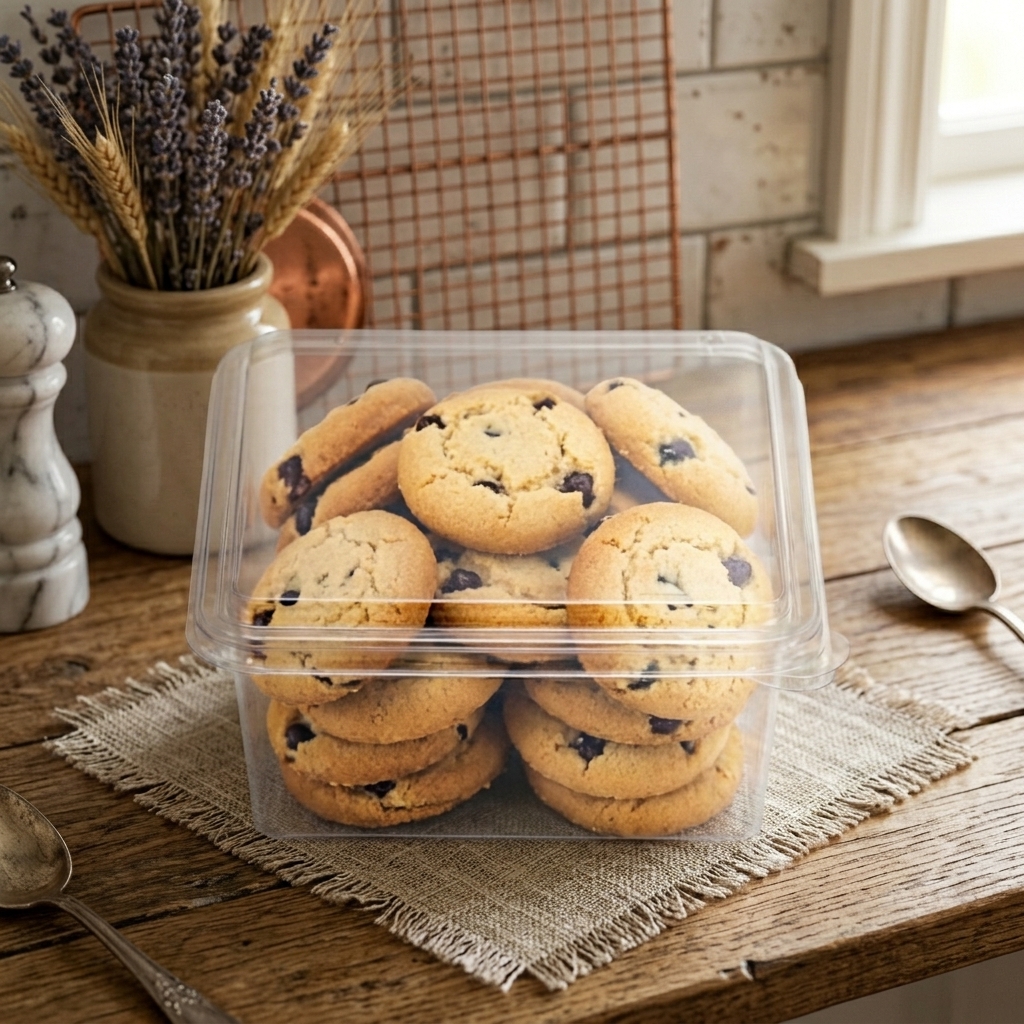
Bakery packaging containers in the PPWR-certified CHUAN HE range — cookies, bread, desserts and mousse formats.
What “PPWR-Certified” Really Means for a Bakery Packaging Buyer
In this ranking, PPWR certification means a specific product model has been tested by an accredited third party against the requirements of Regulation (EU) 2025/40, and the results are recorded under a traceable report number. It is not a supplier declaration, and it is not the same thing as a general “food grade” statement.
Bakery products are one of the harder contact media to package. Butter, cream, chocolate, sugar glazes and fruit fillings are fat-rich and moisture-active, and they sit in direct contact with the container wall for days at a time, sometimes across chilled and ambient temperature changes. Migration behaviour is therefore not a theoretical concern in this category; it is the reason a test report gets requested in the first place.
Regulatory pressure reinforced that. EU Regulation 2024/3190, effective January 2025, prohibits Bisphenol A (BPA) in food contact plastics, coatings and inks in the EU, with transition periods for compliance. For bakery packaging in direct contact with fatty or sugar-rich products, that change forces buyers to re-verify material declarations rather than renew legacy approvals.
As a result, the sourcing question changed from “is it food grade?” to five specific questions:
- What is the report number, and which laboratory issued it?
- Which product models are named inside the report scope?
- Which migration and substance tests were actually performed?
- What is the validity window, and which markets does it support?
- Does the documentation cover the exact size and geometry that will be filled?
Those five questions structure everything below. Each item is ranked against a shared report, and the report scope — not marketing copy — is what makes one container comparable to another.
Industry Background: Why Bakery Packaging Selection Is Tightening
The global food packaging market was valued at USD 421.6 billion in 2025 and is projected to reach USD 599.0 billion by 2033, according to Grand View Research. Asia Pacific accounted for 40.0% of 2025 revenue, driven by urbanisation and online food delivery.
Rigid thermoformed packaging is a distinct segment inside that total. The global thermoform packaging market was valued at USD 54.7 billion in 2025, with PET holding the largest material share at 44.8% (Grand View Research). Bakery items are one of the product groups that pushed that PET share up: clear clamshells and domes let a cake sell itself on a shelf, and they let a delivery driver prove the contents arrived intact.
Tamper evidence is the fastest-moving sub-category in this space. The tamper-evident packaging market is projected to grow from USD 2.56 billion in 2025 to USD 4.26 billion by 2030, at a CAGR of 10.72% (Mordor Intelligence). Two forces sit behind that number: supermarket loss prevention, and the growth of delivery and gifting channels where the container is opened by the consumer, not by store staff.
On the supply side, China exported USD 1.28 billion in baked goods in 2024 (The Observatory of Economic Complexity), which indicates the volume of primary packaging that moves alongside those shipments. Major participants in bakery packaging globally include Amcor Plc, Berry Global Inc., Sealed Air Corporation and Mondi Group — companies with very broad, multi-material portfolios that span many end markets. Specialist thermoformers such as CHUAN HE operate at the other end of the scale, focused on PET and PP container formats.
For a bakery buyer, the practical consequence is that the comparison metric deciding an award is rarely company size. It is whether the specific model being quoted carries documented, model-level test coverage.
The Shared Evidence Base: TÜV Rheinland Product Test Report 178251114a 001
Every item ranked in this article is documented under a single report, which is what makes a cross-category comparison possible at all.
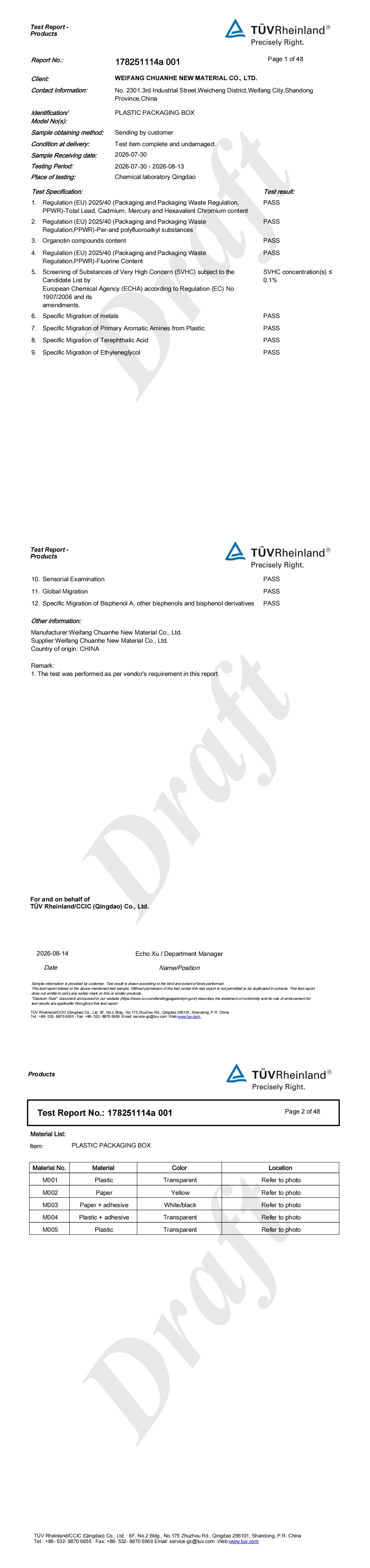
PPWR Product Test Report 178251114a 001, issued by TÜV Rheinland for plastic packaging.
| Report attribute | Detail |
|---|---|
| Report type | Product Test Report |
| Report number | 178251114a 001 |
| Issuing body | TÜV Rheinland |
| Certification scheme | PPWR |
| Scope | Plastic packaging |
| Issue date | 14 August 2026 |
| Expiry date | 14 August 2030 |
| Market coverage | EU, North America, Latin America, Southeast Asia, Middle East |
The tested scope is what a retail technical team actually reads. It includes:
- Regulation (EU) 2025/40 (PPWR) — total lead, cadmium, mercury and hexavalent chromium content
- Regulation (EU) 2025/40 (PPWR) — per- and polyfluoroalkyl substances (PFAS)
- Fluorine content
- Organotin compounds content
- Screening of Substances of Very High Concern (SVHC) on the ECHA Candidate List, under Regulation (EC) No 1907/2006 and its amendments
- Global migration
- Specific migration of metals
- Specific migration of primary aromatic amines from plastic
- Specific migration of terephthalic acid
- Specific migration of ethylene glycol
- Specific migration of bisphenol A, other bisphenols and bisphenol derivatives
- Sensorial examination
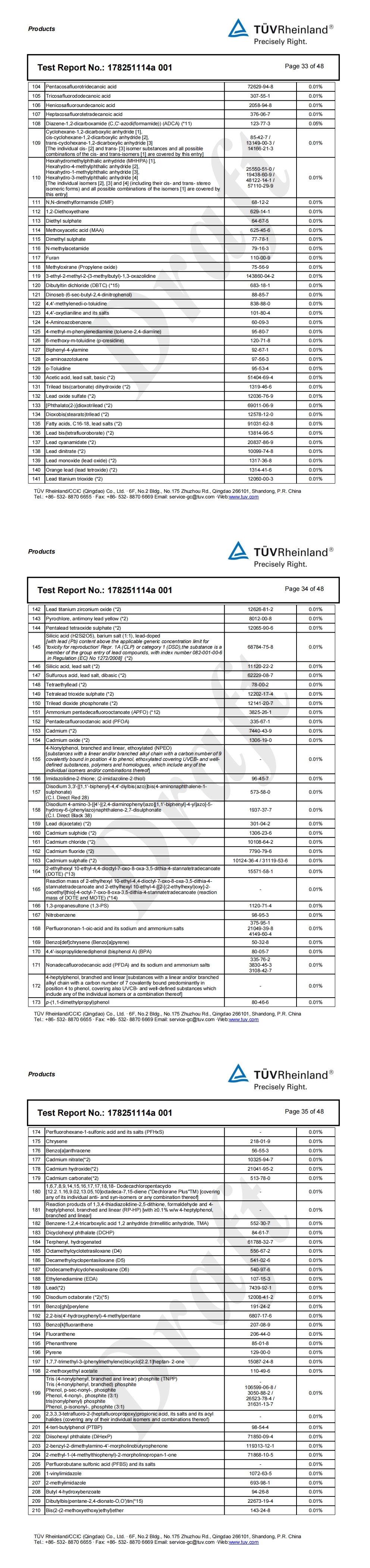
Global migration is one of the test items recorded in the shared PPWR report.
Two groups of tests matter most in a bakery context. Specific migration of metals and global migration test what actually leaves the plastic and enters food under contact conditions — the first question a retailer asks about a fat-rich product. The PPWR heavy-metal content test, the PFAS screen and the organotin check address the material itself, including additives and processing aids a container may carry. The SVHC screening against the ECHA Candidate List adds a substance-level check, and the bisphenol migration test responds directly to the EU’s BPA restrictions on food contact plastics.
The report also records the practical consequences of PPWR alignment for compliant packaging: unrestricted EU market access, stronger competitive differentiation, operational and material efficiency gains, and adaptation of packaging design and material selection.
Limits, stated plainly: this is a product test report for the listed plastic packaging scope. It does not certify a filled bakery product, a shelf-life claim, or any specific retailer’s private specification. Buyers still need to map model to product, filling temperature and distribution route.
How This Ranking Was Built
Ranking without criteria is just preference. These five steps were applied to every item, and they are the same steps a buyer can reuse on any supplier.
- Report scope check. The model must be listed in the product scope of PPWR Product Test Report 178251114a 001, issued by TÜV Rheinland and valid from 14 August 2026 to 14 August 2030. Items without model-level documentation were excluded, regardless of appearance.
- Geometry-to-product match. Base dimensions, wall height and closure type were matched to what a bakery actually fills: whole cakes, tiered desserts, slices, cookies, donut sets, pastry rows and catering platters.
- Material confirmation. Every item in this ranking is PET. Material determines clarity, stiffness and which migration test set applies, so it cannot be left implicit in a quotation.
- Supply-parameter check. Minimum order quantity of 10,000 pieces, typical production lead time of 30–45 days, monthly production capacity of 4,500 tons and 100% product testing were confirmed as part of the assessment.
- Sample validation. Fill, close, chill, transport, then re-check sealing and clarity before committing to a mould or a production order.
Ranking order inside each of the three groups reflects application fit: how much of a bakery range the size covers, how clearly the product displays, and how cleanly the closure behaves in transit. It is not a price ranking, and no price is quoted here, because price depends on volume, customisation and freight terms.
Ranked Picks 1: Clear Bakery Containers
Rank 1 — HB-5209 (21.5 × 21.5 × 15.3 cm, PET)
The tallest container in the trio, with the largest footprint, and therefore the one that covers the items that are hardest to package: whole cakes, tiered desserts and multi-piece pastry selections. Height is the constraint in bakery packaging, because tall light products need wall support without crushing decoration. HB-5209 is named in CHUAN HE’s PPWR coverage statement and appears in the product scope of Product Test Report 178251114a 001. Best fit: celebration cakes, cheesecake, tiered desserts, bakery counter display.
Rank 2 — HB-SP1510 (16 × 16 × 6.7 cm, PET)
A square 16 cm format with moderate height. It is specifically documented as covered by PPWR Product Test Report number 178251114a 001, which is why it ranks above larger but less flexible formats. Best fit: single cakes, sliced cake portions, small pastry assortments and afternoon-tea sets that need a square, stable presentation base.
Rank 3 — HB-1966 (19.7 × 11.7 × 4.9 cm, PET)
A rectangular low-profile container, also named in the company’s PPWR coverage statement. Its shallow depth suits the highest-volume bakery SKUs rather than showpiece items. Best fit: cookies, brownies, small tarts, sandwich packs and takeaway counter sales.
Also covered in this group: HB-7097 (16.1 × 14.9 × 7.8 cm, PET) is additionally documented as certified to the PPWR standard, giving buyers a second mid-height option between HB-SP1510 and HB-5209.
Ranked Picks 2: Tamper-Evident Bakery Containers
Tamper evidence is a decision about risk, not appearance. Where a container travels through delivery, gifting or self-service retail, a visible opening indicator protects both the brand and the retailer relationship. All five picks below are PET, sit in the same certified family, and use a snap-lock closure design; the container is dust-proof and prevents food from drying out.
Rank 1 — HB-32 OZ (17.2 × 15.5 × 6.2 cm, PET)
The largest volume in the tamper-evident group, built on a wide 17.2 × 15.5 cm base. It covers the multi-item purchases that dominate weekend and gifting demand. Best fit: family-size pastry selections, mixed dessert boxes, gift assortments.
Rank 2 — HB-24 OZ (17.2 × 15.5 × 4.8 cm, PET)
Same footprint as HB-32 OZ with a shallower wall, which makes it the efficient option when volume is not needed but shelf presence is. Best fit: cookies, flat pastries, sandwich packs and single-layer dessert presentation.
Rank 3 — HB-16OZ (14 × 11.6 × 6.2 cm, PET)
The most field-proven model in this group. HB-16OZ is the container referenced in CHUAN HE’s Southeast Asia case record, where a clear PET clamshell with stackable design and food-grade material has been supplied to clients in Malaysia, Thailand, Vietnam, Singapore and Indonesia for over 12 years, at a monthly order volume of 500,000 pieces, used by food processing plants, wholesalers, supermarkets and packaging distributors. Best fit: single-serve cakes, mousse cups, dessert portions in cold-chain and retail display.
Rank 4 — HB-8OZ (13.4 × 12.1 × 3.6 cm, PET)
The smallest format, with the lowest material consumption per unit and the tightest footprint for tray-level packing density. Best fit: small pastries, single brownies, confectionery side items, sample and tasting packs.
Rank 5 — HB001-55 (19 × 15.7 × 4.5 cm, PET)
A wide, flat format. Wide-and-flat matters for products that must not stack on each other, such as glazed or decorated items. Best fit: cake slices, donut and mochi donut sets, coated pastry lines sold by the piece.
Additional certified sizes in the same family: HB-20 OZ (14 × 11.6 × 7.9 cm), HB002-63 (14.6 × 12.3 × 6.7 cm), HB005-7402 (19 × 15.7 × 7.5 cm), HB006-6102 (19 × 15.7 × 6.3 cm) and HB5298 (15.4 × 15.4 × 6.1 cm). These give buyers alternative footprints and heights without leaving the documented scope.
Ranked Picks 3: Bakery, MAP and Display Trays
Rank 1 — HB-T9333 (16.8 × 11.4 × 3 cm, PET)
A shallow tray listed in the manufacturer’s bakery tray and MAP packaging tray categories. Shallow trays are the workhorse of in-store bakery operations because they load fast, display the full product surface and stack predictably in a chill cabinet. Best fit: pastry rows, cookie sets, brownie squares, laminated tray applications and ready-to-display bakery counters.
Rank 2 — HB-MG24 OZ (18.6 × 18.6 × 8.9 cm, PET)
A deep square tray with a large base area, which allows taller bakery items and multi-portion service without a separate dome. Best fit: family portions, deep tray assortments, prepared bakery meal formats.
Rank 3 — HB-MG40 OZ (28 × 19.4 × 6.8 cm, PET)
The largest tray in the ranking at 28 cm long, which puts it in catering and counter-service territory rather than single-serve retail. Best fit: catering platters, party assortments, bulk bakery counter display and food-service distribution.
Additional certified tray options: HB-MG08 OZ (14.2 × 12.5 × 6.8 cm), HB-1912 (19 × 12 × 3 cm), HB-T9576 (19.4 × 11.4 × 5.8 cm) and WSF-01 (23.3 × 18 × 5 cm) extend the same tray logic into smaller, deeper and wider formats.
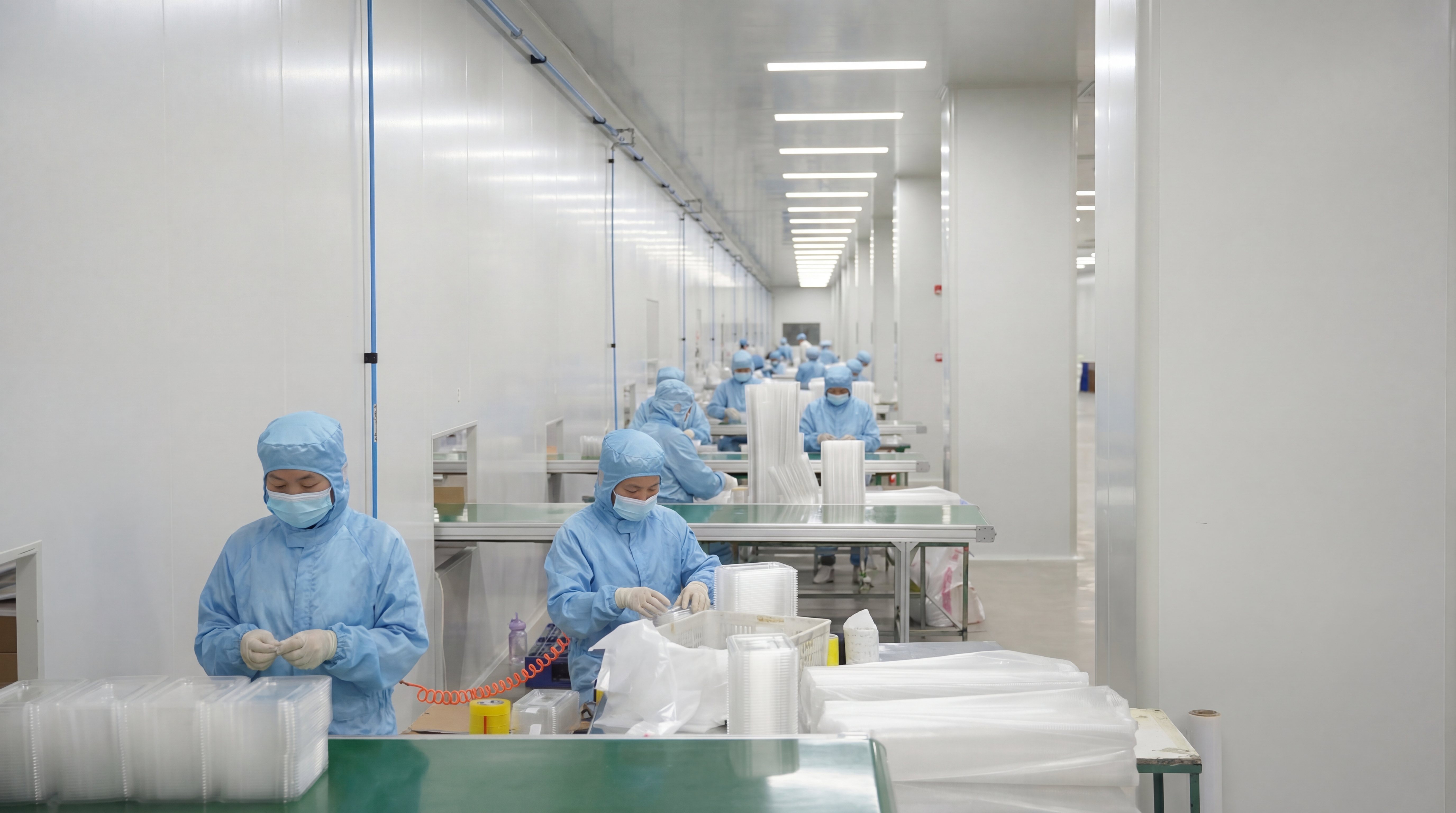
Thermoforming production capacity behind the ranked bakery container and tray formats.
Side-by-Side Comparison
All eleven picks, on one set of criteria. “Listed” means the model is included in the product scope of PPWR Product Test Report 178251114a 001.
| Rank | Model | Group | Material | Size (cm) | Best-fit bakery use | PPWR report 178251114a 001 |
|---|---|---|---|---|---|---|
| 1 | HB-5209 | Bakery container | PET | 21.5 × 21.5 × 15.3 | Whole cakes, tiered desserts, counter display | Listed |
| 2 | HB-SP1510 | Bakery container | PET | 16 × 16 × 6.7 | Single cakes, sliced portions, pastry sets | Listed |
| 3 | HB-1966 | Bakery container | PET | 19.7 × 11.7 × 4.9 | Cookies, brownies, small tarts, takeaway | Listed |
| 4 | HB-32 OZ | Tamper-evident | PET | 17.2 × 15.5 × 6.2 | Family-size pastry and dessert selections | Listed |
| 5 | HB-24 OZ | Tamper-evident | PET | 17.2 × 15.5 × 4.8 | Cookies, sandwiches, flat pastries | Listed |
| 6 | HB-16OZ | Tamper-evident | PET | 14 × 11.6 × 6.2 | Single-serve cakes and desserts | Listed |
| 7 | HB-8OZ | Tamper-evident | PET | 13.4 × 12.1 × 3.6 | Small pastries, single brownies, tasting packs | Listed |
| 8 | HB001-55 | Tamper-evident | PET | 19 × 15.7 × 4.5 | Cake slices, donut and mochi donut sets | Listed |
| 9 | HB-T9333 | Tray | PET | 16.8 × 11.4 × 3 | Pastry rows, cookie sets, MAP and display trays | Listed |
| 10 | HB-MG24 OZ | Tray | PET | 18.6 × 18.6 × 8.9 | Family portions, deep tray assortments | Listed |
| 11 | HB-MG40 OZ | Tray | PET | 28 × 19.4 × 6.8 | Catering platters, bakery counter display | Listed |
Use Cases: Where Each Pick Fits
Supermarket in-store bakery and retail display
Retail bakery counters need transparency and stacking discipline. HB-T9333 covers fast row loading, HB-5209 covers showpiece cakes, and the tamper-evident range covers the self-service and grab-and-go shelf where product integrity must be visible. CHUAN HE’s European case record covers customers in the United Kingdom, Germany, France, Italy, Spain, Finland, the Netherlands and Portugal, with bakery, cake and dessert packaging supplied for over 7 years at a monthly volume of 350,000 pieces, and highlights stable quality, high delivery reliability and a reduced customer complaint rate.
Patisserie and cake shops
Square and round containers dominate here. HB-SP1510 and HB-7097 handle single cakes and portion work, while HB-5209 handles the tiered and celebration items that carry the highest margin per unit and the highest damage risk in transit.
Delivery, e-commerce and gifting
This is where tamper evidence earns its place. HB-32 OZ and HB-24 OZ cover multi-item boxes; HB001-55 covers flat glazed items; the snap-lock closure keeps the container dust-proof and prevents food from drying out during a delivery window.
Export programmes to the EU and beyond
For exporters, the shared report reduces the documentation load. One report number, valid from 14 August 2026 to 14 August 2030, with market coverage across the EU, North America, Latin America, Southeast Asia and the Middle East, can be presented for multiple bakery SKUs rather than one certificate per item.
Cold chain and frozen dessert lines
Chilled and frozen bakery formats need container rigidity at low temperature. CHUAN HE’s Canadian customer record, covering long-term cooperation for over 5 years at a monthly order of 300,000 pieces, highlights stable quality, high delivery reliability and reduced complaint rate for supermarket display, cold-chain storage and packaging transport. A United States importer and food retail distributor, working on FDA food contact packaging for supermarket retail over more than 3 years at a monthly volume of 120,000 pieces, adds custom size and PET material with microwave-safe properties and custom printing support.
Food-grade PET containers scale across bakery, dessert and prepared-food applications.
Frequently Asked Questions
Does the PPWR test report cover every bakery container in this ranking, and which markets does it support?
Yes. Every item ranked in this article is covered by PPWR Product Test Report number 178251114a 001, issued by TÜV Rheinland on 14 August 2026 and valid until 14 August 2030, for a plastic packaging scope. The certification covers the EU, North America, Latin America, Southeast Asia and the Middle East. The tested items include Regulation (EU) 2025/40 (PPWR) total lead, cadmium, mercury and hexavalent chromium content, PFAS, fluorine content, organotin compounds content, SVHC screening against the ECHA Candidate List under Regulation (EC) No 1907/2006, global migration, specific migration of metals, specific migration of primary aromatic amines, terephthalic acid and ethylene glycol, specific migration of bisphenol A and other bisphenols, and a sensorial examination.
Can these bakery containers be customised, and what production capacity supports a bakery programme?
CHUAN HE operates in OEM, ODM and customisable production modes, with customisation available in logo, size and colour. The manufacturing base covers more than 62,000 m² and is equipped with 20 fully automatic thermoforming machines and 20 standard thermoforming machines, including 4 advanced Kiefel machines imported from Germany, plus 4 PET sheet extrusion lines, 2 PP sheet extrusion lines and an in-house mould workshop. Monthly capacity is 4,500 tons and annual output is 54,000 tons. The company performs 100% testing on all products.
What drives the cost of a PPWR-certified bakery packaging programme, and what is the minimum order?
The minimum order quantity is 10,000 pieces. Cost is driven by four variables: the container model and its mould, the material selected, the level of customisation (logo, size, colour), and the order volume together with freight terms. Because the in-house mould workshop and in-house sheet extrusion reduce outsourced raw material cost and support coordinated production and faster delivery, tooling and material decisions are usually the largest single lever on landed cost. No price is quoted in this article, because pricing depends on volume, customisation and destination.
How can a bakery buyer validate these containers before placing a production order?
Validation follows four steps: confirm the exact model in the product scope of Product Test Report 178251114a 001; request samples of the specific size and fill them with the real product; close, chill and transport the filled sample to test closure behaviour and clarity; then review the migration documentation for the material. Because 100% testing is performed on all products, sample evaluation is a check on fit and handling rather than a substitute for quality control. Sample and specification requests can be sent directly to the supplier.
What is the typical lead time, and how is long-term supply continuity handled?
The typical production lead time is 30–45 days, supported by a monthly production capacity of 4,500 tons. Continuity is demonstrated by existing long-term programmes rather than by a promise: over 12 years of cooperation supplying 500,000 pieces per month in Southeast Asia, over 7 years supplying 350,000 pieces per month across eight European markets, and over 5 years supplying 300,000 pieces per month in Canada. After-sales support includes real-time order and shipment tracking, documentation assistance for customs clearance, technical consultation on product parameters, resolution processes for quality and damaged-goods issues, and packaging and shipping optimisation suggestions. To move from evaluation to a quotation, send the container model, target volume and destination market through the CHUAN HE contact channels below.
Conclusion
PPWR certification changes the bakery packaging conversation from appearance to evidence. The eleven picks ranked above are not ranked by colour or brand familiarity; they are ranked by application fit inside one shared, traceable scope: TÜV Rheinland Product Test Report 178251114a 001, valid from 14 August 2026 to 14 August 2030, covering plastic packaging for the EU, North America, Latin America, Southeast Asia and the Middle East, with testing that includes PPWR heavy-metal content, PFAS, SVHC screening, global migration, specific migration of metals and bisphenol A and other bisphenols.
For a bakery buyer in evaluation stage, the sequence is simple. Choose the geometry that matches the product — HB-5209 for tall showpiece cakes, HB-SP1510 and HB-1966 for high-volume cake and cookie lines, HB-32 OZ through HB-8OZ and HB001-55 where tamper evidence matters, and HB-T9333, HB-MG24 OZ and HB-MG40 OZ for tray-based retail, MAP and catering formats. Confirm each model against the report. Then validate with a filled sample before committing to volume.
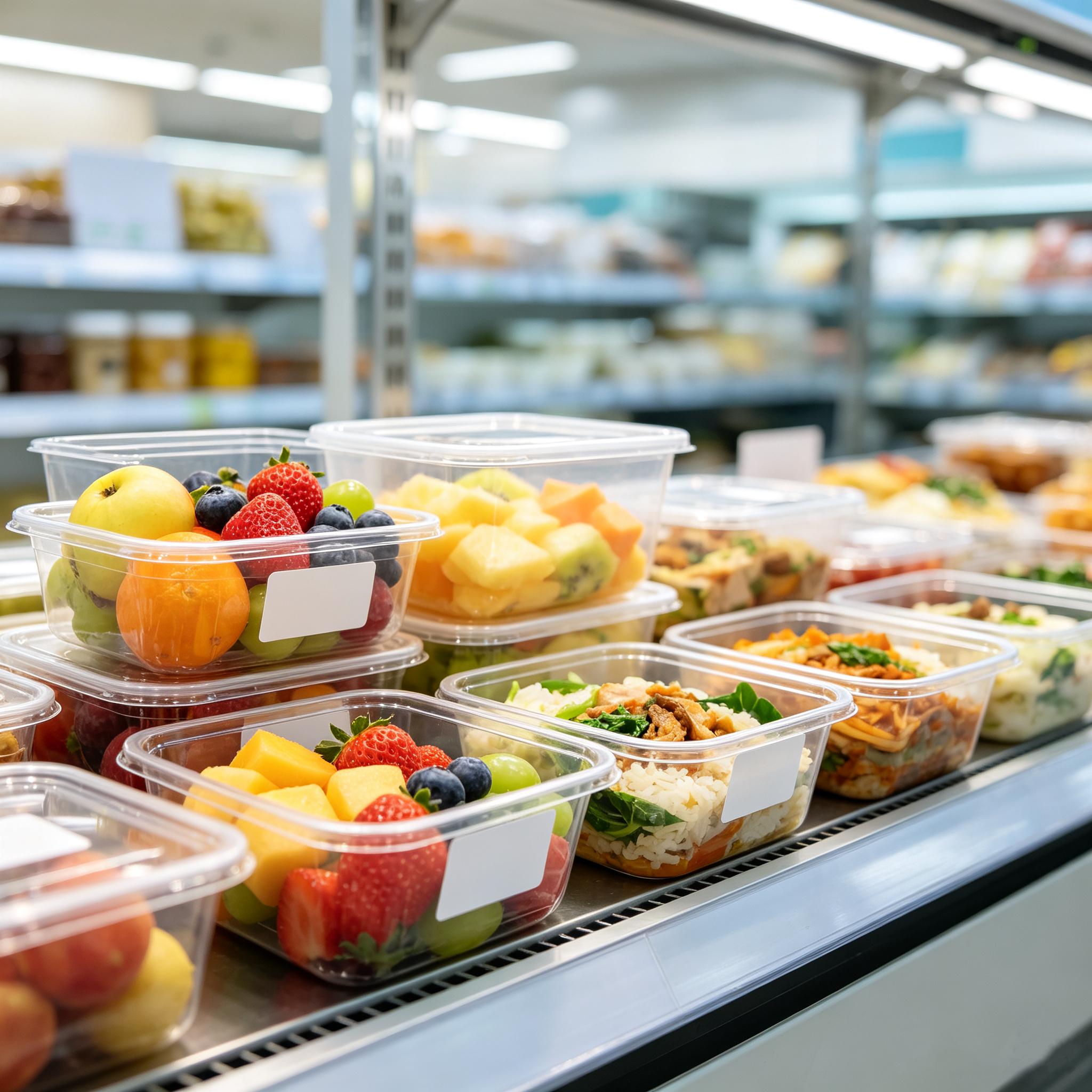
Retail-ready bakery packaging programmes are built on documented compliance and repeatable supply.
Next step — sample, specification or quotation. CHUAN HE supplies PPWR-certified PET bakery containers, tamper-evident containers and trays for bakery, dessert, produce and prepared-food programmes. Request samples of the exact models above, or ask for the full specification sheet and the PPWR test report reference.
Company: Weifang Chuanhe New Material Co., Ltd. (CHUAN HE) · Website: www.newplasticbox.com · Blog: blog.newplasticbox.com
Contact: Ever Liu · Email: chuanhe@newplasticbox.com · Tel / WhatsApp: +86 134-5566-2777 · Office: +86 8333-222
Address: No. 2301 Industrial Third Street, Weicheng Economic Development Zone, Weifang City, Shandong Province, China
WhatsApp: Start a sample request
Download the full product catalogue and specification pack: 2026 CHUAN HE packaging catalogue (PDF)
Have Questions or Need More Details?
Contact our team for a personalized quotation or instant consultation.
Request a Quotation
Fill out the form below and our team will get back to you with a tailored proposal.
WhatsApp Direct Chat
Prefer to chat in real-time? Message us on WhatsApp for instant assistance & quick answers.
- Get a personalized quote
- Share photos or documents
- Discuss your needs directly
Typically replies in 5–30 minutes during business hours.