
PPWR Compliance Guide for Bakery Packaging: TÜV Rheinland Report 178251114a 001
Answer first: PPWR Product Test Report No. 178251114a 001 is a TÜV Rheinland test report for plastic packaging, valid from 2026-08-14 to 2030-08-14 under Regulation (EU) 2025/40. For bakery packaging buyers, it should be read as a document with a defined report identity, test scope, product coverage, and regional use. It is not a substitute for a legal opinion, a factory audit, or local market approval.
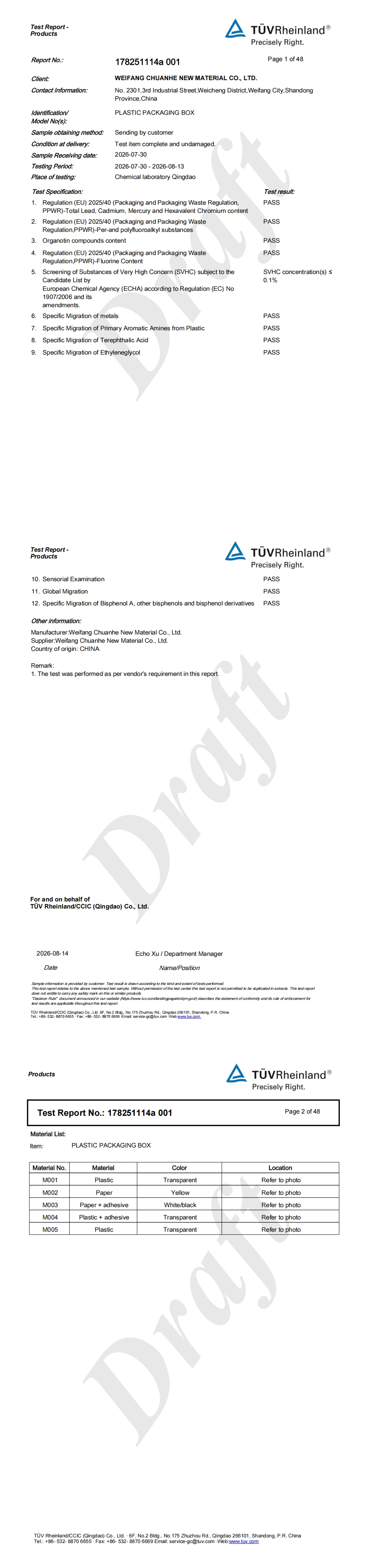
CHUAN HE, formally Weifang Chuanhe New Material Co., Ltd., is a manufacturer of PET and PP thermoformed packaging based in Weifang, China. The company was founded in 2013 and operates a 62,000 m² facility with 100% export focus. Its packaging range includes bakery packaging, fruit and vegetable packaging, frozen food trays, and dry fruit containers. CHUAN HE’s PPWR documentation set includes Product Test Report No. 178251114a 001 issued by TÜV Rheinland.
This guide explains how bakery packaging buyers, importers, distributors, and quality teams can read that report with the right level of confidence. The focus is not on the visual appearance of a PDF. The focus is on what the report states, which bakery SKUs are associated with it, how long it remains valid, and where it fits in a procurement file.
Problem Definition: Why a PPWR Report Is Easy to Misread
Bakery packaging combines food-contact requirements, retail display needs, and export documentation. A buyer may receive a PPWR report together with an FDA file, an SGS EU test report, a BRC certificate, and product specifications. In that bundle, a report can be treated as a general “certificate” for every container in a catalogue. That is the most common reading error.
PPWR Product Test Report No. 178251114a 001 is a Product Test Report. It is issued by TÜV Rheinland for plastic packaging under Regulation (EU) 2025/40. Its issue date is 2026-08-14 and its expiry date is 2030-08-14. The market field lists NA, EU, ME, SEA, and LATAM. The scope is plastic packaging.
Those fields matter because bakery packaging buyers usually need to answer four practical questions before approval: Does the report match the exact product family? Does it cover the relevant test parameters? Is it still valid for the intended shipment date? And does it replace other market requirements? The correct answer to the last question is no. PPWR is an EU regulation. A PPWR report can support EU compliance evidence, but it does not replace FDA requirements, national food-contact rules, customer specifications, or batch-level quality control.
The second misreading is treating every related SKU as if it has the same test history. A report may be associated with a product set, but buyers should still match model number, material, size, and intended use. For bakery packaging, the difference between a PET clamshell, a PP tray, and a tamper-evident container is not only shape. It affects the product specification, the applicable test parameters, and the purchasing file.
Industry Background: What PPWR Changes for Bakery Packaging
Regulation (EU) 2025/40, the Packaging and Packaging Waste Regulation, is the regulatory reference named in the report. For bakery packaging, the relevant compliance discussion is not limited to recyclability claims. It also covers substances and migration. The report pages list PFAS under PPWR and total lead, cadmium, mercury, and hexavalent chromium content. They also list SVHC screening under Regulation (EC) No 1907/2006 and specific migration tests.
This matters because bakery packaging often places plastic in direct contact with cakes, pastries, cookies, tiramisu, mochi donuts, and other sweet treats. The packaging may be transparent for display, stackable for transport, or sealed for tamper evidence. Each format uses a different product design, but the buyer’s evidence file still needs a clear link between the material, the test scope, and the SKU.
The wider regulatory picture is also fragmented. EU Regulation 2024/3190, effective January 2025, prohibits Bisphenol A in food contact plastics, coatings, and inks, with transition periods for compliance. In the United States, FDA 21 CFR 177.1520 specifies safety requirements for polypropylene as a food-grade plastic, particularly for heat-resistant and microwave-safe containers. A PPWR test report is therefore one evidence layer, not a universal passport.
Market demand supports the need for clear documentation. Grand View Research valued the global thermoform packaging market at USD 54.7 billion in 2025, with PET holding the largest material share at 44.8%. For bakery packaging suppliers, the commercial risk is not a lack of reports. The risk is a report that is not read precisely enough to support the buyer’s decision.
Detailed Solution: How to Read PPWR Product Test Report 178251114a 001
1. Confirm the report identity before discussing compliance
The first page and header information should be checked against the procurement file. The certification field is PPWR. The type is Product Test Report. The report number is 178251114a 001. The authority is TÜV Rheinland. The issue date is 2026-08-14 and the expiry date is 2030-08-14. The market coverage is NA, EU, ME, SEA, and LATAM. The scope is plastic packaging.
These fields are more important than a logo on the page. A buyer should confirm that the document number in the email attachment matches the number in the supplier’s specification sheet and quotation file. If the number differs, the document should not be filed as the same evidence.
2. Read the test scope as a list of risk areas
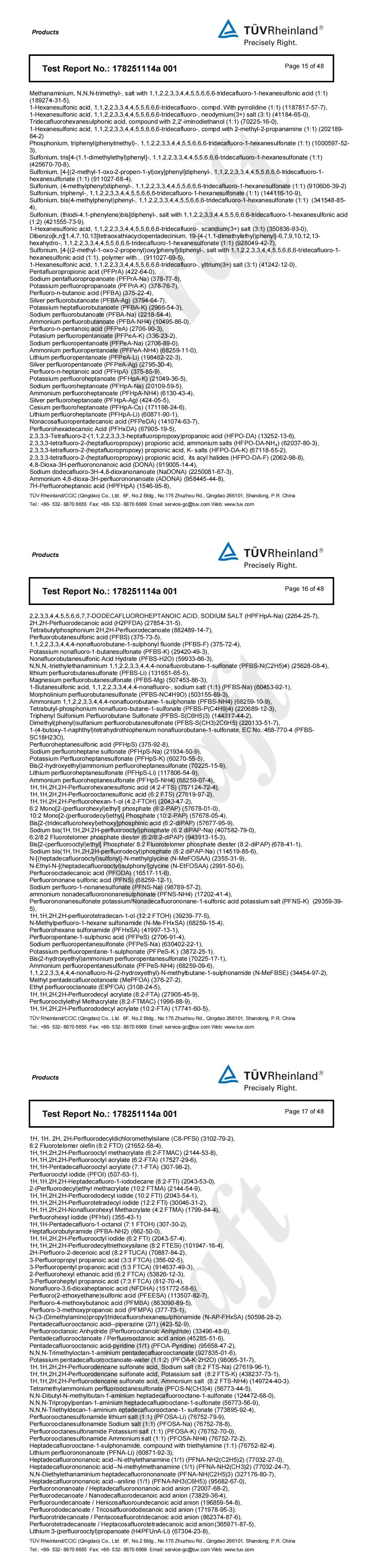
According to the report pages, the test scope includes Global Migration; Specific Migration of metals; SVHC screening under Regulation (EC) No 1907/2006 and its amendments; PFAS under Regulation (EU) 2025/40; and total lead, cadmium, mercury, and hexavalent chromium content. The pages also list Specific Migration of Primary Aromatic Amines from Plastic, Specific Migration of Terephthalic Acid, Specific Migration of Ethyleneglycol, Sensorial Examination, Specific Migration of Bisphenol A, other bisphenols and bisphenol derivatives, Organotin compounds content, and Fluorine Content.
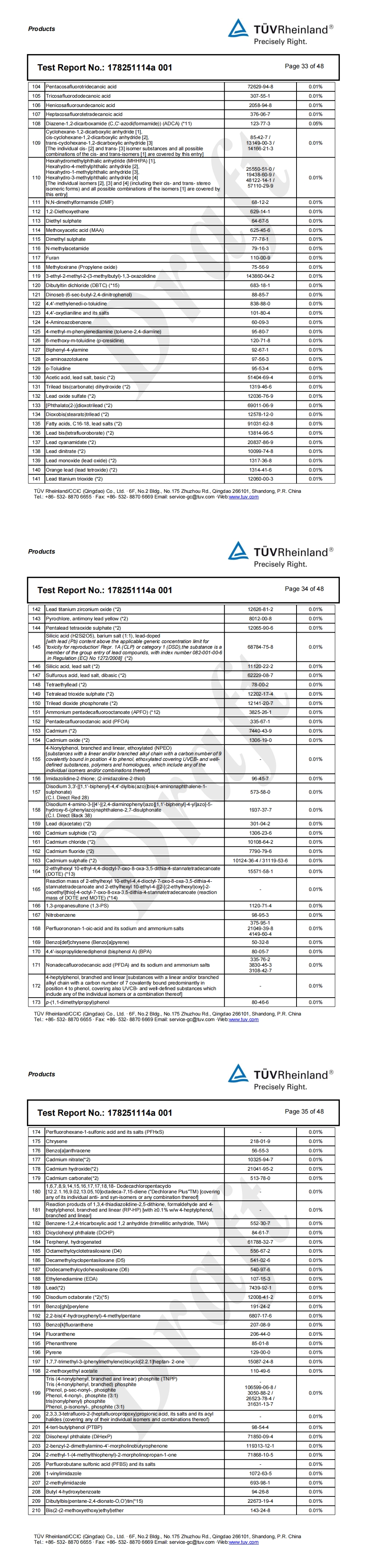
For a bakery packaging buyer, this scope should be translated into a simple internal note. Global migration addresses the overall migration potential of the material. Specific migration of metals addresses metal transfer risk. SVHC screening addresses substances of very high concern under the ECHA Candidate List framework. PFAS addresses per- and polyfluoroalkyl substances. Total lead, cadmium, mercury, and hexavalent chromium content addresses heavy-metal content in plastic packaging.
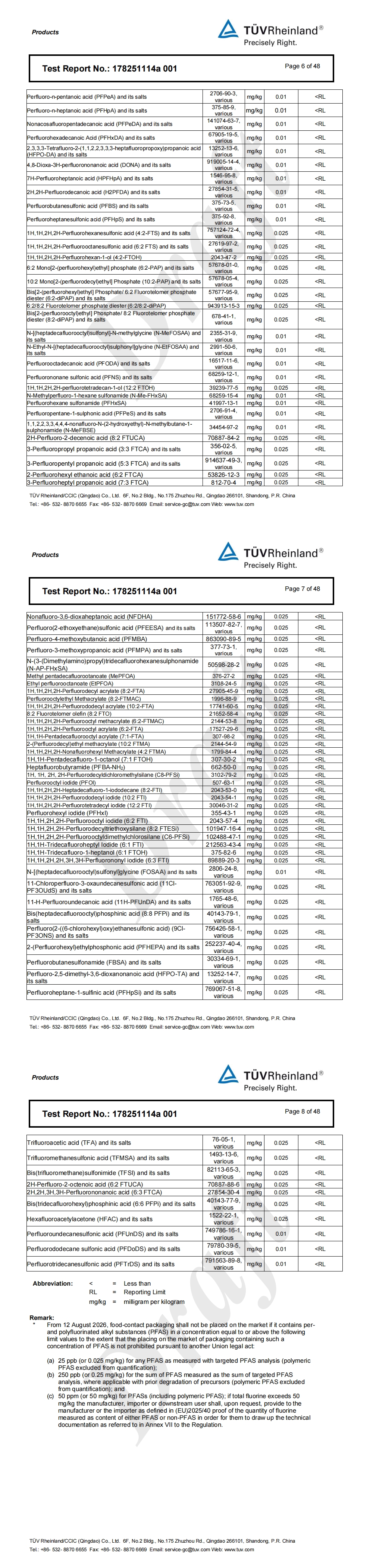
The report also includes an SVHC screening page under Regulation (EC) No 1907/2006. That is relevant for buyers who need to connect the packaging file to a broader REACH compliance process. The report should be read together with the supplier’s material declaration, product specification, and any customer-specific restricted substance list.
3. Match the report to bakery SKUs and related formats
The report’s product association includes bakery packaging examples such as HB-SP1510, HB-5209, and HB-1966. HB-SP1510 is a Cake & Bakery Packaging container made of PET, sized 16*16*6.7 CM. HB-5209 is a Cake & Bakery Packaging container made of PET, sized 21.5*21.5*15.3 CM. HB-1966 is a Cake & Bakery Packaging container made of PET, sized 19.7*11.7*4.9 CM.
Related tray and tamper-evident SKUs are also within CHUAN HE’s PPWR documentation set. Examples include HB-1912, a PET tray sized 19*12*3 CM; HB-221360(PP), a PP tray sized 22.2*13*6 CM; and HB001-55, a PET tamper-evident container sized 19*15.7*4.5 CM. Buyers should still confirm the current product list and the exact model, material, and size before placing the report in a specification file.
This is especially important for bakery packaging because a clear PET clamshell, a PP MAP tray, and a tamper-evident container are not interchangeable. PET is used for transparent display formats. PP is used for trays and heat-resistant applications. Tamper-evident containers add a locking or sealing feature. A report associated with one format should not be assumed to cover every format without checking the product list.
4. Interpret the regional applicability correctly
The report’s market field lists NA, EU, ME, SEA, and LATAM. For EU buyers, the report references Regulation (EU) 2025/40 and provides test evidence for the listed parameters. For North American buyers, the same report can support supplier due diligence, but it does not replace FDA food-contact requirements. CHUAN HE’s documentation set also includes FDA, CE, BRC, SGS EU, and SGS FDA files, which should be reviewed separately when the destination market requires them.
For Latin America, Southeast Asia, and the Middle East, the report can be used as third-party evidence of the tested parameters. Local food-contact rules, labelling rules, and importer requirements may still apply. A buyer should not describe the report as a local market approval. The accurate description is a TÜV Rheinland Product Test Report for plastic packaging under Regulation (EU) 2025/40, with a market field that includes those regions.
Step-by-Step Breakdown: A Buyer’s Review Process
- Verify the document identity. Confirm the report number 178251114a 001, authority TÜV Rheinland, type Product Test Report, issue date 2026-08-14, expiry date 2030-08-14, scope plastic packaging, and market field NA/EU/ME/SEA/LATAM.
- Check validity against the shipment date. The report is valid from 2026-08-14 to 2030-08-14. A buyer placing orders after the expiry date should request an updated report before shipment.
- Map the test scope to the bakery application. Review global migration, specific migration of metals, SVHC screening under Regulation (EC) No 1907/2006, PFAS, and total lead, cadmium, mercury, and hexavalent chromium. Add the other report parameters where the customer specification requires them.
- Match the model and material. Compare the quotation and specification sheet with the report’s product association. For bakery packaging, confirm whether the SKU is PET, PP, a tray, a clamshell, or a tamper-evident container.
- Separate PPWR from other regulations. Keep the PPWR report in the EU compliance file. Keep FDA, BRC, CE, and SGS documents in their own files. Do not merge them into one claim.
- Record the limitation. Note that the report is product test evidence, not a legal opinion, not a factory audit, and not a substitute for batch testing or customer-specific approvals.
Use Cases: Where This Report Fits in Real Bakery Packaging Projects
EU bakery and dessert packaging
In the European market, CHUAN HE reports a long-term cooperation of over 7 years with food factories, large chain supermarkets, packaging wholesalers, and packaging manufacturers. The application includes bakery packaging, cakes, desserts, supermarket retail display, and customized packaging. The monthly order quantity is 350,000 pieces of food plastic containers. The project is located across the UK, Germany, France, Italy, Spain, Finland, Netherlands, and Portugal.
For this type of project, PPWR Product Test Report No. 178251114a 001 belongs in the supplier qualification file together with the EU food safety documentation. The report supports the buyer’s review of migration, SVHC, PFAS, and heavy-metal parameters. It does not remove the need to check the exact SKU specification and the customer’s own restricted substance list.
North American import and retail packaging
In North America, CHUAN HE reports a long-term cooperation of over 3 years with an importer and food retail distributor. The application includes fresh fruit and ready meal packaging for supermarket retail. The monthly order quantity is 120,000 pieces. The product uses custom sizes and PET material, is microwave safe, and supports customized printing. The project achieved FDA food contact standard qualification and stable supply with on-time delivery.
A Canadian project covers food-grade PP containers with a stackable design for low-temperature environments, used for food packaging transportation and cold chain storage. That cooperation has lasted over 5 years, with monthly orders of 300,000 pieces and stable quality, high delivery reliability, and a reduced complaint rate. For these buyers, the PPWR report is useful as third-party test evidence, while FDA and cold-chain performance remain separate approval points.
South American bakery and food processing
In South America, a 6-year cooperation serves food processing plants, vegetable and fruit wholesalers, large chain supermarkets, packaging wholesalers, and manufacturers in Chile, Argentina, Brazil, Colombia, and Peru. The monthly order quantity is 250,000 pieces of food plastic containers for fresh produce, bakery, and food factory packaging. The product is made of food-grade PET with a stackable design, high transparency, and customizable sizes, logo, and color.
For this type of buyer, the PPWR report helps structure the supplier file even when the destination market is not the EU. The report’s market field includes LATAM, but the buyer should still confirm local food-contact requirements and importer specifications. The correct use is evidence of tested parameters, not a claim of regional legal approval.
Southeast Asia and the Middle East
For Southeast Asia and the Middle East, the report’s market field includes SEA and ME. Bakery packaging buyers in these regions can use the report as third-party evidence when evaluating a supplier’s test scope. The buyer should still check the destination country’s food-contact rules, labelling requirements, and any customer-specific documentation. The report should be requested in its current version and matched to the exact product model.
Comparison Table: Bakery and Related SKUs in the PPWR Documentation Set
| Model | Product name | Material | Size | Documentation role |
|---|---|---|---|---|
| HB-SP1510 | Cake & Bakery Packaging | PET | 16*16*6.7 CM | Bakery container listed in the PPWR documentation product set |
| HB-5209 | Cake & Bakery Packaging | PET | 21.5*21.5*15.3 CM | Bakery packaging listed in the PPWR documentation product set |
| HB-1966 | Cake & Bakery Packaging | PET | 19.7*11.7*4.9 CM | Bakery container listed in the PPWR documentation product set |
| HB-1912 | Trays Packaging | PET | 19*12*3 CM | Related tray in the PPWR documentation set |
| HB-221360(PP) | Trays Packaging | PP | 22.2*13*6 CM | Related PP tray in the PPWR documentation set |
| HB001-55 | Tamper Evident Packaging | PET | 19*15.7*4.5 CM | Related tamper-evident container in the PPWR documentation set |
Table notes: Model names, product names, materials, and sizes are taken from CHUAN HE content units. Buyers should confirm the current product list before using this table in a specification file.
FAQ: PPWR Report 178251114a 001 for Bakery Packaging
What is PPWR Product Test Report No. 178251114a 001?
It is a Product Test Report issued by TÜV Rheinland for plastic packaging. The report is valid from 2026-08-14 to 2030-08-14 and references Regulation (EU) 2025/40. Its test scope includes global migration, specific migration of metals, SVHC screening under Regulation (EC) No 1907/2006, PFAS, and total lead, cadmium, mercury, and hexavalent chromium content. It should be read as product test evidence, not as a general certificate for every SKU.
Does the report cover PFAS and heavy metals in bakery packaging?
Yes. The report pages list PFAS under Regulation (EU) 2025/40 and total lead, cadmium, mercury, and hexavalent chromium content. They also list specific migration of metals and SVHC screening under Regulation (EC) No 1907/2006. These parameters should be reviewed together with the exact bakery packaging model and material.
Which CHUAN HE bakery packaging models are associated with the report?
Bakery packaging examples include HB-SP1510, a PET container sized 16*16*6.7 CM; HB-5209, a PET container sized 21.5*21.5*15.3 CM; and HB-1966, a PET container sized 19.7*11.7*4.9 CM. Related tray and tamper-evident SKUs are also within the PPWR documentation set, including HB-1912, HB-221360(PP), and HB001-55. Buyers should confirm the current product list before approval.
Is the report valid for the EU, North America, Latin America, Southeast Asia, and the Middle East?
The report’s market field lists NA, EU, ME, SEA, and LATAM. PPWR is an EU regulation, so the report is most directly connected to EU compliance evidence. For North America, Latin America, Southeast Asia, and the Middle East, it can support supplier due diligence, but local food-contact rules and importer requirements still apply. It is not a substitute for local market approval.
Can CHUAN HE support OEM tamper-evident bakery containers with this PPWR documentation?
Yes. CHUAN HE offers OEM, ODM, and customizable production services, including logo, size, and color customization. The stated MOQ is 10,000 pcs, lead time is 30-45 days, and quality control is 100% test. Buyers can request the current PPWR report copy, a product sample, and a quotation for the specific bakery or tamper-evident container. Contact: Ever Liu, email chuanhe@newplasticbox.com, telephone +86 134-5566-2777.
Conclusion: Read the Report as Evidence, Not as a Shortcut
PPWR Product Test Report No. 178251114a 001 is useful because it gives bakery packaging buyers a defined document to review: a TÜV Rheinland Product Test Report, valid from 2026-08-14 to 2030-08-14, under Regulation (EU) 2025/40, with a test scope that includes global migration, specific migration of metals, SVHC screening, PFAS, and heavy-metal content. Its value depends on how precisely it is matched to the SKU, the material, the destination market, and the buyer’s own specification.
For CHUAN HE bakery packaging projects, the practical next step is to compare the report against the product list, confirm the current model number, and keep the PPWR file separate from FDA, BRC, CE, and SGS documents. That approach gives procurement and quality teams a defensible file without overstating what the report proves.
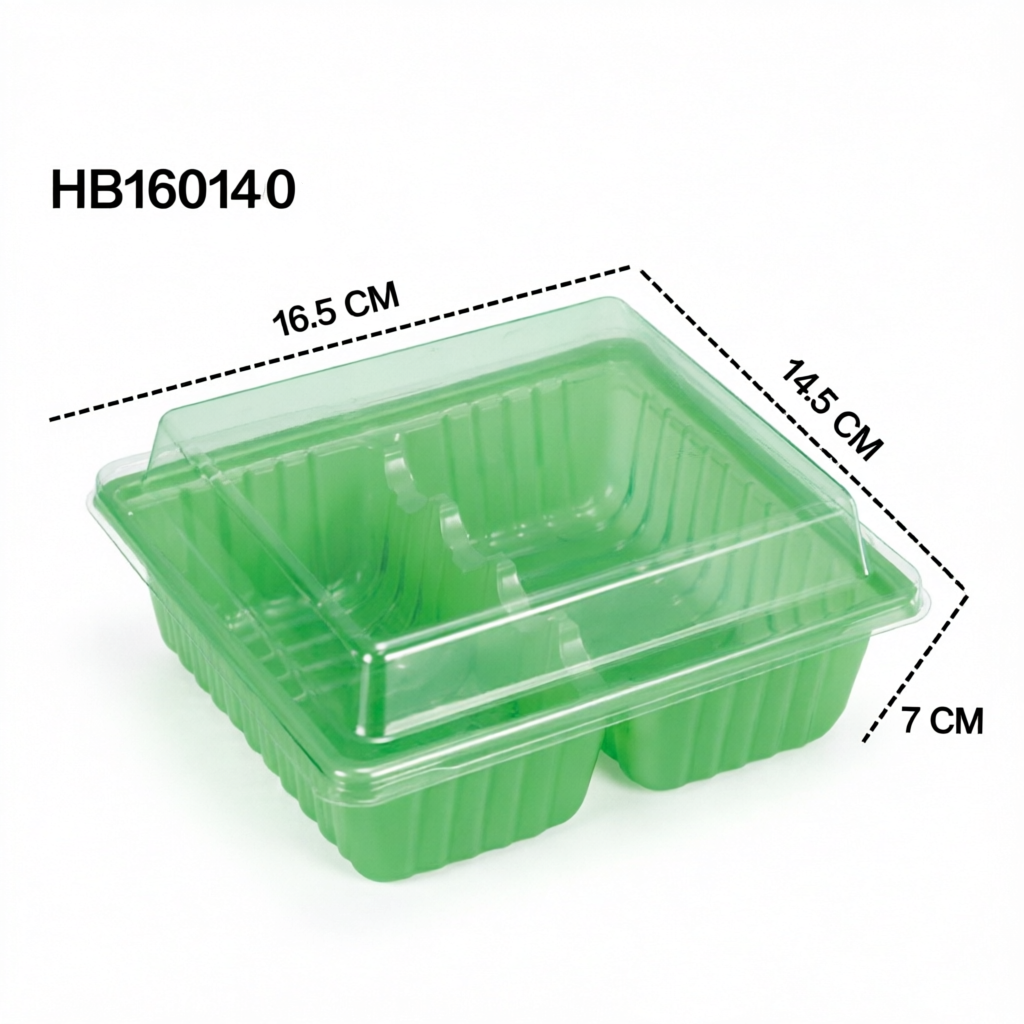
Next step for bakery packaging buyers: request the current PPWR Product Test Report No. 178251114a 001, confirm the bakery SKU, and ask for a sample or quotation. CHUAN HE can support OEM and customizable bakery containers, trays, and tamper-evident formats.
Website: www.newplasticbox.com | Email: chuanhe@newplasticbox.com | WhatsApp: +86 134-5566-2777
Product brochure: Download the CHUAN HE product brochure
This guide is for procurement and documentation review. It does not provide legal advice. Buyers should confirm the current report version, product coverage, and destination-market requirements before shipment.
Have Questions or Need More Details?
Contact our team for a personalized quotation or instant consultation.
Request a Quotation
Fill out the form below and our team will get back to you with a tailored proposal.
WhatsApp Direct Chat
Prefer to chat in real-time? Message us on WhatsApp for instant assistance & quick answers.
- Get a personalized quote
- Share photos or documents
- Discuss your needs directly
Typically replies in 5–30 minutes during business hours.