
PPWR for Bakery Packaging: Inside TÜV Rheinland Report 178251114a 001
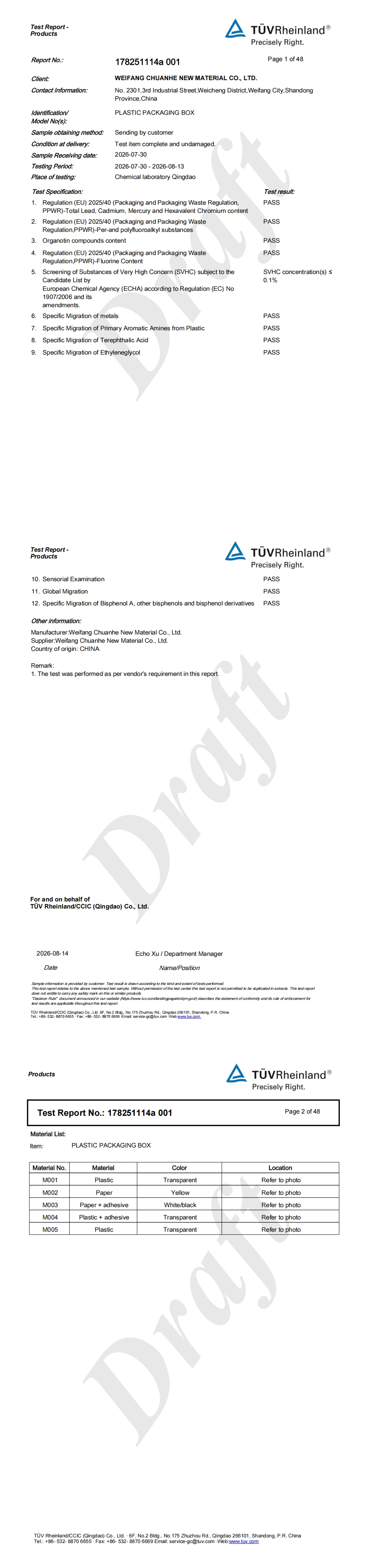
Report 178251114a 001 is a TÜV Rheinland product test report held by Weifang Chuanhe New Material Co., Ltd., the manufacturer behind the CHUAN HE brand. It is valid from 2026-08-14 to 2030-08-14 and covers four bakery packaging items — HB-SP1510, HB-5209, HB-1966 and HB-7097 — for the EU, North America, Latin America, Southeast Asia and Middle East markets.
The tested scope is narrow and precise: global migration and specific migration of metals, SVHC screening under Regulation (EC) No 1907/2006, PFAS, and total lead, cadmium, mercury and hexavalent chromium under Regulation (EU) 2025/40. Those five areas are the whole of what the document addresses. Everything else a buyer may need for a technical file has to come from elsewhere.
That distinction matters at the decision and ordering stage. A bakery packaging buyer rarely needs a lecture on regulation; the buyer needs to know whether the file in hand will survive an audit, a retail customer's questionnaire or a customs query, and what it explicitly does not cover. This explainer takes the report apart by section so it can be filed, matched and quoted accurately.
The Documentation Gap Behind the Phrase “PPWR Compliant”
Regulation (EU) 2025/40, the Packaging and Packaging Waste Regulation known as PPWR, is the reference buyers and suppliers now use when they discuss packaging compliance in Europe. In everyday sourcing conversation the phrase “PPWR compliant” is used loosely — for a declaration, a test summary, a certificate or a promise in an email. For anyone building a technical file, those are four different things with four different levels of evidence.
Bakery packaging exposes the gap faster than most categories. A clamshell, dome or tray spends minutes to hours in direct contact with cake, pastry, cream, sweets or dough — frequently filled warm, frequently displayed chilled, frequently stacked several high on a supermarket shelf. Contact time, fat content and temperature all sit on the same risk list, which is why substance and migration testing rather than a general conformity statement is what a bakery buyer actually wants to see.
Three mismatches cause most documents to be rejected during supplier qualification:
- Item mismatch. A report is valid for named items. If the code on the purchase order is not the code in the report, the report does not travel with the shipment, however good the test results are.
- Parameter mismatch. A buyer worried about PFAS or about heavy metals needs the section that addresses PFAS or heavy metals. A pass on a different parameter does not substitute for it.
- Date and market mismatch. An expired report, or a report covering a region you do not ship to, creates the same practical outcome: no usable evidence for your destination.
Report 178251114a 001 closes those three gaps for a defined slice of the CHUAN HE bakery range — and only that slice. Reading it correctly is the difference between using it well and overstating it.
Why Bakery Containers Carry a Heavier Evidence Burden
Three structural features of bakery packaging push buyers toward test documentation rather than certificates of general conformity.
The first is direct contact with demanding food types. Cream, butter, chocolate, glazed pastry and dough are all awkward neighbours for a plastic surface: warm filling raises the mobility of substances, fat encourages migration, and a chilled display cabinet adds condensation. Rigid thermoformed food packaging is therefore evaluated with the food in mind, not just the container.
The second is multi-market supply. A container specification developed for a European retail group is often the same specification shipped into North America, Latin America, Southeast Asia and the Middle East, sometimes from the same tool. When one test report covers all five regions, procurement teams can maintain one document set instead of a region-by-region folder.
The third is scale. Market Research Future valued the global bakery packaging market at USD 57.76 billion in 2024, and buyers operating at that scale standardise SKUs, consolidate suppliers and re-use specifications across product lines. Consolidation raises the value of a single, clearly scoped document and raises the cost of ambiguity.
The industry direction is therefore straightforward: buyers are shifting from “can you confirm compliance” to “send the report number, the item list, the parameters and the expiry date”. Suppliers who can answer in that format move to the shortlist faster.
What Report 178251114a 001 Covers
The report is organised around five testing areas. Each one answers a different question asked by a different person in the buying chain — the quality manager, the regulatory affairs officer, the retail customer's own compliance team. Treating them as separate answers is the most useful way to read the document.
1. Global migration and specific migration of metals
Global migration measures the overall transfer of substances from the packaging into the food or food simulant under defined test conditions; specific migration measures the transfer of identified metals. For a bakery container, this is the section that speaks to the everyday scenario — crumb and cream in contact with the base and lid, warm filling poured into the tray, a pastry sitting on the same surface for hours.
2. SVHC screening under Regulation (EC) No 1907/2006
SVHC screening checks the packaging against substances of very high concern under Regulation (EC) No 1907/2006. This is the section brand owners and retail groups usually ask for by name, because their own customer commitments are written in SVHC language rather than in packaging-regulation language.
3. PFAS under Regulation (EU) 2025/40
The report covers per- and polyfluoroalkyl substances with Regulation (EU) 2025/40 (PPWR) as the applicable standard. PFAS has become a standing question for food-contact paper and board, and buyers now ask it of rigid plastic bakery containers as well, particularly where grease resistance is part of the brief.
4. Total lead, cadmium, mercury and hexavalent chromium under Regulation (EU) 2025/40
The fourth area is total content of lead, cadmium, mercury and hexavalent chromium in plastic packaging, again with Regulation (EU) 2025/40 (PPWR) as the applicable standard. Note the word “total”: this is a content test on the material, not a migration test, and it complements rather than replaces the migration sections above.
| Scope item in the report | Regulatory reference stated | What it answers for a bakery buyer |
|---|---|---|
| Global migration and specific migration of metals | Test parameter covered by report 178251114a 001 | Whether overall transfer and targeted metal transfer from the container have been measured |
| SVHC screening | Regulation (EC) No 1907/2006 | Whether the material has been screened against substances of very high concern |
| PFAS | Regulation (EU) 2025/40 (PPWR) | Whether per- and polyfluoroalkyl substances have been addressed for the covered items |
| Total lead, cadmium, mercury and hexavalent chromium | Regulation (EU) 2025/40 (PPWR) | Whether total heavy-metal content in the packaging material has been tested |
Scope boundary worth repeating to your own compliance team: the report documents the five areas above for the named items. It is a test document, so the actual measured results sit inside the report itself and should be read there rather than inferred from a supplier summary. Other obligations that apply to your market should be requested as part of the wider documentation package, not assumed to be inside this file.
Report Identity: Items, Validity and Market Coverage
The identity block is the part procurement should transcribe first, because it is what makes the rest of the document usable. Report number, holder, issuer, validity window, item list and market coverage all have to line up with your purchase order before any test parameter becomes relevant.
| Field | Detail |
|---|---|
| Report number | 178251114a 001 |
| Issuer | TÜV Rheinland |
| Report holder | Weifang Chuanhe New Material Co., Ltd. (brand: CHUAN HE) |
| Validity period | 2026-08-14 to 2030-08-14 |
| Covered bakery items | HB-SP1510, HB-5209, HB-1966, HB-7097 |
| Markets covered | EU, North America, Latin America, Southeast Asia, Middle East |
| Tested scope | Global and specific migration of metals; SVHC screening; PFAS; total lead, cadmium, mercury and hexavalent chromium |
The four covered bakery items
HB-SP1510, HB-5209, HB-1966 and HB-7097 are the bakery items named in the report. The practical rule is simple: quote the item code on the enquiry, on the sample request and on the purchase order, and check that the same code appears in the report. Where a project needs a different code from the CHUAN HE range, ask which document applies to that code before the technical file is assembled — this is a ten-minute question that prevents a rejected shipment file six weeks later.
The five market regions
Coverage extends to the EU, North America, Latin America, Southeast Asia and the Middle East. For buyers running regional rollouts this is the most commercially useful line in the document: one report number can be referenced across several destination markets instead of a separate evidence trail per region. It also simplifies private-label programmes, where the same container is packed in one place and sold through retail partners in more than one region.
Step-by-Step: Using the Report in a Live Purchase Decision
The sequence below is the one that keeps a bakery packaging project on schedule. Each step produces an artefact that belongs in the technical file, so the file assembles itself as the project moves from evaluation to execution.
- Transcribe the identity block. Report number 178251114a 001, issuer TÜV Rheinland, holder Weifang Chuanhe New Material Co., Ltd., validity 2026-08-14 to 2030-08-14. Record it in the supplier master record, not in an inbox.
- Match the item code. Confirm that the code you intend to buy is one of HB-SP1510, HB-5209, HB-1966 or HB-7097. Item-level matching is the single most common failure point in supplier documentation.
- Match the parameter to the product risk. Cream- and fat-heavy fillings, warm filling and long chilled display point to the migration sections. A retail customer asking about substances of very high concern points to the SVHC screening. A grease-resistance brief points to PFAS. A material-level question points to the heavy-metal content section.
- Match the market. Confirm your destination sits inside the five covered regions before you build the file around this report.
- Complete the documentation package. The report is one document. Pair it with the declaration of conformity, food-contact compliance documentation such as FDA food contact compliance where your market requires it, batch traceability records, and third-party test evidence held by the manufacturer.
- Lock commercial terms before the trial order. Agree minimum quantity, delivery terms, acceptance criteria and payment route in writing so the trial is not delayed by commercial negotiation.
- Diarise 2030-08-14. Set a reminder ahead of expiry and request the updated report as part of your renewal cycle rather than after a customer asks for it.
Commercial terms to settle at the same time
Documentation and commercial terms are usually handled by different people and then collide at the order stage. Settling both together removes that collision.
- Minimum order quantity: 10,000 units.
- Delivery terms: FOB, CIF or DDP.
- Acceptance criteria: pre-shipment test.
- Payment terms: T/T, L/C, D/P, D/A, MoneyGram, PayPal, Western Union or cash.
Bakery Applications This Report Supports
The four covered items sit inside a wider bakery and food packaging range, and the applications below are the ones where a PPWR-scoped test report is most often requested by the buyer's own customer.
- Cake shops and bakery retailers. Cake bakery packaging and transparent cake packaging boxes where the product is visible on the shelf and the buyer is a retail chain with its own compliance questionnaire.
- Supermarket and chain retail. Bakery display and storage, where containers are stacked, handled repeatedly and sold under a retailer's private label.
- Chilled and ready-to-eat counters. Salad containers, dessert clamshells and takeaway ready meal packaging, where contact time in a chilled cabinet is long.
- Frozen bakery and dough. Frozen containers and clear food packaging for part-baked and frozen lines, where the container moves between temperature zones.
- Pastry, cookie and confectionery lines. Clamshell packaging for pastry and dessert, PET blister food packaging for cookie formats, and stackable tiramisu containers that need to present cleanly and stack without marking.
- Delivery and takeaway. Tamper evident packaging containers, where the closure is designed for one-time opening so any subsequent opening is visible at the delivery point.
- Private label and e-commerce brands. Custom recyclable food packaging programmes with custom shape, colour, embossing and logo printing, supplied factory-direct in small or bulk wholesale volumes.
Manufacturing and Quality Context Behind the Report
A test report is only as good as the production system that repeats it. Weifang Chuanhe New Material Co., Ltd. was founded in 2013 and operates a 62,000 m² manufacturing base in Weifang, Shandong Province, adjacent to Qingdao Port. The site runs 40 thermoforming machines — 20 fully automatic and 20 standard units, including four Kiefel machines imported from Germany — supported by four PET sheet extrusion lines, two PP sheet extrusion lines and an in-house mold workshop.

The company reports annual output of 54,000 tons, a 100% export ratio, and a portfolio built on PET and PP thermoformed packaging containers, including eco-friendly, recyclable and reusable formats for bakery, fruit and vegetables, frozen food and dry fruit. Certifications held include CE, BRC, FDA, EU and SGS quality management systems.

Quality control is described in operational terms rather than slogans: food-grade raw material inspection, production hygiene control, online quality inspection, finished product sampling tests, and regular third-party testing with long-term archiving of all compliance records. Production risks are managed through GMP implementation together with migration and physical testing of materials, and compliance risks through FDA food contact compliance, regular certification updates and record retention.
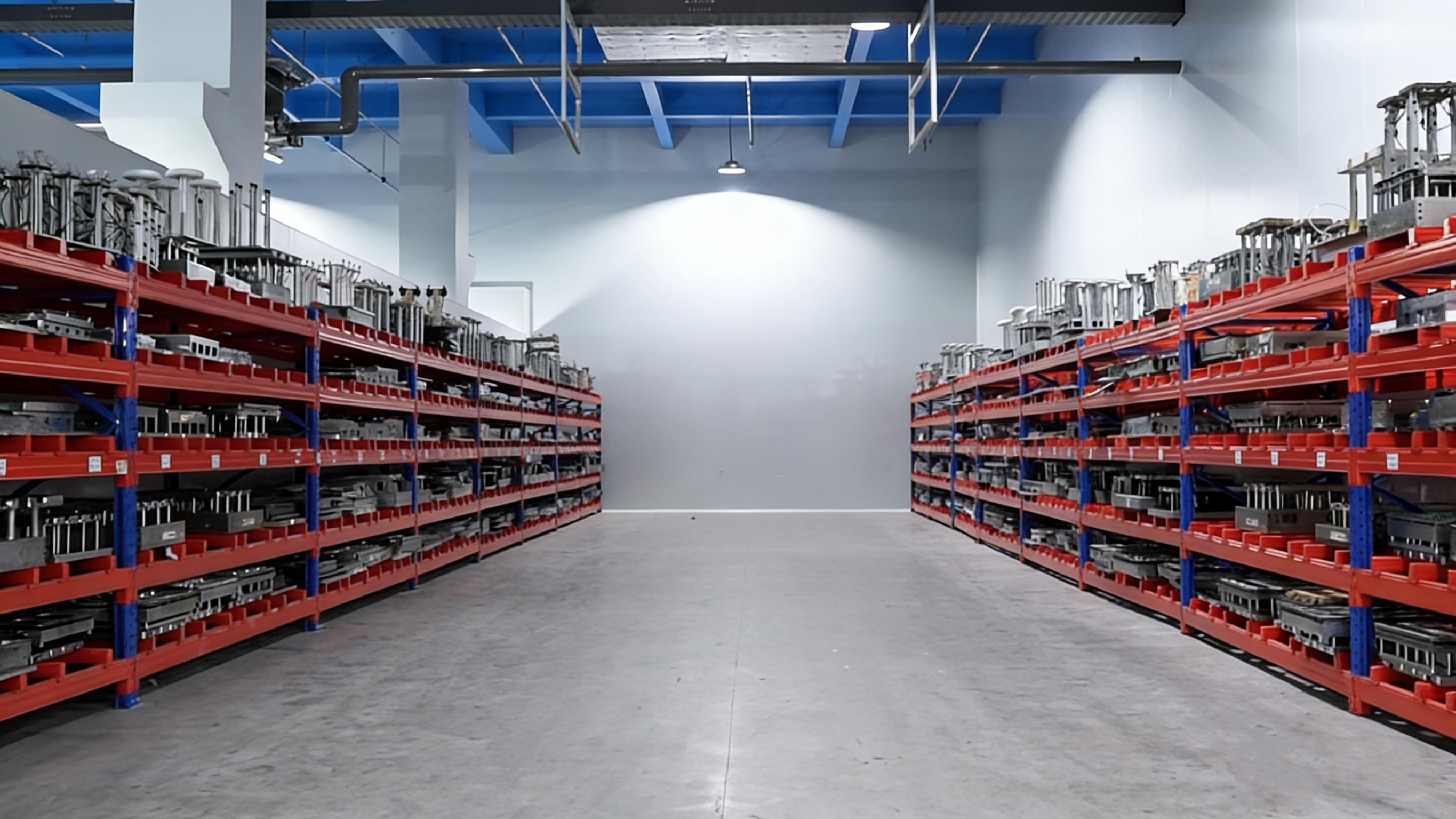
For buyers, the operational translation is this: the report is evidence about specific items, and the factory context explains how those items stay consistent between the tested batch and the tenth shipment. Customisation covers shape, colour, embossing and logo printing, with small and bulk wholesale orders supported through factory-direct supply.

Frequently Asked Questions
Does report 178251114a 001 make a bakery container fully PPWR compliant?
The report documents global migration and specific migration of metals, SVHC screening under Regulation (EC) No 1907/2006, PFAS, and total lead, cadmium, mercury and hexavalent chromium under Regulation (EU) 2025/40, for the named bakery items, and remains valid from 2026-08-14 to 2030-08-14. It is a test document covering those parameters for those items. Buyers should confirm that the rest of the documentation their market requires — including the declaration of conformity — is supplied alongside it.
Which bakery items and which markets does the report cover?
Covered bakery items are HB-SP1510, HB-5209, HB-1966 and HB-7097. Market coverage extends to the EU, North America, Latin America, Southeast Asia and the Middle East. Items outside those four codes should be checked against their own documentation before being filed under report 178251114a 001.
What are the purchasing terms and acceptance criteria?
Minimum order quantity is 10,000 units. Delivery terms are FOB, CIF or DDP. The acceptance criterion is a pre-shipment test. Payment terms include T/T, L/C, D/P, D/A, MoneyGram, PayPal, Western Union and cash.
Can buyers request samples or customised containers before committing to a volume order?
Customisation options cover shape, colour, embossing and logo printing, and both small and bulk wholesale orders are supported through factory-direct supply, with standard sizes available in the wider range. Sampling and custom tooling requests are best raised as a direct enquiry that names the item code and the destination market, so the correct report reference and specification sheet are quoted back in the same exchange. Start with the CHUAN HE product range and request a sample and quotation against the code you intend to buy.
How long is the report valid, and what happens at the end of the validity period?
Report 178251114a 001 is valid from 2026-08-14 to 2030-08-14. Registrations are renewed rather than assumed to continue, and the manufacturer states that compliance risks are handled through FDA food contact compliance, regular certification updates and long-term record archiving. Buyers should set an internal reminder ahead of 2030-08-14 and request the renewed documentation as part of the normal supplier review cycle.
Conclusion: File the Report for What It Proves
Report 178251114a 001 is a usable, well-scoped document: TÜV Rheinland as issuer, four named bakery items, five defined test areas, five market regions, and a validity window running to 2030-08-14. Used at item level, it answers a specific set of questions that bakery buyers genuinely get asked — migration, SVHC, PFAS and heavy-metal content — without needing to be reinterpreted in an email thread.
Used at item level is the important part. The report does not cover every container in the CHUAN HE range, and it does not replace the declaration of conformity, food-contact documentation or batch records that complete a technical file. What it does is give a procurement team a checkable reference number and a checkable parameter list, which is the difference between a compliance claim and a compliance record.
Next Step: Sample, Quotation and Full Documentation
If your project uses HB-SP1510, HB-5209, HB-1966 or HB-7097, request a sample and quotation against the exact item code and destination market so the matching report reference travels with the offer. The full CHUAN HE range, including tamper evident containers, thermoformed trays, stackable dessert containers and custom recyclable food packaging, is available factory-direct from Weifang Chuanhe New Material Co., Ltd.
Download the catalogue: CHUAN HE product brochure (PDF)
Website: www.newplasticbox.com
Email: chuanhe@newplasticbox.com | Tel: +86 134-5566-2777 / +86 8333-222
WhatsApp: +86 134-5566-2777 | Address: No. 2301 Industrial Third Street, Weicheng Economic Development Zone, Weifang City, Shandong Province, China
Have Questions or Need More Details?
Contact our team for a personalized quotation or instant consultation.
Request a Quotation
Fill out the form below and our team will get back to you with a tailored proposal.
WhatsApp Direct Chat
Prefer to chat in real-time? Message us on WhatsApp for instant assistance & quick answers.
- Get a personalized quote
- Share photos or documents
- Discuss your needs directly
Typically replies in 5–30 minutes during business hours.