
Specifying PET Produce Trays: Thickness, Dimensions and MAP Line Compatibility
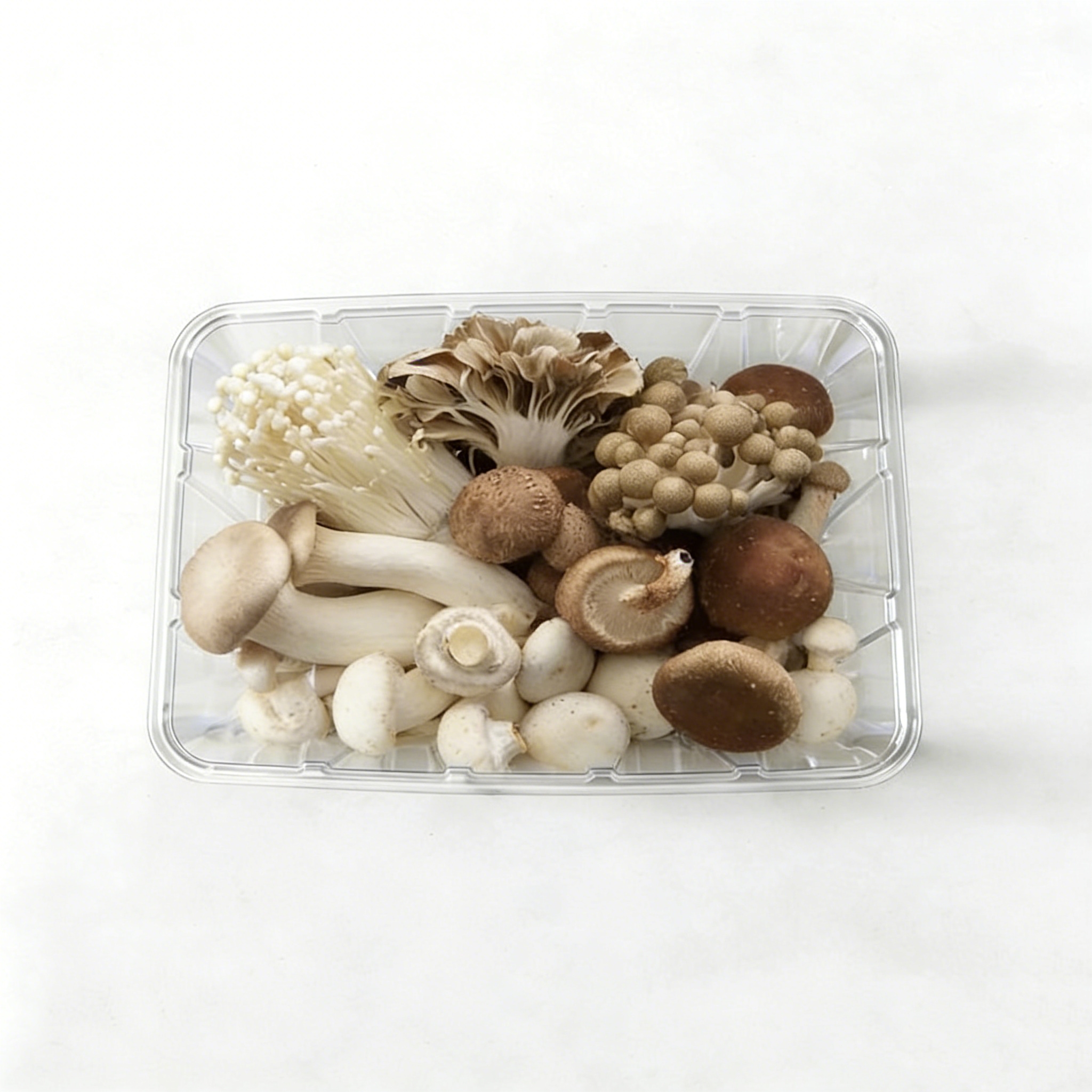
Food-grade PET trays for fruit and vegetable packaging, produced by Weifang Chuanhe New Material Co., Ltd. (CHUAN HE).
Three parameters decide whether a PET tray actually works in a fruit and vegetable packaging line: the wall thickness that carries the load, the outer footprint and depth that must match the sealing die and the shipper, and the tray geometry that determines whether the pack can be sealed on a modified atmosphere packaging (MAP) line. This guide works through those parameters using published CHUAN HE tray dimensions — including the HB-MG40 OZ tray at 28 × 19.4 × 6.8 cm and the tamper-evident OZ series that runs from HB-8OZ at 13.4 × 12.1 × 3.6 cm to HB-32 OZ at 17.2 × 15.5 × 6.2 cm.
Problem Definition: Why Tray Specifications Fail After the Trial
A produce tray that passes a hand sample can still fail on the line, and the failure is usually dimensional or structural rather than chemical. The recurring failure modes are familiar to anyone running a packhouse: a tray whose outer footprint does not sit correctly in the sealing die of an existing MAP line; a deep tray whose base deflects under a full load; a stack that becomes unstable once trays are filled, chilled and palletised; or a clarity complaint at retail after condensation builds on the lid under chilled display conditions.
Each of those failures traces back to a parameter that was never written down explicitly. In practice, trays are often specified by reference to a previous purchase — “the same as our current punnet” — rather than by function. That works until something changes: the packhouse adds a new produce line, the retailer resets the planogram, or the film supplier switches the lidstock. At that point the tray has to be re-specified from first principles, and the parameters that were never documented become the bottleneck.
Six parameters need to be explicit before a tray is ordered:
- Outer footprint and depth — and whether the quoted figures are top-out or base dimensions, because a tapered tray measures differently at each point.
- Lid format — separate lid, attached tamper-evident lid, or film-sealed tray. The three are not interchangeable on the same tooling.
- Wall thickness and rigidity at the rim, the base and the corner radii, which are the three zones that carry load and fail first.
- Stackability — the load a filled, chilled tray can carry when stacked, and how the tray nests empty.
- Clarity and condensation behaviour at chilled display temperature, which is a retail decision rather than a production one.
- Material declaration and food-contact documentation for the destination market, which increasingly decides whether a tray can be sold at all.
For a buyer in the research and evaluation stage, these six items also form the checklist for comparing suppliers, because a supplier that cannot answer them in writing is unlikely to answer them consistently at scale.
Industry Background: Why Tray Parameters Are Being Re-Specified Now
Two forces are pushing produce buyers back into tray specification: regulatory change in Europe, and continued growth in the underlying packaging demand.
On the regulatory side, EU Regulation (EC) No 1935/2004 sets the general framework for all food contact materials, requiring that they do not release constituents into food at levels harmful to human health. EU Regulation (EU) No 10/2011 then governs plastic materials and articles intended to come into contact with food, which is the regulation that applies specifically to PET and PP containers. Layered on top of both, the EU Packaging and Packaging Waste Regulation (PPWR) will, from 2030, ban single-use plastic packaging for fresh fruit and vegetables under 1.5 kg. Any tray format aimed at European retail therefore has to be defensible on both food-contact grounds and packaging-waste grounds, and the documentation burden now sits with the buyer as much as the converter.
On the demand side, the global fresh food packaging market reached USD 134.60 billion in 2024 and is projected to reach USD 240.50 billion by 2035, according to Spherical Insights & Consulting. Within that, the produce packaging segment specific to fruits and vegetables was valued at approximately USD 38.08 billion in 2024, per Market Research Future, while the Europe fresh food packaging market alone was valued at USD 15.2 billion in 2024 with a projected CAGR of 4.5% through 2033. Grand View Research forecasts the global thermoformed plastic market for food packaging growing at a CAGR of 4.9% to reach USD 20.66 billion by 2030 — confirming that thermoformed trays remain the workhorse format even as the rules around them tighten.
The practical consequence for a specifier is that the tray decision has moved from a purchasing formality to a technical one. A tray that is dimensionally correct but undocumented is now a commercial risk, and a tray that is documented but dimensionally wrong is an operational one.
Detailed Solution: How the CHUAN HE PET Tray Platform Is Built
Weifang Chuanhe New Material Co., Ltd. (CHUAN HE) is a thermoformed packaging manufacturer based in Weifang, Shandong Province, China, founded in 2013. The company designs and produces PET and PP thermoformed containers for fruit and vegetable packaging and bakery packaging, with a 100% export orientation across North America, Europe, the Middle East, Southeast Asia and Latin America.
Material and Forming Control
The trays discussed here are PET, food grade and BPA-free, and are specified as compliant with food-contact standards. What matters for dimensional consistency is where the material comes from: CHUAN HE operates four PET sheet extrusion lines and two PP sheet extrusion lines in-house, plus an in-house mold workshop. Sheet extrusion upstream of thermoforming is the reason the platform can hold a specification over repeat orders — the sheet gauge feeding the forming machines is controlled internally rather than bought in against a third-party tolerance.
Forming capacity on the same site includes 20 fully automatic thermoforming machines and 20 standard thermoforming machines, four of which are advanced Kiefel machines imported from Germany. The manufacturing base covers more than 62,000 m² and sits adjacent to Qingdao Port. Monthly capacity is 4,500 tons across the two material families.
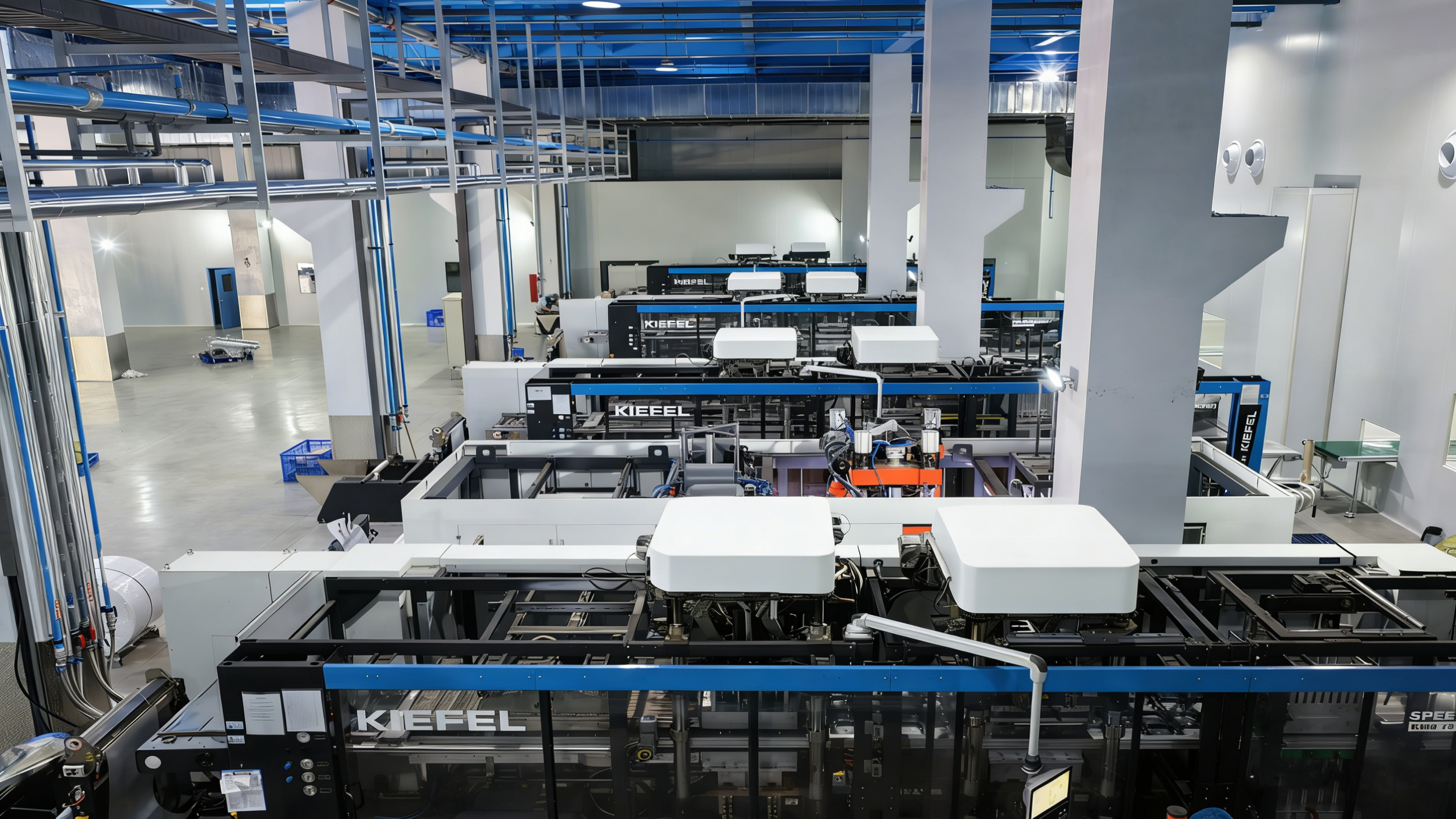
Thermoforming equipment at the CHUAN HE facility, where sheet gauge control and mold design together determine finished tray rigidity.
How Thickness Should Be Evaluated in a Thermoformed Tray
Thickness behaves differently in a thermoformed tray than in a flat sheet, and this is where most specification conversations go wrong. The gauge of the extruded sheet is an input, not the tray wall. As the heated sheet is drawn into the mold, the wall thins unevenly: generally, the areas of greatest draw — the base corners of a deep tray — end up thinner than the rim, and the floor of the tray is somewhere in between.
That means a buyer should evaluate thickness on two levels. The first is the sheet gauge ordered by the converter, which is a supplier-side control. The second, and more useful commercially, is the finished wall thickness at the rim, base and corner radii of the actual tray. Those three zones are where rigidity is won or lost, and they are the zones to measure on a sample before committing to volume.
Rigidity is the visible output of that thickness distribution. The CHUAN HE Trays Packaging family is specified with a rigid, sturdy structure designed to resist deformation and to reduce goods damage during transit. That specification matters most on deep trays, because draw depth relative to footprint is what stresses the base. HB-MG24 OZ at 18.6 × 18.6 × 8.9 cm, for example, is a deep, near-square tray where the base and lower corners carry the load; WSF-01 at 23.3 × 18 × 5 cm is a long, shallow format where the rim and side walls carry more of the stacking load instead.
For anti-crush applications such as dry fruit or heavier produce, the practical selection rule is to choose the deepest tray the pack design allows without exceeding the draw the tooling was built for, then confirm the base deflection under a full, chilled load. Adding thickness to compensate for a footprint that is too large is a costly way to solve a geometry problem.
MAP Compatibility: What “Compatible” Actually Requires
The CHUAN HE Trays Packaging family is classified as MAP packaging trays and is specified as compatible with MAP modified atmosphere packaging production lines. Compatibility, in practice, is a three-part condition rather than a single attribute.
First, the rim geometry has to provide a sealing surface that the lidding film can bond to consistently across the full perimeter. Second, the tray has to hold its shape under the pressure and temperature conditions of the sealing cycle — a tray that flexes at the seal point produces leakers. Third, the material declaration has to match the lidstock, because a PET tray sealed with a film intended for a different substrate is a packaging-line problem disguised as a materials problem.
Because the same Trays Packaging platform is listed for produce, bakery, meat, poultry and ready meals, buyers exploring MAP for fresh produce can validate the tray format on a family that is already tooled for sealing rather than starting from a display-only tray.
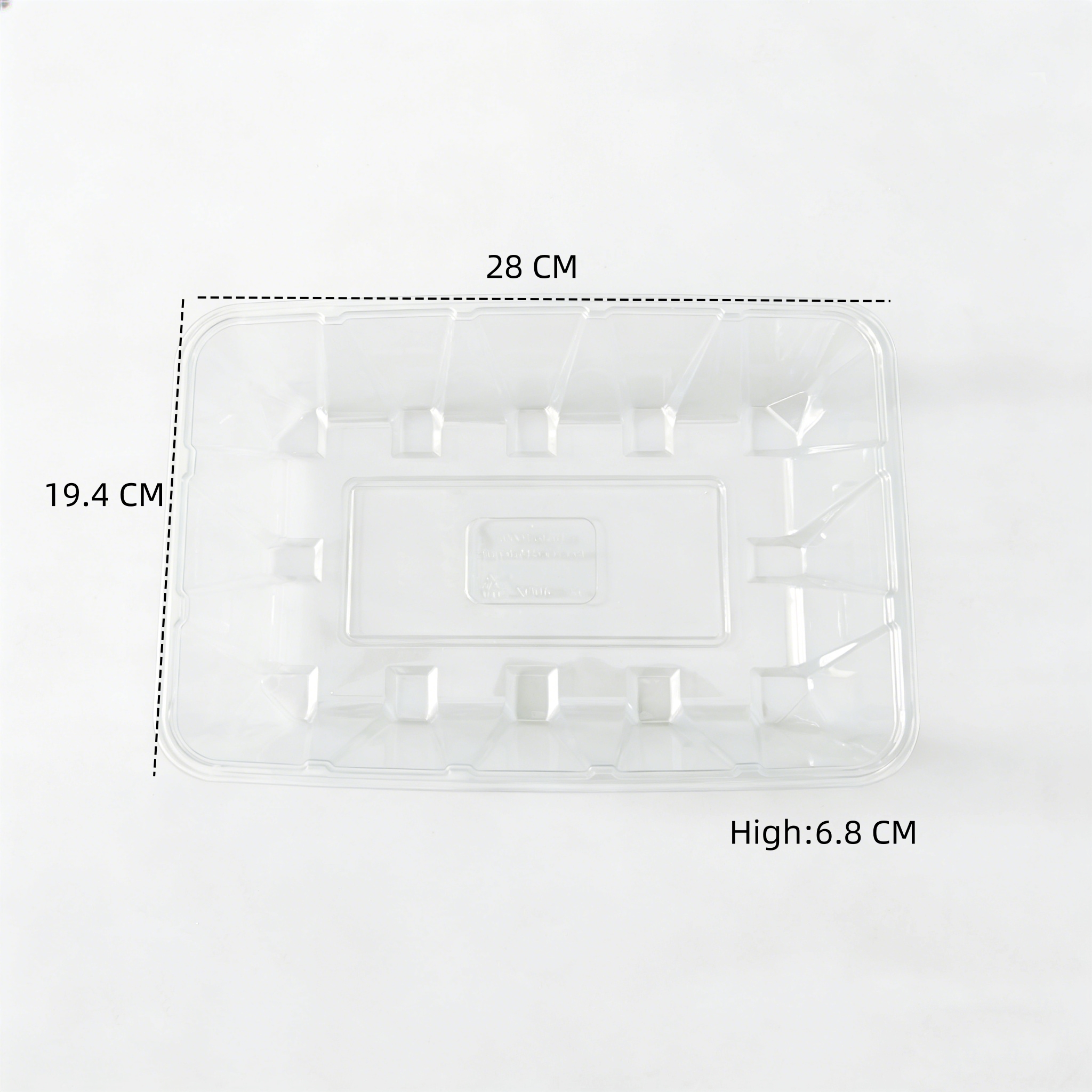
HB-MG40 OZ — 28 × 19.4 × 6.8 cm. The largest tray format in the CHUAN HE platform, listed across produce, bakery, meat, poultry and ready-meal applications.
Trays Packaging: The MAP-Ready Tray Envelope
| Model | Outer dimensions (cm) | Material | Format note |
|---|---|---|---|
| HB-MG40 OZ | 28 × 19.4 × 6.8 | PET | Largest tray in the platform; listed for produce, bakery, meat, poultry and ready meals |
| WSF-01 | 23.3 × 18 × 5 | PET | Long, shallow tray; rim-led stacking |
| HB-221360 (PP) | 22.2 × 13 × 6 | PP | One of two PP models in the tray family |
| HB-T9576 | 19.4 × 11.4 × 5.8 | PET | Standard rectangular tray |
| HB-1912 | 19 × 12 × 3 | PET | Shallowest tray listed; small pack weight |
| HB-MG24 OZ | 18.6 × 18.6 × 8.9 | PET | Deep, near-square tray; highest draw depth in the family |
| HB-T9333 | 16.8 × 11.4 × 3 | PET | Small shallow tray |
| HB-75-28 (PP) | 16.8 × 11.4 × 3 | PP | Same footprint as HB-T9333 in PP |
| HB-3066 | 14.4 × 12.2 × 4.7 | PET | Compact tray |
| HB-MG08 OZ | 14.2 × 12.5 × 6.8 | PET | Smallest tray footprint, mid-depth |
All models listed in the CHUAN HE Trays Packaging type are described as stackable, shatter-resistant clear display trays compatible with MAP production lines, with custom shape, colour, embossing and logo printing available.
Tamper-Evident Series: How the OZ Size Ladder Affects Packhouse Efficiency
The tamper-evident series is where packhouse efficiency is most directly affected by size choice, because each step in the size ladder changes both the number of units per tray-load and the number of units per retail case.
| Model | Outer dimensions (cm) | Position in the ladder |
|---|---|---|
| HB-8OZ | 13.4 × 12.1 × 3.6 | Smallest and shallowest format |
| HB-16OZ | 14 × 11.6 × 6.2 | Same footprint family as HB-20 OZ, lower depth |
| HB-20 OZ | 14 × 11.6 × 7.9 | Same footprint as HB-16OZ, deeper pack |
| HB-24 OZ | 17.2 × 15.5 × 4.8 | Wider footprint, shallow depth |
| HB-32 OZ | 17.2 × 15.5 × 6.2 | Same footprint as HB-24 OZ, deeper pack |
| HB002-63 | 14.6 × 12.3 × 6.7 | Mid-size, mid-depth |
| HB5298 | 15.4 × 15.4 × 6.1 | Square format |
| HB001-55 | 19 × 15.7 × 4.5 | Large shallow format |
| HB006-6102 | 19 × 15.7 × 6.3 | Large format, increased depth |
| HB005-7402 | 19 × 15.7 × 7.5 | Deepest format in the series |
Note on dimensions: the 14 × 11.6 × 7.9 cm format in the tamper-evident series corresponds to HB-20 OZ; the 8 OZ model in the same series measures 13.4 × 12.1 × 3.6 cm. Buyers should always confirm dimensions per model number rather than per ounce label.
The efficiency logic is straightforward. A shallow format such as HB-8OZ at 13.4 × 12.1 × 3.6 cm fills fewer grams per unit, so it suits high-count, high-value lines — berry and cherry tomato punnets — where the retail price justifies the unit cost and the packhouse can run at speed. A deeper format such as HB-20 OZ at 14 × 11.6 × 7.9 cm holds the same footprint but more product, which reduces units per pallet layer while increasing product per unit handled. The decision is therefore a trade between handling count and pack weight, and it should be made against the packhouse’s existing case counts rather than in isolation.
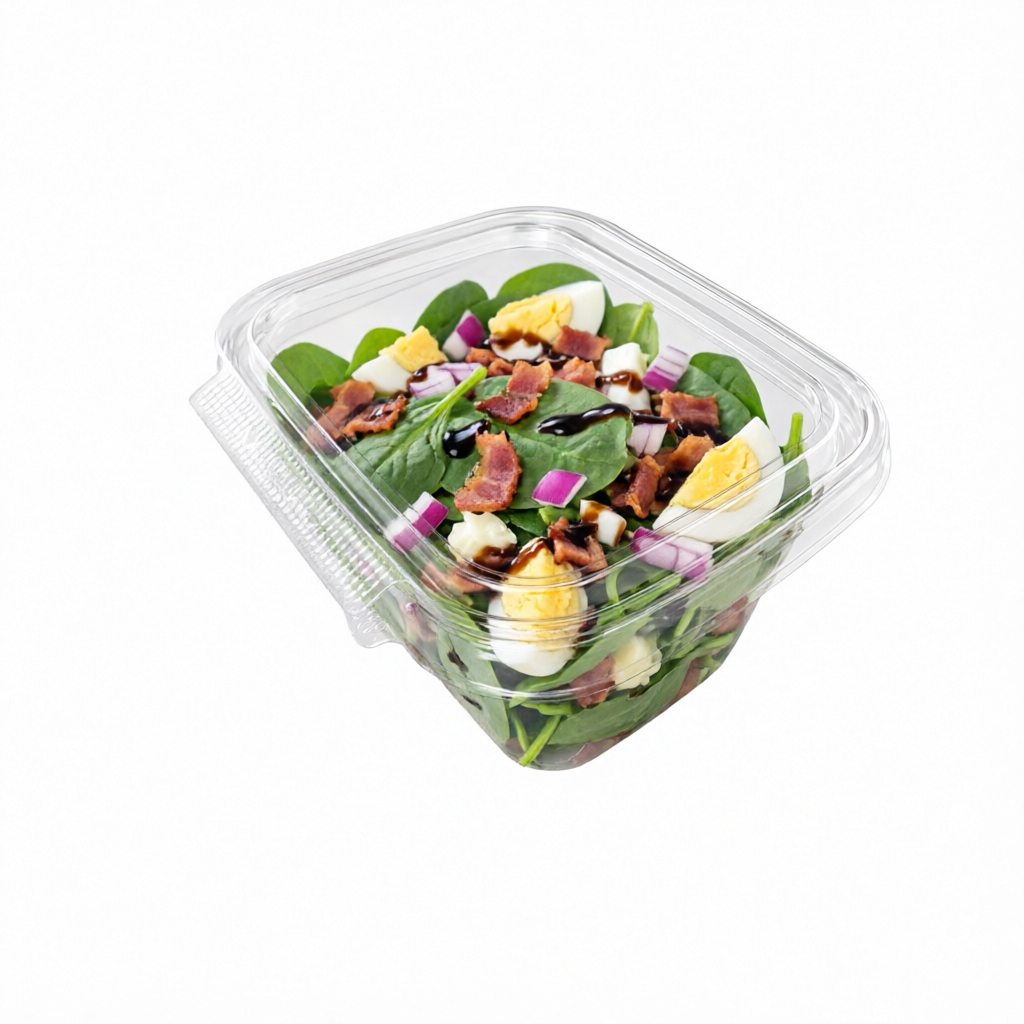
The 14 × 11.6 × 7.9 cm format (HB-20 OZ) in the CHUAN HE tamper-evident series, used for berry, cherry tomato and fresh produce punnets.
Compliance Documentation Behind the Tray
Food-contact documentation is the part of a tray specification that is hardest to retrofit. CHUAN HE holds CE, BRC, FDA, EU and SGS certifications covering plastic packaging, with documented examples including CE certification M.2025.206.C131101 issued by UDEM under EN 1186-1:2002 for the EU market, an SGS EU test report TSNHL26000684001 tested to EN 1186-3:2022, an FDA certification 11242824478 issued under P.L. 107-188, an SGS certification TSNHL26001599701 tested to US FDA 21 CFR 177.1630, and BRCS certification CN26/00005423 issued by SGS under the Global Standard for Packaging Materials. A separate TÜV Rheinland test report, 178251114a 001, covers Regulation (EU) 2025/40 (PPWR) for total lead, cadmium, mercury and hexavalent chromium content as well as per- and polyfluoroalkyl substances (PFAS).
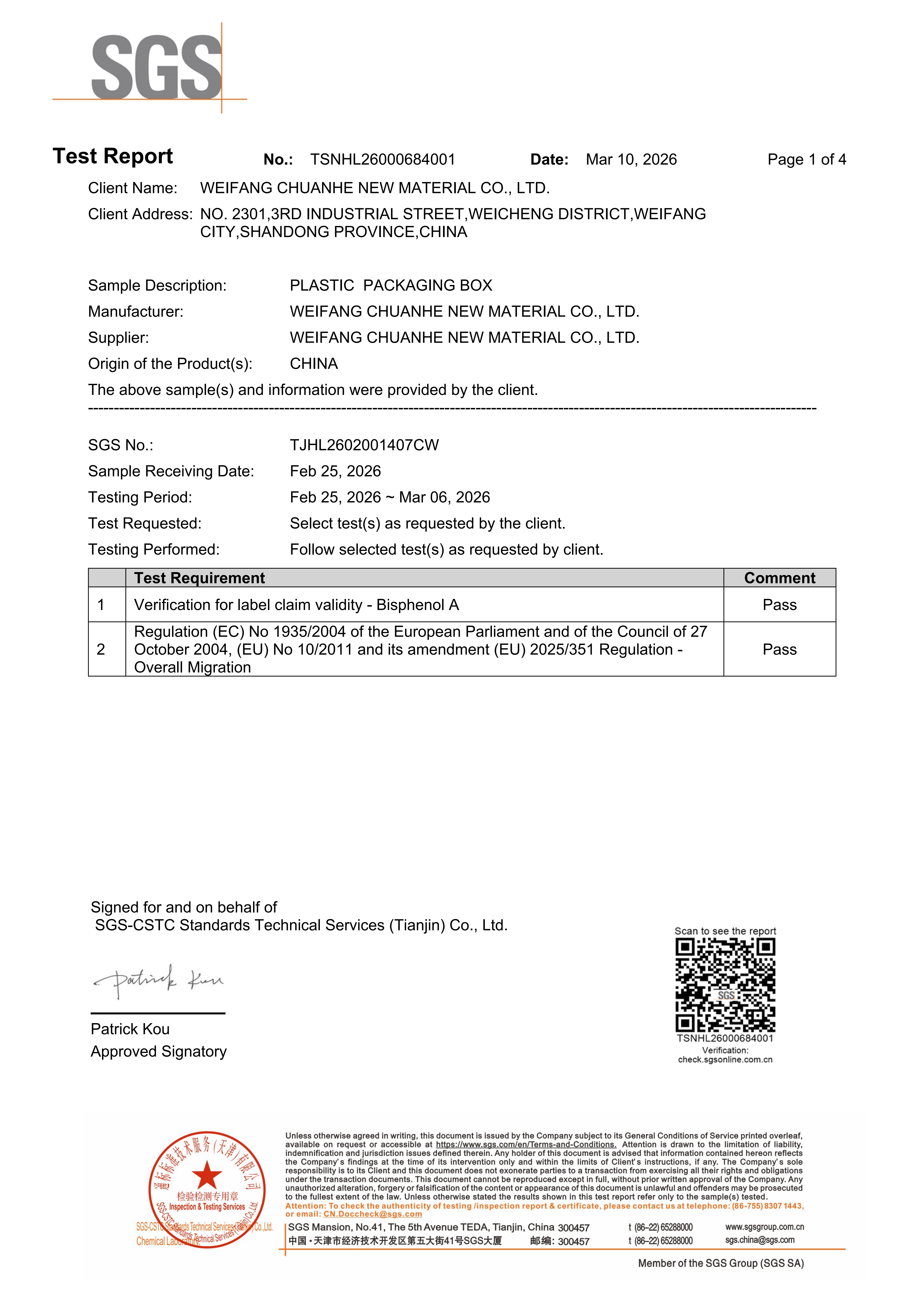
SGS EU test documentation for CHUAN HE PET packaging, tested to EN 1186-3:2022.
Step-by-Step Breakdown: Specifying a Produce Tray That Runs First Time
The following sequence keeps the tray decision in the right order, so that compliance and tooling work happen once rather than three times.
Step 1 — Define the packed unit, not the tray. Agree the product, the target net weight and the retail presentation before looking at any tray dimension. A tray chosen from a catalogue without a packed-unit definition will be re-specified within one season.
Step 2 — Fix the outer footprint against real constraints. The footprint must satisfy the sealing die on an existing MAP line, the retailer’s shelf depth and the shipper case count. Where two of these conflict, the sealing die usually wins, because it is the most expensive element to change.
Step 3 — Set depth from product height, not from volume alone. Choose the shallowest depth that clears the product and the headspace required by the pack format. Compare, for example, HB-16OZ at 14 × 11.6 × 6.2 cm against HB-20 OZ at 14 × 11.6 × 7.9 cm — the footprint is identical and only depth changes, which isolates the depth decision from the footprint decision.
Step 4 — Specify rigidity at three zones. Write the requirement as wall thickness and deflection at the rim, the base and the corner radii. State the load case: filled tray, chilled, stacked to the intended height.
Step 5 — Confirm the lid or seal format. Separate lid, attached tamper-evident lid, or film seal. Custom hinged or flip-lid geometries, plus colour, size and shape customisation, are supported through ODM/OEM services, but the lid format must be locked before tooling is cut.
Step 6 — Check stackability and nesting. Confirm the stacking load on a filled tray and the nesting ratio on an empty one, because pallet and cold-store efficiency are driven by both. Vent hole placement, where required for freshness in harvest and retail conditions, should be agreed at this stage as well.
Step 7 — Assemble the compliance file. Collect the food-contact test reports, the certification numbers and the declarations that cover the material actually being ordered, matched to the destination market.
Step 8 — Validate on a trial order. Run the tray through the actual sealing line, the cold chain and the retail display before scaling. Trial orders are supported, and the standard minimum order quantity is 10,000 pcs.
Use Cases: Where These Tray Parameters Decide the Outcome
Berry and Cherry Tomato Clamshell Packs
Small-format clear clamshells for strawberry, berry and cherry tomato punnets depend on clarity first and rigidity second, because the pack is judged on shelf. The tamper-evident OZ ladder gives a controlled progression of footprints from HB-8OZ at 13.4 × 12.1 × 3.6 cm upward, so a packer can standardise on one lid format across several SKUs. Vent holes for freshness are part of the specification in harvest-to-retail produce applications.
Salad and Prepared Leaf
Salad packaging containers add a different requirement: containment of dressing. The CHUAN HE salad range, for example HB5053 at 15.2 × 10.2 × 5.3 cm and HB1720 at 18.5 × 18.5 × 6 cm, is specified with a leakproof, airtight lid and a stackable design, with optional compartment formats that separate sauce from leaves. For a packhouse running both produce and prepared salads, matching tray and salad box footprints reduces changeover time.
MAP Trays for Produce, Meat and Ready Meals
Where a single tray format has to serve produce, meat, poultry and ready meals, the Trays Packaging family is the relevant platform. HB-MG40 OZ at 28 × 19.4 × 6.8 cm is the largest format and is listed across all those categories, which makes it a practical candidate for a buyer standardising on one MAP-compatible tray across multiple lines.
Supermarket Display and Cold Cabinets
For supermarket produce packaging, the selection criteria shift from line speed to display. Clear, transparent bodies are specified for retail visibility and for supermarket display effect, and stackable designs allow the same tray to be used in the cold cabinet and in the back-of-store chiller. Condensation behaviour under chilled display is the one attribute buyers should confirm against the ordered material rather than assume from a sample shown at ambient temperature.
Export, Cold Chain and Dry Fruit Crossover
For exporters, the tray has to survive transit as well as display. Anti-deformation structure reduces goods damage in transit, and the tamper-evident format provides evidence of integrity between packing and retail. Deep, rigid formats such as HB-MG24 OZ at 18.6 × 18.6 × 8.9 cm suit heavier and crush-sensitive loads, including dry fruit and bakery crossover applications where the same tray must protect without a retail film.
Comparison Table: Selecting Within the Platform
The most useful comparison for a buyer is not between brands but between the material options already available in the same tooling platform, because that is the decision that can be made without new tooling cost.
| Consideration | PET in the CHUAN HE platform | PP in the CHUAN HE platform |
|---|---|---|
| Models | Trays from HB-MG08 OZ (14.2 × 12.5 × 6.8 cm) to HB-MG40 OZ (28 × 19.4 × 6.8 cm); tamper-evident 8–32 OZ series; produce, salad and bakery containers | HB-75-28 (PP) at 16.8 × 11.4 × 3 cm; HB-221360 (PP) at 22.2 × 13 × 6 cm |
| Declared food-contact status | Food grade, BPA-free, compliant with food-contact standards | Food grade, BPA-free, compliant with food-contact standards |
| MAP line compatibility | Yes — Trays Packaging family | Yes — Trays Packaging family |
| Customisation | ODM/OEM: shape, colour, size, embossing and logo printing | ODM/OEM: shape, colour, size, embossing and logo printing |
| Typical selection driver | Applications where clear visibility supports retail sale | Applications where PP is already qualified in the buyer’s process or line |
Read together with the tray envelope table above, this gives a buyer two decisions to make rather than one: which footprint and depth, and which material. Both can be resolved inside the existing platform for most produce applications.
FAQ
How do I verify that a fresh produce packaging manufacturer is EU food contact certified?
Work from the regulations down to the documents. Regulation (EC) No 1935/2004 is the framework requiring food contact materials not to release constituents into food at harmful levels; Regulation (EU) No 10/2011 is the regulation that governs plastic materials and articles, including PET and PP containers. Then request the evidence behind them. As a documented example, the CHUAN HE fruit & vegetable container HB-7001 holds CE certification M.2025.206.C131101 issued by UDEM under EN 1186-1:2002 for the EU market, and the company holds an SGS EU test report numbered TSNHL26000684001 tested to EN 1186-3:2022, issued 10 March 2026 and valid to 10 March 2036. Under Regulation (EU) 2025/40 (PPWR), the TÜV Rheinland test report 178251114a 001, issued 14 August 2026 and valid to 14 August 2030, covers total lead, cadmium, mercury and hexavalent chromium content as well as PFAS. That combination — framework rule, plastic-specific rule, and waste-regulation test data — is the file to ask any EU food contact certified fresh produce packaging manufacturer for.
Can these PET trays be run on an existing MAP packaging line?
The CHUAN HE Trays Packaging family is classified as MAP packaging trays and is specified as compatible with MAP modified atmosphere packaging production lines, with models covering produce, bakery, meat, poultry and ready meals. In practice, three checks should precede a production run: that the tray rim provides a consistent sealing surface for your lidstock across the full perimeter; that the tray holds shape through the sealing cycle without flexing at the seal point; and that the material declaration matches the film being used. Because the same family spans HB-MG08 OZ at 14.2 × 12.5 × 6.8 cm through to HB-MG40 OZ at 28 × 19.4 × 6.8 cm, a buyer can usually match an existing sealing die without new tooling.
How do I choose between a large tray such as HB-MG40 OZ and the tamper-evident OZ sizes?
Choose by pack function rather than by volume. HB-MG40 OZ at 28 × 19.4 × 6.8 cm is the largest format in the platform and is listed across produce, bakery, meat, poultry and ready-meal applications — a good fit where one tray must serve several lines. The tamper-evident series is built as a size ladder for single-portion and punnet packs: HB-8OZ at 13.4 × 12.1 × 3.6 cm, HB-16OZ at 14 × 11.6 × 6.2 cm, HB-20 OZ at 14 × 11.6 × 7.9 cm, HB-24 OZ at 17.2 × 15.5 × 4.8 cm and HB-32 OZ at 17.2 × 15.5 × 6.2 cm. Note that HB-16OZ and HB-20 OZ share a footprint and differ only in depth, and that HB-24 OZ and HB-32 OZ do the same — which makes them useful for testing a depth change without disturbing case counts.
Can I validate a tray on a small order before committing to volume?
Trial orders are supported, and ODM/OEM customisation covers colours, sizes and shapes including rectangle, square, round or fully custom geometries. The standard minimum order quantity across the platform is 10,000 pcs, so it is worth confirming with the supplier early which models can be trialled below that level and which are subject to the standard MOQ. For validation, specify the check points in advance: rim, base and corner wall thickness on a sample; footprint against the sealing die; and stack performance with a filled, chilled tray.
What is the production lead time and capacity behind these trays?
Standard lead time is 30–45 days, against a monthly capacity of 4,500 tons and 100% testing in the process. Production is supported by 20 fully automatic thermoforming machines, 20 standard thermoforming machines including four Kiefel machines imported from Germany, four PET sheet extrusion lines, two PP sheet extrusion lines and an in-house mold workshop on a manufacturing base of more than 62,000 m² in Weifang, Shandong Province, adjacent to Qingdao Port. To move from specification to a quotation, send the tray footprint, depth, lid format, material, target volume and destination market to chuanhe@newplasticbox.com or message +86 134-5566-2777 on WhatsApp, and the platform can be matched against the closest existing model before tooling is discussed.
Conclusion
PET produce tray selection comes down to writing three things down before ordering: the finished wall thickness at the rim, base and corner; the outer footprint and depth locked against the sealing die and the shipper; and the lid or seal format that determines MAP compatibility. Everything else — clarity, stackability, vent holes, colour and logo — is a refinement of those three.
A platform approach makes that work faster. With trays running from HB-MG08 OZ at 14.2 × 12.5 × 6.8 cm to HB-MG40 OZ at 28 × 19.4 × 6.8 cm, and a tamper-evident ladder spanning 8 OZ to 32 OZ, most produce specifications can be matched to existing tooling rather than new development.
Next Step
Weifang Chuanhe New Material Co., Ltd. (CHUAN HE) manufactures PET and PP thermoformed containers for fruit and vegetable packaging and bakery packaging at No. 2301 Industrial Third Street, Weicheng Economic Development Zone, Weifang City, Shandong Province, China. The full product catalogue, including dimensions and certification documentation, is available for download.
Download the catalogue: CHUAN HE product brochure (PDF)
Website: www.newplasticbox.com
Email: chuanhe@newplasticbox.com
WhatsApp: +86 134-5566-2777
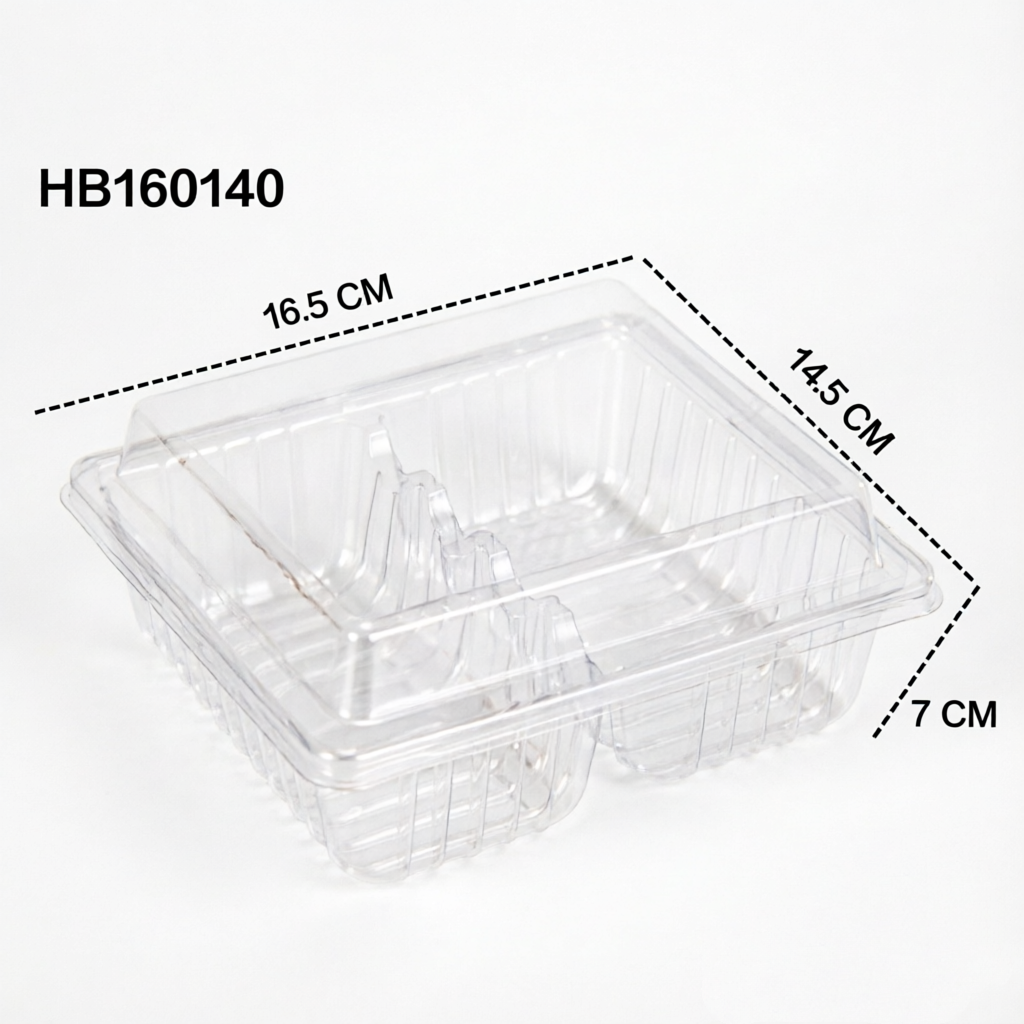
Clear, food grade PET produce containers and trays — request the CHUAN HE catalogue for the full model and dimension list.
Have Questions or Need More Details?
Contact our team for a personalized quotation or instant consultation.
Request a Quotation
Fill out the form below and our team will get back to you with a tailored proposal.
WhatsApp Direct Chat
Prefer to chat in real-time? Message us on WhatsApp for instant assistance & quick answers.
- Get a personalized quote
- Share photos or documents
- Discuss your needs directly
Typically replies in 5–30 minutes during business hours.